STRUCTURE OF
THE POSITIVE RADIAL SOLUTIONS FOR
A
SUPERCRITICAL
NEUMANN PROBLEMIN A BALL
Yasuhito
Miyamoto1
Graduate School of Mathematical Sciences,
University of Tokyo
Let $\Omega\subset \mathbb{R}^{N},$ $N\geq 3$, be a bounded domain with smooth boundary.
We study the positive solution ofthe Neumann problem
(1) $\{\begin{array}{ll}\epsilon^{2}\triangle u-u+u^{p}=0 in \Omega,\partial_{\nu}u=0 on \partial\Omega,\end{array}$
where $\epsilon>0$ is
a
positive parameter. This problem arises in stationaryproblems of the shadow system ofthe
Gierer-Meinhardt
model and theKeller-Segel model with logarithmic sensitivity function. When the
domain is the entire space $\mathbb{R}^{N}$
, the problem (1) also appears in the
study ofthe standing wave of the nonlinear Schr\"odinger equation. The
problem (1) has attracted much attention for
more
than two decades.Solutions
of various shapes have been found in [4, 6, 11, 12]. However,many authors study the
case
$1<p<p_{S}$. Here,Ps $:=\{\begin{array}{ll}\frac{N+2}{N-2} fN\geq 3,\infty if N=1, 2.\end{array}$
When$p>p_{S}$, the Sobolev embedding $H^{1}(\Omega)\mapsto L^{p+1}(\Omega)$ does not hold
and it is difficult to use variational methods. There are few results
about the structure of the positive solutions in the
case
$p\geq p_{S}.$We consider the positive radial solutions when $p>p_{S}$ and $\Omega=B.$
Then (1)
can
be reduced to the ODE(2) $\{\begin{array}{ll}u_{rr}+\frac{N-1}{r}u_{r}+\lambda f(u)=0 (0<r<1) ,u_{r}(1)=0, u(r)>0 (0\leq r\leq 1) ,\end{array}$
lThis work was partially supported by the Japan Society for the Promotion of
Science, Grant-in-Aidfor Young Scientists (B) (Subject No. 24740100) and byKeio
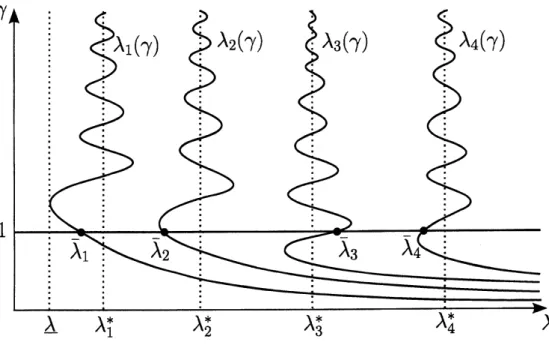
FIGURE 1. Schematic picture of the bifurcation diagram
of (2) in the
case
$p_{S}<p<p_{JL}.$where $f(u)=-u+u^{p}$ and $\lambda=1/\epsilon^{2}>0$. Adimurthi and Yadava [1, 2]
studied the critical case $p=p_{S}$ when $\Omega$ is a unit ball $B$. They have
shown that if $N\geq 7$, then (2) has
a
solution for all small $\lambda>0$, whileif $N\in\{4$, 5,6$\}$, then (2) has
no
solution for small $\lambda>$ O. Del Pinoet.al. [3] constructed
a
bubble tower solution when $p$ is slightly greaterthan $p^{*}$
We study the bifurcation diagram of the radial solutions of (1), using
ODE techniques. In this study the existence of the singular solution of
(2) plays
an
important role.Theorem A. Suppose that $p>p_{S}$. The problem (1) has infinitely
many singular solutions $(\lambda_{n}^{*}, U_{n}^{*}(r))\in \mathbb{R}_{+}\cross(C^{2}(0,1)\cap C^{0}(0,1] \cap H^{1}(B)$)
$(n=1,2, \cdots and \lambda_{1}^{*}<\lambda_{2}^{*}<\cdotsarrow\infty)$ such that the following
asser-tions hold:
(i) $U_{n}^{*}(r)satisfie\mathcal{S}$
(3) $U_{n}^{*}(r)=A(p, N)(\sqrt{\lambda_{n}^{*}}r)^{-\theta}(1+o(1))$ as $(r\downarrow 0)$,
where
(4) $A(p, N):=\{\theta(N-2-\theta)\}^{\frac{1}{p-1}}$
(ii) $\mathcal{Z}_{(0,1]}[U_{n}^{*}(\cdot)-1]=n.$
(iii) $U_{n}^{*}(r)>0(0<r\leq 1)$.
Moreover, the singular solution $(\lambda_{n}^{*}, U_{n}^{*})$ is unique, i. e.,
if
$(\tilde{\lambda}_{n}^{*},\tilde{U}_{n}^{*})$ is a $\mathcal{S}$ingular $\mathcal{S}$olution such that (i) and (ii) hold, thenThe main result is the following:
Theorem B. Suppose that $p>p_{S}$. Let $S$ be the set
of
the regular$solution\mathcal{S}$. Then
$S=C_{0} \cup\bigcup_{n=1}^{\infty}(C_{n}^{+}\cup C_{n}^{+})$,
where $C_{n}^{+}$ (resp. $C_{n}^{-}$) is the branch emanating
from
the trivial branch$\{(\lambda, 1)\}_{\lambda>0}$, which we denote by $C_{0}$, such that $u(O)>1$ (resp. $u(O)<$ 1). $C_{n}^{\pm}$ is
a
$C^{1}$-junctionof
$\gamma$ $:=u(O)$, hence $C_{n}^{\pm}$can
be describedas
$\{(\lambda_{n}(\gamma),$ $u_{n}(r,$$\gamma$ Moreover, the following hold:
(i) $\lambda_{n}(1)=\overline{\lambda}_{n},$
(ii) $\lambda_{n}(\gamma)arrow\lambda_{n}^{*}(\gammaarrow\infty)$,
(iii)
if
$p_{s}<p<p_{JL}$, then $\lambda_{n}(\gamma)$ oscillates infinitely many times around$\lambda_{n}^{*}$, where
PJL $:=\{\begin{array}{ll}1+\frac{4}{N-4-2\sqrt{N-1}} if N\geq 11,\infty if 2\leq N\leq 10,\end{array}$
(iv) $\lambda_{n}(\gamma)arrow\infty(\gamma\downarrow 0)$,
(v)
if
$\gamma>0$ is $\mathcal{S}mall$, then $u_{1}(r, \gamma)$ is non-degenerate in the spaceof
radial
functions
and it concentrates on the boundary,(vi) $\lambda_{1}(\gamma)<\lambda_{2}(\gamma)<\cdots$
Figure 1 is
a
schematic picture of the bifurcation diagram of (2)in the
case
$p_{S}<p<p_{JL}$. When $p_{S}<p<p_{JL}$, (2) has infinitelymany regular solutions for $\lambda=\lambda_{n}^{*}$. Each branch blows up at $\lambda_{n}^{*}$, while
it is unbounded in the positive direction of $\lambda$
in the subcritical
case
$1<p<p_{S}.$
The following corollary is an immediate consequence of Theorem B.
Corollary C. Suppose that $p>p_{S}$. There $exi_{\mathcal{S}}t\underline{\lambda}>0$ and $\overline{\lambda}(>\underline{\lambda})$
such that a radially decreasing solution
of
(2), which belongs to $C_{1}^{+},$does not exist
for
$\lambda\in(0, \underline{\lambda})\cup(\overline{\lambda}, \infty)$.The main tool of the proof is
an
intersection number between thesingular solution and a regular solution. Using a scaling argument,
one can show that each branch has infinitely many turning points if
$p_{S}<p<p_{JL}$. See [8] for details of the proof. In the
case
$p\geq p_{JL}$ weLet
us
explain the strategy of the proof. Let $u(s)$ $:=U(r)$ and$s$ $:=\sqrt{\lambda}r$. The equation (1) is transformed to the problem
(5) $\{\begin{array}{ll}u_{ss}+\frac{N-1}{s}u_{s}+f(u)=0, 0<\mathcal{S}<\sqrt{\lambda},u_{s}(\sqrt{\lambda})=0, u>0, 0\leq s\leq\sqrt{\lambda}.\end{array}$
First we construct the singular solution$u^{*}(s)$ of the equation in (5) near
$s=0$ and show that $u^{*}(\mathcal{S})=As^{-\theta}(1+o(1))(s\downarrow 0)$. Here $A$ $:=A(p, N)$
and $A(p, N)$ is defined by (4). Second we show that the domain of$u^{*}(s)$
can
be extended to $0<\mathcal{S}<\infty$, that $u^{*}(s)$ satisfies the equation in (5),and that $u^{*}(s)>0$ for $s>$ O. Third
we
show that $u^{*}(s)$ oscillatesaround 1 infinitely many times as $sarrow\infty$ and that $u^{*}(s)$ has the set of
the critical points $\{s_{n}^{*}\}_{n=1}^{\infty}$ of$u^{*}$ such that $0<s_{1}^{*}<s_{2}^{*}<\cdotsarrow\infty$ and
$\{\begin{array}{ll}s_{n}^{*} is a local minimum point of u^{*} and u^{*}(s_{n}^{*})<1 if n\in\{1, 3, 5, \},s_{n}^{*} is a local maximum point of u^{*} and u^{*}(s_{n}^{*})>1 if n\in\{2, 4, 6, \}.\end{array}$
We set $\lambda_{n}^{*}$ $:=(s_{n}^{*})^{2}$ and $U_{n}^{*}(r)$ $:=u^{*}(s)(s=\sqrt{\lambda_{n}^{*}}r)$. Then, $(\lambda_{n}^{*}, U_{n}^{*})$ is
a
singular solution stated in Theorem A.Let $(\lambda_{n}(\gamma), u(s, \gamma))$ denote the solution of (5) such that $u(O, \gamma)=\gamma$
and $u_{s}(0, \gamma)=0$. We show that $\lambda_{n}(\gamma)arrow\lambda_{n}^{*}$ as$\gammaarrow\infty$ and that $u(s, \gamma)$
converges to $u^{*}(s)$ in an appropriate sense. In [7] Merle and Peletier
proved a similar convergence result for the Dirichlet problem
$\{\begin{array}{ll}U_{rr}+\frac{N-1}{r}U_{r}+\lambda U+U^{p}=0, 0<r<1,U(1)=0, U>0, 0\leq r<1.\end{array}$
when $p>p_{S}$. We show that $u(s, \gamma)arrow u^{*}(s)$, following arguments in
the proof of [7, Theorem $A$].
We show that $\lambda_{n}(\gamma)$ oscillates around $\lambda_{n}^{*}$ if $p_{S}<p<p_{JL}$. Let
$\rho$
$:=\gamma^{\frac{p-1}{2}}s$
. We define $\tilde{u}(\rho, \gamma)$ $:=u(s, \gamma)/\gamma$ and $\tilde{u}^{*}(\rho)$ $:=u^{*}(s)/\gamma$. We
use
the intersection number between $\tilde{u}$ and $\tilde{u}^{*}$ The function $\tilde{u}(\rho, \gamma)$satisfies
(6) $\{\begin{array}{ll}\tilde{u}_{\rho\rho}+\frac{N-1}{\rho}\tilde{u}_{\rho}+\tilde{u}^{p}-\frac{1}{\gamma^{p-1}}\tilde{u}=0, 0<\rho<\infty,\tilde{u}(0)=1, \tilde{u}_{\rho}(0)=0.\end{array}$ Let $\overline{u}(\rho, \gamma)$ be the regular solution of
We show that
as
$\gammaarrow\infty,$$\tilde{u}(\rho, \gamma)arrow\overline{u}(\rho, 1)$ in $C_{loc}^{2}(0, \infty)\cap C_{loc}^{0}[0, \infty)$
and
$\tilde{u}^{*}(\rho)arrow\overline{u}^{*}(\rho)$ in $C_{loc}^{0}(0, \infty)$,
where $\overline{u}^{*}(\rho)$ a singular solution of the equation in (7). We recall the
fact that $\mathcal{Z}_{(0,\infty)}[\overline{u}^{*}(\cdot)-\overline{u}(\cdot, 1)]=\infty$. Hence, for each $\delta>0,$
(8) $\mathcal{Z}_{(0,\delta)}[u^{*}(\cdot)-u(\cdot, \gamma)]arrow\infty (\gammaarrow\infty)$,
since $s\in(0, \delta)$ is corresponding to $\rho\in(0, \delta\gamma^{\frac{N-1}{2}})$ and $\delta\gamma^{\frac{N-1}{2}}arrow\infty$
$(\gammaarrow\infty)$. Sinceeach
zero
of$u^{*}(\cdot)-u(\cdot, \gamma)$ is simple, eachzero dependscontinuously on $\gamma$. The divergence (8) tells us that
a zero
which issimple enters the interval $(0, \sqrt{\lambda_{n}^{*}}$] from$s=\sqrt{\lambda_{n}^{*}}$infinitely many times.
Therefore, there exists
a
sequence of large numbers $\{\gamma_{j}\}_{j=1}^{\infty}(\gamma_{1}<\gamma_{2}<$. . . $arrow\infty)$ such that $u^{*}(\sqrt{\lambda_{n}^{*}})=u(\sqrt{\lambda_{n}^{*}}, \gamma_{j})$ and the following holds:
$u_{S}(\sqrt{\lambda_{n}^{*}}, \gamma_{j})<0$ for $j\in\{1$, 3, 5, $\}$ and $u_{S}(\sqrt{\lambda_{n}^{*}}, \gamma_{j})>0$ for $j\in$ $\{2$, 4, 6, $\}$. Using the convergence $u(s, \gamma)arrow u^{*}(s)$, we show that if $n\in\{1$, 3, 5, $\}$ $($resp. $n\in\{2,4,6, \cdots\})$
(9) $\lambda_{n}(\gamma_{j})\{\begin{array}{ll}>\lambda_{n}^{*}, (j\in\{1,3,5, \cdots<\lambda_{n}^{*}, (j\in\{2,4,6, \cdots\end{array}$
$($resp. $\lambda_{n}(\gamma_{j})\{_{>\lambda_{n}^{*}’}^{<\lambda_{n}^{*}},$ $(j\in\{2,4,6(j\in\{1,3,5, \cdots )$
which implies that $\lambda_{n}(\gamma)$ oscillates around $\lambda_{n}^{*}i_{I1}$finitely many times as
$\gammaarrow\infty.$
This method
can
be applied to Dirichlet problems. In [9] the authorstudies
(10) $\{\begin{array}{ll}\triangle u+\lambda f(u)=0 in B,u>0 in B,u=0 on \partial B,\end{array}$
where $f(u)=u^{p}+g(u)$, $p>p^{*}$, and $|g(u)|<Cu^{p-\epsilon}$ We
assume
that$f\in C^{1}$ and $f(u)>0$ for $u\geq 0$. If $3\leq N\leq 10$, then the branch of the
solutions of (10) has infinitely many turning points. It is shown that
there is a nonlinear term $f(u)$ such that the branch has finitely many
turning points.
In [10] he studies (10), where $f(u)=e^{u}+g(u)$ and $|g(u)|<Ce^{(1-\epsilon)u}.$
of (10) has infinitely many turning points around some $\lambda^{*}>0$ and that
if
(f1’) $N\geq 10,$ $-e^{u}<g’(u) \leq\frac{N-10}{8}e^{u}$ in $(0, \infty)$,
and $g”(u)>-e^{u}$ in $(0, \infty)$,
then the branch does not have a turning point and blows up at $\lambda^{*}$ In
particular, the branch consists only of the minimal solutions. Thus,
when (f1’) is satisfied, then the bifurcation diagram is qualitatively the
same as
thecase
$f(u)=e^{u}$REFERENCES
[1] Adimurthi and S. Yadava, Existence and nonexistence
of
positive radial so-lutionsof
Neumann problems with critical Sobolev exponents, Arch. Rational Mech. Anal. 115 (1991), 275-296.[2] Adimurthi and S. Yadava, Nonexistence ofpositive radial solutions ofa quasi-linear Neumannproblemwith a criticalSobolev exponent, Arch. Rational Mech.
Anal. 139 (1997), 239-253.
[3] M. del Pino, and M. Musso, and A. Pistoia, Super-critical boundary bubbling in a semilinear Neumann problem, Ann. Inst. H. Poincar\’e Anal. Non Lin\’eaire
22 (2005), 45-82.
[4] C. Gui and J. Wei, On multiple mixed interior and boundary peak solutions for some singularly perturbed Neumannproblems, Canad. J. Math. 52 (2000),
522-538.
[5] Z. Guo and J. Wei, Global solution branch and Morse index estimates of a semilinear elliptic equation with super-critical exponent, Trans. Amer. Math.
Soc. 363 (2011), 4777-4799.
[6] A. Malchiodi and M. Montenegro, Boundary concentration phenomena for
a singularly perturbed elliptic problem, Comm. Pure Appl. Math. 55 (2002),
1507-1568.
[7] F. Merle and L. Peletier, Positive solutions of elliptic equations involving
su-percritical growth, Proc. Roy. Soc. Edinburgh Sect. A118 (1991), 49-62.
[8] Y. Miyamoto, Structure of the positive radial solutions for the supercritical
Neumann problem $\epsilon^{2}\Delta u-u+u^{p}=0$ in a ball, UTMS Preprint Series 2013,
http:$//$kyokan.ms.$u$-tokyo. ac.jp/users/preprint/pdf/2013-6. pdf
[9] Y. Miyamoto, Structure ofthepositive solutionsfor supercritical elliptic equa-tions in a ball, to appear in J. Math. Pures Appl.
[10] Y. Miyamoto,
Classification
ofbifurcation
diagramsfor elliptic equations withexponential growth in a ball, to appear in Ann. Mat. Pura Appl.
[11] J. Wei, On the boundary spike layer solutions to a singularly perturbed
Neu-mann problem, J. Differential Equations 134 (1997), 104-133.
[12] J.Wei, On the interior spike layer solutions to a singularly perturbedNeumann
Graduate School of Mathematical Sciences
University of Tokyo
3-8-1 Komaba, Meguro-ku, Tokyo
153-8914
JAPAN
$E$-mail address: [email protected]