Global
bifurcation
diagrams
and
exact multiplicity of
positive
solutions
for
a
one-dimensional
prescribed
mean
curvature
problem
arising in
MEMS
Yan-Hsiou
Cheng
Department of
Mathematics
and
information
Education
National
Taipei
University
of Education,
Taipei,
Taiwan 106,
ROC
Kuo-Chih
Hung,
Shin-Hwa
Wang
Department
of
Mathematics, National
Tsing
Hua
University
Hsinchu,
Taiwan 300,
ROC
1.
Introduction
Inthispaperwestudyglobal bifurcation diagrams and exactmultiplicity ofpositivesolutions
$u\in C^{2}(-L, L)\cap C[-L, L]$ for theone-dimensionalprescribed
mean
curvature problemarisingin electrostatic MEMS
$\{\begin{array}{l}-(\frac{u’(x)}{\sqrt{1+(u(x))^{2}}})’=\frac{\lambda}{(1-u)^{p}}, u<1, -L<x<L,u(-L)=u(L)=0,\end{array}$ (1.1)
where $\lambda>0$ is a
bifurcation
parameter, and$p,$$L>0$ are two evolution parameters. The
singular nonlinearity
$f(u) \equiv\frac{1}{(1-u)^{p}}, p>0$ satisfies
$f( O)=1,\lim_{uarrow 1^{-}}f(u)=\infty$, and $f’(u),$$f”(u)>0$ on $[0,1)$
.
(1.2) Noticethat the improper integral of$f$ over $[0,1)$ satisfies$\int_{0}^{1}f(u)du=\{\begin{array}{ll}\infty if p\geq 1,\frac{1}{1-p}<\infty if 0<p<1.\end{array}$
The prescribedmeancurvatureproblem
$\{\begin{array}{l}-(\frac{u’(x)}{\sqrt{1+(u(x))^{2}}})’=\lambda f(u) , -L<x<L,u(-L)=u(L)=0,\end{array}$ (1.3)
and $n$-dimensional problemofit, with general nonlinearity$f(u)$ orwithmany different types
and $u^{p}+u^{q}(0\leq p<q<\infty)$ have been recently investigated by many authors,
see
e.g.
[1, 2, 3, 4, 5, 6]. The methods for (1.3) they used
are
based ona
detailed analysis of time maps. Note that, in geometry,a
solution $u(x)$ of (1.3) is also called a graph of prescribed(mean)
curvature
$\lambda\tilde{f}(u)$.
A solution $u\in C^{2}(-L, L)\cap C[-L, L]$ of (1.3) with $u’\in C([-L, L], [-\infty, \infty])$ is called classical if $|u’(\pm L)|<\infty$, and it is called non-classical if $u’(-L)=\infty$
or
$u’(L)=-\infty,$see [5]. In this paperwe always allow that solutions $u\in C^{2}(-L, L)\cap C[-L, L]$ satisfy $u’\in$
$C([-L, L], [-\infty, \infty])$
.
Noticethat itcan
be shown that (see [5]):(i) Any non-trivial solution $u\in C^{2}(-L, L)\cap C[-L, L]$ of (1.1) is
concave
and positive on$(-L, L)$
.
(u) $A$ positive solution $u\in C^{2}(-L, L)\cap C[-L, L]$ of (1.1) must be symmetric
on
$[-L, L].$Thus $u’(-L)=-u’(L)$
.
(\"ui) $A$classical solution$u\in C^{2}(-L, L)\cap C[-L, L]$ of (1.1) belongs to$C^{2}[-L, L].$
(iv) $A$non-classical solution $u\in C^{2}(-L, L)\cap C[-L, L]$ of (1.1) satisfles $|u’(\pm L)|=\infty.$
For anyfixed$p,$$L>0$, wedefine the bifurcation diagram $C_{p,L}$ of (1.1) by $C_{p,L}\equiv$
{
$(\lambda, \Vert u_{\lambda}\Vert_{\infty}):\lambda>0$ and$u_{\lambda}$ isapositive solution of (1.1)}.We say the bifuurcation diagram $C_{p,L}$ is $\supset$-shaped (see e.g. Fig. l(i) depicted below) ifthere
exists$\lambda^{*}>0$ such that $C_{p,L}$ consists ofa continuous
curve
with exactlyone
turning point atsome
point $(\lambda^{*}, \Vert u_{\lambda}\cdot\Vert_{\infty})$ where thebifurcationdiagram $C_{p,L}$ tums to the left.This research is motivated by very recent papers of Pan and Xing [6] and Bmbaker and Pelesko [1, 7]. Brubaker and Pelesko[7] studied existence andmultiplicityof positive solutions
of the prescribed
mean
curvature problem$\{\begin{array}{l}-div\frac{\nabla u}{\sqrt{1+|\nabla u|^{2}}}=\frac{\lambda}{(1-u)^{2}}, u<1, x\in\Omega_{L},u=0, x\in\partial\Omega_{L},\end{array}$ (1.4)
where $\lambda>0$ is a bifurcationparameter and $\Omega_{L}\subset \mathbb{R}^{n}(n\geq 1)$ is a smooth bounded domain
dependingon some parameter$L>0$
.
Problem (1.4) withan
inversesquaretypenonlinearity$f(u)=(1-u)^{-p},$ $p=2$ is a derived variant of a canonical model used in the modeling of electrostatic Micr$($ Electro MechaIical Systems (MEMS) device obeying the electrostatic
Coulomb law with the Coulomb force satisfies the inverse square law with respect to the distance of the two charged objects, whichis
a
function ofthe deformation variable (cf. [8, p. 1324].$)$ The modeling of electrostatic MEMS device consists of a thin dielectric elasticmembrane with boundary supported at $0$ below arigid platelocated at $+1$
.
In (1.4), $u$ istheunknown profile of the deflectingMEMSmembrane, $\lambda$is thedropvoltagebetween theground
plateandthe deflectingmembrane, and the term $|\nabla u|^{2}$is calleda
&inging
field(cf. [7]). Whena voltage $\lambda$ is applied, the membrane deflects towards the ceiling plate and a snap-through
may
occur
when it exceedsa
certain critical value $\lambda^{*}$, referred toas
the “pull-in voltage”.(So if voltage $\lambda$ exceeds pull-in voltage $\lambda^{*}$,
an
equilibrium defection is no longer attainableand the lower surface will touch up
on
the upper plate.) This creates a so-called “pull-ininstability” which greatlyaffects the design of many devices. Also, in the actual design ofa
possible stable steady-statedeflection $(that is, \Vert u_{\lambda}*\Vert_{\infty}(<1)$, cf. Theorems 1-2andFigs. 1-2
below), referred toasthe “pull-indistance”, witha relatively smallapplied voltage. Werefer to [7] and the book [9] for detailed discussionson MEMS devices modeling. We also refer to
the book [10] for mathematical analysis of electrostatic MEMS problem (1.4). Notice that
thephysically relevant dimensions
are
$n=1$ (Inthiscase
$\Omega_{L}$ isa rectangular strip with twoopposite edges at $x=\pm L$ fixed ($2L$ isthe length of the strip) and the remaining two edges
free, the deflection $u=u(x, y)$ may be assumed
a
function of$x$ only.) and $n=2(\Omega_{L}$ is a planarbounded domainwith smooth boundary, and $L$is thecharacteristiclength (diameter)of the domain. Inparticular, $\Omega_{L}$isa circular disk of radius $L.$)
Withgeneral$p>0,$ $(1.1)$ isageneralized MEMS problem under the assumption that the
Coulomb force satisfies the inverse p-th power law with respect to the distance of the two
charged objects, where$p>0$ characterizes the
force
strength. See [11, 12, 13, 14] for related references in which the Coulomb force satisfies inverse p-th power law with variouspositive numbers $p\neq 2.$Pan and Xing [6] and Brubaker and Pelesko [1] studied global bifurcation diagrams and
exact multiplicity ofpositivesolutions for theone dimensionalproblemof (1.4),
$\{\begin{array}{l}-(\frac{u’(x)}{\sqrt{1+(u(x))^{2}}})’=\frac{\lambda}{(1-u)^{2}}, u<1, -L<x<L,u(-L)=u(L)=0.\end{array}$ (1.5)
(Notice that, problem (1.1) reduces toproblem (1.5)when$p=2.$) Panand Xing [6, Theorem
1.1] andBrubakerandPelesko [1, Theorem 1.1] independentlyprovedthat thereexists$L^{*}>0$
such that, onthe $(\lambda, \Vert u\Vert_{\infty})$-plane, the bifurcation diagram$C_{2,L}$ of (1.5) consists of$a$
(contin-uous) $\supset$-shaped curvewhen $L\geq L^{*}$, and
as
$L$ transitions from greater thanor equalto $L^{*}$ toless than $L^{*}$ the upper branch of the bifurcation diagram
$C_{2,L}$ of (1.5) splitsinto two parts. SeeFig. 1 and
see
[6, Theorem 1.1] and [1, Theorem 1.1] for details. Note that Brubaker and Pelesko [1, Theorem 1.1] showedthat $L^{*}\approx 0.3499676$and theyalsogave somecomputationalresults, see [1, Fig. 2].
$0$ $\lambda^{*}$
(i)
Fig. 1. Global bifurcation diagrams $C_{p,L}$ with$p\geq 1.$
(i) $L>L^{*}$
.
(ii) $L=L^{*}$.
(iii) $0<L<L^{*}.$In this paper we extend and improve the results ofPan and Xing [6, Theorem 1.1] and
Bmbaker and Pelesko [1, Theorem 1.1] by generalizing the nonlinearity $f(u)=(1-u)^{-2}$
in (1.5) to $f(u)=(1-u)^{-p}$ with general $p\in[1, \infty)$, see Theorem 2.1 stated below. Our
[1,
section
4]on
the (possible)extension
of(global) bifurcation diagram results of generalizedMEMSproblem (1.1) undertheassumptionthat the Coulomb force satisfiesthe inverse p-th
power law with respect to the distance of the two charged objects, where$p>0$ characterizes
the
force
strength. To this open question, wefind and prove that global bifurcation diagrams$C_{p,L}$ for
$0<p<1$
are
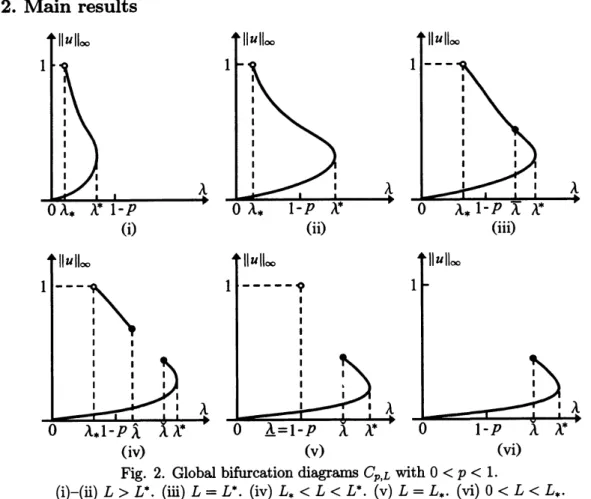
different to and more complicated than those for $p\geq 1$; compareFig. 2 depicted below with Fig. 1. Thus $p$ is also
a
bifurcation parameter to prescribedmean
curvature problem (1.1). Thisresult is of particular interestsince$p$ isnot a bifurcationparameterto thecorraeponding semilinear problemofquasilinear problem (1.1),
$\{\begin{array}{l}-u"(x)=\frac{\lambda}{(1-u)^{p}}, u<1, -L<x<L,u(-L)=u(L)=0.\end{array}$ (1.6)
For (1.6) with any$p>0$ and $L>0$, by applyin$g(1.2)$ and Laetsch [15, Theorems 2.5,
2.9
and3.2],we obtainthat,
on
the$(\lambda, \Vert u\Vert_{\infty})$-plane, thebifurcation diagram of positive solutionsconsists of$a$ (continuous) $\supset$-shaped
curve
which startsfrom the origin and ends at $(0,1)$, cf.Fig. l(i).
The paper isorganized
as
follows. Section 2 contains statementsofmain results. Section 3 contains several lemmas needed to prove the mainresults. Section 4 containsthe proofs of themain results.2.
Main results
(i) (ii) (iii)
(iv) (v) (vi)
Fig. 2. Global bifurcationdiagrams $C_{p,L}$ with $0<p<1.$
The mainresults in thispaper are nextTheorems 2.1 and 2.2 for (1.1).
Theorem 2.1 (See Fig. 1). Consider (1.1) with$p\geq 1$
.
There exists$L^{*}=L^{*}(p)>0$ suchthat thefollowing assertions $(i)-(iii)$ hold:
(i) (See Fig. $1(i).$) If$L>L^{*}$, then there exists $\lambda^{*}>0$ such that (1.1) has exactly $t_{1}vo$
positive solutions $u_{\lambda},$ $v_{\lambda}$ with $\Vert u_{\lambda}\Vert_{\infty}<\Vert v_{\lambda}\Vert_{\infty}$ for $0<\lambda<\lambda^{*},$ exactly onepositive
solution$u_{\lambda}$ for$\lambda=\lambda^{*}$, andnopositivesolution for$\lambda>\lambda^{*}.$
(ti) (SeeFig. $1(ii).$) If$L=L^{*}$, then there exist $0<\overline{\lambda}(=\overline{\lambda}(p))<\lambda^{*}$ such that (1.1) has
exactly twopositivesolutions$u_{\lambda},$ $v_{\lambda}$ with $\Vert u_{\lambda}\Vert_{\infty}<\Vert v_{\lambda}\Vert_{\infty}$ for$0<\lambda<\lambda^{*}$, exactly
one
positive solution $u_{\lambda}$ for
$\lambda=\lambda^{*}$, and nopositive solution for$\lambda>\lambda^{*}.$
(iii) (SeeFig. $1(iii).$) If$0<L<L^{*}$, then there exist $0<\hat{\lambda}<\check{\lambda}<\lambda^{*}$ such that (1.1) has
exactlytwo positivesolutions$u_{\lambda},$$v_{\lambda}$ with $\Vert u_{\lambda}\Vert_{\infty}<\Vert v_{\lambda}\Vert_{\infty}$for$0<\lambda\leq\hat{\lambda}$and$\check{\lambda}\leq\lambda<\lambda^{*},$
exactlyonepositive solution$u_{\lambda}$ for
$\hat{\lambda}<\lambda<\check{\lambda}$
and$\lambda=\lambda^{*}$, and nopositive solution for
$\lambda>\lambda^{*}.$
Theorem 2.2 (See Fig. 2). Consider (1.1) with$0<p<1$
.
There exist $0<L_{*}(=L_{*}(p))$ $<L^{*}(=L^{*}(p))$ such that thefollowing assertions $(i)-(iv)$hold:(i) (SeeFig. $2(i)-(ii).$) If$L>L^{*}$, then there exist$0<\lambda_{*}<\lambda^{*}$ such that (1.1) hasexactly
twopositivesolutions$u_{\lambda},$ $v_{\lambda}$ with $\Vert u_{\lambda}\Vert_{\infty}<\Vert v_{\lambda}\Vert_{\infty}$ for$\lambda_{*}<\lambda<\lambda^{*}$, exactlyonepositive
solution $u_{\lambda}$ for$0<\lambda\leq\lambda_{*}$ and $\lambda=\lambda^{*}$, andnopositive solution for$\lambda>\lambda^{*}.$
(ii) (SeeFig. 2(tii).) If$L=L^{*}$, then there exist $0<\lambda_{*}<\overline{\lambda}(=\overline{\lambda}(p))<\lambda^{*}satis\thetaing\lambda_{*}<$
$1-p<\overline{\lambda}$such that (1.1) has exactly twopositivesolutions
$u_{\lambda},$$v_{\lambda}$ with $\Vert u_{\lambda}\Vert_{\infty}<\Vert v_{\lambda}\Vert_{\infty}$
for$\lambda_{*}<\lambda<\lambda^{*}$, exactlyonepositive solution
$u_{\lambda}$ for$0<\lambda\leq\lambda_{*}$ and $\lambda=\lambda^{*}$, andno
positivesolution for$\lambda>\lambda^{*}.$
(iii) (See Fig. $2(iv)\cdot$) If$L_{*}<L<L^{*}$, then there exist $0<\lambda_{*}<\hat{\lambda}<\check{\lambda}<\lambda^{*}satis\theta ing$
$\lambda_{*}<1-p<\lambda$ such that (1.1) has exactly two positive solutions$u_{\lambda},$ $v_{\lambda}$ with $\Vert u_{\lambda}\Vert_{\infty}<$
$\Vert v_{\lambda}\Vert_{\infty}$ for$\lambda_{*}<\lambda\leq\hat{\lambda}$ and$\check{\lambda}\leq\lambda<\lambda^{*}$, exactlyonepositive solution
$u_{\lambda}$ for$0<\lambda\leq\lambda_{*},$
$\hat{\lambda}<\lambda<\check{\lambda}$
and$\lambda=\lambda^{*}$, andnopositivesolution for$\lambda>\lambda^{*}.$
(iv) (SeeFig. $2(v)-(vi).$) If$0<L\leq L_{*}$, then there exist$0<\check{\lambda}<\lambda^{*}$ satisfying$1-p<\check{\lambda}$such
that (1.1) has exactly two positivesolutions$u_{\lambda},$$v_{\lambda}$ with $\Vert u_{\lambda}\Vert_{\infty}<\Vert v_{\lambda}\Vert_{\infty}$ for$\check{\lambda}\leq\lambda<\lambda^{*},$
exactlyonepositivesolution$u_{\lambda}$ for$0<\lambda<\check{\lambda}$ and$\lambda=\lambda^{*}$, and nopositive solution for
$\lambda>\lambda^{*}.$
3.
Lemmas
In this section, in the next Lemmas 3.1-3.8, we develop some time-maptechniques to prove
Theorems 2.1-2.4. First, we introduce the timemap method used in [4, 5]. Let $F(u)\equiv$
$\int_{0}^{u}f(t)dt$
.
We have that:(I) If$p\geq 1,$ $F$ : $[0,1)arrow[0, \infty)$ and hence $F^{-1}$ is well defined on $[0, \infty)$
.
Then for any $\lambda>0$, thetime map formulafor (1.1) takes theformas follows:where
$F(u)= \int_{0}^{u}f(t)dt=\{\begin{array}{ll}-\log(1-u) if p=1, (3.2)\frac{-1+(1-u)^{1-p}}{p-1} if p\in(1, \infty) . \end{array}$
Noticethat it
can
be provedthat $T_{\lambda}(r) \in C^{2}((0, F^{-1}(\frac{1}{\lambda})])$,see
[2, Lemma3.1].(II) If$0<p<1,$ $F$ : $[0,1] arrow[0, \frac{1}{1-p}]$ and hence $F^{-1}$ is onlydefined on $[0, \frac{1}{1-p}]$
.
Then thetime map formulafor (1.1) takes theform
as
follows:$T_{\lambda}(r)= \int_{0}^{r}\frac{1+\lambda F(u)-\lambda F(r)}{\sqrt{1-[1+\lambda F(u)-\lambda F(r)]^{2}}}du,$
$r=\Vert u\Vert_{\infty}\in\{\begin{array}{ll}(0, F^{-1}(\frac{1}{\lambda})] if \lambda>1-p,(0,1) if 0<\lambda\leq 1-p,\end{array}$
(3.3) where
$F(u)= \int_{0}^{u}f(t)dt=\frac{1-(1-u)^{1-p}}{1-p}$
.
(3.4)Note that the time map formula$T_{\lambda}(r)$ in (3.3) with
$0<p<1$
is thesame as
that in(3.1) with $p\geq 1$
.
But the domain of$T_{\lambda}(r)$ in (3.3) with$0<p<1$
is different fromthat in (3.1) with $p\geq 1$, since $\lim_{uarrow 1}-f(u)=\infty$ and $F^{-1}$ : $[0, \frac{1}{1-p})arrow[0,1)$ when $0<p<1$
.
Notice that it alsocan
be proved that $T_{\lambda}(r) \in C^{2}((0, F^{-1}(\frac{1}{\lambda})])$ if$\lambda>1-p$and$T_{\lambda}(r)\in C^{2}((0,1))$ if$0<\lambda\leq 1-p.$
Observe that positive solutions $u_{\lambda}$ for (1.1) correspond to
$\Vert u_{\lambda}\Vert_{\infty}=r$ and $T_{\lambda}(r)=L$
.
(3.5)Thus, studying of the exact number of positive solutions of (1.1) for any fixed $\lambda>0$ is
equivalentto studymingtheshape of the timemap $T_{\lambda}(r)$
on
its domain.First,we determin$e$ the limit behaviors of$T_{\lambda}(r)$ and $T_{\lambda}’(r)$ in the following lemma.
Lemma 3.1. Consider$T_{\lambda}(r)$
.
Then(i) Forfixd$p>0,$ $\lim_{rarrow 0+}T_{\lambda}(r)=0$and$\lim_{rarrow 0+}T_{\lambda}’(r)=\infty$ for any$\lambda>0.$
(ti) Forfixed$p\geq 1,$ $T_{\lambda}’(F^{-1}( \frac{1}{\lambda}))<0$ forany$\lambda>0.$
(iii) Forfixed$p\in(O, 1),$ $T_{\lambda}’(F^{-1}( \frac{1}{\lambda}))<0$ for any$\lambda>1-p$and$\lim_{rarrow 1}-T_{\lambda}’(r)=-\infty$forany $0<\lambda\leq 1-p.$
Proof of Lemma 3.1. First,theresults inparts $(i)-(\ddot{u})$follow from [4, Propositions2.6, 2.7,
2.10] since $f(O)=1>0$and $f’(u)=p(1-u)^{-p-1}>0$
on
$[0,1)$.
Finally, for part (i\"u), for fixed $p\in(0,1)$, the result $T_{\lambda}’(F^{-1}(1/\lambda))<0$ if $\lambda>1-p$
follows from [4, Propositions 2.10]. The remaining part of the proof of part (m) isto prove
$\lim_{rarrow 1}-T_{\lambda}’(r)=-oo$for $0<\lambda\leq 1-p.$
Let $u=rs$, then (3.3) becomes
$T_{\lambda}(r)=r \int_{0}^{1}\frac{1+\lambda F(rs)-\lambda F(r)}{\sqrt{1-[1+\lambda F(rs)-\lambda F(r)]^{2}}}ds, r\in(0,1)$
.
We computethat
where
$I_{1}(r) \equiv\int_{0}^{1}\frac{1+\lambda F(rs)-\lambda F(r)}{\sqrt{1-[1+\lambda F(rs)-\lambda F(r)]^{2}}}ds,$
and
$I_{2}(r) \equiv\int_{0}^{1}\frac{\lambda r[f(rs)s-f(r)]}{\{1-[1+\lambda F(rs)-\lambda F(r)]^{2}\}^{3/2}}ds.$
We computethat
$\lim_{rarrow 1}I_{1}(r)- =\lim_{rarrow 1^{-}}\int_{0}^{1}\frac{1+\lambda F(rs)-\lambda F(r)}{\sqrt{1-[1+\lambda F(rs)-\lambda F(r)]^{2}}}ds$
$= \int_{0}^{1}\lim_{rarrow 1^{-}}\frac{1+\lambda F(rs)-\lambda F(r)}{\sqrt{1-[1+\lambda F(rs)-\lambda F(r)]^{2}}}ds$
$= \int_{0}^{1}\frac{1-\lambda\frac{(1-s)^{1-p}}{1-p}}{\sqrt{1-[1-\lambda\frac{(1-s)^{1-p}}{1-p}]^{2}}}ds$
$= l_{-\frac{\lambda}{1-p}}^{1} \frac{y[\frac{(1-y)(1-p)}{\lambda}]^{1-\overline{p}}\Rightarrow}{\sqrt{1-y^{2}}\lambda}dy, (sety=1-\lambda\frac{(1-s)^{1-p}}{1-p})$
$= \frac{(1-p)^{\#_{-\overline{p}}}}{\lambda^{\frac{1}{1-p}}}\int_{1-\frac{\lambda}{1-p}}^{1}\frac{y(1-y)^{\overline{1}}\underline{r}_{\overline{p}}}{\sqrt{1-y^{2}}}dy$
$<$ $\infty$ (3.7)
by simpleanalysisof the last integral for $y$ near $1^{-}$
Onthe other hand,weshow that $\lim_{rarrow 1^{-}}I_{2}(r)=-\infty$
.
Forany fixed$r\in(0,1)$, sinceboth $F$ and $f$are
increasing function on $(0,1)$, weobtain that$f(rs)s-f(r)<0$
for$s\in(O, 1)$ and $\{1-[1+\lambda F(rs)-\lambda F(r)]^{2}\}^{3/2}$is strictlydecreasing in $s\in(0,1)$.
Hence wecompute that$I_{2}(r) = \int_{0}^{1}\frac{\lambda r[f(rs)s-f(r)]}{\{1-[1+\lambda F(rs)-\lambda F(r)]^{2}\}^{3/2}}ds$
$\leq \int_{0}^{1}\frac{\lambda r[f(rs)s-f(r)]}{\{1-[1-\lambda F(r)]^{2}\}^{3/2}}ds$
$= \frac{\lambda r}{\{1-[1-\lambda F(r)]^{2}\}^{3/2}}\int_{0}^{1}[f(rs)s-f(r)]ds$
$= \frac{\lambda r}{\{1-[1-\lambda F(r)]^{2}\}^{3/2}}[\frac{(1-r)^{p}+pr-1-r^{2}(1-p)^{2}}{(1-p)(2-p)(1-r)^{p}r^{2}}].$
This implies that
$\lim_{rarrow 1^{-}}I_{2}(r)\leq\lim_{rarrow 1^{-}}\frac{1}{\{1-[1-\lambda F(r)]^{2}\}^{3/2}}[\frac{(1-r)^{p}+pr-1-r^{2}(1-p)^{2}}{(1-p)(2-p)(1-r)^{p}r^{2}}]=-\infty$
.
(3.8)Combining $(3.6)-(3.8)$, we obtainthat
Thiscompletes the proofof Lemma
3.1.
$\blacksquare$In the next lemma, wethen prove that $T_{\lambda}(r)$ hasexactly
one
critical point, a localmaxi-mum,
on
its domain.Lemma3.2. Consider$T_{\lambda}(r)$
.
Then(i) Forfixed$p\geq 1,$ $T_{\lambda}(r)$ hasexactly
one
critical point, a localmaximum, on$(0, F^{-1}(1/\lambda))$for
any
$\lambda>0.$(ti) Forfixd$p\in(0,1),$$T_{\lambda}(r)$ has exactly
one
criticalpoint,a locd$maJ\dot{g}mum$,on
$(0, F^{-1}(1/\lambda))$forany$\lambda>1-p.$
$(\ddot{\dot{m}})$ Forfixed$p\in(O, 1),$ $T_{\lambda}(r)$ has exactly
one
criticalpoint,a
localmaximum,on
$(0,1)$ forany$0<\lambda\leq 1-p.$
Proof of Lemma 3.2. For part (i) with $p\geq 1$ be fixed. Since $f(O)=1>0,$ $f’(u)=$
$p(1-u)^{-p-1}>0$
on
$[0,1)$, and $f”(u)=p(p+1)(1-u)^{-p-2}>0$on
$[0,1),$ $(1.1)$ has at mosttwo positive solutions for any $\lambda,$$L>0$ by [3, Theorem 3.4]. Supposethat, onthe contrary,
part (i) does not hold. Then by Lemma $3.1(i)-(\ddot{u}),$ $T_{\lambda}(r)$ has at least two critical points, a
local maximum and a local minimum, on $(0, F^{-1}(1/\lambda))$
.
So by (3.5), (1.1) has at least threepositivesolutions forsome $\lambda,$$L>0$, which contradicts to the fact that (1.1) has at most two
positivesolutions. So part (i) follows.
The proofsof parts (u) and (iu)
are
simmilar to that of part (i),so
we
omit them. The proof ofLemma3.2
iscomplete. $\blacksquare$For any$p\geq 1$, let
$h_{p}( \lambda)\equiv\sup\{T_{\lambda}(r)$ : $r \in(0, F^{-1}(\frac{1}{\lambda})]\},$ $\lambda>0$
.
(3.9)For any $0<p<1$, let
$h_{p}(\lambda)\equiv\{\begin{array}{ll}\sup\{T_{\lambda}(r) :r\in(O, F^{-1}(\frac{1}{\lambda})]\} if \lambda>1-p,\sup\{T_{\lambda}(r) :r\in(O, 1)\} if 0<\lambda\leq 1-p.\end{array}$ (3.10)
We mainlydetermine somebasic properties of$h_{p}(\lambda)$ in the following lemma.
Lemma 3.3. Consider$T_{\lambda}(r)$ and$h_{p}(\lambda)$ withfixed$p>0$
.
Then(i) Forfixed$r\in(0,1),$ $T_{\lambda}(r)$isacontinuous, strictly decreaeing$f\iota mctionof\lambda>0$
.
Moreover,$\lim_{\lambdaarrow 0}+T_{\lambda}(r)=\infty.$
(ii) $h_{p}(\lambda)$ isa continuous, strictlydecreasingfunction of$\lambda>0$. Moreover, $\lim_{\lambdaarrow 0}+h_{p}(\lambda)=$
$\infty$and$\lim_{\lambdaarrow\infty}h_{p}(\lambda)=0.$
Proof ofLemma3.3. Let$p>0$ befixed.
(i) First, for fixed$r\in(O, 1)$, it
can
be proved that $T_{\lambda}(r)$ isacontinuous function of$\lambda>0.$The proof is easy but tedious and we omit it. For any fixed $r\in(0,1)$ and
$0<u<r,$
$\frac{1+\lambda F(u)-\lambda F(r)}{\sqrt{1-[1+\lambda F(u)}-\lambda F(r)]^{2}}$ is strictly decreasing in
$\lambda$ since $0<F(r)-F(u)<1/\lambda$
.
So $T_{\lambda}(r)$ is astrictly decreasing function of$\lambda>0$
.
Moreover, $\lim_{\lambdaarrow 0}+T_{\lambda}(r)=\infty$follows directlyfrom the time map formula (3.1). So part (i) follows.(ii) By Lemma
3.2
and part (i), we obtain that $h_{p}(\lambda)$ is a continuous, strictly decreasingfunction of$\lambda>0$, and$\lim_{\lambdaarrow 0+}h_{p}(\lambda)=\infty$. Onthe otherhand,since$\lim_{\lambdaarrow\infty}F^{-1}(\frac{1}{\lambda})=0$ and
$0<r \leq F^{-1}(\frac{1}{\lambda})$ for large $\lambda$,
we
have $\lim_{\lambdaarrow\infty}h_{p}(\lambda)=0$.
So part (ii)follows. The proof ofLemma
3.3
iscomplete. $\blacksquare$For any$p\geq 1$, let
$g_{p}( \lambda)\equiv T_{\lambda}(F^{-1}(\frac{1}{\lambda})), \lambda>0$
.
(3.11)Forany $0<p<1$, let
$g_{p}(\lambda)\equiv\{\begin{array}{l}T_{\lambda}(F^{-1}(\frac{1}{\lambda})) if \lambda>1-p,(3.12)\lim_{rarrow 1}-T_{\lambda}(r) if 0<\lambda\leq 1-p.\end{array}$
Let $\alpha=F^{-1}(\frac{1}{\lambda})$ and $u=\alpha s$, then by (3.1),
$T_{\lambda}(F^{-1}( \frac{1}{\lambda})) = \int_{0}^{F^{-1}(\frac{1}{\lambda})}\frac{\lambda F(u)}{\sqrt{1-[\lambda F(u)]^{2}}}du$
$= \alpha\int_{0}^{1}\frac{\lambda F(\alpha s)}{\sqrt{1-[\lambda F(\alpha s)]^{2}}}ds$
$= \int_{0}^{1}\frac{1\frac{t}{\lambda}}{\sqrt{1-t^{2}}f(F^{-1}(\frac{t}{\lambda}))}dt$
by change of variable$t=\lambda F(\alpha s)$
.
So for$p\geq 1,$ $(3.11)$ implies$g_{p}( \lambda)=T_{\lambda}(F^{-1}(\frac{1}{\lambda}))=\int_{0}^{1}\frac{1\frac{t}{\lambda}}{\sqrt{1-t^{2}}f(F^{-1}(\frac{t}{\lambda}))}dt, \lambda>0$
.
(3.13)For $0<p<1$, by (3.3) and (3.4),
$\lim_{rarrow 1^{-}}T_{\lambda}(r) = \int_{0}^{1}\frac{1+\lambda F(u)-\lambda F(1)}{\sqrt{1-[1+\lambda F(u)-\lambda F(1)]^{2}}}du$
$= \int_{0}^{1}\frac{(1-p)-\lambda(1-u)^{1-p}}{\sqrt{2\lambda(1-p)(1-u)^{1-p}-\lambda^{2}(1-u)^{2-2p}}}du.$
So for$0<p<1,$ $(3.12)$ implies
$g_{p}(\lambda)=\{\begin{array}{ll}\int_{0}^{1}\frac{1}{\sqrt{}1-t^{2}}\frac{\frac{t}{\lambda}}{f(F^{-1}(\frac{t}{\lambda}))}dt if\lambda>1-p,\int_{0}^{1}\frac{(1-p)-\lambda(1-u)^{1-p}}{\sqrt{2\lambda(1-p)(1-u)^{1-p}-\lambda^{2}}(1-u)^{2-2p}}du if 0<\lambda\leq 1-p.\end{array}$ (3.14)
We first determine some basicpropertiesof$g_{p}(\lambda)$ in thefollowing lemma.
Lemma 3.4. Consider$g_{p}(\lambda)$
.
Then(i) For fixed$p>0,$$g_{p}(\lambda)$ is
a
continuous function of$\lambda>0.$(ii) For fixed$p\geq 1,$ $\lim_{\lambdaarrow 0+}g_{p}(\lambda)=\lim_{\lambdaarrow\infty}g_{p}(\lambda)=0.$
Proof of Lemma 3.4. (i) Since the map $\lambda\mapsto\frac{\frac{t}{\lambda}}{f(F^{-1}(\frac{l}{\lambda}))}$is a composition of$y \mapsto\frac{F(y)}{f(y)}$ and
$y=F^{-1}( \frac{t}{\lambda})$
.
For fixed$p\geq 1,$ $g_{p}(\lambda)$ isa
continuous fimction of$\lambda>0$ by (3.13). Forfixed$p\in(0,1),$ $g_{p}(\lambda)$ is a continuous function of$\lambda\in(0,1-p)$ by (3.13) and (3.14). In addition, $g_{p}(\lambda)$ is
a
continuous function of$\lambda<1-p$by (3.14). Moreover, since$\lim_{\lambdaarrow(1-p)^{-}}g_{p}(\lambda)=\lim_{\lambdaarrow(1-p)^{+}}g_{p}(\lambda)=g_{p}(1-p)=\lim_{rarrow 1^{-}}T_{1-p}(r)=\int_{0}^{1}\frac{1-u^{1-p}}{\sqrt{2u^{1-p}-u^{2-2p}}}du$, (3.15)
$g_{p}(\lambda)$ is
a
continuous at $\lambda=1-p$.
So part (i) follows.$(\ddot{u})$ Forfixed$p\geq 1$, by (3.2), we firstobtain that
$\lim_{yarrow 0+}\frac{F(y)}{f(y)}=\lim_{yarrow 0+}\frac{\frac{1-(1-y)^{p-1}}{(p-1)(1-y)^{p-1}}}{\frac{1}{(1-y)^{p}}}=\lim_{yarrow 0+}\frac{(1-y)-(1-y)^{p}}{p-1}=0$ for$p>1$, (3.16)
and
$\lim_{yarrow 0+}\frac{F(y)}{f(y)}=\lim_{yarrow 0+}\frac{-\log(1-y)}{\frac{1}{1-y}}=0$ for$p=1$
.
(3.17) Wechange variablesin (3.13) bywriting $y=F^{-1}( \frac{t}{\lambda})$, then$\lim_{\lambdaarrow\infty}g_{p}(\lambda)=\int_{0}^{1}\frac{1}{\sqrt{1-t^{2}}}\lim_{\lambdaarrow\infty}\frac{\frac{t}{\lambda}}{f(F^{-1}(\frac{t}{\lambda}))}dt=\int_{0}^{1}\frac{1}{\sqrt{1-t^{2}}}\lim_{yarrow 0+}\frac{F(y)}{f(y)}dt=0$
by (3.16) and (3.17). Onthe otherhand,
$\lim_{yarrow 1^{-}}\frac{F(y)}{f(y)}=\lim_{yarrow 1^{-}}\frac{\frac{1-(1-y)^{p-1}}{(p-1)(1-y)^{p-}}}{\frac{1}{(1-y)^{p}}}=\lim_{yarrow 1^{-}}\frac{(1-y)-(1-y)^{p}}{p-1}=0$ for$p>1$, (3.18)
and
$\lim_{yarrow 1^{-}}\frac{F(y)}{f(y)}=\lim_{yarrow 1^{-}}\frac{-\log(1-y)}{\frac{1}{1-y}}=-\lim_{yarrow 1^{-}}(1-y)\log(1-y)=0$ for$p=1$
.
(3.19)Wechange variables in (3.13) by writing $y=F^{-1}( \frac{t}{\lambda})$, then forfixed$p\geq 1,$
$\lim_{\lambdaarrow 0+}g_{p}(\lambda)=\int_{0}^{1}\frac{1}{\sqrt{1-t^{2}}}\lim_{\lambdaarrow 0+}\frac{\frac{t}{\lambda}}{f(F^{-1}(\frac{t}{\lambda}))}dt=\int_{0}^{1}\frac{1}{\sqrt{1-t^{2}}}\lim_{yarrow 1^{-}}\frac{F(y)}{f(y)}dt=0.$
So part (u) follows.
(ui) Forfixed$p\in(O, 1)$,by (3.14),
$\lim_{\lambdaarrow 0+}g_{p}(\lambda) = \lim_{\lambdaarrow 0+}\int_{0}^{1}\frac{(1-p)-\lambda(1-u)^{1-p}}{\sqrt{2\lambda(1-p)(1-u)^{1-p}-\lambda^{2}(1-u)^{2-2p}}}du$
$= \int_{0}^{1}\lim_{\lambdaarrow 0+}\sqrt{2\lambda(1-p)(1-u)^{1-p}-\lambda^{2}(1-u)^{2-2p}}^{du}$
$(1-p)-\lambda(1-u)^{1-p}$
$=$ $\infty.$
In addition, the proof of$\lim_{\lambdaarrow\infty}g_{p}(\lambda)=0$ is siular to that ofpart $(\ddot{u})$
,
and hence we omitit. So part (iu) follows.
The proof ofLemma3.4 is complete. $\blacksquare$
In the following Lemmas 3.5-3.7, for$p\geq 1$, we mainly prove that $g_{p}(\lambda)$ has exactly
one
Lemma
3.5.
Consider$g_{p}(\lambda)$ withfixed$p\geq 2$.
Then(i) $g_{p}’(\lambda)<0$on [1,$\infty)$
.
(ii) $g_{p}"(\lambda)<0$ on $(0,1)$
.
(iii) $g_{p}(\lambda)$ has exactly one critical point, a local maximum, atsome $\overline{\lambda}(\in(0,1))$ on $(0, \infty)$
.
Proof ofLemma 3.5. Let$p\geq 2$ be fixed.
(i) We change variables in (3.13) bywriting $y=F^{-1}( \frac{t}{\lambda})$, then
$g_{p}( \lambda)=\int_{0}^{1}\frac{1\frac{t}{\lambda}}{\sqrt{1-t^{2}}f(F^{-1}(\frac{t}{\lambda}))}dt=\int_{0}^{1}\frac{1F(y)}{\sqrt{1-t^{2}}f(y)}dt, \lambda>0.$
Since$F(u)= \frac{-1+(1-u)^{1-p}}{p-1}$isadifferential, strictlyincreasingfunction, by the InverseFunction
Theorem, wecompute that
$g_{p}’( \lambda) = \int_{0}^{1}\frac{1f^{2}(y)-f’(y)F(y)1-t}{\sqrt{1-t^{2}}f^{2}(y)f(F^{-1}(\frac{t}{\lambda}))\lambda^{2}}dt$
$= \frac{1}{\lambda^{2}}\int_{0}^{1}\frac{tf’(y)F(y)-f^{2}(y)}{\sqrt{1-t^{2}}f^{3}(y)}dt$ (3.20)
$= \frac{1}{(p-1)\lambda^{2}}\int_{0}^{1}\frac{t}{\sqrt{1-t^{2}}}[(1-y)^{p}-p(1-y)^{2p-1}]dt.$
Since $F^{-1}(u)=1-[1-(1-p)u]^{\frac{1}{1-p}}$ and$y=F^{-1}( \frac{t}{\lambda})$,
$g_{p}’( \lambda)=\frac{1}{\lambda^{3}}\int_{0}^{1}\frac{t(t-\lambda)}{\sqrt{1-t^{2}}}[1+(p-1)\frac{t}{\lambda}]^{-g_{\frac{-1}{-1}}}pdt\underline{2}<0$ (3.21)
for all $\lambda\geq 1$
.
So part (i) follows.(ii) Since $F(u)= \frac{-1+(1-u)^{1-p}}{p-1}$ is
a
differential, strictly increasing function, by (3.20) andtheInverse FunctionTheorem, wecompute that
$g_{p}"(\lambda)$ $=$ $\frac{1}{\lambda^{3}}\int_{0}^{1}\frac{t}{\sqrt{1-t^{2}}}\frac{3f^{;2}(y)F^{2}(y)-f(y)f"(y)F^{2}(y)-4f^{2}(y)f’(y)F(y)+2f^{4}(y)}{f^{5}(y)}dt$ $=$ $\frac{1}{(p-1)^{2}\lambda^{3}}\int_{0}^{1}\frac{t}{\sqrt{1-t^{2}}}\{\frac{2p^{2}-p}{[1+(p-1)t/\lambda]^{\frac{3p-l}{p-1}}}-\frac{2p}{[1+(p-1)t/\lambda]^{\mapsto_{p-}^{l-1}}}+\frac{2-p}{[1+(p-1)t/\lambda]^{p-}\neg p}\}dt$
.
(3.22) $=$ $\frac{1}{(p-1)^{4}\lambda}l^{1+(p-1)\frac{1}{\lambda}}\frac{w-1}{\sqrt{1-(\frac{\lambda}{p-1})^{2}(w-1)^{2}}}warrow^{3-2-p}[(2-p)w^{2}-2pw+(2p^{2}-p)]dw,$ (3.23) where$w \equiv 1+(p-1)\frac{t}{\lambda}$.
Then:(1) For $p>2$, we define $\eta_{0}\equiv\frac{-(p-1)_{}2\overline{p}-p}{p-2}$ and $\eta_{1}\equiv\frac{(p-1)\sqrt{}\Gamma p-p}{p-2}$ be the two
zeros
of thequadraticpolynomial $(2-p)w^{2}-2pw+(2p^{2}-p)$ such that
$(2-p)w^{2}-2pw+(2p^{2}-p)\{\begin{array}{l}>0 on (\eta_{0}, \eta_{1}) ,<0 on (-\infty, \eta_{0})\cup(\eta_{1}, \infty) .\end{array}$
Observethat $\eta_{0}=\frac{-(p-1)\sqrt{}T\overline{p}-p}{p-2}<0<1<\frac{(p-1)\sqrt{}\Gamma_{P}-p}{p-2}=\eta_{1}<p<1+(p-1)\frac{1}{\lambda}$for$p>2$
(2) For$p=2$,
we
define$\eta_{1}\equiv 3/2$ such that$(2-p)w^{2}-2pw+(2p^{2}-p)=-4w+6\{\begin{array}{l}>0 on (1, \eta_{1}) ,<0 on (\eta_{1}, \infty) .\end{array}$
Then for$p\geq 2$ and $0<\lambda<1$,by (3.23),
we
compute that$(p-1)^{4}\lambda_{9_{p}"}(\lambda)$ $l^{\eta_{1}} \frac{w-1}{\sqrt{1-(\frac{\lambda}{p-1})^{2}(w-1)^{2}}}w^{1-p}$ $=$ $3_{L^{-}}\underline{2}[(2-p)w^{2}-2pw+(2p^{2}-p)]dw$ $+ \int_{\eta_{1}}^{1+(p-1)_{X}^{1}}\frac{w-1}{\sqrt{1-(\frac{\lambda}{p-1})^{2}(w-1)^{2}}}w^{1-p}$ $\underline{3}g\underline{-2}[(2-p)w^{2}-2pw+(2p^{2}-p)]dw$ $<$ $l^{\eta_{1}} \frac{w-1}{\sqrt{1-(\frac{\lambda}{p-1})^{2}(\eta_{1}-1)^{2}}}w^{3_{L_{\frac{2}{p}}^{-}}}1-[(2-p)w^{2}-2pw+(2p^{2}-p)]dw$ $+ \int_{\eta_{1}}^{1+(p-1)+}\frac{w-1}{\sqrt{1-(\frac{\lambda}{p-1})^{2}(\eta_{1}-1)^{2}}}w^{1-p}$ $=3-2[(2-p)w^{2}-2pw+(2p^{2}-p)]dw$ $=$ $\frac{1}{\sqrt{1-(\frac{\lambda}{p-1})^{2}(\eta_{1}-1)^{2}}}l^{1+(p-1)_{X}^{1}}(w-1)w^{3_{R_{\frac{2}{p}}^{-}}}1-[(2-p)w^{2}-2pw+(2p^{2}-p)]dw$ $\underline{2}=^{-1}$ $=$ $\frac{1(p-1)^{4}(\lambda-1)}{\sqrt{1-(\frac{\lambda}{p-1})^{2}(\eta_{1}-1)^{2}}\lambda^{3}}(\frac{\lambda+p-1}{\lambda})^{p-1}$ $<$ $0.$
By the above analyses, we obtain that $g_{p}"(\lambda)<0$ for $p\geq 2$ and $0<\lambda<1$
.
So part $(\ddot{u})$follows.
(m) Part (m) follows from parts $(i)-(\ddot{u})$and Lemma$3.4(i)-(\ddot{u})$
.
The proofof Lemma
3.5
iscomplete. $\blacksquare$Lemma3.6. Consider$g_{p}(\lambda)$ withfixed$p\in(1,2)$
.
Then(i) $g_{p}’(\lambda)<0$ on [1,$\infty)$
.
$(\ddot{u})g_{p}’(\lambda)>0$on $(0, \frac{4}{3\pi}].$
$(\ddot{u}i)g_{p}"(\lambda)<0$ whenever$g_{p}’(\lambda)=0$ for$\lambda\in(\frac{4}{3\pi}, 1)$
.
(iv) $g_{p}(\lambda)$ has exactly
one
critical point, a local maximum,atsome
$\overline{\lambda}(\in(\frac{4}{3\pi}, 1))$on
$(0, \infty)$.
Proof ofLemma 3.6. Let$p\in(1,2)$ befixed.
(ii) For anygiven $\lambda\in(0,1),$ $(3.21)$ implies that $g_{p}’(\lambda)$ $=$ $\frac{1}{\lambda^{3}}\int_{0}^{\lambda}\frac{t(t-\lambda)1}{\sqrt{1-t^{2}}^{\underline{2}_{R}}[1+(p-1)\frac{t}{\lambda}]p^{\frac{-1}{-1}}}dt+\frac{1}{\lambda^{3}}\int_{\lambda}^{1}\frac{t(t-\lambda)1}{\sqrt{1-t^{2}}^{\underline{2}g_{\frac{-1}{-1}}}[1+(p-1)\frac{t}{\lambda}]^{p}}dt$ $> \frac{1}{\lambda^{3}}\int_{0}^{\lambda}\frac{t(t-\lambda)1}{\sqrt{1-\lambda^{2}}[1+(p-1)\frac{t}{\lambda}]^{2}p^{\frac{-1}{-1}}B}dt+\frac{1}{\lambda^{3}}\int^{1}\frac{t(t-\lambda)1}{\sqrt{1-\lambda^{2}}[1+(p-1)\frac{t}{\lambda}]^{p}2_{f_{\frac{-1}{-1}}}}dt$ $= \frac{1}{\lambda^{3}\sqrt{1-\lambda^{2}}}\int_{0}^{1}\frac{t(t-\lambda)}{[1+(p-1)\frac{t}{\lambda}]^{2}p1_{\frac{-1}{-1}}}dt$ $= \frac{\Psi_{p}(\lambda)}{(\frac{\lambda+p-1}{\lambda})^{\star_{p-}}(2-p)\lambda^{2}\sqrt{1-\lambda^{2}}}$, (3.24)
where $\Psi_{p}(\lambda)\equiv\lambda^{L_{\frac{2}{1}}^{-}}p-(\lambda+p-1)^{1}\overline{p}-\overline{1}-\lambda(\lambda+p)-1$
.
We compute that$\Psi_{p}’(\lambda)=(p+2\lambda-2)(\frac{\lambda+p-1}{\lambda})^{\frac{1}{p-1}}-(p+2\lambda)$
and
$\lambda(\lambda+p-1)\Psi_{p}’(\lambda)-(p+2\lambda-2)\Psi_{p}(\lambda)=-(1-\lambda)(2-p)<0$
since $1<p<2$ and$0<\lambda<1$
.
Thisimplies that $\Psi_{p}(\lambda)$ has at most one zero in $(0,1)$ for all$p\in(1,2)$
.
Moreover, since$\lim_{\lambdaarrow 0+}\Psi_{p}(\lambda)=\infty$ and$\Psi_{p}(\frac{4}{3\pi})=(\frac{4}{3\pi})^{p}g_{\frac{-2}{-1}}(\frac{4}{3\pi}+p-1)^{\overline{p}-\overline{1}}-\frac{4}{3\pi}(\frac{4}{3\pi}\angle+p)-1\geq 0$
for all$p\in(1,2)$,
we find $\Psi_{p}(\lambda)\geq 0$ for all $p\in(1,2)$ and $\lambda\in(0, \frac{4}{3\pi}]. By (3.24)$, $g_{p}’(\lambda)>0$ on $(0, \frac{4}{3\pi}]$ for
$p\in(1,2)$
.
So part (ii) follows.(iii) By (3.21) and (3.22), wefind
$\lambda^{3}g_{p}"(\lambda)+2\lambda^{2}g_{p}’(\lambda)=\int_{0}^{1}\frac{tpt(t-2\lambda)}{\sqrt{1-t^{2}}2^{3_{f_{\frac{-2}{-1}}}}}dt$
.
(3.25)(1) If$\lambda\in[-,$1$)$, $\lambda^{3}g_{p}"(\lambda)+2\lambda^{2}g_{p}’(\lambda)<0$by (3.25). Hence,wefind that$g_{p}"(\lambda)<0$whenever
$g_{p}’(\lambda)=0$for $\lambda\in[\frac{1}{2},1)$
.
(2) If$\lambda\in(\frac{4}{3\pi}, \frac{1}{2})$, $\lambda^{3}g_{p}"(\lambda)+2\lambda^{2}g_{p}’(\lambda)$ $= \int_{0}^{2\lambda}\frac{tpt(t-2\lambda)}{\sqrt{1-t^{2}}2^{3_{f_{\frac{-2}{-1}}}}}dt+\int_{2\lambda}^{1}\frac{tpt(t-2\lambda)}{\sqrt{1-t^{2}}2\cdot L_{\frac{2}{1}}^{-}}dt$ $< \int_{0}^{2\lambda}\frac{tpt(t-2\lambda)}{\sqrt{1-t^{2}}\lambda^{2}[1-2(1-p)]^{\ovalbox{\tt\small REJECT}^{3}-}p-\frac{2}{1}}dt+\int_{2\lambda}^{1}\frac{tpt(t-2\lambda)}{\sqrt{1-t^{2}}2^{3-}p-}dt$ $= \frac{p}{\lambda^{2^{\underline{3}_{R}}}(2p-1)p^{\frac{-2}{-1}}}\int_{0}^{1}\frac{t^{2}(t-2\lambda)}{\sqrt{1-t^{2}}}dt$ $= \frac{p(4-3\pi\lambda)}{6\lambda^{2^{\underline{3}g_{\frac{-2}{-1}}}}(2p-1)p}$ $\leq$ $0$
.
(3.26)Hence,
we
find that $\phi_{p}’(\lambda)<0$ whenever $g_{p}’(\lambda)=0$by (3.26) for$\lambda\in(\frac{4}{3\pi}, \frac{1}{2})$.
By the above analyses, we obtain that $g_{p}"(\lambda)<0$ whenever $g_{p}’(\lambda)=0$ for $p\in(1,2)$ and
$\lambda\in(\frac{4}{3\pi}, 1)$
.
So part (iii) follows.(iv) Part (iv) follows fromparts $(i)-(\ddot{\dot{m}})$ andLemma $3.4(i)-(\ddot{u})$
.
The proofof Lemma
3.6
is complete. $\blacksquare$Lemma 3.7. COnsider$g_{p}(\lambda)$ with$p=1$
.
Then(i) $g_{p}’(\lambda)<0$
on
[1,$\infty)$.
$(\ddot{u})g_{p}’(\lambda)>0$
on
$(0, \frac{1}{2}].$$(\ddot{\dot{m}})t_{p}’(\lambda)<0$ whenever $g_{p}’(\lambda)=0$ for $\lambda\in(\frac{1}{2},1)$
.
(iv) $g_{p}(\lambda)$ has exactly
one
criticalpoint,a
localmaximum, atsome
$\overline{\lambda}(\in(\frac{1}{2},1))$on
$(0, \infty)$.
Proof of Lemma 3.7. (i) Consider $f(u)=(1-u)^{-1}$
.
Then $f’(u)=(1-u)^{-2},$ $F(u)=$$-\log(1-u)$, and $F^{-1}(u)=1-e^{-u}$
.
Hence, by (3.11), we find that $g_{p}( \lambda)=\frac{1}{\lambda}\int_{0}^{1}\frac{t}{e^{t/\lambda\sqrt{1-t^{2}}}}dt$and hence
$g_{p}’( \lambda)=\frac{1}{\lambda^{3}}\int_{0}^{1}\frac{t(t-\lambda)}{e^{t/\lambda\sqrt{1-t^{2}}}}dt<0$ for$\lambda\geq 1.$
So part (i) follows.
$(\ddot{u})$ For $\lambda\in(0, \frac{1}{2}]$,
we
have$\lambda^{3}g_{p}’(\lambda) = \int_{0}^{\lambda}\frac{t(t-\lambda)}{e^{t/\lambda}\sqrt{1-t^{2}}}dt+\int^{1}\frac{t(t-\lambda)}{e^{t/\lambda}\sqrt{1-t^{2}}}dt$
$> \int_{0}^{\lambda}\frac{t(t-\lambda)}{e^{t/\lambda\sqrt{1-\lambda^{2}}}}dt+\int^{1}\frac{t(t-\lambda)}{e^{t/\lambda\sqrt{1-\lambda^{2}}}}dt$
$= \frac{1}{\sqrt{1-\lambda^{2}}}\int_{0}^{1}\frac{t(t-\lambda)}{e^{t/\lambda}}dt$
$= \frac{\lambda}{e^{1}\tau\sqrt{1-\lambda^{2}}}[\lambda^{2_{e^{\tau-}}^{1}}(1+\lambda+\lambda^{2})].$
Since
$\lambda^{2_{e^{\tau-}}^{1}}(1+\lambda+\lambda^{2})>0$ for$\lambda\in(0, \frac{1}{2}].$
We obtain that $g_{p}’(\lambda)>0$ for$p=1$ and $\lambda\in(0, \frac{1}{2}]. So part (ii)$follows.
$(\ddot{\dot{m}})$ By parts $(i)-(ii),$ $g_{p}(\lambda)$ has critical points in $( \frac{1}{2},1)$
.
If$\lambda\in(\frac{1}{2},1)$,$g_{p}"( \lambda)+\frac{2}{\lambda}g_{p}’(\lambda)=\frac{1}{\lambda^{5}}\int_{0}^{1}\frac{t^{2}(t-2\lambda)}{e^{t/\lambda\sqrt{1-t^{2}}}}dt<0.$
Hence, $f_{p}’(\lambda)<0$whenever $\phi_{p}(\lambda)=0$for$p=1$ and $\lambda\in(\frac{1}{2},1)$
.
So part (iu) follows.(iv) Part (iv) follows from parts $(i)-(m)$ and Lemma$3.4(i)-(\ddot{u})$
.
The proof of Lemma3.7iscomplete. $\blacksquare$
In the final lemma of this section, for
$0<p<1$
, we mainly prove that $g_{p}(\lambda)$ hasexactlyLemma 3.8. Consider$g_{p}(\lambda)$ with fixed$p\in(0,1)$
.
Then(i) $g_{p}’(\lambda)<0$on [1,$\infty)$
.
(ii) $g_{p}’(\lambda)<0$on $(0,1-p)$ and$g_{p}’((1-p)^{-})<0.$
(iii) $g_{p}’((1-p)^{+})>0$
.
In particular, for $1/2<p<1,$ $g_{p}’(\lambda)>0$ on $(1-p, \frac{1}{2})$.
(iv) $g_{p}"(\lambda)<0$ whenever$g_{p}’(\lambda)=0$ for $\lambda\in(1-p, 1)$
.
(v) $g_{p}(\lambda)$ has exactly two critical points, one local minimum at $\underline{\lambda}=1-p$ and one local
maximumat $\overline{\lambda}\in(\underline{\lambda}, 1)$,
on
$(0, \infty)$.
Proof ofLemma 3.8. Let$p\in(0,1)$ be fixed.
(i) For $\lambda\geq 1-p$and similar argument as (3.21), wefind that
$g_{p}’( \lambda)=\frac{1}{\lambda^{3}}\int_{0}^{1}\frac{t(t-\lambda)1}{\sqrt{1-t^{2}}[1-(1-p)\frac{t}{\lambda}]^{2}p^{\frac{-1}{-1}}t}dt<0$ forall$\lambda\geq 1$
.
(3.27)So part (i) follows. (ii) Recall that
$g_{p}( \lambda)=\int_{0}^{1}\frac{(1-p)-(1-s)^{1-p}\lambda}{\sqrt{2(1-p)(1-s)^{1-p}\lambda-(1-s)^{2-2p}\lambda^{2}}}dsif\lambda<1-p.$
Thenwecomputethat
$g_{p}’(\lambda)$ $=$ $\int_{0}^{1}\frac{-2(1-p)^{2}(1-s)^{1-p}+2(1-p)(1-s)^{3-3p}\lambda-(1-s)^{3-3p}\lambda^{2}}{[2(1-p)(1-s)^{1-p}\lambda-(1-s)^{2-2p}\lambda^{2}]^{3/2}}ds$
$= \int_{\lambda^{0.\underline{\Delta}}}^{(y/\lambda)1\overline{p}}\frac{-2(1-p)^{2}y/\lambda+2(1-p)y^{3}/\lambda^{2}-y^{3}/\lambda}{[2(1-p)y-y^{2}]^{3/2}}$
$-(1-p)\lambda^{dy}$ $($set$y=(1-s)^{1-p}\lambda)$
$= \int_{0}^{\lambda}[(2-\lambda-2p)y^{2}-2\lambda(p-1)^{2}]\overline{(1-p)[2(1-y]^{3/2}\lambda^{3-2}}\overline{)}\#_{-p}^{dy}$
$<$ $0$ for $\lambda\in(0,1-p)$,
since$y=(1-s)^{1-p}\lambda<\lambda$and
$(2-\lambda-2p)y^{2}-2\lambda(p-1)^{2} < (2-\lambda-2p)\lambda^{2}-2\lambda(p-1)^{2}$ $= \{-[\lambda-(1-p)]^{2}-(p-1)^{2}\}\lambda$ $<$ $0$ for$\lambda\in(0,1-p)$
.
(m) By (3.27),
we
computethat $(1-p)^{3}g_{p}’((1-p)^{+})$ $= \int_{0}^{1}\frac{t(t-1+p)}{\sqrt{1-t^{2}}}(1-t)^{2_{f_{\frac{-1}{-p}}}}1dt$ $= \int_{0}^{1-p}\frac{t(t-1+p)}{\sqrt{1-t^{2}}}(1-t)^{1-p}2-1dt=+l_{-p}^{1}\frac{t(t-1+p)}{\sqrt{1-t^{2}}}(1-t)^{1}dt2_{f_{\frac{-1}{-p}}}$ $> \int_{0}^{1-p}\frac{t(t-1+p)}{\sqrt{1-(1-p)^{2}}}(1-t)^{2_{R_{\frac{-1}{-p}}}}1dt+l_{-p}^{1}\frac{t(t-1+p)}{\sqrt{1-(1-p)^{2}}}(1-t)^{2_{L_{\frac{1}{p}}^{-}}}1-dt$ $= \frac{1}{\sqrt{1-(1-p)^{2}}}\int_{0}^{1}t(t-1+p)(1-t)^{2_{B}}1^{\frac{-1}{-p}}dt$$=$ $\frac{2(1-p)^{3}}{p(2-p)}+\frac{(p-1)\Gamma(_{\overline{1}-\overline{p}}z)}{\Gamma(\frac{2}{1}A^{-})}$ ($\Gamma(x)\equiv\int_{0}^{1}t^{x-1}e^{-t}dt$is thegammafunction) $>$ $0$ for$0<p<1.$
Onthe otherhand, for $\lambda\in(0,1),$ $(3.27)$ implies that
$g_{p}’(\lambda)$ $=$ $\frac{1}{\lambda^{3}}\int_{0}^{\lambda}\frac{t(t-\lambda)1}{\sqrt{1-t^{2}}^{2_{L_{\frac{1}{1}}^{-}}}[1-(1-p)\frac{t}{\lambda}]^{p-}}dt+\frac{1}{\lambda^{3}}\int_{\lambda}^{1}\frac{t(t-\lambda)1}{\sqrt{1-t^{2}}^{2_{L_{\frac{1}{1}}^{-}}}[1-(1-p)\frac{t}{\lambda}]^{p-}}dt$ $> \frac{1}{\lambda^{3}}\int_{0}^{\lambda}\frac{t(t-\lambda)1}{\sqrt{1-\lambda^{2}}[1-(1-p)\frac{t}{\lambda}]^{2}p^{-1}-1=}dt+\frac{1}{\lambda^{3}}\int^{1}\frac{t(t-\lambda)1}{\sqrt{1-\lambda^{2}}[1-(1-p)\frac{t}{\lambda}]^{2}p\Delta_{\frac{-1}{1}}-}dt$ $= \frac{1}{\lambda^{3}\sqrt{1-\lambda^{2}}}\int_{0}^{1}\frac{t(t-\lambda)}{[1-(1-p)\frac{t}{\lambda}]^{2}pL^{-}-\frac{1}{1}}dt$ $= \frac{\lambda^{L_{\frac{2}{1}}^{-}}p-(\lambda+p-1)^{+_{p}}-\lambda(\lambda+p)-1}{(\frac{\lambda+p-1}{\lambda})^{\star_{p-}}(2-p)\lambda^{2}\sqrt{1-\lambda^{2}}}$ $\Psi_{p}(\lambda)$ $( \frac{\lambda+p-1}{\lambda})^{+_{p-}}(2-p)\lambda^{2}\sqrt{1-\lambda^{2}}$ ’
where$\Psi_{p}(\lambda)\equiv\lambda^{g}p^{\frac{-2}{-1}}(\lambda+p-1)^{arrow_{p-}}-\lambda(\lambda+p)-1$
.
For $\lambda>1-p$,we
compute that $\Psi_{p}’(\lambda)=(p+2\lambda-2)(\frac{\lambda+p-1}{\lambda})^{\frac{1}{p-1}}-(p+2\lambda)$and
$\lambda(\lambda+p-1)\Psi_{p}’(\lambda)-(p+2\lambda-2)\Psi_{p}(\lambda) = -(1-\lambda)(2-p)$
$<$ $0$ for all$p\in(O, 1)$ and $\lambda\in(O, 1)$
.
So $\Psi_{p}(\lambda)$ has at mostonezero in $(0,1)$for all$p\in(O, 1)$
.
Moreover, since$\lim_{\lambdaarrow 1-p}\Psi_{p}(\lambda)=\infty$and
$\Psi_{p}(\frac{1}{2})=\frac{1}{4}(2p-1)p\star_{--\frac{p}{2}-\frac{5}{4}}>0$ if$1-p< \frac{1}{2},$
we
findthat $\Psi_{p}(\lambda)\geq 0$for all$p \in(\frac{1}{2},1)$ and $\lambda\in(1-p, \frac{1}{2})$.
Hence, $\mathfrak{X}(\lambda)>0$for $p \in(\frac{1}{2},1)$ and $\lambda\in(1-p, \frac{1}{2})$.
Sopart (i\"u) follows.(iv) By parts (ii)-(iii), we have that:
(a) if$p \in(O, \frac{1}{2}], then g_{p}(\lambda)$ has critical points in $(1-p, 1)$,
(b) if$p \in(\frac{1}{2},1)$, then$g_{p}(\lambda)$ has critical pointsin $( \frac{1}{2},1)\subset(1-p, 1)$
.
Moreover, wecomputethat
$\lambda^{3}g_{p}"(\lambda)+2\lambda^{2}g_{p}’(\lambda) = \int_{0}^{1}\frac{tpt(t-2\lambda)}{\sqrt{1-t^{2}}\lambda^{2}[1-(1-p)t/\lambda]^{3}pf_{\frac{-2}{-1}}}dt$
$\{<0<0$
forall$\lambda\in(\frac{1}{2},1)ifp\in(\frac{\frac{1}{3}}{2},1)$
forall $\lambda\in(1-p,1)\subset(,1).$if$p \in(0, \frac{1}{2}].$ By above analyses, $g_{p}"(\lambda)<0$ whenever $g_{p}’(\lambda)=0$ for$\lambda\in(1-p, 1)$
.
So part (iv) follows.(v) Part (v) follows fromparts $(i)-(iv)$ and Lemma3.4(i) and (iii).
The proofofLemma 3.8is complete. $\blacksquare$
4. Proofs
of
main
results
By (3.5), the positivesolutions $u_{\lambda}\in C^{2}(-L, L)\cap C[-L, L]$ for (1.1) correspond to
$\Vert u_{\lambda}\Vert_{\infty}=r$ and $T_{\lambda}(r)=L.$
Thus, we study the shape of the time map $T_{\lambda}(r)$ on its domain to find the exact number of
positivesolutions of (1.1) for anyfixed $\lambda>0.$
Proof ofTheorem 2.1. Let $p\geq 1$ be fixed. By Lemmas 3.1-3.7, we have the following
properties:
(1) $\lim_{rarrow 0+}T_{\lambda}(r)=0$ for all $\lambda>0.$
(2) $\lim_{rarrow 0}+T_{\lambda}’(r)=\infty$ for all $\lambda>0.$
(3) $T_{\lambda}’(F^{-1}(1/\lambda))<0$ forall $\lambda>0.$
(4) $T_{\lambda}(r)$ has exactly
one
critical point,a
localmaximum,on
$(0, F^{-1}(1/\lambda))$
.
(5) For fixed $r\in(0,1),$ $T_{\lambda}(r)$ is a continuous, strictly decreasing function of $\lambda>0$, and
$\lim_{\lambdaarrow 0}+T_{\lambda}(r)=\infty.$
(6) $h_{p}(\lambda)$isacontinuous,strictlydecreasing function of
$\lambda,$$\lim_{\lambdaarrow 0}+h_{p}(\lambda)=\infty$and
$\lim_{\lambdaarrow\infty}h_{p}(\lambda)=$
$0.$
(7) $g_{p}(\lambda)$ has exactly
one
critical point, a local maximum, at $\overline{\lambda}(\in(0,1))$ on$(0, \infty)$ and $\lim_{\lambdaarrow 0+g_{p}(\lambda)=\lim_{\lambdaarrow\infty}g_{p}(\lambda)=0}.$
Fig.
3.
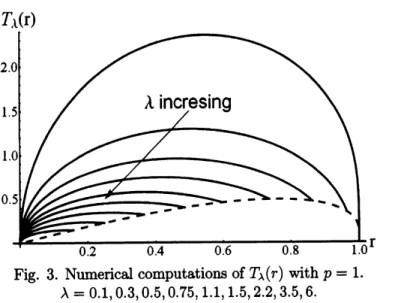
Numericalcomputationsof$T_{\lambda}(r)$ with$p=1.$$\lambda=0.1,0.3,0.5,0.75,1.1,1.5,2.2,3.5,6.$
Let $L^{*}=T_{\overline{\lambda}}(F^{-1}(1/\overline{\lambda}))$ for $\lambda=\overline{\lambda}$
.
We obtain that:(i) For$L>L^{*}$, thereexists$\lambda^{*}>0$such that$h_{p}(\lambda^{*})=L$
.
Thus part (i)followsimmmediatelyby properties (1)$-(7)$ and (3.5).
(u) For$L=L^{*}$, there exist positive numbers$\overline{\lambda}<\lambda^{*}$ such that$g_{p}(\overline{\lambda})=L^{*}$ and $h_{p}(\lambda^{*})=L^{t}.$
Thus part $(\ddot{u})$ followsimmediately byproperties (1)$-(7)$ and (3.5).
(m) For$0<L<L^{*}$, there exist positive numbers $\hat{\lambda}<\check{\lambda}<\lambda^{*}$ such that $g_{p}(\hat{\lambda})=g_{p}(\check{\lambda})=L$
and $h_{p}(\lambda^{*})=L$
.
Thus part (m) followsimmediately byproperties (1)$-(7)$ and (3.5).The proof of Theorem2.1 is
now
complete. $\blacksquare$Proof of Theorem 2.2. Let $p\in(0,1)$ be fixed. ByLemmas
3.1-3.4
and 3.8, we have thefollowing properties:
(1) $\lim_{rarrow}0+T_{\lambda}(r)=0$ for all $\lambda>0.$
(2) limn$arrow 0+T_{\lambda}’(r)=\infty$forall $\lambda>0.$
(3) $T_{\lambda}’(F^{-1}(1/\lambda))<0$ for $\lambda>1-p.$
(4) $\lim_{rarrow 1}-T_{\lambda}’(r)=-\infty$ for $0<\lambda\leq 1-p.$
(5) $T_{\lambda}(r)$ has exaetlyone critical pointin $(0, F^{-1}( \frac{1}{\lambda}))$ for$\lambda>1-p.$
(6) $T_{\lambda}(r)$ has exactlyonecritical point in $(0,1)$ for$0<\lambda\leq 1-p.$
(7) For fixed $r\in(0,1),$ $T_{\lambda}(r)$ is a continuous, strictly decreasing function of $\lambda>0$, and
$\lim_{\lambdaarrow 0+}T_{\lambda}(r)=\infty.$
(8) $h_{p}(\lambda)$is acontinuous, strictly decreasing function of$\lambda,$$\lim_{\lambdaarrow 0+}h_{p}(\lambda)=\infty$and$\lim_{\lambdaarrow\infty}h_{p}(\lambda)=$
$0.$
(9) $g_{p}(\lambda)$ has exactly two critical points,
one
local minimum at $\underline{\lambda}=1-p$ andone
localmaximum at $\overline{\lambda}\in(\underline{\lambda}, 1)$, on $(0, \infty),$ $\lim_{\lambdaarrow 0}+g_{p}(\lambda)=\infty$ and $\lim_{\lambdaarrow\infty}g_{p}(\lambda)=0.$
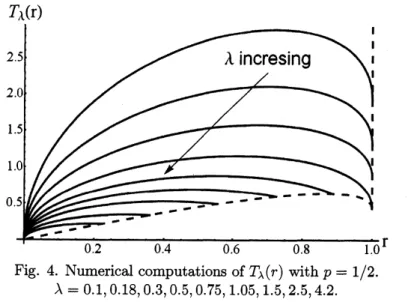
Fig. 4. Numerical computationsof$T_{\lambda}(r)$ with$p=1/2.$ $\lambda=0.1,0.18,0.3,0.5,0.75,1.05,1.5,2.5,4.2.$
Let $L^{*}=T_{\overline{\lambda}}(F^{-1}(1/\overline{\lambda}))$ and $L_{*}= \lim_{rarrow 1^{-}}T_{\underline{\lambda}}(r)=T_{1-p}(1)$
.
We obtain that:(i) For $L>L^{*}$, there exist positive numbers$\lambda_{*}<\lambda^{*}$such that $g_{p}(\lambda_{*})=L$ and $h_{p}(\lambda^{*})=L.$
Thus part (i) follows immediately by properties (1)$-(9)$ and (3.5).
(ii) For $L=L^{*}$, there exist positive numbers $\lambda_{*}<\overline{\lambda}<\lambda^{*}$ such that $g_{p}(\lambda_{*})=g_{p}(\overline{\lambda})=L^{*}$
and $h_{p}(\lambda^{*})=L^{*}$
.
Thus part (ii) followsimmediately byproperties (1)$-(9)$ and (3.5).(m) For $L_{*}<L<L^{*}$, there exist positive numbers $\lambda_{*}<\hat{\lambda}<\check{\lambda}<\lambda^{*}$ such that $g_{p}(\lambda_{*})=$
$g_{p}(\hat{\lambda})=g_{p}(\check{\lambda})=L$ and $h_{p}(\lambda^{*})=L$
.
Thus part (iii) follows immediately by properties(1)$-(9)$ and (3.5).
(iv) For $L=L_{*}$, there exist $0<\underline{\lambda}=1-p<\check{\lambda}<\lambda^{*}$ such that $g_{p}(\underline{\lambda})=g_{p}(\check{\lambda})=L_{*}$ and
$h_{p}(\lambda^{*})=L_{*}$
.
For $0<L<L_{*}$, there exist $0<\check{\lambda}<\lambda^{*}$ such that $g_{p}(\check{\lambda})=L$ and $h_{p}(\lambda^{*})=L$.
Thus part (iv) followsimmediately by properties (1)$-(9)$ and (3.5).The proofof Theorem 2.2 isnow complete.$\blacksquare$
Acknowledgments. Most of the computation in thispaper has been checked using the
symbolic manipulator Mathematica 7.0.
References
[1] N.D. Brubaker, J.A. Pelesko, Analysis ofa one-dimensional prescribed
mean
curvatureequation with singular nonlinearity, Nonlinear Anal. 75 (2012)
5086-5102.
[2] P. Habets, P. Omari, Multiple positive solutions of
a
one-dimensional prescribedmean
curvatureproblem, Commun.Contemp. Math. 9 (2007)
701-730.
[3] P.Korman, Y. Li,Globalsolutioncurvesforaclass of quasilinear boundary value problem,
Proc. Roy. Soc. Edinburgh Sect. A 140 (2010) 1197-1215.
[4] H. Pan, R. Xing, Timemapsandexact multiplicity results for one-dimensional prescribed
[5] H.Pan,
R.
Xing, Timemaps
and
exact
multiplicityresults forone-dimensional
prescribedmean
curvature equations, II, Nonhnear Anal.74
(2011)3751-3768.
[6] H. Pan, R. Xing, Exact multiplicity results for a one.dimensional prescribed
mean
cur-vature problem relatedto a MEMS model, Nonlinear Anal. Real World Appl.
13
(2012)2432-2445.
[7] N.D. Brubaker, J.A. Pelesko, Non-linear effects
on
canonical MEMS models, EuropeanJ. Appl. Math. 22 (2011)
455-470.
[8] F. Lin, Y. Yang, Nonhnear non-local ellipticequation modelhng electrostatic actuation,
Proc. R. Soc. Lond. Ser. AMath. Phys. Eng. Sci.
463
(2007)1323-1337.
[9] J.A. Pelesko, D.H. Bemstein, Modeling MEMS and NEMS, Chapman Hall and CRC
Press, BocaRaton, FL,
2003.
[10] P. Esposito, N. Ghoussoub, Y. Guo, Mathematical analysis ofpartial differential
equa-tions modelingelectrostaticMEMS, Courant LectureNotes inMathematics,
20.
CourantInstitute of Mathematical Sciences, New York; American Mathematical Society, Provi-dence, RI,
2010.
[11] F. Comu, Correlations in quantum plasmas. I.Resummationsin Mayer-like
diagrammat-ics, Phys.Rev. E53 (1996) $4562\triangleleft 594.$
[12] C. Gruber, J.L. Lebowitz, P.A. Martin, Sumrules for inhomogeneous Coulombsystems,
J. Chem. Phys. 75 (1981)
944-954.
[13] M. Mazars,Ewald methods for inversepower-lawinteractions in tridimensional and quasi-two-dimensionalsystems, J. Phys. A: Math. Theor. 43 (2010)
425002
(16pp).[14] B.G. Sidharth,Phaseshifts inthecollisionofmassive particles, J. Math.Phys.
30
(1989)$673\triangleleft 77.$
[15] T. Laetsch, The number ofsolutions ofa nonhnear two point boundary value problem,
IndianaUniv. Math. J. 20 (1970) 1-13.
Kuo-ChihHung
Department of Mathematics
National Tsing Hua University
Hsinchu 300 TAIWAN