Title
癌幹細胞維持機構とEMT (上皮間葉転換) を同時標的とする頭頸部癌転移治療の研究
Sub Title
Basic study aiming at anti-metastatic therapy that targets both cancer stem-like cell property and
EMT (epithelial to mesenchymal transition) in head and neck cancer
Author
今西, 順久(Imanishi, Yorihisa)
羽生, 昇( Habu, Noboru)
佐藤, 陽一郎( Satō, Yōichirō)
渡部, 佳弘( Watanabe, Yoshihiro)
猪狩, 雄一( Ikari, Yūichi)
斎藤, 真( Saitō, Shin)
Publisher
Publication year
2020
Jtitle
科学研究費補助金研究成果報告書 (2019. )
Abstract
本研究より次の成果を得た。1) Flt-4発現頭頸部癌細胞にVEGF-Cの癌細胞自身に対するautocrine機
構が存在し,CNTN-1およびVEGF-Cの発現亢進による細胞増殖能・遊走能の制御を介して頸部リン
パ節転移を含めた癌の進行に寄与していると考えられた。2) 咽頭癌細胞において,Cox2のみなら
ずその下流のEP2の選択的阻害が細胞増殖能・遊走能の抑制を導くEMTの反転 (即ちMETの誘導)
を介した抗腫瘍効果を発揮する可能性が示唆された。3) 咽頭癌細胞において, HIF-1αの選択的阻害
は幹細胞能およびEMTの抑制を介した抗腫瘍効果を有する可能性が示唆された。
Our study demonstrated the following results: 1) Flt-4-expressing HNSCC cells possess their own
VEGF-C/Flt-4 autocrine mechanism that enhances tumor cell proliferation and motility via
upregulating the expression of VEGF-C itself and CNTN-1, thereby contributing to cancer
progression including lymph node metastasis. 2) In pharyngeal cancer cells, selective inhibition
of EP2, as well as that of Cox2, can exert anti-metastatic effects via EMT reversal (i.e., by inducing
MET) that attenuates cell proliferation and migration. 3) Selective HIF-1α-inhibition may lead to
anti-metastatic effects by suppressing both stemness property and EMT in pharyngeal cancer
cells.
Notes
研究種目 : 基盤研究 (C) (一般)
研究期間 : 2016~2019
課題番号 : 16K11245
研究分野 : 医歯薬学
Genre
Research Paper
URL
https://koara.lib.keio.ac.jp/xoonips/modules/xoonips/detail.php?koara_id=KAKEN_16K11245seika
慶應義塾大学学術情報リポジトリ(KOARA)に掲載されているコンテンツの著作権は、それぞれの著作者、学会または出版社/発行者に帰属し、その権利は著作権法によって 保護されています。引用にあたっては、著作権法を遵守してご利用ください。
The copyrights of content available on the KeiO Associated Repository of Academic resources (KOARA) belong to the respective authors, academic societies, or publishers/issuers, and these rights are protected by the Japanese Copyright Act. When quoting the content, please follow the Japanese copyright act.
慶應義塾大学・医学部(信濃町)・講師(非常勤)
科学研究費助成事業 研究成果報告書
様 式 C−19、F−19−1、Z−19 (共通)
機関番号:
研究種目:
課題番号:
研究課題名(和文)
研究代表者
研究課題名(英文)
交付決定額(研究期間全体):(直接経費)
32612
基盤研究(C)(一般)
2019
∼
2016
癌幹細胞維持機構とEMT(上皮間葉転換)を同時標的とする頭頸部癌転移治療の研究
Basic study aiming at anti-metastatic therapy that targets both cancer stem-like
cell property and EMT (epithelial to mesenchymal transition) in head and neck
cancer
80255538
研究者番号:
今西 順久(IMANISHI, YORIHISA)
研究期間:
16K11245
年
月
日現在
2
6
7
円
3,600,000
研究成果の概要(和文):本研究より次の成果を得た。1) Flt-4発現頭頸部癌細胞にVEGF-Cの癌細胞自身に対す
るautocrine機構が存在し,CNTN-1およびVEGF-Cの発現亢進による細胞増殖能・遊走能の制御を介して頸部リン
パ節転移を含めた癌の進行に寄与していると考えられた。2) 咽頭癌細胞において,Cox2のみならずその下流の
EP2の選択的阻害が細胞増殖能・遊走能の抑制を導くEMTの反転(即ちMETの誘導)を介した抗腫瘍効果を発揮す
る可能性が示唆された。3) 咽頭癌細胞において,HIF-1αの選択的阻害は幹細胞能およびEMTの抑制を介した抗
腫瘍効果を有する可能性が示唆された。
研究成果の概要(英文):Our study demonstrated the following results: 1) Flt-4-expressing HNSCC
cells possess their own VEGF-C/Flt-4 autocrine mechanism that enhances tumor cell proliferation and
motility via upregulating the expression of VEGF-C itself and CNTN-1, thereby contributing to cancer
progression including lymph node metastasis. 2) In pharyngeal cancer cells, selective inhibition of
EP2, as well as that of Cox2, can exert anti-metastatic effects via EMT reversal (i.e., by inducing
MET) that attenuates cell proliferation and migration. 3) Selective HIF-1α-inhibition may lead to
anti-metastatic effects by suppressing both stemness property and EMT in pharyngeal cancer cells.
研究分野: 医歯薬学
キーワード: 頭頸部扁平上皮癌 転移 EMT(上皮間葉転換 ) 幹細胞能 Flt-4 VEGF-C Cox-2 EP2
1版
令和
研究成果の学術的意義や社会的意義
頭頸部癌における治療成績向上の最大の障壁はその制御困難な転移にある。本研究の結果は,癌転移と薬剤抵抗
性に関わるEMTと幹細胞能を同時誘導する分子機構の一端を明らかにし,その関連分子を指標とする転移リスク
評価の有用性,およびそれらを標的とする治療の有効性を示唆するものであり,癌診療に新たな戦略を導く可能
性が期待される。
※科研費による研究は、研究者の自覚と責任において実施するものです。そのため、研究の実施や研究成果の公表等に
ついては、国の要請等に基づくものではなく、その研究成果に関する見解や責任は、研究者個人に帰属されます。
1. 研究開始当初の背景
(1) 頭頸部癌治療の最大障壁である転移
頭頸部扁平上皮癌(HNSCC)は統計上世界で 560,000 人/年以上の新患者を認める罹患率第
6 位のがんであるが,近年の集学的治療の進歩にも拘わらずその治療成績は 30 年以上に亘り向
上がみられない。その最大の要因の一つは制御困難な転移にある。従って転移の分子機構のさ
らなる解明は,一次治療後の後発性転移のリスク評価と予防,および転移に対する有効な標的
治療の開発を考えるうえで,臨床現場の視点から極めて重要な課題である。
(2) 転移における EMT と幹細胞能の関与
癌が転移を成立させるイベントは多くの点で
EMT (epithelial to mesenchymal
transition:上皮間葉転換:上皮細胞が,細胞間接着の喪失と細胞骨格の再構築を介して,間
葉細胞の性質を獲得す
る現象
)に類似しており,上皮性癌細胞における EMT はそ
の形態変化
に伴う転移能の獲得を意味している。自己複製能と多分化能を有する癌幹細胞(CSC, Fig.1)は,
腫瘍細胞の発生と維持のみならず,その悪性度
に関わる薬剤耐性や転移能を介して,治療抵抗
性や治療後再発に寄与していると考えられる。
興味深いことに近年,EMT と幹細胞能の深い
共通性を示唆する報告が重ねられているが,
EMT と幹細胞能を同時誘導する分子機構の詳
細は
HNSCC を含めまだ明らかにされていない。
(3) これまでの研究結果
①頭頸部癌における
EMT および幹細胞能のマーカー分子発現と癌転移
我々は
HNSCC 細胞において,転写因子 Oct3/4 および Nanog が幹細胞マーカーの候補分子
であり,細胞遊走能・浸潤能の亢進に寄与している可能性,および
Oct3/4 の発現亢進は,細胞
接着因子
E-cadherin (E-cad)の発現減弱と E-cad の転写抑制因子である SIP1 の発現亢進とと
もに,
stage I-II 舌癌部分切除症例における後発性頸部リンパ節転移(delayed neck metastasis:
DNM)の独立予測因子であることを報告した。しかしながら幹細胞マーカー分子が転移に寄与
する分子機構,および
EMT との相互関係はまだ明らかでない。
②Cox2 選択的阻害による MET(間葉上皮転換)の誘導(=EMT の抑制)
PGE
2合成酵素である
cyclooxygenase-2 (Cox2)はその多彩な作用を介して癌の発生と進行に
寄与しており,その選択的阻害による抗腫瘍効果が期待されている。我々は舌癌細胞における
選択的
Cox2 阻害は E-cad の転写抑制因子(snail, SIP1, twist)の発現抑制を介して MET を誘導
(EMT を抑制)すること,臨床検体の検討から Cox2 発現亢進と E-cad 発現減弱が舌癌の頸
部
LN 転移に深く関与している可能性を報告した。しかしながら Cox2 の下流シグナルを標的
とする,より選択的な阻害の効果は報告されていない。
③癌細胞自身の
Flt-4 の発現と VEGF-C オートクリン機構
腫瘍細胞由来のリンパ管新生因子
VEGF-C は従来,リンパ管内皮細胞(LEC)特異的に発
現するとされる受容体
Flt-4 を発現する LEC にパラクリン機構で作用していると考えられてい
たが,
Flt-4 の癌細胞自身における選択的発現と,VEGF-C/Flt-4 のオートクリン機構の存在が
指摘されている。我々も
Flt-4 が HNSCC 細胞に選択的に発現されること,同発現細胞におい
て
Flt-4 の活性化および阻害により,effector 分子として着目した神経細胞接着分子
Contactin-1(CNTN-1),Cox2 および VEGF-C 自身の発現が亢進/減弱されることを予備実
験にて確認し,VEGF-C/Flt-4 の下流に EMT を含め癌細胞自身の形質変化を誘導する種々の
シグナルの存在が示唆された。
2. 研究の目的
本研究の目的は,幹細胞能と
EMT を誘導する分子メカニズムを解明することにより,その
誘導シグナルに関わる分子標的を制御する新たな抗転移治療および転移予防の戦略を開発する
Fig.1とともに,転移予測における新規バイオマーカーを確立することにより,HNSCC を含めた癌
の治療成績を向上させることである。
3. 研究の方法
(1) Flt-4 発現 HNSCC 細胞に対する VEGF-C/Flt-4 シグナルの刺激/阻害における,下流
effector 分子と考えられる CNTN-1,Cox2 および VEGF-C 自身の発現変化,および誘導され
る表現形質の変化について評価した。
(2) HNSCC 細胞における Cox2/PGE
2/EP2 シグナルの刺激/阻害,および低酸素誘導因子
HIF-1αの刺激/阻害によって誘導される EMT/MET および幹細胞能を含めた表現形質の変化
を評価した。
(3) HNSCC の臨床検体を用い,上記関連各分子の癌細胞における発現を免疫組織化学的に評価
し,臨床病理組織学的因子との統計学的相関を検討した。
4. 研究成果
(1) HNSCC における Flt-4 発現と
VEGF-C/Flt-4 axis の役割に関する検討
①HNSCC 細胞に対する qPCR スクリ
ーニングで認められた選択的
Flt-4 発現
は
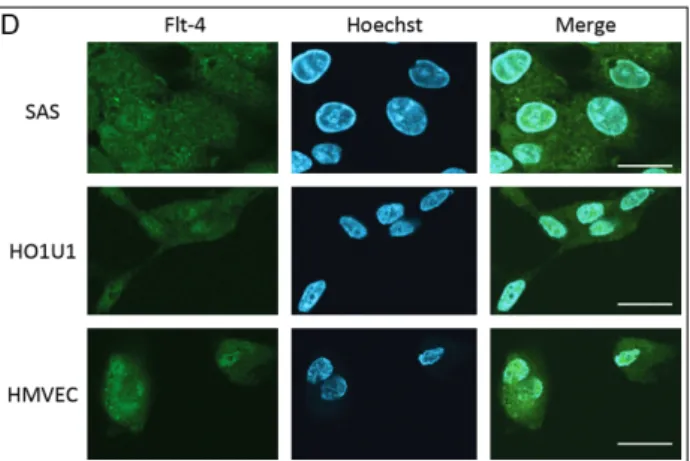
RT-PCR, 免疫蛍光細胞染色(ICC)で
も確認された(Fig.2)。Recombinant
VEGF-C および Flt-4 選択的 VEGF-C
変異体による
Flt-4 activation,抗 Flt-4
中和抗体および
Flt-4 選択的阻害剤によ
る
Flt-4 inhibition を行った結果,SAS
では
CNTN-1 と VEGF-C ともに,一方
HO1U1 では CNTN-1 の
みに,発現亢進と抑制を認
めた。SAS に対する
in
vitro
proliferation assay
および
migration assay
にて,Flt-4 activation/
inhibition により細胞増
殖能,遊走能ともに亢進/
抑制が認められた(Fig.3)。
以上より,
HNSCC にお
いても
VEGF-C のパラク
リン機構のみならず
Flt-4
を介したオートクリン機
構が存在し,CNTN-1 お
よび
VEGF-C 自身の発現
誘導を介して,各々増殖能
と遊走能を亢進させていると考えられた。
②舌扁平上皮癌臨床検体を用いた免疫組織化学的発現検討の結果,単変量解析において Flt-4,
CNTN-1, VEGF-C 各々の発現はいずれも頸部 LN 転移との間に,また CNTN-1 とリンパ管侵
襲・静脈侵襲,VEGF-C と静脈侵襲との間に,各々有意な相関を認めた。多変量解析の結果,
Flt-4 陽性は頸部 LN 転移に関する独立相関因子の一つであった。
以上より,癌細胞は自身が
Flt-4 を発現することで VEGF-C のオートクリン機構も有し,
VEGF-C/Flt-4 axis in oral squamous cell carcinoma cells
2052 Am J Cancer Res 2018;8(10):2046-2063
localized in the cytoplasm, seemingly as a result of receptor internalization (Figure 1D).
Effects of Flt-4 stimulation and inhibition on the mRNA expression of CNTN-1 and VEGF-C in OSCC cells
We examined the effect of Flt-4 stimulation and inhibition on the mRNA expression levels of CNTN-1 and VEGF-C in the SAS and HO1U1 cell lines using rVEGF-C and VEGF-C (Cys156Ser) as stimulation reagents and recombinant Flt-4/ Fc and MAZ51 as inhibition reagents. In SAS cells, Flt-4 stimulation upregulated both
CNTN-1 and VEGF-C expression compared to the con-trol, with increases of 1.5- and 2.3-fold in CNTN-1 and 1.4- and 1.8-fold in VEGF-C with rVEGF-C and VEGF-C (Cys156Ser), respectively (Figure 2A). In contrast, Flt-4 inhibition down-regulated both CNTN-1 and VEGF-C expression compared to the control, with decreases of 0.4- and 0.6-fold in CNTN-1 and 0.4- and 0.5-fold in VEGF-C with recombinant Flt-4/Fc and MAZ51, respectively (Figure 2B). In HO1U1 cells, Flt-4 stimulation resulted in relatively less upregula-tion of CNTN-1 expression, with increases of 1.3- and 1.2-fold with rVEGF-C and VEGF-C (Cys156Ser), respectively, whereas no increase Figure 3. Alterations in the proliferation and migration activity of SAS cells following Flt-4 stimulation and inhibition. The effects of Flt-4 stimulation and inhibition on proliferation and migration activity were examined using recom-binant VEGF-C or VEGF-C (Cys156Ser) (selective Flt-4 agonist) as stimulation reagents and recomrecom-binant human Flt-4/Fc chimera (specific VEGF-C neutralizer) or MAZ51 (specific Flt-4 inhibitor) as inhibition reagents. (A and B) An in vitro cell proliferation assay was conducted using SAS cells. The data are presented as the fold increase in the OD values of the absorbance measured at 450 nm compared with the respective controls. Flt-4 stimulation promoted proliferation activity in a dose-dependent manner (A), whereas Flt-4 inhibition suppressed proliferation activity in a dose-dependent manner (B). (C and D) An in vitro migration assay was performed using SAS cells. The results are presented as the fold increase in the number of migrated cells compared with the respective controls. To eliminate the possible influence of differences in proliferation activity, each value was normalized according to the corresponding ratio of the proliferation rate found in the same condition. Flt-4 stimulation enhanced migration activity in a dose-dependent manner (C), whereas Flt-4 inhibition attenuated migration activity in a dose-dependent manner (D). The values represent the mean ± standard deviation. Difference between each condition and control was statistically analyzed using a two-tailed t-test: *, P < 0.05; N.S., not significant.
Fig.3: Proliferation and migration activity of SAS cells
VEGF-C/Flt-4 axis in oral squamous cell carcinoma cells
2049
Am J Cancer Res 2018;8(10):2046-2063
Figure 1. Baseline mRNA expression of Flt-4, VEGF-C, and CNTN-1 in HNSCC cells. The mRNA expression levels of
each gene in the HNSCC cell lines were assessed by quantitative real-time PCR. The relative expression levels of
the genes were compared after normalization using those of GAPDH. A: Flt-4. B: VEGF-C and CNTN-1, in which the
relative expression levels were calibrated by dividing each value by that of HSC-2 for the sake of convenience. C: The
selective expression of Flt-4 in SAS and HO1U1 cells was further confirmed by standard PCR. D: Immunofluorescent
staining of SAS and HO1U1 cells, as well as HMVEC cells, revealed the cytoplasmic localization of Flt-4, indicating
the receptor internalization that reflects its activation. Nuclei were stained with Hoechst 33258. Scale bar: 10 μm.
in serum-deprived medium (2% FBS medium).
The cells were then treated with different
selec-tive Flt-4 stimulators: rVEGF-C (100 ng/ml) or
VEGF-C (Cys156Ser) (50 ng/ml for SAS and
100 ng/ml for HO1U1), or inhibitors:
recombi-nant Flt-4/Fc (100 ng/ml for SAS and 200 ng/
ml for HO1U1) or MAZ51 (10 μM). These con-
centrations of the reagents were each found to
be optimal with no toxic effect on cell viability
up to at least 24 h based on our preliminary
experiments. Treatments with only the sol-
vent for a reagent: PBS for rVEGF-C, VEGF-C
(Cys156Ser), and recombinant Flt-4/Fc, or
dimethyl sulfoxide (DMSO) (Nacalai Tesque,
Kyoto, Japan) for MAZ51, were set as controls.
For the evaluation of alterations in gene
expres-sion associated with Flt-4 stimulation or
inhibi-tion, total RNA was extracted after a 12-h
incu-bation. The experiment in each condition was
performed at least three times to assess for
consistency of response.
In vitro cell proliferation assay
Cell proliferation rates were assessed using
the Cell Counting Kit-8 (Dojindo Laboratories,
Japan) according to the manufacturer’s
instruc-tions. Briefly, SAS cells were plated at 6×10
3cells per well in 96-well plates and incubated in
culture medium containing 5% FBS with or
with-out reagents for 24 h at 37°C. The water-solu-
ble tetrazolium salt WST-8 (10 μL) was added to
each well, and the plate was incubated for 2 h
at 37°C. Viable cells were quantified by
mea-suring the optical density (OD) values of the
absorbance at 450 nm using a microplate
read-er. The experiment was conducted five times
and run in sextuplicate each time.
In vitro cell migration assay
Cell migratory ability was evaluated using
24-well Transwell inserts (polycarbonate filters)
Fig.2: Flt-4 expression in HNSCC cells cells
CNTN-1 および VEGF-C の発現亢進
による増殖能・遊走能の亢進を介して,
頸部
LN 転移を促進している可能性が
示唆された(Fig.4)。
(2) 咽頭癌細胞における選択的
Cox2/EP2 阻害による EMT 抑制効果
に関する検討
種々の
HNSCC 細胞に対する qPCR
スクリーニングにより,E-cad 低発現
咽頭扁平上皮癌細胞として
BICR6 お
よび
FaDu を選別した(Fig.5)。Cox2
および(PGE
2受容体である)EP2 に対し celecoxib および PF-04418948 を用い各々の選択的
阻害を行った結果,いずれにおいても
E-cad 発現回復,E-cad 転写抑制因子および vimentin
の発現減弱を認めた。
in vitro
proliferation assay および migration assay の結果,細胞増殖能,
遊走能ともに抑制が認められた。また,
下咽頭癌経口切除検体の病理組織学
的検討から,E-cadherin 発現低下と
Cox2 発現亢進を伴う EMT の頸部リ
ンパ節転移への深い関与が示唆され
た。
以上より,Cox2 のみならず,その
下流の
EP2 の選択的阻害が EMT 抑制
(MET 誘導)を介した抗腫瘍効果を
発揮する可能性が示唆された。
(3) 咽頭癌細胞における HIF-1α選択的阻害による抗腫瘍効果の検討
咽頭扁平上皮癌細胞
FaDu および Detroit512 に対し,KC7F2 を用い HIF-1αの選択的阻害
を行った結果,癌幹細胞マーカーである転写因子
Oct3/4 と Nanog,および E-cad 転写抑制因
子
twist の発現抑制を認めた。
in vitro
proliferation assay では用量依存的に細胞増殖能が抑制
された。
以上より,HIF-1αの選択的阻害は幹細胞能および EMT の抑制を介した抗腫瘍効果を有す
る可能性が示唆された。
今後の展望:
(1) VEGF-C/Flt-4 シグナルの effector 分子の可能性がある Cox2 についても評価することによ
り,同シグナルの
EMT および幹細胞能への関与を検討してゆく。また,治療標的としての有
効性をリンパ管新生抑制作用との相乗効果を含めて評価することが望まれる。
(2) Cox2 および EP2 の選択的阻害による幹細胞能抑制効果についても,薬剤感受性増強を含
めた抗腫瘍効果として評価してゆく。また
EP2 選択的阻害の MET 誘導を介した治療有効性を
in vivo
モデルおよび臨床レベルで評価する必要がある。
(3) EMT の指標となる E-cad, Cox2 に加え EP2,幹細胞能指標と考えられる Oct3/4, Nanog,
および
VEGF-C/Flt-4/CNTN-1 シグナルの各因子について,転移予測バイオマーカーとしての
有用性を
prospective に評価することが望まれる。
EP2 and Cox-2 inhibition reverses EMT in hypopharyngeal cancer
1101 Am J Transl Res 2020;12(3):1096-1113
ogy to a polygonal shape in both cells (Figure 2A and 2B).
Alterations in the mRNA expressions of tran-scriptional repressors of E-cadherin by Cox-2 and EP2 inhibition
Additionally, the inhibitory effects of celecoxib and PF-04418948 were examined on the mRNA expressions of the representative tran-scriptional repressors of E-cadherin: snai1,
ZEB1, and twist (Figure 3A and 3B). In BICR6 cells, celecoxib clearly downregulated all three repressors, with decreases of 0.45-, 0.63-, and 0.81-fold in snai1, ZEB1, and twist, respective-ly. In contrast, in FaDu cells, only snai1 was suppressed by celecoxib, decreasing by 0.50-fold, whereas no alteration was observed in ZEB1 and twist. Moreover, in BICR6 cells, PF-04418948 distinctly reduced snai1 and ZEB1, with decreases of 0.39- and 0.26-fold, respectively, whereas no effect was found on
Figure 1. Baseline mRNA expression levels of Cox-2 and CDH-1, and the effects of Cox-2 and EP2 inhibition on CDH-1 and vimentin mRNA expression. The mRNA expression levels of each gene were assessed by quantitative real-time PCR. The relative expression levels of genes were compared after normalization using those of ACTB. (A) Baseline mRNA expression of Cox-2 and CDH-1 in HNSCC cells. Relative expression levels were calibrated by divid-ing each value with that of BICR6 cells for the sake of convenience. (B and C) Alterations in the mRNA expression levels of CDH-1 (B) and vimentin (C) in BICR6 and FaDu cells after a 12-h incubation with the Cox-2 inhibitor cele-coxib (50 μM) or EP2 antagonist PF-04418948 (1 μM). The data are presented as the fold increase or decrease in the relative expression levels of each gene compared with the respective controls. In both BICR6 and FaDu cells, celecoxib upregulated CDH-1 expression, and PF-04418948 led to its upregulation more noticeably (B). By contrast, vimentin expression was downregulated by celecoxib, and PF-04418948 induced its downregulation more mark-edly in both cells (C). The values represent the mean ± standard deviation. Differences between each condition and control were statistically analyzed using a two-tailed t-test: *, P < 0.05.
Fig.5: Baseline mRNA expression levels of Cox-2 and CDH-1
VEGF-C/Flt-4 axis in oral squamous cell carcinoma cells
2057 Am J Cancer Res 2018;8(10):2046-2063
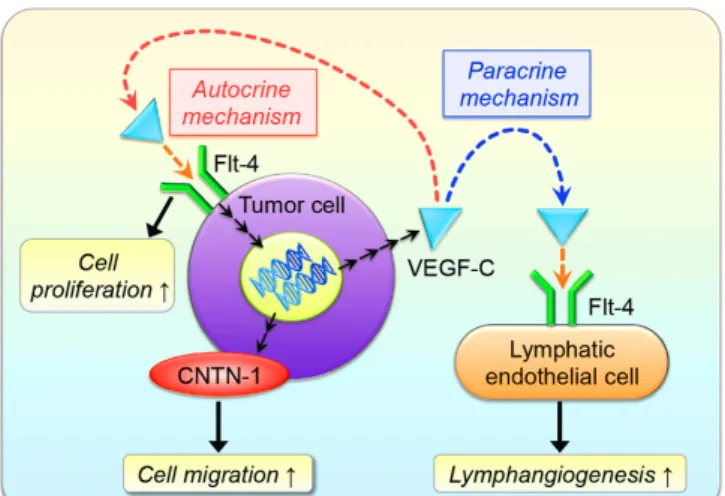
Figure 5. A schematic diagram demonstrating the VEGF-C/Flt-4 autocrine sys-tem in OSCC cells. Tumor cell-derived VEGF-C binds to Flt-4 expressed on the tumor cells, and its activation upregulates the expression levels of VEGF-C itself and CNTN-1 in an autocrine manner, thereby enhancing tumor cell pro-liferation and migration. This autocrine mechanism of the VEGF-C/Flt-4 axis in tumor cells likely contributes to cancer progression, including the development of lymphatic metastasis, along with the primary well-known paracrine mecha-nism involving lymphatic endothelial cells that leads to lymphangiogenesis. previous studies; while the earlier reports did
not refer to its specific downstream effector [26, 30, 31], a few recent studies identified sev-eral molecules as the downstream effectors of the VEGF-C/Flt-4 axis [43, 46, 48]. In a previ-ous study using the same OSCC cell line (SAS) with 4 inhibition via a dominant-negative Flt-4-overexpressing cell model or MAZ51 treat-ment, the expression of VEGF-C was shown to be positively regulated by autocrine activation of Flt-4 by VEGF-C itself [46]. This result imply-ing the existence of the VEGF-C/Flt-4 autocrine loop was corroborated by our study using both Flt-4 stimulation and inhibition. The above-mentioned study further demonstrated that this upregulation of VEGF-C in this autocrine loop is mediated through Flt-4-associated in- tracellular signal transductions, mainly via the protein kinase C (PKC), p42/44 mitogen-acti-vated protein kinase (MAPK), and p38 MAPK pathways but not via the phosphatidylinositol-3 kinase (PI3K)-Akt pathway, although their re- sulting effects on cell migration activity were not assessed [46]. However, considering that in lymphatic endothelial cells the PKC-dependent p42/44 MAPK pathway was shown to mediate VEGF-C/Flt-4 activation-induced signal trans-ductions leading to cell growth, survival, and
could also be enhanced by VEGF-C, although it was not evaluated.
Regarding cell migration, its enhancement by the autocrine VEGF-C/Flt-4 signaling found in the present study is also in agreement with sev-eral previous studies; while some of them did not specify its specific downstream molecules [26, 39, 40, 49], a few studies demonstrated that CNTN-1 was the downstream effector of the VEGF-C/Flt-4 axis [37, 44, 48]. CNTN-1, intially found to be expressed on the external membrane surface of central and peripheral neurons [53, 54], is of vital importance for the development and maintenance of the nervous system by playing roles in axon elongation in the cerebellum [55], assembly of septate-like junctions between axons and myelinating glial cells [56], and formation of the neuromuscular junction [57] and synapses [58, 59]. Concerning its molecular function, CNTN-1 has been dem-onstrated to interact with a variety of cell sur-face proteins, including the L1 family of the Ig superfamily (L1, NrCAM, and neurofascin) [60, 61], receptor protein tyrosine phosphatase α (RPTPα) [62], RPTPβ [61, 63], tenascin-R [64], tenascin-C [65], a soluble form of RPTP zeta [66], and the Notch receptor [67].
migration [52], endogenous-ly upregulated VEGF-C thro- ugh the VEGF-C/Flt-4 auto-crine loop in tumor cells is assumed to promote not only tumor cell proliferation but also tumor cell migra-tion, as demonstrated in the present study. Besides a study using HNSCC cells, a study using VEGFR-3-expre- ssing KKLS cells derived from gastric carcinoma sho- wed that treatment with rV- EGF-C resulted in the phos-phorylation of Akt, stimula-tion of cell proliferastimula-tion, and increased expression of cy- clin D1, placental growth fa- ctor, autocrine motility fac-tor (AMF), and autocrine mo- tility factor receptor (AMFR) [43]. Because AMF and AM- FR are known to regulate tu- mor cell motility, these re- sults suggest that the migra-tion activity of those cells Fig.4: The VEGF-C/Flt-4 autocrine system
5.主な発表論文等 〔雑誌論文〕 計6件(うち査読付論文 6件/うち国際共著 0件/うちオープンアクセス 4件) 2019年 2018年 2018年 2017年 オープンアクセスとしている(また、その予定である) − 10.1186/s12885-017-3396-0 3.雑誌名 6.最初と最後の頁 有 オープンアクセス 国際共著 2.論文標題 5.発行年
Clinical outcomes of transoral videolaryngoscopic surgery for hypopharyngeal and supraglottic cancer
BMC Cancer 445
掲載論文のDOI(デジタルオブジェクト識別子) 査読の有無
オープンアクセスとしている(また、その予定である) −
4.巻 Imanishi Y, Ozawa H, Sakamoto K, Fujii R, Shigetomi S, Habu N, Otsuka K, Sato Y, Watanabe Y,
Sekimizu M, Ito F, Tomita T, and Ogawa K
17 1.著者名 10.18632/oncotarget.24863 3.雑誌名 6.最初と最後の頁 有 オープンアクセス 国際共著 2.論文標題 5.発行年
Pretreatment monocyte counts and neutrophil counts predict the risk for febrile neutropenia in patients undergoing TPF chemotherapy for head and neck squamous cell carcinoma
Oncotarget 18970-18984
掲載論文のDOI(デジタルオブジェクト識別子) 査読の有無
オープンアクセスとしている(また、その予定である) −
1.著者名 4.巻
Shimanuki M, Imanishi Y, Sato Y, Nakahara N, Totsuka D, Sato E, Iguchi S, Sato Y, Soma K, Araki Y, Shigetomi S, Yoshida S, Uno K, Ogawa Y, Tominaga T, Ikari Y, Nagayama J, Endo A, Miura K, Tomioka T, Ozawa H, Ogawa K
9 なし 3.雑誌名 6.最初と最後の頁 有 オープンアクセス 国際共著 2.論文標題 5.発行年
VEGF-C/Flt-4 axis in tumor cells contributes to the progression of oral squamous cell carcinoma via upregulating VEGF-C itself and contactin-1 in an autocrine manner
American Journal of Cancer Research 2046-2063
掲載論文のDOI(デジタルオブジェクト識別子) 査読の有無
オープンアクセス 国際共著
オープンアクセスではない、又はオープンアクセスが困難 −
4.巻 Shigetomi S, Imanishi Y, Shibata K, Sakai N, Sakamoto K, Fujii R, Habu N, Otsuka K, Sato Y,
Watanabe Y, Shimoda M, Kameyama K, Ozawa H, Tomita T, Ogawa K
8 1.著者名 両側梨状陥凹同時多発表在癌に対する二期的経口切除 頭頸部外科 215-222 掲載論文のDOI(デジタルオブジェクト識別子) 査読の有無 なし 3.雑誌名 6.最初と最後の頁 有 4.巻 渡部佳弘, 岡本康秀, 今西順久, 池真理, 遠藤理奈子, 竹林亜貴子, 小澤宏之 29 1.著者名 2.論文標題 5.発行年
2018年 2017年 〔学会発表〕 計36件(うち招待講演 4件/うち国際学会 4件) 2019年 2019年 2.発表標題 2.発表標題 第120回日本耳鼻咽喉科学会学術講演会 第120回日本耳鼻咽喉科学会学術講演会 3.学会等名 3.学会等名 佐藤陽一郎 今西順久 佐藤えみり 松居祐樹 井口聖名 栗林徹 舟越和人 井口聖名 松居祐樹 佐藤えみり 佐藤陽一郎 重冨征爾 島貫茉莉江 今西順久 1.発表者名 1.発表者名 4.発表年 4.発表年 オープンアクセスとしている(また、その予定である) − 喉頭下咽頭癌における治療前PET検査を用いた予後予測能の検討 中咽頭癌における原発巣SUVmaxの予後予測能の検討 10.1245/s10434-015-5082-2 3.雑誌名 6.最初と最後の頁 有 オープンアクセス 国際共著 2.論文標題 5.発行年
Impact of hematological inflammatory markers on clinical outcome in patients with salivary duct carcinoma: a multi-institutional study in Japan
Oncotarget 1083-91
掲載論文のDOI(デジタルオブジェクト識別子) 査読の有無
オープンアクセスではない、又はオープンアクセスが困難 −
1.著者名 4.巻
Kawakita D, Tada Y, Imanishi Y, Beppu S, Tsukahara K, Kano S, Ozawa H, Okami K, Sato Y, Shimizu A, Sato Y, Fushimi C, Takase S, Okada T, Sato H, Otsuka K, Watanabe Y, Sakai A, Ebisumoto K, Togashi T, Ueki Y, Ota H, Shimura T, Hanazawa T, Murakami S, Nagao T
8 10.1002/hed.25021 3.雑誌名 6.最初と最後の頁 有 オープンアクセス 国際共著 2.論文標題 5.発行年
Clinical diagnosis and treatment outcomes for parapharyngeal space schwannomas: A single-institution review of 21 cases
Head Neck 569-576
掲載論文のDOI(デジタルオブジェクト識別子) 査読の有無
4.巻 Sato Y, Imanishi Y, Tomita T, Ozawa H, Sakamoto K, Fujii R, Shigetomi S, Habu N, Otsuka K,
Watanabe Y, Sekimizu M, and Ogawa K
40
2019年 2019年 2019年 2019年 2.発表標題 2.発表標題 2.発表標題 2.発表標題 第81回耳鼻咽喉科臨床学会 第43回日本頭頸部癌学会 第43回日本頭頸部癌学会 第43回日本頭頸部癌学会 3.学会等名 3.学会等名 3.学会等名 3.学会等名 佐藤陽一郎 今西順久 佐藤えみり 松居祐樹 井口聖名 松居祐樹 今西順久 井口聖名 佐藤えみり 中原奈々 佐藤陽一郎 重冨征爾 栗林徹 舟越和人 井口聖名 今西順久 松居祐樹 佐藤えみり 佐藤陽一郎 島貫茉莉江 重冨征爾 栗林徹 舟越和人 渡部佳弘 今西順久 岡本康秀 竹林亜貴子 長谷部夏希 佐藤陽一郎 小澤宏之 小川郁 1.発表者名 1.発表者名 1.発表者名 1.発表者名 4.発表年 4.発表年 4.発表年 4.発表年 p16陽性/陰性中咽頭癌における血液学的炎症および栄養指標の予後予測能の検討 導入化学療法後の経口的咽喉頭癌切除例における治療成績の臨床統計学的検討 当院における喉頭癌症例の治療前PET評価について
2018年 2018年 2018年 2018年 2.発表標題 2.発表標題 2.発表標題 2.発表標題 第119回日本耳鼻咽喉科学会学術講演会 第42回日本頭頸部癌学会 第42回日本頭頸部癌学会
AACR (American Association for Cancer Research) 2018 Annual Meeting(国際学会) 3.学会等名 3.学会等名 佐藤えみり 今西順久 中原奈々 佐藤陽一郎 島貫茉莉江 井口聖名 重冨征爾 栗林徹 舟越和人 黒岩信子 斎藤真 小澤宏之 今西順久 関水真理子 渡部佳弘 伊藤文展 猪狩雄一 中原奈々 小川郁 3.学会等名 3.学会等名
Shin Saito, Hiroyuki Ozawa, Yorihisa Imanishi, Mariko Sekimizu, Yoshihiro Watanabe, Fumihiro Ito, Yuichi Ikari, Nana Nakahara, Kaori Kameyama, and Kaoru Ogawa
御子柴卓弥 小澤宏之 齋藤真 猪狩雄一 中原奈々 伊藤文展 渡部佳弘 関水真理子 今西順久 小川郁 1.発表者名
4.発表年 4.発表年
4.発表年
Cox-2 expression is associated with chemoresistance through cancer stemness property in head and neck squamous cell carcinoma
中下咽頭癌に対するTPF療法時の有害事象予測因子としてのhematological inflammatory markerの有用性
下咽頭癌喉頭癌化学放射線療法施行症例における血液学的炎症および栄養指標の予後予測能の比較検討 頭頸部扁平上皮癌におけるCOX―2発現と癌幹細胞形質を介した化学療法抵抗性の関連の検討 4.発表年 1.発表者名 1.発表者名 1.発表者名
2018年 2018年 2018年 2018年 2.発表標題 2.発表標題 2.発表標題 2.発表標題 第77回日本癌学会学術総会 第11回喉頭機能温存治療研究会(招待講演) 第70回日本気管食道科学会 3.学会等名 3.学会等名 第70回日本気管食道科学会
Yuichi Ikari, Hiroyuki Ozawa, Yorihisa Imanishi, Mariko Sekimizu, Yoshihiro Watanabe, Fumihiro Ito, Nana Nakahara, Shin Saito, Kaori Kameyama, and Kaoru Ogawa
今西順久 佐藤陽一郎 佐藤えみり 松居祐樹 井口聖名 渡部佳弘 小澤宏之 渡部佳弘 今西順久 岡本康秀 池真理 竹林亜貴子 長谷部夏希 小澤宏之 小川郁 佐藤陽一郎 今西順久 佐藤えみり 松居祐樹 井口聖名 3.学会等名 3.学会等名 4.発表年 4.発表年 4.発表年 4.発表年 1.発表者名 1.発表者名 1.発表者名 1.発表者名
The functional and clinicopathological analysis of hypoxia inducible factor-1α (HIF-1α) in head and neck squamous cell carcinoma
シンポジウム「喉頭温存治療の失敗例に学ぶ」:
経口切除手術における機能温存失敗例 -喉頭制御温存不成功要因の検討-「経口的手術・内視鏡手術 私の工夫①」 導入化学療法後の咽頭扁平上皮癌経口切除術
2019年 2019年 2019年 2019年 2.発表標題 2.発表標題 2.発表標題 2.発表標題 3.学会等名 3.学会等名 3.学会等名 3.学会等名 第29回頭頸部外科学会 第29回頭頸部外科学会 第25回東大・慶應ジョイントカンファレンス 重冨征爾 今西順久 大塚邦憲 坂本耕二 藤井良一 羽生昇 冨田俊樹 小川郁 重冨征爾 今西順久 大塚邦憲 坂本耕二 藤井良一 羽生昇 冨田俊樹 小川郁 第7回南関東頭頸部腫瘍懇話会(招待講演) 4.発表年 4.発表年 4.発表年 1.発表者名 1.発表者名 4.発表年 頭頸部扁平上皮癌におけるFlt-4(VEGFR-3)の発現とVEGF-C/CNTN-1を介したautocrine mechanismの臨床的意義に関する検討
頭頸部扁平上皮癌細胞自身におけるFlt-4(VEGFR-3)の発現とVEGF-C/CNTN-1を介した autocrine mechanismの臨床的意義に関する検討 下咽頭癌喉頭癌化学放射線療法施行症例におけるCONUT関連因子の治療成績予測能の検討 中咽頭癌における血液学的炎症および栄養指標の予後予測能の検討 1.発表者名 1.発表者名 佐藤えみり 今西順久 中原奈々 井口聖名 松居祐樹 佐藤陽一郎 重冨征爾 栗林徹 舟越和人 井口聖名 今西順久 松居祐樹 佐藤えみり 佐藤陽一郎 重冨征爾 島貫茉莉江 栗林徹 舟越和人
2017年 2017年 2017年 2017年 2.発表標題 2.発表標題 2.発表標題 2.発表標題 第118回日本耳鼻咽喉科学会学術講演会 第118回日本耳鼻咽喉科学会学術講演会 3.学会等名
Yoshihiro Watanabe, Yorihisa Imanishi, Hiroyuki Ozawa, Kaori Kameyama, Koji Sakamoto, Ryoichi Fujii, Seiji Shigetomi, Noboru Habu, Kuninori Otsuka, Yoichiro Sato, Mariko Sekimizu, Fumihiro Ito, Yuichi Ikari, Shin Saito, and Kaoru Ogawa
Yuichi Ikari, Hiroyuki Ozawa, Yorihisa Imanishi, Tomita Toshiki, Mariko Sekimizu, Yoshihiro Watanabe, Fumihiro Ito, Shin Saito, Kaori Kameyama, and Kaoru Ogawa
島貫茉莉江 戸塚大輔 中原奈々 佐藤陽一郎 重冨征爾 今西順久 渡部佳弘 今西順久 小澤宏之 坂本耕二 藤井良一 重富征爾 羽生昇 佐藤陽一郎 関水真理子 伊藤文展 猪狩雄一 斎藤真 冨田俊樹 小川郁 3.学会等名 3.学会等名 3.学会等名 4.発表年 4.発表年 4.発表年 4.発表年 1.発表者名 1.発表者名
Anti-cancer effects of selective Cox-2 and EP2 inhibition through suppression of EMT and the clinical implications of overexpression of Cox-2 and downregulation of E-cadherin in pharyngeal squamous cell carcinoma
The functional and clinicopathological analysis of hypoxia inducible factor-1α (HIF1-α) in head and neck squamous cell carcinoma
TPF療法における投与前および投与開始後早期単球数による発熱性好中球減少症の予測能の検討
咽頭扁平上皮癌におけるCox2およびEP2選択的阻害によるEMT抑制効果とE-cadherinとCox2発現の臨床的意義の検討 1.発表者名
1.発表者名
AACR 2017 Annual Meeting(国際学会)
2017年 2017年 2017年 2017年 2.発表標題 2.発表標題 2.発表標題 第41回日本頭頸部癌学会 第41回日本頭頸部癌学会 第41回日本頭頸部癌学会 第18回頭頸部表在癌研究会 2.発表標題 3.学会等名 3.学会等名 3.学会等名 3.学会等名 中原奈々 今西順久 島貫茉莉江 戸塚大輔 佐藤陽一郎 重冨征爾 栗林徹 黒岩信子 竹中浩二 佐藤陽一郎 中原奈々 戸塚大輔 島貫茉莉江 栗林徹 竹中浩二 黒岩信子 小澤幸彦 今西順久 関水真理子 小澤宏之 斎藤真 猪狩雄一 伊藤文展 今西順久 小川郁 今西順久 佐藤陽一郎 島貫茉莉江 佐藤えみり 井口聖名 小澤宏之 坂本耕二 藤井良一 重冨征爾 羽生昇 大塚邦憲 渡部佳弘 関水真理子 伊藤文展 小川郁 4.発表年 4.発表年 4.発表年 4.発表年 1.発表者名 1.発表者名 1.発表者名 1.発表者名 下咽頭喉頭癌放射線治療例におけるnutritional-immune-inflammatory markerの予後予測能の検討 喉頭下咽頭癌放射線治療症例における治療前PET-CT SUVmax値の予後予測能の検討 中咽頭扁平上皮癌75例におけるp16およびCOX-2発現の検討 下咽頭癌および声門上癌に対する経口切除術(TOVS)の長期治療成績
2017年 2017年 2017年 2017年 3.学会等名 3.学会等名 3.学会等名 第12回日本耳鼻咽喉科学会神奈川県地方部会川崎医会学術集会(招待講演) 第55回日本癌治療学会学術集会 第69回日本気管食道科学会 3.学会等名 2.発表標題 佐藤陽一郎 今西順久 中原奈々 戸塚大輔 島貫茉莉江 佐藤えみり 井口聖名 栗林徹 舟越和人 竹中浩二 黒岩信子 小澤幸彦 佐藤陽一郎 今西順久 島貫茉莉江 佐藤えみり 井口聖名 栗林徹 舟越和人 小澤幸彦 2.発表標題 2.発表標題 渡部佳弘 今西順久 小澤宏之 坂本耕二 藤井良一 重富征爾 羽生昇 亀山香織 小川郁 今西順久 第76回日本癌学会学術総会 4.発表年 4.発表年 4.発表年 1.発表者名 1.発表者名 4.発表年 喉頭下咽頭癌症例における治療前PET-CT SUVmaxの予後予測能の検討 喉頭癌放射線治療症例における治療前PET-CT SUVmaxを用いた予後予測能の検討 咽頭癌細胞株におけるCox2及びEP2選択的阻害によるEMT抑制効果と咽頭扁平上皮癌におけるE-cadherinとCox2発現の臨床的意義の検討 川崎市立川崎病院耳鼻咽喉科の診療と臨床研究の現況 1.発表者名 1.発表者名 2.発表標題
2018年 2016年 2016年 2016年 2.発表標題 2.発表標題 第40回日本頭頸部癌学会学術講演会 3.学会等名 3.学会等名 3.学会等名 3.学会等名 第6回南関東頭頸部腫瘍懇話会(招待講演) 島貫茉莉江 井口聖名 佐藤えみり 佐藤陽一郎 今西順久
Noboru Habu, Yorihisa Imanishi, Kaori Kameyama, Masayuki Shimoda, Yutaka Tokumaru, Koji Sakamoto, Ryoichi Fujii, Seiji Shigetomi, Kuninori Otsuka, Yoichiro Sato, Yoshihiro Watanabe, Hiroyuki Ozawa, Toshiki Tomita, Masato Fujii, Kaoru Ogawa
斎藤真,小澤宏之,猪狩雄一,伊藤文展,関水真理子,冨田俊樹,今西順久,小川郁
渡部佳弘,今西順久,小澤宏之,藤井良一,羽生昇,佐藤陽一郎,関水真理子,猪狩雄一,斎藤真,冨田俊樹,小川郁 AACR 2016 Annual Meeting(国際学会)
第40回日本頭頸部癌学会学術講演会 4.発表年 4.発表年 4.発表年 4.発表年 1.発表者名 1.発表者名
Predictive factors of febrile neutropenia development in patients undergoing TPF chemotherapy for head and neck squamous cell carcinoma (TPF療法における発熱性好中球減少症の発症予測因子の検討)
Expression of stem cell markers Oct3/4 and Nanog in the head and neck squamous carcinoma cells and its clinical implications for delayed neck metastasis in stage I/II tongue squamous cell carcinoma
当院における中・下咽頭癌に対する導入化学療法の効果および有害事象の検討 咽頭扁平上皮癌におけるCox2-inhibitionとE-cadherin発現制御に関する検討 1.発表者名 1.発表者名 2.発表標題 2.発表標題
2016年 2017年 〔図書〕 計0件 〔産業財産権〕 〔その他〕 − 6.研究組織 連 携 研 究 者 渡部 佳弘 (WATANABE YOSHIHIRO) (30445374) 慶應義塾大学・医学部・共同研究員 (32612) 連 携 研 究 者 佐藤 陽一郎 (SATO YOICHIRO) (40624440) 慶應義塾大学・医学部・共同研究員 (32612) 連 携 研 究 者 羽生 昇 (HABU NOBORU) (60365369) 慶應義塾大学・医学部・共同研究員 (32612) 2.発表標題 2.発表標題 所属研究機関・部局・職 (機関番号) 氏名 (ローマ字氏名) (研究者番号) 備考 第54回日本癌治療学会学術集会 第27回日本頭頸部外科学会学術講演会 3.学会等名 3.学会等名 佐藤陽一郎,今西順久,島貫茉莉江,戸塚大輔,中原奈々,栗林徹,小澤宏之,小川郁 中原奈々,今西順久,島貫茉莉江,戸塚大輔,佐藤陽一郎,重冨征爾,栗林徹,黒岩信子,竹中浩二 1.発表者名 1.発表者名 4.発表年 4.発表年
下咽頭癌N2b以上症例に対するup-front neck dissection + CCRT(UFND)の検討
6.研究組織(つづき) 連 携 研 究 者 斎藤 真 (SAITO SHIN) (80594522) 慶應義塾大学・医学部・助教 (32612) 氏名 (研究者番号) 所属研究機関・部局・職 (機関番号) 備考 連 携 研 究 者 猪狩 雄一 (IKARI YUICHI) (20573471) 慶應義塾大学・医学部・助教 (32612)