Timed versus Repeated-timed Reading
Todd Leroux
Abstract
This confirmatory quantitative pilot study investigated the effect of timed-reading (TR), and comparative treatments of timed-reading versus repeated-timed-reading (RR) on 18 female 2nd-year university students of English as a foreign language. Reading speed and
comprehension were measured at four benchmarks: Pre-test, Benchmark 1, Benchmark 2, and a 2 – week Delayed-posttest. Reading speed results show increased reading speed between Pre-test and Benchmark 1, and between Benchmark 1 and 2. Participants in TR (n =9) and RR (n =9) groups read 14 and 7 passages, respectively over a 14-week period. The results suggest continued reading speed development within treatment groupings throughout the 14 weeks but no difference between treatments (starting from Benchmark 2). Delayed-posttest reading speed declines were not significant. Reading comprehension was not impacted by gains in reading speed and there were no differences between treatments. Results reject the null hypothesis: RR will be more efficacious than TR for reading speed gains.
Introduction
The focus on reading in L2 contexts has increased dramatically in the last 30 years in part due to the continued expansion of English as the currency of the global economy (Carrell & Grabe, 2002). Added to the inevitable ubiquity of the Internet, the ability to process text efficiently and with purpose renders vital not only the ability to read, but also the need to read quickly.
In academic contexts in Japan, use of the TOEIC Listening and Reading Test is increasing, “a significant proportion of the universities and colleges surveyed used the test for purposes of accreditation, course placement, and measuring progress within a curriculum” (Trew, 2007a, p. 4). L2 reading speed can therefore be a difference-maker because these tests place a heavy emphasis on reading and reading related skills. The TOEIC Listening and Reading Test has a reading section of 75 minutes, while
the listening component consumes a modest 45 minutes. Test-takers with reading for speed skills will have an increased probability of actual test completion. In other words, they are often reduced to blind guesses as they have run out of time. Test-takers can also increase their listening comprehension scores by having the ability to read for speed (Chung & Nation, 2006, p. 182). For example, in the listening section of the TOEIC test for Part 3 (Conversations) and Part 4 (Talks), as identified in TOEIC preparation textbooks, quickly previewing the questions and possible answer choices prior to listening is strongly recommended (Trew, 2007b). Having this ability enhances one’s ability to predict content, and to be more capable of identifying key words and/or main ideas (Brown, 2001, p. 259).
Moreover, moderate to significant improvements in reading speed can be realized in a short time, so the return on class time investment is excellent (Chang, 2012; Gorsuch & Taguchi, 2008; Chung & Nation, 2006; Nuttall, 2005). Viewing the benefits of increasing learners’ reading speeds quickly, from a broader perspective, also pays dividends. When learners experience success perceived self-efficacy is enhanced, which impacts on motivation and even the willingness to adopt additional language learning strategies, skills, and/or tactics. All of the above, of course, are tied to gains in learning achievement (Zimmerman, 1995; Pintrich & De Groot, 1990; Bandura & And, 1996).
Literature Review
Reading, for many of us in developed nations, is perhaps taken for granted like working electricity or running water. However, behind these ‘givens’ are unseen processes. In fact, the act of reading is a complex task; it requires working memory. Working memory (WM) is theorized as a complex process that is multi-dimensional: function varies with task. It is a higher-level cognitive process that allows reasoning, learning and reading comprehension (Baddeley, 1986). WM and long-term memory (LTM) interface reciprocally and guide our mental actions (Baddeley, 2012). WM is fundamental to understanding the processes of reading as it is the ‘locus of control’ (Grabe, 2009, p. 21). The processes of reading have been classified into lower-order and higher-order. The lower-order sub-processes include word recognition, syntactic parsing, and meaning/semantic-proposition encoding; and the higher-order sub-processes include text-model formation (what the text is about), situation-model building (how we decide to interpret the text), inference-making, executive-control
processing (how we direct our attention) and strategic processing (Grabe, 2009, p. 21; Grabe, 2002, pp. 14-23).
Reading fluency has naturally received more consideration in L1 contexts than L2 (Grabe, 2009, p. 292) though attitudes toward L2 reading have changed, particularly with the progression and popularity of extensive reading (Day & Bamford, 1998). Thus, L2 reading fluency development is rightfully receiving some attention though perhaps not enough. Indeed, reading fluency has significantly more utility than simply reading for speed with a target level of comprehension because reading fluency emphasizes the ability to read quickly and comprehend text-based information for extended periods of time. The aforementioned is an observation rather than a judgment, and there is little disagreement with the latter: reading fluency over reading speed is desired given that reading fluency is a longitudinal development of reading ability and includes vocabulary development, and a general appreciation or enjoyment of the act of reading. As defined by Grabe (2009), “Reading fluency is the ability to read rapidly with ease and accuracy, and to read with appropriate expression and phrasing. It involves a long incremental learning process, and text comprehension is an expected outcome” (p. 291). He also adds that fluent readers can read for an extended period of time with an average reading rate of 250 – 300 words per minute (p. 289). The National Reading Panel (2000) stated that, “Fluent readers are both fast and accurate in word recognition and can additionally use prosodic and syntactic knowledge to process text with a minimal amount of attention; that is to say, automatically.” LaBerge & Samuels (1974) postulated that ‘Automaticity Theory’ is foundational in the attempt to account and define the construct that is reading fluency and fluent readers themselves (p. 32). Automaticity as it relates to reading fluency includes autonomy, effortlessness, speed and a lack of conscious awareness (Moors & De Houwer, 2006, p. 231). Further and more specifically, automatic word recognition is central to reading fluency and comprehension” (Samuels, 2004, 2006).
Reading comprehension is part of reading fluency. In basic terms, it is the level of understanding of the text by the reader. It is the interplay between lower and higher-level processes with automaticity perhaps being the dial adjusting a reader’s focus between the two, and naturally, the outcome being to what degree the text has been decoded into accurate meaning of what was intended. Reading comprehension is also dependent upon the purpose of reading in the first place: reading for main idea, reading to learn, and skimming to name but a few (Grabe, 2009, p. 8).
reading speed development. Reading speed, or reading rate, is one component of reading fluency though it employs the processes and sub-processes associated with reading fluency. Reading speed gains can be made through various reading treatments and interventions without a decline in reading comprehension. According to Chung and Nation (2006), there are several ways to increase reading speed including repeated reading and through a speed-reading course (also known as timed-reading), which “involves timed readings of different passages with controlled length and vocabulary.” (p. 182). Further, these courses should also include “comprehension questions after each passage and speed-reading and comprehension graphs providing visible proof of progress” (Chung & Nation, p. 183).
In L2, though fluency has not been well defined, Segalowitz puts forward the combination of fluidity, speed and accuracy. Further, word recognition can be developed through repetition in order for automaticity and fluency to develop in a process referred to as transfer-appropriate learning (Grabe, 2000, p. 303). Only one study was found on the effect of a speed-reading course and the transfer to other texts (Tran, 2012), who found that those that participated in a speed-reading course achieved reading speed gains higher than those that did not. Tran’s study also supported Chung & Nation’s (2006) results of gains of approximately 50 words per minute (WPM).
As fluency development is an incremental and longitudinal process, many of the L2 studies undertaken concerning reading speed are short-term: covering one or two 15-week semesters. Types of studies commonly used involved timed-readings, repeated-readings, and repeated-timed-readings.
Chang (2010) studied the impact of timed-reading treatments on two-intact classes in Taiwan (N=84) over a 13-week period. She reported results of reading speed increases of 25% (29 WPM) and comprehension level gains of 4% (.63). Chung & Nation (2006) devised various scoring methods to determine reading speed gains in Korean university students (N=46). They found that their devised ‘average scoring method’ evidenced an increase of 52% (73 WPM) after 23 passages read over nine weeks.
Repeated-reading, as the name states, is where text passages are reread, perhaps several times. The purpose of the repetition is directly aimed at controlling word recognition. If the same words are met repeatedly, then the cognitive resources allocated to decoding are reduced/minimized, which promotes automaticity, at least for the text under review. This will increase reading speed in the short-term and contributes, along with many other factors, to fluency development long-term. Taguchi,
et. al. (2012) found an average gain in reading speed of 31 WPM over 42 repeated-reading sessions over 17 weeks. In addition, through an open-ended questionnaire, participants reported a more positive attitude to reading longer texts. Taguchi and Gorsuch continued their research partnership and engaged in additional studies of repeated-reading treatments with one investigating transfer effects, but results proved to be inconclusive (Taguchi & Gorsuch, 2002).
Chang (2012) investigated the effect of timed-reading (52 passages) and repeated oral reading (26 passages) on 35 adult students of English as a foreign language over a 13-week period. Reading speeds and comprehension levels were measured at three occasions: pre-intervention, post-intervention, and delayed post-intervention. The reading speed results show that the timed-reading group increased 49% (50 WPM) and 27% (23 WPM) for the repeated-reading group. Further, gains were retained after a 6-week delayed posttest without additional reading activities. Reading comprehension levels were comparable between groups measuring approximately 55 – 65% from pre-test to postpre-test. Chang and Millet (2013) investigated timed-repeated-readings and their impact on reading speed, comprehension and the transfer to unpracticed text with 26 university students. Consistent with previous L2 research results indicated timed-repeated-reading speed gains of 46% (47 WPM) at posttest and 45% (45 WPM) gains in the transfer to unpracticed text. As well, there were significant differences between the timed-repeated-reading group and a control group, which presented very modest gains. As regards reading comprehension the timed-repeated-reading group increased comprehension rates 19% though there were within group differences only and not between.
Similar to Chang (2012) and Chang & Millet (2013), this pilot study will investigate the null hypotheses of the following research questions by comparing treatments of timed-reading (TR) and repeated-timed-reading (RR):
RQ1: RR treatments will be more efficacious than the TR treatment as regards reading speed increases.
RQ2: RR treatments will be more efficacious than the TR treatment as regards reading comprehension.
RQ3: TR will increase participant reading speed over seven passages (Pre-test to Benchmark 1).
RQ4: TR and RR will continue to increase participant reading speed between eight and fourteen passages (Benchmark 2 to Benchmark 3).
RQ5: Delayed posttest reading speed will not diminish over a 2-week period.
RQ6: Parallel reading speed and comprehension rates will not have a negative correlation.
Methodology Participants
Eighteen, 2nd-year female university students from one intact, required English
class were included in this study. The class itself was not streamed for proficiency, and participant variability (ability, proficiency, motivation) was evident. The participants engaged in a team-taught language program where a Japanese native-speaker focused on reading and benchmark testing content, while the English native-speaker instructor engaged in an integrated class (listening, speaking, reading, writing and vocabulary) using a thematically and to a lesser degree functionally organized language textbook. Learners are, on average, tested every four classes and tests include sections of listening, grammar, vocabulary and reading. Classes met once a week for 90 minutes for a total of 15 weeks.
Instrumentation
Nation’s Vocabulary Size Test (VST) was applied to measure participant written receptive vocabulary size – as it was suitable to the overall purpose of this quantitative pilot study. In total, it is a 140 – item instrument with a selection of ten words from 14 – 1000 level words from the British National Corpus (BNC). According to Nation (2012), the test measures knowledge of written word form, the form and meaning connection, and to a smaller degree knowledge. The test measures largely decontextualized knowledge of the word although the tested word appears in a single non-defining context in the test. The test is presented in a multiple-choice format and is suitable for assessing participants with a range of proficiency. Due to curriculum-determined time limitations and a historical appreciation of likely participant ability (Leroux, 2014, pp. 9-10), only the 1st – 1000 word level, and 2nd – 1000 word levels were assessed (Nation
& Beglar, 2007; Nation, 2004; Nation, 2001).
From Basic Reading Power 1st edition (out of print), there was a section of readings
Faster). The 20 readings were about the life and life experiences of ‘The Diamond Family’. Each reading passage contained words from either the 1st or 2nd – 1000 word
level of the BNC as checked by the Range program. There were 200 words/tokens per reading (within in one or two words) in all cases. In addition to the text, there was a title for each passage, an associated picture, markings for starting and finishing times, and eight multiple-choice questions each containing four answer choices (a - d). Question types included main idea, factual (primary) and inferential. The theme of the readings, the life and times of the Diamond family, was expanded and thus provided various levels of schemata that could be used by the participants to assist with their comprehension of future readings. Because of the nature of the study was to compare the efficacies of timed-readings (TR) and repeated-timed-readings (RR), the comprehension questions were split into two forms: A & B and reduced to seven questions for each form. Four questions from the initial reading were used for Form A and four for form B. Following the basic format of questions from the initial publication an additional six questions (three for Form A and Form B) were created by the researcher.
Asian and Pacific Speed Readings for ESL Learners is a re-editing of Quinn and Nation’s (1974) Speed Reading: A Course for Learners of English. According to the authors,
The programme contains twenty 550[-]word readings, each with ten comprehension questions. The readings are based on topics related to Asia and the Pacific and are written within the 1000 most frequently used words of English (West, 1953). The only exceptions are words that are explained in the text, the titles of passages or content words like country names and animal names. In addition, the grammar has been restricted by limiting the number of relative clauses, passives and difficult time references.
Four of these reading passages were used as benchmarks though modified. They were modified in four ways: length, addition of an associated picture, the questions used, and basic format for recording start and finish times. Consistent with the treatment reading passages, the benchmarks were limited to 200 word/tokens within one or two words. Minor adjustments to final or closing sentences were sometimes made for purposes of readability. Based on the reading content, a picture was sought from the Internet and inserted below the title: in the same format as the other reading passages
in order to activate participant cognitive processes regarding the topic. As the length of the reading passage was reduced, not all original questions could be used. Thus, two or three new questions had to be created for each reading for a total of seven as in the practice reading passages. Finally, to maximize familiarity between practice reading passages and benchmark reading passages, the format was modified for layout sameness.
Procedure
At the beginning of the semester participants received a description of the course, its goals and objectives, required materials, grading schedule, an outline of topics covered, an explanation of class rules and expectations, as well as information on the special course component of reading speed development.
The reading course aspect was given particular attention in that participants were required to engage in a reading speed improvement component though it would not be part of their final grade. Participants were informed that the reading speed component would occur ten minutes prior to the end of each class. Ultimately, many participants were removed from sample analysis due to attendance, diligence and/or general motivation issues that impacted the pilot study being undertaken.
The VST was administered during the first class including instructions that the vocabulary assessment was not part of their grade, nor was it a test. Participants were given five minutes to complete. Correction of the VST immediately ensued. Participants reviewed their scores but were not allowed to retain their actual test papers. The researcher took possession of all VSTs to input scores into MS Excel for future input into SPSS 23.
After a review of the VST scores, the instruments chosen for the study were confirmed in terms of appropriateness (See Appendix A). In the next class, participants were provided written general instructions in English and Japanese for their first reading for speed pre-test passage. Key points were:
1. This is not a test. Just try your best. 2. Do not use a dictionary.
3. Read the passages as quickly as possible.
4. After reading, look at the blackboard/television and write the last time that is written/seen (that is your reading time).
5. Turn paper over. Answer all the questions. Do not look back at the passage 6. Stop.
The pre-test reading passage was from the Asian Pacific Speed Reading program (modified). It should be noted that the A/V system (television, internet, HDMI hook up) was used with an on-line stopwatch as it allowed for the researcher to monitor the participants.
After all participants completed the reading passage and associated multiple-choice questions, papers were exchanged with fellow participants and scored. At this point, participant recording sheets were distributed and instruction on how to record scores was provided. Each participant was checked for process comprehension. The researcher asked the participants to close their eyes and report their score by raising their hand when their score out of seven was stated – working backwards – seven, six, five, four and so on. At this point, information about reading for specific purposes was expressed to the participants:
1. The purpose of this reading program is to increase reading speed.
2. Scoring six or seven correct answers out of seven on the post-reading passage questions indicates that ‘you’ are reading too slow and should increase your reading speed. Scoring five out of seven means that you are reading at a speed that is adequate for comprehension but try to read slightly faster for the next reading passage. If a participant scored four or less, they were advised that they were reading too fast and needed to slow down to increase comprehension. The first set of actions to increase reading speed was presented to the participants (Intervention 1):
1. Read title
2. Look at picture and guess what the story might be about (think about vocabulary you might see)
3. Read first and last sentence 4. Skim the entire text
The first reading passage, ‘The Diamond Family’ was distributed to the participants who were told that ‘Diamond’ is the last name of a person or family and not a precious gem. Participants were quickly reminded of the actions to be used for reading fast (Intervention 1). Participants were advised to ‘Get Ready’ and ‘Go!’ The online timer was started and the researcher circulated the class to collect observational data as regards overt participant actions. Reminders were given to the participants to record their time when they finished their reading passage and to complete the multiple-choice questions. A maximum time of seven minutes total was allotted to the participants. Upon completion, participants exchanged papers with each other and received correct answers. Participants recorded their scores and were allowed to check their errors, or ask the researcher/each other questions. Finally, using a required class organizing binder, participants inserted their reading passage and recording sheets along with the general instructions sheet (Intervention 1 information).
The next class was the next reading passage. The researcher and participants reviewed the general instructions sheet prior to reading, and as a class activity participants were asked to identify the actions for reading fast: Intervention 1, by calling out each step. Answers were written on the board. Finally, participants were asked to review their first reading passage as regards speed/time and number of correct answers. They were encouraged to “do a little bit better” for the second reading passage. The practice of reviewing speed and comprehension scores was repeated each reading passage for participants in order for them to better realize their respective reading speed increases along with the maintenance of adequate comprehension rates. Reading passage number two was distributed and the previous process of reviewing what was needed to read fast (Intervention 1) repeated. This was done from reading passage number one to seven. In addition, participants received encouragement from the researcher prior to the engagement of each reading passage.
The second benchmark test (Benchmark 1) was conducted after participants have had seven opportunities with practice reading passages using Intervention 1 tactics. As with regular reading passages a review of general procedures and Intervention 1, actions were reviewed prior to Benchmark 1 commencement. Once again, Benchmark 1 was a modified passage from the Asian Pacific Speed Readings for ESL Learners. Participants completed the reading passage and recorded their scores. Immediately after Benchmark 1, Intervention 2 was introduced:
1. Use what you know to skim-over words (names of people, situations)
2. Skip unknown words (i.e. do not try to pronounce unknown words in your mind) Note. For this point an example was provided: undisciplined. None of the participants knew the word and several were asked to try to pronounce unsuccessfully while using significant time in the process.
3. Do not use a pencil or mark your reading passage.
After the second intervention instructions were introduced, the participants were randomly divided into two groups: TR (timed-reading: new reading passages numbered eight – fourteen) and RR (repeated-timed-reading: re-reading passages numbered one – seven). A brief explanation of the purpose for having repeated readings for one group and not the other was provided to the participants. As had been standard practice, a quick review of instructions and interventions was completed and the TR and RR groups engaged the established process including the recording of scores.
After reading passage fourteen, Benchmark 2 was completed with a process exactly as was Benchmark 1; this was Class 14 - the final class before the New Year break. The participants were instructed to review their reading speed increases and comprehension percentages one more/last time. After this review, each participant’s complete reading package was collected for data to be input for later analysis. The participants were thanked for their participation and hard work.
After the 2-week holiday break, the final class of the semester, the participants were provided with a delayed posttest. For this, the only instructions to the participants were to apply what they had been doing throughout the semester regarding the reading for speed program. Participant delayed posttest reading passages were collected, and the data input by the researcher.
All data input was reviewed and co-reviewed for accuracy. Several participants were excluded from the pilot study for excessive absence rates and missed passages or benchmark tests, while other participants were excluded due to outright fraudulent behavior regarding actual reading or the recording of scores.
Results
Mean scores for the dependent variable reading speed are presented in Figure 1. As can be seen, the linear representations are near identical. Initial reading speed for Group 1 is lower than Group 2 and will be tested for significant mean differences, but the growth rate follows an identical path. Reading comprehension rates between treatments exhibit a different growth path (Figure 2). Group 1 shows an initial increase in reading comprehension rates; however, at Benchmark 2, comprehension rates declined and leveled off at the delayed posttest. Group 2, on the other hand, exhibited stable comprehension rates through each benchmark test with a decline at the delayed posttest.
Figure 1. Benchmark reading speed mean scores in words per minute for Groups 1 and Group 2 (N = 18). Benchmark 1 2 3 4 W P M 140 120 100 80 60 40 20 0 Group 2 Group 1
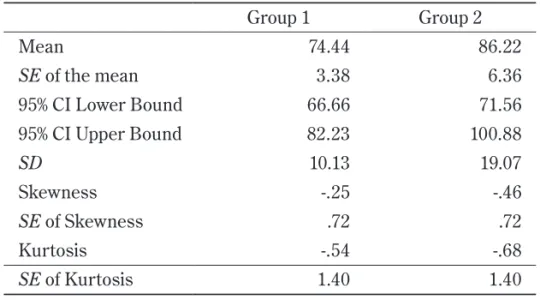
The descriptive statistics for the pre-test dependent variable reading speed (Table 1) indicate group sameness as evidenced by the significant overlap of confidence intervals of groups though Upper Bound CI for Group 2 is much higher than Group 1. As well, skewness and kurtosis values are within acceptable parameters but have high standard values of error. The same can be said for the dependent variable reading comprehension, which exhibits evidence of normality based on skewness, kurtosis, but not for their respective standard error values (Table 2).
Figure 2. Benchmark reading comprehension scores for Group 1 and Group 2 (N = 18).
Table 1 Descriptive Statistics for reading speed in words per minute (WPM)
Group 1 Group 2 Mean 74.44 86.22 SE of the mean 3.38 6.36 95% CI Lower Bound 66.66 71.56 95% CI Upper Bound 82.23 100.88 SD 10.13 19.07 Skewness -.25 -.46 SE of Skewness .72 .72 Kurtosis -.54 -.68 SE of Kurtosis 1.40 1.40 Note. N=18. Benchmark C om pr eh ens ion 1 2 3 4 0.08 0.07 0.06 0.05 0.04 0.03 0.02 0.10 0.00 Group 2 Group 1
A mixed repeated-measures analysis of variance (ANOVA) was conducted for reading speed and reading comprehension rates. Due to significant statistics yields for Levene’s test of the equality of error at Benchmark 1 and Benchmark 2 for reading speed, the assumption of a normal distribution of scores has been violated (Green & Salkind, 2008, p.187). A non-parametric test, the Mann-Whitney U test, was used to assess group differences (Green & Salkind, 2008, p. 377). Results of the Mann-Whitney U test to compare the medians of Group 1 (TR) and Group (RR) for reading speed and reading comprehension indicated no differences between groups: there was no difference between treatments TR and RR (See Appendix B). Thus, the null hypothesis for RQ1 & RQ2 is rejected: RR is not more efficacious than TR to increase reading speed or reading comprehension.
Group 1 and Group 2 were subsequently investigated separately through a series of paired-samples t tests to determine within-subjects significant differences for reading speed and reading comprehension.
Paired-sample t tests were conducted to evaluate whether reading speed increased
at Benchmark 1, Benchmark 2 and at the 2-week delayed posttest. The paired-samples t tests suggest that for Group 1 (TR) significant mean differences exist between each benchmark test except at the delayed posttest (Table 3). Specifically, there was a significant difference in the score at Benchmark 1 (M = 104.11, SD = 11.52), t(8) = -6.29, p = .05, and Benchmark 2 (M = 131.11, SD = 16.82), t(8) = -4.75, p = .05. However, the delayed posttest was not significant (M = 118.22, SD = 20.25), t(8) = 2.06, p =
Table 2 Descriptive Statistics for reading comprehension scores
Group 1 Group 2 Mean .56 .63 SE of the mean .06 .06 95% CI Lower Bound .42 .49 95% CI Upper Bound .69 .78 SD .18 .19 Skewness -.30 -.61 SE of Skewness .72 .72 Kurtosis -.61 -.19 SE of Kurtosis 1.40 1.40 Note. N=18.
.05 though the delayed posttest results p approached significance (.07). The results suggest that reading speed continued to increase at benchmark test points after seven and fourteen timed-reading passages as assessed by benchmark tests with no decline at the delayed posttest.
Paired-sample t tests were conducted to evaluate whether reading speed increased
at two benchmark test points and at a 2-week delayed posttest for Group 2 (RR). The paired-samples t tests suggest that for Group 2 (TR at Pretest to Benchmark 1; RR from Benchmark 1 to Benchmark 2) there are significant mean differences at each benchmark test though no differences were evidenced from Benchmark 2 to the Delayed Posttest. Specifically, there was a significant difference in the scores at Benchmark 1 (M = 106.00, SD = 26.01), t(8) = -3.84, p = .05, and Benchmark 2 (M = 130.44, SD = 38.17, t(8) = -2.60, p = .05, but not for the Delayed Posttest (M = 120.89, SD = 38.75), t(8) = 2.14, p = .05 (Table 4). The results suggest that reading speed continued to increase over fourteen reading passages (numbers one to seven as timed-reading; numbers eight to fourteen as repeated-timed-reading) as assessed by benchmark tests. As in the TR treatment, the null hypothesis is confirmed for RQ3, RQ4 and RQ5.
Table 3 Descriptive Statistics and t-test Results for Group 1 (TR) Reading Speed (WPM)
Table 4 Descriptive Statistics and t-test Results for Group 2 (TR at Pretest to Benchmark 1, RR from Benchmark 1 to Benchmark 2) Reading Speed (WPM)
Pretest Benchmark 1 Benchmark 2 DelayedPosttest 95% CI forMean
Difference Outcome M SD M SD M SD M SD n r t df Reading speed 74.44 10.13 104.11 11.52 131.11 16.82 118.22 20.25 9 29.67, 27.00, -12.89 .15, .32, .50 -6.29*, -4.75*, 2.06 8 * p < .05.
Pretest Benchmark 1 Benchmark 2 DelayedPosttest 95% CI forMean
Difference Outcome M SD M SD M SD M SD n r t df Reading speed/rate 86.22 19.07 106.00 26.01 130.44 38.17 120.89 38.75 9 19.78, 24.44, -9.55 .15, .32, .50 -3.84*, -2.60*, 2.14 8 * p < .05.
Paired-samples t tests were conducted to evaluate within-subject group differences at each benchmark of reading comprehension. The paired-samples t tests suggest that for Group 1 (TR) there are no significant mean differences between each benchmark test, or at the delayed posttest (Table 5). Specifically, there were no significant differences in the scores at Benchmark 1 (M = .56, SD = .18), t(8) = -2.14, p = .05, Benchmark 2 (M = .73, SD = .30), t(8) = 1.23, p = .05, or the Delayed Posttest (M = .55, SD = .75), t(8) = .01, p = .05. The results suggest that reading comprehension rates did not decrease with reading speed gains over fourteen timed-readings. Thus, the null hypothesis is confirmed for RQ6 for TR: reading comprehension rates did not decrease with reading speed gains.
Paired-samples t tests were conducted to evaluate within-subject group differences for reading comprehension at each benchmark. The paired-samples t tests suggest that for Group 2 (TR at Pretest to Benchmark 1; RR from Benchmark 1 to Benchmark 2) there are no significant mean differences between benchmark tests, or at the delayed posttest (Table 6). Specifically, there was no significant difference in the scores at Benchmark 1 (M = .63, SD = .19), t(8) = -.45, p = .05, and Benchmark 2 (M = .65, SD = .19), t(8) = .01, p = .05; and the Delayed Posttest was not significant (M = .52, SD = .21), t(8) = 1.56, p = .05. The results suggest that reading comprehension rates did not decrease with reading speed gains over fourteen readings (numbers one to seven as timed-reading; numbers eight to fourteen as repeated-timed-reading). Thus, the null hypothesis is confirmed for RQ6 for RR: reading comprehension rates did not decrease with reading speed gains.
Table 5 Descriptive Statistics and t-test Results for Group 1 (TR) Reading Comprehension Score
Pretest Benchmark 1 Benchmark 2 DelayedPosttest 95% CI forMean
Difference Outcome M SD M SD M SD M SD n r t df Reading Comprehen-sion .56 .18 .73 .21 .56 .30 .55 .27 9 .37, .65, .71 .21, -.41, -.32 -2.14, 1.23, .01 8 * p < .05.
Finally, to assess the relationship between reading speed and reading comprehension, Pearson Product-Moment correlations were conducted. In order to satisfy the assumption of a normal distribution of scores, Group 1 (TR) (Table 7), and Group 2 (RR) (Table 8) were investigated separately in terms of the two dependent variables under scrutiny. Correlation coefficients were computed for reading speed and reading comprehension at four benchmarks: Pre-test, Benchmark 1, Benchmark 2, and Delayed Posttest. According to the results, there were no significant correlations between reading speed and reading comprehension from a parallel benchmark-to-benchmark comparison (E.g. reading speed test to reading comprehension Pre-test). The results suggest that reading speed does not impact reading comprehension positively or negatively under either condition: TR or RR.
Table 7 Correlations among the Dependent Variables: Reading Speed & Comprehension for Group 1 (TR)
Table 6 Descriptive Statistics and t-test Results for Group 2 (TR at Pretest to Benchmark 1, RR from Benchmark 1 to Benchmark 2) Reading Comprehension Scores
Pretest Benchmark 1 Benchmark 2 DelayedPosttest 95% CI forMean
Difference Outcome M SD M SD M SD M SD n r t df Reading Comprehension .63 .19 .65 .19 .65 .23 .52 .21 9 .17, .43, .37 .83*, .07, .40 -.45, .01, 1.56 8 * p < .05. Correlation Coefficients Speed (WPM) Comprehension
Pre-test Benchmark 1 Benchmark 2 Delayed-posttest
Pre-test 0.18
Benchmark 1 0.18
Benchmark 2 0.43
Delayed-posttest 0.21
Discussion
RQ1: RR treatments will be more efficacious than timed-reading treatment as regards reading speed increases was rejected. This was confirmed by the Mann-Whitney U test, a non-parametric test indicating no group differences. The results of this pilot study both support and challenge previous research findings. For example, Taguchi, et. al. (2012), Chang (2012), Chang & Millet (2013) all found reading speed gains in various treatments for reading speed. The reading speed gains in this pilot study are in the proverbial ballpark relative to the aforementioned studies. However, as regards the efficacy between TR and RR, though this study applied silent repeated-timed-readings (as opposed to oral), there was no difference found between treatment types on the dependent variable.
Though the sample sizes for most of the L2 reading fluency research studies are small, some significant results have been obtained, which speaks to the potentiality of increasing reading speed in learners even at the beginner level (Grabe, 2009, p. 304). This fact, alongside Bandura’s SCT (Social Cognitive Theory) brings to bear an important, yet uninvestigated area of L2 research: namely the impact of mastery experience on student motivation via improving learners’ perceived self-efficacy. (Schwarzer, 2014, p. 4; Usher & Pajares, 2006, p. 126; Bandura, 1977). Given the need for short to immediate returns on developing perceived self-efficacy, and the associated benefits, incorporating a timed-reading program for just a few weeks, Table 8 Correlations among the Dependent Variables: Reading Speed & Comprehension
for Group 2 (RR)
Correlation Coefficients Speed (WPM)
Comprehension
Pre-test Benchmark 1 Benchmark 2 Delayed-posttest
Pre-test 0.29
Benchmark 1 0.25
Benchmark 2 -0.51
Delayed-posttest -0.21
regardless of class focus is possible, for example, conversation classes (Leroux, 2015, p. 42) can perhaps contribute to motivation, course satisfaction and achievement of learners in other tasks.
RQ2: RR treatments will be more efficacious than TR treatments as regards reading comprehension was rejected. Previous repeated-timed-reading researchers, Taguchi, Gorsuch and others, would incorporate multiple readings of the same text. As identified in the literature review, multiple readings of a text is for the purpose of reducing the cognitive load of decoding unknown words i.e. focusing on and improving word recognition and automaticity. Multiple viewings of the same vocabulary would satisfy this goal (Nation, 2001, p. 23). Perhaps, only two views are not adequate for repeated-reading to be efficacious. More research in this specific area is required. However, one point is abundantly clear, and that is L2 learners are not fully utilizing their cognitive abilities in terms of text comprehension. This was evidenced in the fact that reading speed increased without losses in comprehension.
RQ3: TR will increase participant reading speed over seven passages (Benchmark 1) was confirmed. Timed-readings were administered for the entire sample i.e. prior to alternative treatment introduction. Whether this gain was due to the treatment, task familiarity, or a combination thereof, is unclear. However, extracting valuable, salient information out of this metaphorical sausage is not a fruitless endeavor.
First, what is abundantly clear is that the participants in this study had little idea of reading for different purposes (Grabe, 2009, p. 8). Providing participants an awareness of various reading purposes and regular hands-on opportunities to practice and experience, in this case, gains in reading speed while maintaining comprehension resulted in altered reading practices, which is consistent with topic literature. (Grabe & Stoller, 2011, p. 5, Nuttall, 2005, p. 48) For example, early in the study while overtly observing explicit participant activities during reading, it was noted that many participants were marking their reading passages with slashes, or they underlined or circled certain text items. With a modicum of experience teaching reading (i.e. researcher awareness of slash reading for comprehension practices), the researcher engaged each participant individually to a) ask them why they were marking the reading passage, and b) to advise them to stop. Participants expressed that is how they had learned to read and understand text, thus, they applied it to an alternative situation with the apparent assumption that the technique was applicable for other reading circumstances. Eventually, all participants complied though some required repeated attention on that specific issue.
Next, another issue to consider, mentioned above, is that there was a noticeable increase in a second language skill and that it occurred in a very short period of time. With participants recording their own scores numerically and also emerging in graphic form, the growth is visual and often marked. Hence, experiencing noticeable, quantifiable gains or success can lead to a positive feedback cycle via beliefs in self-efficacy as postulated in Bandura’s SCT: self-regulation through increased persistence in task completion as well as in the focusing of cognitive processes (Schunk & Parajes, 2009: Zimmerman, 2000, p. 86; Bandura, 1986, p. 730; Bandura, 1977). Self-efficacy has broad-reaching impacts on academic achievement. Specifically regarding TOEIC scores, though it is difficult to correlate increased reading speed with increased scores on TOEIC listening and reading sections, adding positive perceptions of self-efficacy to the model will likely increase the amount of variance that can be accounted for.
RQ4: TR and RR will continue to increase participant reading speed between eight and fourteen passages (Benchmark 2). The null hypothesis was confirmed based on the results for both treatments. The growth patterns are linear and nearly identical from Benchmark 1 and Benchmark 2. As well, both groups exhibited similar declines in the delayed posttest though not statistically significant. Including the second intervention, it would appear that learners are able to continue to increase their reading speed for a least one full semester. Would they, under proper conditions, be able to continue their reading speed growth to L1 levels, or be able to expand their reading speed increases to longer texts? This is another research question worthy of investigation. What is clear is the need to select appropriate texts, have learners chart their progress, and also add some form of reflective practice into the model (Nation & Chang, 2006). What is more, ‘Immediate or concrete experiences are the basis for observations and reflections’ (Kolb, 2005, p. 194; Kolb, 1984). Further, in a study by Schnickel (2015), while incorporating reflective practice into classroom conversation activities through a process he termed ‘yo-yo’ found that “84% of students had the sense that yo-yo supported the development of their English language skills” (p. 27). Hence, regular reflection after concrete experiences adds another dimension to reading for speed programs.
RQ 5: Delayed posttest reading speed will not diminish over a 2-week period. The null hypothesis was confirmed by the results. However, it should be noted that significance levels were close. Given the small sample size, there might indeed be losses in reading speed without additional practice over a 2-week period. However, the study by Chang (2012) also reported no loss in speed and after a six-week delayed
posttest (and without additional instruction). There are, however, easily imagined confounding variables at play. In particular, the delayed posttest in this study occurred after the New Year holiday in Japan, which is the major holiday. Perhaps confounding the model further is that the delayed posttest was also the final class of the year; hence, learner motivation could conceivably be at an all-semester low. Thus, delayed posttests are problematic as per the above and may be better investigated in the subsequent semester.
RQ6: Parallel reading speed and comprehension rates will not have negative correlations. The null hypothesis was confirmed. Due to the small sample size, significance levels would have been difficult to realize (Grabe, 2009, p. 304), thus, caution must be exercised with respect to this research question. However, a visual inspection of the data would lead to believe that an increase in reading speed will not necessarily lead to a loss in reading comprehension (Figure 2) though there may be variability based on human factors such as motivation, general wellness or some sort of reading topic familiarity. There is also a major limitation of this research question: Form A and Form B reading comprehension questions were not tested for fit (infit and outfit) statistics (Bond & Fox, 2007; Tabachnick & Fidell, 2007). Thus, the comprehension questions themselves might require modification and/or outright deletion/replacement.
Conclusion
This confirmatory quantitative pilot study was the foundation for further and more involved research. What is more, the research on this topic is under-represented in the field of L2, while its relative importance in academic settings and high-stakes testing is clear. Further, the connections to other major areas of L2 research such as motivation and achievement have yet to be investigated in relation to implemented reading speed programs. In specific terms, the results of this study would suggest that either timed-reading or repeated-timed-reading treatments would yield similar outcomes: significant increases in learners’ abilities to read quickly, with purpose and with reasonable comprehension will be realized in an extremely short period of time. How these gains are applied: TOEIC, TOEFL or other benchmark tests, motivation, other academic achievement, extensive reading programs or to developing learner perceived self-efficacy is virtually unlimited. Additionally, being able to set learner expectation levels based on sound research will also add credibility to an instructor’s
practices, and add incentive to learners to use other strategies and skills that can lead to success in the L2 classroom in an EFL context.
Limitations
There are several limitations to this pilot study. First, the research design: groupings for treatments should be established from the beginning. Initially, the thought was to have all participants obtain a certain level of proficiency before introducing alternate treatments, but this in fact reduced the ability to measure treatment efficacy due to time constraints.
The VST should not have been used to assess participant vocabulary. Some form of vocabulary levels test would have provided a better assessment of student vocabulary levels as some tests of 30-item measures at each level, which would address issues of instrument precision, which was likely present in the data.
Another limitation was the extremely high number of study mortalities. In the mixed-level class that this study took place, 40% of the sample population was excluded. The reasons varied but included repeated absenteeism, or fraudulent participation whether in actual reading or recording of scores. Low-level participants seemed to be exhibiting avoidance strategies.
A confounding variable was introduced early in the study: a department-wide extensive reading program. Approaches to the extensive reading program were controlled for between teachers, but actual practices were not monitored by the researcher of this pilot study, nor were the reading practices of the participants. Thus, the extensive reading program and the degree to which each participant was involved should have been added to the model and controlled.
Finally, reading comprehension questions need to be checked for infit and outfit statistics with question modifications and/or deletions made. This would ultimately yield more valid reading comprehension results.
References
Baddeley, A. (1986). In M. Demagistiri, et. al., Incidence of Executive Functions on Reading Comprehension Performance in Adolescents. Electronic Journal of Research in Educational Psychology, 12(2), 343-370.
Baddeley, A. (2012). Working memory: theories, models, and controversies. Annual review of psychology, 63, 1-29.
Bandura, A., & And, O. (1996). Multifaceted Impact of Self-Efficacy Beliefs on Academic Functioning. Child Development, 67(3), 1206-22.
Bandura, A. (1977). Self-efficacy: Toward a unifying theory of behavior change. Psychological Review, 84, 191–215.
Bandura, A. (1989). Regulation of Cognitive Processes through Perceived Self-Efficacy. Developmental Psychology, 25(5), 729-35.
Bond, G & Fox, C. (2007). Applying the Rasch Model: Fundamental Measurement in the Human Sciences (2nd ed.). Mahwah, NJ: Lawrence Erlbaum Associates.
Brown, H.D. (2001). Teaching by Principles: An Interactive Approach to Language Pedagogy (2nd ed.). White Plains, NY: Pearson.
Carrell, P., & Grabe, W. (2002). In N. Schmidt (Eds.), An Introduction to Applied Linguistics (pp. 233-250). New York: Oxford University Press.
Chang, A. (2010). The Effect of a Timed-Reading Activity on EFL Learner: Speed, Comprehension, and Perceptions. Reading In A Foreign Language, 22(2), 284-303. Chang, A. (2012). Improving Reading Rate Activities for EFL Students: Timed Reading
and Repeated Oral Reading. Reading In A Foreign Language, 24(1), 56-83.
Chang, A. (2012). Improving Reading Rate and Comprehension through Timed Repeated Reading. Reading In A Foreign Language, 25(2), 126-148.
Chung, M., & Nation, P. (2006). The effect of a speed reading course. English Teaching, 61(4), 181-295.
Day, R., & Bamford, J. (1998). In J. Yamashita, Effects of Extensive Reading on Reading Attitudes in a Foreign Language. Reading In A Foreign Language, 25(2), 248-263.
Gorsuch, G. J., & Taguchi, E. (2008). Repeated reading for developing reading fluency and reading comprehension: The case of EFL learners in Vietnam. System, 36, 253–278.
Grabe, W. (2009). Reading in a second language: Moving from theory to practice. New York, NY: Cambridge University Press.
Grabe, W. & Stoller, F. (2011). Teaching and Researching Reading (2nd ed). Edinburgh
Gate, Harlow: Pearson Education.
Green, S & Salkind, N. (2008). Using SPSS for Windows and Macintosh: Analyzing and understanding data (5th ed.). Upper Saddle River, NJ: Pearson Prentice Hall.
Kolb, A. Y., & Kolb, D. A. (2005). Learning styles and learning spaces: Enhancing experiential learning in higher education. Academy of management learning & education, 4 (2), 193-212.
Kolb, D. A. (1984). Experiential learning: Experience as the source of learning and development (1). Englewood Cliffs, NJ: Prentice-Hall.
LaBerge, D. & Samuels, S. J. (1974). In E. Taguchi, et. al., Assisted repeated reading with an advanced-level Japanese EFL reader: A longitudinal diary study: Vol. 24, No. 1, (pp. 30–55). Reading in a Foreign Language, April 2012.
Leroux, T. (2014). A Case for Supplemental Vocabulary Component Development for Textbook-based English Classes. FLC Journal (9), 1-19.
Leroux, T. (2015). Treating the Classroom Like the Boardroom: An Authoritarian Approach. CLEIP Journal (1), 33-62.
Moors, A. & DeHouwer, J. (2006) In Kuhn, M., Schwanenflugel, P., & Meisinger, E. Aligning Theory and Assessment of Reading Fluency: Automaticity, Prosody, and Definitions of Fluency: Vol 45(2), (pp. 230-251). Reading Research Quarterly.
Nation, P. (2001). Learning vocabulary in another language. Cambridge, England: Cambridge University Press.
Nation, Paul. (2004) A study of the most frequent word families in the British National Corpus. In P. Bogaards and B. Laufer (eds.), Vocabulary in a Second Language: Selection, Acquisition and Testing Amsterdam: (pp. 3-13), John Benjamins.
Nation, P., & Beglar, D. (2007). A vocabulary size test. The Language Teacher 31(7), 9-13.
Nation, P. (2008). Teaching ESL/EFL reading and writing. New York: Routledge. Nation, P. (2012). The Vocabulary Size Test: Instructions and description.
National Reading Panel. (2000). Report of the subgroups: National reading panel. Washington, DC: National Institute of Child Health and Development.
Nuttall, C. (2005). Teaching Reading Skills: In a Foreign Language. Oxford: Macmillan Education.
Pintrich, P. R., & De Groot, E. V. (1990). Motivational and self-regulated learning components of classroom academic performance. Journal of educational psychology, 82(1), 33-40.
Quinn, E., Nation, P., Millet, S. (2007). Asian Pacific Speed Readings for ESL Learners: Twenty passages written at the one thousand word level. English Language Institute Occasional Publication, No.24.
Samuels, A. (2004). In E. Taguchi, et. al., Assisted repeated reading with an advanced-level Japanese EFL reader: A longitudinal diary study: 24(1), (pp. 30–55). Reading in a Foreign Language, 2012.
Samuels, A. (2006). In E. Taguchi, et. al., Assisted repeated reading with an advanced-level Japanese EFL reader: A longitudinal diary study: Vol. 24(1), (pp. 30–55). Reading in a Foreign Language, 2012.
Schnickel, J. (2015). Reflection and Peer Support in the Mixed-Level Classroom. Jissen Women's University Annual Reports, March, 2015.
Schwarzer, R. (2014). Self-efficacy: Thought control of action. Taylor & Francis.
Schunk, D. & Parajes, F. (2009). In K. Wentzel & A. Wigfield (eds). The Handbook of Motivation in School 1st ed. (pp. 35 – 54). New York: Routledge.
Taguchi, E., Takayasu-Maas, M., & Gorsuch, G. (2004). Developing reading fluency in EFL: How assisted repeated reading and extensive reading affect fluency development. Reading in a Foreign Language Volume 16(2), 70 – 96.
Reading New Passages: A Preliminary Investigation. Reading in a Foreign Language, 14(1), 43- 65.
Tabachnick, B. & Fidell, L. (2007). Using Multivariate Statistics (5th ed.). Boston:
Pearson Education.
Tran, T. (2012). The Effects of a Speed Reading Course and Speed Transfer to Other Types of Texts. RELC Journal 43(1), 23-37.
Trew, G. (2007a). A Teacher Guide for Teaching TOEIC Listening and Reading Test: Preparing Your Students for Success. Oxford: Oxford University Press.
Trew, G. (2007b). Tactics for TOEIC: Listening and Reading Test. Oxford: Oxford University Press.
Usher, E. L., & Pajares, F. (2006). Sources of academic and self-regulatory efficacy beliefs of entering middle school students. Contemporary Educational Psychology, 31(2), 125-141.
Zimmerman, B. (1995). Self-efficacy in educational development. In A. Bandura (ed.). Self-efficacy in Changing Societies (pp. 202 – 231). Cambridge: Cambridge University Press.
Zimmerman, B. (2000). Self-Efficacy: An Essential Motive to Learn. Contemporary Educational Psychology 25, 82–91.
Appendix A
Vocabulary Size Test scores are presented in Appendix Figure 1. The purpose of testing the results with the VST was to validate the use of the major instruments used for the ensuing pilot study measures: The Diamond Family from Basic Reading
Power 1st ed. and the modified Asian Pacific Speed Reading Programme readings.
Not surprisingly, the 1st - 1000 word scores (note the range from four – ten correct
responses) are positively skewed reflecting the participants’ knowledge of the most commonly used words in English according to the BNC. Given that the participants are generally beginner level L2 learners, it is also not surprising that scores on the 2nd – 1000 word level is negatively skewed (note the range of scores from one to six).
When combined, VST scores for the 1st & 2nd – 1000 word levels generally resemble
a bimodal distribution, which is a reasonable expectation given expected participant vocabulary levels, and the relatively small sample size of N = 18.
Descriptive statistics indicate a reasonably normal distribution of scores based on an examination of mean and standard deviation as well as the low respective standard errors of the means of the by group for Total VST scores (Appendix Table 1). There is also a considerable overlap of the confidence intervals, which typically indicate group sameness. Values of skewness, kurtosis and their respective standard error values, particularly for Group 1, raise concerns regarding normal distributions. Perfectly symmetrical distributions will present a value of 0. Liberal allowances for skewness ranges are from -2 to +2. (Green & Salkind, 2008, Tabachnik & Fidell, 2007, p. 79). There are several reasons for skewness values exceeding acceptable allowances for normal distribution with a major reason being the interaction of extreme outliers on
Figure 1. 1st – 1000, 2nd – 1000 and Total VST Scores for N = 18.
5 4 3 2 1 4 5 6 7 8 9 10 0 Frequency VST1 6 4 2 1 3 4 5 6 0 6 4 2 0 Frequency Frequency VST2 VTotal 2 7.50 10.00 12.50 15.00
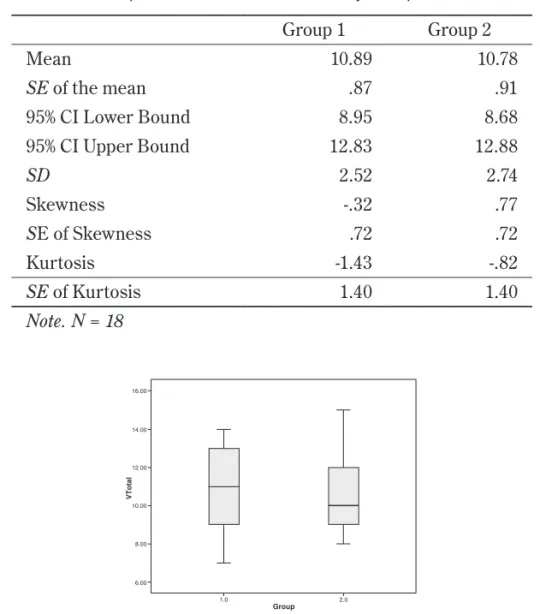
small sample sizes. The data was checked for outliers though none were apparent. Another reason for data presenting large error sizes (and large confidence intervals) could be the instrument precision or reliability and/or sample size. Whatever the case, a parametric test: independent samples t test was conducted after Levene’s test of equality of variances was not significant. The t test was not significant t(16) = .09, p = .90 for VST scores for Group 1 (M = 10.89, SD = 2.52) and Group 2 (M = 10.78, SD = 2.73). The 95% confidence interval indicates significant overlap suggesting high similarity of score distributions between groupings (Appendix Figure 2). The eta square index indicated that only 2% of the variance was accounted for by whether a participant was assigned to Group 1 or Group 2.
Figure 2. Boxplot of Total VST scores for means and confidence intervals for Group 1 and Group 2. Group 1 Group 2 Mean 10.89 10.78 SE of the mean .87 .91 95% CI Lower Bound 8.95 8.68 95% CI Upper Bound 12.83 12.88 SD 2.52 2.74 Skewness -.32 .77 SE of Skewness .72 .72 Kurtosis -1.43 -.82 SE of Kurtosis 1.40 1.40 Note. N = 18
Table 1 Descriptive Statistics for Total VST by Group
6.00 8.00 10.00 16.00 14.00 12.00 VTotal Group 1.0 2.0
Appendix B
Non-parametric median comparison output from SPSS 23 for reading speed and comprehension between treatments TR & RR using the Mann-Whitney U test.