South East Asian Studies,Vol. 15, No.1, June1977
Education, Developlllent and Change in Malaysia*
Martin RUDNER**
The creation of a modern, national, integrated institution of education in Malaysia was a post-colonial undertaking. The conception of education in British Malaya had been narrowly confining, both socially and scholastically. Indeed, through to the end of the colonial period, education was segregated into separate and disjointed linguistic-ethnic streams: English, Malay, Chinese and Tamil, with impoverishment of resources their common lot.l ) Following the Second World War there had occurred a dramatic rise in enrolments, to be sure; however ongoing organizational discontinuities and constraints resulted in a downward trend in enrol-ment ratios during the last years of colonial rule.2
) The advent of representative government in 1955, and independence in 1957, marked a point of departure for the modernisation of educational institutions and policies. Over the period of independence, education has been systematically assimilated, by stages, with government's emerging goals of national develop-ment.
The study of the performance of education systems presents certain methodological diffi-culties. Itis often convenient to portray educational trends by devising input-output tabu-lations for particular denominators, or variables, e.g. enrolments, expenditures, etc. However, a degree of caution must be exercised in their interpretation, lest logical fallacies intrude through the application of 'closed' systems analysis to essentially 'open' institutions like edu-cation. Education cannot be logically isolated from the context of society, from external normative and social influences.3) The following discussion will, therefore, treat the
develop-ment of the Malaysian education institution as a system, in relationship with the multiplexity of attitudinal, historical and cultural factors affecting the country's economic, political and social life.
* The author expresses his appreciation to the Harry S. Truman Research Institute at the Hebrew University of Jerusalem for its support for research in Malaysia and Singapore; and to the Institute of Southeast Studies, Singapore, for a visiting fellowship and the privilege of using its facilities.
** Department of Economics, Research School of Pacific Studies, The Australian National University. 1) On colonial education policy and practice in British Malaya, see Charles Hirschman, 'Educational
Patterns in Colonial Malaya', ComparatizJe Education Review (1972); Philip Loh Fook Sen, Seeds of Separatism: Educational Policy in Alalaya 1874-1940 (Oxford, 1976); Rex Stevenson, Cultivators and Administrators: British Educational Policy Towards the ~falays,1875-1906(Oxford, 1976).
2) Malaya's overall enrolment rate was given as 63 per cent in1951(Member for Education, Federation of Malaya Legislative Council Proceedings,19Sept1951),declining to about 58per cent of the eligible age group by 1959: International Bank for Reconstruction and Development, Economic Development of Malaya (Singapore, 1954), pp.142-77. See Part3, below.
3) Viz. Gunnar Myrdall, Asian Drama (London, 1968), pp. 1533-6 and appendix 3,section 2.
I The Evolution of a National Education Institution
Among the priority issues tackled by the inter-communal Alliance Party government following its victory by an overwhelming majority in the country's first general election (1955), was the reform of education policy. Shortly after assuming office, the government appointed a special parliamentary committee under the then Minister of Education, Dato (later Tun) Abdul Razak, to consider the reconstitution of Malaya's fragmented colonial educational system along more integrated, national lines. The Razak Committee's charge aimed at:
" ... establishing a national system of education acceptable to the people of the Feder-ation as a whole which will satisfy their needs and promote their cultural, social, economic and political development as a nation, having regard to the intention of making Malay the national language of the country whilst preserving and sustaining the growth of the language and culture of other communities ..."4)
The criterion of acceptability enabled the Razak Committee to combine diverse ethnic and modernising values into a formula for education institution-building. The ensuing legis-lation of 1957 set the process in motion. The new policy crystallised in an education institu-tion linguistically plural in form, integrally nainstitu-tional in content, Malay in its symbolism and developmental in its purpose. Given the enthusiasm of independence, it appeared as if the Alliance formula had indeed succeeded in sublimating the primordial racial controversies of the recent colonial past.5)
But not for long. The Alliance leadership presumed, with a simplistic utilitarian faith that was to become characteristic of their political style, that the benefits of dynamic growth would serve to overcome latent dissensions in society. Hence, the very rapid expansion of primary school enrolments seemed to demonstrate widespread acceptance of the linguistic and cultural elements of the 1957 reforms among the main ethnic blocs, Malay, Chinese and Indian (Tamil). However, the extent of the consensus achieved did not preclude further dispute over the attendant social, economic, and political functions of the new education policy, as it un-folded. During the 1960s, education was to become, in effect, a policy surrogate for issues of high strategy concerning the direction of national development. For Malaysia, the emergent education system acquired a special significance as an instrument for, and expression of, po-litically determined goals.
The initial thrust of the 1957 policy reforms focussed on the primary level of education, and particularly on the historically sensitive matters of language and curriculum. In reshap-ing the heterogeneity of the past, primary schoolreshap-ing was reconstituted into an educationally integrated whole having linguistically separate parts: so-called 'Standard schools' in which
4) Report of the Education Committee (Kuala Lumpur,1956), p. 1.
5) On Malaysian education since independence, see, e.g. Francis Wong and Ee Viang Hong, Education in .Malaysia(Hong Kong, 1971); R. O. Tilman, 'Education and Political Development in Malaysia', Yale University Southeast Asian Studies, Reprint Series No. 27; and Higher Education and Development in Southeast Asia (LA.U.;U.N.E.S.C.O., Paris, 1969).
M.RUDNER: Education, Development and Change in Malaysia
the main language of instruction was Malay, and 'Standard-type' schools in which it was English, Chinese (Kuo-Yii) or Tamil. All Standard-type schools provided compulsory in-struction in Malay, the constitutionally-ordained National Language; similarly, English was a compulsory subject in all schools.6 ) Thus the Razak policy distinguished between linguistic usage and language status, admitting pluralism in the media of primary instruction while conferring educational primacy onto English as the international language, and Malay as the National Language. Moreover, all Standard and Standard-type schools were to use a common curriculum and syllabus. Indeed, the notion of common educational content was the pivot around which the Razak policy turned. The uniformity of educational content com-prised the institutional cement that bound linguistic pluralism to national norms of educational enculturation.
Standardisation of the primary school curriculum was significant not just for encultura-tion, but also with respect to patterns of socialisation in education. Historically, each of the language streams had its own instructional orientation and, through this, its particular social bias. The English medium followed the grammar school type; Chinese schooling was direct-ed at recreating the literati of the classical tradition of China; Malay direct-education was perceivdirect-ed early on in terms of a fossilised, agrarian, peasantry; while the Tamil school was geared to its constituency of an immigrant plantation and urban lumpenproletariat. Just as the English and Chinese schooling reflected their respective literary traditions in educational socialisation, the Malay and Tamil curricula connoted education for social stabilisation, at best, or economic impoverishment, at worst. Following the Second World War some initial but not very defi-nite steps were taken to modernise the vernacular schools' curricula. This process was carried to fruition by the 1957 policy reform. In line with the new policy, the grammar school out-look of English-medium education was now extended to all Standard and Standard-type schools. Public education conceived as plural in form and national in content, became also literary-academic in orientation.
Secondary education received a somewhat more ambivalent treatment under the 1957 policy. The Razak Committee, for its part, had called for the institution of a new, assimilated 'National-type' secondary school network having English as its medium of instruction. The purpose was to bring about the desired linguistic-cultural synthesis at higher rungs of inde-pendent Malaya's education system. Serving all communities, this assimilated secondary level would blend Anglophone manner with communal accommodation, after the style of the contemporary Alliance ruling elite. In order to encourage existing Chinese and English secondary schools to conform to the new model, the government for the first time offered full financial support for National-type secondary education. At the same time, privately-6) Furthermore, provision was made for the teaching of Chinese and/or Tamil (Malay already being
com-pulsory) in English-medium Standard-type schools at the request of 15 or more pupils in any grade.
maintained schools were permitted to continue operating and even qualified for partial grants-in-aid. By pursuing a dual policy of supporting both continuity and change in secondary schooling, conflict was avoided or postponed, though at the price of failure to give momentum to the new directions in post-primary institution-building.
Paradoxically, the successful implementation of the Razak Committee recommendations at the primary school level shifted the focal point of public controversy onto the more am-biguous secondary education policy. As numbers of pupils passing through the Standard and Chinese and Tamil-medium Standard-type schools increased during the late 1950s, the English language basis of National-type secondary education posed an increasingly frustrating bar to their advancement.7) Although the issue appeared still to be linguistic, language in fact represented an education policy mechanism regulating pupil progression and, ultimately, access to social status and roles. Bitterness over education language obstacles to social mo-bility was sharply manifest in the relative success of the more cummunal-oriented Malay and non-Malay opposition parties in the 1959 general elections. The returned, but shaken, Alliance government felt impelled to take stock of its education policies, for which a review committee was set up under the new Minister of Education, Abdul Rahman Talib.
Whereas the initial Razak Committee formulations comprised, in essence, a formula for inter-communal accommodation, the policy review undertook an exercise in social and cultural engineering. Responding to perceived challenges from their communal flanks, the Alliance leadership came to treat post-primary education instrumentally as an antidote to the incu-bation of counter-elites. The Rahman Talib Committee accordingly confirmed the post-1957 pattern of primary schooling, and set about harnessing secondary-level education to the im-perative of elite formation in the Alliance image. However, since the Alliance had not yet formulated any coherent social doctrine of its own, the policy review fell back on ethno-lin-guistic differentiation, as between Malays and non-Malays, as the basis of post-primary edu-cational reform.
The reversion to a dualistic approach to secondary education underscored the divergent enculturation and socialisation goals pertaining to Malays and non-Malays. Malays were to be satisfied of the status of the National Language in education, and assured of their vernacu-lar avenue to upward mobility. Their post-primary education could continue in Malay. As regards non-Malays, it was deemed necessary to extend English-language National-type edu-cation as a means of inculcating Chinese and Indians with attitudes and values considered suitable. For, English education was regarded as making non-Malays acceptable for co-option to the elite, in the oligarchic tradition of Anglo-Malay colonial condominium, per-petuated, in a cultural sense, in the Anglophone Chinese-Malay independence partnership. The separate acculaturalization and socialization patterns introduced into secondary education 7) With effect from 1958, special Malay language classes were attached to otherwise English-medium
M.RUDNER: Education, Development and Change in Malaysia
bore the seeds of future conflict among the second-generation elites of the different communi-ties. Later in the 1960s, government reacted by shifting back to a unitary post-primary model, though the future basis of institutional assimilation would be the National Language exclusively (albeit gradually).
In the meantime, the conclusions of the policy review were given formal legislative sanc-tion in the 1961 Educasanc-tion Act. Henceforward, all publicly-financed secondary schooling had to be conducted in two official languages only, either Malay or English, though Chinese and/or Tamil could still be taught only as subjects. Malay secondary education was free, while government-aided English secondaries had to levy tuition fees. English and Malay also became the joint languages of public examination both for entry to, and graduation from, secondary education. To facilitate the linguistic transition on the part of pupils from Chinese and Tamil Standard-type primaries, a special one-year Remove Class was instituted prior to secondary level. Otherwise, those Chinese middle schools that had hitherto qualified for partial grants-in-aid were now obliged to transform themselves into English or Malay-medium National secondaries, or else remain unassisted, private enterprises. The reaction of Sino-phone Chinese to the 1961 enactment was predictably bitter, and many middle schools refused to comply until financial pressures compelled most to conform to the new policy standard. In doing so, all chose conversion to National-type, as a matter of course. While the Malay medium achieved formal parity for purposes of secondary education, it was not without irony that the new policy thus served the expansion of English-language secondary education, which even tended to attract pupils from the Malay stream.
At this stage there was no suggestion that the grammar school tradition of Malayan edu-cation be altered. As during colonial times, the quality of secondary schooling was still strongly identified with literary-style academic education. Popularisation and functional differentiation of a post-primary education were characteristically impugned and dismissed for allegedly devaluing scholastic standards. Itwas in this light that the policy review fixed an arbitrary ceiling on the pass rate from primary to secondary level at 30 per cent, based on past colonial practice. This then became the criterion for educational planning in the Second Five-Year Plan (1961-65).8) For the overflow, quasi-vocational educational alternatives were set up, in distinct subordination to the grammar-style mainstream, and limited in scope and intent.9) The prevailing obsession with grammar school education not only circumscribed the development of post-primary institutions, but, even more significantly, also restricted the capacity to cope with functional specialisation. Offcialdom preferred to blame public preju-dice for the unpopularity of technical and vocational schooling, though responsibility can be
8) Second Five- Year Plan 1961-1965, (Kuala Lumpur,1961), para 157.
9) At the time there were only two technical secondary schools, and two junior trade schools in the entire Federation. Under the 1961 policy so-called 'secondary continuation' and 'rural trade' schools were established as dead-end quasi-vocational alternatives. They never gained popularity and were abolished only four years later when more substantial post-primary reforms were introduced.
traced directly to the grammar school cult fostered and supported by the education authori-ties themselves.
The third stage of education institution-building evolved out of economic considerations, which induced a further reform of secondary-level education towards a greater consonance with development strategy and planning. The expansion and extension of the old grammari-an format led, by the middle 1960s, to grammari-an education policy gap between large grammari-and growing numbers of primary schoolleavers, and emerging as semi-educated unemployed, concurrent with a shortage of middle and higher calibre professional, technical and vocational skills. Educational shortcomings had become a limiting factor in economic development. Concern over the country's lagging economic performance prompted the Alliance government, follow-ing the 1964 general election, to inject manpower plannfollow-ing considerations into the education policy component of the First Malaysia Plan, 1966-70. In the event, this manpower planning concept denoted the primacy of development goals even over entrenched educational values, and paved the way for far reaching changes in the internal organisation and orientation of secondary education.
The reforms introduced with effect from 1965 divided secondary schooling into two stages, separated by selection and differing in curriculum. At the lower secondary stage, admission was non-selective, open, and the three-year programme offered a so-called 'comprehensive' curriculum combining academic, technical and crafts subjects. Post-primary selection was thus deferred, and the dead-end 'secondary continuation' and 'rural trade' categories abolish-ed. Upper secondary schooling still remained selective, but was now separated educationally and organisationally into parallel academic, technical, vocational and teacher training streams. Agricultural subjects were incorporated in the 'comprehensive' curriculum and, after 1969, agricultural science was offered as an Upper Secondary (both academic and vocational) al-ternative. A pre-university 'Sixth Form' was similary divided into arts, science and technical streams. This institutional realignment of Malaysian education connoted a new policy conception in moving towards the rationalisation of levels and types of post-primary schooling in relation to the manpower requirements of the economy.
Although the immediate introduction of open-admission, comprehensive education re-sulted in an acknowledged fall in standards, especially in the academically-weaker Malay-medium stream, this was now accepted, in the manner of 'positive thinking', as the unavoid-able short-run cost of social adaptation for eventual economic development.
The tertiary level of education was to experience at this stage a similar process of in-stitutional reform and innovation. The country's first institution of higher learning, the University of Malaya (founded in Singapore, 1949, Kuala Lumpur Division, 1957; separation and autonomy, 1961), was conceived as an English academy for the scholastic elite, which defined its social composition and educational purpose. Pressures of events (the combination of language politics, educational reforms and social trends during the 1960s) brought about the
M. RUDNER: Education, Development and Change in Malaysia
official adoption of English-Malay bilingualism at the University of Malaya by mid-decade, followed by the establishment of the Malay-language Universiti Kebangsaan Malaysia (N ational University of Malaysia) in 1970. Along with the termination of the English social and linguistic monopoly came a broadening of the scope and structure of higher education. Within the conventional universities of the English model, the sciences and technocratic pro-fessions were given increasing prominence, a trend reflected in the new foundation set up in Penang in 1969, subsequently renamed Universiti Sains Malaysia (Malaysian University of Science). Moreover, the early 1970s also witnessed the establishment of new types of func-tionally-specialised tertiary institutions geared to high-level manpower requirements of par-ticular communities in their quest for economic development. These included the university-status Universiti Teknologi Malaysia (Malaysian Technological University) and Universiti Pertanian (University of Agriculture) operating in Malay; and the MARA Institute of Tech-nology and U ngku Omar Polytechnic offering professional and sub-professional courses in technical and administrative subjects, in Malay and English, respectively. Additionally for non-Malays, English-medium pre-university and sub-professional studies were also available at the Tunku Abdul Rahman College. Malaysian education still retained a scholastic bias, to be sure, evidenced in the schools' preoccupation with preparing candidates for university, rather than intermediate employment opportunities. Yet, the emergence of an academically and functionally differentiated tertiary structure underlined the policy trend towards aligning education institution-building more closely with manpower planning for economic develop-ment.
The next stage of educational reform witnessed a revival of the language question, this time as part of the political search for symbols of national identity. As the constitutionally-prescribed ten-year term for reviewing its National Language provisions approached in 1967, the communal controversy over future language rights surfaced with renewed passion and extended, by implication, to education as well. Language politics revolved around the in-creasingly forceful efforts of the newly emergent, modern, Malay-educated elite, with certain factional backing from the United Malays National Organisation (UMNO), senior partner of the Alliance. Together, these ultra-nationalist components of Malay political life en-deavored to consolidate the National Language status of Malay and therefore ensure its social rewards. An artful Alliance compromise had the National Language Act, 1967, proclaim Malay the "sole official language" whilst reserving the use of other language for education and certain other public purposes. The long-standing inter-communal modus vivendi was pre-served more or less intact, but the ultra-nationalist core of Malay demands remianed unsatis-fied. Malay ultra-nationalism now turned against the rival and non-domiciled English-language education stream. Partly to mollify the fervor among Malays, and partly as a ges-ture towards the National Language objective of the Act, the Education Ministry decreed the juxtaposition of Malay language teaching upon four minor subjects in the first three grades of
English-medium primary schools, with effect from 1968. Whereas the Malayanisation of the English stream had originally been thought of as a quiet and gradual process, the pace of change was ultimately to be dictated by political events.
The challenge to Malay political primacy apparent in the 1969 general election results and culminating in racial violence,lO) propelled Malay nationalism towards a more strenuous reassertion of the Malay norms of statehood. As a result, the conversion of English schools to the Malay language was accelerated and progressed on the basis of a detailed timetable, subject by subject, year by year, scheduled for completion by 1983. Thereafter English would no longer have the status of a main stream language of public instruction. This would leave Malay as the only educational language ranging over the primary, secondary and tertiary levels. Standard-type schools in the Chinese or Tamil media were as yet unaffected by the conversion timetable. However, they would in any case be reduced to the status of peripheral, virtually terminal primary school languages when Malay became the exclusive medium of post-primary education.
That the target oflinguistic Malayanisation was English-language schooling-rather than Chinese or Tamil-pointed to the current political anxieties of the UMNO leadership, the dominant element in Malaysia's ruling Alliance. Earlier Malay suspicions about non-Malay loyalty gradually abated, a tribute to the efficacy of the Razak education policy. They were replaced by a new sense of political rivalry over national status questions. The cataclysmic events of 1969 indicated to Malays that the newly emergent, nationally-educated, non-Malay elite had yet to be induced to accept the established political equation for allocating power. Thus, the conversion of the English stream was calculated to foster shared educational ex-periences in elite formation, while ensuring that this enculturation process was steeped in Malay linguistic and national symbols. The extension of Malay political norms through the education system to non-Malays conveyed a double sense of belonging: that non-Malays belong to Malaysia, while Malaysia belongs to the Malays.
I t is noteworthy that these developments pertained mainly to the territories of peninsular Malaysia, the former Malaya, and only to a lesser degree to the Eastern Malaysian States of Sabah and Sarawak. By constitutional agreement the administration of education in Sabah and Sarawak has remained under State jurisdiction (though federally financed). Policies therefore have differed somewhat from those pursued by the Federal government in peninsu-lar Malaysia. Lately, however, there has been a marked trend towards conformity with the national system.
The building of a national education system in Malaysia had to treat with the funda-mental problems of language, culture, social change, economics, and politics, which con-fronted society. Yet, educational institution-building did not reflect haphazard or ad hoc 10) On the Revival of communalist antagonisms in the 1969 elections, see Martin Rudner, 'The Malaysian
M. RUDNER: Education, Development and Change in Malaysia
arrangements. At each stage it constituted the outcome of considered policy. These policy solutions were designed to cope with the complexity of social issues involving education, in accordance with the multiple goals of government. Outside the administration, an active public interest exercised its influence as both a stimulus and constraint on policy, and it is significant that the stages of education institution-building were broadly coterminous with general elections. Education policy evolved from an object to an integral subject, or instru-ment, of national policy-making, producing radical changes in educational organisation and orientations in the process.
II
The 'Supply' of Education
Expenditures on education govern the quantum of educational resources placed at the disposal of society at any given time. Historically, education in British Malaya was subject to complex financial treatment, with private and state and central sources participating in its provision each according to its own lights. The shift from considerable private to predomi-nantly public finance of education was matched by the increased predominance of the central authorities, even more than the constitution obligated. Adapting public finance to assume the cost of education institution-building involved the redefinition of certain conventional economic attitudes, budgetary principles, allocative priorities and administrative goals.
Changes in official attitudes and assumptions regarding the economic utility of education heralded the changes in actual policies concerning the public finance of education. In British Malaya education was commonly viewed as a postitive thing, for its humanistic value as well as for its role in elite formation. Yet, this same attitude disclosed certain negative assump-tions about the economics of education. Colonial officialdom tended to see education as a purely social service, something good and desirable but offering few direct economic re-turns.11) Education finance was therefore treated as a consumption item in public accounts, which implicitly depleted the financial resources available for investment in economic growth. It was symptomatic of the character of colonial rule that those groups allowed to partici-pate in colonial administration generally shared this attitude towards education, especially the influential British business interests who regularly insisted that "non-productive" social spending be "cut according to the cloth" of residual finance. They were allied to a traditional Malay elite on the defensive against rural social change. Even those who pressed for the expansion of educational finance, mainly professionals, trade unionists and rural Malay spokesmen, did so on the basis of social service and social welfare criteria rather than in broad-er development tbroad-erms, by implication validating the conventional assumptions. One notable exception was the newly ascendant UMNO leadership of Tunku Abdul Rahman, who from 11) Vide. The Colonial Empire, 1939-1947, London: HMSO, 1947, Cmd. 7167, p. 107; see also Martin Rudner, 'The Draft Development Plan of the Federation of Malaya, 1950-1955',Journal oj Southeast Asian Studies (1973), and Gayl D. Ness, Bureaucracy and Rural Development in Malaysia (Berkeley, 1967) esp. Pl'. 100--2.
the unofficial side of the colonial Legislative Council very early advocated mass education as a lever for Malay economic, social and political advancement. 12) Nevertheless, for the domi-nant colonial power elite there remained the dichotomy between education as a social service, however worthy its social or cultural objectives, and the hard economics of public finance.
The transition to elected government did not result in a frontal assault on inherited eco-nomic doctrine. Rather, the new Alliance government's inclination towards identifying edu-cation instrumentally with its emergent national goals served, in effect, to infiltrate an altered conception of education into public finance. With the introduction of the 1957 national school policy, public expenditure on education now came to be redefined as "investment" in the country's political "future" .13) Still, conventional economic philosophy had not yet conceiv-ed of conceiv-education as being functionally relatconceiv-ed to economic, as distinct from social or political, development objectives. This was to come later, after it became increasingly apparent during the early 1960s that inadequate human resources constituted a limiting factor for economic planning. The Government's development imperative thereupon absorbed education policy and turned it towards economic ends:
" ... the traditional system of education is (now) being reoriented to achieve not only the objectives of nation-building and universal literacy, but also the economic goals of the country."14)
This marked a revision of the policy conception of education, from a mere social (or political) service to a manpower approach centering on human capital formation for economic de-velopment .15)
The re-evaluation of educational finance, from budgetary liability to economic resource, signified a cognitive change in the precepts of public accounting, as well. Public financial perspectives shifted over from narrow revenue accounting to broader national and later social accounting. 16) While it may be tempting to explain this movement on the basis of improved government financial capabilities over time, actually the essence of the change was more in fiscal priorities. Thus, during the late colonial period restrictions were applied to expendi-tures on education at the same time as substantial reserve balances were being accumulated in London. By contrast, the development plans of the 1960s called for greatly expanded public expenditures on education, even at the expense of running down reserves, and borrowing.
It has not been so much government's ability to afford education, as its willingness, prompted by decisions in the political sphere and articulated through changes in attitudes, that determin-ed the provision of determin-educational finance.
The First Five-Year Plan, introduced in 1956 by the newly-elected Alliance government, 12) Legislative Council Proceedings, 20 September, 1951.
13) Minister of Education, Legislative Council Proceedings, 11 December 1958. 14) First Malaysia Plan, 1966-70 (Kuala Lumpur, 1966), para 491.
15) Ibid., paras. 37, 42-3, 180.
M.RUDNER: Education, Development and Change in Malaysia
provided for a considerable expansion of public spending on the capital projects of government
departments and authorities over the quinquennium.!7) Highest plan priority was assigned
to projects related to the export and nascent industrial sectors, while implementation of the
new national school policy received second priority. Yet, Education Ministry proposals for
some M$128 m. capital investment were nevertheless pruned by the Treasury's Economic Secretariat, under the direction of expatriate colonial financial officials, to less than half that
amount. But even that constituted a three-fold increase, in real terms, over public capital
expenditure on education during the previous five-year period. Subsequent plans were to
greatly increase the magnitude and scope of public investment, while successive changes
in the priorities and machinery of planning influenced education's share.lS )
The much enlarged sums involved in the Second Five-Year Plan, 1961-65, were similarly devoted mainly to the development of the state apparatus, especially those parts dealing with
'economic' or 'productive' undertakings. The education target was addressed to the objects
of the then-current policy review. Educational objectives were expressed rather simplistically
in terms of crude enrolment and demographic relationships. Overall planning perspectives
remained fundamentally unaltered, although this Second Five-Year Plan hint at social
ac-counting contained the germ of a new ingredient for education planning. The next plan,
termed the First Malaysia Plan, 1966-70, emphasised the mobilisation of investable resources for accelerated economic growth, and in so doing treated education as a factor for human
capital formation. Later, social and economic criteria for education planning were brought
together and refined in the Second Malaysia Plan of 1971-75, with reference to its radical goal of "restructuring" society along more "balanced" lines of economic attainment between
Malays and non-Malays. The Third Malaysia Plan 1976-80, aimed at a strategy of
conquer-ing poverty, on strata rather than purely racial lines.!9) Objectives of employment, social
mobility and economic nationalism thus rendered education into an integral component of planning for development of the economy.
This evolving planning role for education had a zigzag effect on the ratio of educational
investment under the plans. Capital appropriations for education increased absolutely over
the successive quinquennia, to be sure. The relative proportion of total public investment
devoted to education grew in the earlier departmentalised Five-Year Plans, from eight per
cent of the First to 12 per cent of the Second. There followed a decline, paradoxically, under
the macro-economic Malaysia Plans (Peninsular Malaysia figures in brackets) to 11.6 (10.3)
17) This Plan, so-called, was never actually published, but its particulars were made known in the Report on Economic Planning in the Federation olMalaya in 1956, Legislative Council Paper 14 of 1956. For a study of this plan and its place in Malaysian economic history, see Martin Rudner,Nationalism, Plan-nz'ng and Economic llIodcrnization in Malaysia, (Beverly Hills, Calif., 1975).
18) For an historical survey of planning in Malaya, see David Lim, 'Malaysia', in Vip Vat Hoang, ed" Development Planning in Southeast Asia: Role of the University (Singapore, 1973), and Martin Rudner, iVationalism) Planning and Economic j1/j'odernisatz"on in Mala.-ysia.
19) Third J,.falaysia Plan 1976-1980 (Kuala Lumpur, 1976), Prime Minister's Foreward, 'lJ-'llii.
per cent in the First, and again to 7.4 (6.3) per cent in the Second, rising with the priority of social development to 9.4 per cent of the mid-term revision of the Second Malaysia Plan and stabilising at 9.1 (8.4) per cent of the Third.20 ) The closer integration of education into macro-economic planning was more than merely a gesture in the direction of popular social services. Indeed, the more integrated approach to educational planning led also to increased public investment 'downstream' from the education system, in employment-related industrial developments.
In the event, developmental priorities were allocated somewhat differently by actual
pat-terns of public finance, compared to the original plans. Malaysian planning experience dis-closes regular and significant divergence in the sectoral distribution of public investment between original plans and their implementation. On the whole, economic and administ-ration/security planning targets were achieved, and usually overfulfilled, while social sector objectives remained chronically underfulfilled.
Ecucation shared the social sector shortfall, though the degree of plan underfulfillment depended on the place of education in the current development strategy as well as government motives and commitment. The First Five-Year Plan achieved only 62 per cent of its edu-cation expenditure target, slightly less than the social sector average, displaying the discon-tinuities between education planning and public finance. Subsequently, development strate-gy become more consistent in the Second Five-Year Plan, so that its education target was 91 per cent fulfilled, a level unprecedented for social development. Afterward, the shift in em-phasis from fiscal outlays to structural reforms in the First Malaysia Plan saw the rate of plan fulfillment drop to 70 per cent, far inferior to the 77 per cent social sector average (all-Malaysia figures; rates for Peninsular Malaysia were 77.9 and 80.8 per cent, respectively). Education plan fulfillment rose again under the renewed urgency of the Second Malaysia Plan to 88 per cent of the revised mid-term target, compared to 94 per cent for the social services and 95 per cent for public investment overall.21 )
The ratio of (public) investment in education to total public investment under the plans experienced a similarly chequered trend. Between the First and Second Five-Year Plans the ratio increased from six to nine per cent as the policy focus shifted from the primary to the secondary level, and commitments entered high gear over the Rahman Talib policy review. The ratio reduced to 7.7 (Peninsular Malaysia: 7.9) per cent of the First Malaysia Plan, but climbed again to 8.7 (9.5) per cent in response to the ethnic re-structuring goals of the revised Second Malaysia Plan.
Objective difficulties exacerbated the effects of policy and ~dministrativeambivalence. Arguably, a good part of the persistent shortfall in public investment in education represented 20) Ifnon-defence-related expenditure only be considered, the Peninsular share for education rose from 6.3 per cent of the First Five-Year Plan to 12.6 per cent of the Second, falling to 11.5 per cent of the First Malaysia Plan and further to 7.6 per cent of the Second, and rising to 10.3 per cent of the Third. 21) Third Malaysia Plan table 22-9.
~
Table 1 Malaysian Development Plan Targets1956-75 (M$ million)
--===:::--===,.,;,=
First FYP Second FYP First Malaysia Plan Second Malaysia Plan Third
Malaysia Plan ~
Est. Est. Penin- I · :;0
Plan Actual Plan Actual Plan* Plan Actual Plan* Actual* Plan Revised c:
Actual* Actual sular Ma aysla tl
z (1) (2) (3) (4) (5) (6) (7) (8) (9) (10) (11) (12) (13) (14) (15) ttl ::tI Total ttl0.. public 1148. 7 1007.0 2150.0 2651. 7 3153.6 3610.2 4556.9 4242.9 5868. 21 8075. 8 7250.0 10255. 4 9920 15445. 7 18554. 9 cn investment
e
o·
.? Economic 780.4 760.2 1477.9 1763.7 2228.7 2210.8 2710.2 2685.4 3898. 76 5771. 9 4870.9 7349. 7 7127 10475. 5 12665. 1 t::J Sector Cb<Cb 0" "0 :3 Cb Social Sector 277.9 138.9 491. 0 413.6 797.4 644.7 975.3 752.1 836.02 1132.6 1067.4 1431. 0 1449 2511. 3 3092.1 g Il:> ::l 0.. (J - of which 95.4 60.9 260.0 236.0 368.0 286.9 470.8 329.4 370.11 765.6 337 963.8 866.6 1296.9 1691. 3 ::rIl:> Education ::l aq Cb 5· General ~Admin. and 90.4 108.0 181. 1 474.4 687.5 754.7 865.4 804.9 1133.34 1171. 3 1311. 7 1474.7 1344 2458.8 2797.6 e:.
Security '<rnIl:>
- - - Pi·
* Peninsular Malaysia-Malaya, only.
Source: Report on Economic Planning in the Federation of Malaya in1956; First Malaysia Plan; Second It:falaysia Plan; Treasury Report, 1975-76; Third Malaysia Plan.
scarcities of suitable resources, pedagogical and other, especially at the more specialised secondary and technical levels and in East Malaysia. The accelerated expansion of education in recent years telescoped the normal gestation period for resource creation, inevitably causing bottlenecks for further expansion and refinement.22) These scarcities retarded educational
investment even when funds were available, though mis-allocations of actual investment (eg the lags in teacher training) compounded the inadequacy of the educational resources base over the long run.
The allocation of public investment whitin the education system, among the different levels and types of schooling, spelled out the goals and perspectives attached to government's 'supply' of education. A detailed breakdown of expenditures for the earlier period of plan-ning is not available. However it may be inferred that the First Five-Year Plan invested com-paratively heavily in the expansion of primary education in order to realize the policy ob-jectives propounded by the Razak Committee. This was eased under the Second Five-Year Plan, by which time the policy review had re-directed the emphasis towards National-type secondary education. Subsequently, the integral manpower approach adopted in the First Malaysia Plan brought about a further re-allocation of internal investment priorities in education (Table 2). Post-primary education now absorbed over three-quarters of actual public investment in education over the 1966-70 quinquennium, with the bulk going to the secondary (51.9 per cent) and university (12.6 per cent) levels. Even so, the secondary school investment target remained underfulfilled almost by half, while for the much vaunted techni-cal type (secondary) schools the investment short fall amounted to nearly 65 per cent. Teach-er training suffTeach-ered an even more sevTeach-ere investment lag, ironically in view of the pronounced shortage of qualified teaching staff for the schools. By comparison the universities did
rela-Table 2 Internal Distribution of Development Expenditure by Level of Education, Penninsular Malaysia, 1966-1975
(M$ million) First Malaysia Plan Second Malaysia Plan
Plan Est. Per cent Revised Est. Per cent
Actual Fulfillment Plan Actual Fulfillment
(1) (2) (3) (4) (5) (6)
Primary school level 54.6 48.5 88.8 87.4 80.2 91. 8
Secondary school level 188. 7 100.7 53.4 133. 2 138.0 103.6
Technical school level 30.8 10.8 35. 1 34.0 25.7 75.6
University level 30.0 24.4 81. 3 235.4 198.5 84.3
Teacher training 28.5 9.7 34.0 9.0 3.6 40.0
Higher Technical level 7.7 6.6 85.7
Notes: Figures do not total the aggregate given in Table 1, due to the omission of training and other programmes financed under the 'Education and Training' item in the plan.
Sources: Second Malaysia Plan; Third Malaysia Plan.
M.RUDNER: Education, Development and Change in Malaysia
tively well in Malaysia, as elsewhere, having attained over 80 per cent fulfillment by way of attracting a disproportionate-in terms of enrolments, at least-share of realised public invest-ment. This distribution of education investment continued in the Second Malaysia Plan; despite the nominal overfulfillment of the secondary school target, its actual allocation of real investment resources, discounted for inflation, had scarcely been augmented over the quin-quennium. The actual distribution of education investment superimposed, in effect, its own pattern of institution building onto the original policy scheme.
The ensuing balance of investment in education represented an effective demotion of the priority of secondary schooling, and teacher training most of all, in favour of enhanced tertiary level development. Although the disparity between plan and realisation for secondary school-ing was corrected in the Second Malaysia Plan, the distributive balance remained much the same. Development emphasis on the elitist tertiary level discriminated against populist pro-gression in secondary schooling, and (because of laggard investment in teacher training) tended to sacrifice the calibre of primary education. Yet, this operational re-definition of investment priorities seems to have occured haphazardly, without regard for rationality in the development of educational resources. Such deviations from planned institutional priorities consequently lowered the efficiency of investment in educational development.
Internal rates of return attributable to the various levels and types of schooling provide a convenient indicator of the net marginal revenue product of education investment, together with attendant current outlays.23) In his pioneering study of the returns to Malaysian edu-cation, made half-way through the First Malaysia Plan period,
a.E.
Hoerr24 ) concluded that for Peninsular Malaysia (e.g. Malaya), at least, educational investment yields a comparatively high average revenue product, socially as well as privately (Table 3). Internal net social rates of return to all levels of education were judged favourably, compared to the officially-determined public opportunity cost ofcapital~set at 10 per cent.25 ) In particular, secondary-23) The internal Rate of Return to education is that discount Rate that equates the discounted flow of edu-cation costs to the discounted flow of income benefits, and is the equivalent of the net marginal revenue product of education capital; 'vide. T. Schultz, 'Capital Formation by Education,' Journal of Political Economy (1960) and G. Becker, Human Capital (New York, 1960). On the limitations of education investment analysis, and Rate of Return models generally, see Stephen Merrett, 'The Rate of Return to Education: A Critique', Oxford Economic Papers(1966), pp. 289-303.24) O. E. Hoerr, 'Education, Income and Equity in Malaysia,' Reprinted inReadings on lVfalaysian Econo-mic Development. ed. David Lim(1975). This remains the only study of the returns to education capital in Malaysia, to date. The distinction between social and private rates of return reflect the usual differ-ences in the education costs actually incurred by the state and private beneficiary, on the one hand, and discontinuities in the flow of benefits from education in 'insulated' labour markets like Malaysia, on the other. Ozay Mehmet, 'Manpower Planning and Labour Markets in Developing Countries: A Case Study of West Malaysia',Journal of Development Studies (1972), pp. 277-289.
25) This is the rate used by the Economic Planning Unit of Malaysia for weighing social preferences in public investment. Another rate for comparison would be the interest rate earned on overseas reserve balances accumulated owing to the long-standing Treasury 'Reserves Syndrome'. In 1969, yields on long-term US and UK government bonds, an indicator of the Returns to Malaysian Official Overseas Reserves, rang-ed from 7.48 to 8.82 per cent; Bank Negara Malaysia, Annual Report and Statement of Accounts, 1970 (1971), pp. 7-8.
Table 3 Internal Rates of Return to Education in Peninsular Malaysia,1967-8
Cumulative Marginal Cumulative
-_.._ _. ~ . ~ _ . _ . " " . _ . _ _ .
-Social Benefit/Cost
Net Gross Net Net Gross Net Ratio at10% Discount
Social Private Private Social Private Private Rate
(1) (2) (3) (4) (5) (6) (7) Primary level 8.2 29.5 12.9 8.2 29.5 12.9 0.82 Lower Secondary 11. 9 45.5 17.0 15.6 61. 5 21.1 1.06 Upper Secondary 13.6 52.0 17.6 15.3 65.0 18.9 1.28 'Sixth Form' 13. 2 52.8 17.1 12.8 55.3 15.6 1.31 University 9.5 49.7 16.0 5.8 37.2 14.4 0.92 (domestic)
Source: Hoerr, Education, Income and Equity in Malaysia.
level schooling demonstrated higher social and private returns than the primary or even uni-versity levels, well above the opportunity cost of capital. This was so despite a relatively high unemployment rate among non-specialised, lower-secondary schoolleavers.26) In these circumtances, the high net returns to secondary education testified to the significant economic potential for siutably equipped middle-echelon manpower. Laggard investment in secondary education, and the application of strict selectivity rules above the comprehensive lower secondary level, would therefore seem to imply considerable opportunity costs in terms of incremental educational returns forgone.
Applying cumulative social benefit/cost ratios to the various levels of education, at a 10 per cent social time preference rate, it appears that public expenditure on post-primary edu-cation was generally profitable. Although primary schooling produced social returns slightly below the opportunity cost of capital, these costs have come to be regarded more as indivisible investment in the substructure of educational capital formation, particularly after the intro-duction of open-access, comprehensive lower-secondary education. While the university ratio was, on average, marginally inferior to that of the secondary level, this may understate the contribution of the very remunerative professional and technical faculties~as well as the research and consultancy functions of universities. On the whole, the comparatively advan-tageous social returns to education were exceeded by the respective private rates of return, which again proved especially favourable for secondary-level education. In his factoring of income flows, Hoerr has estimated that education may account for some 60 per cent of un-adjusted money incomes in Peninsular Malaysia, though this reduces upon adjustment for unemployment and labour-force participation rates in inverse relationship with levels of edu-cational attainment.27)
Education institution-building was also marked by a greatly increased ratio of (public) education expenditures to national income. The portion of GNP devoted to public education, 26) Ibid., p. 91; Second Malaysia Plan, pp. 99-100.
M.RUDNER: Education, Development and Change in Malaysia
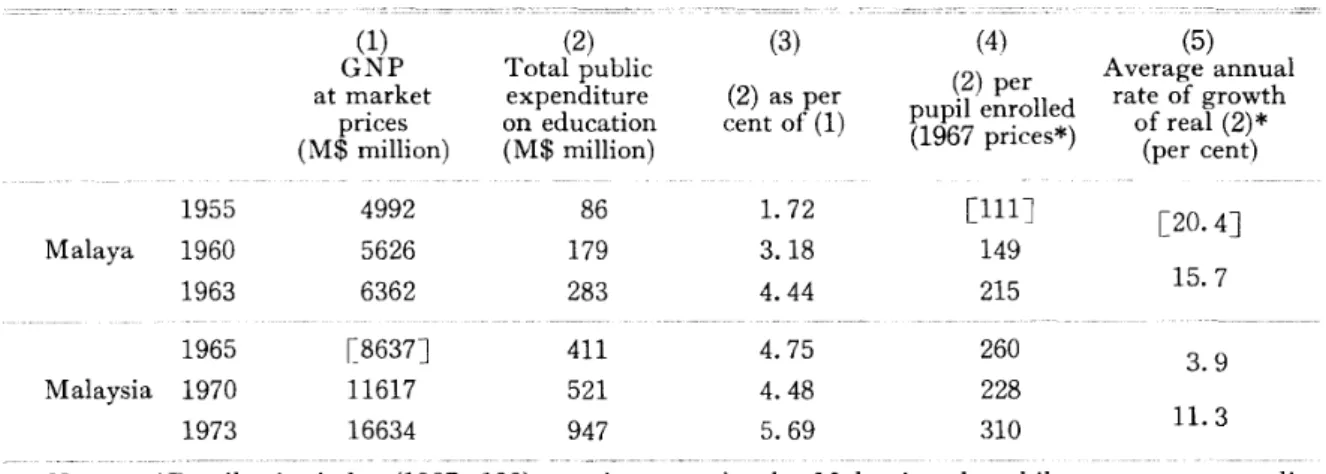
indicated by total public sector expenditure (development and current) on formal schooling at all levels, grew from less than two per cent at the end of the colonial period to over three per cent by the end of the First Five-Year Plan, to some 4-3/4 per cent at the end of the Second Five-Year Plan, even considering adjustments for the formation of Malaysia. After a slight decline under the First Malaysia Plan, the ratio reached well beyond five per cent of Malaysian GNP mid-way through the Second.28 ) Pupil numbers had grown by a factor of three, yet the level of public expenditure on education per pupil enrolled rose almost three-fold, in real terms, between 1955 and 1973 (Table 4).
Rates of expenditure reflected the intensity of government goal commitment for each stage of education institution-building or reform. For independent Malaya/Malaysia, the most rapid rate of increase of educational expenditures occurred during the First and Second Five Year Plan and Second Malaysia Plan periods. These plan quinquennia constituted particular stages of policy which emphasised the primacy of educational goals pertaining to the social and political systems. Developments in education were instrumentally related to certain compelling political objectives at each stage, which induced higher public financial priorities for the purpose. The rate of increase of public expenditure on education was low-est, in real terms less than the gorwth of enrolments, under the First Malaysia Plan. There is some irony in that that period coincided with the primacy of educational goals relating to economic objectives, but with little or no political urgency attached. Official attitudes and policy had integrated education into economic development strategy at the time, without, however, ensuring the warranted capital and current commitments. In Malaysian practice, the realisation of financial commitments derived more from political motivations than from
Table 4 Public Educational Capital Formation 1955-73
(1) (2) (3) (4) (5)
GNP Total public
(2) per Average annual at market expenditure (2) as per
pupil enrolled rate of growth prices on education cent of (1)
(1967 prices*) of real (2)*
(M$ million) (M$ million) (per cent)
1955 4992 86 1. 72 [111J [20.4J Malaya 1960 5626 179 3. 18 149 1963 6362 283 4.44 215 15.7 1965 [8637J 411 4.75 260 3.9 Malaysia 1970 11617 521 4.48 228 1973 16634 947 5.69 310 11. 3
Note: *Retail price index (1967 : 190) pertains to peninsular Malaysia only, while aggregate expendi-tures apply to all Malaysia.
Source: Economic Reports, 1973-74,1974-75; First Malaysia Plan; Second Malaysia Plan, adapted. 28) The so-called 'Karachi Plan' for education in Asia, to which Malaysia subscribed, envisaged the
expendi-ture of four to five per cent of GNP on formal education only by 1980; UNESCO and ECAFE, Final Report, Meetz'ng of Alinisters of Education of Asian Member States Participating in the K aracht' Plan, Tokyo, 2-11 April, 1962, (Bangkok, 1962). The 'Karachi Plan' was adopted in 1959.
economic purpose,jerse. Economic ends may have provided a rationale for resource mobili-sation on behalf of education, however actual commitments depended on the political im-peratives that effectively governed educational 'supply' in relation to determined policy goals.
III
The 'Demand' for Education
Enrolments reveal the effective social demand for education at each level for each type of schooling. School enrolments in Malaysia are voluntary i.e. not legally compulsory, and fee-paying at post-primary levels, for the non-Malay population. Historically, only Malays were accorded free education, extended in the 1960s through to the secondary and tertiary levels. Primary schooling for non-Malays was made free in 1962 in 'Standard-type' institutions, as a sweetener for the controversial secondary school reforms, though the colonial custom obliging government-aided secondaries to provide a margin of 10 per cent free places for the (non-Malay) poor has been retained. 'Free' education, in the Malaysian usage, has meant free tuition only; and while conceding that children of poor families (Malay as well as non-Malay) have had difficulty meeting the attendant costs of schooling, government has pleaded financial stringencies for not making 'free' education wholly free. Neither has government seen fit to make primary education compulsory. Instead, its policy has been to 'assure' school place for all qualified children up to (from the 1970s) age 15. This facile substitution of assurances for compulsory attendance relieved government of the burden of providing for genuinely uni-versal primary education, while shifting the onus of enrolment over onto society-at-Iarge. Nevertheless, the provision of places and extension of free and aided schooling produced a notable institutional change as the once strong private school sector declined to relative un-importance while incremental enrolment concentrated in public education.29)
The total school population of British Malaya prior to the Second World War was to the order of 263,000 enrolled.30) Enrolments subsequently increased sharply in post-war years,
reaching over three-quarters of a million in Malaya alone by the middle 1950s (plus an ad-ditional158,000 in Singapore). This accelerated growth of enrolments denoted a far-reaching change in public attitudes towards education.31 ) To be sure, the surge in enrolments resulted in part from pent-up demand from the war years and difficult aftermath. Of greater long-run significance, however, was the wider recognition accorded the value of education, which, coupl-29) At the primary level in 1974, private schools, mainly Chinese, comprised one per cent of all schools and enrolled a half per cent of all pupils. At the secondary level private schools, mainly English, comprised 18 per cent of all schools (excluding, however, technical and vocational schools) and enrolled just over seven per cent of all pupils: Education in Malaysia) 1974, annex 2. Note that figures supplied for Malaysian education refer to enrolments, rather than attendance. Since there is usually a gap between enrolment and actual attendance, especially in poor and rural areas, this reduces the usefulness of official statistics for measuring real educational attainments. However, the enrolment figures do provide, at least, an indicator of trends in social participation in education.
30) Figures in this paragraph are from the IBRD, The Economic Developments of Malaya.
M. RUDNER: Education, Development and Change in Malaysia
ed with rising incomes, translated into an increasing public appetite for formal, secular school-ling. Expanded private demand for education was reinforced by its growing social utility, in as much as the post-war expansion of government service and economic developments gener-ally produced broader employment opportunities for educated manpower. Unfortunately, the inadequate provision for education in colonial public finance restricted the capacity of existing educational facilities to cope with both the demand backlog as well as current demand from the rapidly increasing school-age population. Consequently, the ratio of primary-level enrolments out of the eligible age group actually declined during the first half of the 1950s, to approximately 58 per cent in 1954,32) notwithstanding the expansion of numbers.
Self-government led to institutional reforms and policy goals that gave rise to a dramatic upsurge in primary school intake. In order to maximize the effects of the Razak Committee prescriptions, the Alliance government declared its intention to accommodate all children of age 7
+
who so desire in Standard or Standard-type primary schools by 1960. This output target explicity acknowledged a likely fall in scholastic quality ("it is better to offer a slightly lower standard of education temporarily than no education at all"). 33) Government even accepted the possibility of deficit financing in order to bring this about, a radical departure from the fiscal norms of the past.Responding to government's commitment, Malayan primary school enrolments reached the one-million mark already in 1958, two years ahead of target. A good part of this sudden increase in fact consisted of over-age pupils whose schooling had been forcibly deferr-ed. And yet there was no slack in enrolments as this backlog was made up. Demand for primary education now shifted in favour of more widespread and longer schooling on the part of the appropriate age groups. This was no doubt inspired by the favourable private rates of return current for primary and post-primary education, stimulated still further by policy innovations including the introduction of free primary schooling (for non-Malays) in 1962. Primary enrolments continued their rise, though the average annual rate of increase slowed down from 7.5 per cent during the 1955-60 era to around 3 per cent, equivalent to the rate of population growth, thereafter. The effect of this was to very nearly double the total primary school population of peninsular Malaysia between 1955 znd 1973, to over 1-1/2 million enroll-ed.
Primary enrolments in the East Malaysian States of Sabah and Sarawak, where education was administratively separate from the Federal centre, displayed an even more rapid growth rate arising out of their comparatively lower startingpoir~t. Nevertheless, apart from a rapid short-term increase immediately following the formation of Malaysia, the longer run growth trend of primary enrolment in Sabah and Sarawak for the decade 1964-74 scarcely bettered that for the earlier period of British rule, 1955-64 (Table 5).
32) IBRD, The Econom£c Development of Malaya, pp. 142ff.
33) Minister of Education, Federat£on of Malaya Leg£slatz've Coundl Proceed£ngs 15, Nov. 1956.
Table 5 Primary-Level Enrolments,1955-1973
Peninsular Malaysia Sabah and Sarawak
1955 1958 1960 1964 1968 1973 Enrolment ('000) 776 1, 007 1, 125 1, 197 1, 371 1, 531 Index (1955=100) 100 129 145 154 177 197 Enrolment Ratiol (per cent) 58 na 86 90 91 91 Enrolment ('000) 92 120 142 161 250 2522 Index (1955= 100) 100 130 154 175 272 317 1 Enrolment Ratio: enrolment as proportion of eligible age group for primary-level education.
2 1974
na: not available
Sources: Educat£onal Stat£st£cs of Malays£a 1937 to 1967; Educat£onal Stat£st£cs of Malays£a 1969; Education in Malays£a 1974; Progress of Education in the Asian Region; a Stat£stical Revz'ew. More significant than mere numerical growth has been the real and very substantial im-provement in the ratio of primary school enrolments to their eligible age groups in Peninsular Malaysia (no data is available on enrolment ratios for the East Malaysian States). This ratio stood at about 58 per cent in 1955, at the end of the colonial era in Malayan education. Increased enrolments accompanying the first stage of policy reform elevated this ratio to 86 per cent five years later. Since a large but uncertain portion of the primary school popu-lation then consisted of over-age backlog, the effective ratio for the properly eligible age group was somewhat less than this aggregate figure appears to indicate. Once this backlog was overcome, around the middle 1960s, the distortion disappeared. Growing demand for prima-ry education among the currently eligible age group brought the effective ratio to 90 per cent in 1964, stabilising at just over 91 per cent by the late 1960s, early 19705. Primary education had become mass public education, though still not quite universal education.
Stabilization of the enrolment ratio at 90-91 per cent implied, conversely, that about 9 per cent of the eligible age group remained consistently outside the scope of formal primary education. These presumably comprised the socially remote and economically most dis-advantaged segments of the population. Foredoomed by their lack of even elementary school-ing, at a time of rising educational levels in the community generally, this hard core of cational impoverishment represented the long-run social cost of the falure to utilize compulsory means of attaining universal primary education.
Along with higher enrolment ratios, a marked improvement has been recorded in the education of females, particularly in Peninsular Malaysia. Female enrolments persistently lagged during the colonial period, despite the efforts of educators. Only 44 per cent of Ma-laya's eligible female age group was enrolled in primary school, in 1953, compared to over 78 per cent of the male group, with females constituting only 37 per cent of total primary-level
M. RUDNER: Education, Development and Change in Malaysia
enrolments as late as 1955.34 ) Under-enrolment of females gave way before the expansion of popular demand for education accompanying the policy changes after independence. The ratio of female enrolment grew to 89 per cent of the eligible female age group by the late 1960s, so that slightly less than 49 per cent of total primary-level enrolments consisted of girls.35 )
That proportion remained virtually constant into the 1970s, for Peninsular Malaysia. Else-where there was a greater imbalance in East Malaysia, though there the female proportion had grown from 40 per cent in 1963 to 45 per cent of primary enrolment a decade later.36)
Higher female enrolment rates contributed, paradoxically, to the lowering of private and social returns to education especially at the primary level, where females were concentrated. This was because the female population, constituting now about half of primary enrolments, generally experienced lower rates of absorption into the labour force. And, among those absorbed, females, whatever their educational attainments, invariably suffered wage or salary discrimination. Nonetheless, the spread of education among the female population suggests the likelihood of increasing female participation and at higher-levels in the labour force in future. Moreover, the recent expansion of female enrolments contains the prospect of inter-generation transmission of the values being inculcated, with long-run effects on cultural atti-tudes and social behaviour.
The demand for education also revealed itself in vastly improved retention ratios for suc-cessive cohorts of primary schoolers. Prolongation of primary education signified a real gain in sustained, effective enrolment. Previously, not only were the aggregate enrolment rates low, but pupil 'wastage' was also inordinately heavy. Retention ratios for colonial Malayan primary schools as late as the 1950-55 period averaged a mere 32 per cent .37)
Be-tween 1957 and 1962, the accelerated demand for primary education also took the form of greater continuity of schooling, boosting the retention ratio to over 80 per cent. Then, with the introduction of free non-Malay primary schooling, the 1962 cohort experienced the reten-tion of some 84 per cent of its initial enrolment. (It is noteworthy that retention ratios for females were still lower than for males, 78 as compared to 88 per cent). The improvement, though impressive, was still incomplete, so that it served ironically to accentuate the relative deprivation of the disadvantaged. Educational 'wastage' on the current scale has tended to exacerbate the already existent social gap in the universality of primary education, particularly since the enrolments of those retained in the school system has become all the more 'effective' educationally.38)
34) Federatz'on of Malaya Annual Report, 1953, p. 173; Progress of Educatz'on z'n the Asian Regz'on, pp. 90-91, Table A8.
35) Educatz'onal Statz'stz'cs of Malaysia 1938 to 1967 (Kuala Lumpur, 1968), Tables 4-11. 36) Educatz'on z'n Malaysz'a, 1974, annexes 1, 3, 9.
37) Figures in this paragraph are from UNESCO, Regional Office for Education in Asia, Long Term Pro-jectz'ons for Education in Malaysz'a (Bangkok, 1962), p. 13; and Progress in Educatz'on in the Asz'an
Regz'on, p. 111, table A15. These retention ratios apply to peninsular Malaysia only.
38) On Retention Ratios and the effectiveness of primary enrolment, see 'The Problem of Educational Wastage' in Bulletz'n of the UNESCO Regional Office for Education z'n Asz'a, Vol. 1 (1967).
The growth of primary-level enrolments disclosed variations in the demand for educa-tion in and among the four linguistic streams over the successive policy stages. Such vari-ations denoted changes in 'taste', or social preferences, for educational languages, tempered by the accent of government policy. The demand for English language education grew most rapidly during the last decade of colonial rule, though relatively high rates of growth of enrol-ment also occurred in the Malay and, to a lesser extent, Chinsee streams (Table 6), despite adverse circumstances. The education language reform of 1957 inspired increased rates of enrolment for the Chinese, Tamil and, to a lesser degree, Malay streams, even if incremental demand still favoured English by a wide margin. However, Chinese medium primary school-ing subsequently declined, absolutely as well as relatively, followschool-ing the adoption of the nation-al (Rahman Tnation-alib) secondary education policy. Most of the shift in enrolments went to the English stream. This preference for English education was ultimately reversed by the de-cision to gradually convert the English stream to the National Language.39 ) From the late 1960s English enrolments therefore fell off suddenly and drastically. A small part of the demand shift reverted to the Chinese stream, which now terminated at the primary level. However, the main gains in enrolment were recorded by the Malay stream, which exclusively offered assured post-primary continuity of language. Malay stream enrolments thus acceler-ated during the second half of the 1960s and first half of the 1970s at nearly three times the rate for primary education as a whole.
Differential growth rates for the various streams, as policies unfolded, yielded a changing linguistic balance at the primary education level. After the first decade of reform, the lin-guistic balance showed a significant movement away from Chinese and towards English language education. Compared to 1956 (figures in brackets), by 1966 the Malay and Tamil medium schools continued to attract a virtually constant 45 and 6 per cent, respectively, of total primary enrolments, whereas the English rose to 21.5 per cent (15.6 per cent) at the ex-pense of a Chinese decline to 27.5 per cent (33.6 per cent). Eight years later, the evolution of educational language policy had engineered a dramatically altered linguistic distribution of
Table 6 Primary Enrolment Trends by Language Stream, Peninsular Malaysia Malay Stream English Stream Chinese Stream Tamil Stream All Streams
Year No. Index No. Index No. Index No. Index No. Index
1947 170,693 100 57,013 100 190,349 100 35.386 100 453, 441 100 1956 392,012 229 135,875 238 291,224 153 48, 212 136 867, 323 191 1961 503,041 295 218, 100 382 378,031 198 64,355 182 1,163,527 256 1966 575,991 337 275,848 484 352,517 185 76,691 217 1,281,047 282 1974 942,479 552 61,846 108 470,472 247 79,814 225 1,554,611 343
Source: Educational Statistics of }I-:lalaysia1938-1967; Education in Malaysia, 1974
39) The conversion of English primaries to the Malay medium, began in earnest in 1969 and was to be com-pleted by 1975; the secondary level by 1980; sixth form by 1982.
M.RUDNER: Education, Development and Change in Malaysia
enrolment. Over 60 per cent of the primary population were now enrolled in Malay medium schools, 30 per cent in Chinese schools, 5 per cent in Tamil schools, leaving a residual 4 per cent in English schools pending completion of their conversion to National Language Stand-ard. The displacement of English schooling by policy means led to a slight revival of Chinese-medium education, but more importantly to the emergence of Malay for the first time as the language of instruction for the majority of enrolments and on an increasingly multi-racial basis. This trend towards the decommunalisation of Malay-medium education, as its share of primary level enrolment began to exceed the Malay proportion of the school population (Table7),implied new meaning for the term, 'National Language.'
Expanded primary enrolments, coupled to generally rising educational aspirations, exerted increasing demand pressure on access to post-primary levels of education. Transition ratios, indicating the actual proportions continuing through to higher levels of schooling, have remained relatively inflexible, however. Institutional and policy-inspired rigidities, largely eliminated at the primary level, remained to restrict the demand-responsiveness of post-primary education. These rigidities were not happenstance, but can be traced to the atti-tudinal legacy of colonial post-primary education policy. British Malayan secondary edu-cation had been modelled on the archetype English grammar school, and was intended as preparation for higher administrative and professional roles. Strict selectivity was applied, and operated according to officially prescribed optimal (actually, maximal) transition ratios, in pursuit of elitist standards.40) As a result, secondary-level enrolment ratios were kept com-paratively low, at about 11 per cent of the eligible age group at the end of the colonial period. Restricted orientation plus selectivity combined to ensure a strong upper class bias in these transition and post-primary enrolment ratios.
Table 7 Peninsular Malaysia: Enrolments by Race and Level of Education,1970-75
1970 1975
Malay Chinese Indian Others Total Malay Chinese Indian Others Total Primary 759,064 511,729 142,147 8,529 1,421,469 875,975 550,064151,7449,126 1,586,909 % 53.4 36.0 10.0 0.6 100.0 55.2 34.7 9.6 0.5 100.0 Lower 193,054 146,872 36, 339 2, 270 378,535 305,700 198,493 54,290 2,988 561,471 secondary % 51. 0 38.8 9.6 0.6 100.0 54.4 35.4 9.7 0.5 100.0 Upper 43,627 38,800 6,258 715 89,400 101, 486 54,095 10,420 1,108 167, 109 secondary % 48.8 43.4 7.0 0.8 100.0 60.7 32.4 6.2 0.7 100.0 Post 4,609 5, 267 637 106 10,619 8,817 6,617 804 97 16,335 secondary % 43.4 49.6 6.0 1.0 100.0 54.0 40.5 4.9 0.6 100.0
Source: Third 111alaysia Plan.
40) The IBRD Report, Economic De1!elopment of Malaya, p. 465, cites colonial Education Ministry sources for setting the education constituency for grammar-type secondary education at a maximum of 20 per cent of the eligible age group. The optimal transition ratio was accordingly fixed at 30 per cent.