九州大学学術情報リポジトリ
Kyushu University Institutional Repository
GENERATING MAPPING CLASS GROUPS OF SURFACES BY TORSION ELEMENTS
吉原, 和也
http://hdl.handle.net/2324/2236045
出版情報:九州大学, 2018, 博士(数理学), 課程博士 バージョン:
権利関係:
GENERATING MAPPING CLASS GROUPS OF SURFACES BY TORSION ELEMENTS
指導教員 : 佐伯修教授 吉原和也
2019 年 2 ⽉ 18 ⽇
概要
古典的な群論において、与えられた群に対して、⽣成系、あるいは有限位数 の元のみからなる⽣成系を具体的に与える問題がある。写像類群に関しても古 くからこの問題についての結果がある。
この論⽂では、有向曲⾯と⾮有向曲⾯の写像類群について、有限位数の元の みからなる⽣成集合を考える。
有向曲⾯の場合、Lanier (2018)は、𝑘 ≥ 6、種数が
𝑘 − 1
&+ 1以上の時につ
いて、写像類群が位数𝑘の元3つで⽣成されることを⽰している。また、彼は𝑘 ≥ 8または𝑘 = 6の時に、⾮負整数𝑎, 𝑏について種数が𝑎𝑘 + 𝑏(𝑘 − 1) > 0に等し
い時に位数𝑘の元3つ、種数が𝑎𝑘 + 1 𝑎 ≥ 1 に等しい時に位数𝑘の元4つで写像 類群が⽣成されることを⽰した。本論⽂の最初の主結果は、位数6の元のみか らなる写像類群の⽣成系を新しく構成し、彼の結果を𝑘 = 6に限定した時に種 数が7,8,9,13,14,19である場合について改善したことである。⾮有向曲⾯の場合、Szepietowski (2004)が involutions(位数 2 の元)のみから なる点付き写像類群の⽣成系を構成したが、彼の⽣成系の個数は種数と点の個 数に依存する。involutions のみからなる⽣成系で⽣成元の個数が種数や点の個 数に依存しないようなものが構成できるかという問題が考えられる。点の個数 が0の場合、Szepietowski (2006)は写像類群が4つの involutions で⽣成できる ことを⽰し、この問題に肯定的な解答を与えた。点の個数が1以上の場合、こ の問題に対する解答は知られていなかった。これに対して、本論⽂では点付き の写像類群が、種数が奇数かつ13以上の場合に8個、種数が偶数かつ14以上の 場合に11個の involutions で⽣成できることを⽰し、肯定的な回答を与える。
TORSION ELEMENTS
KAZUYA YOSHIHARA
Abstract. LetΣg,n (resp. Ng,n) denote the closed orientable (resp. non- orientable) surface of genus g with n punctures and let Mod(Σg,n) (resp.
Mod(Ng,n)) denote the mapping class group ofΣg,n(resp.Ng,n).
In this thesis, we consider finite generating sets for the mapping class groups Mod(Σg,n) and Mod(Ng,n) which consist of elements of finite order.
In the orientable case, Lanier proved that Mod(Σg,0) is generated by three elements of orderkfork≥6 andg≥(k−1)2+ 1. Fork≥8 ork= 6 and non- negative integersaandb, he also showed that Mod(Σg,0) is generated by three (resp. four) elements of orderkifg=ak+b(k−1) (resp.g=ak+ 1 (a≥1)).
In this thesis, we construct a new finite generating set for Mod(Σg,0) which consits only of elements of order six. When we restict Lanier’s theorem to k= 6, we improve his theorem forg= 7,8,9,13,14,and 19.
In the non-orientable case, Szepietowski showed that Mod(Ng,n) is gener- ated by finitely many involutions. The number of elements in his generating set depends linearly ongandn. In the case ofn= 0, Szepietowski found an involution generating set in such a way that the number of its elements does not depend ong, showing that Mod(Ng,0) is generated by four involutions. As our second main theorem of this thesis, forn≥0, we prove that Mod(Ng,n) is generated by eight involutions ifg≥13 is odd and by eleven involutions if g≥14 is even.
1. Introduction
For n ≥ 0, letΣg,n (resp. Ng,n) denote the closed connected orientable (resp.
non-orientable) surface of genusgwith arbitrarily chosenndistinct points which we callpunctures. Themapping class groupMod(Σg,n) (resp. Mod(Ng,n)) is the group of isotopy classes of orientation preserving diffeomorphisms (resp. diffeomorphisms) of Σg,n (resp. Ng,n) which preserve the set of punctures. Denote by PMod(Σg,n) (resp. PMod(Ng,n)) the subgroup of Mod(Σg,n) (resp. Mod(Ng,n)) consisting of the isotopy classes of diffeomorphisms which fix each puncture.
In the orientable case, Dehn [De] and Lickorish [Li1] first proved that Mod(Σg,0) is generated by Dehn twists. Lickorish [Li2] showed that certain 3g−1 Dehn twists generate Mod(Σg,0) for g≥1. This number was improved to be 2g+ 1 by Humphries [Hu] forg ≥3. Moreover, Humphries showed that Mod(Σg,0) cannot be generated by 2g (or less) Dehn twists for any g ≥2. Johnson [J] proved that 2g + 1 Dehn twists also generate Mod(Σg,1). If we allow generators other than Dehn twists, then we can obtain smaller generating sets for Mod(Σg,n). Lu [Lu]
found a generating set of Mod(Σg,0) which consists of three elements, where two of the generators are of finite order. Forn= 0,1, Wajnryb showed that the group Mod(Σg,n) is generated by two elements, one of which has finite order [W2].
It has been extensively studied the problem of finding smaller sets of generators and torsion generators for finite groups and mapping class groups. The study of
1
2 KAZUYA YOSHIHARA
finding torsion generating sets for Mod(Σg,n) was started by Maclachlan [Ma]. He proved that Mod(Σg,0) is generated by torsion elements and used this result to show that the moduli space of Riemann surfaces of genus g is simply connected as a topology space. Patterson [P] showed that Mod(Σg,n) is generated by torsion elements forg≥3 andn≥1. Korkmaz [Ko2] showed that Mod(Σg,n) is generated by two elements of order 4g+2 forg≥3 andn= 0,1. McCarthy and Papadopoulos [MP] proved that Mod(Σg,0) is generated by infinitely many conjugates of a certain involution. Luo [Luo] showed that Mod(Σg,n) is generated by 12g+ 1 involutions forg≥3, n≤1. In his paper, Luo asked the following question: Is there a unversal upper bound which is independent of g and n for the number of torsion elements necessary to generate Mod(Σg,n)? Brendle and Farb [BF] gave a positive answer to Luo’s question for n= 0,1. They found a generating set for Mod(Σg,0) which consists of six involutions. Moreover, they showed that Mod(Σg,n) can be realized as a quotient of a Coxeter group on six generators. For everyn≥0, Kassabov [Ka]
proved that Mod(Σg,n) is generated by four (resp. five or six) involutions if g≥8 (resp. ifg≥6 or ifg≥4). Monden [Mo1] proved that Mod(Σg,n) is generated by four (resp. five) involutions ifg ≥7 (resp. if g≥5). He also showed the following theorem ([Mo2]).
Theorem 1.1 (Monden, 2011). For g ≥ 3, Mod(Σg,0) is generated by three ele- ments of order three and by four elements of order four.
Recently, Lanier showed the following theorems ([La]).
Theorem 1.2 (Lanier, 2018). Fork≥6 andg≥(k−1)2+ 1,Mod(Σg,0)is gen- erated by three elements of orderk. Also,Mod(Σg,0)is generated by four elements of order5 wheng≥8.
Theorem 1.3(Lanier, 2018). (1)Letk≥5and letg >0be of the formak+b(k−1) with non-negative integera andb or of the form ak+ 1 with integera >0. Then Mod(Σg,0) is generated by four elements of order k. (2) Let k≥8 or k = 6and let g > 0 be of the form ak+b(k−1) with non-negative integer a and b. Then Mod(Σg,0) is generated by three elements of order k. If instead k= 7 and g is of the form7 + 7a+6bwith integera, b >0, then three elements of order7also suffice.
In this paper, we first construct a generating set of Mod(Σg,0) which consists of elements of order six. For g = 7,8,9,13,14, and 19, our generating set improves Lanier’s theorem ifk= 6.
Theorem 1.4. (1) For g≥7, Mod(Σg,0) is generated by three elements of order six. (2) Forg= 5,6,Mod(Σg,0) is generated by four elements of order six.
The idea of proof is as follows: By using lantern relation, we write one of ele- ments of Humphries’s generator set as a product of elements of order six. And, we construct mapping classes of order six which map the simple closed curves corre- sponding to above element to simple closed curves corresponding another generator.
Although the basic idea is similar to the cases of order two, three, and four, the consutructions for mapping classes of order six are more complicated. The pre- sentations of Mod(Σg,0) are given by Wajnryb ([W1]). But a presentations of this groups with only torsion generators are not known except Korkmaz’s one. Since the generators in Korkmaz’s presentation depend ong, it is not known such a pre- sentation that generators are independent of g. Using Theorem 1.4 to Wajnryb’s presentation, we expect to get such a presentaion.
In the non-orientable case, Lickorish [Li3] first proved that Mod(Ng,0) is gen- erated by Dehn twists and Y-homeomorphisms. Chillingworth [C] found a finite set of generators of this group. Korkmaz [Ko1] found finite generating sets for the groups Mod(Ng,n) and PMod(Ng,n). The number of Chillingworth’s generators is improved tog+ 1 by Szepietowski [S2]. Hirose [Hi] proved that his generating set is the minimal generating set by Dehn twists and Y-homemorphisms. Szepietowski [S1] proved that Mod(Ng,n) is generated by involutions. The cardinality of his generating set of involutions depends linearly on g andn. We can consider Luo’s problem for Mod(Ng,n): Is there a unversal upper bound which is independent ofg andnfor the number of torsion elements necessary to generateMod(Ng,n)? In the casen= 0, Szepietowski gave a positive answer and found four involutions which generate Mod(Ng,0) forg≥4 [S3]. But, in the casen̸= 0, it is not known. We will gave a positive answer for this problem.
Theorem 1.5. Let n be a non-negative integer. Then, for g odd with g ≥ 13, Mod(Ng,n)is generated by eight involutions. For g even with g≥14, Mod(Ng,n) is generated by eleven involutions.
The idea of proof is as follows: First, we consider Korkmaz’s generating set for PMod(Ng,n) which consists of Dehn twists, Y-homeomorphism, and puncture slides. We write one of Dehn twists, one of puncture slides, and Y-homeomorphism as products of involutions which are allowed permutation of punctures. Next, we construct involutions to map simple closed curves corresponding to above Dehn twist and puncture slide to simple closed curves corresponding other Dehn twist and other puncture slide in Korkmaz’s generating set, respectively. Then, a sub- groupGgenerated by these involutions includes PMod(Ng,n). There is a surjection from Mod(Ng,n) to a symmetric group on nletters by an action of Mod(Ng,n) on n puctures. We note that we construct involutions as in which a restriction this surjection toGis also surjection onto the symmetric group. It is well known that the abelianization of Mod(Ng,n) is isomorphic to Z2!
Z2!
Z2 for g ≥ 7. By Theorem 1.5, a minimal number of involutions which need to generate Mod(Ng,n) is three or more and eight (resp. eleven) or less ifg is odd (resp. even). Presen- tations of Mod(Ng,n) are given by Szepietowski, Omori, Paris-Szepietowski, and Stukow ([S4],[O],[PS],[St2]). But a presentations of Mod(Ng,n) with only torsion generators are not known. Theorem 1.5 is one of the approaches for obtaining such presentations. As a Corollary of Theorem 1.5, there is a surjection from the Coxeter group with 8 or 11 generators onto Mod(Ng,n) for g ≥13, n ≥0. If this kernel is finitely generated, we can get a presentation of Mod(Ng,n) with generating set which only consist of involutions. As a Corollary of Theorem 1.5, a Dehn twist along a non-separating simple closed curve, a Y-homeomorphism, and a puncture slide are products of two involutions. Generally, we have the question of whether there is a number C such that every element in Mod(Ng,n) can be written as a product of at mostC involutions. But this is not known.
The paper is organized as follows. In Section 2 we recall the properties of Dehn twists, Y-homeomorphisms and puncture slides. In Section 3 in order to prove the Theorem 1.4, we construct elements of order six and show a single Dehn twist is written as a product of elements of order six. In Section 4 we construct involutions of Mod(Ng,n) and prove the theorem 1.5. Finally, in Section 5, We note that Theorem 1.5 implies that Mod(Ng,n) is the quotient of 8 or 11 generator Coxeter groups. And we consider some problems for Theorem 1.5.
4 KAZUYA YOSHIHARA
2. Preliminaries 2.1. Orientable surfaces.
LetΣg,ndenote a closed oriented surface of genusgwithnpunctures. The set of orientation preserving diffeomorphisms ofΣg,nwhich preserve the set of punctures obviously forms a group, which we denote by Diff+(Σg,n). Let Diff+0(Σg,n) be the subset consisting of all elements of Diff+(Σg,n) that are isotopic to the identity, where the isotopies fix punctures. It is immediately seen that Diff+0(Σg,n) is a normal subgroup of Diff+(Σg,n). The mapping class group of Σg,n, denoted by Mod(Σg,n), is the quotient group Diff+(Σg,n)/Diff+0(Σg,n). Usually we identify a diffeomorphism with its isotopy class. We assign the orientation ofΣg,nas in Fig. 1.
For a simple closed curveaonΣg,n, theright handed Dehn twistta alongais the isotopy class of the diffeomorphism obtained by cuttingΣg,n alonga, twisting one of the sides by 2πto the right and gluing the two sides ofaback to each other (see Fig. 1). We recall the following lemmas and theorems. These are well known (see [FM]).
Figure 1. Dehn twist along a simple closed curvea
Lemma 2.1. Let a be a simple closed curve onΣg,n and let f be any element in Mod(Σg,n). Then we have
f taf−1=tf(a).
Lemma 2.2. Let aandb be simple closed curves onΣg,n. (1)If ais disjoint from b, then we have
tatb=tbta.
(2)If aandb intersect transversely at one point, then we have tatbta =tbtatb.
Lemma 2.3 (lantern relation). Let S be a four-holed sphere and x1, x2, x3, y1, y2,y3 andy4 be simple closed curves inS as shown in Fig. 2. Then we have
tx1tx2tx3 =ty1ty2ty3ty4.
Lantern relation was discovered by Dehn, and later by Johnson. We say that an ordered setc1, c2, . . . , cn of simple closed curves on Σg forms an n-chain ifci and ci+1intersect transversely at one point fori= 1,2, . . . , n−1 andciis disjoint from cj if|i−j|≥2.
Lemma 2.4(chain relation). Let c1, c2, . . . , cn be ann-chain. For nodd, we have (tc1tc2. . . tcn)n+1=td1td2,
and forneven, we have
(tc1tc2. . . tcn)2n+2=td,
Figure 2. Simple closed curves x1, x2, x3, y1, y2, y3 and y4 on four-holed sphere
whered1 andd2 (resp. d) are the boundary components of the regular neighbor- hood of this n-chain ifnis odd (resp. even).
Fori= 1,2, . . . , g andj = 1,2, . . . , g−1,ai, bi and cj are simple closed curves onΣg,0 as in Fig. 3.
Lickorish proved the following theorem.
Theorem 2.5. For g≥3,Mod(Σg,0) is generated by3g−1Dehn twists ta1,ta2, . . .,tag,tr1,tr2,. . .,trg−1,tb1,tb2,. . .,tbg.
Humphries reduced Lickorish’s system of generators for Mod(Σg,0) as follows.
Theorem 2.6. For g≥3,Mod(Σg,0) is generated by2g+ 1Dehn twists ta1,ta2, tr1,tr2,. . .,trg−1,tb1,tb2,. . .,tbg.
We call the curvesa1, a2, r1, r2, . . . , rg−1, b1, b2, . . . , bg Humphries’s curves.
Figure 3. Simple closed curvesa1, . . . , ag, b1, . . . , bg, andc1, . . . , cg−1
2.2. Non-orientable surfaces.
LetNg,n be the closed non-orientable surface of genusg with npunctures and let∆be the set of punctures ofNg,n. We represent the surfaceNg,nas a connected sum of an orientable surface and one or two projective planes (one for g odd and two forg even). In Figs. 4 and 5, each encircled cross mark represents a crosscap:
the interior of the encircled disk is to be removed and each pair of antipodal points on the boundary are to be identified.
6 KAZUYA YOSHIHARA
Figure 4. SurfaceNg,n forg= 2r+ 1 and its simple closed curves
Figure 5. SurfaceNg,n forg= 2r+ 2 and its simple closed curves
The set of all diffeomorphisms ofNg,n which preserve the set of punctures obvi- ously forms a group, which we denote by Diff(Ng,n). Let Diff0(Ng,n) be the subset consisting of all elements of Diff(Ng,n) that are isotopic to the identity, where the isotopies fix ∆. It is immediately seen that Diff0(Ng,n) is a normal subgroup of Diff(Ng,n). The mapping class group of Ng,n, denoted by Mod(Ng,n), is the quotient group Diff(Ng,n)/Diff0(Ng,n). We denote by PMod(Ng,n) the subgroup of Mod(Ng,n) consisting of the isotopy classes of diffeomorphisms which fix each puncture. LetSymn be a symmetric group onnletters. Clearly we have the exact sequence
1→PMod(Ng,n)→Mod(Ng,n)→π Symn→1,
where the last projection is given by the restriction of homeomorphism to its action on the puncture points. Let c be a simple closed curve on Ng,n. If the regular neighborhood ofc, denoted byNc, is an annulus (resp. a M¨obius band), we call c two-sided (resp.one-sided) simple closed curve. Letabe a two-sided simple closed curve onNg,n. By the definition, the regular neighborhood ofais an annulus, and it has two possible orientation. Now, we fix one of its two possible orientations.
For two sided simple closed curvea, we can also define the Dehn twistta.
It is well known that Mod(Ng,n) is not generated by Dehn twists. We need an- other class of diffeomorphisms, called Y-homeomorphism, to generate Mod(Ng,n).
A Y-homeomorphism is defined as follow. For a one-sided simple closed curve m and a two-sided oriented simple closed curve a which intersects m transversely in one point, the regular neighborhood K of m∪a is homomeomorphic to the Klein bottle with one hole. Let M be the regular neighborhood of m. Then the Y-homeomorphism Ym,a is the isotopy class of the diffeomorphism obtained by
pushingM once alongakeeping the boundary ofKfixed (see Fig. 6).
Figure 6. Y-homeomorphism onK
Furthermore, to generate the groups Mod(Ng,n) and PMod(Ng,n) we need a puncture slide. A puncuter slide is defined as follow. LetM denote a M¨obius band with a puncturexembedded inNg,n. For a one-sided simple closed curveαbased atxonM, we push the puncturexonce alongαkeeping the boundary ofM fixed.
Then apuncture slide onM is described as the result.
Figure 7. Puncture slide onM These diffeomorphisms have the following properties.
Lemma 2.7. For any diffeomorphismf of the surfaceNg,n and a two-sided simple closed curve a, we have
tϵf(a)=f taf−1,
where if f |Na is an orientation preserving diffeomorphism (resp. orientation re- versing diffeomorphism), thenϵ= 1 (resp. ϵ=−1).
Lemma 2.8. For a one-sided simple closed curvemand a two-sided simple closed curvea, we have the following.
(1)Ym−1,a=Ym,a. (2)Ym,a−1 =Ym,a−1.
(3)For any elementf inMod(Ng,n), we have f Ym,af−1=Yf(m),f(a).
Lemma 2.9. Let v be a puncture slide of xalong a one-sided simple closed curve α.
For any elementf in Mod(Ng,n),f vf−1 is the puncture slide off(x)along f(α).
8 KAZUYA YOSHIHARA
3. Proof of Theorem 1.4
In this section, we prove that Mod(Σg,0) is generated by elements of order six.
Letmbe a positive integer.
3.1. Construction of elements of order six.
We construct two elements of order six.
3.1.1. Case of g= 5mfor some integer m≥2.
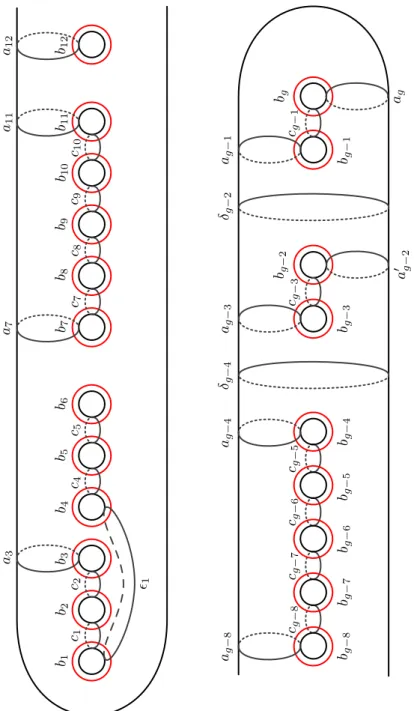
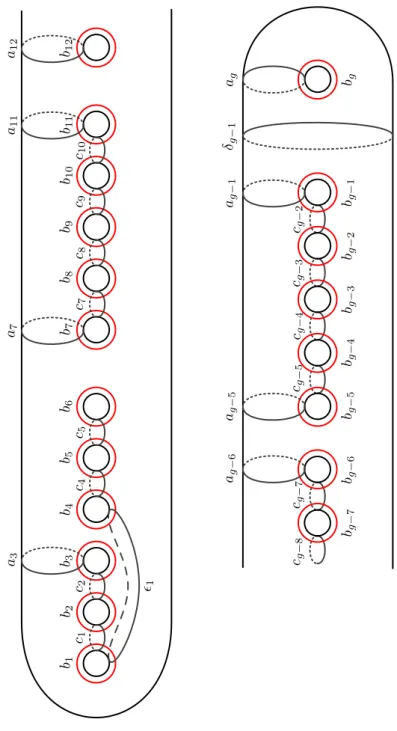
We construct an element f1 in Mod(Σg,0) which has order six as follows. We cut the surface Σg,0 along the curves a3, c1, c2, ϵ1, c4, c5, a5i−3, c5i−3, c5i−2, c5i−1,c5i,a5i+1(i= 2,3, . . . , m−1) as shown in Fig. 8 and obtainm−1 surfaces L1,1, L1,2,. . . , L1,m−1. The surfaceL1,1is a surface of genus 4 with 6mboundary components,L1,iis a sphere with 6 boundary components bounded bya5i−3,c5i−3, c5i−2,c5i−1,c5i anda5i+1 (i= 2,3, . . . , m−1). LetL′1,1 be a subsurface of genus 4 inL1,1 bounded byδg−1. Letf1,1,f1,2,. . .,f1,m−1 be theπ/3 rotation as shown in Fig. 9. Note that in this pictureδg−4is on the back side and the mapf1,1keeps the subsurface L′1,1 fixed. We found that (f1,1)6 produces a twsittδg−4. In order to cancel the twist tδg−4, we define f1,1′ as a composition of f1,1 and f1,m which defined as follow.
f1,m= (tag−3tbg−3tcg−3tbg−2tag−2′ )−1(tag−1tbg−1tcg−1tbgtag).
Since the diffeomorphismsf1,1′ ,f1,2,. . .,f1,m−1coincide on the boundaries, they define a diffeomorphismf1:Σg,0→Σg,0 of order six.
We construct an elementh1 in Mod(Σg,0) of order six. We cut the surfaceΣg,0
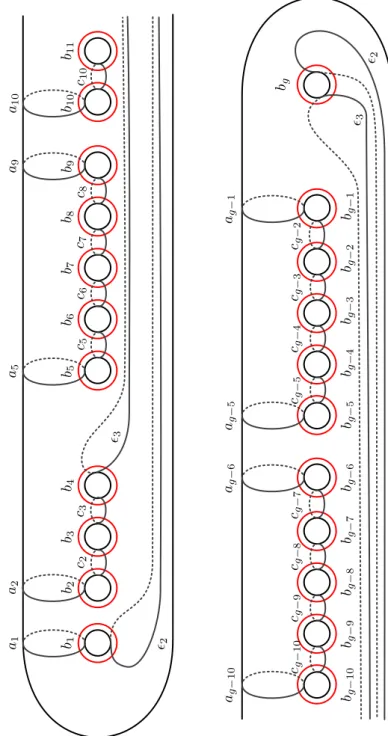
along the curves a1, a2, c2, c3, ϵ2, ϵ3, a5i−5, c5i−5, c5i−4, c5i−3, c5i−2, a5i−1 (i= 2,3, . . . , m) as shown in Fig. 10 and obtainm+ 1 surfacesM1,1,M1,2,. . . , M1,m+1. The surfaceM1,1is a surface with 6mboundary components,M1,iis a sphere with 6 boundary components bounded by a5i−5, c5i−5, c5i−4, c5i−3, c5i−2, a5i−1 (i = 2,3, . . . , m) andM1,m+1 is a sphere with 6 boundary components bounded bya1, a2,c2,c3,ϵ2,ϵ3. Leth1,1, h1,2,. . .,h1,m+1 beπ/3 rotation as shown in Fig. 11.
Since the diffeomorphismsh1,1,h1,2,. . .,h1,m+1coincide on the boundaries, they define a diffeomorphismh1:Σg,0→Σg,0of order six.
The diffeomorphismf1 acts on the curves onΣg,0 as follows:
(f1)5(a3) = (f1)4(c5) = (f1)3(c1) = (f1)2(c4) = (f1)(c2) =ϵ1,
(f1)5(a5i−3) = (f1)4(c5i−3) = (f1)3(c5i−2) = (f1)2(c5i−1) = (f1)(c5i) =a5i+1, (f1)4(b5i−3) = (f1)3(b5i−2) = (f1)2(b5i−1) = (f1)(b5i) =b5i+1 (i= 2,3, . . . , m−1), (f1)4(ag−1) = (f1)3(bg−1) = (f1)2(cg−1) = (f1)(bg) =ag.
The diffeomorphismh1 acts on the curves onΣg,0 as follows:
(h1)5(a1) = (h1)2(c3) = (h1)(c2) =a2,
(h1)4(b1) = (h1)3(bg) = (h1)2(b4) = (h1)(b3) =b2,
(h1)5(a5i−5) = (h1)4(c5i−5) = (h1)3(c5i−4) = (h1)2(c5i−3) = (h1)(c5i−2) =a5i−1, (h1)4(b5i−5) = (h1)3(b5i−4) = (h1)2(b5i−3) = (h1)(b5i−2) =b5i−1 (i= 2,3, . . . , m).
Figure 8. Cutting the surface I
10 KAZUYA YOSHIHARA
Figure 9. Z6-symmetry ofΣg,0I
Figure 10. Cutting the surface II
12 KAZUYA YOSHIHARA
Figure 11. Z6-symmetry ofΣg,0 II
3.1.2. Case of g= 5m+ 1 for some integerm≥2.
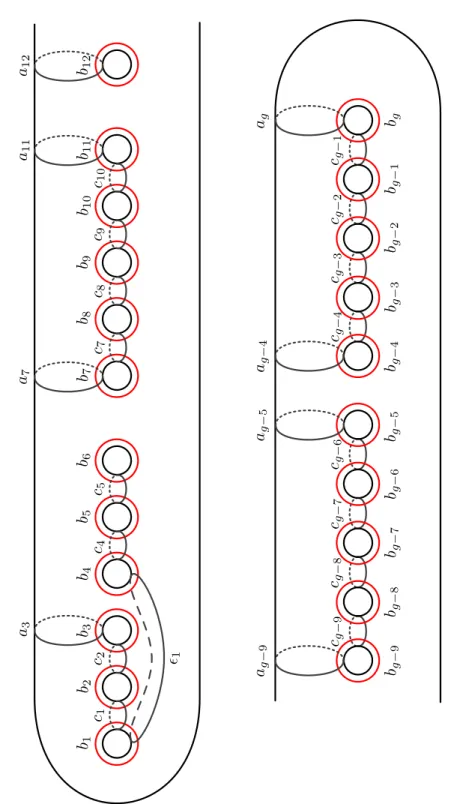
We construct an elementf2 in Mod(Σg,0) which has order six as follows. We cut the surfaceΣg,0along the curvesa3,c1,c2,ϵ1,c4,c5,a5i−3,c5i−3,c5i−2,c5i−1, c5i, a5i+1 (i = 2,3, . . . , m) as shown in Fig. 12 and obtain m surfaces L2,1, L2,2, . . . , L2,m. The surfaceL2,1is a surface with 6m+ 6 boundary components,L2,iis a sphere with 6 boundary components bounded bya5i−3,c5i−3,c5i−2,c5i−1,c5i and a5i+1 (i= 2,3, . . . , m). Letf2,1,f2,2,. . .,f2,m beπ/3 rotation as shown in Fig. 13.
Since the diffeomorphismsf2,1, f2,2, . . .,f2,m coincide on the boundaries, they define a diffeomorphismf2:Σg,0→Σg,0 of order six.
We construct an elementh2 in Mod(Σg,0) of order six. We cut the surfaceΣg,0
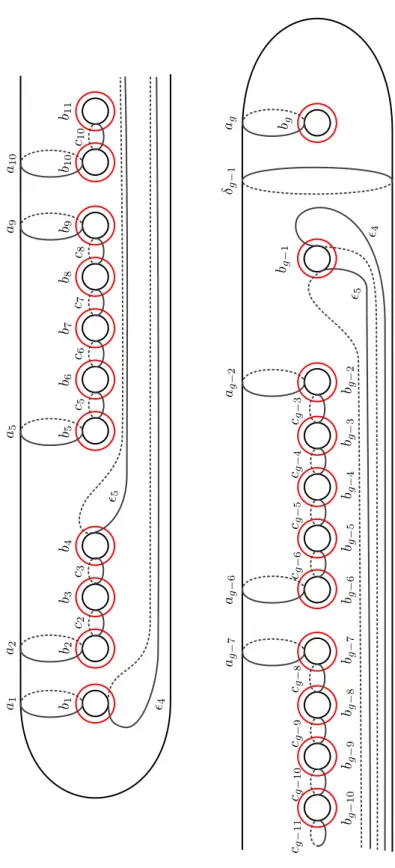
along the curves a1, a2, c2, c3, ϵ4, ϵ5, a5i−5, c5i−5, c5i−4, c5i−3, c5i−2, a5i−1 (i= 2,3, . . . , m) as shown in Fig. 14 and obtainm+ 1 surfacesM2,1,M2,2,. . . , M2,m+1. The surface M2,1 is a torus with 6mboundary components,M2,i is a sphere with 6 boundary components bounded by a5i−5, c5i−5, c5i−4, c5i−3, c5i−2, a5i−1 (i = 2,3, . . . , m),M2,m+1 is a sphere with 6 boundary components bounded by a1,a2, c2, c3,ϵ4,ϵ5. LetM2,1′ be a subsurface of genus 1 in the surfaceM2,1 bounded by δg−1. Leth2,1,h2,2,. . .,h2,mbeπ/3 rotation as shown in Fig. 15. Note that in this pictureδg−1is on the back side and the maph2,1keepsM2,1′ fixed. We found that (h2,1)6 produces a twisttδg−1. In order to cancel the twist tδg−1, we defineh′2,1 as a composition ofh2,1 andh2,m+2which defined as follow.
h2,m+2= (tagtbg)−1.
Since the diffeomorphismsh′2,1, h2,2, . . ., h2,m coincide on the boundaries, they define a diffeomorphismh2:Σg,0→Σg,0of order six.
Fori= 2,3, . . . , m,f2 acts on the curves onΣg,0 as follows:
(f2)5(a3) = (f2)4(c5) = (f2)3(c1) = (f2)2(c4) = (f2)(c2) =ϵ1,
(f2)5(a5i−3) = (f2)4(c5i−3) = (f2)3(c5i−2) = (f2)2(c5i−1) = (f2)(c5i) =a5i+1, (f2)4(b5i−3) = (f2)3(b5i−2) = (f2)2(b5i−1) = (f2)(b5i) =b5i+1.
Fori= 2,3, . . . , m,h2 acts on the curves onΣg,0as follows:
(h2)5(a1) = (h2)2(c3) = (h2)(c2) =a2,
(h2)4(b1) = (h2)3(bg−1) = (h2)2(b4) = (h2)(b3) =b2,
(h2)5(a5i−5) = (h2)4(c5i−5) = (h2)3(c5i−4) = (h2)2(c5i−3) = (h2)(c5i−2) =a5i−1, (h2)4(b5i−5) = (h2)3(b5i−4) = (h2)2(b5i−3) = (h2)(b5i−2) =b5i−1
h2(bg) =ag.
14 KAZUYA YOSHIHARA
Figure 12. Cutting the surface III
Figure 13. Z6-symmetry ofΣg,0,III
16 KAZUYA YOSHIHARA
Figure 14. Cutting the surface IV
Figure 15. Z6-symmetry ofΣg,0,IV
18 KAZUYA YOSHIHARA
3.1.3. Case of g= 5m+ 2 for some integerm≥1.
We construct an element f3 in Mod(Σg,0) which has order six as follows. We cut the surfaceΣg,0along the curvesa3,c1,c2,ϵ1,c4,c5,a5i−3,c5i−3,c5i−2,c5i−1, c5i, a5i+1 (i = 2,3, . . . , m) as shown in Fig. 16 and obtain m surfaces L3,1, L32, . . . , L3m. The surface L3,1 is a torus with 6m+ 6 boundary components, L3,i is a sphere with 6 boundary components bounded bya5i−3,c5i−3,c5i−2,c5i−1,c5i and a5i+1 (i = 2,3, . . . , m). Let L′3,1 be a subsurface of genus 1 in L3,1 bounded by δg−1. Letf3,1,f3,2,. . .,f3,mbeπ/3 rotation as shown in Fig. 17. Note that in this pictureδg−1 is on the back side and the mapf3,1 keepsL′3,1fixed. We found that (f3,1)6 produces a twist tδg−1. In order to cancel the twisttδg−1, we define f3,1′ as a composition off3,1 andf3,m+1 which defined as follow.
f3,m+1= (tagtbg)−1.
Since the diffeomorphismsf3,1′ , f3,2, . . .,f3,m coincide on the boundaries, they define a diffeomorphismf3:Σg,0→Σg,0 of order six.
We construct an element h3 in Mod(Σg,0) of order six as follows. We cut the surface Σg,0 along the curvesa1, a2, c2,c3, ϵ6, ϵ7, a5i−5,c5i−5,c5i−4,c5i−3,c5i−2, a5i−1 (i= 2,3, . . . , m) as shown in Fig. 18 and obtainm+ 1 surfaces M3,1, M3,2, . . . , M3,m+1. The surface M3,1 is a surface of genus 2 with 6m boundary com- ponents, M3,i is a sphere with 6 boundary components bounded by a5i−5, c5i−5, c5i−4, c5i−3, c5i−2, a5i−1 (i = 2,3, . . . , m), M3,m+1 is a sphere with 6 boundary components bounded bya1,a2,c2, c3,ϵ6,ϵ7. LetM3,1′ be a subsurface of genus 2 in M3,1 bounded by δg−2. Let h3,1,h3,2, . . .,h3,m+1 be π/3 rotation as shown in Fig. 19. Note that in this pictureδg−2is on the back side and the map h3,1 keeps M3,1′ fixed. We found that (h3,1)6 produces a twist tδg−2. In order to cancel the twist tδg−2, we define h′3,1 as a composition of h3,1 and h3,m+2 which defined as follow.
h3,m+2= (tag−1tbg−1tcg−1tbgtag)−1.
Since the diffeomorphismsh′3,1,h3,2,. . .,h3,m+1coincide on the boundaries, they define a diffeomorphismh3:Σg,0→Σg,0of order six.
Fori= 2,3, . . . , m,f3 acts on the curves onΣg,0 as follows:
(f3)5(a3) = (f3)4(c5) = (f3)3(c1) = (f3)2(c4) = (f3)(c2) =ϵ1,
(f3)5(a5i−3) = (f3)4(c5i−3) = (f3)3(c5i−2) = (f3)2(c5i−1) = (f3)(c5i) =a5i+1, (f3)4(b5i−3) = (f3)3(b5i−2) = (f3)2(b5i−1) = (f3)(b5i) =b5i+1.
Fori= 2,3, . . . , m,h3acts on the curves onΣg,0as follows:
(h3)5(a1) = (h3)(c3) =a2,
(h3)4(b1) = (h3)3(bg−2) = (h3)2(b4) = (h3)(b3) =b2,
(h3)5(a5i−5) = (h3)4(c5i−5) = (h3)3(c5i−4) = (h3)2(c5i−3) = (h3)(c5i−2) =a5i−1, (h3)4(b5i−5) = (h3)3(b5i−4) = (h3)2(b5i−3) = (h3)(b5i−2) =b5i−1,
(h3)−3(bg−1) = (h3)−2(cg−1) = (h3)−1(bg) =ag.
Figure 16. Cutting the surface V
20 KAZUYA YOSHIHARA
Figure 17. Z6-symmetry ofΣg,0,V
Figure 18. Cutting the surface VI
22 KAZUYA YOSHIHARA
Figure 19. Z6-symmetry ofΣg,0,VI
3.1.4. Case of g= 5m+ 3 for some integerm≥1.
We construct an element f4 in Mod(Σg,0) which has order six as follows. We cut the surfaceΣg,0along the curvesa3,c1,c2,ϵ1,c4,c5,a5i−3,c5i−3,c5i−2,c5i−1, c5i, a5i+1 (i = 2,3, . . . , m) as shown in Fig. 20 and obtain m surfaces L4,1, L4,2, . . . , L4,m. The surfaceL4,1is a surface of genus 2 with 6m+6 boundary components, L4,iis a sphere with 6 boundary components bounded bya5i−3,c5i−3,c5i−2,c5i−1, c5i anda5i+1 (i= 2,3, . . . , m). LetL′4,1be a subsurface of genus 2 inL4,1bounded byδg−2. Letf4,1,f4,2,. . .,f4,m beπ/3 rotation as shown in Fig. 21. Note that in this pictureδg−2 is on the back side and the mapf4,1 keepsL′4,1 fixed. We found that (f4,1)6produces a twisttδg−2. In order to cancel the twisttδg−2, we definef4,1′ as a composition off4,1 andf4,m+1 which defined as follow.
f4,m+1= (tag−1tbg−1tcg−1tbgtag)−1.
Since the diffeomorphismsf4,1′ , f4,2, . . .,f4,m coincide on the boundaries, they define a diffeomorphismf4:Σg,0→Σg,0 of order six.
We construct an element h4 in Mod(Σg,0) of order six as follows. We cut the surface Σg,0 along the curvesa1, a2, c2,c3, ϵ8, ϵ9, a5i−5,c5i−5,c5i−4,c5i−3,c5i−2, a5i−1 (i= 2,3, . . . , m) as shown in Fig. 22 and obtainm+ 1 surfaces M4,1, M4,2, . . . , M4,m+1. The surface M4,1 is a surface of genus 3 with 6m boundary com- ponents, M4,i is a sphere with 6 boundary components bounded by a5i−5, c5i−5, c5i−4, c5i−3, c5i−2, a5i−1 (i = 2,3, . . . , m), M4,m+1 is a sphere with 6 boundary components bounded by a1, a2, c2, c3, ϵ8, ϵ9. Let M4,1′ be a subsurface of genus 3 in M4,1 bounded by δg−3. Let h4,1, h4,2, . . ., h4,m+1 be π/3 rotation as shown in Fig. 23. Note that in this picture δg−3 is on the back side and the map h4,1
keepsM4,1′ fixed. We found that (h4,1)6 produces a twisttδg−3. In order to cancel the twisttδg−3, we defineh′4,1 as a compostion ofh4,1 andh4,m+2 which defined as follow.
h4,m+2= (tag−2tbg−2tcg−2tbg−1ta′g−1)−1(tagtbg).
Since the diffeomorphismsh′4,1,h4,2,. . .,h4,m+1coincide on the boundaries, they define a diffeomorphismh4:Σg,0→Σg,0of order six.
Fori= 2,3, . . . , m,f4 acts on the curves onΣg,0 as follows:
(f4)5(a3) = (f4)4(c5) = (f4)3(c1) = (f4)2(c4) = (f4)(c2) =ϵ1,
(f4)5(a5i−3) = (f4)4(c5i−3) = (f4)3(c5i−2) = (f4)2(c5i−1) = (f4)(c5i) =a5i+1, (f4)4(b5i−3) = (f4)3(b5i−2) = (f4)2(b5i−1) = (f4)(b5i) =b5i+1,
(f4)−3(bg−1) = (f4)−2(cg−1) = (f4)−1(bg) =ag.
Fori= 2,3, . . . , m,h4 acts on the curves onΣg,0as follows:
(h4)5(a1) = (h4)2(c3) =h4(c2) =a2,
(h4)4(b1) = (h4)3(bg−3) = (h4)2(b4) = (h4)(b3) =b2,
(h4)5(a5i−5) = (h4)4(c5i−5) = (h4)3(c5i−4) = (h4)2(c5i−3) = (h4)(c5i−2) =a5i−1, (h4)4(b5i−5) = (h4)3(b5i−4) = (h4)2(b5i−3) = (h4)(b5i−2) =b5i−1,
(h4)−2(bg−2) = (h4)−1(cg−2) =bg−1,(h4)−1(bg) =ag.
24 KAZUYA YOSHIHARA
Figure 20. Cutting the surface VII
Figure 21. Z6-symmetry ofΣg,0,VII
26 KAZUYA YOSHIHARA
Figure 22. Cutting the surface VIII
Figure 23. Z6-symmetry ofΣg,0,VIII
28 KAZUYA YOSHIHARA
3.1.5. Case of g= 5m+ 4 for some integerm≥1.
We construct an element f5 in Mod(Σg,0) which has order six as follows. For i= 2,3, . . . , m, we cut the surfaceΣg,0along the curvesa3,c1,c2,ϵ1,c4,c5,a5i−3, c5i−3,c5i−2,c5i−1,c5i,a5i+1 as shown in Fig. 24 and obtainmsurfacesL5,1,L5,2, . . . , L5,m. The surfaceL5,1is a surface of genus 3 with 6m+6 boundary components, L5,iis a sphere with 6 boundary components bounded bya5i−3,c5i−3,c5i−2,c5i−1, c5i, a5i+1. LetL′5,1 be a subsurface of genus 3 inL5,1 bounded byδg−3. Letf5,1, f5,2,. . .,f5,mbeπ/3 rotation as shown in Fig. 25. Note that in this pictureδg−3is on the back side and the mapf5,1 keepsL′5,1fixed. We found that (f5,1)6produces a twisttδg−3. In order to cancel the twisttδg−3, we definef5,1′ as a composition of f5,1 andf5,m+1 which defined as follow.
f5,m+1 = (tag−2tbg−2tcg−2tbg−1ta′g−1)−1(tagtbg).
Since the diffeomorphismsf5,1′ , f5,2, . . .,f5,m coincide on the boundaries, they define a diffeomorphismf5:Σg,0→Σg,0 of order six.
We construct an element h5 in Mod(Σg,0) of order six as follows. For i = 2,3, . . . , m, we cut the surfaceΣg,0 along the curves a1, a2, c2, c3, ϵ10,ϵ11, a5i−5, c5i−5,c5i−4,c5i−3,c5i−2,a5i−1as shown in Fig. 26 and obtainm+ 1 surfacesM5,1, M5,2, . . . , M5,m+1. The surface M5,1 is a surface of genus 4 with 6m boundary components, M5,i is a sphere with 6 boundary components bounded by a5i−5, c5i−5,c5i−4, c5i−3,c5i−2, a5i−1, M5,m+1 is a sphere with 6 boundary components bounded by a1, a2, c2, c3, ϵ10, ϵ11. LetM5,1′ be a subsurface of genus 4 inM5,1
bounded by δg−4. Leth5,1, h5,2, . . .,h5,m+1 be π/3 rotation as shown in Fig. 27.
Note that in this pictureδg−4is on the back side and the maph5,1keepsM5,1′ fixed.
We found that (h5,1)6 produces a twisttδg−4. In order to cancel the twisttδg−4, we defineh′5,1 as a composition ofh5,1 andh5,m+2 which defined as follow.
h5,m+2= (tag−3tbg−3tcg−3tbg−2ta′g−2)−1(tag−1tbg−1tcg−1tbgtag).
Since the diffeomorphismsh′5,1,h5,2,. . .,h5,m+1coincide on the boundaries, they define a diffeomorphismh5:Σg,0→Σg,0of order six.
Fori= 2,3, . . . , m,f5 acts on the curves onΣg,0 as follows:
(f5)5(a3) = (f5)4(c5) = (f5)3(c1) = (f5)2(c4) = (f5)(c2) =ϵ1,
(f5)5(a5i−3) = (f5)4(c5i−3) = (f5)3(c5i−2) = (f5)2(c5i−1) = (f5)(c5i) =a5i+1, (f5)4(b5i−3) = (f5)3(b5i−2) = (f5)2(b5i−1) = (f5)(b5i) =b5i+1,
(f5)−2(bg−2) = (f5)−1(cg−2) =bg−1,(f5)−1(bg) =ag. Fori= 2,3, . . . , m,h5 acts on the curves onΣg,0as follows:
(h5)5(a1) = (h5)2(c3) =h5(c2) =a2,
(h5)4(b1) = (h5)3(bg−4) = (h5)2(b4) = (h5)(b3) =b2,
(h5)5(a5i−5) = (h5)4(c5i−5) = (h5)3(c5i−4) = (h5)2(c5i−3) = (h5)(c5i−2) =a5i−1, (h5)4(b5i−5) = (h5)3(b5i−4) = (h5)2(b5i−3) = (h5)(b5i−2) =b5i−1,
(h5)−2(bg−3) = (h5)−1(cg−3) =bg−2, (h5)3(bg−1) = (h5)2(cg−1) = (h5)(bg) =ag.
Figure 24. Cutting the surface IX
30 KAZUYA YOSHIHARA
Figure 25. Z6-symmetry ofΣg,0,IX
Figure 26. Cutting the surface X
32 KAZUYA YOSHIHARA
Figure 27. Z6-symmetry ofΣg,0,X
3.1.6. Case of g= 5.
We construct an elementf6in Mod(Σ5,0) which has order six as follows. We cut the surfaceΣ5,0along the curvesa3, a5, c1, c2, c4,ϵ1as shown in Fig. 28 and obtain 2 six holed spheresL6,1 andL6,2.
Figure 28. Simple Closed Curves onΣ5,0
Letf6,1andf6,2beπ/3 rotation as shown in Fig. 29. Since the diffeomorphisms f6,1 andf6,2coincide on the boundaries, they define a diffeomorphismf6:Σ5,0→ Σ5,0 of order six.
Figure 29. Z6-symmetry ofΣ5,0,XI
We construct an elementh6in Mod(Σ5,0) which has order six. We cut the surface Σ5,0along the curvesa1, a2, c2, c3, c4,ϵ12as shown in Fig. 28 and obtain two spheres with 6 boundary componentsM6,1 andM6,2. Leth6,1 andh6,2 beπ/3 rotation as shown in Fig. 30.
Since the diffeomorphismsh6,1andh6,2coincide on the boundaries, they define a diffeomorphismh6:Σ5,0→Σ5,0 of order six. In this case, fori= 1,2, . . . ,4 and