Generating
the
full
mapping class
group
by
involutions
Naoyuki
Monden
Osaka University
August
20,
2008
AbstractLet $\Sigma_{g,b}$ denote a closed orientable surface of genus
$g$ with $b$
punc-tures and let Mod$(\Sigma_{g,b})$ denote its mapping class group. In $[Luo|$ Luo
proved that ifthe genus is at least 3, Mod$(\Sigma_{g,b})$ is generated by
involu-tions. He also asked ifthere exists
a
universal upper bound, independentof genus and the number of punctures, for the number of torsion
ele-ments/involutions needed to generate Mod$(\Sigma_{g,b})$
.
Brendle and Farb [BF]gave
an answer
in thecase
of$g\geq 3,$$b=0$and$g\geq 4,$$b=1$, bydescribingageneratingset consisting of6involutions. Kassabovshowedthatforevery
$b$ Mod$(\Sigma_{g,b})$ can be generated by 4 involutions if$g\geq 8,5$ involutions if
$g\geq 6$ and 6 involutions if$g\geq 4$
.
We proved that for every $b$ Mod$(\Sigma_{g,b})$can be generated by 4 involutions if$g\geq 7$ and 5 involutions if$g\geq 5$
.
1
Introduction
Let $\Sigma_{g,b}$ be
an
closed orientable surface of genus$g\geq 1$ with arbitrarily chosen$b$ points (which we call punctures). Let Mod$(\Sigma_{g,b})$ be the mapping $cls$ group
of$\Sigma_{g,b}$, which isthe group of homotopy classes oforientation-preserving
home-omorphisms preserving the set ofpunctures. Let Mod$\pm(\Sigma_{g,b})$ be the extended
mapping classgroupof$\Sigma_{g_{i}b}$
,
which isthe group ofhomotopyclass ofall(includ-ingorientation-reversing) homeomorphisms preserving theset ofpunctures. By
$Mod_{g,b}^{0}$
we
will denote the subgroup of Mod$g,b$ whichfixes
the puncturespoint-wise.
In $[MP|$,
McCarthy.and
Papadopoulos proved that Mod$(\Sigma_{g,0})$ is generatedby infinitely many conjugetes of asingle involution for $g\geq 3$
.
Luo,see
$[Luo|$,described the finite set of involutions which generate Mod$(\Sigma_{g,b})$ for $g\geq 3$
.
Heako proved that Mod$(\Sigma_{g,b})$ is generated by torsion elements in all
cases
except$g=2$ and $b=5k+4$
,
but this group is not generated by involutions if$g\square 2$.
Brendle and Farb proved that ,Mod$(\Sigma_{g,b})$
can
be generated by $6involutions$ for$g\geq 3,$$b=0$ and $g\geq 4,$$b\square 1$ (see [$BF|)$
.
$\ln[Ka|,$ $Ksabov$ proved thatfor every$b$ Mod$(\Sigma_{g,b})$
can
be generated by 4involutions if $g\geq 8,5$ involutions if$g\geq 6$and 6 $involutioi_{\mathfrak{B}}$ if$g\geq 4$
.
He also proved in thecase
ofMod$\pm(\Sigma_{g,b})$.
Our main result is stronger than [Ka].
Main Theorem. For all$g\geq 3$ and$b\geq 0$
,
the mapping class group Mod$(\Sigma_{g,b})$$(a)4$ involutions
if
$g\geq 7$;$(b)5$ involutions
if
$g\geq 5$.
2
Preliminaries
Let $c$ be
a
simple closedcurve on
$\Sigma_{g,b}$.
Then the (right hand) Dehn twist $T_{c}$about $c$ is the homotopy class of the homeomorphism obtained by cutting $\Sigma_{g,p}$
along $c$, twisting one ofthe side by 36$0^{}$ to the right and gluing two sides of
a
back to each ohter. Figure 1 shows the Dehn twist about the
curve
$c$.
We will$T_{c}arrow$
Figure 1: The Dehn twist
denote by $T_{c}$ the Dehn twist around the
curve
$c$.
We record the following lemmas.
Lemma 1. Forany homeomorphism$h$
of
thesurface
$\Sigma_{g,b}$ the twists around thecurves
$c$ and $h(c)$are
$\omega njugate$ in the mapping classgroup Mod
$(\Sigma_{g,b})$,$T_{h(c)}$ $=$ $hT_{c}h^{-1}$
.
Lemma 2. Let $c$ and $d$ be two simple closed $cun$)$es$ on $\Sigma_{g_{2}b}$
.
If
$c$ is disjointfrom
$d_{f}$ then$T_{c}T_{d}=T_{d}T_{c}$
3
Proof of main
theorem
In this section
we
proof maintheorem. The keypoints of proofare
to generate$T_{\alpha}$ in 4 involutions by using lantern relation.
3.1
The policy of proof
We give the policy of proof of maintheorem.
Lemma 3. Let $G,$ $Q$ denote the groups and let $N,H$ denote the subgmups
of
G. Suppose that the group $G$ has thefollowing exact sequence;
$1arrow Narrow iGarrow\pi Qarrow 1$
.
If
$H\omega ntainsi(N)$ and has a $su’\dot{\eta}ection$ to $Q$ then we have that $H=G$.
Proof.
We suppose that there existssome
$g\in G-H$.
By the existence ofsurjection from $H$ to $Q$,
we can see
that there existssome
$h\in H$ such that$g^{-1}h\in Ker\pi=1m\dot{u}$ Then there exists some $n\in N$ such that $i(n)=g^{-1}h$
.
By $i(N)\subset H$, since $i(n)\in H$ and $h\in H$,
we
have $g=h\cdot i(n)^{-1}\in H$.This is contradiction in $g\not\in H$. Theref\‘ore, we can prove that $H=G$
.
$\square$It is clear that
we
have the exact sequence:$1arrow$ Mod$g,b0arrow$ Mod$g,barrow$ Sym$barrow 1$
.
Therefore,
we can see
the following corollary;Corollary 4. Let$H$ denote the subgroup
of
Mod$(\Sigma_{g,b})$, which$\omega ntainsMod^{}(\Sigma_{g,b})$and has
a
surjection to Sym$b$.
Then $H$is equal to Mod$(\Sigma_{g,b})$.
We generate the subgroup $H$ which has the condition of corollary 4 by
in-volutions.
Let
us
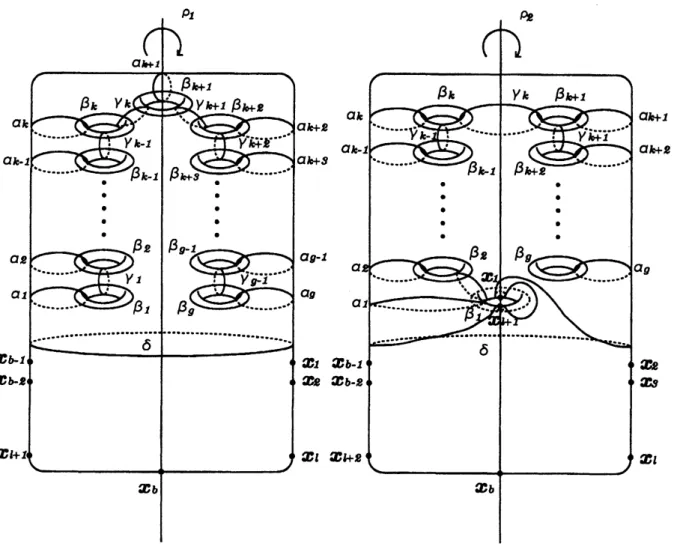
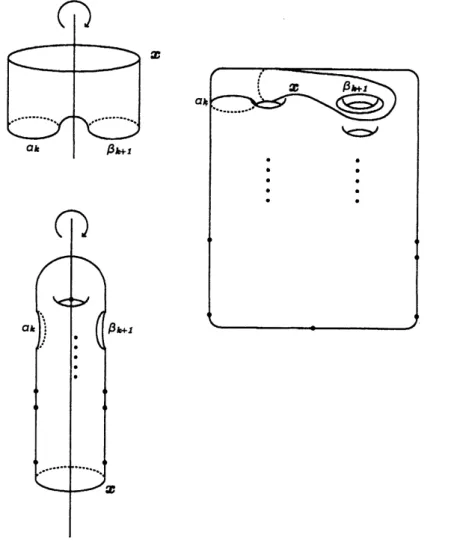
embed our surface $\Sigma_{g,b}$ in the Euclidian spaoe in two different waysas
shown
on
Figure 2. (In these pictureswe
willassume
that genus $g=2k+1$ isodd and the number ofpunctures$b=2l+1$ is odd. In the
case
ofeven
genus weonly have to swap the top parts ofthe pictures, and in the case of
even
numberofpunctures
we
have
toremove
the last point.)In Figure 2
we
have also marked the puncture pointsas
$x_{1},$ $\ldots,$$x_{b}$ andwe
have the
curves
$\alpha_{i},$ $\beta_{i},$$\gamma i$ and
$\delta$
.
Thecurve
$\alpha_{i},$ $\beta_{i},$
$\gamma_{i}$
are
non
separatingcurve
and $\delta$ is separating
curve.
Each embedding gives a natural involution of the surface–the half tum
ro-tation around its axis ofsymmetry. Let us call these involutions $\rho 1$ and $\rho 2$
.
Then
we can
get following lemma;Lemma 5 ([Mo]). The subgroup
of
the mapping class group be genemted by $\rho_{1}$,$\rho 2$ and 3 Dehn twists $T_{\alpha},$ $T_{\beta}$ and $T_{\gamma}$ around
one
of
thecurve
in each family$\omega ntains$ the subgroup $Mod^{0}(\Sigma_{g,b})$,
The existence
a
surjection from the subgroup $H$ of Mod$(\Sigma_{g,b})$ to Sym$b$ is
equivalent to showing taht the Sym$b$
can
be generated by involutions;$r_{1}$ $=$ $(1, b-1)(2, b-2)\cdots(l, l+1)(b)$
$r_{2}$ $=$ $(2, b-1)(3, b-2)\cdots(l, l+2)(1)(l+1)(b)$
$r_{3}$ $=$ $($1, $b)(2, b-1)(3, b-2)\cdots(l, l+2)(l+1)$
corresponding to 3 involutions in $H$
.
Lemma 6. The symmetric gmup Sym$b$ is generated by$r_{1},$$r_{2}$ and $r_{3}$
.
Proof.
Thegroup
generated by$r_{i}$ contains the long cycle$r_{3}r_{1}=(1,2, \ldots, b)$ andtransposition $r_{3}r_{2}=(1, b)$
.
These two elements generate the whole symmetricgroup, therefore the involutions $r_{i}$ generate Sym$b$
.
$\square$We note that the images of$\rho_{1}$ and $\rho_{2}$ to Sym$b$
are
$r_{1}$ and $r_{2}$.
Therefore, by Lemma 1, Corollary 4, Lemma 5 and Lemma 6
we
sufficient togenerate $H$ by $\rho_{1},$ $\rho_{2}$ and involutions which have the following conditions;
$\langle 1\rangle$ involutions which genarate the Dehn twist around $\gamma$,
$\langle 2\rangle$ two of each involutions which exchange $\alpha$ and $\beta,$ $\beta$ and $\gamma,$ $\gamma$ and $\alpha$, $\langle 3\rangle$ involution whose image is
Figure 2: The embeddings ofthe surface $\Sigma_{g,b}$ in
Euclidian
space used to define3.2
Generating
Dehn
twists
by
4 involutions
In this subsection,
we
argue about $\langle 1\rangle$.
Moreover, we generate Dehn twistsby 4 involutions. The basic idea is to
use
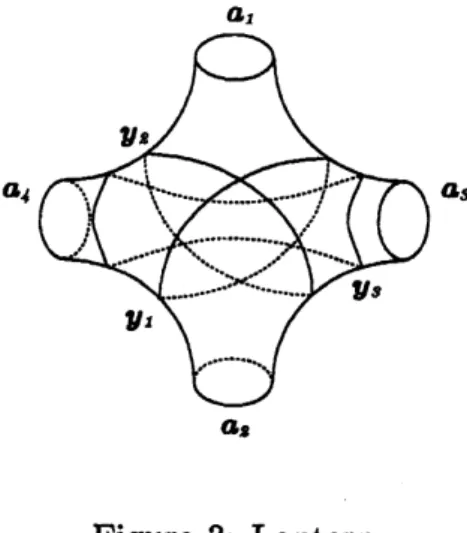
the lantern relation.We begin by recalling the lantem relation in the mapping class group. This
relation
was
first discovered by Dehn and later rediscovered by Johnson.Figure 3: Lantem
From
now
onwe
willassume
that the genus $g$ of the surface is at least 5.Let the $S_{0,4}$ be
a
surface ofgenus$0$ with 4 boundary components. Denote by$a_{1},$ $a_{2},$$a_{3}$ and $a_{4}$the four boundary
curves
ofthe surface $S_{0,4}$and let the interiorcurves
$y1,$$y2$ and $y3$ beas
shown in Figure 3.The following relation:
$T_{\nu 1}T_{v2}T_{y3}=T_{a_{1}}T_{a_{2}}T_{as}T_{a_{4}}$
.
(1)among the Dehn twists around the
curves
$a_{i}$ and $yi$ is known as the lanternrelation. Notioe that the
curves
$a_{i}$ do not intersect any othercurve
and thatthe Dehn twists $T_{a_{i}}$ commute with every twists in this relation. This allows
us
to rewrite the lantem relation
as
follows$T_{a_{4}}=(T_{y1}T_{a_{1}}^{-1})(T_{y2}T_{a}^{-1}2)(T_{y3}T_{a_{8}}^{-1})$
.
(2)Let $R$ denote the product $\rho_{2}\rho_{1}$
.
By Figure 2we
cansee
that $R=\rho_{2}\rho_{1}$ actsas
follows:$R\alpha_{i}$ $=$ $\alpha_{i+1},$ $(1\square i<g)$
$R\beta_{i}$ $=$ $\beta_{i+1},$ $(1\square i<g)$ (3)
$R\gamma_{i}$ $=$ $\gamma_{i+1},$ $(1\square i<g-1)$
.
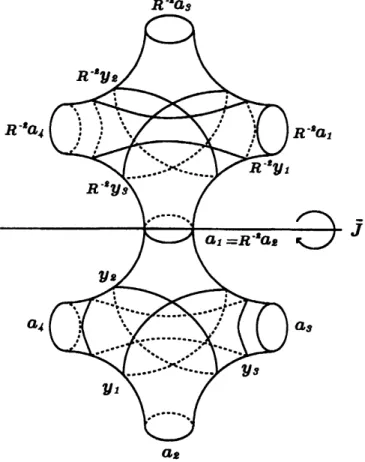
The lanterns $S$ and $R^{-2}S$ have
a
common
boundary component $a_{1}=R^{-2}a_{2}$and their union is
a
surface $S_{2}$ homeomorphic to a sphere with 6 boundarycomponents. By Figure 4
we
cansee
that there exists an involution $\overline{J}$ of $S_{2}$which takes $S$ to $R^{-2}S$
.
Let
us
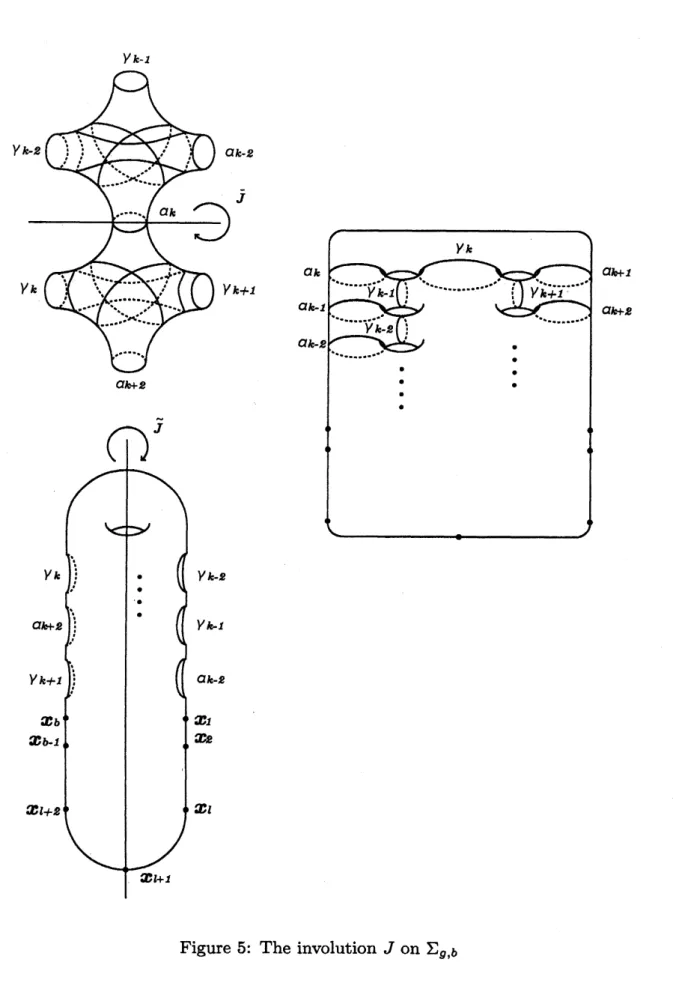
embed the surface $S_{2}$ in $\Sigma_{g,b}$as
shownon
Figure 5. The boundarycomponents of $S_{2}$
are
$a_{1}=\alpha_{k},$ $a_{2}=\alpha_{k+2},$ $a_{3}=\gamma_{k+1},$ $a_{4}=\gamma k,$ $R^{-2}a_{1}=\alpha_{k-2}$,$\alpha_{k+1}$
.
The Figure 5 shows the existence of the involution $\tilde{J}$on the complement
of $S_{2}whi\underline{c}h$ is $a_{\sim}surface$ of genus $g-5$ with 6 boundary components. Gluing
together $J$ and $J$ gives us the involution $J$ of the surface $\Sigma_{g,b}$
.
By Figure 4 $J$acts
as
follows$J(a_{1})=R^{-2}a_{2},$ $J(a_{3})=R^{-2}a_{1},$ $J(y_{1})=R^{-2}y_{2},$ $J(y3)=R^{-2}y_{1}$.
Therefore,
we
have$R^{2}J(a_{1})=a_{2},$ $R^{2}J(y_{1})=y_{2}$
$JR^{-2}(a_{1})=a_{3},$ $JR^{-2}(y_{1})=y3$
.
(4)Let $\rho 3$ denote $T_{a_{1}}\rho_{2}T_{a_{1}}^{-1}$
.
By Lemma 1, (4) and that $\rho_{2}$ sends $a_{1}=\alpha_{k}$ to $y1=\alpha_{k+1}$,
we
have$\tau_{v2}1T_{a_{1}}-1_{=\rho\rho 2}T_{a_{1}}T_{a_{1}}^{-1}=\rho_{2\beta_{3}}$,
$T_{y2}T_{a_{2}}^{-1}=R^{2}J\rho_{2}\rho_{3}JR^{-2},$ $T_{\nu s}T_{a_{3}}^{-1}=JR_{\beta_{2}\rho 3}^{-2}R^{2}$ $J$
.
(5)By (2) and (5)
we
have$\tau_{\gamma k}=(\rho 2\rho 3)(R^{2}J\rho 2\rho 3JR^{-2})(JR^{-2_{\beta 2\rho 3}}R^{2}J)$
.
(6)$a_{t}$
$y$k-X
3.3
Genus
at
least 5
We proofthat the mapping class group is generated by
5
involutions.The five involutions are $\rho_{1},$ $\rho 2,$$\rho_{3},$ $J$ and another involution $I$
.
We constructinvolution $I$ in the
same
wayas
involution $J$ like Figure 6.Figure 6: The involution $I$ on $\Sigma_{g,b}$
Theorem 7.
If
$g\geq 5$, the group $G_{3}$ generated by$\rho_{1},$ $\rho 2,$ $\rho_{3},$ I and $J$ is the
whole mapping class gmup Mod$(\Sigma_{g,b})$
.
Pmof.
By the relation (6)we
satisfy the condition $\langle 1\rangle$.
Since $J$ sends$\alpha_{k-2}$ to
$\gamma k+1$ and $I$ sends $\alpha_{k}$ to $\beta_{k+1}$
, we
consistthe condition $\langle 2\rangle$.
Wecan
alsosee
thatwe
satisfy the condition $\langle 3\rangle$ froma
way to the construction of the involution $J$.
Therefore,
we can
finish the proof ofthe theorem because wecan
satisfy theconditions in 3.1. $\square$
3.4
Genus
at
least
7
We want to improve the above argument and show that for the genus $g\geq 7$
we do not need the involution $I$ in order to generate the mapping class group.
Yk-l
The $S_{2}$ andtwo pairsof pants have
common
boundary components$R^{-2}a_{1}$ and$a_{3}$ and their union is
a
surface $S_{3}$ homeomorphic toa
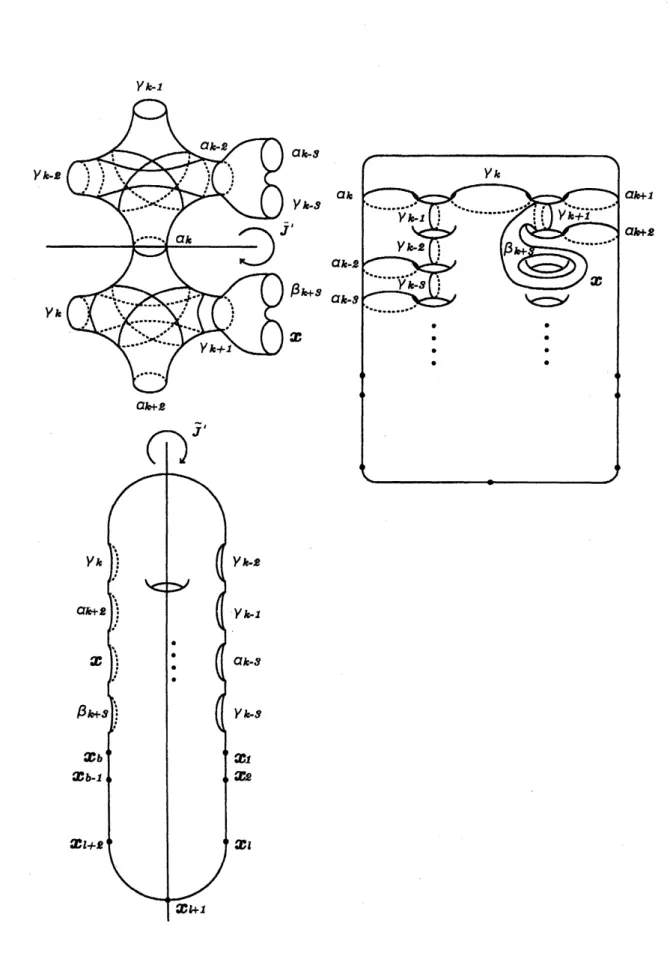
sphere with 8 boundarycomponents. Figure 7 shows the existence of the involution $\overline{J}’$ on
$S_{3}$ which
extends the involution $\overline{J}$ on $S_{2}$
.
Let
us
embed $S_{3}$ in the $\Sigma_{g,b}$as
shownon
Figure 7. From Figure 7 wecan
findthe involution $\tilde{J}^{l}$
of the complement of$S_{3}$
.
Let $J’$ be the involution obtained bygluing together $\overline{J}’$ and $\tilde{J}’$
.
Moreover, $hom$ Figure7 we can
construct $J’$ whichacts on the punctures
as
the involution $r_{3}$.
Theorem 8.
If
$g\geq 7$, the gmup $G_{4}$ genemted by$\rho_{1},$ $\rho 2,$ $\beta 3$ and $J’$ is the whole
mapping class gmup Mod$(\Sigma_{g,b})$
.
Pmof.
Flrom the construction of $J’$we
have$T_{\gamma k}=(\rho 2\rho 3)(R^{2}J’\rho_{2\beta 3}J’R^{-2})(J’R^{-2}\rho_{2}\rho 3R^{2}J’)\in G_{4}$
.
Therefore,
we
can see
thatwe
satisfy the condition $\langle 1\rangle$.
Since $J$‘ can send$\alpha_{k-2}$
to $\gamma k+1$ and$\beta_{k+3}$ to $\gamma k-3$,
we
can
satisfythe condition $\langle 2\rangle$ only in $J’$.
Moreover,By that $J’$ acts
as
$r_{3}$,we
consist the condition $\langle 3\rangle$.
Therefore, thegroup
$G_{4}$ isthe whole mapping class
group.
口4
Acknowledgement
I would like to thank
Professor
Hisaaki Endo for careful readings and formany helpful suggestions and comments. And I would like to thank Hitomi
Fukushima, Yeonhee Jang and Kouki Masumoto for many advices.
Reference
[BF] T. E. Brendle and B. Farb. Every mapping class gmup is generated by 3
torsion elements and by
6
involutions. J. Algebra 278 (2004),187-198.
[De$|$ M. Dehn. Papers
on
group theory and topology. Springer-Verlag, NewYork,1987 (Die Gruppe der Abbildungsklassen, Acta Math. Vol. 69 (1938),
135-206)
$[Ge|$ S. Gervais. $A$
finite
presentationof
the mapping class groupof
a
puncturedsurface.
Topology 40 (2001), No. 4,703-725
[Hu] S. P. Humphries. Genemtors
for
the mapping class gmup. Topology oflow-dimensional manifolds Proc. Second Sussex Conf. Chelwood
Gate
1977, Lecture Notes in Math. 722 (1979), Springer,
44-47.
[Jo] D. Johnson. The structure
of
Torelli gmup $I:A$finite
setof
genemtorsfor
$\mathcal{I}$
.
Ann. of Math. 118 (1983), 423-442.[Ka] M. Kassabov. Genemting Mapping Class Gmups by Involutions.
arXiv:math.GT/0311455 vl 25 Nov 2003.
[Ko] M. Korkmaz. Generating the
surface
mapping class gmup by two elements.$[Li|$ W. B. R. Lickorish. $A$
finite
setof
genemtorsfor
the homeotopy gmupof
a
2-manifold.
Proc. Cambridge Philos. Soc. 60 (1964),769-778.
$[Lu|$ N. Lu. On the mappingclass gmups
of
the closed oreentablesurfa
ces. Topol-ogy Proc. 13 (1988), 293-324.$[Luo|$ F. Luo. Torsion Elements in the Mapping Class Gmup
of
aSurface.
arXiv:math.GT/0004048 v18 Apr 2000.
$[Ma|$ C. Maclachlan. Modulus space is $simply-\omega nnected$
.
Proc. Amer. Math. Soc.29 (1971), 85-86.
[Mo] N.
Monden.
Generating the mappingclass
groupof
a
puncturedsurface
byinvolutions. arXiv$:0807.0916v16$ Ju12008.
[MP] J. MacCarthy and A. Papadopoulos. Involutions in
surface
mapping classgmups. Enseign. Math. 33 (1987),
275-290.
[Pa] D. B. Patterson. The
fundamental
gmupof
the modulus space. Michigan Math. J. 26 (1979),213-223.
[St] M. Stukow. The extendedmappingclass gmup isgenemted by3symmetries.
C. R. Math. Acad. Sci. Paris. 338 (2004), 403-406.
$[Wa|$ B. Wajnryb. Mapping class gmup
of
a
surface
is generatedbytwo elements.Topology. 35 $($1996$)$, 377-383.
Department of Mathematics, Graduate School of Science, Osaka University,
Toyonaka, Osaka 560-0043, Japan