はじめに
2008年4月より遠位塞栓防止用デバイス(embolic protection device;EPD)として,フィルタータイプの Angioguard XP(Cordis Endovascular, Miami Lakes, FL, USA)を用いた頚動脈ステント留置術(carotid artery stenting;CAS)が保険適応となったが,日本国 内の各施設ではそれ以前よりバルーンタイプのEPDで あるPercuSurge GuardWire(Medtronic, Minneapolis, MN, USA. 以下GuardWire)を主に使用してきた.両者の塞
栓防止のコンセプトは異なり,Angioguard XPについて は経験を重ねる中でその長所および短所が理解されつつ ある状況である.今回我々はAngioguard XPを用いた CAS施 行 例 の こ れ ま で の 初 期 治 療 成 績 に つ い て,
GuardWire導入直後に施行した例と手技の安定した時期 に施行した例と比較検討し,文献的考察を加え報告する.
方 法
当科では頚動脈狭窄症に対する外科的治療として patch graft を 用 い た 頚 動 脈 内 膜 剥 離 術(carotid
頚動脈狭窄症に対するAngioguard XPを用いた 頚動脈ステント留置術の治療成績
- PercuSurge GuardWire による治療成績との比較-
徳永浩司1) 杉生憲志1) 西田あゆみ1) 平松匡文1)
菱川朋人1) 小野成紀1) 伊達 勲1)
Treatment results of carotid artery stenting under distal protection with the use of Angioguard XP compared with those of PercuSurge GuardWire
Koji TOKUNAGA1) Kenji SUGIU1) Ayumi NISHIDA1) Masafumi HIRAMATSU1) Tomohito HISHIKAWA1) Shigeki ONO1) Isao DATE1)
1) Department of Neurological Surgery, Okayama University Graduate School of Medicine, Dentistry and Pharmaceutical Sciences
●Abstract●
Objective: To compare clinical results of carotid artery stenting (CAS) under distal protection with the use of Angioguard XP and PercuSurge GuardWire.
Methods: 138 patients treated by CAS under distal protection from September 2002 to November 2008 were included in this study. 85 patients treated with GuardWire were divided into 2 sequential groups, the early GW group (n=42) and the late GW group (n=43). Angioguard XP was used in 53 patients (the AG group) from November 2007. Treatment results from the 3 groups were investigated.
Results: A stent was successfully deployed in all patients. 1 patient in the early GW group died of intracerebral hemorrhage which developed 5 days after CAS. In the late GW group, 1 patient died of multiple organ failure after intraoperative abdominal wall hemorrhage and another patient showed persistent hemiparesis due to intracerebral hemorrhage which occurred 1 week after CAS. Procedure-associated learning curve was not demonstrated between the 2 groups. In the AG group, postoperative MRI diffusion-weighted imaging disclosed new high-intensity lesions in the area of the treated carotid artery in 7 patients, in which 2 patients suffered from thromboembolic strokes.
Conclusion: Hemorrhagic complications were causes of disability for patients treated with GuardWire. Thromboembolic events were more frequently encountered in patients undergoing CAS with Angioguard XP.
●Key Words●
balloon device, carotid artery stenting, carotid stenosis, distal embolic protection, filter device
(Received March 16, 2009:Accepted May 10, 2009) 1)岡山大学大学院 脳神経外科
<連絡先:徳永浩司 〒700-8558 岡山市鹿田町2-5-1 E-mail: [email protected]>
endarterectomy;CEA)を第一選択としているが,CEA 高危険群についてはCASの適応としている.2002年9 月から2008年11月の間に当科にてEPD使用下にCASを 施行した連続138例を対象とした.性別は男性128例,女 性10例で,年齢は平均73歳(52~88歳)であった.これ らのうち2002年9月から2006年4月までのGuardWire導 入後早期に治療した症例をGW前期群,2006年4月から 2008年3月までの間に治療した症例をGW後期群,2007 年11月からのEPDとしてAngioguard XPを用いて治療 した症例をAG群とした.GW前期群は42例,GW後期群 は43例,AG群は53例あった.
当科における標準的なCASの手技は以下の通りであ る. 局 所 麻 酔 下 に 大 腿 動 脈 か ら6Fr Shuttle sheath
(COOK MEDICAL INC., Bloomington, IN, USA)を病 側総頚動脈に進める.GuardWireあるいはAngioguard XPを狭窄部に通過させて内頚動脈末梢に置き,前拡張 の後,ステントとしてSMARTあるいはPrecise(Cordis Endovascular, Miami Lakes, FL, USA)を留置し,必要 に応じてより広径のPTAバルーンによる後拡張を加え る.GuardWireを使用した場合,あるいはAngioguard XP使用時にno flowや極端なslow flowとなった場合に
は,EPDの近位の内頚動脈内の血液吸引を加えた後,
EPDを回収する.術中の脳虚血の状況によってはエダ ラボンを,また徐脈低血圧の出現した際にはアトロピン や昇圧剤を適宜使用する.以上の標準的な手技では CAS遂行が困難あるいは危険と判断された例では適宜 追加手技を講じる.
以上の方法により治療を行ったCAS施行例について,
GW前期群,GW後期群,AG群それぞれの治療成績につ いて,特にmodified Rankin Scale (mRS)の悪化を来す 合併症について検討を加えた.
結 果
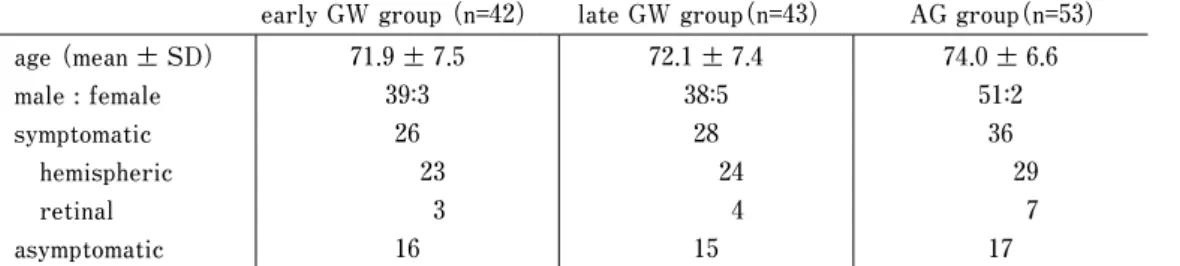
各群の臨床的特徴をTable 1に示した.各群間に年齢 や性差,術前の症候の内訳に差はなかった.全例でステ ント留置に成功し,術前の病変部の狭窄率はGW前期群 84±11%,GW後期群83±12%,AG群84±11%で,それ ぞれCASにより9±8%,12±8%,10±9%に改善した.
GW後期群で積極的な後拡張を控える傾向にあったが,
統計学的有意差はなかった.
CASを選択した理由をTable 2に示した.高齢,高位 病変,対側閉塞,不安定な冠動脈疾患などが主な理由で Table 1 Clinical features of the patients undergoing CAS in the three groups
early GW group (n=42) late GW group(n=43) AG group(n=53) age (mean ± SD)
male : female symptomatic hemispheric retinal asymptomatic
71.9±7.5 39:3
26 23 3
16
72.1±7.4 38:5
28 24 4
15
74.0±6.6 51:2
36 29 7
17 AG : Angioguard, CAS : carotid artery stenting, GW : GuardWire
Table 2 Reasons for a choice to CAS of the patients in the three groups
early GW group(n=42) late GW group(n=43) AG group(n=53) age ≧ 75
high or low cervical lesion contralateral carotid occlusion clinically significant cardiac disease recurrent stenosis after CEA unstable neurological condition previous radiation therapy to the neck contralateral laryngeal nerve palsy other surgical risks
patient’s or referring doctor’s preference
5(12%) 4(10%) 6(14%) 4(10%) 1(2%) 4(10%)
0 1(2%) 1(2%) 16(38%)
7(16%) 8(19%) 4(9%) 1(2%) 3(7%) 2(5%) 2(5%)
0 0 14(33%)
17 (32%) 14 (26%) 9(17%) 5(9%) 2(4%)
0 3(6%)
0 3(6%)
0 AG : Angioguard, CAS : carotid artery stenting, CEA : carotid endarterectomy, GW : GuardWire
あった.Angioguard XP認可前には患者や紹介医の希望 に従ってCASを行う場合もあったが,認可後には医学 的理由のみから治療手段を選択した.
AG群においてCAS遂行のために7例で追加手技を要 した.内訳は高度狭窄のためにAngioguard XP通過に際 して病変の拡張を加える必要が2例であり,内頚動脈起 始部の高度屈曲のため5Frインナーカテーテルによる サポートを3例で,また病変部に不安定な血栓の存在が 疑われたことからAngioguard XPのフィルターの展開ま でのproximal protectionを2例で行った.これら以外に 後拡張後no flowあるいは極端なslow flowのため,フィ ルター回収前に血液吸引を6例で要した.
治療の合併症に関して,30日以内のmRSの低下を示 す出血性あるいは虚血性strokeは,GW前期群で1例,
GW後期群で2例,AG群で2例に認めた.GW前期群に おいて治療中から帰室後も遷延する神経症状を2例で認 め,うち1例は視力低下,1例は構語障害を呈した.後 者は翌日には改善したが,前者は治療5日後に脳出血を 生じ,治療9日後に死亡した(Fig. 1A).GW後期群で は1例で術中に腹壁内出血を生じ,ショック状態となり 脳梗塞を来たし,3ヵ月後に多臓器不全で死亡した(Fig.
1B).他の1例では血流遮断中に生じた麻痺が術後も遷 延したが,翌日には改善した.また他の1例では治療1 週間後に同側に脳出血を生じ,開頭血腫除去を行い30日 後のmRSは2となった.AG群の2例で認められた30日 以内のstrokeのうち,術前よりmRS2であった1例では,
手技中の血栓塞栓性合併症により右麻痺・失語症が悪化 してmRS4となり,30日後もmRS3の状態で他院に転
じた(Fig. 2A).また1例では治療翌日に脳梗塞による 麻痺を生じてmRS2となり,1ヵ月後もmRS1の状態 であった(Fig. 2B).他の3例では手技終了直後には術 中生じた虚血症状を残していたが,いずれも翌日には消 失した.これら3例のうち,フィルター回収前の血管造 影にて1例でslow flowを,他の2例でno flowとなり,
後者ではフィルター直下の血液吸引を行った.
術直後のMRIに関しては,GW期にはルーチンには行 っておらず,神経学的異常の疑われた6例で施行された のみであり,AG期と比較できなかった.AG群において 術後翌日以内のMRI検査は34例で施行され,9例(26%)
でdiffusion強調画像(DWI)上の新たな高信号病変が認 められた.このうち7例(21%)で治療と同側の内頚動 脈領域に病変が認められ,うち4例は症候性(2例は前 述のstroke例,他の2例は翌日に改善)であったが,他 の3例では無症候性であった.これ以外の2例では対側 内頚動脈領域あるいは後方循環に高信号域が認められ た.
考 察
CAS手技中にplaqueから生じるdebrisは周術期におけ るstrokeの原因となるが,その防止目的で使用される EPDの有用性については未だに高いレベルのエビデン スは存在しない.最近でもEPD非使用下でのCASの治 療成績は良好であるとした報告も認められるが16,21),一 般的には血栓塞栓性合併症の防止のためにはEPDが有 効であると考えられている10,14,25).EPD使用下と非使用 下 のCASの 治 療 成 績 を 比 較 し たKastrupら10)のmeta- Fig. 1
A: A plain CT image showing massive right intracerebral hemorrhage which developed five days after CAS using GuardWire.
B: A plain CT image immediately after CAS using GuardWire showing a huge hematoma (arrows) in the right abdominal wall.
A B
analysisでは,30日以内のminor stroke,major strokeと もに使用群で有意に少なく,EPDがCASの血栓塞栓性 合 併 症 を 減 少 さ せ る と 結 論 さ れ た.Endarterectomy versus Stenting in Patients with Symptomatic Severe Carotid Stenosis(EVA-3S)は狭窄率が60%以上の症 候性頚動脈狭窄症を対象としたCEAに対するCASの非 劣性の証明を目的としたtrialである.その中で当初は認 めていたEPD非使用下のCASの30日以内のstroke rate が,EPD使用下のそれの3.9倍に上ったことから,trial の途中からEPDの使用が推奨される事態に至った15). EPD非使用のCAS 67例とフィルタータイプのEPD使用 のCAS137例について術後のMRI DWIを評価した報告 では,同側のDWI陽性病変の出現率はEPD非使用群で 67%,使用群で49%と後者で有意に少なかった11). フィルターデバイスの有用性および限界に関する実験 的検討として,Ohkiら20)は,CEAの際に採取したplaque をflow model内に置き,フィルターデバイスを用いた CASをシミュレートしたところ,大部分のdebrisは病変 部の拡張時あるいはステント留置時に生じ,フィルター デバイスによるdebrisの捕捉率は88%であったと報告し た.またMuller-Hulsbeckら17)はflow modelの中にそれ ぞれAngioguard,TRAP system,FilterWire EX,Neuro Shieldの4種類のフィルターデバイスを置き,その近位 部 か らcadaveric carotid arteryのplaqueか ら 作 成 し た 500-1500μmのparticleを流したところ,いずれのデバ イスでも完全に遠位塞栓を防ぐことはできず,特に Angioguardに お い て は, 注 入 量 の4.4%と 最 も 多 く の
particleの取り逃がしが認められたと報告した.臨床の 場でフィルターデバイスの違いによる治療成績の差を明 らかにすることは難しく,Iyerら8)は3,160回のCASの 分析から,30日以内の合併症率にはフィルターのタイプ よりも,ステントのデザインが影響する可能性を示した.
またHartら7)は低エコー輝度の病変に対するCASでは,
open-cellのステント(Preciseなど)あるいはconcentric- typeのフィルターデバイス(Angioguard XPなど)を使 用した場合には,30日以内のstroke/death/TIAが他に比 べて有意に多いことを示した.
EPDにはフィルタータイプに加えて,以前は日本国 内でルーチンに使用されていたバルーンタイプのGuard- Wireがある.共通するデバイスの限界として,展開・
拡張部位の内頚動脈損傷や通過時の塞栓子発生が挙げら れる.一方,相違点としては,フィルタータイプには順 行性血流を維持しつつ手技を施行しうる利点があるが,
フィルターと血管壁の隙間をdebrisがすり抜けたり,ま た孔より小さなdebrisは捕捉できない欠点がある.Rapp ら22)は手術の際採取したplaqueにPTAを加えたところ,
100μm以下のfragmentが平均70万個以上発生し,うち 60-100μmのものを平均375個みとめた.これら60-100μm のfragment 100個をラット内頚動脈に注入したところ,
大部分のラットで組織学的に脳虚血病変を認め,フィル ターの孔より小さい100μm以下のmicroemboliで脳梗塞 が生じうることを示した.一方,バルーンタイプのEPD では血流遮断中の脳虚血が懸念され,特に側副血行の乏 しい症例で手技中に徐脈低血圧が加わると脳虚血が回復 Fig. 2 Diffusion-weighted images one day after CAS with the use of Angioguard XP of two
patients (A, B) with newly developed stroke demonstrating ischemic lesions in the territories of the treated carotid arteries.
A B
困難な程度に陥る可能性がある.しかし仮に血流遮断中 に神経症状が出現しても,再遮断後は虚血耐性を高める preconditioning効果により症状の再現なく手技が完遂で きるとの報告もある5).またフィルタータイプに比べて 外頚動脈系への塞栓症を増やす危険性があり18),我々の GW前期群の中で術直後に視力低下を生じ,後に脳出血 を生じた1例も,視力障害は外頚動脈系への塞栓症であ った可能性がある.ただし,バルーンタイプではデバイ スを通過するdebrisはフィルターよりも少なく抑えられ ると考えられ24),我々のシリーズでもGuardWireを使用 した群ではAG群に比べて虚血性合併症が少ない傾向が あった.Kimら12)が治療後のDWI陽性所見および塞栓 性合併症率はバルーンタイプとフィルタータイプの EPDで同等であったと報告したように,両者に差は無 かったとする報告も多い29).なお,これら以外の塞栓防 止デバイスであるflow reversal systemは,理論的には microemboliも含めすべてのdebrisを回収できる利点が あるが3),術中の虚血不耐性や煩雑な手技などの欠点も 存在する2).
我々のシリーズでは治療後に脳出血をGW群の2例に 生じたが,AG群では認められなかった.出血はいずれ も治療の数日後に生じていた.OgasawaraらはCEAある いはCASの4494例における脳過潅流症候群について検 討したところ,GuardWireを用いたCAS 2,898例のうち 21例(0.7%)に,一方CEA1596例では6例(0.4%)に 脳出血を生じたと報告した.CAS後の脳出血はCEAに 比べて術後早期に生じるとされ,発生機序も脳内血管へ の塞栓症や内皮損傷などCEAとは異なると考えられて
いる4,19).我々の2例の脳出血がGuardWire特有の塞栓
防止機序により生じたものとは今回の分析では断定でき ない.デバイスの違いや厳格な血圧コントロールが脳出 血発生頻度に影響するのか,またCASにおける術後出 血の機序は如何なるものかついては症例の蓄積による検 討が必要であろう1).腹壁内出血の1例はガイディング カテーテルに関係した合併症と思われ,GuardWireとの 関連性は低いと思われる.
他 の 外 科 的 手 技 と 同 様 にCASに お い て もlearning curveが存在する13,23,28).Verziniら28)は種々のフィルタ ータイプのEPDとself-expandable stentを用いて行った 627例のCASについて,前期の3年間と後期の3年間に 分けて検討したところ,30日以内のmajor stroke or death およびany stroke or deathはいずれも前期に比べ後期で 有意に低かった.彼らのシリーズでは前期におけるmajor
strokeの多くはガイディングカテーテル留置時に生じ,
後期ではすべて前拡張,ステント留置,後拡張の間に生 じていた.Hammerら6)も,CAS後のDWI高信号病変は 対側内頚動脈領域や後方循環にも多く見られ,これらは 手技の初期段階の大動脈や総頚動脈でのカテーテル操作 が原因としており,EPD誘導以前の段階における操作 の習熟が,初期のlearning curveの克服に重要であるこ とを示した.技術的なlearning curveに関してGuard- Wireによる内頚動脈遮断時間をGW前期群とGW後期群 の間で比較してみたが,手技の細部が時期によって異な っており,手技に関連したlearning curveの有無を示す ことはできなかった.すなわちGW前期群では後拡張ま で一期的に治療し,その間,内頚動脈を遮断した例が半 数近くあり,遮断時間は8~9分間に及んだが,GW後 期群では前拡張とそれ以降の手技の間で遮断を一旦解除 する例が増え,またGuardWireを使用した晩期には多く の例で後拡張をしなかったため,6~7分間の遮断で手 技を終了していた.またGW前期群・後期群ともに虚血 によって神経症状の悪化を残した例はなかった.CAS 導入以前に同一チームで数多くの血管内治療に携わって きたことが,GW前期群・後期群における低い虚血性合 併症の発生頻度の理由の1つと思われた.
今後,合併症低減のためには手技やデバイスの改良に 加えCASに伴う血栓塞栓症の危険性が高い症例の見極 めが重要となる.柏木らはAngioguard XPを用いたCAS の術中塞栓性合併症に関して多施設共同研究を行い,術 前MRIのplaque imageで病変長および病変部と筋肉や顎 下腺との信号比を分析したところ,狭窄長が25mm以上 かつT1強調像でplaqueの信号比が高い症例,あるいは T2強調像で信号比が低い症例で有意に塞栓性合併症が 多く見られたと報告した9).SprouseらがCAS施行時の debris発生の臨床的な予測因子について分析したとこ ろ,フィルター内にdebrisは60.3%の症例で確認され,
高血圧,高コレステロール血症,9mm以上のステント径,
CAS施行中の神経学的症候の出現などがdebrisの発生に 関係していた26).また単に高齢を理由にCASを選択し がちであるが,高齢者ではCASのリスクも高いことを 理解しておく必要がある27).我々も最近では内頚動脈の 高度蛇行例やMRIで著しく不安定なプラークを示す例で はEPDとしてGuardWireの選択も考えている.
おわりに
GuardWire使用期には虚血性合併症により後遺症を生
じた例はなく,出血性合併症が予後不良の原因であった.
ただし,この出血性合併症がGuardWire特有の塞栓防止 機序に由来するものとは今回の分析からは断定できなか った.一方,Angioguard XP使用期には虚血性合併症に よりmRSの低下を残した例があり,今後は手技やデバ イスの改良やCAS適応症例の見極めが重要となろう.
文 献
1) Abou-Chebl A, Reginelli J, Bajzer CT, et al: Intensive treatment of hypertension decreases the risk of hyperperfusion and intracerebral hemorrhage following carotid artery stenting. Catheter Cardiovasc Interv 69:690-696, 2007.
2)Adami CA, Scuro A, Spinamano L, et al: Use of the Parodi anti-embolism system in carotid stenting: Italian trial results. J Endovasc Ther 9:147-154, 2002.
3)Asakura F, Kawaguchi K, Sakaida H, et al: Diffusion- weighted MR imaging in carotid angioplasty and stenting with protection by the reversed carotid arterial flow.
AJNR 27:753-758, 2006.
4)Buhk JH, Cepek L, Knauth M: Hyperacute intracerebral hemorrhage complicating carotid stenting should be distinguished from hyperperfusion syndrome. AJNR 27:1508-1513, 2006.
5)Chaer RA, Trocciola S, DeRubertis B, et al: Cerebral ischemia associated with PercuSurge balloon occlusion balloon during carotid stenting: Incidence and possible mechanisms. J Vasc Surg 43:946-952 2006.
6)Hammer FD, Lacroix V, Duprez T, et al: Cerebral microembolization after protected carotid artery stenting in surgical high-risk patients: results of a 2-year prospective study. J Vasc Surg 42:847-853 2005.
7)Hart JP, Peeters P, Verbist J, et al: Do device characteristics impact outcome in carotid artery stenting? J Vasc Surg 44:725-731, 2006.
8)Iyer V, de Donato G, Deloose K, et al: The type of embolic protection does not influence the outcome in carotid artery stenting. J Vasc Surg 46:251-256, 2007.
9)柏木淳之,清末一路,中原一郎,他:Angioguard XP を 用いた経皮的頚動脈ステント留置術における塞栓性合併 症予測因子の検討 MRI plaque image と狭窄長による 予測に関する多施設共同研究.JNET 2:179-187, 2008.
10)Kastrup A, Groschel K, Krapf H, et al: Early outcome of carotid angioplasty and stenting with and without cerebral protection devices: a systematic review of the literature. Stroke 34:813-819, 2003.
11)Kastrup A, Nagele T, Groschel K, et al: Incidence of new brain lesions after carotid stenting with and without cerebral protection. Stroke 37:2312-2316, 2006.
12)Kim SJ, Roh HG, Jeon P, et al: Cerebral ischemia
detected with diffusion-weighted MR imaging after protected carotid artery stenting: comparison of distal balloon and filter device. Korean J Radiol 8:276-285, 2007.
13)Lin PH, Bush RL, Peden EK, et al: Carotid artery stenting with neuroprotection: assessing the learning curve and treatment outcome. Am J Surg 190:850-857, 2005.
14)Macdonald S: Is there any evidence that cerebral protection is beneficial? Experimental data. J Cardiovasc Surg (Torino) 47:127-136, 2006.
15)Mas JL, Chatellier G, Beyssen B: Carotid angioplasty and stenting with and without cerebral protection: clinical alert from the Endarterectomy Versus Angioplasty in Patients With Symptomatic Severe Carotid Stenosis (EVA-3S) trial. Stroke 35:e18-20, 2004.
16)Maynar M, Baldi S, Rostagno R, et al: Carotid stenting without use of balloon angioplasty and distal protection devices: preliminary experience in 100 cases. AJNR 28:1378-1383, 2007.
17)Muller-Hulsbeck S, Jahnke T, Liess C, et al: In vitro comparison of four cerebral protection filters for preventing human plaque embolization during carotid interventions. J Endovasc Ther 9:793-802, 2002.
18)Muller-Hulsbeck S, Jahnke T, Liess C, et al: Comparison of various cerebral protection devices used for carotid artery stent placement: an in vitro experiment. J Vasc Interv Radiol 14:613-620, 2003.
19)Ogasawara K, Sakai N, Kuroiwa T, et al: Intracranial hemorrhage associated with cerebral hyperperfusion syndrome following carotid endarterectomy and carotid artery stenting: retrospective review of 4494 patients. J Neurosurg 107:1130-1136, 2007.
20)Ohki T, Roubin GS, Veith FJ, et al: Efficacy of a filter device in the prevention of embolic events during carotid angioplasty and stenting: An ex vivo analysis. J Vasc Surg 30:1034-1044, 1999.
21)Pandey AS, Koebbe CJ, Liebman K, et al: Low incidence of symptomatic strokes after carotid stenting without embolization protection devices for extracranial carotid stenosis: a single-institution retrospective review.
Neurosurgery 63:867-873, 2008.
22)Rapp JH, Pan XM, Yu B, et al: Cerebral ischemia and infarction from atheroemboli <100 microm in Size.
Stroke 34:1976-1980, 2003.
23)Roubin GS, New G, Iyer SS, et al: Immediate and late clinical outcomes of carotid artery stenting in patients with symptomatic and asymptomatic carotid artery stenosis: a 5-year prospective analysis. Circulation 103:532-537, 2001.
24)Rubartelli P, Brusa G, Arrigo A, et al: Transcranial Doppler monitoring during stenting of the carotid bifurcation: evaluation of two different distal protection
devices in preventing embolization. J Endovasc Ther 13:436-442, 2006.
25)Schonholz CJ, Uflacker R, Parodi JC, et al: Is there evidence that cerebral protection is beneficial? Clinical data. J Cardiovasc Surg (Torino) 47:137-141, 2006.
26)Sprouse LR 2nd, Peeters P, Bosiers M: The capture of visible debris by distal cerebral protection filters during carotid artery stenting: Is it predictable? J Vasc Surg 41:950-955, 2005.
27)Stingele R, Berger J, Alfke K, et al: Clinical and angiographic risk factors for stroke and death within 30
days after carotid endarterectomy and stent-protected angioplasty: a subanalysis of the SPACE study. Lancet Neurol 7:216-222, 2008.
28)Verzini F, Cao P, De Rango P, et al: Appropriateness of learning curve for carotid artery stenting: an analysis of periprocedural complications. J Vasc Surg 44:1205 -1202, 2006.
29)Zahn R, Ischinger T, Mark B, et al: Embolic protection devices for carotid artery stenting: is there a difference between filter and distal occlusive devices? J Am Coll Cardiol 45:1769-1774, 2005.
JNET 3:79-85, 2009
要 旨
【目的】Angioguard XPを用いた頚動脈ステント留置術(CAS)の治療成績を,それ以前のPercuSurge GuardWire(以下
GuardWire)によるCASの成績と比較した.【方法】2002年9月以降遠位塞栓防止デバイスを用いてCASを行った138例を
対象とした.GuardWireによるCAS導入直後に治療を行った前期施行例(GW前期群)と手技の確立した時期に治療を行 った後期施行例(GW後期群)の2群に分けた.85例のGuardWire使用例はGW前期群42例とGW後期群43例であった.
2007年11月以降のAngioguard XPを使用した症例はAG群とし,53例あった.これらの治療成績について,特に発生した合
併症に注目して分析した.【結果】全例でステント留置に成功した.GW前期群では1例が治療5日後の脳出血で死亡し,
GW後期群では1例が腹腔内出血による多臓器不全から3ヵ月後に死亡し,他の1例が脳出血により片麻痺を残した.GW 前期群と後期群の間にlearning curveの影響は示されなかった.AG群では治療後のMRI拡散強調画像で7例に同側頚動脈領
域の梗塞を認め,2例が神経症状の悪化するstrokeとなった.【結論】GW期には出血性合併症が予後不良の原因であった.
Angioguard XPを用いたCASでは虚血性合併症が認められ,その低減に努める必要があった.