Japan Advanced Institute of Science and Technology
JAIST Repository
https://dspace.jaist.ac.jp/
Title
Bridging between universAAL and ECHONET for smart
home environment
Author(s)
Lim, Yuto; Lim, Sin Yee; Nguyen, Minh Dat; Li,
Cheng; Tan, Yasuo
Citation
2017 14th International Conference on Ubiquitous
Robots and Ambient Intelligence (URAI): 56-61
Issue Date
2017-06-28
Type
Conference Paper
Text version
author
URL
http://hdl.handle.net/10119/15274
Rights
This is the author's version of the work.
Copyright (C) 2017 IEEE. 2017 14th International
Conference on Ubiquitous Robots and Ambient
Intelligence (URAI), 2017, 56-61. Personal use of
this material is permitted. Permission from IEEE
must be obtained for all other uses, in any
current or future media, including
reprinting/republishing this material for
advertising or promotional purposes, creating new
collective works, for resale or redistribution to
servers or lists, or reuse of any copyrighted
component of this work in other works.
Bridging Between universAAL and ECHONET
for Smart Home Environment
Yuto LIM, Sin Yee LIM, Minh Dat NGUYEN, Cheng LI, Yasuo TAN
School of Information Science, Japan Advanced Institute of Science and Technology (JAIST)1-1 Asahidai, Nomi, Ishikawa 923-1292, Japan Email:{ylim, limsinyee, datnm, s1510216, ytan}@jaist.ac.jp
Abstract—Ambient Assisted Living (AAL) pursues the issues of how information and communication technology (ICT) is used to support the quality of life (QoL) of the elderly and disabled people in smart home environment. Among the many AAL solutions, universAAL is one of the most open platforms that provides a holistic and standardized approach for an easy and economic development of AAL services. However, compatibility with smart home networking systems that are based on ECHONET standard is not supported. Therefore, this paper proposes a bridging in between the universAAL and the ECHONET standard and thereby enable the integration of new AAL services for ECHONET-based smart home automation systems.
Keywords—System Integration, universAAL, ECHONET,
iHouse, Smart Homes
1. INTRODUCTION
The utilisation of information and communication technolo-gies (ICT) in smart home is essential for the development for ambient assisted living (AAL) [1] to support ageing population live independently and actively in social connectivity. AAL spaces are smart environments which centred on human users, are embedded with various interconnecting devices to operate collectively by utilising information and intelligence that is distributed throughout the infrastructure. AAL Spaces are classified in space profiles, each identifying the typical set of devices used in a specific AAL scenario. AAL spaces that has the ability to be remotely managed is known as one of their important characteristics to perform the similar requirements for use cases in which a person is assisted by caregivers. The fundamental services characterising every AAL space such as context information provision and user adaptation can be guaranteed cooperatively from the distributed services provided via design process to support remote access and management of AAL space. In order to provide better solutions to AAL with more feasible technology and practical economic, a European research project which is known an universAAL [2] has been launched as an open standards as well as a platform to realise it. The advantages of this research project is to provide alternative solutions towards elderly and disabled people with ease of deployment, configuration, personalisation and the most important is it is economically affordable.
The objective of this paper is to explain and discuss the system integration of universal AAL (uAAL) adaptation and ECHONET Lite in order to improve the information commu-nication network environment of smart nursing space within
iHouse. As stated in [3], integration of KNX as a solution provided by Home/Building Automation domain universAAL has been know as widespread Home and Building Automation standard in Europe. This integration has provided interaction facilities with KNX sensor networks to support the features of monitor and control over KNX devices and sends to uAAL buses. The integration of the ZigBee protocol with the OSGi platform also is of general interest for many application domains and its development, is separated from the specific adaptation in the universAAL projects. It implements uAAL wrappers for ZB Home Automation devices to provide context events and services in uAAL. Apart from that, Z-wave has some similarities with ZigBee that is developed as a home automation communication specifications. The integration into universAAL is dependant on specific vendor devices, unlike the other, standard-based technology integrations. The integra-tion of uAAl bundle suite has been carried out to connect to different sensor and actuator technologies as mentioned earlier, however, there is no prior research related to ECHONET Lite and uAAL. Hence, the main motivation of this paper is to investigate, design and implement the integration between uAAL adaptation and ECHONET Lite in iHouse. The rest of this paper is organized as follows. In section 2, the research background of uAAL, ECHONET Lite in iHouse and CARESSES project are given. Section 3 presents the implementation details of the system regarding to the scenario with the overview ontology. Finally, our work is summarized in section 4.
2. RESEARCHBACKGROUND
2.1. universAAL (uAAL)
The core of universAAL platform is built up by the modules in Middleware which can be divided into Container, Discov-ery and Peering, Communication and Data Representation. In Container part, various containers allow the Middleware logic to be executed in different environments so that the Middleware can run on devices with plain Java, computers or embedded systems running OSGi, or in Android smartphones. The Discovery and Peering part is responsible for intercon-necting and communicating the instances of the Middleware regardless of running environment by using technologies such as jSLP and jGroups. The Communication part enables the flow of uAAL semantic information across peers by defining specific-purposes buses with ultimate logic of the Middleware.
!"#$%&"'(
)*+*,"#(
Service Bus( UI Bus(
ASOR( Context Bus( CHE( SR( GUI H.( !" !" !" Communication UPnP R-OSGi Peering Ontologies
Serialization Data Representation
! )%--."/*#"( 011.%&*2%3+'( OSGi Container OS Container uPnP Container 0-*12*2%3+( !
R-OSGi: Remote service of Open Services Gateway Initiative UPnP: Universal Plug and Play
CHE: Context History Entrepôt
ASOR: AAL Space Orchestrator GUI H.: Guide User Interaction Handler
UI : User Interaction SR: Situation Reasoner Android
Container
Fig. 1. uAAL Layer Model
These buses define what applications connect to, and when they do so, they are in constant contact no matter the Device, Container or Peering technology they are running with.
Middleware also handles all uAAL nodes in a space by establishing peer to peer communications between them to share diverse uAAL semantic communication in term of context, service and user interaction regarding to the shared ontological model. It contains the context-awareness modules in which a semantic data and history store, providers of user profiles and AAL Space profiles, and one generic and one specific context reasoner. It also provides service modules to support the details on how service matchmaking works in universAAL middleware, and how it can be used to orchestrate services. Moreover, the User Interface Framework that allows defining custom application UI and custom renderers for it. A uAAL Application is the software part of an AAL Service, and is understood as a piece of software that communicates with others by making use of the uAAL Execution Platform. A Manager is an Application that is part of the platform itself and is necessary for its proper operation, or provides relevant basic services or events for other applications.
Local Device Discovery and Integration (LDDI) has been achieved in universAAL according to the design decision and the supported technologies for hardware integration. The LDDI group aims at defining an abstraction layer that is able to represent and to facilitate the integration of sensors and actuators embedded in AAL spaces. The integration of ECHONET can be done similarly to the exporters that have been implemented such as KNX, ZigBee, Z-wave and so on. By doing this, the devices supported by the technologies can be plugged into universAAL and making them accessible through the Service and Context buses.
2.2. ECHONET
A. Overview: ECHONET is denoted as Energy
Conserva-tion and Homecare Network. According to [4], ECHONET consortium has began in December 1997 for systematically enable energy, medical care and security at home in Japan by
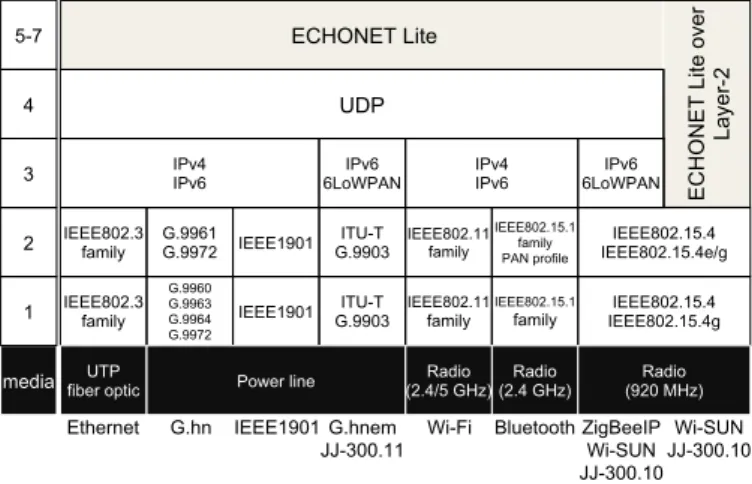
establishing it in home networks. ECHONET was certified by International Electrotechnical Commis- sion (IEC) and Inter-national Organization for Standardization (ISO) and has be-came a de jure standard since January 2009. The basic system architecture of ECHONET consists of a controller accesses to various programmable devices to deliver a notification based on the specified conditions through any communication media. These large amount of devices are modelled as object. How-ever, the ECHONET specification is not universally useable more than ten years due to two major factors. Firstly, the specification requires more complicated system configuration for multiple controllers and multiple devices. Another factor is that the Internet Protocol (IP) address is not considered. In December 2011, ECHONET is therefore redesigned to new ECHONET Lite with the protocol and technology of transmission media as illustrated in Figure 2.
IEEE802.3 family! Ethernet! ITU-T G.9903! G.9961 G.9972 IEEE802.15.1 family PAN profile IEEE1901! IEEE802.15.4 IEEE802.15.4e/g 2! media! 3! 4! 5-7! 1! IEEE802.11 family! IEEE802.3 family! ITU-T G.9903! G.9960 G.9963 G.9964 G.9972! IEEE802.15.1 family
IEEE1901! IEEE802.11 family! IEEE802.15.4g IEEE802.15.4
UTP
fiber optic! Power line!
Radio (2.4 GHz) Radio (920 MHz) Radio (2.4/5 GHz)! IPv4 IPv6! IPv6 6LoWPAN! IPv6 6LoWPAN! IPv4 IPv6! UDP! ECHONET Lite!
ECHONET Lite over
Layer-2 ! G.hn! IEEE1901!G.hnem JJ-300.11! Wi-Fi! Bluetooth!ZigBeeIP Wi-SUN JJ-300.10! Wi-SUN JJ-300.10!
Fig. 2. ECHONET Lite Communication Layer
B. Existing Implementation (iHouse): The concept of smart
home has been defined by F.K. Aldrich in [5] that the residence is integrated with information and computing technology cor-respondence to the approaching IoT era by the unimaginable growth of interconnected devices. The primary idea of the invention of smart home is to provide the energy saving and convenience environment with high reliable and security communication.
The current implementation of iHouse which is shown in Figure 3, can be defined as ishikawa, internetted, inspiring, intelligent House. In order to provide an advanced exper-imental environment for future smart homes, iHouse has been implemented according to Standard House Design by Architectural Institute of Japan. The location of iHouse is built at Nomi city, Ishikawa prefecture. In iHouse, there consists of sensors, electronic devices and home appliances connecting to each other by utilising ECHONET Lite version 1.1 and ECHONET version 3.6. This configuration network results more than 300 sensors and actuators.
Fig. 3. iHouse
CARESSES
(uAAL)! iHouse Environment
WLAN AP Mrs. Yamada! Sensors Bath Tub! Local Server (uAAL) WAN Communication ECHONET Lite-oriented Objects! Pepper Robot! uAAL Adaptation! uAAL Middleware! Third Party Apps! uAAL Apps! ! KNX, ZigBee, etc.! ECHONET Lite! Pepper Robot! " # = API
Fig. 4. Overview of Research
2.3. CARESSES Project
3. SYSTEMINTEGRATION
3.1. Scenario
With correspondence to CARESSES project, the system integration has been investigated according to the scenario of Mrs Yamada. Mrs Yamada who is a 75 years old Japanese lady, was diagnosed with thyroid cancer 7 years ago, and had a total thyroidectomy. After the operation, she has been taking thyroid hormone replacement every morning, she will feels very tired and cold without the hormone. She is staying alone in Kobe while her husband works in Osaka will only stays with her during weekends, her son and daughter are both married and live in Tokyo. Due to one of the effects from the operation, she sometimes feels depression and misses her family more than usual. Hence, her husband recently suggested her to stay in a care facility during weekdays where she moved in. In that facility, the robot will takes care on her daily life during weekdays as well as monitoring her hormones and physical condition tracking with her doctor in Tokyo.
The cultural identity of the robot is built on the general as-sumption according to Hofstede’s Cultural dimensions theory in which the specific cultural elements of Mrs Yamada to be taken into consideration are:
• Cultural awareness (cultural identity): age, education, former occupation, heritage;
• Cultural knowledge: values, beliefs, self care behaviours, attitude towards health and health problems;
• Cultural sensitivity: language, accent, interpersonal skills, communication skills, ability to trust others, ability to be compassionate to others. !"##"$% &'(')% *$+,% -./.0.% -".12%3)%4+%.%54))5"%1')%46%)14+%$''/7%8455% 9':%;1";<%)1"%)"/#"$.):$"%='$%/">%% *.9%3%1"5#%9':7%*$+,%-./.0.> ?:$",%3)%4+%@A%0"B$""%C"5+4:+% 6'8,% D17%;.6%9':%;1";<%)1"%)"/#"$.):$"% +"))46B%.)%)1"%.4$E;'604)4'6"$7%#5".+">% D=%;':$+"2%3)%4+%@F%0"B$""% C"5+4:+,% -"+,% D<.97%3%+"",%G455%9':%+")%4)%/'$"%;''5"$% #5".+">%H")%+")%4)%@I%0"B$""%C"5+4:+,% C'6)"J)+%46%)1"%$"0%('J%+1':50%("%.(+)$.;)"0%
Fig. 5. Conversation Example
Figure 5 illustrated the scenario describing a possible in-teraction between Pepper robot and Mrs Yamada. The con-versation example is demonstrating interaction between them to set the temperature of air-conditioner in living room. The operation to complete the predefined scenario can be divided into three sections: (1) Check the temperature in the living room via temperature sensor; (2) Check the temperature setting in the air-conditioner; and (3) Control the temperature setting in the air-conditioner. In order to carry out the operations as explained earlier, the integration of uAAL adaptation and ECHONET Lite in the iHouse has been investigated. Figure 6 showed the operation in the first section where the command is made from the uAAL adaptation to read the value from the temperature sensor located in the living room of iHouse and then the temperature sensor notifies and replies the room temperature value to the uAAL adaptation.
Publisher: uAAL Subscriber: Sensor Publisher: Sensor Subscriber: uAAL ! " # $% &%'()% *+,-./% 0''1%'2345356.,% !% "% #% $%
Command by uAAL for read a value from sensor Register and set value
Sensor notifies value Subscriber succeed by uAAL
! " # $%
Fig. 7. System Architecture
3.2. System Architecture
The system architecture can be visualised as shown in Figure 7. The main focus of the system architecture is the integration between the uAAL adaptation to ECHONET Lite in iHouse environment. The operation from the uAAL adap-tation will be handled through controller based on the context management of context bus containing context events with the publish-subscribe messaging pattern. The controller in OS container will interpret the command information according to the communication built with context bus by matching and filtering the context events with the restrictions provided, then resulting a series of information that is required to be transmitted to the ECHONET in order to perform several func-tionality inside the iHouse. The information extracted from controller in uAAL adaptation will undergoes an application programming interface (API) to establish the communication between the uAAL platform and ECHONET in home gateway. In the ECHONET adaptation, the information received will be translated regarding to the syntax required for the ECHONET communication protocol that supporting in iHouse. In order to process for the syntax translation, a database for the list of devices as well as the objects used in ECHONET assembled earlier will be accessed when peering with the message transmitted from uAAL adaptation. The format of the syntax protocol translation and the critical information to be extracted for the integration will be discussed further in the section below.
3.3. System Protocol Translation
The uAAL application which provides several services will delivers a command in term of message to give instruction for the interaction with the intelligent devices in the iHouse via uAAL platform. The flow of the uAAL semantic information through the middleware by defining the context bus and service bus as the peers communication from the application layer to the adaptation layer. This can be handled with correspondence to the ontology management for the serialisation component encrypts and parses messages across the nodes. The system syntax protocol translation is carried out in the API between uAAL adaptation and ECHONET adaptation.
!"#!!$"%&!'()*+,(-,../0,(1,/2,3(45(67+,8" '9#!+3/:./;<=:(9#(45(67+,8" >!%?!.@,;*A,.(.=B3;,(!$"%&!'()*+,(=6C,;+(4D(67+,.8" !E$!!$"%&!'()*+,(@3=@,3+7(45(67+,8" E#$!@3=@,3+7(2/+/(;=B:+,3(45(67+,8" !#'!@3=@,3+7(F/GB,(2/+/" #!%?!.@,;*A,.(2,.<:/<=:(!$"%&!'()*+,(=6C,;+(4D(67+,.8" !>H!!$"%&!'()*+,(.,3F*;,(45(67+,8( %E$!:B-6,3(=I(@3=;,..*:0(@3=@,3<,.(45(67+,8( !"#$%&'"#&'#()#*+',*#&-.&'"-/&*00(& uAAL Adaptation" uAAL Middleware" uAAL Apps" ECHONET Lite" ! API 1#+2&'"#&'#()#*+',*#&03&/#./0*/&-.&'"-/&*00(&
J"
EHD2" TID" SEOJ" DEOJ" ESV" OPC" EPC1" PDC1" EDT1" EHD 1" 456&7877& 496&7855& 4:6&7877& 456&*#/*;& 496&*#/*;& 4:6&*/#*;&
78<9& 78=7& 7875& 7875&
,>>?&@0$+@&/#*;#*& /#./0*/& *#+2&
EPCn" PDCn" EDTn"
=A>B>(
'#()#*+',*#&
*#/*;&C&,/#&03&*#/#*;#2&D-'/& C&/E.'+8&'*+./@+'-0.&
Fig. 8. Syntax Protocol Translation: uAAL Adaptation to ECHONET Lite
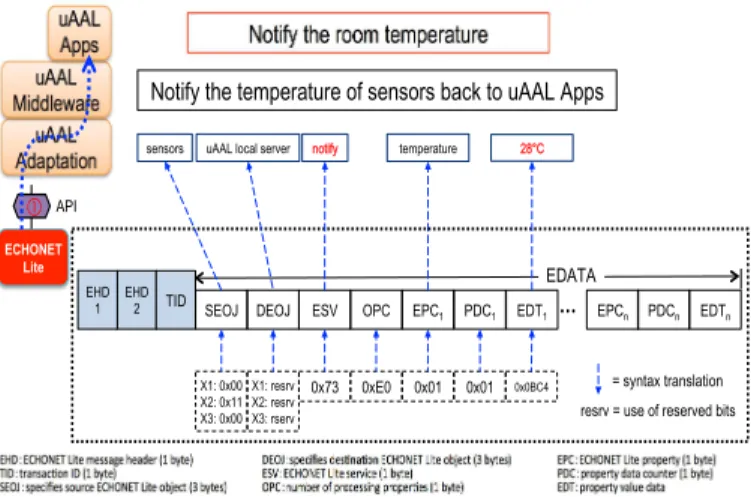
This syntax translation is essential for the communication from uAAL to ECHONET and vice versa. Figure 8 illustrated the syntax protocol translation from the uAAL adaptation to ECHONET Lite protocol in iHouse. During this process, the command to check the temperature in the room will be sent from uAAL application and then the controller in uAAL adaptation will extracts the crucial information such as local server, sensor type, operation and predicate to be delivered to the API. In API, each of the extracted components will be referred to the defined EDATA of ECHONET Lite format and translated respectively. With the information translated into the required format in ECHONET, the operation can be processed to interact with the devices installed within iHouse.
!"#!!$"%&!'()*+,(-,../0,(1,/2,3(45(67+,8" '9#!+3/:./;<=:(9#(45(67+,8" >!%?!.@,;*A,.(.=B3;,(!$"%&!'()*+,(=6C,;+(4D(67+,.8" !E$!!$"%&!'()*+,(@3=@,3+7(45(67+,8" E#$!@3=@,3+7(2/+/(;=B:+,3(45(67+,8" !#'!@3=@,3+7(F/GB,(2/+/" #!%?!.@,;*A,.(2,.<:/<=:(!$"%&!'()*+,(=6C,;+(4D(67+,.8" !>H!!$"%&!'()*+,(.,3F*;,(45(67+,8( %E$!:B-6,3(=I(@3=;,..*:0(@3=@,3<,.(45(67+,8( !"#$%&'#()'*""+'#)+,)*-#.*)' uAAL Adaptation" uAAL Middleware" uAAL Apps" ECHONET Lite" ! API !"#$%&'#()'#)+,)*-#.*)'"%'/)0/"*/'1-23'#"'.445'4,,/'
J"
EHD2" TID" SEOJ" DEOJ" ESV" OPC" EPC1" PDC1" EDT1" EHD 1" 678'9:99' 6;8'9:77' 6<8'9:99' 678'*)/*=' 6;8'*)/*=' 6<8'*/)*=' 9:><' 9:?9' 9:97' 9:97' .445'@"2-@'/)*=)*' /)0/"*/' 0"#$%&' EPCn" PDCn" EDTn" ?A4B4( #)+,)*-#.*)' *)/*='C'./)'"%'*)/)*=)D'1$#/' C'/&0#-:'#*-0/@-#$"0' ;EFG' 9:9HGI'
Fig. 9. Syntax Protocol Translation: ECHONET Lite to uAAL Adaptation
Once the destination device or sensor has received the command frame from ECHONET adaptation, it will perform the operation according to the received information. Then it will reply with the notification together with the required result and updated them in the ECHONET Lite frame format. Figure 9 showed the reversed syntax protocol translation from ECHONET Lite to uAAL adaptation. In this case, the information in ECHONET Lite format will be extracted and
translated into the specific format required in uAAL adaptation in the API. By collecting the updated information of the temperature from the message, uAAL adaptation will then transmit the value and involved objects back to the context bus and then to the uAAL application.
3.4. Ontology
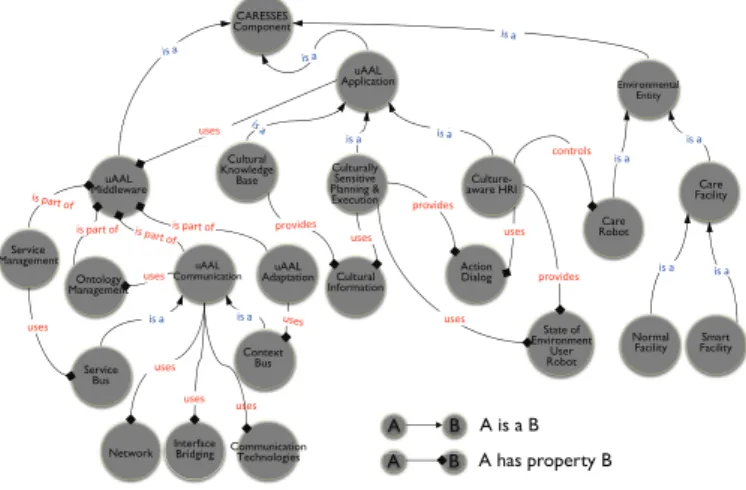
The knowledge in uAAL is shared in the form of ontolo-gies which can be represented in some standard format like serialized RDF. However, there is a code representation in universAAL ontologies in order to allow them to be handled by the Middleware. Ontological model is also known as information model to represent real-life information that can be understood by computers. The overview of the ontology is shown in Figure 10. Cultural Knowledge Base Interface Bridging Environmental Entity Service Bus Context Bus Care Robot uAAL Communication Culturally Sensitive Planning & Execution Care Facility Network Ontology Management Service Management A is a B B A A has property B B A uAAL Middleware uAAL Adaptation Cultural Information Culture-aware HRI Action Dialog is a uses uses is part of is a is a is a is a Communication Technologies uses uses uses provides controls CARESSES Component uAAL Application State of Environment User Robot provides uses uses uses Normal Facility FacilitySmart
is a is a
uses
Fig. 10. Overview of Ontology
4. CONCLUSION
This paper gave an overview framework of the bridging in between the universAAL and the ECHONET standard for culture aware AAL services in smart home environment.
ACKNOWLEDGEMENT
This work is part of CARESSES project that was supported in part by a Horizon 2020, Research and Innovation Action (RIA) with topic SCI-PM-14-2016 from both the European Commission and the Ministry of Internal Affairs and Com-munications, Japan. Grant agreement number is 737858.
REFERENCES
[1] R. Costa, D. Carneiro, P. Novais, L. Lima, J. Machado, A. Marques, and J. Neves, “Ambient assisted living,” in 3rd Symposium of Ubiquitous Computing and Ambient Intelligence 2008, pp. 86–94, Springer, 2009. [2] S. Hanke, C. Mayer, O. Hoeftberger, H. Boos, R. Wichert, M.-R. Tazari,
P. Wolf, and F. Furfari, universAAL – An Open and Consolidated AAL Platform, pp. 127–140. Berlin, Heidelberg: Springer Berlin Heidelberg, 2011.
[3] A. Fides, “Knx integration,” 2015.
[4] S. Matsumoto, “Echonet: A home network standard,” IEEE Pervasive Computing, vol. 9, pp. 88–92, July 2010.
[5] R. Harper, Inside the smart home. Springer Science & Business Media, 2006.