64 Original Paper
Introduction
Group care in large-scale conventional elderly care facilities has been reported to make the daily living of dementia sufferers difficult due to various limitations on daily living activities and for other reasons [1]. A report titled “Geriatric Care in 2015: Establishing Care that Maintains the Dignity of the Elderly” published in 2003 by the Geriatric Care Study Group points out the necessity of more “unit care” services in private rooms (in a small-scale living unit) in care facilities so as to provide individualized care. The report also insisted that it was important to clarify care service contents which effectively meet the individual needs of the elderly with dementia.
In Japan, an elderly nursing home that provided “unit care” services in small-scale living units was established in 2002. In 2005, a geriatric health service facility and a medical care facility that provided “unit care” services were institutionalized. Quality of care in each of these facilities is an important element to ensure a comfortable life for the elderly with dementia in unit care facilities, as well as substantiality of the physical environment such as private rooms (in a small-scale living unit). Currently however, services
Abstract
This study was conducted to develop a measure for evaluating the quality of dementia care provided by caregivers in unit care geriatric health service facilities in Japan. A secondary factor model consisting of the following factors was used in the study. Primary factors were: “Creating a safe environment with a home-like atmosphere,” “Helping residents maintain their ordinary life,” “Helping maintain and improve the lifestyles of individual residents,” “Providing support in a way that respects each resident’s unique personality,” “Encouraging social interaction with others” and “Maintaining family relationships,” and one secondary factor, “Quality of dementia care.” The construct validity of the above measure was assessed in terms of the relationship between the factor model and an external criterion using structural equation modeling (SEM) based on data from 984 caregivers. Job satisfaction was used as the external criterion. As a result, the fit of the factor model to the data and the relationship between dementia care quality and job satisfaction were statistically supported. The Cronbach alpha coefficient for the measure was within statistically permissible limits. Based on the above results, we concluded that the measure to evaluate dementia care quality that was developed in the study is effective for evaluating the quality of dementia care provided by caregivers in unit care geriatric health service facilities.
(Accepted Nov. 17, 2010)
Key words: unit care geriatric health service facility, dementia care, measure, caregiver, construct validity
Sachiko HARA
*, Sakae MIKANE
**, Yoshiko FUTOYU
**and Kazuo NAKAJIMA
**Development of a Measure to Evaluate the Quality of Dementia Care
Provided by Caregivers at Unit Care Geriatric Health Service Facilities
*
School of Nursing, Faculty of Medicine, Shimane University, Izumo, Shimane 693-8501, Japan E-Mail: [email protected]and efforts that are provided by unit care facilities differ widely from facility to facility [2] because they are largely dependent on individual staff members’ experience and are still on a trial-and-error basis. In unit care facilities, because the care that is different from group care in large-scale conventional elderly care facilities is demanded, it is important to devise care that utilizes the physical environment of private rooms or small-scale living units. Nevertheless the care is not embodied precisely. Since it is important to ensure and improve the quality of care provided to people with dementia at unit care facilities, we need to urgently create a care quality index that shows specific details of care services that can be applied to actual unit care settings and help maintain a high standard quality of dementia care. Some attempts have been made in Japan to develop guidelines [3–6] for care provided by group homes for elderly people with dementia. However, care for elderly people with dementia is provided in a wide range of settings such as their own homes, group homes and geriatric health service facilities. For this reason, Nagata [7] argues that it is necessary to study what care should be provided to elderly people with dementia in each setting. Despite the necessity, no studies have been conducted on quality indices and guidelines for dementia care at unit care facilities, which have been increasing in recent years. This is a problem affecting the quality of dementia care in unit care facilities, and a measure to evaluate quality of dementia care accurately should be developed.
The objectives of this study are to develop a measure to evaluate dementia care quality that can be applied to unit care geriatric health service facilities, and to assess its construct validity and reliability. Terminology
Unit care: This refers to care provided in a setting where the living environment and daily lifestyle emulates that of a normal household. In other words, unit care is a health service that realizes individual care by combining lifestyle with healthcare (Ministry of Health, Labor, and Welfare Ordinance No. 28, 2003). Specifically, facilities are divided into units of approximately 10 private rooms, each unit having its own dining hall and communal spaces for the purpose of achieving care that respects individual autonomy and sustains interpersonal and social relationships.
Dementia care quality: In assessing the quality of care, the Donabedian model [8] places importance on the following three elements of care: structure, process and outcomes. Structure is defined as the presence or absence of human, physical, financial and organizational resources and detailed information on these resources in care settings. Process is defined as a set of activities involved in the care-providing process and detailed information on these activities. Outcomes refer to the results caused by the structure and process. In evaluating dementia care quality in this study, the focus was placed on the “process” of the Donabedian model so that we can present important elements that should be provided by caregivers in the process of caring for elderly people with dementia on a behavioral level.
Methods 1. Subjects
The survey subjects in this study were full-time professional caregivers who worked in unit care geriatric health service facilities throughout Japan. Unit care geriatric health service facilities are defined as health service facilities providing “unit care” for elderly people. They were listed in the Care Service Information System of each prefecture. The study includes both facilities where all rooms are private rooms with unit care, which are categorized as “unit care type,” and facilities providing both shared and private rooms with unit care, which are categorized as “partial unit care type.” We had requested all 269 unit care geriatric health service facilities registered as of November 2008 with the prefectural Care Service Information
System to participate in the study, and received agreement from 69 facilities (25.7%). The study was conducted for all full-time professional caregivers working in these 69 facilities.
2. Survey items
Survey items consisted of characteristics of facilities and caregivers, dementia care quality, and job satisfaction.
2.1 Characteristics of facilities and caregivers
Characteristics of the facilities were as follows: the year of registration as a unit care facility, facility type based on declaration of compensation status, the day or night shift system for caregivers, use of floor leader system, the mean level of nursing care provided to facility residences in October 2008, and the dementia severity of facility residences. A floor leader is defined as a supervisor who is responsible for a floor with more than one unit.
Characteristic of the caregivers were as follows: age, sex, job position, qualification, years of experience as a caregiver, years of experience working for geriatric health service facilities, and attendance of training for unit leader. According to the standards for the management of unit care geriatric health service facilities, a full-time unit leader must be stationed at each unit.
2.2 Categories of dementia care quality and items representing each category
The authors extracted dementia care provided in unit care facilities, in our preliminary research [9]. In the research, we had conducted a focus group interview for three hours with four caregivers working in unit care geriatric health service facilities, focusing on very important care for elderly with dementia. The data obtained in the interview was classified, and as a result, it was suggested that dementia care can be divided into the following five categories: “Creating a safe environment with a home-like atmosphere”, “Helping residents maintain their ordinary life”, “Helping maintain and improve the lifestyles of individual residents”, “Providing support in a way that respects each resident’s unique personality”, and “Encouraging social interaction with others”.
In this study, after five researchers in geriatric nursing had a discussion based on the analysis results above and a nursing and care manager of a unit care facility confirmed the results, another category of “Maintaining family relationships” was added to the five previously established categories. Through discussions between the author and co-authors, 20 items were chosen as concrete items to arrange in six categories, the following 20 items were selected to be surveyed:
(1) the “Creating a safe environment with a home-like atmosphere” category consists of four items: “Reproduce living situation at home as much as possible to create surroundings familiar to him/her”, “Decorate the resident’s room with what he/she used to have at home in a way that suits his/her tastes”, “Adopt a physical environment similar to the one the resident had at home to enable him/her to live safely”, and “Create together with the resident scenes and atmospheres that evoke nostalgic feelings about the his/her ‘good old days’”;
(2) the “Helping residents maintain their ordinary life” category consists of four items: “Live together with the resident in a family-like manner”, “Stay close to the resident with him/her so that his/her state can be easily observed, for example, during club activities”, “Incorporate seasonal foods into daily meals and seasonal events into daily activities”, and “Stimulate the five senses of the resident in daily life”;
(3) the “Helping maintain and improve the lifestyles of individual residents” category consists of four items: “Assist residents in such a way that they can do what they used to do in their own way”, “Assist individual residents in a way that takes their characteristics into account in a consistent manner among all staff members”, “Find the best way to help individual residents exert their abilities on a
trial-and-error basis while observing their responses to timings and methods of care”, and “Allow time for residents to find ways to initiate the next movement and to solve problems on their own”; (4) the “Providing support in a way that respects each resident’s unique personality” category consists
of two items: “Take time to stay beside residents to share their thoughts and feelings”, and “Listen to what residents need and want now and in the future”;
(5) the “Encouraging social interaction with others” category consists of three items: “Provide opportunities for residents within the same unit to interact with each other”, “Assist residents to interact with those in other units”, and “Provide opportunities for residents to interact with people outside the facility”;
(6) the “Maintaining family relationships” category consists of three items: “Build closer relationships with residents’ family members”, “Exchange information with the resident’s family about his/her living conditions and the care he/she receives”, and “Understand the circumstances of residents’ families and supporting them”.
Responses to the above items on care quality were analyzed using a five-point Likert scale for frequency, because respondents can measure care activities in terms of frequency. Respondents were asked about the actual frequency of care activities, not about the desirable frequency, using the question “how often do you perform the following activities when providing care to elderly people with dementia?” Respondents were allowed to choose one of the following five answers: always (5 points), often (4), sometimes (3), seldom (2), and almost never (1). The higher the scores respondents get, the higher the quality of care they provide. 2.3 Job satisfaction
Job satisfaction was measured using the scale developed by Macdonald et al. [10] which reliability and validity had been verified. The scale consists of 10 items, each of which uses a five-point Likert scale with the following criteria: “strongly agree (5 points),” “agree (4),” “neither agree nor disagree (3),” “disagree (2),” and “strongly disagree (1).” After responding to all the questions, the total score (10 to 50 points) is obtained. This scale can be applied to a wide variety of job tasks conducted by those aged 20 to 60 years old, regardless of sex. For use this study, the author and others translated the job satisfaction scale into Japanese by permission of the developer without changing the original meaning. The job satisfaction scale translated into Japanese was checked by the man who could manage both Japanese and English.
3. Survey procedures and ethical considerations
A letter requesting participation in this study that included an explanation about the objectives and method of the study was sent by postal mail, along with a consent form and a survey sheet about the characteristics of the facility, to the directors of unit care geriatric health service facilities throughout Japan. Only those who agreed to participate were asked to return the consent form signed by the facility director and the completed survey sheet. After receiving consent, the questionnaire sheets on the characteristics of caregivers and quality of dementia care the same number as the number of full-time caregivers in each facility were sent along with request letters for participation and return envelopes. Participation by caregivers was voluntary and their consent was implied by their returning the completed survey. It was an anonymous self-report questionnaire and respondents were asked to return the completed questionnaire by mail individually. The survey period was from November 2008 to February 2009. This study was approved by the Shimane University Faculty of Medicine Nursing Research Ethics Committee. 4. Statistical analysis
The construct validity of the measure was assessed in this study from the perspective of a factor model through confirmatory factor analysis using structural equation modeling (SEM). The factor model consisted
of “Creating a safe environment with a home-like atmosphere,” “Helping residents maintain their ordinary life,” “Helping maintain and improve the lifestyles of individual residents,” “Providing support in a way that respects each resident’s unique personality,” “Encouraging social interaction with others,” and “Maintaining family relationships” as primary factors, and “Quality of dementia care” as the secondary factor.
In this study, the construct validity of the measure was also assessed in terms of the relationship with the external criterion. Mayeroff [11] believed that caring is for care providers to achieve the fulfillment of their professional duties. Based on these ideas, we established a hypothesis (causal model) that the quality of dementia care provided by caregivers affects their job satisfaction, and the fit of the causal model to the data was analyzed using SEM. In the analysis, age, sex, years of experience as a caregiver, years of experience working for geriatric health service facilities, and experience or no experience receiving training for unit leaders were entered as control variables.
In assessing the fit of the factor model and the causal model to the data described above, used were the comparative fit index (CFI) and root mean square error of approximation (RMSEA), which are less susceptible to influence from the sizes of samples and observed variables. When the CFI is ≥ 0.9 and RMSEA is ≤ 0.08, the model is generally considered to fit the data. The significance of path coefficients was assessed by the Wald test. A path coefficient was considered statistically significant when the critical ratio (CR) was ≥ 1.96 (5% significance level).
The reliability of the measure to evaluate dementia care quality was assessed by calculating the Cronbach alpha coefficients for the overall measure and each subscale.
In this study, statistical analyses using SEM were conducted using Amos 17.0 and other statistical analyses using SPSS 17.0.
Results
2,000 copies of the questionnaire were distributed to full-time caregivers at 69 unit care geriatric health service facilities, 1,088 copies (return rate: 54.4%) were completed and returned. After excluding invalid questionnaires, 984 (valid response rate: 49.2%) were used for the study.
1. Characteristics of respondents
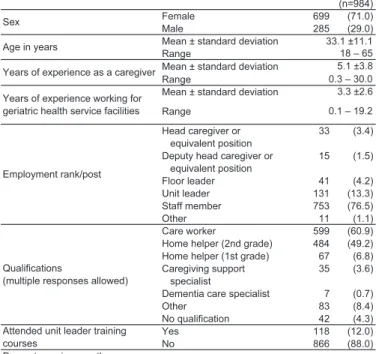
The characteristics of the respondents are shown in Table 1. The mean age was 33.1 years and female respondents accounted for 71%. The years of experience as a caregiver ranged from 0.3 to 30.0 years with the mean 5.1 years. The mean number of years of experience working for geriatric health service facilities was 3.3 years. Staff employees accounted for 76.5%. Those who had received unit leader training accounted for 12%. Qualified care workers accounted for the largest proportion, 60.9%, followed by qualified home helpers (2nd grade), 49.2%.
A brief profile of unit care geriatric health service facilities where the respondents were working is shown in Table 2. Of the 69 facilities from which we received responses, 31 facilities were categorized as “Unit care” type and 38 as “Partial unit care” type. During the day shift, 46 facilities (66.7%) assigned the same caregivers to each unit and 20 facilities (29.0%) to each floor. During the night shift, 42 facilities (60.9%) assigned one caregiver to two units and 15 facilities (22.7%) assigned one for each. Sixty facilities (87.0%) responded that they used a floor leader system. The mean nursing care level of residents was 3.16 (SD = 0.36). As for dementia severity according to the activities of daily living (ADL) scale for elderly people with dementia (established in October 1993 by the then Ministry of Health and Welfare), the largest number of
Table 1 Characteristics of subjects
Table 2 Outline of facilities
facilities (25 facilities, 36.2%) responded that residents with Rank III (occasional symptoms, behaviors and communication difficulties that hamper daily living for which care is needed) or higher accounted for 40 to 60%.
2. Trends in responses to questions concerning dementia care quality
The response distribution to the questions concerning the quality of dementia care provided by caregivers at unit care geriatric health service facilities is shown in Table 3. The combined number of responses of “Always” and “Frequently” to item X7: “Incorporate seasonal foods into daily meals and seasonal events into daily activities” was 714 (72.5%), larger than any other item, followed by item X15: “Provide opportunities for residents in the same unit to interact with each other,” which was 686 (69.8%), and X10:
Table 3 Response distribution of items related to the frequency of dementia care in unit care geriatric health service faciliti
”Assist individual residents in a way that takes their characteristics into account in a consistent manner among all staff members,” which was 585 (59.5%). For the combined number of responses of “Never” and “Almost never,” the largest number of respondents chose either of these two responses to item X17: “Provide opportunities for residents to interact with people outside the facility,” which was 580 (58.9%), followed by the combined number of 553 (56.2%) to item X3: “Adopt a physical environment similar to the one the resident had at home to enable him/her to live safely,” while to item X1: “Provide living conditions the resident would have at home as much as possible to create surroundings familiar to him/her,” it was 534 (54.3%).
3. Assessment of the fit of the factor model of the measure to evaluate dementia care quality to the data
Fig. 1 Factor model of the measure to evaluate dementia care quality (Standardized solutions)
n=984, CFI=0.928, RMSEA=0.054
Notes: † indicates areas that have been abbreviated for distinguishing the model.
The secondary factor model (Fig. 1) consisting of the following factors was established and the fit of the model to the data was assessed: “Creating a safe environment with a home-like atmosphere,” “Helping residents maintain their ordinary life,” “Helping maintain and improve the lifestyles of individual residents,” “Providing support in a way that respects each resident’s unique personality,” “Encouraging social interaction with others,” and “Maintaining family relationships” as primary factors, and “Quality of dementia care” as the secondary factor. As a result of the assessment, the CFI was 0.928 and the RMSEA was 0.054. The path coefficients from the secondary factor to the primary factors and those from the primary factors to the observed variables were all considered statistically significant.
4. Assessment of the relationship between dementia care quality and job satisfaction
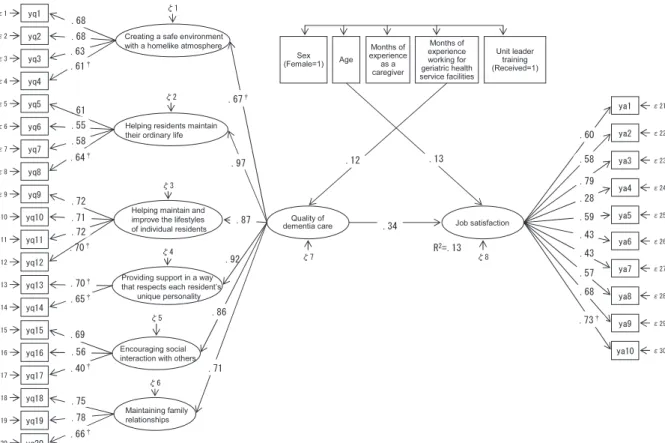
Fig. 2 Relationship between the quality of dementia care and job satisfaction (Standardized solutions)
n=984, CFI=0.900, RMSEA=0.044
Notes: 1) † indicates areas that have been abbreviated for distinguishing the model.
2) To avoid overcrowding the figure, statistically nonsignificant paths (p>.05) and correlation coefficients (covariances) between independent variables are not shown.
The response distribution to the questions concerning job satisfaction is shown in Table 4. The mean score for job satisfaction was 28.0 points and the standard deviation was 6.2, with a range from 10 to 50 points. The fit of the causal model (Fig. 2) for the quality level of dementia care provided by caregivers and the job satisfaction to the data was assessed. As a result, the CFI was 0.900 and the RMSEA was 0.044. The path coefficient (0.34) from dementia care quality to job satisfaction level was considered statistically significant. The contribution percentage of all the entered variables to job satisfaction was 13%. Of the five variables entered as control variables, a statistically significant relationship was observed between age (path coefficient: 0.13) and job satisfaction and between months of experience working for geriatric health service facilities (path coefficient: 0.12) and dementia care quality.
5. Assessment of the reliability of the measure to evaluate dementia care quality
The Cronbach alpha coefficient for the overall measure consisting of six factors and 20 items was 0.90. The Cronbach alpha coefficients for the subscales were as follows: the four items under “Creating a safe environment with a home-like atmosphere” was 0.74; the four items under “Helping residents maintain their ordinary life” was 0.68; the four items under “Helping maintain and improve the lifestyles of individual residents” was 0.80; the two items under “Providing support in a way that respects each resident’s unique personality” was 0.63; the three items under “Encouraging social interaction with others” was 0.56; and the three items under “Maintaining family relationships” was 0.77. Although these values
are not high, it was concluded that they were statistically permissible limits, judging from the numbers of items.
The mean score for the dementia care quality measure as a whole was 63.3 points and the standard deviation was 12.2, with a range from 22 to 100 points. The mean score, standard deviation and range for the subscale of “Creating a safe environment with a home-like atmosphere” were 10.1, 3.2, and 4 to 20, respectively; those for “Helping residents maintain their ordinary life” were 13.6, 3.0, and 4 to 20; those for “Helping maintain and improve the lifestyles of individual residents” were 14.1, 3.2, and 4 to 20; those for “Providing support in a way that respects each resident’s unique personality” were 6.6, 1.8, and 2 to 10; those for “Encouraging social interaction with others” were 9.4, 2.2, and 3 to 15; and those for “Maintaining family relationships” were 9.5, 2.6, and 3 to 15.
Discussion
1. Significance of the development of a measure to evaluate quality of dementia care
This study was conducted in order to develop a measure to evaluate dementia care quality that can be applied to unit care geriatric health service facilities and to assess the construct validity and reliability of the developed measure. In the study, we developed a measure consisting of six factors with 20 items to evaluate dementia care quality. Its construct validity was assessed based on the relationship between a factor model and the external criterion, and its reliability (internal validity) was assessed by Cronbach alpha coefficients. As a result, both the construct validity and reliability were statistically supported. An environment in response to the symptom and deterioration of ability is necessary for elderly with dementia, and it may be said even if the environment itself becomes a valuable care means. As for this measurement, it is a peculiarity that some care methods which made good use of the physical environment of private rooms and small-scale living units were embodied. They are "Creating a safe environment with a home-like atmosphere" and "Encouraging social interaction with others".
The “Survey on Caregiver Stress” [12] conducted in 2005 by the Care Work Foundation revealed that 85% of caregivers working at group homes and special unit care elderly nursing homes felt anxious about whether they provide appropriate care. We can easily see that caregivers at unit care geriatric health service facilities are more or less in the same situation. It is expected that the use of the measure to evaluate dementia care quality developed in this study can help caregivers confirm the appropriateness of care they provide to elderly people with dementia through their self-assessment, thus reducing their anxiety. This can eventually ensure the provision of care that should be provided and the improvement of necessary caring skills.
According to the 2007 National Survey of Health Service Facilities and Businesses (Ministry of Health, Labor and Welfare), 93.2% of users of geriatric health service facilities have dementia. In our study, unit care geriatric health service facilities where 40% or more of elderly residents with dementia are classified as Rank III on the ADL scale accounted for 59.3%. This result indicates that caregivers of geriatric health service facilities need to always provide high quality dementia care. It was inferred from the study that the measure we developed can be useful for caregivers to make retrospective self-assessments of their daily care activities and can contribute to improving dementia care quality.
2. Relationships between quality of dementia care provided by caregivers and job satisfaction
In this study, the construct validity of the measure to evaluate dementia care quality was assessed in the relationship with job satisfaction as the external criterion, in addition to the aspect of the factor model. As an analysis result, the fit of the causal model to the data with dementia care quality as the independent
variable was within statistically permissible limits. It was indicated that the higher self-evaluation of the quality of dementia care, the higher job satisfaction. There is no doubt that high quality care favorably affects facility residents’ satisfaction, and previous studies [13,14] reported an interdependent relationship between job satisfaction felt by care service providers and satisfaction felt by those receiving their services. With these taken into consideration, we assumed that our conclusion that the provision of high quality care affects the job satisfaction of caregivers can be theoretically justified. This conclusion not only supports the construct validity of the measure to evaluate dementia care quality but also means that the notion that the quality of care provided by a caregiver defines his/her job satisfaction cannot be denied, even taking into account the five control variables (sex, age, months of experience as a caregiver, months of experience working for geriatric health service facilities, and experience or no experience receiving training for unit leaders). Therefore, it is guessed that the measurement of quality of dementia care bring useful data for caregivers, in order to enhance job satisfaction, in other words, in order for them to continue working lively and finding the job meaningful.
3 Limitations of this study
Twenty items to compose a measure to evaluate dementia care quality were originally extracted from one focus group interview, discussion of authors, and one consultation with a manager. Therefore, it is necessary to review about the validity of these items more adequately in the future. Another limitation of this study is to have used an English job satisfaction scale translated into Japanese. In addition, there is a certain limitation for the generalization of this research result, because the facilities which cooperated with this study are 69 facilities (25.7% of all unit care facilities).
Conclusion
With the aim of developing a measure to evaluate quality of dementia care provided by caregivers in unit care geriatric health service facilities, we first established a secondary factor model consisting of the primary factors “Creating a safe environment with a home-like atmosphere,” “Helping residents maintain their ordinary life,” “Helping maintain and improve the lifestyles of individual residents,” “Providing support in a way that respects each resident’s unique personality,” “Encouraging social interaction with others,” and “Maintaining family relationships,” and the secondary factor “Quality of dementia care,” and then its construct validity was assessed in terms of the relationship between the factor model and an external criterion (job satisfaction) using structural equation modeling (SEM). As a result, the fit of the factor model of a measure consisting of six factors with 20 items to the data and the relationship between dementia care quality and job satisfaction were statistically supported. Moreover, the Cronbach alpha coefficient for the measure was within statistically permissible limits. We therefore believe that the measure we developed in this study can be useful for caregivers in making retrospective self-assessments of their care activities on a daily basis and can provide useful information to caregivers in order to enhance their job satisfaction.
Acknowledgements
The authors would like to thank the geriatric health service facilities that participated in this study for their kind cooperation.
References
Psychiatry 15:929-935, 2004. (in Japanese)
2. Shibao K: Shisetsusa-bisu no shitsu wo meguru kenkyuu・seisaku・jissen no doukou: shitsutekihyouka ni tsuite. Jpn J Social Welfare 48:185-188, 2007. (in Japanese)
3. Nagata C: Kea no shitsu no hosyou –ninchisyoukoureisya kea purosesu no shitsu hyouka shihyou no kentou wo tooshite. Bull Kumamoto Univ, School Health Sci 2:7-18, 2006. (in Japanese)
4. Nagata C: Ninchisyoukoureisya guru-pu ho-mu ni okeru kea purosesu no shitsu –kea purosesu gaidorain sakusei no kokoromi. Res J Care Welfare 13:157-168, 2006. (in Japanese)
5. Nagata C: Ninchisyoukoureisya guru-pu ho-mu ni okeru kea purosesu no shitsu no hyouka. Bull Kumamoto Univ, School Health Sci 3: 71-87, 2007. (in Japanese)
6. Nagata C, Oshi H: Ninchisyoukoureisya guru-pu ho-mu kea no shitsu –kea purosesu gaidorain no kaihatsu. Prog Social Welfare Res 2:50-67, 2007. (in Japanese)
7. Nagata C: Guru-pu ho-mu ni okeru ninchisyoukoureisya kea to shitsu no tankyuu. Kyoto, Mineruba syobou, 247-248, 2009. (in Japanese)
8. Donabedian A: Explorations in Quality Assessment and Monitoring: The Definition of Quality and Approaches to Its Assessment (vol 2). Washington, Health Administration Press, 1980.
9. Hara S, Ono M, Yoshioka S, Futoyu Y: Yunittogata kaigoroujinhokenshisetsu no keasutaffu ga juuyou to kangaeru ninchisyou kea no jissen naiyou. Bull Shimane Univ Faculty Med 31:1-9, 2008. (in Japanese)
10. Macdonald S, Maclntyre R: The genetic job satisfaction scale: scale development and its correlates. Empl Assist Q 13:1-16, 1997.
11. Mayeroff M: Kea no honshitsu: ikirukoto no imi. Tokyo, Yumiru syuppan, 13, 1987. (in Japanese)
12. Zaidanhoujin kaigo roudou antei senta-: Kaigo roudousya no sutoresu ni kansuru tyousa houkokusyo. 2005. (in Japanese)
13. Fujimura K: Syokuin no manzoku ha naze juuyou ka. Nursing Today 14:12-15, 1999. (in Japanese)
14. Onda M, Matsuda T, Taguchi Y, Yamakado K: Byouin ni okeru soshiki kanri shisei to kanja manzoku tono kanren –gairai kanja manzokudo to syokumu manzoku no kanren ni chakumoku shita bunseki. Hospital Administration 42:267-275, 2005. (in Japanese)