1. はじめに マアジ Trachurus japonicus はアジ科マアジ属 の一種で,日本では重要な水産資源であり,東シ ナ海から日本海に分布するマアジを対馬暖流系 群,太平洋沿岸に分布するマアジを太平洋系群と 分け,資源評価が行われている。年間漁獲量をみ ると,マイワシやさば類とは異なり,黒潮流域で ある太平洋側に比べて,対馬暖流域である日本海
千葉県館山湾におけるマアジの魚群行動と海洋構造
根本雅生
1)*・澁谷勝晶
1)・中野知香
1), 3)・古見拓郎
1)・
上嶋紘生
2)・宮崎唯史
2)・北出裕二郎
1)The relationship between the behavior of fish school, Jack mackerel Trachurus
japonicus and oceanic conditions in Tateyama Bay, Chiba Prefecture, Japan
Masao NEMOTO1)*, Katsumasa SHIBUYA1), Haruka NAKANO1), 3), Takuro FURUMI1), Hiroki JOSHIMA2), Tadashi MIYAZAKI2)and Yujiro KITADE1)
Abstract: In this study, the relationship between the behavior of fish school, Jack mackerel Trachurus japonicus and oceanic conditions was investigated in Tateyama Bay, Chiba Prefecture, Japan. We showed that the fish school entered from offshore to the inside of Tateyama Bay with the flood tide inflow of water masses having lower temperature and higher salinity at the bottom layer. The fish school appeared in the inside of Tateyama bay along with mixed water masses of Tokyo Bay, Sagami Bay, and the offshore Kuroshio water. The Kuroshio water mass was distributed over the depth from several tenth of meter to around 100 m depth off Tateyama Bay. These results indicated that the fish school behaves with a diurnal tidal cycle in accordance with the movement of the Kuroshio water, and as a result, Jack mackerel was fished near the bottom layer where the mixed water was flowed into the bay.
Keywords: Jack mackerel, behavior of fish school, tidal period, Tateyama Bay
1)東京海洋大学海洋環境科学部門 〒108Ȃ8477 東京都港区港南 4Ȃ5Ȃ7
Department of Ocean Sciences, Tokyo University of Marine Science and Technology, 4Ȃ5Ȃ7 Konan, Minato-ku, Tokyo 108Ȃ8477, Japan
2)東京海洋大学練習船青鷹丸 〒108Ȃ8477 東京都港区港南 4Ȃ5Ȃ7
Training Vessel Seiyo-Maru, Tokyo University of Marine Science and Technology, 4Ȃ5Ȃ7 Konan, Minato-ku, Tokyo 108Ȃ8477, Japan
3)現所属:(財)日本気象協会
〒170Ȃ6055 東 京 都 豊 島 区 東 池 袋 3Ȃ1Ȃ1 サ ン シャイン 60 55 階
Japan Weather Association, Sunshine 60 Bldg. 55, 3Ȃ1Ȃ1 Higashi-Ikebukuro, Toshima-ku, Tokyo 170Ȃ 6055, Japan
*連絡著者:根本雅生
〒108Ȃ8477 東京都港区港南 4Ȃ5Ȃ7 東京海洋大学
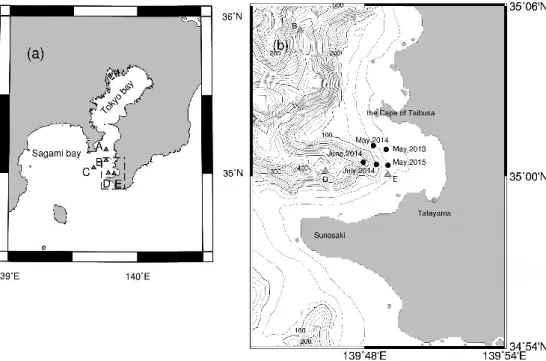
側で圧倒的に多くなっている。この漁獲量の偏り は,分布の偏りともとらえられる。これは,本種 が一般的には多獲性浮魚類の範疇に含まれてはい るが,むしろ底魚的な生態を有するためである(塚 本,2007; 渡邊ら,2015; 依田ら,2015)。つまり, 未成魚期のマアジは東シナ海を中心にして日本海 ならびに本州太平洋側の沖合まで広域に分布して いるものの,成魚期になると陸棚上の底層や沿岸 が主な分布域となるため(西田,2006),大陸棚の よく発達した東シナ海から日本海西部ではマアジ の漁獲が多くなる(塚本,2011)。 また,沿岸地先に来遊したマアジ魚群の行動に ついて,受動的な漁具である定置網周辺海域にお いて,漁獲対象とする魚群の行動生態を把握する 目的で研究が行われた。標識放流(徳永,1983), テレメトリー(市原ら,1975;町中ら,1977),水 中カメラ(井上,1992),魚群探知機(井上・有元, 1985),スキャニングソナー(井上,1987;井上, 1988;金ら,1993)を用いて研究が進められ,定 置網に関連する魚群行動や漁具性能に関連する知 見が得られている。しかし,これら多くの研究は, 定置網漁場内の魚群の移動経路から定置網に入網 するまでの過程についての報告であった。 しかしながら,沖合から接岸し,沿岸地先に来 遊する過程での魚群行動に関して明確に示した知 見は比較的少ない(為石,1988)。沿岸域に来遊す る魚群の行動を解明することは,沿岸漁業の効率 的な操業および経営安定にとって有効であり,海 洋観測および釣獲試験を同時に行い,その過程を 解明することは意義があると考える。そこで,本 研究では沿岸地先に来遊するマアジ魚群の接岸行 動を解明するために,館山湾を研究対象海域とし てマアジ魚群の行動について調査を行った。 2. 調査と解析 2.1 調査海域 東京湾外湾の千葉県側に位置する湾の一つに館 山湾がある。館山湾は,千葉県館山市と南房総市 の海岸線に面し,大房岬と洲崎を結んだ線より東 側を指す。館山湾は湾奥では水深 10m 程度であ るが,湾口では水深 300m 程度になる館山海底谷 を有しており,地形の変化に富んだ湾である (Fig. 1)。この湾は沖合系水の影響を直接受けや すいと考えられ,湾内での流れは,湾口中央部よ り海底谷沿いに湾内に流入した後,湾奥にて分流 するとされている(石野ら,1980)。 2.2 調査方法 東京海洋大学所属練習船「青鷹丸」により,館 山湾におけるマアジ生態調査を 2013 年 5 月, 2014 年 5 月,6 月,7 月,2015 年 5 月の計 5 回実 施した。調査項目は,マアジの生物学的特性(生 息水深,尾叉長 Fork length;FL 等)を調べるた め の 釣 り に よ る 釣 獲 試 験,な ら び に CTD (Conductivity - Temperature - Depth, Falmouth Scientific, Inc. 社製),および海洋微細構造プロ フ ァ イ ラ ー TurboMAP(Turbulence Ocean Microstructure Acquisition Profiler, JFE アドバ ンテック社製)によって得られる水温・塩分の観 測と,ADCP(Acoustic Doppler Current Profiler, RDI 社製)の係留によって得られる流向流速観測 である。 まず,館山湾錨泊前に館山湾およびその沖側に 設定した 3 点(St. C,D,E),および館山湾抜錨後に 東京湾湾口部の 2 点(St. A,B)にて,CTD による 観測を行った(Fig. 1a)。そして,館山湾中央部(水 深 40m 付近)において錨泊し,釣獲試験ならびに TurboMAP の定点観測を実施した(Fig. 1b)。調 査時間帯は,日没から日出までとした。 釣獲試験は釣竿を用いた一本釣りにより行っ た。また,時間帯ごとの人数による漁獲努力量の 偏りが出ないように実施した。釣獲された魚は魚 種を特定したうえで,尾叉長(FL),体重(Body weight;BW)を計測し,釣獲深度を記録した。 釣獲深度は,釣糸のマーカーを目安として求めた。 TurboMAP による水温・塩分の観測は,2013 年 5 月では 60 分間隔,それ以外では 30 分間隔で 実施した。サンプリング周波数は 128Hz である。 TurboMAP は有線式の測器であるため,深度 2m 付近より自由落下させた後,着底するまでデータ をとり続けることができる。 また,ADCP は船からロープを用いて係留し
Fig. 1 Observation Site,(a)Tokyo bay and Sagami bay, and(b)Tateyama bay shown as dashed area of(a)with contours of depth(50m interval). Triangles indicate CTD stations and black circles are survey points of Jack mackerel.
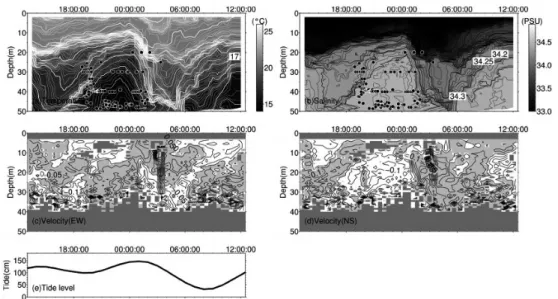
Fig. 2 Temporal change of temperature, salinity and velocity components(E-W, N-S)on 22 May, 2013 are shown in Fig. 2(a) ,(b) ,(c)and (d) . Light gray-shaded areas indicate East component in(c)and North component in(d). Tidal level change at Tateyama is also shown in(e). Black circles in Fig.2(a)and(b)show caught depths.
た。測定間隔は 1 秒で,1m ごと最大 49 層を取得 できるように設定した。ADCP は,おおむね海面 から 1m のところに位置していた。 潮位資料としては,気象庁が公開している天文 潮位(推算潮位)を使用した。 2.3 解析方法 TurboMAP の水温・塩分に関しては,再起型 フィルターを施すことにより塩分のスパイクを除 去した。その後,1m ごとのデータを作成した。 流向流速データに関しては,各層毎に,ヘディン グ,ピッチング,ローリングが 15°以下であり, PG4(Percent Good;4 ビームで計測した際の有
Fig. 3 Same as Fig. 2, but on 29 May. 2014.
効データ比率)が 80%を上回るデータを抽出した のち,1 分間隔で平均したものを使用した。 3. 結 果 2013 年 5 月のマアジの釣獲は,22 日 22 時頃か ら 23 日 4 時頃に集中していた(Fig. 2a, b 黒丸)。 また,釣獲がみられた 20m から 30m には,水温 15.5~17.5℃,塩分 34.5PSU の低温高塩な水塊が 分布していた(Fig. 2a, b)。このとき ADCP に よって得られた東西流速は,東向きであったこと が推測される(Fig. 2c, d)。また,館山における推 算潮位から,22 日 22 時には上げ潮であり,23 日 4 時には下げ潮であったことがわかる(Fig. 2e)。 以上のことから,22 時頃から翌 4 時頃に出現した
Fig. 5 Same as Fig. 2, but on 8 July 2014.
水塊は,館山湾外から流入したものであることが 示唆された。
2014 年 5 月(Fig. 3)においても,マアジの釣獲 が集中していた 29 日 22 時頃から 30 日 4 時頃 に,底層(15m 以深)に水温 17.0~19.0℃,塩分 34.5PSU の低温高塩な水が出現していた(Fig. 3a, b 黒丸)。このときの底層付近の流速は,東西成分 では 20 時頃までは西向きであったが,20 時から 4 時頃にかけて 10cm/s 以下の東向きの流れに変 わり,4 時以降に再び西向きの流れに変わってい た(Fig. 3c)。南北成分は 16 時から 1 時まで南向 きであったが,1 時から 5 時にかけて北向きの 5cm/s 以下の流れに変わっていた(Fig. 3d)。 2014 年 6 月(Fig. 4)では,マアジの釣獲深度は 24 日 19 時頃から 25 日 5 時頃にかけて 30~40 m 深で集中していた(Fig. 4a, b 黒丸)。同深度帯に は,水温 14.5~17.0℃,塩分 34.4~34.5PSU の水塊 が分布していた(Fig. 4a, b)。このときの流速は, 東西成分では 20 時から 4 時頃にかけて 10cm/s 以下の東向きの流れであった(Fig. 4c)。南北成 分は 18 時から 22 時頃には北向きの流れであった が,それ以降は 5cm/s 以下の南向きの流れとなっ ていた(Fig. 4d)。以上のことから,底層付近の流 向は北東から南東に変化していたことがわかる。 2014 年 7 月 に お い て も 上 げ 潮 に と も な い, 20~50m 深 に か け て 水 温 14.0~16.5℃,塩 分 34.5PSU の低温高塩な水塊が流入していたことが わかる(Fig. 5a, b, e)。この水塊は 8 日 18 時から 翌 2 時頃に出現していたが,このときにマアジの 釣獲が集中していた(Fig. 5a, b 黒丸)。この水塊
が出現したときの流れは,0 時頃までは南東向き であったが(Fig. 5c, d),2 時以降流向が北西向き に変化するとともに流速は大きくなり,東西成分 では最大で西向きに 50cm/s,南北成分では最大 で北向きに 30cm/s であった。 2015 年 5 月においても,マアジの釣獲がみられ た 31 日 18 時から翌 4 時頃に,水温 14.0~19.0℃, 塩分 34.5PSU の低温高塩な水が底層から 20m 以 深に出現していた(Fig. 6a, b 黒丸)。この水塊は, 20 時から 3 時頃にかけて 10cm/s 以下の上げ潮 にともなう東向きの流れによって館山湾に流入 し,下げ潮にともなって,北西向きに流出したこ とがわかった(Fig. 6c, d, e)。 以上の結果から,春季から初夏の館山湾におい て,マアジは低温高塩な水塊の出現とともに釣獲 されていることが明らかとなった。 4. 考 察 4.1 マアジの生息深度 館山湾にて釣獲されたマアジの釣獲深度の頻度 分布を,Fig. 7 に示す。マアジ釣獲深度のモード をみると,いずれの時期においても海底から 4~5m 付近にモードが認められた。ここで,「母 集団分布は正規分布である」という帰無仮説のも とで,適合度の検定を行った結果,2013 年 5 月, 2014 年 6 月,2014 年 7 月では p 値 0.01 未満であ り,帰無仮説は棄却された。また,2014 年 5 月お よび 2015 年 5 月では有意であると判定されたも のの,2014 年 5 月の頻度分布をみると海底付近に 釣獲のモードは認められる。また,この時は表層 から中層に高密度でゴマサバの魚群が分布してい た。そのため,中層に分布していたマアジを釣獲 できなかったか,底層付近に分布が偏った可能性
Fig. 8 T-S diagrams, gray dashed line: st. A, gray thin line: st. B, gray thick line: st. C, black dashed line: st. D, black thin line: st. E, Contours indicate (0.5 interval) . Fish caught points; Black circles:
May 2013, Circles: May 2014, Triangles: June 2014, Crosses: July 2014, Gray circles: May 2015.
Fig. 9 Distribution of water properties in the case of catching a fish. Black circles: May 2013, Circles: May 2014, Triangles: June 2014, Crosses: July 2014, Gray circles: May 2015. Contours indicate (0.5 interval).
が考えられる。2015 年 5 月の頻度分布では,海底 付近だけでなく近底層にも釣獲のモードがみられ た。マアジは浮魚であるものの,水温よりむしろ 水深によって生息域が限定されているという底魚 的な生態を有しているとの報告があることから (塚本,2007),次節ではマアジの釣獲がみられた 時刻および深度での水温・塩分に着目して議論を 進める。 4.2 マアジの魚群分布と海洋構造 マアジの釣獲は,各月ごとに異なるものの特定 の時間帯に集中していた。このとき沖側からの低 温高塩な水塊の流入が認められた。そこで本節で は,低温高塩な水塊の起源を探るとともに,マア ジの釣獲された時刻および深度の水温・塩分を TurboMAP 観測データより抽出することで,マ アジの分布特性と海洋構造の関連を調べることと した。 まず,釣獲があった低温高塩な水塊は,館山湾 湾口部に位置する St. E の水塊特性と一致してい ることがわかる(Fig. 8 マアジの釣獲点,黒色実 線)。また,この T-S ダイアグラムより,2013 年 5 月ならびに 2014 年 5 月の St. E の水塊は St. A の水塊と類似していたことがわかる(Fig. 8 黒色 実線,灰色破線)。一方,2015 年 5 月,2014 年 6 月ならびに 7 月では,St. E の水塊は St. B の水塊 と類似していた(Fig. 8 黒色実線,灰色実線)。ま た,T-S ダイアグラムにおいては塩分の極大付近 にマアジの釣獲が集中していることがわかる。 Yanagi et al.(1989)は東京湾湾口部における密度 や濁度分布の変動から,成層期において黒潮系沖 合水が等密度の水塊が存在する湾内中層に貫入 (中層貫入)することを指摘している。八木ら (2003)は東京湾における外海水進入特性を 3 次 元流動モデルにもとづく数値実験によりとりまと め,その特徴として外海水中層貫入現象発生時の 空間構造として,東京湾内東側(千葉県側)中層 に外海水が流入する性質があることを示した。ま た,相模湾では 250m 以浅に黒潮系沖合水と河川 系水,東京湾系水およびこれらの混合層水が分布 している(宇田,1937;岩田,1979)。東京湾湾口 部に位置する St. A や St. B には,東京湾や相模湾 の水塊と黒潮系沖合水の混合した水塊(黒潮系沿 岸水)がみられることがわかる。これらのことよ り,館山湾ではこの黒潮系沿岸水が潮汐周期にと もない底層から流入していると考える。 ここで,マアジの釣獲割合と潮汐周期との関係 をみると,満ち潮時(潮位上昇時)での釣獲割合 は 2013 年 5 月 で は 66.1%,2014 年 5 月 で は 51.0%,2014 年 6 月では 52.3%,2014 年 7 月では
73.6%,2015 年 5 月では 78.0%であった。調査日 における館山湾に波及してきたマアジ魚群の密 度・量により影響は出るものと考えるが,満ち潮 での釣獲割合が引き潮時と比較して高いことがわ かる。 次に,マアジの釣獲がみられた水温は 14~20℃ であった。一方,塩分は 5 月には 34.4~34.6PSU であったが,6 月,7 月には 34.0~34.5PSU であり, 時期による違いがみられたが(Fig. 9),このこと は夏季の東京湾,館山湾内に注ぎ込む河川水等の 増加にともなう塩分の低下によるものと考えられ る。マアジの適水温は 18~23℃といわれており, 館山湾では適水温よりもわずかに低い水温帯でマ アジの釣獲が多くなっていた(Fig. 10)。このこ とは,いろいろな理由が考えられるが,その一つ にマアジの生息域が水温よりも深度の影響を受 け,底魚的特性を有するというマアジの生物学的 特性によるものと考える。 5. まとめ 本研究では,千葉県館山湾を研究対象海域とし て,春季から初夏の日没時から日出時におけるマ アジ魚群の行動と海洋構造との関係について,連 続的な海洋観測と釣りによる調査を行った。 マアジは主に底層付近で釣獲され,その釣獲深 度ではほぼ塩分極大を示した。また,釣獲された 時間帯では,流れはほぼ湾内に向かっていた。以 上より,春季から初夏にかけて潮汐周期にともな う底層からの低温高塩な水塊の流入とともに湾内 へマアジ魚群が波及していることを示した。この ことは,潮汐にともなって東京湾や相模湾の水塊 と黒潮系沖合水の混合した水塊(黒潮系沿岸水) とともに,マアジ魚群が館山湾内に出現すること を示すものである。また,館山湾において日没後 に湾内に波及するマアジ魚群の行動は,伊藤ら (2009)が示したマアジが日中には沖合に位置す る人工魚礁の周辺部や天然礁の底層部付近に留ま り,日没後には礁から離脱し,沿岸域に来遊し, 日出前には沖合の礁へと蝟集し始めるというマア ジの行動様式である日周行動と一致しており,マ アジがごく沿岸域で日周行動するという生態学的 特性を確認したものと考える。一方で,伊藤ら (2009)では夜間にマアジは表層を遊泳すること を示していたが,本研究ではマアジは海底付近に 生息していることが確認されている。黒潮系沖合 水は,館山湾沖では数十メートルから 100m 程度 の深度に分布していた。この黒潮系沖合水を中心 としてマアジが日周行動を行っており,館山湾で はこの水塊が流入する海底付近でマアジが釣獲さ れたものと考えるが,これらのことに関しては調 査海域を拡張する等,さらなる議論を進める必要 がある。 謝 辞 本論文をまとめるにあたり,査読者の方々から 非常に意義のある多くのご指摘・ご助言をいただ きました,ここに感謝の意を表します。また,本 研究を進めるにあたり,館山湾での調査に多大な るご理解をいただいた館山船形漁業協同組合の 方々,漁獲調査・海洋観測にご協力いただいた東 京海洋大学練習船「青鷹丸」乗組員の方々に心よ り謝意を表します。また,青鷹丸での調査・観測 にご協力いただいた資源・海洋情報解析学研究室 ならびに海洋物理学研究室の乗船調査メンバーに 心からお礼申し上げます。 引用文献 市原忠義・米盛 保・浅井久男(1975):南千島,エト ロフ島沖合における南下回遊期のシロザケ(アキ ザケ)の遊泳行動.遠洋水研報,13,63Ȃ77. 井上喜洋・有元貴文(1985):相模湾定置網漁場におけ る魚群性状.日本水産学会誌,51(11),1789Ȃ 1794. 井上喜洋(1987):定置網周辺における魚群の規模と 移動状況.日本水産学会誌,53(8),1307Ȃ1312. 井上喜洋(1988):ソナーによる定置網漁場における, 魚群の行動に関する研究.水工研報,9,227Ȃ287. 井上喜洋(1992):キンコ網に入るサケの行動.てい ち,81,1Ȃ14. 石野 誠・大塚一志・木原興平・糸洌長敬(1980):館 山湾内水の流動特性(1).東京水産大学研究報 告,67(1), 55Ȃ66. 伊藤 靖・三浦 浩・中村憲司・吉田 司(2009):日本
海佐渡島羽茂地先の人工魚礁における超音波バ イオテレメトリーを用いたマアジの行動様式. 日本水産学会誌,75(6),1019Ȃ1026. 岩田静夫(1979):平均場から見た相模湾の海況.相 模湾資源環境調査報告書Ȃ2,15Ȃ26. 金 文官・有元貴文・松下吉樹・井上喜洋(1993):定 置網漁場における魚群の移動行動.日本水産学 会誌,59(3),473Ȃ479. 町中 茂・今村 月・橋田新一(1977):バイオ・テレ メトリーシステムによるブリの行動生態に関す る研究.石川水研報,2,1Ȃ20. 西田 宏(2006):マアジとマイワシの繁殖生態.水 産総合研究センター研究報告,別冊(4),113Ȃ 118. 為石日出生(1988):相模湾のマアジ漁況と海況.第 11 回相模湾の環境保全と水産振興.水産海洋研 究会報,52(4),319Ȃ323. 塚本洋一(2007):マアジの生物学的特徴.月刊海洋, 39(8), 495Ȃ499. 塚本洋一(2011):マアジの資源動向の実態と加入量 予測.1)マアジの加入量予測手法に関する現状 の整理.水産海洋研究,75(2),83Ȃ84. 徳永武雄(1983):網型別標識魚の放流結果について. ていち,64,43Ȃ71. 宇田道隆(1937):「ぶり」漁期における相模湾の海況 及び気象と漁況との関係.水産試験場報告,8, 1Ȃ50. 渡邊千夏子・川端 淳・上村泰洋・赤嶺達郎・亘 真 吾・水戸啓一(2015):平成 26 年度マアジ太平洋 系群の資源評価.平成 26 年度我が国周辺水域の 漁業資源評価 第 1 分冊,水産庁増殖推進部・独立 行政法人水産総合研究センター,78Ȃ105. 八木 宏・片岡理英子・山口 肇・藤原建紀(2003): 東京湾の外海水進入特性に関する数値実験.海 洋工学論文集,50,931Ȃ935.
Yanagi, T., H. Tamaru, T. Ishimaru and T. Saino (1989):Intermittent outflow of high-turbidity bottom water from Tokyo Bay in summer. La mer, 27, 34Ȃ40. 依田真里・由上龍嗣・黒田啓行・福若雅章(2015):平 成 26 年度マアジ対馬暖流系群の資源評価.平成 26 年度我が国周辺水域の漁業資源評価 第 1 分 冊,水産庁増殖推進部・独立行政法人水産総合研 究センター,106Ȃ136. 受付:2016 年 11 月 1 日 受理:2016 年 12 月 5 日
1. Introduction
Genus, Sargassum C. Agardh(Sargassaceae, Phaeophyceae), is the largest genus of the brown
algae which is the most ecologically abundant and economically important. Sargassum species are distributed in tropical to temperate regions all
Growth and reproductive seasonal pattern of Sargassum
polycystum C. Agardh(Sargassaceae, Phaeophyceae)population
in Samaesarn Island, Chon Buri Province, Thailand
Thidarat NOIRAKSAR1)*, Vipoosit MANTHACHITRA2), Aunkul BURANAPRATHEPRAT2)and Teruhisa KOMATSU3)
Abstract: Sargassum forests form important habitats in coastal waters worldwide. Sargassum polycystum C. Agardh is a dominant species consisting of Sargassum forests and distributed widely in the Gulf of Thailand. We studied seasonal variations of S. polycystum on the intertidal reef flats in Samaesarn Island off the northeast coast of the Gulf of Thailand by monthly quadrat sampling, observation of S. polycystum and measurements of environmental variables from January 2014 to December 2015. Percent cover, thallus length, standing crop, percentages of the numbers of immature and mature plants of S. polycystum per 0.25 m2were the maximum during
the dry and cold season from November to February. They showed a significant negative correlation with water temperature(p<0.05)and significant positive correlation with DO and phosphate (p<0.05). Percentage of the number of holdfasts, main without stipes of S. polycystum per 0.25 m2, which was the highest in among the numbers of juvenile, immature and mature
plants, and main holdfasts without sipes of S. polycystum per 0.25 m2in March 2014 and December
2015, showed a significant and negative correlation with current speed(p<0.05). Plant density, percentage of the number of juvenile plants of S. polycystum were the maximum during the rainy season from May to September. These results indicate that the monsoon drives environmental variables controlling the seasonal pattern of the growth and reproduction of S. polycystum. Its maturation and reproduction occur under a calm sea condition and low water temperature with sufficient solar radiation in January-February at the end of dry season.
Keywords : Sargassum polycystum, phenology, Gulf of Thailand; growth
1)Institute of Marine Science, Burapha University, Bangsaen, Chon Buri 20131, Thailand
2)Department of Aquatic Science, Faculty of Sci-ence, Burapha University, Bangsaen, Chon Buri 20131, Thailand
3)Atmosphere and Ocean Research Institute, The
University of Tokyo, 5Ȃ1Ȃ5, Kashiwanoha, Kashi-wa, Chiba 277Ȃ8564, Japan
*Corresponding author: Thidarat Noiraksar Tel: + 66(0)38 391671
Fax: + 66(0)38 391674
over the world(YOSHIDA, 1983). Sargassum beds absorb CO2and produce O2in seawater through
photosynthesis. Thus, they influence dissolved oxygen content in seawater(DO)(MIKAMIet al. 2007)and consequently pH distributions through changing equilibrium of carbonate in seawater by absorption and release of CO2(KOMATSU, 1989;
KOMATSU and KAWAI, 1986) . They influence downward radiation from the sun through their canopy(KOMATSU et al., 1990) , and eventually water temperature distributions inside the Sar-gassum forest(KOMATSU et al., 1982; KOMATSU, 1985, KOMATSU et al., 1995) . Their stipes and fronds buffer water motion inside the forest (KOMATSU and MURAKAMI, 1994). Many commer-cially important species spawn in Sargassum beds (e.g. sea urchins, abalones, cuttlefish);larvae and juveniles use the beds as nursery grounds. De-tached Sargassum species from the substrates form drifting seaweeds providing habitats for fishes and attached animals(KOMATSUet al., 2007; KOMATSUet al., 2008). Thus, Sargassum beds sup-port biodiversity and are an imsup-portant habitat for marine animals.
In Thailand, Sargassum species were recorded by Reinbold in “Flora of Koh Chang” from the specimens collected by SCHMIDT(1900)during the Danish Expedition to Siam. Sargassum poly-cystum C. Agardh was reported from Koh Kahdat, Trat Province situated on the northeast coast of the Gulf of Thailand for the first time. S. polycystum is distributed widely along the Gulf of Thailand(LEWMANOMONT, 1988; NOIRAKSAR et al., 2006; NOIRAKSARand AJISAKA, 2008). S. polycystum has secondary holdfasts that are transformed from a stolon and heavily muricate on main branches(CHIANGet al., 1992; AJISAKAet al., 1995, 1999)(Fig. 1). Normally recruitment of S. poly-cystum populations is maintained by sexual reproduction while its recruitment is also sus-tained by secondary holdfasts(NOIRAKSAR and
AJISAKA, 2008). Although there are some reports about distributions and ecology of S. polycystum in some countries, its ecology of Thailand hasnʼt been fully examined. To conserve S. polycystum in Thailand, it is necessary to understand its ecology. This study aims to elucidate growth and reproductive patterns in a natural habitat off northeast coast of the Gulf of Thailand.
2. Materials and methods 2.1 Study site
Samaesarn Island, Chon Buri Province(12°31′ 21.37″N, 100°57′25.12″E)is surrounded with a large intertidal flat, of which the substratum is composed of rock and dead coral with fine to coarse sand, followed by a subtidal coral reef. This intertidal flat is exposed during the low tide in the day time for about 4Ȃ6 hours from April to May(Fig. 2). This island is designated as the con-servation area rich in benthic marine algae in-cluding four species of Sargassum(S. aquifolium, S. oligocystum, S. polycystum and S. swartzii) with other seaweeds such as Turbinaria conoides, Padina australis, Padina santae-crucis, Lobophora
Fig. 1 Thallus stages of Sargassum polycystum. a juvenile plant, b immature plant, and c mature plant
asiatica, L. pachyventera, Amphiroa anceps, Bryop-sis pennata, Gelidiella acerosa, Chondrophycus cartilagineus, etc. Among them, S. polycystum is the most dominant species.
2.2 Quadrat sampling of seaweeds and meas-urements of environmental parameters Three belt transects, 30 m apart parallel to the shore were set in the Sargassum bed(Fig. 2). Quadrats(0.5 x 0.5 m)were placed at 10 m inter-vals along each line with a length of 120 m starting from a point near an end randomly decided Thirty-six quadrats in total were moni-tored in each month for a period of 24 months from January 2014 to December 2015. We meas-ured percent covers of all quadrats and collected
seaweeds on three quadrats per line in each month. Collected seaweeds were preserved in plastic bags with sodium chloride and brought back to the laboratory at the Institute of Marine Science, Burapha University. The samples were rinsed in fresh water and cleaned of sand and shells. Plant density means the total numbers of juvenile plants, immature plants, mature plants and main holdfasts without stipes of S. polycys-tum on a quadrat (0.5 x 0.5 m). A stipe length of individual S. polycystum was measured. Epiphyt-ic plants and aquatEpiphyt-ic animals attached to an indi-vidual were removed before the wet sample was weighed prior to drying in a hot air oven(TS8000 Termaks, Bergen, Norway)at 60℃ for 48 h. Dry weight of each sample was then obtained (CP3202S, Sartorius, Goettingen, Germany)and used for calculating standing crop, which is ex-pressed as the dry weight(g)per unit area.
Three environmental parameters such as water temperature, salinity and DO were record-ed at the time of sample collection with a portable multiparameter measuring instrument(YSI 556 MPS, Ohio, USA). Water current was measured by current meters(Valeport Model-105, Vale-port Limited, UK)deployed off the study site(Fig. 2). Water samples were collected for the analysis of nutrients(phosphate, nitrate and silicate)us-ing a spectrophotometer(HACH DR 2500, Colo-rado, USA). Nitrate was measured using cadmi-um reduction and diazotization method. Phos-phate was analyzed by ascorbic acid method. Silicate was analyzed by molybdosilicate method (STRICKLANDand PARSONS, 1972).
2.3 Statistical analysis
A two-way ANOVA was applied to examine differences among characteristics of S. polycys-tum by month and year. Before the ANOVA, standing crop, plant density and thallus length per unit area were transformed using a
loga-Fig. 2 The study site, on the eastern coast of Samaesarn Island, Chon Buri Province.
rthmic transformation, while percent cover, and percentages of juvenile plants, immature plants, mature plants and main holdfasts in the number of all plants of S. polycystum per 0.25 m2 were
transformed using an arcsine transformation. We examined relationships among percent cover, thallus length, standing crop, plant density, per-centages of juvenile plants, immature plants, ma-ture plants and holdfasts on the number of all plants of S. polycystum per 0.25 m2with the eight
environmental parameters using Spearmanʼs rank correlation analysis.
3. Results
3.1 Seasonal growth pattern of Sargassum polycystum
S. polycystum was monthly found throughout the year for a period of two years. The annual maximum percent covers of S. polycystum per unit area in 2014 and 2015 were obtained in January 2014(66.3±5.4%)and January 2015 (69.0±8.0 %)during the northeast monsoon sea-son from November to February corresponding to the dry season of winter months in the northeast coast of Gulf of Thailand, respectively. The annual minimum percent covers of S. polycystum per unit area in 2014 and 2015 occurred in June(4.3±1.4%)and July(4.5±0.8%) during the southwest monsoon season from May to September corresponding to the rainy season of summer months in the northeast coast of the Gulf of Thailand, respectively(Fig. 3). Results of two-way ANOVA(95% confidence level)indi-cated monthly differences in percent cover of S. polycystum per unit area were significant al-though its interaction of year and months was significant(Table 1).
The annual maximum thallus lengths in 2014 and 2015 were obtained in December 2014 (18.0±3.2 cm)and February 2015(18.0±2.8 cm) during the dry season, respectively. The annual
minimum thallus lengths in 2014 and 2015 oc-curred in July 2014(1.6±0.4 cm)and July 2015 (1.1±1.1 cm)during the rainy season, respec-tively(Fig. 3). Results of two-way ANOVA indi-cated difference in monthly thallus length of S. polycystum was significant although its interac-tion of year and months was significant (Table 1). The annual maximum standing crops in 2014 and 2015 were obtained in January(58.23±13.41 g dw. 0.25 mȂ2)and February(63.15±9.25 g dw.
0.25 mȂ2)during the dry season, respectively.
The annual minimum standing crops in 2014 and 2015 were in July(3.59±0.95 g dw. 0.25 mȂ2)and
July(5.21±1.09 g dw. 0.25 mȂ2)during the rainy
season, respectively(Fig. 3). Results of two-way ANOVA indicated difference in monthly standing crop of S. polycystum was significant although its interaction of year and months was significant (Table 1).
The annual maximum plant densities consist-ing of juvenile plants, immature plants, mature plants and main holdfastsin in 2014 and 2015 were obtained in August(533.2±148.9 no. 0.25 mȂ2)
and August(387.0±78.3 no. 0.25 mȂ2) during the
rainy season, respectively. The annual minimum plant density in 2014 and 2015 occurred in February(102.2±35.9 no. 0.25 mȂ2)during the
dry season and June(108.8±21.9 no. 0.25 mȂ2)
during the rainy season, respectively(Fig. 3). Re-sults of two-way ANOVA indicated difference in monthly plant density of S. polycystum was significant although its interaction of year and months was significant(Table 1).
The annual maximum percentages of juvenile plants in 2014 and 2015 were obtained in August (62.9±15.7%)and July(86.3±2.9 %)during the rainy season, respectively. The annual minimum percentages of juvenile plants in 2014 and 2015 occurred in February (3.4±1.4%) and February (15.3±4.7%)during the dry season, respectively (Fig. 4). Results of two-way ANOVA indicated
difference in monthly percentage of juvenile plants of S. polycystum was significant(Table 1). The annual maximum percentages of imma-ture plants in 2014 and 2015 were obtained in January(87.9±2.2%)and February(61.1±5.4%) during the dry season, respectively. The annual
minimum percentages of immature plants in 2014 and 2015 occurred in August(3.2±1.1%)and July(0.5±0.5%)during the rainy season, respec-tively(Fig.4). Results of two-way ANOVA indi-cated difference in monthly percentage of imma-ture plants of S. polycystum was significant
Fig. 3 Percent cover, thallus length, standing crop and plant density of Sargassum polycystum (mean±standard error)in Samaesarn Island, Chon Buri Province from January 2014ȂDecember
although its interaction of year and months was significant(Table 1).
The annual maximum percentage of mature plants in 2014 and 2015 were obtained in February(13.6±5.0%)and January(13.4±6.1
%)during the dry season, respectively(Fig. 4). There was a low percentage of mature plants between March and November in 2014 and 2015. Results of two-way ANOVA, indicated difference in monthly percentage of mature plants of S.
Table 1. Results of ANOVA testing effects of year and month on percent cover, thallus length, standing crop, plant density, percentages of the numbers of juvenile, immature and mature plants, and main holdfasts without stipes of Sargassum polycystum per 0.25 m2.
Source of variation Percent coverage of S. polycystum Thallus length of S. polycystum
df MS F p df MS F p
Year 1 0.099 1.906 0.169 1 0.188 4.206 0.042 Month 11 0.815 15.667 0.000 11 0.818 18.268 0.000 Interaction 11 0.141 2.707 0.003 11 0.182 4.056 0.000
Error 192 .052 163 0.045
Standing crop of S. polycystum Plant density of S. polycystum
df MS F p df MS F p
Year 1 0.012 0.138 0.711 1 0.443 2.844 0.04 Month 11 1.415 16.315 0.000 11 0.417 2.740 0.003 Interaction 11 0.221 2.551 0.005 11 0.415 2.725 0.003
Error 171 0.087 171 0.152
Juvenile plants of S. polycystum Immature plants of S. polycystum
df MS F p df MS F p
Year 1 0.498 6.618 0.011 1 0.045 0.954 0.330 Month 11 1.373 18.257 0.000 11 1.004 21.160 0.000 Interaction 11 0.085 1.133 0.338 11 0.224 4.725 0.000
Error 192 0.075 192 0.047
Mature plants of S. polycystum Holdfasts of S. polycystum
df MS F p df MS F p
Year 1 0.015 1.058 0.305 1 0.195 15.641 0.000 Month 11 0.031 2.179 0.017 11 0.086 6.887 0.000 Interaction 11 0.018 1.248 0.258 11 0.031 2.520 0.005
Error 192 0.014 192 0.012
Fig. 4 Percentage of plant stages and density of Sargassum polycystum in Samaesarn Island, Chon Buri Province from January 2014 to December 2015
polycystum was significant(Table 1).
The annual maximum percentage of main hold-fasts in 2014 and 2015 were obtained in March (23.4±7.5%)during the first inter-monsoon and December(24.5±10.0 %)during the dry season, respectively. There was a low percentage of holdfasts during the rainy season (Fig. 4). Results of two-way ANOVA, indicated differen-ces between year and among months were significant although its interaction of year and months was significant(Table 1).
3.2 Relationships between the features of plant and environmental variables
The monthly average measurements of envi-ronmental parameters were shown in Fig. 5. The annual highest water temperatures in 2014 and 2015 were measured in May(31.2℃)and May (31.0℃)during the rainy season, respectively, and the annual lowest water temperatures in 2014 and 2015 were in December(27.4℃)and December(27.2℃)during the dry season, re-spectively. The annual highest salinities in 2014 and 2015 were observed in October(35.1)during the second inter-monsoon and July(35.3)during the rainy season, respectively, and the annual lowest salinities in 2014 and 2015 were in No-vember(32.0)and January(30.4)during the dry season, respectively. The annual highest DOs in seawater in 2014 and 2015 were observed in December(7.3 mg lȂ1)and February(8.21 mg lȂ1)
during the dry season, respectively, and the annual lowest DOs in 2014 and 2015 were in July (4.22 mg lȂ1)and July(4.13 mg lȂ1) during the
rainy season, respectively. The annual highest Phosphate contents in seawater in 2014 and 2015 were observed in October(0.12 mg lȂ1)during
the second inter-monsoon season and July(0.21 mg lȂ1)during the rainy season, respectively, and
the annual lowest phosphate contents were in March(0.02 mg lȂ1)during the first
inter-monsoon season and May(0.03 mg lȂ1)during
the rainy season, respectively. The annual highest nitrate contents in seawater in 2014 and 2015 were observed in July(1.15 mg lȂ1)and July
(1.53 mg lȂ1)during the rainy season,
respective-ly, and the annual lowest nitrate contents in 2014 and 2015 were in April(0.73 mg lȂ1)during the
first inter-monsoon season and August(0.6 mg lȂ1) during the rainy season, respectively.
The annual highest silicate contents in seawater in 2014 and 2015 were observed in June(4.73 mg lȂ1) and July(5.53 mg lȂ1)during the rainy
season, respectively, and the annual lowest silicate contents in 2014 and 2015 were in January (1 mg lȂ1)and December(1.1 mg lȂ1)during the
dry season, respectively. In general, silicate and phosphate contents in seawater were increased during the rainy season except December 2014 for phosphate. The annual highest water currents in 2014 and 2015 were observed in July(38.3 cm sȂ1) and September(33.1 cm sȂ1)during the
rainy season, respectively, and the annual lowest water currents in 2014 and 2015 were in March (14.2 cm sȂ1)during the first inter-monsoon
season and July(10.8 cm sȂ1)during the rainy
season, respectively.
A spearmanʼs rank-order correlation was ap-plied to determine the relationship between the characteristics of S. polycystum and environmen-tal variables(Table 2). There was a significant negative correlation between water temperature and characteristics of S. polycystum such as percent cover(rs= 0.569, p =0.004), thallus length
(rs= 0.630, p = 0.001), standing crop(rs= 0.583,
p = 0.003), percentage of immature plants(rs=
0.469, p = 0.021)and percentage of mature plants (rs= 0.496, p = 0.014) . On the other hand, the
water temperature was positively correlated with percentage of juvenile plants(rs= 0.496,
p=0.014). The salinity negatively and significant-ly correlated with the percent cover(rs= 0.424, p
= 0.039) , standing crop(rs= 0.463, p = 0.023) ,
percentage of immature plants(rs= 0.522, p =
0.009)and percentage of mature plants(rs=
0.429, p = 0.036) . The DO significantly and positively correlated with percent cover(rs=
0.539, p = 0.007) , thallus length(rs= 0.602, p =
0.002), standing crop(rs= 0.504, p = 0.012),
per-centage of immature plants(rs= 0.431, p = 0.035)
or percentage of mature plants(rs= 0.518, p =
0.009) , while it negatively correlated with per-centage of juvenile plants(rs= 0.470, p = 0.020).
The phosphate content significantly and positive-ly correlated with plant density(rs= 0.416, p =
0.043)or percentage of juvenile plants(rs= 0.482,
p = 0.017). The current speed significantly and negatively correlated with percentage of hold-fasts (rs= 0.790, p = 0.002).
4. Discussion
Monsoon is a very important forcing that controls ecology of seaweed in Southeast Asia. Southwest monsoon from May to September accompanies strong waves with rain while northeast monsoon from November to February accompanies a calm sea condition with sunshine and low water temperature in the northeast coast of the Gulf of Thailand(Fig. 5). The first inter-monsoon season from March to April is also a
Fig. 5 Environmental variables of seawater measured off the east coast of Samaesarn Island from January 2014 to December 2015.
calm sea condition. Phenology of Sargassum species may be controlled with water tempera-ture strongly related to the monsoon because water temperature is one of the most critical factors affecting the phenological patterns of Sargassum species(ANG, 2006). It is speculated that warm surface water is accumulated along the northeast coast of the Gulf of Thailand by the southwest monsoon from May to September and cold surface water is supplied by the coastal upwelling along the northeast of the Gulf of Thailand driven by the northeast monsoon from November to February.
In the Philippines, the dry and wet seasons are from January to May and from June to December,
respectively. TRONOand LLUISMA(1990)studied Sargassum populations at Santiago Island, Bolinao and reported that thallus length and fertility of S. polycystum attained the highest in December(447 g wet wt mȂ2)and in January or February,
respectively, before the sudden reduction in standing crop. Investigating Sargassum beds in Bolinao, TRONO and TOLENTINO(1993)reported that the maximum standing crops of both intertidal and subtidal Sargassum beds were obtained in October to December or January, and the reproductive period was from November to January during the cold season there. LARGOet al. (1994)examined the seasonal changes in the growth and reproduction of Sargassum species in Liloan, Cebu, and found that the maximum thallus length of S. polycystum was in January(30.0±11.4 cm), and its reproductive period was from De-cember to January and February to May during the dry season. OHNO et al.(1995)reported S. polycystum at Danajon Reef, the Central Visayas area had a mean standing crop of 4.3 kg mȂ2with
the maximum one of 9.6 kg mȂ2 in December.
CALUMPONG et al.(1999)reported the maximum standing crop and percent cover of S. polycystum in Negro Island were in May(11.3±0.5 g mȂ2,
10Ȃ15%), and the reproductive stage was found
Table 2. Significant of Spearmanʼs rank correlation between analysis between environmental parameters and the characteristics of Sargassumplant.
S. polycystum Water temperature(℃) Salinity(psu) (mg lDOȂ1) Phosphate(mg lȂ1) Current speed(cm sȂ1)
rs p rs p rs p rs p rs p % cover Ȃ0.569 0.004** Ȃ0.424 0.039* 0.539 0.007** 0.185 0.387 0.315 0.319 Thallus length Ȃ0.630 0.001** Ȃ0.367 0.078 0.602 0.002** Ȃ0.048 0.823 Ȃ0.028 0.931 Standing crop Ȃ0.583 0.003** Ȃ0.463 0.023* 0.504 0.012* Ȃ0.103 0.631 Ȃ0.119 0.713 Plant density 0.091 0.671 Ȃ0.108 0.614 Ȃ0.144 0.501 0.416 0.043* 0.392 0.208 % juvenile plants 0.444 0.030* 0.367 0.078 Ȃ0.470 0.020* 0.482 0.017* 0.126 0.697 % immature plants Ȃ0.469 0.021* Ȃ0.522 0.009** 0.431 0.035* 0.014 0.948 0.224 0.484 % mature plants Ȃ0.496 0.014* Ȃ0.429 0.036* 0.518 0.009** Ȃ0.200 0.348 0.037 0.908 % holdfasts 0.015 0.944 0.088 0.684 0.074 0.731 Ȃ0.232 0.274 Ȃ0.790 0.002** ** p = 0.01; * p = 0.05
Table 3. Periods of Sargassum polycystum growth, reproduction and degeneration phases at Samae-sarn Island from January 2014 to December 2015 Plant stages Timing
Growth January 2014
Reproduction January-February 2014 Degeneration February-July 2014 Growth August 2014-February 2015 Reproduction November 2014-Februaty 2015 Degeneration March-July 2015
Growth August-December 2015 Reproduction December 2015 Degeneration December 2015
from March to May. Thus, the reproductive period and the months of the maximum standing crop of S. polycystum range in the dry and cold season in the Philippines like those in Samaesarn Island.
In Taiwan, HWANG et al.(2004)reported per-cent cover and standing crop of S. polycystum decreased with increasing water temperature in coral reef in Nanwan Bay. They also stated that its reproductive stage was in January-April during the dry and cold season. In Malaysia, MAY -LINand CHING-LEE(2013)studied S. polycystum at Teluk Kemang, Port Dickson, of which dry season is from June to September, and reported that the pattern of mean thallus length(MTL)and the maximum fertilities showed the highest in July 2010(MTL = 228 mm, largest length class within 800Ȃ899 mm)and in August 2010(17%), respec-tively. In India, Rao(2002)reported that the growth of S. polycystum attained its maximum length in the winter months(November to De-cember/ January)and S. polycystum became reproductive between November and February in Visakhapatnam coast, east India, of which dry season is from November to March. The seasonal growth cycle in S. polycystum showed a signifi-cant negative correlation with seawater tempera-ture. PADAL et al.(2014)verified the same tendency in Visakhapatnam coast as the same as Rao(2002). The maximum mean length, maxi-mum fertilities and reproductive stage of S. polycystum occur in dry season when the sea is calm and seawater temperature is low in Taiwan, Malaysia and India. Thus, it is reasonable that those of S. polycystum in Samaesarn Island do from December to February in the dry season and March in the inter-monsoon season when the sea is calm and seawater temperature is low.
For reproduction of S. polycystum, the thalli must become the longest in a year. The longer the thallus length is, the stronger the drag force
posed by waves is(XU and KOMATSU, 2016) . Therefore, maturation period must be under a calm condition. In the study area, the northeast monsoon season from November to February and the first inter-monsoon season from March to April are calm sea condition. Since the northeast monsoon season is dry season, the solar radiation is sufficient for photosynthesis of S. polycystum to acquire energy to prepare reproduction with elongation of its thalli.
Percentage of holdfasts was low in the rainy season and showed a significant and negative correlation with current speed(p < 0.05) . In general, main branches and stipes of Sargassum species are damaged by strong waves in the monsoon season and remained only holdfasts. The Sargassum plants were damaged by the strong water motion(LARGO et al., 1994) . The study area is affected by the southwest monsoon from May to October. In the northeast coast of the Gulf of Thailand, southwest monsoon produ-ces greater waves with fetch longer than in northeast monsoon season. Therefore, the onset of southeast monsoon removes large thallus after the luxuriant growth in February. DO is also influenced by stratification of surface layer. Since southwest monsoon brings warm water in the northeast coast of the Gulf of Thailand, it is possible that the stratification is strengthened and eventually DO is decreased. Therefore, DO was higher in the dry season and lower in the rainy season. This phenomenon coincides with higher percent cover, thallus length, standing crop, percentage of immature plants and percent-age of mature plants of S. polycystum that provide O2through photosynthesis to
seawater-during the dry season from November to Feb-ruary. Therefore, they are apparently correlated to DO.
Phosphate and nitrate might be increased with increase in discharge from the river to the Gulf of
Thailand during the rainy season in east Gulf of Thailand. Hwang et al.(2004)stated that phos-phate limits growth of Sargassum germlings. This hypothesis may be applied to a positive relation between phosphate, and plant density or percent-age of juvenile plants.
S. polycystum existed throughout the year in Samaesarn Island, Chon Buri Province in the Gulf of Thailand as in the Philippines(TRONO and LLUISMA, 1990; CALUMPONG et al., 1999), Malaysia (MAY-LINand CHING-LEE, 2013)and India(RAO, 2002; PADAL et al., 2014) . This means that S. polycystum is a perennial species that can regenerate new stipes from a persistent rhizoidal holdfast. Many young S. polycystum consisting of juvenile and immature plants constituted a population.
A typical growth cycle in Sargassum species is characterized by presence of a slow growth phase, a rapid growth phase, and a reproductive phase that is followed by senescence and dieback (ANG, 2006). In the present study, we can summa-rize the phenology of S. polycystum to three periods of growth, reproduction and degeneration in a year(Table 3).
Present study shows the variations of environ-mental factors and growth patterns of S. polycys-tum from the northeast coast of the Gulf of Thailand. The monsoon drives environmental variables such as water temperature, sunshine, calm sea condition, etc. which influence seasonal variations of growth, reproduction and degenera-tion of S. polycystum. Reproducdegenera-tion of S. polycys-tum occurs under the calm condition during the dry and cold season. In this way, seasonal growth and reproduction are controlled by the monsoon in the northeast coast of the Gulf of Thailand. Acknowledgments
We are deeply indebted to the sponsors of this study which was conducted under the National
Science and Technology Development Agency (NSTDA). Our thanks go to Plant Genetic Con-servation Project Under the Royal Initiation of Her Royal Highness Princess Maha Chakri Sirindhorn(RSPG);Naval Special Warfare Com-mand, Royal Thai Navy; Institute of Marine Science and Faculty of Science, Burapha Univer-sity; Atmosphere and Ocean Research Institute, The University of Tokyo; School of Marine Biosciences, Kitasato University; the Asian CORE Program of the Japan Society for the Promotion of Science, Establishment of research and educa-tion network on coastal marine science in South-east Asia; and Core-to-Core Program, of the Japan Society for the Promotion of Science, Research and Education Network on coastal ecosystems in Southeast Asia(RENSEA)for their supports.
References
AJISAKA, T., PHANG, S. M. and YOSHIDA, T.(1999):
Preliminary report of Sargassum species collect-ed from Malaysian coasts. In Taxonomy of Economic Seaweeds with Reference to Some Pacific Species vol. 7. ABBOTT, I. A.(ed.),
Califor-nia Sea Grant College, La Jolla, p. 23Ȃ41. AJISAKA, T., NORO, T. and YOSHIDA,
T.(1995):Zygo-carpic Sargassum species(Subgenus Sargas-sum)from Japan. In Taxonomy of Economic Seaweeds with Reference to Some Pacific Species vol. 5. ABBOTT, I. A.(ed.), California Sea Grant
College, La Jolla, p. 11Ȃ44.
ANG, P. O. Jr.(2006):Phenology of Sargassum spp. in
Tung Oing Chau Marine Park, Hong Kong, SAR, China. J. Appl. Phycol., 18, 629Ȃ636.
CALUMPONG H. P., MAYPA, A. P. and MAGBANUA, M.
(1999):Population and alginate yield and quality assessment of four Sargassum species in Negros Island, Central Philippines. Hydrobiol., 398Ȃ399, 211Ȃ215.
CHIANG, Y-M, YOSHIDA, T., AJISAKA, T., TRONO, G. C. Jr.,
TSENG, C. K. and LU, B.(1992):Distribution and
variation in Sargassum polycystum C. Agardh (Fucales, Phaeophyta). In Taxonomy of
Econom-ic Seaweeds with Reference to Some PacifEconom-ic and Western Atlantic Species vol. 3, ABBOTT, I.A.
(ed.), California Sea Grant College, p. 35Ȃ42. HWANG, R. L., TSAI, C. C. and LEE, T.
M.(2004):As-sessment of temperature and nutrient limitation on seasonal dynamics among species of Sargas-sum from a coral reef in Southern Taiwan. J. Phycol., 40, 463Ȃ473.
KOMATSU, T.(1985):Temporal fluctuations of water
temperature in a Sargassum forest. J. Oceanogr. Soc. Jpn., 41, 235Ȃ243.
KOMATSU, T.(1989):Day-night reversion in the
hori-zontal distributions of dissolved oxygen content and pH in a Sargassum forest. J. Oceanogr. Soc. Jpn., 45, 106Ȃ115.
KOMATSU, T. and KAWAI, H.(1986):Diurnal changes of
pH distributions and the cascading of shore water in a Sargassum forest, J. Oceanogr. Soc. Jpn., 42, 447Ȃ458.
KOMATSU, T. and MURAKAMI, S.(1994):Influence of a
Sargassum forest on the spatial distribution of water flow. Fish. Oceanogr., 3, 256Ȃ266.
KOMATSU, T., ARIYAMA, H., NAKAHARa, H. and SAKAMOTO,
W.(1982):Spatial and temporal distributions of water temperature in a Sargassum forest. J. Oceanogr. Soc. Jpn, 38, 63Ȃ72.
KOMATSU, T., KAWAI, H. and SAKAMOTO, W.(1990):
Influences of Sargassum forests on marine environments. Bull. Coast. Oceanogr., 27, 115Ȃ126. (in Japanese with English abstract).
KOMATSu, T., MATSUNAGA, D., MIKAMI, A., Sagawa, T.,
Boisnier, E., Tatsukawa, K., Aoki, M., Ajisaka, T., UWAI, S., TANAKA, K., ISHIDA, K., TANOUE, H. and
SUGIMOTO, T.(2008):Abundance of drifting
sea-weeds in eastern East China Sea. J. Appl. Phycol., 20, 801Ȃ809.
KOMATSU, T., MURAKAMI, S. and KAWAI, H.(1995):Some
features of jump of water temperature in a Sargassum forest. J. Oceanogr., 52, 109Ȃ124. KOMATSU, T., TATSUKAWA, K., FILIPPI, J.-B., SAGAWA, T.,
MATSUNAGA, D., MIKAMI, A., ISHIDA, K., AJISAKA, T.,
TANAKA, K., AOKI, M., WANG, W. D., LIU, H. F.,
ZHANG, S. Y., ZHOU, M. D. and SUGIMOTO, T.(2007):
Distribution of drifting seaweeds in eastern East China Sea. J. Mar. Syst., 67, 245Ȃ252.
LARGO,D. B., OHNO, M. and CRITCHLEY, A. T.(1994):
Seasonal changes in the growth and reproduction of Sargassum polycystum C. Ag. and Sargassum siliquosum J. Ag.(Sargassaceae, Fucales)from Liloan, Cebu, in Central Philippines. Jpn. J. Phycol., 42(1), 53Ȃ61.
LEWMANOMONT, K.(1988):Marine algae of coral reefs
of Thailand. Thai Fish. Gazette, 41(6), 561Ȃ568. MAY-LIN, B. Y. and CHING-LEE, W.(2013): Seasonal
growth rate of Sargassum species at Teluk Kemang, Port Dickson, Malaysia. J. Appl. Phycol., 25(3), 805Ȃ814.
MIKAMI, A., KOMATSU, T., AOKI, M. and SAGAWA, T.
(2007): Biomass estimation of a mixed-species Sargassum forest using aerial photography, field survey and Geographical Information Systems. In GIS/spatial analyses in fisheries and aquatic sciences. Volume 3. NISHIDA, T., P.J. KAIOLA and
A.E. CATON(eds.) , Fishery-Aquatic GIS
Re-search Group, Saitama. p. 147Ȃ160.
NOIRAKSAR, T. and AJISAKA, T.(2008):Taxonomy and
distribution of Sargassum(Phaeophyceae)in the Gulf of Thailand. J. Appl. Phycol., 20, 963Ȃ977. NOIRAKSAR, T., AJISAKA, T. and KAEWSURALIKHIT, C.
(2006):Species of Sargassum in the east coast of the Gulf of Thailand. ScienceAsia, 32(Sup. 1): 99Ȃ106.
OHNO, M., LARGO, D. B. and TRONO, G. C. Jr.(1995):A
survey of standing crop, lengths of primary lateral branches and reproductive states of Sargassum communities on the reefs of the Philippine Islands. Bull. Mar. Sci. Fish., Kochi University, 15: 67Ȃ78.
PADAL, S. B., RAO, D. A. and SUBBARANGAIAH, G.(2014):
Habitat influences the seasonal growth, fruiting behaviour in Sargassum polycystum C. Agradh. (Fucales, Phaeophyceae)at Visakhapatnam
coast, India. Int. J. Pharm. Bio-Sci., 1(1), 1Ȃ8. RAO, A. S.(2002):Seasonal growth pattern in
Sargas-sum polycystum C. Agradh.(Phaeophyta, Fu-cales)occurring at Visakhapatnam, east coast of India. Indian J. Mar. Sci., 3(1), 26Ȃ33.
SCHMIDT, J.(1916):Flora of Koh Chang. Contributions
to the knowledge of the vegetation in the Gulf of Siam. Bianco Luno, Copenhagen, 498 pp.
STRICKLAND, J. D. H. and PARSONS, T. R.(1972): A
practical handbook of seawater analysis. Second Edition, Bulletin 167. Fisheries Research Board of Canada, Ottawa, 310 pp.
TRONO, G. C. Jr. and LLUISMA, A.O.(1990):Seasonality
of standing crop of a Sargassum(Fucales, Phaeophyta)bed in Bolinao, Pangasinan, Philip-pines. Hydrobiol., 204/205, 331Ȃ338.
TRONO, G. C. Jr. and TOLENTINO,G. L.(1993):Studies on
the management of Sargassum(Fucales, Phaeo-phyta)bed in Bolinao, Pangasinan, Philippines. Kor. J. Phycol., 8(2), 249Ȃ257.
YEONG, B. M. and WONG, C. L.(2012):Three monthsʼ
monitoring of environmental factors, biomass, length and size classes variation of Sargassum species at Cape Rechado, Port Dickson. Pertanika J. Trop. Agri. Sci., 35(3), 623Ȃ630.
YOSHIDA, T.(1983): Japanese species of Sargassum
subgenus Bactrophycus(Phaeophyta, Fucales). J. Fac. Sci., Hokkaido Univ., Series V(Botany), 13, 99Ȃ246.
XU, M. and KOMATSU, T.(2016):Field measurement of
drag force on Sargassum horneri(Turner)C. Agardh towed by a boat and estimation of its drag coefficient. La mer, 54, 77Ȃ86.
Received: December 9, 2016 Accepted: January 13, 2017
Morphogenesis and growth in the early life stages of
Sargassum oligocystum Montagne from fertilized eggs to
juveniles examined in culture
Thidarat NOIRAKSAR1)*, Vipoosit MANTHACHITRA2), Hisao OGAWA3), Khanjanapaj LEWMANOMONT4)and Ken-ichi HAYASHIZAKI5)
Abstract: Species of Sargassum are widely distributed along the coasts of Thailand. Sargassum oligocystum Montagne is a dominant species consisting of Sargassum beds, playing an important ecological role in a marine ecosystem along the east coast of the Gulf of Thailand. However, there is little information available on the early life stages of S. oligocystum . To fill the gap in this ecological knowledge, fertilized eggs obtained from the receptacles of wild matured individuals were cultured and morphogenesis in the early life stages of S. oligocystum due to their development was observed through laboratory culture. A fertilized egg divided transversely into one large cell and one small cell. The latter gradually induced rhizoidal cells after several divisions and many rhizoidal cells came out at the basal part of germling in 3 day culture. Finally, they became the holdfast of germling. In the large cell, cell divisions occurred and apical part came out in 1 day culture. It developed into the first cauline leaf in 7 day culture and the fourth cauline leaf was appeared in 30 day culture, which were lanceolate. Cauline leaves were lanceolate to spatulate in 60 day culture and broad spatulate in 90 day culture. Three-month-old juveniles of S. oligocystum were cultured in two 500 L fiberglass tanks set outdoor under a roof with translucent windows, and one was filled with seawater and another was filled with seawater with urea dissolved at a concentration of 4 g tȂ1. When juveniles cultured in two different conditions for five
weeks, the growth rate of the germlings of S. oligocystum cultured in seawater was always higher than that of culture in seawater with urea dissolved. The results suggest that S. oligocystum has a potential to adapt to grow under lower nutrient environment.
Keywords : Sargassum oligocystum, morphogenesis, early development and growth, culture
1)Institute of Marine Science, Burapha University, Bangsaen, Chon Buri 20131, Thailand
2)Department of Aquatic Science, Faculty of Sci-ence, Burapha University, Bangsaen, Chon Buri 20131, Thailand
3)Center of Excellence for the Oceans, National Taiwan Ocean University, 2 Pei-Ning Road, Keelung 20224, Taiwan
4)Faculty of Fisheries, Kasetsart University,
Chatu-jak, Bangkok 10900, Thailand
5)School of Marine Biosciences, Kitasato University, Kitasato, Minami-ku, Sagamihara, Kanagawa, 228Ȃ 8555, Japan
*Corresponding author: Thidarat Noiraksar Tel: + 66(0)38 391671
Fax: + 66(0)38 391674
1. Introduction
Sargassum C. Agardh is one of the largest genus of brown algae and the most important seaweed both ecologically and economically. The Sargassum plants are distributed all over the world, especially in tropical and temperate regions(YOSHIDA, 1983). Seaweed beds consist-ing of Sargassum species influence the dissolved oxygen content in seawater(hereafter, this is referred to as DO)through photosynthesis (KOMATSU 1989; MURAOKA, 2004; MIKAMi et al., 2007)and consequently the pH value by CO2
absorption through photosynthesis and release through respiration(KOMATSUand KAWAI, 1986). They support biodiversity and habitat for marine organisms(KOMATSU et al., 1982; KOMATSU, 1985; KOMATSU et al., 1990; KOMATSU and MURAKAMI, 1994; KOMATSU et al., 1995; KOMATSU et al., 2007; KOMATSUet al., 2008). Sargassum species comprise bioactive compounds such as vitamins, carote-noids, dietary fibers, proteins, and minerals, and biologically active compounds, like terpenoids, flavonoids, sterols, sulfated polysaccharides, poly-phenols, sargaquinoic acids, sargachromenol and pheophytin(LUCASand SOUTHGATE, 2012). Sargas-sum species are used as human foods, especially by people living in coastal areas(e.g. KIRIMURA, 2007). There are many reports on the bioactive substances extracted from seaweeds, such as antibacterial, antifungal, antiviral, anti-inflamma-tory, anti-diabetic, antioxidant, and cytotoxic substances(e.g. ZANDIet al., 2010; TAJBAKHSHet al., 2011; YENDOet al., 2014; MEHDINEZHADet al., 2015). Sargassum plants also play an effective bio-absorption role to remove nutrients(FEI, 2004) and heavy metals such as cadmium ion(Cd2+),
copper ion(Cu2+), and mercuric ion(Hg2+
)dis-solve in seawater. Therefore, this function of Sargassum species is focused from the environ-mental and economic aspects(RAMAVANDIet al., 2015; DELSHABet al., 2016).
Many reports exist concerning the early de-velopment stages of Sargassum species such as S. micracanthum and S. ringgoldianum(OGAWA, 1974) , S. muticum(NORTON, 1977; HALEs and FLETCHER, 1989; UCHIDA et al., 1991; KERRISONand LE, 2016), S. horneri(NANBA, 1993; UCHIDA, 1993; YOSHIDAet al., 1995; YOSHIDAet al., 1999; CHOIet al., 2008) , S. filicinum(YOSHIDA et al., 1999) , S. confusum(KAWAGOEet al., 2005), S. vachellianum (YANand ZHANG, 2013), S. thunbergii(ZIGUOet al., 2008; YONGZHENG et al., 2015) , S. echinocarpum (HAMZAet al., 2016)and S. swartzii(KAVALEand VEERAGURUNATHAN, 2016). In addition, there are reports on the technical development for artificial seed production in S. fulvellum(HWANG et al., 2006, 2007)and S. thunbergii(ZHANGet al., 2012). However, there is not any available information on the embryo release and early development of S. oligocystum which is one of the most common and abundant species in tropical waters of the western Pacific Ocean.
There are some extensive researches on fertil-izer application in seaweed cultivation(AMANO and NODA, 1987; BRAULT and QUÉGUINER, 1989; PHILLIPS and HURD, 2003; TYLER et al., 2005; MANSILLAet al., 2007; KIMand YARISH, 2014; MIKIet al., 2016). Urea is an organic compound with the chemical formula of CO(NH2)2and is widely used
as a fertilizer for nitrogen source. Urea has the highest nitrogen content of all solid nitrogenous fertilizers in common use and can get anywhere at a reasonable price. The standard crop-nutrient rating(NPK rating)of urea is 46Ȃ0Ȃ0, and it is also used in many multi-component solid fertilizer formulations for land plants(WIKIPEDIA, 2016). However, it is unknown on the effect of urea on the growth of S. oligocystum.
Seaweed culture techniques have been oped by researchers to observe the early devel-opment of seaweeds. Unfortunately, we have no detailed studies on Thai Sargassum species until
now. The objective of this study is to present the morphogenesis and growth in the early life stage of S. oligocystum from the fertilized egg stage to the juvenile stage, and to test an effect of urea on the growth of its juvenile plants. Materials were cultured under laboratory and outdoor condi-tions. Results were served for the objectives of this study.
2. Materials and methods
2.1 Laboratory culture of fertilized eggs Mature S. oligocystum plants were collected in the intertidal zone of Samaesarn Island, Chon Buri Province, Thailand(12°31′21.37″N, 100°57′ 25.12″E)in April 2014(Fig. 1). The plants were cleaned to eliminate epiphytes and rinsed thor-oughly with sterilized seawater. Receptacles were examined to check whether fertilized eggs were released and the eggs had attached to their surface or not. The fertilized eggs were removed from the receptacles by brush and rinsed several times with sterile seawater. Plant Nutrition + liq-uid(Tropica, Aquacare)was used as a culture medium and renewed once a week. Culture conditions were as follows: a salinity of 30, a water temperature of 25℃ and photosynthetic active
radiation(PAR)of 85 µmol photons mȂ2sȂ1with
the use of cool daylight fluorescent tubes(Phi-lips, TLȂD 18W/54Ȃ765 1SL, Thailand)for a 12 h: 12 h(L:D)(Figs. 2a, b). PAR was measured with a light meter(LIȂ250A, LIȂCOR, USA). Growth and development from the fertilized egg stage to the juvenile stage for 90 d were observed. Juve-nile thalli cultured for 90 d were used for an outdoor tank culture experiment.
2.2 Outdoor tank culture of juveniles
Three-month-old S. oligocystum juvenile thalli were cultured in outdoor tanks of 500 L made from fiberglass, set under a roof with translucent plastic windows(Fig. 2c). To know the nutrition-al effects for the growth of S. oligocystum juvenile, three hundred juvenile thalli were cultured in a tank filled with seawater and also a tank filled with seawater with urea fertilizer dissolved at a concentration of 4 g tȂ1(hereafter,
this is referred to as seawater with urea dissolved for simplicity)(Fig. 2d). The culture mediums in both tanks were renewed once a week. Two repli-cates were used for each treatment. At intervals of 7 d during 35 d of culture, fifteen young thalli were randomly selected to measure the size of juvenile thalli under each treatment for examina-tion of their growth(Fig. 2e). In an outdoor tank, we measured eight environmental parameters such as water temperature, PAR(HOBO Pend-ant UAȂ002Ȃ64, USA), pH(Mettler Toledo pH Five Go, Switzerland), salinity(ATAGO 508 IIW, Japan).
2.3 Growth rate and data analyses
A growth rate of a thallus was estimated from an increase in size of thallus. A specific growth rate for S. oligocystum was obtained with the formula proposed by Luhan and Sollesta(2010):
Fig. 1 Mature thalli of Sargassum oligocystum ob-served around Samaesarn Island.
SGR= ( WtȂ W0)
(1) where SGR, t, W0 and Wt are specific growth
rates, time of day after the start of outdoor tank culture, an initial size of thallus(mm)on the first day of culture and a size of thallus(mm)at t, respectively. The first day t and a size Wton the
first day of each week were set as 0 and W0
because measurements were conducted at inter-vals of 7 d for 35 d. Differences in specific growth rates of S. oligocystum thallus per week were examined between those cultured in seawater or seawater with urea dissolved, and comparing the eight environmental parameters between the two different mediums.
Fig. 2 Pictures showing laboratory cultures of Sargassum oligocystum germlings(a and b); juveniles in outdoor tanks(c and d)in Samaesarn Island and the diameter measurement of the thallus(e).
3. Results
3.1 Field observation and embryo culture in a laboratory
The receptacle formation of S. oligocystum was observed from February to June around Samae-sarn Island, Chon Buri Province, Thailand.
Fertil-ized eggs released from conceptacles attached to their surface. After verifying the start of germi-nation, zygotes were isolated in containers filled with culture medium. The first segmentation in an egg occurred transversely to the longitudinal axis of the egg and divided it into one large cell
Fig. 3 Embryo development of Sargassum oligocystum in a container filled with a culture medium of Plant Nutrition+liquid(Tropica, Aquacare)under a salinity of 30, a water
temperature of 25℃ and PAR of 85 µmol photons mȂ2sȂ1. Pictures of fertilized eggs in a
receptacle on the 1st day(a), a germling on the 3rd day with an arrow showing the rhizoidal cell(b), a germling on the 7th day(c), a juvenile on the 30th day(d), a juvenile on the 60th day(e)and a juvenile on the 90th day(f).