ORIGINAL ARTICLE
LIFESTYLE HAS SIGNIFICANT EFFECTS ON ATHEROSCLEROSIS IN THE POPULATION AS YOUNG AS BELOW 40 YEARS OLD
Takanobu Iwama
1,2),Kazuma Danjo
1),Masashi Matsuzaka
1),Ippei Takahashi
1), Hiroki Iwasaki
1),Kiyotaka Watanabe
1),Noriyuki Okubo
1),Kazuyuki Takahashi
3),
Takashi Umeda
1)and Shigeyuki Nakaji
1)Abstract The epidemiological research was carried out to investigate the relationship between brachial-ankle pulse wave velocity (baPWV) and atherosclerosis-related factors. Subjects were 1,730 Iwaki residents (Aomori Prefecture, Japan) who participated in the Iwaki Health Promotion Project between 2005 and 2010. They were divided into different genders and age group. The results were analyzed using multiple linear regression analysis with baPWV as a dependent variable, and atherosclerosis-related factors as independent variables. In male of the youngest age group, baPWV was found to have a significant positive correlation with the number of cigarette consumption per day. In female of the youngest age group, baPWV was found to have significant positive correlations with triglyceride and glucose levels, and a significant negative correlation with frequency of exercise. Therefore, cigarette smoking in young male was suggested to be a major risk factor, and exercise habit in young female was suggested to be a preventive factor of atherosclerosis.
Hirosaki Med.J. 63:55―65,2012
Key words: atherosclerosis; atherosclerosis-related factors; brachial-ankle pulse wave velocity;
obesity; blood pressure.
原 著
40歳より若い年代における動脈硬化に対する生活習慣の影響
岩 間 孝 暢
1,2)檀 上 和 真
1)松 坂 方 士
1)高 橋 一 平
1)岩 崎 宏 貴
1)渡 邉 清 誉
1)大久保 礼 由
1)高 橋 和 幸
3)梅 田 孝
1)中 路 重 之
1)抄録 上腕-足首間脈波伝播速度(baPWV)と動脈硬化関連因子との関連を弘前市岩木地区在住の一般住民において検討 した.対象は平成17~21年に岩木健康増進プロジェクト・プロジェクト健診を受診した1,730名として,生活習慣,血液 生化学検査,baPWV を測定した.対象者を男女および若年群,中年群,高齢群に区分し,baPWV を従属変数,動脈硬 化関連因子を独立変数として重回帰分析を行った.その結果,若年男性群では baPWV と喫煙本数が有意に正の相関を 示した.高齢男性群では baPWV と BMI が負の相関を示した.若年女性群では baPWV と空腹時血糖,中性脂肪が正の 相関を示し,運動頻度が有意に負の相関を示した.中年および高齢女性群では,baPWV と BMI が負の相関を示した.
以上より,若年群において男性では喫煙が動脈硬化の危険因子であり,女性では運動習慣が予防因子であることが明ら かとなった.
弘前医学 63:55―65,2012
キーワード:動脈硬化;動脈硬化関連因子;baPWV;肥満;血圧.
1)Department of Social Medicine, Hirosaki University Graduate School of Medicine
2)Department of Rehabilitation Science, Division of Occupational Therapy, Hirosaki University of Health and Welfare
3)Department of Welfare, Akita University of Nursing and Welfare
Correspondence: M. Matsuzaka
Received for publication, December 22, 2011 Accepted for publication, December 28, 2011
1)弘前大学大学院医学研究科社会医学講座
2)弘前医療福祉大学保健学部医療技術学科作業療法学
3)専攻秋田看護福祉大学 別刷請求先:松坂方士 平成23年12月22日受付 平成23年12月28日受理
Introduction
Atherosclerosis is characterized by a condition in which the arterial wall loses its flexibility, causing stiffening of the arterial wall. Some of the major atherosclerotic diseases include cerebrovascular disease and cardiac disorders which account for the 2
ndand 3
rdhighest crude mortality rates in Japan
1).
Initially, the morphological changes of athero- sclerosis appears asymptomatically at an early stage of life. However, the condition progresses with age causing a variety of vascular diseases such as ischemic cardiac disease and cerebrovascular diseases.
Atherosclerosis is additionally known to be the result of various factors including lifestyle
2). The known related risk factors include age
3), gender
4), blood pressure
5), cigarette smoking
6), diabetes mellitus or obesity
7)and other general lifestyle habits
8). In other words, the presence and degree of these factors in young persons will make a difference in the degree of atherosclerosis in their future, which will also affect the lifestyle- related diseases (ischemic cardiac disease and cerebrovascular diseases etc), QOL and even their life expectancy.
A method by which atherosclerosis could be accurately evaluated was unavailable in the past. Other methods such as carotid echography and the evaluation of the eyeground arteries were available only for examining unsubdivided atherosclerosis patients
9). The assessment of blood pressure has been commonly used as an index of atherosclerosis, although it has a major downside of being easily affected by the measurement conditions, especially the psychological factors. In many epidemiological studies, these factors were considered as an obstacle for the completion of detailed deliberation regarding atherosclerosis and other clinical conditions in addition to various diseases
10-12).
In recent years, the pulse wave velocity
(PWV) method has been recognized as an effective index for atherosclerosis
13). Among the various PWVs, brachial-ankle pulse wave velocity (baPWV) is not only an easy, non- invasive method, but has also been reported to reflect the stiffness of the arteries, and has been strongly correlated with cardiovascular diseases caused by atherosclerosis
14, 15). Thus, baPWV has become a common method to evaluate atherosclerosis in many clinical studies, especially in epidemiological investigations.
However, long-term cohort baPWV studies have not yet been conducted, as its introduction into clinical practice is relatively new
16). In the present study, we have investigated an association between baPWV and atherosclerosis- related factors in 1,730 volunteers who partici- pated in the Iwaki Health Promotion Project.
Subjects and Methods
1. Subjects and investigation method
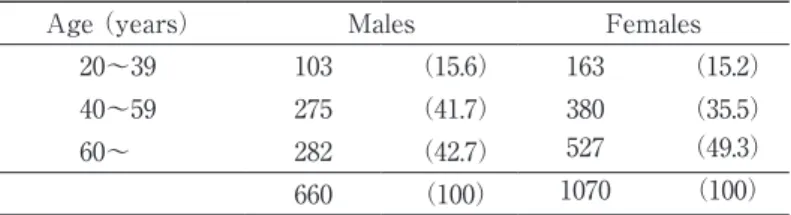
The subjects were 1,730 volunteers (660 males and 1,070 females) who participated in the Iwaki Health Promotion Project between 2005 and 2010. All of the subjects were residents in Iwaki area in Aomori Prefecture, located in northern Japan (Table 1).
2. Investigated items
a. Lifestyle and background of subjects
The data on lifestyle and background
of the subjects were obtained from a self-
completion questionnaire and each answer
was confirmed during an individual
interview with an investigational team
member. Items included in the questionnaire
were age, gender, smoking habit, history of
cigarette smoking and number of cigarette
smoked per day, drinking habit including
amount of alcohol consumption per day,
total hours of work per week, exercise habit
including frequency of exercise per week, and certain lifestyle-related diseases which might affect atherosclerosis (hypertension, diabetes mellitus and dyslipidemia).
b. Blood biochemistry
Enzymatic methods were used to measure the levels of serum glucose, total cholesterol, triglyceride, and HDL cholesterol. All blood samples were taken under fasting condition. LDL cholesterol was excluded from the investigated items because direct measurement method of LDL cholesterol had not been common at the starting part of this study (2005).
Given that diagnostic criteria of metabolic syndrome in Japan do not include HbA1c, it was also excluded from the investigated items in this study.
c. Body mass index (BMI)
BMI was calculated for each subject according to his/her height and weight.
Height was measured using a height ruler, and weight was determined using a body composition scale (Multi-frequency body composition scale, MC-190 TANITA, Tokyo).
d. Blood pressure
Blood pressure was measured with a manometer. The value of diastolic pressure was not eligible for an investigated item for systolic and diastolic pressure provided multi-collinearity when multiple linear regression was done.
e. baPWV
Brachial–ankle PWV was measured using
a volume-plethysmographic apparatus (form PWV/ABI, COLIN Co. Ltd., Tokyo, Japan).
In addition to recording the limb lead ECG, mechano-cardiograms were simultaneously recorded by attaching blood pressure cuffs with a tonometric sensor to the upper arms and ankles. Brachial-ankle PWV was calculated by time-phase analysis. The time interval between the wave front of the brachial waveform and that of the ankle waveform was defined as the time interval between the brachium and ankle ( ΔTba).
The distance between sampling points of baPWV was calculated automatically according to the height of the subject.
The path length from the suprasternal notch to the brachium (Lb) was obtained from superficial measurements and was expressed using the following equation:
Lb = 0.2195 × height of the patient (in cm) -2.0734. The path length from the suprasternal notch to the ankle (La) was obtained from superficial measurements and was expressed using the following equation: La = (0.8129 × height of the patient (in cm) + 12.328). Finally, the following equation was used to obtain baPWV: baPWV = (La- Lb)/ΔTba
17). In this study, the average of left and right values of baPWV was used.
3. Ethical consideration
The purpose of the current study was thoroughly explained verbally to all subjects
Table 1 Age distribution of the subjects
Age (years) Males Females
20~39 103 (15.6) 163 (15.2)
40~59 275 (41.7) 380 (35.5)
60~ 282 (42.7) 527 (49.3)
660 (100) 1070 (100)
n(%)
prior to the study, including their rights to withdraw from the research at anytime as well as protection of their personal information, and written informed consent was obtained from each subject. This study was approved by the ethics committee of the Hirosaki University Graduate School of Medicine (reference number 2011-033).
4. Statistical analysis
Brachial-ankle PWV has been reported to vary both by age and gender
18). Thus, subjects were subgrouped by gender, then into 3 age groups as follows: 20-39 years old
(the youngest group), 40-59 years old (the middle age group) and 60+ years old (the eldest group).
The investigated items such as age, BMI, baPWV, systolic blood pressure, serum glucose level, total cholesterol level, working hours, exercise habit of subjects among three age groups were compared using a one- way analysis of variance. The prevalence of lifestyle-related diseases among three age groups were compared using chi-square test.
In order to determine the relationship between baPWV and atherosclerosis-related factors, baPWV was used as the dependent variable, and the duration of cigarette smoking, BMI, frequency of exercise, serum glucose, total cholesterol, triglyceride and HDL cholesterol were used as the independent variables when multiple linear regression was performed. The atherosclerosis-related factors were listed as the items related to fat and sugar metabolisms and lifestyle-related items
19). Also, age, systolic blood pressure, working hours, amount of alcohol consumption, and having atherosclerosis-related diseases (hypertension, diabetes mellitus and dyslipidemia) were used as corrected items for both gender. Furthermore, menopause was used as a corrected item for women. As for smoking habit, three categories such as
“non-smoker”, “more than one cigarette per day”, and “ex-smoker” were set from two items – “smoking habit”, and the “number of cigarette smoked per day”. Alcohol drinking habit was further categorized into either
“non-drinker”, “more than 1g per day” or “ex- drinker”. The working hours category was further categorized into either “none”, “less than 40 hours per week”, “between 40 hours and 50 hours per week”, “between 50 and 60 hours per week” and “more than 60 hours per week”. Exercise habit was further categorized into either “none”, “once per week”, “2-3 times per week”, “4-5 times per week” or “almost every day”.
SPSS ver.12.0J (SPSS Inc., Chicago, IL, USA) was used for all statistical analyses. All data were separated according to gender, and values were considered significant at p<0.05.
Results
1. Characteristics of subjects
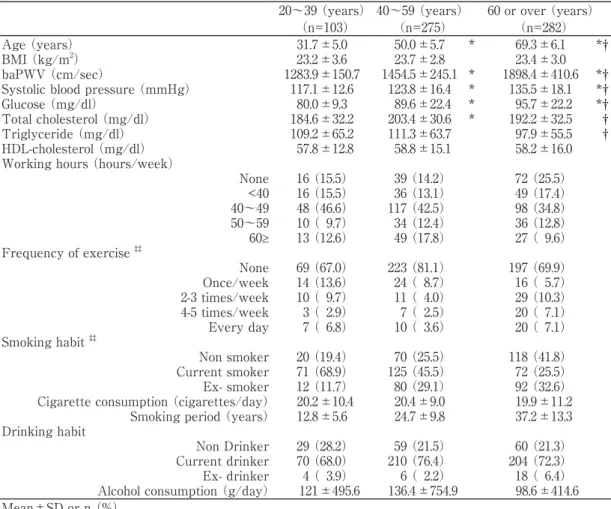
In males, baPWV, systolic blood pressure and serum glucose level were shown to increase significantly with age (p<0.05 all) (Table 2-1).
In females, baPWV, systolic blood pressure, levels of serum glucose and triglyceride significantly increased with age (Table 2-2).
2. Physical activities
In males, those who were in the middle age group were found to have the longest working hours, and it was lower in the eldest age group (Table 2-1). In females, working hours tended to become less as the age increased (Table 2-2). In general, there were a large number of both males and females who had no exercise habit.
3. Lifestyle
A large number of males were current and
ex-smokers in the youngest age group (68.9%
and 11.7% respectively) (Table 2-1). Also, many males were found to drink alcohol in all age groups (68.0% in the youngest age group, 76.4% in the middle age group and 72.3% in the eldest age group) (Table 2-1).
However, most of females were non- smokers in all age groups (61.3% in the youngest age group, 78.4% in the middle age group and 96.4% in the eldest age group), and a higher number of females in the youngest groups tended to have a drinking habit (46.0%
in the youngest age group, 27.4% in the middle age group and 9.3% in the eldest age group) (Table 2-2).
4. Medical conditions
For both genders, the prevalence of hypertension, diabetes mellitus and dyslipid- emia tended to be higher in the eldest age groups, and the percentage of subjects with hypertension was highest in those who were significantly higher in the eldest age group than in other two groups (p<0.01 each)
(Table 3).
5. Relationships between baPWV and atherosclerosis- related factors
For males in the youngest age group,
Table 2-1 Characteristics of the subjects (Males, n=660)
20~39 (years) 40~59 (years) 60 or over (years)
(n=103) (n=275) (n=282)
Age (years) 31.7±5.0 50.0±5.7 * 69.3±6.1 *†
BMI (kg/m2) 23.2±3.6 23.7±2.8 23.4±3.0
baPWV (cm/sec) 1283.9±150.7 1454.5±245.1 * 1898.4±410.6 *†
Systolic blood pressure (mmHg) 117.1±12.6 123.8±16.4 * 135.5±18.1 *†
Glucose (mg/dl) 80.0±9.3 89.6±22.4 * 95.7±22.2 *†
Total cholesterol (mg/dl) 184.6±32.2 203.4±30.6 * 192.2±32.5 †
Triglyceride (mg/dl) 109.2±65.2 111.3±63.7 97.9±55.5 †
HDL-cholesterol (mg/dl) 57.8±12.8 58.8±15.1 58.2±16.0
Working hours (hours/week)
None 16 (15.5) 39 (14.2) 72 (25.5)
<40 16 (15.5) 36 (13.1) 49 (17.4)
40~49 48 (46.6) 117 (42.5) 98 (34.8)
50~59 10 ( 9.7) 34 (12.4) 36 (12.8)
60≥ 13 (12.6) 49 (17.8) 27 ( 9.6)
Frequency of exercise ‡‡
None 69 (67.0) 223 (81.1) 197 (69.9)
Once/week 14 (13.6) 24 ( 8.7) 16 ( 5.7)
2-3 times/week 10 ( 9.7) 11 ( 4.0) 29 (10.3)
4-5 times/week 3 ( 2.9) 7 ( 2.5) 20 ( 7.1)
Every day 7 ( 6.8) 10 ( 3.6) 20 ( 7.1)
Smoking habit ‡‡
Non smoker 20 (19.4) 70 (25.5) 118 (41.8)
Current smoker 71 (68.9) 125 (45.5) 72 (25.5)
Ex- smoker 12 (11.7) 80 (29.1) 92 (32.6)
Cigarette consumption (cigarettes/day) 20.2±10.4 20.4±9.0 19.9±11.2 Smoking period (years) 12.8±5.6 24.7±9.8 37.2±13.3 Drinking habit
Non Drinker 29 (28.2) 59 (21.5) 60 (21.3)
Current drinker 70 (68.0) 210 (76.4) 204 (72.3)
Ex- drinker 4 ( 3.9) 6 ( 2.2) 18 ( 6.4)
Alcohol consumption (g/day) 121±495.6 136.4±754.9 98.6±414.6 Mean±SD or n (%)
Compared with 20~39 (years); * p<0.05 Compared with 40~59 (years); † p<0.05 BMI: Body Mass Index
baPWV: brachial ankle pulse wave velocity Chi square test; ‡‡ p<0.01
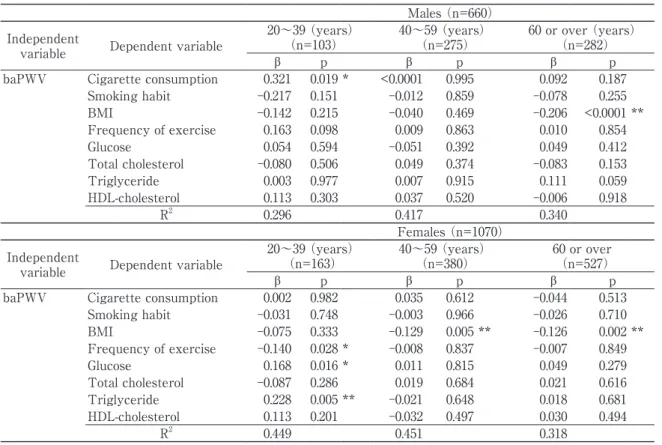
baPWV was positively correlated with
“number of cigarette smoked per day”
(β=0.321, p<0.05) (Table 4). In the middle age group, no significant relationship was observed between baPWV and any atherosclerosis-related factors. However, BMI was the only factor that was found to have a significant inverse correlation with baPWV
(β=-0.206, p<0.01) in the eldest age group.
For females in the youngest age group, baPWV values were significantly positively correlated with serum glucose (β=0.168, p<0.05) and triglyceride (β=0.228, p<0.01)
(Table 4). A significant inverse correlation
was observed between baPWV and frequency of exercise (β=-0.140, p<0.05) in the same age group. For the middle and eldest age groups, BMI (β=-0.029, p<0.01 for the middle age group and β=-0.126, p<0.01 for the eldest age group) was inversely correlated with baPWV.
6. Comparison of BMI among participants with lifestyle-related diseases
Figure 1 shows comparisons of BMI among participants with hypertension, diabetes mellitus and dyslipidemia according to age groups. There was not any participant with these three diseases in the youngest
Table 2-2 Characteristics of the subjects (Females, n=1070)
20~39 (years) 40~59 (years) 60 or over (years)
(n=163) (n=380) (n=527)
Age (years) 31.5±5.6 51.0±5.4 * 68.5±5.5 *†
BMI (kg/m2) 21.1±3.1 22.9±3.4 * 23.4±3.2 *
baPWV (cm/sec) 1123.0±127.4 1396.9±232.0 * 1827.8±391.5 *†
Systolic blood pressure (mmHg) 107.9±12.2 121.0±16.7 * 134.9±17.4 *†
Glucose (mg/dl) 77.6±8.1 85.4±12.3 * 91.9±19.7 *†
Total cholesterol (mg/dl) 181.4±29.7 206.7±32.7 * 214.6±32.1 *†
Triglyceride (mg/dl) 73.4±39.2 87.7±48.4 * 89.3±42.4 *
HDL-cholesterol (mg/dl) 66.1±14.6 66.2±14.4 63.1±13.8
Working hours (hours/week)
None 35 (21.5) 86 (22.6) 157 (29.8)
<40 26 (16.0) 84 (22.1) 123 (23.3)
40~49 72 (44.2) 127 (33.4) 149 (28.3)
50~59 18 (11.0) 56 (14.7) 56 (10.6)
60≥ 12 ( 7.4) 27 ( 7.1) 42 ( 8.0)
Frequency of exercise ‡‡
None 142 (87.1) 327 (86.1) 406 (77.0)
Once/week 9 ( 5.5) 15 ( 3.9) 27 ( 5.1)
2-3 times/week 7 ( 4.3) 10 ( 2.6) 35 ( 6.6)
4-5 times/week 3 ( 1.8) 14 ( 3.7) 12 ( 2.3)
Every day 2 ( 1.2) 14 ( 3.7) 47 ( 8.9)
Smoking habit ‡‡
Non smoker 100 (61.3) 298 (78.4) 508 (96.4)
Current smoker 38 (23.3) 49 (12.9) 12 ( 2.3)
Ex- smoker 25 (15.3) 33 ( 8.7) 7 ( 1.3)
Cigarette consumption (cigarettes/day) 12.9±7.3 12.4±6.9 12.3±7.9 Smoking period (years) 12.4±5.9 24.9±6.2 31.9±11 Drinking habit
Non Drinker 82 (50.3) 262 (68.9) 468 (88.8)
Current drinker 75 (46.0) 104 (27.4) 49 ( 9.3)
Ex- drinker 6 ( 3.7) 14 ( 3.7) 10 ( 1.9)
Alcohol consumption (g/day) 43.9±151.7 29.2±40.5 15.8±19.7 Mean±SD or n (%)
Compared with 20~39 (years); * p<0.05 Compared with 40~59 (years); † p<0.05 BMI: Body Mass Index
baPWV: brachial ankle pulse wave velocity Chi square test; ‡‡ p<0.01
age group. In males, we did not detect any differences in BMI between the middle age group and the eldest age group. In females, BMI of those with hypertension in the middle age group was significantly higher than that
in the eldest age group (p<0.05).
Discussion
In males of the youngest age group, “number
Table 3 Prevalence of lifestyle-related diseases Males (n=660)
20~39 (years) 40~59 (years) 60 or over (years)
(n=103) (n=275) (n=282)
Hypertension ** 2 (1.9) 31 (11.3) 113 (40.1)
Diabetes mellitus ** 0 (0.0) 7 ( 2.5) 20 ( 7.1)
Dyslipidemia 0 (0.0) 12 ( 4.4) 14 ( 5.0)
Females (n=1070)
20~39 (years) 40~59 (years) 60 or over (years)
(n=163) (n=380) (n=527)
Hypertension ** 0 (0.0) 52 (13.7) 247 (46.9)
Diabetes mellitus ** 0 (0.0) 2 ( 0.5) 24 ( 4.6)
Dyslipidemia ** 0 (0.0) 17 ( 4.5) 52 ( 9.9)
Chi square test; ** p<0.01
Table 4 Association between baPWV and atherosclerosis-related items from the multiple regression analysis Males (n=660)
Independent
variable Dependent variable 20~39 (years)
(n=103) 40~59 (years)
(n=275) 60 or over (years)
(n=282)
β p β p β p
baPWV Cigarette consumption 0.321 0.019* <0.0001 0.995 0.092 0.187
Smoking habit -0.217 0.151 -0.012 0.859 -0.078 0.255
BMI -0.142 0.215 -0.040 0.469 -0.206 <0.0001**
Frequency of exercise 0.163 0.098 0.009 0.863 0.010 0.854
Glucose 0.054 0.594 -0.051 0.392 0.049 0.412
Total cholesterol -0.080 0.506 0.049 0.374 -0.083 0.153
Triglyceride 0.003 0.977 0.007 0.915 0.111 0.059
HDL-cholesterol 0.113 0.303 0.037 0.520 -0.006 0.918
R2 0.296 0.417 0.340
Females (n=1070)
Independent
variable Dependent variable 20~39 (years)
(n=163) 40~59 (years)
(n=380) 60 or over
(n=527)
β p β p β p
baPWV Cigarette consumption 0.002 0.982 0.035 0.612 -0.044 0.513
Smoking habit -0.031 0.748 -0.003 0.966 -0.026 0.710
BMI -0.075 0.333 -0.129 0.005** -0.126 0.002**
Frequency of exercise -0.140 0.028* -0.008 0.837 -0.007 0.849
Glucose 0.168 0.016* 0.011 0.815 0.049 0.279
Total cholesterol -0.087 0.286 0.019 0.684 0.021 0.616
Triglyceride 0.228 0.005** -0.021 0.648 0.018 0.681
HDL-cholesterol 0.113 0.201 -0.032 0.497 0.030 0.494
R2 0.449 0.451 0.318
* p<0.05, ** p<0.01
β: standardized partial regression coefficient, R2: coefficient of determination BMI: Body Mass Index, baPWV: brachial ankle pulse wave velocity.
Adjustment items: age, systolic blood pressure, working hours, amount of alcohol consumption, atherosclerosis- related diseases (hypertension, diabetes mellitus and dyslipidemia) and menopause (for women).
of cigarette smoked per day” had a significant positive correlation with baPWV, suggesting that an increasing number of cigarettes smoked per day resulted in an elevated baPWV. In previous studies, cigarette smoking has been reported to affect the cardiovascular system by increasing systolic blood pressure and heart rate
20, 21). Continuous smoking has been reported to cause progression of atherosclerosis
22). Furthermore, it has also been reported that exposure to cigarette smoke at an early stage of life may increase premature development of atherosclerosis
23). The result of the current study supported these previous results.
Furthermore, 68.9% of the young male subjects who participated in the current study claimed to be current smokers and there is therefore an immediate need to develop countermeasures against the smoking habit.
For both genders in the eldest group, BMI was found to have a significant inverse correlation with baPWV. Such results are few in previous studies
24). The possible reason is that a large proportion of subjects have atherosclerosis- related diseases in this age group, and resulted in a decreased body weight as well as ageing.
For females, the exercise frequency was found to have a significant inverse correlation with baPWV in the youngest age group, indicating that many of those who had an exercise habit
tended to have a low baPWV, which is in accord with previous studies
25). It has also been reported that regular exercise can reduce the risk of atherosclerosis-associated cardiovascular diseases, especially in females
26). In addition, the risk of cardiovascular diseases can also be reduced by being physically active from a young age
27). Furthermore, the amount of daily physical exercise and/or regular exercise were reported to strengthen vascular functions
28-30). Therefore, regular physical exercise was suggested to have preventive effects against atherosclerosis. In the present study, 87% of the female residents in Iwaki area who participated in the investigation were found to have no exercise habit. Such results suggested that regular exercise or having an exercise habit are effective ways to prevent atherosclerosis even among females, especially when they are young.
For females in the youngest age group, the serum glucose level and triglyceride level were found to have significant positive correlations with baPWV. According to previous studies, metabolic risk factors of coronary heart disease were stated as total cholesterol, triglyceride and abnormal glucose tolerance
31). It is one of the most important points from the results of the current study is that the management of dyslipidemia and diabetes mellitus or obesity is needed in the youngest generations.
Fig 1 Body mass index according to hypertension, diabetes mellitus and dyslipidemia.
un-paired t-test * p<0.05
40-59 years 40-59 years
Age Age
60 or over years 60 or over years
27
Hypertension Diabetes mellitus Dyslipidemia
For the middle age group in both genders, the results tended to show an average between the youngest and eldest age groups.
The most important finding of the current study was the significant associations between lifestyle and baPWV in the age group which was previously considered to be too young to have effects on atherosclerosis. In other words, those who are below 40 years of age with certain lifestyle are already at the risk of atherosclerosis.
Another important point is that the association between obesity and baPWV (atherosclerosis)
in the eldest age group demonstrated opposite results from previous studies for both genders
(i.e., baPWV increased and BMI decreased as a result of having lifestyle-related diseases as well as aging).
The results obtained from the current study reconfirmed the importance of improving and maintaining a desirable lifestyle from a young age. In addition, the relationship between baPWV and obesity in the elderly should be carefully analyzed during evaluation
32).
There are some limitations in this study.
Firstly, self-completion questionnaire performed in this study did not include therapeutic histories of hypertension, diabetes mellitus and dyslipidemia.
Certain medications, such as angiotensin converting enzyme inhibitors and statins, have influence on progress of atherosclerosis. Secondly, prevalence of hypertension, diabetes mellitus and dyslipidemia was based on self-completion questionnaire so that it could be different from accurate histories of participants.
Acknowledgements
We would like to express our gratitude to all participants and workers at Hirosaki City Hall for their support in this study, especially those who volunteered to participate in the Iwaki Health Promotion Project.
The current study was funded by the Japanese Ministry of Education, Culture, Sports, Science and Technology, grant number 22249019.
References
1)Ministry of Health, Labour, and Welfare, Japan.
Conspectus of vital statistics .(http://www.mhlw.
go.jp/english/database/db-hw/dl/81-1a2en.pdf)
2)Li S, Chen W, Srinivasan SR, Berenson GS.
Childhood blood pressure as a predictor of arterial stiffness in young adults: the Bogalusa heart study.
Hypertension. 2004;43:541-6.
3)Mitchell GF, Parise H, Benjamin EJ, Larson MG, Keyes MJ, Vita JA, Vasan RS, et al. Changes in arterial stiffness and wave reflection with advancing age in healthy men and women: the Framingham Heart Study. Hypertension. 2004;
43:1239-45.
4)Smulyan H, Asmar RG, Rudnicki A, London GM, Safar ME. Comparative effects of aging in men and women on the properties of the arterial tree.
J Am Coll Cardiol. 2001;37:1374-80.
5)Touyz RM. Reactive oxygen species, vascular oxidative stress, and redox signaling in hy- pertension: what is the clinical significance?
Hypertension. 2004;44:248-52.
6)Rahman I, Morrison D, Donaldson K, MacNee W.
Systemic oxidative stress in asthma, COPD, and smokers.Am J Respir Crit Care Med. 1996;154:
1055-60.
7)Hansel B, Giral P, Nobecourt E, Chantepie S, Bruckert E, Chapman MJ, Kontush A. Metabolic syndrome is associated with elevated oxidative stress and dysfunctional dense high-density lipoprotein particles displaying impaired antioxi- dative activity. J Clin Endocrinol Metab. 2004;
89:4963-71.
8)Bayturan O, Tuzcu EM, Lavoie A, Hu T, Wolski K, Schoenhagen P, Kapadia S, et al. The metabolic syndrome, its component risk factors, and progression of coronary atherosclerosis. Arch Intern Med. 2010;170:478-84.
9)Hulthe J, Wikstrand J, Emanuelsson H, Wiklund
O, de Feyter PJ, Wendelhag I. Atherosclerotic changes in the carotid artery bulb as measured by B-mode ultrasound are associated with the extent of coronary atherosclerosis. Stroke. 1997;
28:1189-94.
10)Kelly R, Hayward C, Avolio A, O'Rourke M.
Noninvasive determination of age-related changes in the human arterial pulse. Circulation.1989;
80:1652-9.
11)Kuwajima I, Hoh E, Suzuki Y, Matsushita S, Kuramoto K. Pseudohypertension in the elderly. J Hypertens.1990;8:429-32.
12)Kobrin I, Oigman W, Kumar A, Ventura HO, Messerli FH, Frohlich ED, Dunn FG. Diurnal variation of blood pressure in elderly patients with essential hypertension. J Am Geriatr Soc.
1984;32:896-9.
13)Koji Y, Tomiyama H, Ichihashi H, Nagae T, Tanaka N, Takazawa K, Ishimaru, et al. Comparison of ankle-brachial pressure index and pulse wave velocity as markers of the presence of coronary artery disease in subjects with a high risk of atherosclerotic cardiovascular disease. Am J Cardiol.
2004;94:868-72.
14)Munakata M, Ito N, Nunokawa T, Yoshinaga K.
Utility of automated brachial ankle pulse wave velocity measurements in hypertensive patients.
Am J Hypertens. 2003;16:653-7.
15)Yamashina A, Tomiyama H, Arai T, Hirose K, Koji Y, Hirayama Y, Yamamoto Y, et al. Brachial-ankle pulse wave velocity as a marker of atherosclerotic vascular damage and cardiovascular risk.
Hypertens Res. 2003;26:615-22.
16)Holewijn S, den Heijer M, Stalenhoef AF, de Graaf J. Non-invasive measurements of atherosclerosis
(NIMA): current evidence and future perspectives.
Neth J Med. 2010;68:388-99.
17)Laurin D, Masaki KH, White LR, Launer LJ.
Ankle-to-brachial index and dementia: the Honolulu-Asia Aging Study. Circulation. 2007;116:
2269-74.
18)Tomiyama H, Yamashina A, Arai T, Hirose K, Koji Y, Chikamori T, Hori S, et al. Influences of age and gender on results of noninvasive brachial-ankle pulse wave velocity measurement--a survey of
12517 subjects. Atherosclerosis. 2003;166:303-9.
19)McNeill AM, Rosamond WD, Girman CJ, Golden SH, Schmidt MI, East HE, Ballantyne CM, et al. The metabolic syndrome and 11-year risk of incident cardiovascular disease in the atherosclerosis risk in communities study. Diabetes Care. 2005;28:385-90.
20)Mahmud A, Feely J. Effect of smoking on arterial stiffness and pulse pressure amplification.
Hypertension. 2003;41:183-7.
21)Kool MJ, Hoeks AP, Struijker Boudier HA, Reneman RS, Van Bortel LM. Short- and long-term effects of smoking on arterial wall properties in habitual smokers. J Am Coll Cardiol. 1993;22:1881-86.
22)Tomiyama H, Hashimoto H, Tanaka H, Matsumoto C, Odaira M, Yamada J, Yoshida M, et al. Continuous smoking and progression of arterial stiffening: A prospective study. J Am Coll Cardiol. 2010;55:1979-87.
23)Doonan RJ, Hausvater A, Scallan C, Mikhailidis DP, Pilote L, Daskalopoulou SS. The effect of smoking on arterial stiffness. Hypertens Res. 2010;
33:398-410.
24)Fukui T, Momoi A, Yasuda T. Attention for the interpretation of measurements brachial-ankle pulse wave velocity. Ningen dock.2005;19:29-32.
25)Manson JE, Greenland P, LaCroix AZ, Stefanick ML, Mouton CP, Oberman A, Perri MG, et al.
Walking compared with vigorous exercise for the prevention of cardiovascular events in women. N Engl J Med. 2002;347:716-25.
26)Manson JE, Hu FB, Rich-Edwards JW, Colditz GA, Stampfer MJ, Willett WC, Speizer FE, et al.
A prospective study of walking as compared with vigorous exercise in the prevention of coronary heart disease in women. N Engl J Med. 1999 26;
341: 650-58.
27)Kozakova M, Palombo C, Mhamdi L, Konrad T, Nilsson P, Staehr PB, Paterni M, et al. Habitual physical activity and vascular aging in a young to middle-age population at low cardiovascular risk.
Stroke. 2007;38:2549-55.
28)Tanaka H, Dinenno FA, Monahan KD, Clevenger CM, DeSouza CA, Seals DR. Aging, habitual exercise, and dynamic arterial compliance.
Circulation. 2000;102:1270-75.
29)Sui X, LaMonte MJ, Laditka JN, Hardin JW, Chase N, Hooker SP, Blair SN. Cardiorespiratory fitness and adiposity as mortality predictors in eldest adults. JAMA. 2007;298:2507-16.
30)Vaitkevicius PV, Fleg JL, Engel JH, O'Connor FC, Wright JG, Lakatta LE, Yin FC, et al. Effects of age and aerobic capacity on arterial stiffness in healthy adults. Circulation.1993;88:1456-62.
31)Kannel WB. Metabolic risk factors for coronary heart disease in women: perspective from the Framingham Study. Am Heart J. 1987;114:413-9.
32)Numazawa S, Matsuzaka M, Iwane K, Inoue R, Danjo K, Takahashi I, Umeda T, et al. Relationship between various obesity indices and brachial- ankle pulse wave velocity according to age among Japanese females. Hirosaki Med J. 2011;61:131-7.