応答
著者
関 勝寿
雑誌名
東洋大学紀要 自然科学篇
号
54
ページ
1-14
発行年
2010-03
URL
http://id.nii.ac.jp/1060/00004070/
Creative Commons : 表示 - 非営利 - 改変禁止 http://creativecommons.org/licenses/by-nc-nd/3.0/deed.jaAbstract
Volcanic ash soils have excellent soil hydrological properties, as high water retentivi-ty and high water permeabiliretentivi-ty compared with other clayey soils. They contain abun-dant allophane and organic matter. Having well developed aggregated structures, vol-canic ash soils have large porosities as much as 80%, retain water inside soil aggregate, allow the water move easily through large pores between aggregate and macropores, and consequently have high permeabilities. In this study, various soil hydrological properties of a volcanic ash soil in Japan are shown and discussed;volu-metric ratio of solid, liquid, and gas phases, particle density, hardness, pH, EC, soil organic matter(ignition loss), soil texture, specific surface area, soil water retention curve and saturated and unsaturated hydraulic conductivity. The soil texture was clas-sified as light clay, pH was around 6, and ignition loss was 17 to 27%. Although soil hydrological properties of Andosols change with changing pH because of the pH-dependent charges of allophane, water retention curves and unsaturated hydraulic conductivities were not affected by the electrolyte(NaCl)concentrations used in the measurement. These soil hydrological peculiarities of Andosols were attributed to the stability of soil structures at neutral pH range, where critical coagulation concentration (CCC)was very low.
Keywords:Andosols, electrolyte, hydraulic conductivity, coagulation, dispersion
1.Introduction
Among the most productive soils in the world(Shoji and Takahashi, 2002), volcanic ash soils, especially Andosols, have such excellent soil hydrological properties, as high water retentivity and high water permeability. These hydrological superiorities of vol-canic ash soils are attributed mainly to the widely distributing pore structures of the
Change in Hydrological Properties of Volcanic Ash
Soil in Response to Electrolyte Concentration
Katsutoshi S
eki**1 Faculty of Business Administration, Toyo University 5-28-20, Hakusan, Bunkyo-ku, Tokyo
soils and to the peculiarity of the interaction between soil particles and pore liquids. Among all, the high porosity as much as 80% or more characterizes the volcanic ash soils that allow water move more easily compared with many mineral soils whose porosity is around 50% in average. The saturated hydraulic conductivities of volcanic ash soils are thus so large as 10−5 m s−1, almost equal to those of fine sandy soils. In
addition, the pore size distribution of volcanic ash soils ranges widely owing to both small individual particle size and moderate aggregation structures that form large pore size distributions, resulting in high water retentivity and high hydraulic conductivity.
Japanese volcanic ash soils have abundant allophane and imogolite as secondary min-erals, and therefore understanding of the characteristics of these minmin-erals, especially allophanes, is a key for the understanding of the characteristics of the volcanic ash soils. Especially coagulation and dispersion of the secondary minerals strongly affect hydrological properties of volcanic ash soils. The dispersive characteristics of volcanic ash soils abundant in allophones reflects their variable charge characteristics(Nanzyo, 2002). Allophanic clay has point of zero charge(PZC)at around neutral pH, and dis-persion does not take place easily in this pH range. This nature of allophane makes the hydrological properties of allophonic Andosols susceptible to pH change. Karube et al. (1998a)determined that the PZC of non-deferrated allophane is pH 5.9 and that of
the deferrated is pH 5.1. At either low or high pH, the surface charge of the allophonic clay changes and dispersion takes place. Karube et al.(1998b)determined the critical coagulation concentration(CCC)of pure allophane for different electrolytes and pHs. According to their study, the CCC of deferrated allophane in NaCl solution is lowerst at around pH 6, having the value in the order of 10−2 mol
c m−3, and it increases at
lower and higher pH, being 2.0 molc m−3 at pH 4 and 11.8 molc m−3 at pH 8. The CCC
values differed according to the electrolyte used.
Ishiguro and Nakajima(2000)showed that pH strongly influences saturated hydrau-lic conductivity of allophonic Andosols which has substantial amount of pH-dependent charges. When Andosols was leached with HNO3 of pH 3, the saturated hydraulic
con-ductivity decreased in 3 orders of magnitude. They discussed that this is because the positive charge at low pH generates electric repulsive forces among soil particles, and, as a result, swelling and dispersion takes place. When H2SO4 was used as a leaching
solution, hydraulic conductivity did not decrease during leaching, and it was attributed to the strong specific adsorption of SO42−.
Effect of pH on the soil hydrological properties of Andosols has been thus studied well, but the effect of electrolyte concentration on Andosols has not been well studied. The effect of electrolyte concentration on the hydraulic properties, especially saturated hydraulic conductivity and soil dispersion, has been studied mainly for soils in arid regions, from the practical point of view to solve salinization problem in those area. Suarez et al.(1984)evaluated the effect of pH and electrolyte concentration on
satu-rated hydraulic conductivity and dispersion of three types of soils. In their experimen-tal condition, saturated hydraulic conductivity decreased with increasing pH and decreasing electrolyte concentration, and increasing SAR(sodium adsorption ratio). In their study, the decrease in the hydraulic conductivity was consistent with optical transmission measurements of dispersion. Chiang et al.(1987)determined that Cecil soil, derived from granitic parent material, was easily dispersed and hydraulic conduc-tivity was sensitive to small changes in electrolyte concentration, SAR, or pH, while Davidson and Iredell soils, derived from matric parent material, were coagulated and insensitive to changes in electrolyte concentration and pH except at very high SAR.
In this study, various soil hydrological properties of a volcanic ash soil in Japan were measured. We focused on the effect of NaCl concentration on hydrologic properties of volcanic ash soil, such as soil water retention and saturated and unsaturated hydraulic conductivity.
2.Materials and methods
The soils were sampled from an upland field of Tanashi experimental farm, owned by the University of Tokyo, at the western part of Tokyo, Japan. This experimental field is used for multiple purposes and different crops are planted every year. Tanashi experimental farm is located in Kanto plain, and most area of the Kanto plain, includ-ing the Tanashi area, is covered with “Kanto loam” soil. Kanto loam soil originates from volcanic ash erupted at Mt. Fuji, Hakone mountains and other volcanoes, situated at the west of Kanto area.
Soil pit of 1 m depth was excavated and both disturbed and undisturbed samples were obtained. Disturbed samples were obtained from the depth of every 10 cm, and were used for the measurement of soil water content, particle density, pH, EC, ignition loss, specific surface area and unsaturated hydraulic conductivity. Undisturbed cylin-drical core samples of 100 cm3 were obtained from the depth of every 10 cm, 3 cores
from each depth, and they were used for the measurement of bulk density and soil water retention curve and saturated hydraulic conductivity.
Hardness of the soil was measured in situ by Yamanaka’s soil hardness tester. The empirical relationship between the readings of the Yamanaka’s soil hardness tester and the soil hardness in the unit of the pressure resistance for Andosols(Watanabe, 1992) was used to express the result in the unit of MPa:
y=17.6+16 log10 x (1)
where x is the soil hardness in the unit of MPa and y is the reading of Yamanaka soil hardness tester in the unit of mm.
Water content was measured gravimetrically by oven-drying the disturbed soil sam-ple in 105° C for 24 hours. Bulk density was also measured gravimetrically with the undisturbed core samples. Particle density was measured by the picnometer method. Volumetric ratio of solid, liquid and gas phases were calculated by the values of water content, bulk density and particle density.
With the disturbed samples, pH was measured 1 hour after adding distilled water to the soil sample, so that the mass became soil:water=2:5, and mixing the soil and water well. EC was measured after adding distilled water to the soil sample such that soil:water=1:5, and mixing them well for 1 hour.
Ignition loss was measured for estimating the amount of organic matter. Oven-dried sample was ignited in 800° C for 5 hours and the loss of the mass was measured gravi-metrically.
Particle size analysis was performed by the bouyoucos hydrometer method for the diameter smaller than 0.1 mm and by the wet sieve method for the diameter larger than 0.1 mm. Prior to the measurement of the particle size distribution, mechanical and chemical dispersion was performed. Chemical dispersion was performed by apply-ing sodium hexametaphosphate(Calgon ®;(NaPO3)6)as the chemical dispersing
agent. It is often used as the dispersing agent because it alters the chemical attraction force between soil particles so that they repel each other. HCl was also used as a dis-persion agent for comparison. HCl was added to the soil water mixture until pH of the mixture became 2.4 to 3.0. After the particle size was determined, soil texture was classified according to ISSS(International Society of Soil Science)system.
Specific surface area of Andosols was measured by the EGME(ethylene glycol monoethyl ether)method. Specific surface area of Alluvial soil and sand was also ana-lyzed for the comparison. Alluvial soil was sampled from an onion field at Fukaya city, Saitama prefecture, in the north vicinity of Tokyo. Toyoura sand was used as a sand sample. Alluvial soil and Toyoura sand were also used for the measurement of soil water retention and unsaturated hydraulic conductivity, as will be described later.
Saturated hydraulic conductivities of undisturbed core samples were measured with the falling head method.
Soil water retention curves of Andosols, Alluvial soil and Toyoura sand were mea-sured by the hanging water column method for the suction of up to 2 m. To see the
effects of electrolyte concentration on the soil water retention curve, three types of water were used;distilled water, 0.1N NaCl solution, and 0.5N NaCl solution.
Unsaturated hydraulic conductivities were measured by the steady state flow meth-od. Disturbed samples of Andosols, Alluvial soil, and Toyoura sand were packed in acrylic columns of 5 cm in diameter and 6 cm in height with the bulk densities of 0.80, 1.35, and 1.59 Mg m−3, respectively. The top and bottom of the columns were
support-ed with sintersupport-ed glasses. Two tensiometers with porous cups, connectsupport-ed to pressure transducers, were installed in the column prior to the packing. The column had several small holes to allow air entry into soil and make the soil unsaturated. After the soil was packed in the column, water was suppliedfrom the bottom of the column to satu-rate the soil. After that, the upper part of the column was connected to a Mariotte tank and the bottom part of the column was connected to a drip point. The initial pressure at the top end of the soil was set to be 2 cm by the height of the Mariotte tank, and the pressure at the bottom end of the soil was set to be −2 cm by the height of the drip point, and water was supplied from the Mariotte tank. After that, the height of the Mariotte tank was lowered by 5 cm, and the height of the drip point was lowered by 10 cm, and pressure head at the two tensiometers and the flux was measured after the steady state was attained. After the measurement, the height of the Mariotte tank and the drip point was lowered again, and this procedure was repeated until the drip point reached the height of the floor and could not be lowered further. In this way, unsaturated hydraulic conductivities at different pressure heads were measured.
The soil water retention curves and the unsaturated hydraulic conductivities were approximated by Mualem-van Genuchten equations(van Genuchten, 1980):
Θ=q−qr qS−qr (2) Θ= 1 1 +(ah)n (3) K(Θ)=KSΘ 1 2 1− 1−Θ m1 m 2 (4) where Θ is the dimensionless water content, q is the volumetric water content, qs is
the saturated water content, qr is the residual water content, h is the suction head, Ks
is the saturated hydraulic conductivity, K is the unsaturated hydraulic conductivity, and a, n, m are the parameters, where m=1-1/n. We followed the procedure of van Genuchten(1980);the values of qs, qr, a, n and m were determined by fitting the
water retention curve in the condition of m=1-1/n, and the fitted values of the parameters and the measured values of Ks were used for the prediction of unsaturated
hydraulic conductivities were compared. The actual measured unsaturated hydraulic conductivity is a function of the suction head, K(h), and therefore to compare the measured and predicted values of K, the measured K(h)function was transformed to the K(Θ)function by using equation(3).
3.Results and Discussion
Soil profile of the Tanashi upland field is shown in Figure 1. While the entire layer was classified as Andosols, there was a distinctive two types of soil in the profile. The top surface layer of 35 cm, A horizon, is organic rich soil with dark brown color, which is called “Kuroboku” in Japanese, and the soil beneath 55 cm, B horizon, is another type of Andosols with light brown color, which is called “Tachikawa loam” in Japa-nese. The layer between 35 and 55 cm is a transitional horizon of A and B-horizons. The soils at A horizon and B horizon show different soil physical properties, which will be shown in the following figures.
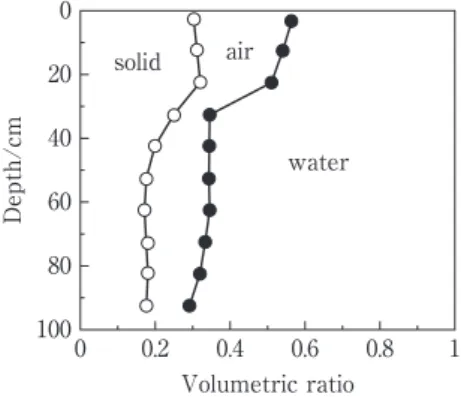
Three phase distribution(Figure 2)was calculated from the measured values of bulk density, water content and particle density. Solid phase was about 30% at the surface 20 cm layer, A horizon, and less than 20% below the 50 cm layer, B horizon. The high porosity of 70% at the surface soil and 80% at the subsurface soil results from the highly developed aggregated structure of the soil, and it is one of the extraordinary characteristics of volcanic ash soils. Moreover, we can notice that the soil is not too wet or dry, having enough water and air throughout the entire soil pro-file. High water retentivity of Andosols ensures that enough water for plant growth is retained in the soil pore, while, at the same time, high water permeability of Andosols ensures that water can drain reasonably fast after rainfall, so that enough air is retained in the soil pore for plant root.
The particle density is shown in Figure 3. The particle density at A horizon is lower than the particle density at B horizon, which is due to the higher amount of organic matter in the A horizon.
Hardness of the soil is shown in Figure 4. Hard pan layer, made artificially by tillage, was observed at the depth of 30 cm, where the hardness shows a sharp peak. It is noted that the hardness of Tachikawa loam soil at the depth from 80 to 100 cm is as large as that at the hard pan despite its low solid ratio of 20%(Figure 2). Profile of pH is shown in Figure 5. It is quite stable around the value of 6 in the entire profile. This is almost the same as the ZPC of pure non-deferrated allophane(Karube, 1992a). In general, Andosols in Japan has relatively low pH around 5 to 6. Profile of EC is shown in Figure 6. It fluctuated in the range of 0.2-0.3 mS cm−1. Ignition loss is
Fig. 1 Soil profile of Tanashi upland field. Transitional horizon A horizon(dark brown) Depth/cm B horizon(light brown) 0 35 55
Fig. 2 Three phase distribution of the
Tanashi field. 0 20 40 60 80 100 Depth/c m 0 0.2 0.4 0.6 0.8 1 Volumetric ratio solid air water
Fig. 3 Particle density of the Tanashi field.
0 20 40 60 80 100 Depth/c m 2.0 2.2 2.4 2.6 2.8 3.0 Particle density/Mg m−3
Fig. 4 Hardness of the Tanashi field.
0 20 40 60 80 100 Depth/c m 0 1 2 3 4 Hardness/MPa
Fig. 5 Profile of pH of the Tanashi field.
0 20 40 60 80 100 Depth/c m 4 5 6 7 8 pH
Fig. 6 Profile of EC of the Tanashi field.
0 20 40 60 80 100 Depth/c m 0 0.1 0.2 0.3 0.4 EC/mS cm−1
horizon. The A horizon has more than 20% of organic matter. Even in the depth of 1 m, where the ignition loss becomes smallest in this profile, 17% of the soil is composed of soil organic matter. Such high amount of soil organic matter is one of the remark-able characteristics of Japanese volcanic ash soils.
Saturated hydraulic conductivity
Saturated hydraulic conductivity is shown in Figure 8. The saturated hydraulic con-ductivity at the surface A horizon was in the order of 10−5 m s−1, and it decreased
one order of magnitude at the depth of 30 cm, where hard pan was formed(Figure 4). In the deeper zone of B horizon, saturated hydraulic conductivity increased gradually, and it reached to the order of 10−4 m s−1. As clearly seen from this measurement,
sat-urated hydraulic conductivity of Andosols in Japan is as large as sandy soils. Andosols is highly aggregated and have large porosity, and the large pores between aggregates serves as a favorable pathway for water, and it makes saturated hydraulic conductivi-ty large.
Specific surface area is shown in Table 1. As compared to Toyoura sand and Alluvi-al soil, the specific surface area of Andosols is by far larger, both at A and B horizons. This is because of the large amount of clay minerals present in the Andosols.
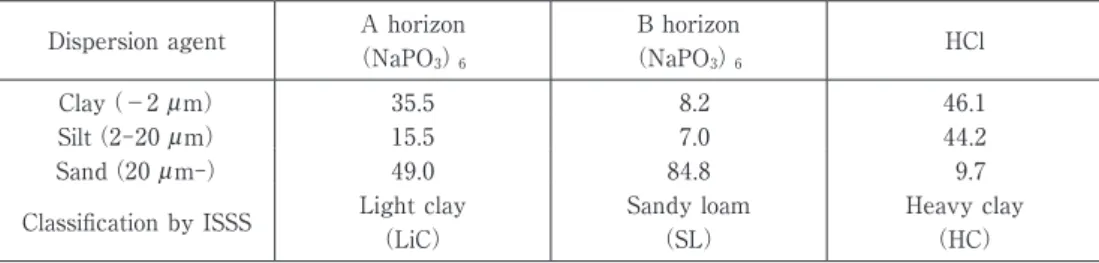
Soil texture of Andosols is shown in Table 2. When sodium hexametaphosphate was used as a dispersion agent, the soil in A horizon had 35.5% clay, 15.5% silt, 49.0% sand, and it was classified as light clay. As for the soil in B horizon, the percentage of sand drastically increased and became 84.8%. This is because the sodium hexameta-phosphate did not work properly as the dispersion agent. In contrast, when HCl was added and pH was adjusted to 2.4 - 3.0, the fraction of sand decreased to only 9.7% and the silt and clay increased to 44.2% and 46.1%, respectively. This suggests that
0 20 40 60 80 100 Depth/c m 0 0.1 0.2 0.3 lgnition loss/g g−1
Fig. 7 Ignition loss of the Tanashi field.
0 20 40 60 80 100 Depth/c m
1.E−06 1.E−05 1.E−04 1.E−03 Saturated hydraulic conductivity/m s−1
Fig. 8 Saturated hydraulic conductivity of
most of the aggregates, diameters larger than 20 mm and classified as sand particle in the particle analysis, did not disperse with the sodium hexametaphosphate but dis-persed when HCl was added and pH was lowered. The dispersion of allophonic clay at low pH, as reviewed in the introduction, led to the change in texture when HCl was added. The fact that sodium hexametaphosphate alone did not work as a dispersion agent as expected for the soil in B horizon suggests that the chemical coagulation force of the aggregate is very strong and the soil cannot be dispersed easily.
Soil water retention curves of Andosols(A horizon)measured with distilled water, 0.1N and 0.5N NaCl solution, are shown in Figure 9. Compared with alluvial soil(Fig-ure 10)and Toyoura sand(Figsoil(Fig-ure 11), water retentivity of Andosols is remarkably high and more than 40% volume of water is retained at the suction of 2 m. This is because the soil has abundant pore of small sizes. The retention curves were fitted with Mualem-van Genuchten equations(2)and(3)using computer software SWRC-Fit(Seki, 2007), and the fitted values are summarized in Table 3. For all types of soils, increasing NaCl concentration resulted in decrease in n, increase in a, and decrease in qs, with few exceptions. In equation(3), the decrease in n means that the slope of the
decrease in water content in response to the suction becomes less steep. In Figures 9-11, the effect is not very clear, but close examination of the figures also revealed this tendency.
Unsaturated hydraulic conductivity of Andosols(Figure 12), alluvial soil(Figure 13), and Toyoura sand(Figure 14)are shown for distilled water, and NaCl solution of 0.1
Table 1 Specific surface area measured by EGME method.
Soil type Specific surface area /m2 g−1
Andosols, A horizon Andosols, B horizon Alluvial soil Toyoura sand 337 528 98 4
Table 2 Soil texture of Andosols.
Dispersion agent (NaPOA horizon
3)6 B horizon (NaPO3)6 HCl Clay(−2 mm) 35.5 8.2 46.1 Silt(2-20 mm) 15.5 7.0 44.2 Sand(20 mm-) 49.0 84.8 9.7
0.7 0.6 0.5 0.4 0.3 0.2 0.1 0 Distilled water NaCl(0.1 N) NaCl(0.5 N) 0 50 100 150 200 Suction/cm
Volumetric water content/m
3 m
−3
Fig. 9 Soil water retention curve of
Andosols. Distilled water NaCl(0.1 N) NaCl(0.5 N) 0.7 0.6 0.5 0.4 0.3 0.2 0.1 0 0 50 100 150 200 Suction/cm
Volumetric water content/m
3 m
−3
Fig. 10 Soil water retention curve of
alluvial soil. Distilled water NaCl(0.1 N) NaCl(0.5 N) 0.7 0.6 0.5 0.4 0.3 0.2 0.1 0 0 50 100 150 200 Suction/cm
Volumetric water content/m
3 m
−3
Fig. 11 Soil water retention curve of
Toyoura sand. Distilled water NaCl(0.1 N) NaCl(0.5 N) MVG curve for(1) MVG curve for(2) MVG curve for(3) 1.E−04 1.E−05 1.E−06 1.E−07 1.E−08 1.E−09 1.E−10 0.4 0.5 0.6 0.7 Volumetric water content/m3 m−3
Unsaturated hydraulic conductivity/m s
−1
Fig. 12 Unsaturated hydraulic conductivity
of Andosols. Distilled water NaCl(0.1 N) NaCl(0.5 N) MVG curve for(1) MVG curve for(2) MVG curve for(3) 1.E−04 1.E−05 1.E−06 1.E−07 1.E−08 1.E−09 1.E−10 1.E−11 1.E−120.2 0.3 0.4 0.5 Volumetric water content/m3 m−3
Unsaturated hydraulic conductivity/m s
−1
Fig. 13 Unsaturated hydraulic conductivity
of alluvial soil. Distilled water NaCl(0.1 N) NaCl(0.5 N) MVG curve for(1) MVG curve for(2) MVG curve for(3) 1.E−04 1.E−05 1.E−06 1.E−07 1.E−08 1.E−09 1.E−10 0 0.1 0.2 0.3 0.4 0.5 Volumetric water content/m3 m−3
Unsaturated hydraulic conductivity/m s
−1
Fig. 14 Unsaturated hydraulic conductivity
N and 0.5 N. For each figure, predicted curves of the Mualem-van Genuteten equation, equation(4), calculated from the parameters in Table 3, are also shown. In Table 3, saturated hydraulic conductivity, Ks, of Andosols and Alluvial soils were measured
independently by falling head method, while the Ks of Toyoura sand are values of
hydraulic conductivity at small suction, determined from the maximum value of K in Figure 14. This is because the Ks values of Toyoura sand measured by falling head
method were too large(3.09, 3.50, 3.42, [×10−4 m s−1], respectively, for distilled
water, NaCl-0.1N, NaCl-0.5N), and Mualem-van Genuchten equations with these Ks
values did not appropriately fit the measured K curve. This comes from hydraulic nature of Toyoura sand, having sharp decrease of hydraulic conductivity from the sat-uration to a small suction of a few centimeters. For example, the saturated hydraulic conductivity measured by falling head method, 3.09×10⁻⁴ m s−1, was 16 times larger
than the maximum value of K in Figure 14, 1.96×10⁻⁵ m s−1(Table 3).
As for the Andosols(Figure 12), the measured and predicted curves agreed reason-ably well. Moreover, the saturated and unsaturated hydraulic conductivities did not show dependence on NaCl concentration. As for the alluvial soil(Figure 13), unsatu-rated hydraulic conductivity increased as the NaCl concentration increased. The increase in the saturated hydraulic conductivity(Table 3)was not remarkable, but the increase in the unsaturated hydraulic conductivity at low water content was very large. Especially at the water content of 30%, the unsaturated hydraulic conductivity differed in three orders of magnitude. The predicted curves also showed similar trend, but the difference was much smaller than the difference among the measured curves. All of the predicted curves seemed to fit best to the measured value at 0.1 N NaCl concentration, where measured value of distilled water was smaller, and that of 0.5 N NaCl was larger than the predicted curves. As for Toyoura sand(Figure 14), mea-sured curves showed moderate to low dependence on the concentration of NaCl. The predicted hydraulic conductivity of 0.1 N NaCl was smallest, because the Ks value in
Table 3 Parameters of van Genuchten model. Ks is a measured value and the remainders(n, a, qr,
qs)are fitted values from soil water retention curve. Ks for Toyoura sand was measured at
small suction.
Soil type NaCl conc. Ks /m s−1 n a/m−1 qr qs
Andosols 0N 7.51×10⁻⁶ 3.04 2.63 0.437 0.644 0.1N 8.82×10⁻⁶ 2.75 3.21 0.442 0.625 0.5N 8.20×10⁻⁶ 2.34 4.28 0.431 0.622 Allucial soil 0N 3.73×10⁻⁵ 3.11 5.26 0.235 0.453 0.1N 3.79×10⁻⁵ 2.97 6.12 0.223 0.463 0.5N 3.98×10⁻⁵ 2.73 7.12 0.223 0.416 Toyoura sand 0N 1.96×10⁻⁵ 11.8 2.67 0.0353 0.368 0.1N 7.00×10⁻⁶ 11.6 2.07 0.0392 0.373 0.5N 2.38×10⁻⁵ 9.17 2.24 0.0264 0.372
Table 3 was smallest. However, accurate assessment of the dependence of K on NaCl concentration will require more accurate definition of Ks values themselves, i.e., at
which “small” suction the values should be measured.
By summarizing the results in Figures 12-14, the unsaturated hydraulic conductivi-ty of Andosols(A horizon)was not dependent on the NaCl concentration, while that of Alluvial soil was very large, and that of sand was relatively low. The observed depen-dence of unsaturated hydraulic conductivity of Alluvial soil on the NaCl concentration can be explained by the feature of coagulation and dispersion of this soil. When the NaCl concentration became larger than the critical coagulation concentration, CCC, coagulation occurs and the unsaturated hydraulic conductivity increases. As for the Andosols, the CCC value is very small for the neutral pH range in this experiment, and allophonic colloidal particles coagulate, forming a very stable aggregate. Therefore in Figure 12, addition of the NaCl did not induce further colloidal coagulation and the unsaturated hydraulic conductivity was stable against the change in NaCl concentra-tion.
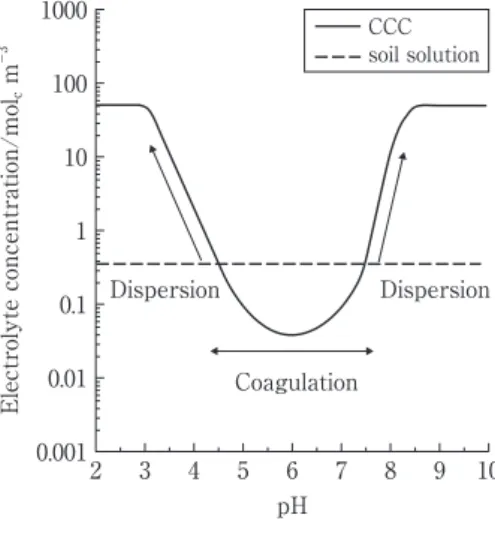
-The stability of the soil hydraulic properties of Andosols in this study(Figures 9 and 12)depends on pH, because, as we reviewed in the introduction, the state of the aggregate can easily change with the change in pH. Based on the finding by Karube et al.(1998b), the CCC is larger when pH is either high or low. Figure 15 gives a typi-cal CCC curve for Andosols, which elucidate the relation of dispersion and coagulation of the soil to pH. In this figure, the electrolyte concentration of the ambient soil solu-tion is assumed to be 0.35 molc m−3 and the CCC is smaller than it in the neutral pH
range of 4.5 to 7.5 and otherwise larger than it. When pH is lower than 4.5 or larger than 7.5, the CCC is larger than the electrolyte concentration of the ambient soil solu-tion, and therefore dispersion of allophanes begins to take place.
It is noted that CCC curve is inherently determined for each soil while the electro-lyte concentration of soil solution changes periodically. In addition, when the CCC value is close to the ambient soil solution, at pH of around 4.5 and 7.5 in the case of Figure 15, the state of dispersion and coagulation is sensible to the change in the elec-trolyte concentration of the soil solution. In other words, the soil easily changes from the dispersion state to coagulation state, and vice versa. When the CCC is far larger than the ambient soil solution, e.g. at pH=3 or 9, the colloidal particles completely dis-perse and again they are insensible to the change in the electrolyte concentration of the ambient soil solution. When the CCC is smaller than the electrolyte concentration of soil solution, that is, in the neutral pH range, allophane is firmly coagulated and not easily disperses. Thus, the stability of allophanic clay to the electrolyte concentration in the neutral pH range can explain the stability of unsaturated hydraulic conductivity against NaCl concentration in Figure 12.
4.Conclusions
Volcanic ash soils in Japan have remarkably high porosity, high water retention and high permeability, because of the well-developed aggregate. They are rich in allophane and organic matter. Because allophane has pH-dependent charges, the soil hydrological properties of the volcanic ash soils in Japan are susceptible to pH change. However, in the neutral pH range, the critical coagulation concentration(CCC)is very small and the allophanic colloidal particles do not disperse easily. This nature makes Andosols remarkably stable in the water retentivity and permeability under the effect of NaCl concentration. The stability of volcanic ash soils against ambient environmental chang-es, in the neutral pH condition, may be contributing more or less to all of the sur-rounding natural environments.
References
Chiang, S. C. Radcliffe, D. E. Miller, W. P. & Newman, K.D. 1987. Hydraulic conductivity of three southeastern soils as affected by sodium, electrolyte concentration, and pH. Soil Sci-ence Society of America Journal. 51, 1293-1299.
Ishiguro, M. & Nakajima, T. 2000. Hydraulic conductivity of an allophonic andisol leached with dilute acid solutions. Soil Science Society of America Journal, 64, 813-818.
Karube, J., Sugimoto, H., Fujihara, M. & Nakaishi, K. 1998a. Stability and charge characteris-tics of allophane and imogolite. Transactions of the Japanese Society of Irrigation, Drainage and Reclamation Engineering, 196, 103-110. in Japanese with English abstract.
1000 100 10 1 0.1 0.01 0.001 Electrolyte concentration/mol c m − 3 2 3 4 5 6 7 8 9 10 pH Dispersion Dispersion Coagulation CCC soil solution
Fig. 15 A typical illustration of the behavior
of coagulation and dispersion of Ando-sols in response to the CCC change with pH.
Karube, J., Suzuki, H. & Nakaishi, K. 1998b. Critical coagulation concentration of allophane. Transactions of the Japanese Society of Irrigation, Drainage and Reclamation Engineering,
197, 57-63. in Japanese with English abstract.
Nanzyo, M. 2002. Unique properties of volcanic ash soils. Global Environmental Research, 6(2), 99-112.
Seki, K. 2007. SWRC fit - a nonlinear fitting program with a water retention curve for soils having unimodal and bimodal pore structure. Hydrology and Earth System Sciences Discus-sion, 4(1), 407-437.
Shoji, S. & Takahashi, T. 2002. Environmental and agricultural significance of volcanic ash soils. Global Environmental Research, 6(2), 113-135.
Suarez, D. L., Rhoades, J. D., Lavado, R. & Grieve, C. M. 1984. Effect of pH on saturated hydraulic conductivity and soil dispersion. Soil Science Society of America Journal, 48(1), 50-55.
van Genuchten, M. T. 1980. A closed-form equation for predicting the hydraulic conductivity of unsaturated soils. Soil Science Society of America Journal, 44(5), 892-898.
Watanabe, H. 1992. Studies on the soil profile modification in humic Ando soils in upland field. Special Bulletin of Chiba Prefecture Agricultural Experimental Station, 21, 1-98. in Japanese.