Secondary School Teachers' Attitudes Towards Communicative Language Teaching:
A report from a KAKEN questionnaire survey
Hirofumi Hosokawa Abstract
This article is based on a questionnaire survey I conducted in March 2015. The survey is part of my KAKENHI (grant-in-aid research) study, whose aim is to investigate the role of classroom discourse between teacher and students at secondary schools in Japan. The incentive for the study originated from the fact that most secondary school English classes are not conducted communicatively. The dominant teaching methodology is the Grammar Translation Method (GTM), which is not suitable to develop learners’ fluency of English. The latest revision of the guidelines by the Ministry of Education, Culture, Sports, Science and Technology (MEXT) proposed that English classes should be conducted in English at senior high schools. This survey investigated secondary school teachers’ attitudes towards Communicative Language Teaching (CLT). The results revealed that practitioners face some common problems when conducting communicative lessons, which, as I shall argue, is the result of insufficient CLT training in pre-service programmes at university.
Keywords: Secondary school education, CLT, Interaction, Classroom discourse, Questions
Introduction
The MEXT has revised the teaching guidelines for secondary schools recently. The new guidelines for junior high schools were implemented in 2012, and those for senior high schools in 2013. The junior high school guidelines were applied to students in all grades in 2012, while the senior high school guidelines were applied only to the first-year students in 2013. In 2015 all secondary school students are studying under the new guidelines.
I will briefly review the revised guidelines and give an overview of the government’s new language policy. The MEXT uses the term ‘foreign language’ instead of ‘English’ because the guidelines are written not only for the teaching of
English but also for languages such as French and German. However, these languages are taught only at a small number of senior high schools. Because this study is about English language teaching, however, I will use the term ‘English’ instead of ‘foreign language’ in the following discussion.
The general objectives of the guidelines written in Section 9, Article 1 for junior high schools and in Section 8, Article 1 for senior high schools are as follows.
Junior High School
To develop students’ basic communication abilities such as listening, speaking, reading and writing, deepening their understanding of language and culture and fostering a positive attitude toward communication through foreign languages.
Section 9: Foreign Language, Article 1. Senior High School
To develop students’ communication abilities such as accurately understanding and appropriately conveying information, ideas, etc., deepening their understanding of language and culture and fostering a positive attitude toward communication through foreign languages.
Section 8: Foreign Language, Article 1. The objectives for both high schools are similar. The latter half is identical: ‘deepening their understanding of language and culture and fostering a positive attitude toward communication through foreign languages’. This objective guides for six years the overall nature and direction of English language teaching at the junior/senior high school level.
It is the former half that is of some difference. At junior high schools the main objective of teaching is to develop basic communication abilities. The four skills are underscored here so that classroom teaching won’t lean heavily on reading and writing. At senior high schools students are expected to further develop communication abilities based on the knowledge acquired from their first three years at junior high schools. More precisely, they are expected to acquire accurate understanding and the ability to express information appropriately.
From the general objectives, the following two points are clear: (1) to develop students’ sociocultural knowledge and foster their interest in other languages and culture (the latter half of the objectives), and (2) to develop their linguistic and cognitive knowledge of English (the former half). These objectives seem to be
appropriate when the present educational situation is taken into account. The new guidelines, however, have received severe criticisms by some university scholars (for example, Erikawa, 2009; Saito, 2009; and Yamada, 2009). The main source of their criticism is the following statement in the senior high school guideline.
Senior High School
When taking into consideration the characteristics of each English subject, classes in principle, should be conducted in English in order to enhance the opportunities for students to be exposed to English, transforming classes into real communication scenes. Consideration should be given to use English in accordance with the students’ level of comprehension. (underline mine)
Section 8: Foreign Language, Article 3; 4. The dominant methodology in Japan has been the GTM, in which the main focus of teaching is translation and grammar explanation. Students translate textbook sentences into Japanese, and thereby learn the target grammar. Therefore, classes are conducted mainly in Japanese. As a consequence, students are hardly exposed to the target language. As for grammar, they are expected to learn it not through communicative activities but through explanation. Article 3:4 above attempted to rectify this situation so as to turn classrooms into crucibles for language acquisition.
Then why was the new policy criticised? Opponents pointed out the following problems: (1) time problem, (2) accuracy problem, and (3) teachers’ English ability. Firstly, English class hours, approximately 140 hours a year, are not long enough for conducting classes in English and in a communicative manner. Because Japanese and English are linguistically distant, students need to learn everything from scratch. Under these circumstances, teaching English in Japanese has been thought to be more efficient than giving students the opportunity to learn it through meaningful usage. Secondly, the accuracy problem has been discussed in the immersion studies of L2 acquisition. Exposure to a target language, even in immersion contexts, does not guarantee successful acquisition of grammatical knowledge (Swain, 1985). Thirdly, opponents of CLT often claim that Japanese teachers of English do not have advanced English abilities to conduct classes in English. However, there does not seem to be sufficient scientific evidence to support this argument.
Each criticism above may entail some truth. The question, however, is whether the GTM can solve the current problems in English education in Japan. I would argue that the answer is ‘No’. Rather than criticising the new policy, it
would be more productive to investigate how practitioners respond to the guidelines, how they teach English in the classroom, and what problems they face when teaching communicatively. These questions led me to the questionnaire survey.
Methods Participants
The survey was conducted in March 2015. I selected 100 junior high schools and 123 senior high schools. Most of them were public schools. These schools were not chosen randomly, but rather intentionally, from Fukuoka prefecture, the location of my university, and from other prefectures in the Kyushu district as well as from Yamaguchi prefecture. One factor I had to consider prior to selection was the school size. It was entirely foreseeable that some schools were small, not having many students and teachers. I tried to avoid such schools. Another factor I considered is that this survey aimed to collect information about teachers’ attitudes towards CLT and their communicative classroom activities. Therefore, I attempted to choose schools which seemed to engage in active English teaching.
Materials
The questionnaire consists of six parts: Part 1: Participants’ information, Part 2: CLT background, Part 3: Methodologies currently employed, Part 4: Effects of interactive lessons, Part 5: Interactive activities, and Part 6: Students’ responses. I will explain each part below.
Part 1 has the following four questions. Question 1 is about teachers’ affiliation. Most teachers teach either at junior or senior high schools, but some teachers teach at both schools. So I asked them to choose their main affiliation. Age groups might be a key factor when studying CLT because it was not until the 1980s that teachers started to pay attention to CLT.
Part 1: Informant Profile
1. Main affiliation 1. Junior high 2. Senior high
2. Main grades in charge 1. 1st grade 2. 2nd grade 3. 3rd grade
3. Sex 1. Male 2. Female
4. Age groups 1. 20s 2. 30s 3. 40s 4. 50s or higher Part 2 has six questions, and asks about how much formal training teachers had on CLT. Questions 5 and 6 are about their university education, and 7 and 8
about CLT training they had after employment. Questions 9 and 10 are about their expectation in the future. All six are Yes or No questions.
Part 2: Study Background on Interactive Teaching Instructions 5. Studied about CLT theories at university
6. Had practical CLT training at university
7. Have taken a CLT theory seminar at in-service training seminars 8. Have taken a practical CLT training at in-service training seminars 9. Want to be exposed to practical CLT training in the future
10. Want to exchange teaching ideas with other teachers in the future In Part 3 and after, I asked teachers to choose the most appropriate answer from five Likert scale: 1 least likely and 5 most likely so. Part 3 has five questions about how they teach in the classroom. These questions will reveal the reality of English teaching at secondary schools.
Part 3: Teaching Methodology Currently Used (Five Likert scale) 11. Teach English mainly by means of the GTM
12. Change methodologies to suit students’ abilities 13. Teach English in English
14. Teach English interactively
15. Teach by trial and error to find out what is the best way to teach Part 4 has ten questions. They ask how effective teachers think CLT is to improve students’ abilities in a range of different domains. The areas cover not only the four skills but also critical thinking skills and students’ attitudes towards using English to express themselves.
Part 4: Effects of Interactive Teaching Instruction (Five Likert scale) 16. Effective to develop speaking ability
17. Effective to develop listening ability 18. Effective to develop reading ability 19. Effective to develop writing ability
20. Effective to develop grammatical knowledge 21. Effective to build vocabulary
22. Effective to develop critical thinking skills 23. Effective to develop presentation skills
25. Effective in general
Part 5 has 15 questions. Questions 26, 27 and 28 ask about ‘Classroom English’ and ‘Small Talk’. Classroom English is used technically, referring to expressions repeatedly used by teacher and students in the classroom. Most of them are greeting expressions and directions to elicit students’ responses. Small Talk refers to free dialogue exchanged between teacher and students before classes commence. Its role is to ease students’ tension and to encourage them to use English. Questions from 31 through 36, nearly a half of this part, are about questions teachers ask students in the classroom. Japanese teachers use authorised textbooks, which contain a variety of reading materials. To teach English communicatively, they need to ask questions to support or scaffold students’ comprehension. These questions include factual as well as inferential questions. Questions 30, 37, 38 and 39 ask about ways for promoting interaction and activities conducted in the classroom. Question 40 asks about the strategies teachers use to check the accuracy of students’ knowledge of English.
Part 5: Interactive Activities Currently Conducted (Five Likert scale) 26. Use fixed English phrases called Classroom English
27. Try to use English in addition to Classroom English 28. Have some time for Small Talk before starting a class 29. Have students memorise dialogues as a base for interaction 30. Arrange classroom atmosphere to elicit interaction
31. Try to support students’ comprehension by asking questions 32. Ask factual questions mainly in reading class
33. Try to ask inferential questions in reading class
34. Make questions impromptu to respond to students’ reactions 35. Adjust questions to match students’ response
36. Arrange questions to elicit interaction
37. Arrange classroom controls to elicit interaction 38. Elicit interaction by using pair work
39. Elicit interaction by using activities
40. Use worksheets to check students’ comprehension
Lastly, Part 6 has ten questions, which ask teachers to assess how students respond in communicative classrooms. Questions 41, 45 and 46 ask about students’ comprehension of English, Questions 42 and 43 their interest in English interaction, and Questions 44, 47 and 48 their actual use of English. The last two
questions 49 and 50 are about the effects of interactive teaching with regard to students’ motivation and English ability.
Part 6: Students’ Responses towards Interactive Teaching (Five Likert scale) 41. Can understand Classroom English
42. Show interest in Small Talks 43. Show interest in English interaction
44. Try to talk to ALTs (native English teachers) in English 45. Can understand English questions
46. Can understand explanations in English 47. Try to respond to questions in English 48. Try to express opinions in English
49. Motivation grows through English interaction 50. English ability improved through English interaction
Needless to say, these fifty questions alone do not fully capture how practitioners teach English and what kind of problems they have. Nevertheless, considering their workload and the time they need to answer the questions, I decided that fifty questions would be sufficient.
Results
The questionnaires were sent to 100 junior and 123 senior high schools at the beginning of March 2015. Five answer sheets were sent to each school. Therefore, 1,115 answer sheets were sent in total. I asked the headmaster and the head of the English department to collect and send them back by 27 March 2015. I received replies from 58 schools, and collected 199 answer sheets (78 sheets from junior high schools, and 121 from senior high schools). The rate of response from the schools I contacted was 26 percent. It was not high, but the survey was conducted during the last month of the Japanese school year. Bearing this in mind, I would claim that I received sufficient, although minimal, number of answer sheets to analyse the present situation of English teaching at secondary schools.
Participants
The ratio of junior and senior high school teachers who responded to the survey was 39.2% and 60.8%, respectively. The main teaching grades of the participants were almost evenly divided into each grade. Closer inspection, however, shows that 37.2% of the junior high school teachers were in charge of
the third grade and that 40.5% of senior high school teachers were in charge of the first grade. Male / Female ratio was approximately 60% and 40%, respectively. Regarding age, at both junior and senior high schools, the age group 40s was higher (37.2% at junior and 43% at senior high schools) than the other age groups. CLT study background
The result of CLT study background was astounding. The number of participants who received theoretical instructions of CLT at university was very low: 48.7% at junior high schools and 46.3% at senior high schools. This means that more than a half of the teachers did not study about CLT at university. The number further goes down for those who underwent practical CLT training: 41.0% at junior high schools and 34.7% at senior high schools. In contrast, the percentage of teachers who took theoretical and practical CLT seminars after employment rises significantly: 61.5% at junior and 69.4% at senior high schools. Furthermore, nearly 86% of both high school teachers wish to take part in practical CLT seminars in the future, and more than 90% wish to exchange practical ideas with other teachers.
Teaching methodology currently conducted in the classroom
Question 11 asked about the GTM. Teachers who chose 4 or 5 Likert scale (GTM group) were 21.8% at junior and 27.3% at senior high schools. This result shows that slightly more high school teachers teach English by means of the GTM. However, teachers who chose 1 or 2 scale (CLT group) were 41.0% at junior and 45.0% at senior high schools. This result indicates that a lot of teachers try to teach communicatively and that this tendency is stronger at senior high schools than at junior high schools. However, it also indicates that there are two different groups, namely, CLT and GTM groups, among teachers. This may send conflicting messages about appropriate pedagogy, and, as a consequence, students may have to adjust their learning style to their teacher’s teaching style.
Question 12 asked whether teachers change their teaching styles according to students’ English abilities. Interestingly, senior high school teachers did so more (73.0%) (Likert scales 4 and 5 combined) than junior high school teachers (56.0%). It might reveal that the ability gap among students widens as they continue to study. To deal with this problem, teachers are expected to be flexible when teaching. This assumption is supported by the result of Question 15, which shows that 85% of practitioners (Likert scales 4 and 5 combined) indeed teach by trial and error. Although the percentage was the same at both high schools, 54.5% of senior high school teachers chose scale 5 (most likely so) in comparison with
38.5% of junior high school teachers. This difference reveals the existence of a wide ability gap among senior high school students.
Regarding lessons in English (Question 13) and interactive lessons (Question 14), less than 40% of teachers chose Likert scale 4 or 5, which correlates to the result of Question 15. This result shows that more time and effort will be needed to transform classes into ‘real communication scenes’ (Section 8. Article 3:4). Effects of interactive teaching instruction
More than 70% of teachers (Likert scale 4 and 5 combined) at both high schools chose five abilities which can be improved by CLT. These were speaking (Question 16), listening (Question 17), presentation skills (Question 23), fostering attitudes towards expressing opinions (Question 24) and general English ability (Question 25). Among them, more than 80% of teachers chose positive Likert scales (4 or 5) for fostering the willingness to communicate in Question 24. In case of senior high schools, nearly 50% of teachers chose Likert scale 5 (most likely so) for speaking and enhancing their students’ willingness to express themselves.
As for grammar, junior and senior high school teachers responded differently. While 42.3% of junior high school teachers chose positive scales (4 or 5) for grammar improvement, only 28.1% of senior high school teachers did so. This result might reflect the difference in teaching styles. At junior high schools grammar might be taught through activities, while at senior high schools it is usually taught through explicit, detailed explanations because accurate knowledge is required for university entrance examinations.
Regarding other skills, more than 50% of junior and senior high school teachers chose positive scales (4 or 5) for writing. Likewise, 42% of junior and 51% of senior high school teachers chose positive scales (4 or 5) for critical thinking. Interestingly, 57% of junior high school teachers chose positive scales for vocabulary building, while only 38% of senior high school teachers did so. Finally, for reading 43% of junior and senior high school teachers chose positive scales (4 or 5), which is much lower than the five areas we have seen above. This is probably because reading was taught primarily by the GTM for a long time. Interactive activities conducted in the classroom
Fifteen questions were asked about interactive activities in the classroom. The questions consist of three groups. The first group from Question 26 to 29 asked about formalised discourse used in the classroom. For Questions 26 and 27, the results were similar for both junior and senior high schools. At junior high schools,
74% of teachers chose positive scales (4 or 5), and at senior high schools 64% of teachers did so. This means that a large number of teachers use ‘Classroom English’ as a means of communication. Question 27 asked whether they try to use English in addition to ‘Classroom English’, for which only 46% of teachers chose positive scales (4 or 5). As for ‘Small Talk’ (Question 28) it turned out that only 22.1% of teachers chose positive scales (4 or 5). Question 29 asked whether teachers have students memorise dialogues. The results were different. Nearly a half (48.7%) of junior high school teachers chose positive scales (4 or 5), while more than a half (56.0%) of senior high school teachers chose negative scales (1 or 2).
The second group from Question 31 to 36 asked about the type of questions teachers ask in the classroom. Very positive responses were received from both junior and senior high schools for Questions 31 (64% and 68%, respectively), Question 34 (82% and 71%) and Question 35 (84.0% and 72%). These results show that teachers try to support students by asking questions (Question 31), making impromptu questions (Question 34), and arranging questions according to students’ responses (Question 35). As for factual and inferential questions (Questions 32 and 33) senior high schools teachers responded more positively (nearly 50%) than junior high school teachers (nearly 35%). Question 36 revealed, however, that both junior and senior high school teachers struggle to use questions for interactive purposes (positive scales 4 and 5 combined: 33% and 23%, respectively).
The third group from Question 37 to 39 asked about classroom control for interaction (Question 37), pair-work activities (Question 38), and other interactive activities (Question 39). The result of Question 37 shows that less than 30% of teachers engage in classroom control to elicit interaction. However, nearly 60% of junior high school teachers chose positive scales (4 or 5) for pair-work and interactive activities. As for senior high school teachers, 68% of teachers use pair-work activities, but the number drops to 47% for other interactive activities. As for accuracy check (Question 40), the result shows that 62% (Likert scales 4 and 5 combined) of junior high school teachers use worksheets, while 47% of senior high school teachers do so.
Students' response towards interactive teaching
Part 6 asked about their students’ response towards interactive teaching. The ten questions consist of four groups. The first group asked how much teachers think students understand ‘Classroom English’ (Question 41), English questions (Question 45) and English explanation (Question 46). It turned out that both junior
and senior high schools reveal the same tendency: ‘Classroom English’ the highest and English explanation, the lowest. The results were as follows: ‘Classroom English’ (4 and 5 combined, 79% at junior and 75% at senior high schools), English questions (48% and 55%) and English explanation (29% and 31%). It shows that students’ comprehension of English declines from ‘Classroom English’ to English explanation.
The second group of questions are about students’ interest in ‘Small Talk’ (Question 42) and in interaction (Question 43). Nearly 60% of junior and senior high school teachers chose positive scales (4 or 5).
The third group, Questions 44, 47 and 48, asked about students’ productive skills. The results were not very positive. As for communication with Assistant Language Teachers (ALTs) (Question 44), 51% of junior and 45% of senior high school teachers (positive scales 4 and 5 combined) think that students try to speak to ALTs. Regarding the attitude towards answering questions (Question 47), 44% of junior and 38% of senior high school teachers chose positive scales. The result of Question 48 was not good, however. Only 32% of junior and 28% of senior high school teachers think that students try to express their opinions and ideas voluntarily.
Finally, as for the effects of interactive classes (Questions 49 and 50), less than 40% of teachers at both junior and senior high schools think that students’ motivation and English ability improve through interactive classes. I will explore these results in the following section.
Discussion
The analysis of the survey we have seen so far is not statistical but descriptive. Nevertheless, it has unveiled problems and implications with regard to communicative language teaching. I will summarise them below.
Firstly, the survey showed that more than a half of the teachers had not taken sufficient theoretical and practical CLT lessons in the teacher-training programme at university. Most teachers took CLT seminars after employment as part of in-service seminars. I would argue that this situation has to be changed. Otherwise, they will continue to depend on personal teaching experience. It also hinders proper understanding of CLT and the implementation of the MEXT guidelines. To avoid this state of affair, MEXT should take the initiative to reform pre-service programmes at university.
Secondly, a large number of in-service teachers are trying to change their teaching styles from the GTM to CLT. However, most of them resort to trial and
error. Unlike the GTM, CLT lessons need teachers’ proper understanding of lesson procedures and active, communicative interaction with students. Therefore, teachers need to be supported by CLT experts, who can provide them with practical advice. It is also important for teachers to establish a network in which they can exchange information and ideas freely with each other.
Thirdly, most teachers think that CLT would be effective when teaching speaking and listening, but ineffective when covering reading and grammar. This is mainly because these areas used to be taught by means of the GTM for a long time. Regarding reading instructions, teachers are not accustomed to scaffolding student learning by posing questions about reading texts. They would need practical training to learn how to make questions that facilitate learning. Likewise, grammar was also taught by explanation rather than by practice. Teachers need to learn how to present new grammar and help students acquire English through meaningful, communicative tasks.
Fourthly, a lot of teachers have problems about how to make their classroom interactive, especially how to use questions to promote interaction. For example, nearly 70% of teachers use ‘Classroom English’. However, the number drops to 20% for the use of ‘Small Talk’. This gap is serious, and should not be neglected. Again I would argue that practical seminars should be given to in-service teachers so that they gain first-hand experience in more interactive teaching approaches.
Lastly, the survey results revealed that teachers are not confident about how they can change students’ attitudes towards expressing themselves in English. Consequently, they are not sure whether or not CLT can motivate students and improve their English abilities. This problem again seems to be related to insufficient pre-and in-service training of CLT. To build common ground in teaching English at secondary schools, I would maintain that it is of great importance to construct a system to support teachers.
Conclusion
The MEXT policy ordains that ‘classes in principle should be conducted in English’. However, it has not been fully implemented yet. This is partly because secondary school teachers need to change their teaching styles from translation-oriented to communication-driven classes. We need to admit that this would take time. It has been only three years since the policy was proposed for senior high school classes. I assume that this policy would be applied to junior high schools in the near future. To make a successful transition, theoretical and practical training would be indispensable.
The MEXT is planning to introduce new university entrance examinations, which will include the four English skills in the year 2020. This would be an additional rationale for developing the quality of communicative classes. I hope that the survey reported in this article has shown part of the present predicament and the problems that need to be addressed in the future.
Funding
This work was supported by KAKENHI (Grant-in-Aid for Scientific Research: (C)) Grant number 26370650. The research period started in April 2014, and ends in March 2017. The KAKEN research has been conducted with my colleagues, Yumi Ohashi and Kentei Takaya, who are in charge of primary and tertiary English education, respectively. The study consists of three phases: (1) Questionnaire surveys to secondary school teachers in 2014, (2) Classroom observations and video-shooting in 2015, and (3) Analyses of the data collected from the questionnaires and classroom observations in 2016. The questionnaire survey reported in this article was conducted by the author alone.
References
Erikawa, H. (2009). Zaikai shuken ka no koko shin shido yoryo (The new senior high school guidelines under the sovereignty of business circles). The English Teachers’ Magazine, 57(13), 41
Gass, S. & Madden, C. (Eds.) (1985), Input in second language acquisition. Rowley, MA: Newbury House.
MEXT (The Ministry of Education, Culture, Sports, Science and Technology) (2008). Chu gakko gakushu shido yoryo (Junior high school guidelines)
MEXT (The Ministry of Education, Culture, Sports, Science and Technology) (2009). Koto gakko gakushu shido yoryo (Senior high school guidelines)
Saito, Y. (2009). Shin kotogakko gakushu shidoyoryo no gu (Folly of the new senior high school guidelines). The English Teachers’ Magazine, 58(2), 41
Swain, M. (1985). Communicative competence: Some roles of comprehensible input and comprehensible output in its development. In S. Gass & C. Madden (Eds.), Input in second language acquisition (pp. 235-253). Rowley, MA: Newbury House.
Yamada, Y. (2009). Eigo de jugyo wo to iu mae ni (Before you say ‘Conduct a class in English). The English Teachers’ Magazine, 58(1), 41
Appendix
Table 1: Junior and Senior High Schools Combined: 199 participants
Q. No. Number (Percent)
1 2 3 4 5 No Mark 1 78(39.2) 121(60.8) 0(0.0) 0(0.0) 0(0.0) 0(0.0) 2 74(37.2) 62(31.2) 63(31.7) 0(0.0) 0(0.0) 0(0.0) 3 74(37.2) 125(62.8) 0(0.0) 1(0.5) 0(0.0) 0(0.0) 4 28(14.1) 47(23.6) 81(40.7) 43(21.6) 0(0.0) 0(0.0) 5 94(47.2) 105(52.8) 0(0.0) 0(0.0) 0(0.0) 0(0.0) 6 74(37.2) 125(62.8) 0(0.0) 0(0.0) 0(0.0) 0(0.0) 7 132(66.3) 67(33.7) 0(0.0) 0(0.0) 0(0.0) 0(0.0) 8 132(66.3) 67(33.7) 0(0.0) 0(0.0) 0(0.0) 0(0.0) 9 171(85.9) 27(13.6) 1(0.5) 0(0.0) 0(0.0) 0(0.0) 10 184(92.5) 15(7.5) 0(0.0) 0(0.0) 0(0.0) 0(0.0) 11 29(14.6) 58(29.1) 61(30.7) 41(20.6) 9(4.5) 1(0.5) 12 2(1.0) 12(6.0) 50(25.1) 87(43.7) 46(23.1) 2(1.0) 13 9(4.5) 41(20.6) 78(39.2) 58(29.1) 12(6.0) 1(0.5) 14 12(6.0) 40(20.1) 75(37.7) 55(27.6) 17(8.5) 1(0.5) 15 5(2.5) 5(2.5) 17(8.5) 75(37.7) 96(48.2) 1(0.5) 16 3(1.5) 12(6.0) 28(14.1) 74(37.2) 80(40.2) 2(1.0) 17 2(1.0) 13(6.5) 40(20.1) 79(39.7) 63(31.7) 2(1.0) 18 1(0.5) 30(15.1) 80(40.2) 63(31.7) 23(11.6) 2(1.0) 19 2(1.0) 29(14.6) 63(31.7) 69(34.7) 35(17.6) 2(1.0) 20 4(2.0) 51(25.6) 75(37.7) 47(23.6) 20(10.1) 2(1.0) 21 4(2.0) 26(13.1) 76(38.2) 65(32.7) 26(13.1) 2(1.0) 22 6(3.0) 29(14.6) 67(33.7) 63(31.7) 32(16.1) 2(1.0) 23 4(2.0) 9(4.5) 39(19.6) 84(42.2) 62(31.2) 1(0.5) 24 6(3.0) 0(0.0) 24(12.1) 76(38.2) 91(45.7) 2(1.0) 25 3(1.5) 4(2.0) 42(21.1) 86(43.2) 62(31.2) 2(1.0) 26 6(3.0) 26(13.1) 31(15.6) 70(35.2) 66(33.2) 1(0.5) 27 8(4.0) 37(18.6) 61(30.7) 58(29.1) 34(17.1) 1(0.5) 28 46(23.1) 66(33.2) 42(21.1) 28(14.1) 16(8.0) 1(0.5) 29 32(16.1) 53(26.6) 49(24.6) 45(22.6) 20(10.1) 0(0.0) 30 13(6.5) 33(16.6) 63(31.7) 67(33.7) 22(11.1) 1(0.5) 31 2(1.0) 12(6.0) 51(25.6) 91(45.7) 42(21.1) 1(0.5) 32 5(2.5) 28(14.1) 78(39.2) 73(36.7) 14(7.0) 1(0.5)
33 6(3.0) 25(12.6) 83(41.7) 67(33.7) 17(8.5) 1(0.5) 34 3(1.5) 13(6.5) 31(15.6) 89(44.7) 62(31.2) 1(0.5) 35 4(2.0) 13(6.5) 27(13.6) 90(45.2) 64(32.2) 1(0.5) 36 16(8.0) 46(23.1) 82(41.2) 44(22.1) 10(5.0) 1(0.5) 37 14(7.0) 51(25.6) 78(39.2) 45(22.6) 10(5.0) 1(0.5) 38 9(4.5) 19(9.5) 39(19.6) 75(37.7) 56(28.1) 1(0.5) 39 9(4.5) 30(15.1) 54(27.1) 69(34.7) 36(18.1) 1(0.5) 40 10(5.0) 28(14.1) 53(26.6) 58(29.1) 49(24.6) 1(0.5) 41 6(3.0) 12(6.0) 27(13.6) 97(48.7) 56(28.1) 1(0.5) 42 6(3.0) 23(11.6) 51(25.6) 84(42.2) 32(16.1) 3(1.5) 43 5(2.5) 23(11.6) 45(22.6) 93(46.7) 30(15.1) 3(1.5) 44 7(3.5) 25(12.6) 68(34.2) 72(36.2) 23(11.6) 4(2.0) 45 2(1.0) 22(11.1) 68(34.2) 93(46.7) 12(6.0) 2(1.0) 46 2(1.0) 45(22.6) 89(44.7) 54(27.1) 7(3.5) 2(1.0) 47 9(4.5) 29(14.6) 77(38.7) 61(30.7) 21(10.6) 2(1.0) 48 10(5.0) 59(29.6) 69(34.7) 48(24.1) 11(5.5) 2(1.0) 49 7(3.5) 29(14.6) 83(41.7) 59(29.6) 18(9.0) 3(1.5) 50 6(3.0) 35(17.6) 83(41.7) 52(26.1) 15(7.5) 8(4.0)
Table 2: Senior high school teachers: 121 participants
Q. No. Number (Percent)
1 2 3 4 5 No mark 1 0(0.0) 121(100.0) 0(0.0) 0(0.0) 0(0.0) 0(0.0) 2 49(40.5) 38(31.4) 34(28.1) 0(0.0) 0(0.0) 0(0.0) 3 48(39.7) 73(60.3) 0(0.0) 1(0.8) 0(0.0) 0(0.0) 4 15(12.4) 24(19.8) 52(43.0) 30(24.8) 0(0.0) 0(0.0) 5 56(46.3) 65(53.7) 0(0.0) 0(0.0) 0(0.0) 0(0.0) 6 42(34.7) 79(65.3) 0(0.0) 0(0.0) 0(0.0) 0(0.0) 7 84(69.4) 37(30.6) 0(0.0) 0(0.0) 0(0.0) 0(0.0) 8 84(69.4) 37(30.6) 0(0.0) 0(0.0) 0(0.0) 0(0.0) 9 104(86.0) 17(14.0) 0(0.0) 0(0.0) 0(0.0) 0(0.0) 10 111(91.7) 10(8.3) 0(0.0) 0(0.0) 0(0.0) 0(0.0) 11 18(14.9) 37(30.6) 33(27.3) 25(20.7) 8(6.6) 0(0.0) 12 1(0.8) 7(5.8) 23(19.0) 53(43.8) 36(29.8) 1(0.8) 13 7(5.8) 26(21.5) 49(40.5) 32(26.4) 7(5.8) 0(0.0) 14 11(9.1) 22(18.2) 47(38.8) 30(24.8) 12(9.9) 0(0.0)
15 3(2.5) 3(2.5) 11(9.1) 38(31.4) 66(54.5) 0(0.0) 16 2(1.7) 7(5.8) 19(15.7) 35(28.9) 57(47.1) 1(0.8) 17 1(0.8) 8(6.6) 23(19.0) 44(36.4) 44(36.4) 1(0.8) 18 1(0.8) 19(15.7) 48(39.7) 38(31.4) 14(11.6) 1(0.8) 19 2(1.7) 16(13.2) 38(31.4) 39(32.2) 25(20.7) 1(0.8) 20 4(3.3) 35(28.9) 47(38.8) 23(19.0) 11(9.1) 1(0.8) 21 3(2.5) 18(14.9) 53(43.8) 29(24.0) 17(14.0) 1(0.8) 22 6(5.0) 16(13.2) 36(29.8) 40(33.1) 22(18.2) 1(0.8) 23 4(3.3) 5(4.1) 20(16.5) 49(40.5) 43(35.5) 0(0.0) 24 4(3.3) 0(0.0) 16(13.2) 40(33.1) 60(49.6) 1(0.8) 25 2(1.7) 2(1.7) 28(23.1) 50(41.3) 38(31.4) 1(0.8) 26 4(3.3) 18(14.9) 21(17.4) 36(29.8) 42(34.7) 0(0.0) 27 6(5.0) 24(19.8) 35(28.9) 33(27.3) 23(19.0) 0(0.0) 28 39(32.2) 38(31.4) 22(18.2) 14(11.6) 8(6.6) 0(0.0) 29 29(24.0) 39(32.2) 26(21.5) 19(15.7) 8(6.6) 0(0.0) 30 12(9.9) 19(15.7) 41(33.9) 35(28.9) 14(11.6) 0(0.0) 31 2(1.7) 6(5.0) 30(24.8) 55(45.5) 28(23.1) 0(0.0) 32 3(2.5) 10(8.3) 49(40.5) 50(41.3) 9(7.4) 0(0.0) 33 4(3.3) 15(12.4) 47(38.8) 43(35.5) 12(9.9) 0(0.0) 34 2(1.7) 8(6.6) 24(19.8) 47(38.8) 40(33.1) 0(0.0) 35 2(1.7) 9(7.4) 22(18.2) 46(38.0) 42(34.7) 0(0.0) 36 14(11.6) 29(24.0) 50(41.3) 22(18.2) 6(5.0) 0(0.0) 37 10(8.3) 31(25.6) 47(38.8) 26(21.5) 7(5.8) 0(0.0) 38 8(6.6) 13(10.7) 17(14.0) 44(36.4) 39(32.2) 0(0.0) 39 7(5.8) 23(19.0) 34(28.1) 37(30.6) 20(16.5) 0(0.0) 40 8(6.6) 22(18.2) 33(27.3) 32(26.4) 26(21.5) 0(0.0) 41 4(3.3) 8(6.6) 17(14.0) 54(44.6) 37(30.6) 1(0.8) 42 6(5.0) 15(12.4) 32(26.4) 48(39.7) 18(14.9) 2(1.7) 43 4(3.3) 15(12.4) 24(19.8) 55(45.5) 21(17.4) 2(1.7) 44 7(5.8) 15(12.4) 40(33.1) 43(35.5) 12(9.9) 4(3.3) 45 1(0.8) 14(11.6) 38(31.4) 59(48.8) 8(6.6) 1(0.8) 46 2(1.7) 27(22.3) 53(43.8) 34(28.1) 4(3.3) 1(0.8) 47 8(6.6) 15(12.4) 50(41.3) 34(28.1) 13(10.7) 1(0.8) 48 9(7.4) 37(30.6) 40(33.1) 28(23.1) 6(5.0) 1(0.8) 49 7(5.8) 17(14.0) 49(40.5) 33(27.3) 13(10.7) 2(1.7)
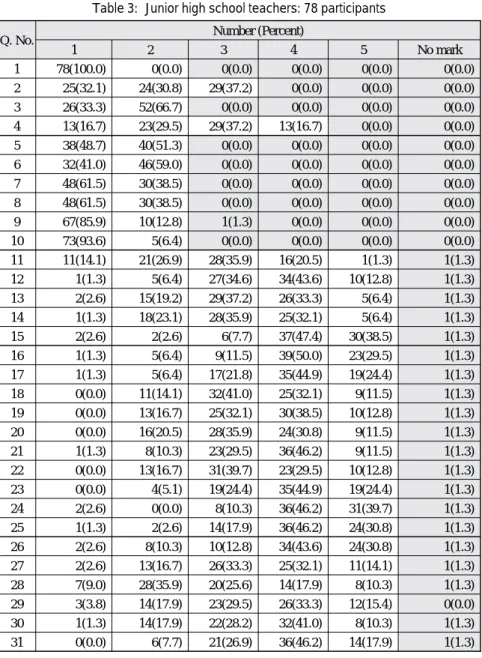
50 6(5.0) 22(18.2) 52(43.0) 27(22.3) 10(8.3) 4(3.3) Table 3: Junior high school teachers: 78 participants
Q. No. Number (Percent)
1 2 3 4 5 No mark 1 78(100.0) 0(0.0) 0(0.0) 0(0.0) 0(0.0) 0(0.0) 2 25(32.1) 24(30.8) 29(37.2) 0(0.0) 0(0.0) 0(0.0) 3 26(33.3) 52(66.7) 0(0.0) 0(0.0) 0(0.0) 0(0.0) 4 13(16.7) 23(29.5) 29(37.2) 13(16.7) 0(0.0) 0(0.0) 5 38(48.7) 40(51.3) 0(0.0) 0(0.0) 0(0.0) 0(0.0) 6 32(41.0) 46(59.0) 0(0.0) 0(0.0) 0(0.0) 0(0.0) 7 48(61.5) 30(38.5) 0(0.0) 0(0.0) 0(0.0) 0(0.0) 8 48(61.5) 30(38.5) 0(0.0) 0(0.0) 0(0.0) 0(0.0) 9 67(85.9) 10(12.8) 1(1.3) 0(0.0) 0(0.0) 0(0.0) 10 73(93.6) 5(6.4) 0(0.0) 0(0.0) 0(0.0) 0(0.0) 11 11(14.1) 21(26.9) 28(35.9) 16(20.5) 1(1.3) 1(1.3) 12 1(1.3) 5(6.4) 27(34.6) 34(43.6) 10(12.8) 1(1.3) 13 2(2.6) 15(19.2) 29(37.2) 26(33.3) 5(6.4) 1(1.3) 14 1(1.3) 18(23.1) 28(35.9) 25(32.1) 5(6.4) 1(1.3) 15 2(2.6) 2(2.6) 6(7.7) 37(47.4) 30(38.5) 1(1.3) 16 1(1.3) 5(6.4) 9(11.5) 39(50.0) 23(29.5) 1(1.3) 17 1(1.3) 5(6.4) 17(21.8) 35(44.9) 19(24.4) 1(1.3) 18 0(0.0) 11(14.1) 32(41.0) 25(32.1) 9(11.5) 1(1.3) 19 0(0.0) 13(16.7) 25(32.1) 30(38.5) 10(12.8) 1(1.3) 20 0(0.0) 16(20.5) 28(35.9) 24(30.8) 9(11.5) 1(1.3) 21 1(1.3) 8(10.3) 23(29.5) 36(46.2) 9(11.5) 1(1.3) 22 0(0.0) 13(16.7) 31(39.7) 23(29.5) 10(12.8) 1(1.3) 23 0(0.0) 4(5.1) 19(24.4) 35(44.9) 19(24.4) 1(1.3) 24 2(2.6) 0(0.0) 8(10.3) 36(46.2) 31(39.7) 1(1.3) 25 1(1.3) 2(2.6) 14(17.9) 36(46.2) 24(30.8) 1(1.3) 26 2(2.6) 8(10.3) 10(12.8) 34(43.6) 24(30.8) 1(1.3) 27 2(2.6) 13(16.7) 26(33.3) 25(32.1) 11(14.1) 1(1.3) 28 7(9.0) 28(35.9) 20(25.6) 14(17.9) 8(10.3) 1(1.3) 29 3(3.8) 14(17.9) 23(29.5) 26(33.3) 12(15.4) 0(0.0) 30 1(1.3) 14(17.9) 22(28.2) 32(41.0) 8(10.3) 1(1.3) 31 0(0.0) 6(7.7) 21(26.9) 36(46.2) 14(17.9) 1(1.3)
32 2(2.6) 18(23.1) 29(37.2) 23(29.5) 5(6.4) 1(1.3) 33 2(2.6) 10(12.8) 36(46.2) 24(30.8) 5(6.4) 1(1.3) 34 1(1.3) 5(6.4) 7(9.0) 42(53.8) 22(28.2) 1(1.3) 35 2(2.6) 4(5.1) 5(6.4) 44(56.4) 22(28.2) 1(1.3) 36 2(2.6) 17(21.8) 32(41.0) 22(28.2) 4(5.1) 1(1.3) 37 4(5.1) 20(25.6) 31(39.7) 19(24.4) 3(3.8) 1(1.3) 38 1(1.3) 6(7.7) 22(28.2) 31(39.7) 17(21.8) 1(1.3) 39 2(2.6) 7(9.0) 20(25.6) 32(41.0) 16(20.5) 1(1.3) 40 2(2.6) 6(7.7) 20(25.6) 26(33.3) 23(29.5) 1(1.3) 41 2(2.6) 4(5.1) 10(12.8) 43(55.1) 19(24.4) 0(0.0) 42 0(0.0) 8(10.3) 19(24.4) 36(46.2) 14(17.9) 1(1.3) 43 1(1.3) 8(10.3) 21(26.9) 38(48.7) 9(11.5) 1(1.3) 44 0(0.0) 10(12.8) 28(35.9) 29(37.2) 11(14.1) 0(0.0) 45 1(1.3) 8(10.3) 30(38.5) 34(43.6) 4(5.1) 1(1.3) 46 0(0.0) 18(23.1) 36(46.2) 20(25.6) 3(3.8) 1(1.3) 47 1(1.3) 14(17.9) 27(34.6) 27(34.6) 8(10.3) 1(1.3) 48 1(1.3) 22(28.2) 29(37.2) 20(25.6) 5(6.4) 1(1.3) 49 0(0.0) 12(15.4) 34(43.6) 26(33.3) 5(6.4) 1(1.3) 50 0(0.0) 13(16.7) 31(39.7) 25(32.1) 5(6.4) 4(5.1)