Introduction
Black soybeans cultivated in the Tanba region of Hyogo prefecture are characterized by extremely large seeds with suitability for boiled seeds processing (Hirota et al. 2005). “Tanbaguro” is now used as the collective name for landraces originating from the Tanba region. By pure-line isolation, “Hyoukei-kuro 3” was selected and has been widely cultivated as a dominant line in Hyogo prefecture. In the previous study (Hirota et al. 2012), we collected black soybean landraces originating from the Tanba region, and demonstrated that seed and/or filling characters varied among these landraces. In order to promote effective use of these genetic resources, it is important to establish a reliable and objective method of evaluation by physical and chemical research with many samples, replacing subjective sensory evaluations for the eating quality of boiled seeds, because sensory evaluations are susceptible to bias due to the panelists and the characteristics of particular trials.
Food texture is one of the essential factors in the eating quality of boiled seeds. Hardness evaluation has been quantified using the breaking force of stress-rupture curve on a texture analyzer in potato (Furudate and Meguro 1997), muskmelon (Hirai et al.
2007), Japanese radish (Komiyama et al. 2009) and green soybean (Furutani et al. 2012). Additionally, the eating quality is strongly affected by other texture components, such as viscosity, as well as hardness. However, evaluation of the viscosity of boiled seeds has not yet been established, although several researchers have presented quantitative indexes of viscosity combining several parameters of stress-rupture curve on a texture analyzer in other foods.
The solubility of pectic substances has been regarded as one of the factors that affect the hardness of samples in Japanese radish (Manabe 1980), muskmelon (Hirai et al. 2007) and soybean (Matsuoka and Shiokawa 1990). Additionally, it has been reported that the calcium content is correlated with the sensory hardness in several vegetables and beans (Kaneko et al. 1982, Makino et al. 1987, Odake et al. 1995). However, most of these studies investigated the change of products between different processing methods; there are few reports of studies that focused on varietal characteristics in soybean.
In this study, we investigated the interrelations among sensory evaluations of hardness and viscosity, physical properties and chemical components, using several black soybean lines and varieties with various seed characteristics, and clarified the contribution of these properties to the texture of boiled seeds in black soybean.
Relationships between Sensory Evaluations, and Physical and
Chemical Properties of Boiled Seeds in Black Soybean
Tomoko Hirota1,2), Shinya Yoshida2,3) and Kosuke Nagai1)
1)Hokubu Agricultural Institute, Hyogo Prefectural Research Center of Agriculture, Forestry and Fisheries (123 Yasui, Wadayama, Asago, Hyogo 669 − 5254, Japan)
2)Graduate School of Agricultural Science, Kobe University (1 − 1 Rokkodai, Nada, Kobe, Hyogo 657 − 8501, Japan) 3)Hyogo Prefectural Research Center of Agriculture, Forestry and Fisheries
(1533 Minamino-oka, Befu, Kasai, Hyogo 679 − 0198, Japan)
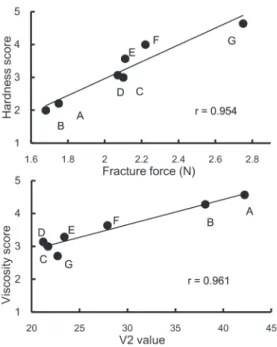
Summary: Interrelationships among sensory evaluations of hardness and viscosity, physical properties and chemical components were investigated using several black soybean lines and varieties possessing various seed characteristics, and the contribution of these properties to the texture of boiled seeds in black soybean was clarified. The fracture force showed a strong positive correlation with the hardness score (r = 0.954). The V2 value in this study, which is the ratio of brittleness strain to brittleness force, showed a strong positive correlation with the viscosity score (r = 0.961). These results indicate that these fracture characteristics using a texture analyzer are effective indexes to evaluate the sensory texture of boiled seeds. The increasing ratio of seed length after soaking (SSL) and the water-soluble pectin content (WSP) of boiled seeds were related to hardness and viscosity by sensory evaluations. It is considered that the objective evaluation methods and these quantitative indexes of texture for boiled seeds are effective for evaluation of the quality of local black soybean varieties and research on their utilization.
Key words: black soybean, boiled seeds, texture, fracture characteristics
Acccepted : May 8, 2013
Corresponding author:Tomoko Hirota([email protected])
Materials and methods Plant materials
Seven black soybean lines were used in this study, and their characteristics are shown in Table 1. Selected lines by seed and/ or flowering characters from “A” to “F”, which were preserved at Hokubu Agricultural Institute (Asago, Hyogo, Japan), had been collected in the fields in Hyogo prefecture, and line “A” named “Hyoukei-kuro 3” is a standard line of “Tanbaguro” in Hyogo prefecture. Seeds of lines “A” to “F” were harvested at Hokubu Agricultural Institute in 2010. Line “G” named “Chusei-hikariguro” is a leading variety in Hokkaido prefecture, and the seeds were purchased as marketed products harvested in 2009.
Measurement of seed size and seed moisture
Seed length, width, thickness and weight were measured for ten average seeds. The length of the seed (SL) was defined as the longest distance across the seed parallel to the hilum, the seed width (SW) as the longest distance from the top to the bottom of the seed, and the seed thickness (ST) as the longest distance across the seed perpendicular to the hilum. For evaluation of seed roundness, a ratio of seed thickness to seed length (ST / SL) was calculated. Seed moisture content was measured using a seed moisture tester (PM-830-2, Kett Co., Japan).
Soaking and boiling treatments
Ten seeds were soaked with 80 ml of distilled water in a beaker and kept for 15 hours at 20℃. Soaked seeds were boiled with 60 ml of distilled water in a beaker for seven minutes at 125℃ using an electric pressure cooker (SR-203P, National Co., Japan) and were allowed to stand for ten minutes.
Measurement of increasing ratio of seed size after soaking
Soaked seed length, width, thickness and weight were measured for ten seeds. For evaluation of increasing ratios of seed size after soaking in length (SSL), width (SSW), thickness (SST) and weight (SSW2), a ratio of water absorbed seeds to dry seeds was calculated.
Measurement of fracture characteristics of boiled seeds
Boiled seed samples with seed coat were compressed with a creep meter (Rheoner RE-3305, Yamaden Co., Japan) at a compression speed of 1 mm/sec using a columnar-type plunger (3 mm in diameter) with a 2 kg load cell. As shown in Fig. 1, measurement parameters, namely, fracture force (FF) (N), fracture strain (FS) (%), fracture energy (FE) (J/m3), brittleness force (BF) (N), brittleness strain (BS) (%) and brittleness energy (BE) (J/m3), were determined from the stress-rupture curve. Viscosity index of boiled seeds in this study was calculated by
the following two equations: V1 = FS / FF and V2 = BS / BF. Fracture tests were conducted using ten seeds with triplicates in each line.
Sensory evaluation
Sensory evaluations were performed with the boiled seeds of each line prepared by the procedure described above with the help of 14 panelists from Hokubu Agricultural Institute. Sensory hardness and viscosity of each sample were scored on a five-point scale from 1 (soft or weak) to 5 (hard or strong), by comparing with the standard sample “D” giving medium score of 3 for each parameter.
Measurement of calcium content of boiled seeds
Suzuki’s method (Suzuki et al. 1987) was applied to measure a calcium content of boiled seeds without seed coat. The homogenized seed sample was weighed (2.00 g) in a polypropylene bottle and 50 ml of 1% hydrochloric acid was added. After one-hour occasional shaking at 20℃, a calcium content was measured with the filtrate using an atomic absorption spectrophotometer (Z-6100, Hitachi Co., Japan). Mean content values were calculated with three replications.
Measurement of pectic substances of boiled seeds
Manabe’s method (Manabe 2001) was applied to measure pectic substances. Alcohol-insoluble solids (AIS) were prepared from 2.00 g of boiled seeds without seed coat. The pectic substances were fractionated from 200 mg of AIS by successive extraction with 50 ml of distilled water for eight hours at 20℃ (water-soluble pectin fraction), 50 ml of 0.4% sodium hexametaphosphate for one hour at 90℃ (chelator-soluble pectin fraction), 50 ml of 0.05 N hydrochloric acid for one hour at 99.5℃ (acid-soluble pectin fraction) and 50 ml of 0.1 N sodium hydroxide for eight hours at 20℃ (non-soluble pectin fraction). The fractions were designated as WSP, CSP, ASP and NSP, respectively. The sum of WSP, CSP, ASP and NSP was designated as total pectin (TP). The amount of galacturonic acid in the four fractions was determined by the carbazole method (Dietz and Rouse 1953). Absorbance at 530 nm was measured using a UV/V scanning spectrophotometer (DU-720, Beckman
Coulter Co., Japan). The mean values were obtained from the four replicate assays.
Results
Seed morphological characters and seed moisture
Seed morphological characters and seed moisture were measured for seven black soybean lines as shown in Table 2. Lines “A” and “B” gave larger values than other lines for all seed characters, particularly for seed width and thickness. The ratio of seed thickness to seed length (ST / SL) ranged from 0.75 to 0.91, in the order of line “A”>“B”>“E”>“F”>“G”>“C”>“D”. The seed weight ranged from 0.50 g to 0.88 g, in the order of line “A”>“B”>“C”and“E”>“D”>“F”>“G”. The initial seed moisture ranged from 10.1% to 13.2%. Line “G” purchased as a sample harvested in 2009 gave a value of 10.1%, which was ca. 2% lower than those of other lines harvested at Hokubu Agricultural Institute in 2010.
Increasing ratio of seed size after soaking
Increasing ratios of seed size (length, width, thickness and weight) after soaking in seven black soybean lines are shown in Table 3. The increasing ratios of seed size ranged from 1.71 to 1.86, from 1.18 to 1.26 and from 1.17 to 1.22 for seed length, seed width and seed thickness, respectively. There were significant differences in the increasing ratios of seed length and seed width between lines, but not of seed thickness. The increasing ratio of seed weight ranged from 2.05 to 2.37, in the order of line “A”>“B”>“G”>“C”>“D”>“E”>“F”.
Fracture characteristics of boiled seeds
Fracture characteristics of boiled seeds in seven black soybean lines are shown in Table 4. For the objective measurement of the texture of boiled seeds, the fracture characteristics were measured using a texture analyzer as reported by other researchers (Furutani et al. 2012, Murakami et al. 2008). The fracture force ranged from 1.68 N to 2.75 N, in the order of line “G”>“F”>“E”>“C”>“D”>“A”>“B”. The fracture strain ranged from 16.4% to 22.4%, in the order of line “F”>“D”>“C”
>“A”>“E”>“B”>“G”. The fracture energy ranged from 24,349 J/m3 to 40,610 J/m3, in the order of line “F”>“G”>“C”>“D”>“E” >“A”>“B”. Lines “A” and “B” were characterized by low fracture force, fracture strain and fracture energy. Line “F” was characterized by high fracture force, fracture strain and fracture energy. Line “G” was characterized by high fracture force and fracture energy and low fracture strain. Lines “C”, “D” and “E” showed intermediate values for fracture parameters. The brittleness force ranged from 0.56 N to 0.85 N, in the order of line “G”>“C”>“D”>“E”>“F” and “A”>“B”. The brittleness strain ranged from 13.6% to 20.3%, in the order of line “B”>“A”>“G” >“C”>“F”>“D”>“E”. The brittleness energy ranged from 27,879 J/m3 to 55,258 J/m3, in the order of line “G”>“A”>“F”>“B” >“C”>“D”>“E”. Lines“A”and“B”were characterized by low brittleness force and high brittleness strain and brittleness energy. Line “F” was characterized by low brittleness force and brittleness strain. Line “G” was characterized by high brittleness
to 4.64, in the order of line “G”>“F”>“E”>“D”>“C”>“A”>“B”. The viscosity score ranged from 2.71 to 4.57, in the order of line “B”>“A”>“F”>“E”>“D”>“C”>“G”. The sensory evaluations Table 3 Increasing ratio of seed size after soaking in seven black soybean lines1)
Table 4 Fracture characteristics of boiled seeds in seven black soybean lines1)
Table 5 Sensory evaluation of boiled seeds for hardness and viscosity in seven black soybean lines1)
1) Sensory hardness and viscosity were
scored on a five-point scale from 1 (soft or weak) to 5 (hard or strong). Sample “D” is the standard line giving medium score of 3. Data are presented in the same manner as in Table 2.
substances, the WSP content ranged from 0.21 g/100 g FW to 0.45 g/100 g FW, in the order of line “B”>“A”>“C” and “E”>“G”>“F”. There was little difference among lines for CSP, ASP, NSP and TP.
Correlations between sensory evaluations and increasing ratio of seed size after soaking
Correlation coefficients between the sensory evaluations and the increasing ratios of seed size after soaking are shown in Table 7. The data were compared among two groups: group “A-F” was designated as lines from “A” to “F” harvested at Hokubu Agricultural Institute in 2010, and group “A-G” was designated as lines from “A” to “G” including a marketed product. The hardness score and the increasing ratio of seed length showed strong negative correlations in group “A-F” (r = −0.912) and group “A-G” (r = −0.840). The hardness score and the increasing ratio of seed weight showed a strong negative correlation in group “A-F” (r = −0.957). In contrast, a similar correlation was not found in group “A-G” (r = −0.541). The viscosity score and the increasing ratio of seed length showed positive correlations in
group “A-F” (r = 0.845) and group “A-G” (r = 0.839). The viscosity score and the increasing ratios of seed size except seed length showed no correlation.
Correlations between sensory evaluations and fracture characteristics of boiled seeds
Correlation coefficients between the sensory evaluations and the fracture characteristics of boiled seeds are shown in Table 8. As shown in Fig. 2, the hardness score and the fracture force showed strong positive correlations in group “A-F” (r = 0.956) and group “A-G” (r = 0.954). The fracture energy and the brittleness strain showed a good agreement with the hardness score in group “A-F”. The brittleness force, the brittleness strain and the fracture force showed good agreements with the viscosity
Table 6 Calcium and pectic substances of boiled seeds in seven black soybean lines1)
1) Abbreviations of chemical components : Ca = calcium content, WSP = water-soluble pectin, CSP =
chelator-soluble pectin, ASP = acid-soluble pectin, NSP = non-soluble pectin, TP = total pectin. Data are presented in the same manner as in Table 2.
Table 7 Correlation coefficients between sensory evaluation and increasing ratio of seed size after soaking1)
Table 8 Correlation coefficients between sensory evaluation and fracture characteristics of boiled seeds1)
score in group “A-F” and group “A-G”. The viscosity score and the V2 value showed strong positive correlations in group “A-F” (r = 0.994) and group “A-G” (r = 0.961). As shown in Fig. 2, the charts of plots and linear regressions showed that the fracture force and the V2 value successfully represent each sensory evaluation.
Correlations between sensory evaluations and chemical components of boiled seeds
Correlation coefficients between sensory evaluations and chemical components (calcium and pectic substances) of boiled seeds are shown in Table 9. The hardness score and the calcium content showed a strong positive correlation in group “A-F” (r =
0.962). In contrast, a similar correlation was not found in group “A-G” (r = 0.141). For the pectic substances, the hardness score and the WSP content showed negative correlations in group “A-F” (r = −0.912) and group “A-G” (r = −0.803). The hardness score and the other pectic substances except WSP showed no correlation. The viscosity score and WSP showed positive correlations in group “A-F” (r = 0.825) and group “A-G” (r = 0.798). Chemical components except WSP showed no correlation with the viscosity score.
Discussion
Relationship between sensory evaluations and fracture characteristics of boiled seeds
It was previously reported that a positive correlation was found between the hardness score and the fracture force (Furudate and Meguro 1997, Furutani et al. 2012, Hirai et al. 2007, Komiyama
et al. 2009). In this study, we also confirmed the correlation
between these two properties. Additionally, the differences in the fracture force between lines, e.g., lines “G” and “C”, and lines “C” and “B”, for which statistical significance was found in the hardness score, were 0.65 N and 0.42 N, respectively. Consequently, we consider that differences of more than 0.5 N in the fracture force were detectable by sensory evaluation for comparison of each line. This fact indicates that the fracture force using a texture analyzer highly reflects the sensory hardness of boiled seed, and is an informative measurement.
On the other hand, the viscosity score by sensory evaluation showed a negative correlation with the fracture force and the brittleness force, and a positive correlation with the brittleness strain (Table 8). In this study, we propose a viscosity index of boiled seeds combining fracture characteristics: the V1 value is the ratio of fracture strain (FS) to fracture force (FF) (i.e., FS / FF), and the V2 value is the ratio of brittleness strain (BS) to brittleness force (BF) (i.e., BS / BF). Similarly, Murakami et al. (2008) reported the “z-value” (i.e., l/h) in boiled seeds, that is, the ratio of fracture time (l) to fracture force (h). Furutani et al. (2012) also reported the “M level” (i.e., a / x + b / y) in green soybean, where a, b, x and y are fracture distance, brittleness distance, fracture force and brittleness force, respectively. As a
Fig. 2 Correlations between sensory evaluation and fracture characteristics of boiled seeds.
Table 9 Correlation coefficients between sensory evaluation and chemical components1)
ratio of seed weight after soaking was negatively correlated with the hardness score that is represented by the fracture force in group “A-F”; however, there was no such correlation in group “A-G” (Table 7). In this study, the initial seed moisture of lines in group “A-F” was about 12 to 13% ; however, that of line “G” (10.1%) was ca. 2% lower than in the other lines. Taira (1982) reported that the increasing ratio of seed weight after soaking has a negative correlation with the initial seed moisture. Accordingly, it is considered that the increasing ratio of seed weight after soaking would not be correlated with the hardness in group“A-G”, owing to the difference of initial seed moisture among samples. On the other hand, the increasing ratio of seed length showed a negative correlation with the hardness and viscosity by sensory evaluation in group “A-F” and group “A-G”. Therefore, the increasing ratio of seed length after soaking may be used to evaluate the processing suitability of boiled seeds regardless of initial seed moisture.
Relationship between sensory evaluations and chemical components of boiled seeds
We analyzed the relationship between the sensory evaluations and the calcium content of boiled seeds in black soybean lines. Previous reports had implicated the calcium content in the sensory hardness using products by different processing methods in ume (Odake et al. 1995), Japanese radish (Kaneko et al. 1982) and bean (Makino et al. 1987). In this study, the calcium content was positively correlated with the hardness score in group “A-F” (Table 9). Our data are consistent with a previous report showing that the sensory hardness would be affected by the calcium content when using seeds of soybean varieties harvested in the same year and location (Saio and Watanabe 1972). However, in this study, there was no such correlation in group “A-G”, including seeds of soybean lines harvested in different years and locations. Our result indicates that the calcium content may not influence the hardness of boiled seeds directly. Taira (1992) reported that the effect of varietal variations on the calcium content in soybean is smaller than that of year and/or location. Further investigations are necessary to clarify the relationship between the sensory hardness and the calcium content for seeds of soybean varieties harvested in different years and/or locations. Next, we analyzed the relationship between the sensory evaluations and the pectic substances of boiled seeds in black soybean lines. As a result, the WSP content showed a negative correlation with the sensory hardness, and a positive correlation with the sensory viscosity (Table 9). Our result is consistent with previous reports showing that the WSP content is affected by the hardness of samples in Japanese radish (Manabe 1980), muskmelon (Hirai et al. 2007) and soybean (Matsuoka and Shiokawa 1990). However, the relationship between the WSP content and the sensory viscosity is a novel observation in this study, since objective evaluation methods of viscosity have not
been established. Furthermore, correlations between the WSP content and the sensory hardness and viscosity were recognized in group “A-G” including seeds of soybean lines harvested in different years and locations. This fact suggests that the WSP content is directly implicated in textural properties.
In conclusion, we clarified that fracture force and V2 value in this study are alternative indexes for sensory evaluations of hardness and viscosity of boiled seeds, respectively. Additionally, the increasing ratio of seed length after soaking and the WSP content of boiled seeds were observed to have relationships with the sensory hardness and viscosity. However, further studies need to confirm these relationships using more soybean lines or varieties. In a previous report (Hirota et al. 2012), we collected black soybean landraces originating from the Tanba region, and demonstrated that seed and/or filling characteristics varied among these landraces. We expect that objective evaluation methods and quantitative indexes in this study can promote understanding of the processing suitability of boiled seeds, and will be applied to evaluation of the quality of these genetic resources and research on their utilization.
References
Dietz, J. H. and A. H. Rouse (1953) A rapid method for estimating pectic substances in citrus juices. Food Res. 18 : 169− 177. Furudate, A. and T. Meguro (1997) Measuring method of boiling
potatoes hardness. Hokkaido Prefectural Agricultural Experiment Station Report 73 : 35− 40 (in Japanese).
Furutani, N., S. Nomura, K. Ohtani and M. Matsui (2012) Development of palatability estimation method in green soybeans of Tamba black soybean. Hort. Res. (Japan) 11 (3) : 309− 314 (in Japanese).
Hirai, G., S. Komiyama, A. Yamaguchi, A. Yamamoto and K. Masuda (2007) Sensory and objective evaluation of postharvest fruit softening and its relationship with pectin solubility in eight commercial cultivars of muskmelon. J. Japan Soc. Hort. Sci. 76 (3) : 237− 243.
Hirota, T., K. Tahata, T. Ogawa, M. Iwai and Y. Inoue (2005) Quality of soybean seeds grown in Hyogo prefecture. Bull. Hyogo Pre. Tech. Cent. Agr. Forest. Fish. (Agriculture) 53 : 6− 12 (in Japanese).
Hirota, T., T. Sayama, M. Yamasaki, H. Sasama, T. Sugimoto, M. Ishimoto and S. Yoshida (2012) Diversity and population structure of black soybean landraces originating from Tanba and neighboring regions. Breed. Sci. 61 : 593− 601.
Kaneko, K., M. Kurosaka and Y. Maeda (1982) Effects of Mg and Ca salts on changes of pectic substance during salting of radish root and its crisp palatability. Nippon Shokuhin Kogyo Gakkaishi 29 (11) : 665− 671 (in Japanese).
Yamamoto (2009) Methods of evaluating texture in Japanese radishes and changes in texture during a light-pickling process. Hort. Res. (Japan) 8 (1) : 101− 107 (in Japanese).
Makino, H., K. Hatae and A. Shimada (1987) Effect of the soaking in NaCl solution on the hardness of cooked bean. J. Cookery Sci. Jpn. 38 (8) : 719− 723 (in Japanese).
Manabe, T (1980) Studies on the firming mechanism of Japanese radish root by pre-heating treatment. Nippon Shokuhin Kogyo Gakkaishi 27 (5) : 234− 239 (in Japanese).
Manabe, T. (2001) Analysis of pectin substances, “Pectin”, Saiwai-Syobou, Tokyo. 26− 48 (in Japanese).
Matsuoka, Y. and M. Shiokawa (1990) Properties of heated black soybean after soaking in NaCl solution. J. Cookery Sci. Jpn. 23 (3) : 311− 314 (in Japanese).
Murakami, T., S. Hiruta, M. Shimomura and K. Hatae (2008) Effect of the frozen storage on the tenderizing of cooked black soybeans. J. Cookery Sci. Jpn. 41 (2) : 117− 125 (in Japanese).
Odake, S., C. Otoguro and K. Kaneko (1995) Effects of calcium
compounds on hardness and sensory evaluation of salted ume fruits. J. Home Eco. Jpn. 46 (7) : 641− 648 (in Japanese). Saio, K. and T. Watanabe (1972) Distribution of inorganic
constituents (calcium, phosphorus and magnesium) in soybean seed and their changes in food processing. Nippon Shokuhin Kogyo Gakkaishi 19 (5) : 219− 222 (in Japanese).
Suzuki, T., A. Yasui, H. Koizumi and C. Tsutsumi (1987) Application of hydrochloric acid extraction procedure to determination of metal elements in soybean, green soybean and roasted soybean flour by atomic absorption spectrophotometry. Nippon Shokuhin Kogyo Gakkaishi 34 (3) : 185− 189 (in Japanese).
Taira, H. (1982) Quality of soybean seeds grown in Japan part 1. physical property, chemical composition, and suitability for food processing. Rept. Natl. Food Res. Inst. 40 : 35− 54 (in Japanese).
Taira, H. (1992) Quality and its variation on soybeans in Japan. Nippon Shokuhin Kogyo Gakkaishi 39 (1) : 122− 133 (in Japanese).