Academia Arena, 2011:3(4) http://www.sciencepub.net
57
A Comparative Study of Performance of Mechanical Engineering Students in Selected Basic Engineering Courses at Ladoke Akintola University of Technology, Ogbomoso
*Oladeji1, J.T., and Sangotayo2, E.O.
1Mechanical Engineering Department, Ladoke Akintola University of Technology, P.M.B. 4000, Ogbomoso, Nigeria. [email protected]/[email protected]
2Mechanical Engineering Department, Ladoke Akintola University of Technology, P.M.B. 4000, Ogbomoso, Nigeria. [email protected]
*Correspondence Author
Abstract: The importance of engineering in nation development cannot be overemphasized. This is because, the prosperity and economic well being of any country have direct link with technological knowhow of such a country.
Hence, adequate and in-depth knowledge of basic engineering courses are required to become a successful engineer.
This study was carried out to compare the performance of mechanical engineering students in selected basic engineering courses at Ladoke Akintola University of Technology, Ogbomoso. Secondary data in form of the results or scores for the past five years were collected from the examination officer of the department, through the permission of the head of department. Essentially, cumulative grade point average (CGPA) of the students was used.
Data were analyzed using means and standard deviations at 95 % confidence level. Data were further subjected to Anova-tests. The trends of performance of students based on courses and years of study were also investigated. The mean scores of 3.26, 3.48, 3.10, 2.84, 3.175 and 2.24 were obtained for the period of five years in the six selected courses in the harmattan semester, while the mean scores in the rain semester were 3.16, 3.02, 2.50, 3.28, 2.84 and 2.98. Statistics revealed that there were no significant differences in the performance of students in the selected courses as well as the trend of performance over the studied years in harmattan semesters. The study concluded that, there were no significant differences in the performance of students in the selected courses in both harmattan and rain semesters. While there is no significant difference in the trend of performance over the studied years in the harmattan semesters, there was significant difference in the trend of performance of students over the years in rain semesters.
[Oladeji, J.T., and Sangotayo, E.O. A Comparative Study of Performance of Mechanical Engineering Students in Selected Basic Engineering Courses at Ladoke Akintola University of Technology, Ogbomoso. Academia Arena, 2011;3(4):57-60] (ISSN 1553-992X). http://www.sciencepub.net.
Keywords: Mechanical engineering, students, performance, rain semester, harmattan semester
1. Introduction
Engineering is one of major disciplines in most worlds’ universities and higher institutions of learning, Nigeria inclusive. In Nigeria, the importance of engineering was underscored with the fact that many universities were established solely as universities of Technology. This is so because; it is mainly on technology that the prosperity of Nigeria
depends. Good technology will also boost our agriculture, and this will guarantee the production of food for the growing population, the generation of employment and the foreign exchange earnings (Anyanwu et al., 1998).
Engineering as a discipline, has many branches.
Notable among them are mechanical, civil, electrical, chemical, agricultural, computer engineering and so on (Khurmi and Gupta, 2006). There are compulsory
and basic courses for all students offering mechanical engineering as a discipline. A student cannot become a successful mechanical engineer without adequate and in-depth knowledge of these courses (Sharma and Aggarwal, 2006). Engineering as a discipline, mechanical engineering inclusive, is faced with many difficulties in Nigerian higher institutions. One of the difficulties being faced by engineering students is lack of exposure to practical, as most students find it difficult to secure places for student industrial work scheme (Adebiyi and Oladeji, 2009). The compulsory National Youth Service Scheme does not help matter as most of graduate engineers are sent to secondary schools to teach. Poor knowledge in allied subjects such as technical drawing, mathematics and space geometry at secondary level also contributes in no small measure to poor performance of students in mechanical engineering courses (Adebiyi and Oladeji, 2009).
Academia Arena, 2011:3(4) http://www.sciencepub.net
58 The main objective of this study was to investigate and compare the performance of students in selected and basic mechanical engineering courses, which are MEE 201- Engineering Drawing I, MEE 203-Workshop Technology I, MEEE 205- Engineering Materials I, MEE 207- Fluid Mechanics I, MEE 211- Engineering Thermodynamics I and MEE 213- Engineering Mechanics I for harmattan semester, and MEE 202- Engineering Drawing II, MEE 204- Workshop Technology II, MEE 206- Engineering Mechanics II, MEE 208- Engineering Materials II, MEE 212- Engineering Materials II and MEE 214- Strength of Materials for rain semester.
The study went further to investigate the trend of performance of students based only on courses and years of study in both harmattan and rain semesters.
2. Materials and Methods
This study was conducted among the mechanical engineering students of Ladoke Akintola University of Technology, Ogbomoso (LAUTECH). LAUTECH is located in Ogbomoso and was established in 1990.
The university was jointly owned by Oyo and Osun States in the south-west geo-political zone of the country and was best state university in Nigeria for four consecutive years. The university has a population of about twenty six thousand and it is heterogeneously inhabited by many Nigerian tribes namely: Yoruba, Ibo, Hausa, and other minority
tribes. The university has six faculties and the main religions practised within the university are Christianity and Islam.
For the purpose of this study, the descriptive method of survey was used. Secondary data in form of the results or scores for the past five years were collected from the examination officer of mechanical engineering department through the permission of the head of department. Data were analysed using means and standard deviations at 95 % confidence level.
Data were further subjected to Anova tests. The method was used because it is considered to be the most appropriate method of comparing means of many groups, which are subjected to the same conditions (Ogunleye, 2009; Oladeji, 2011). The trends of performance of students based on courses and years of study were also investigated. All the statistical analyses were performed on a micro- computer using SPSS 11.0 (Statistical Package for Social Science, 2002).
3. Results
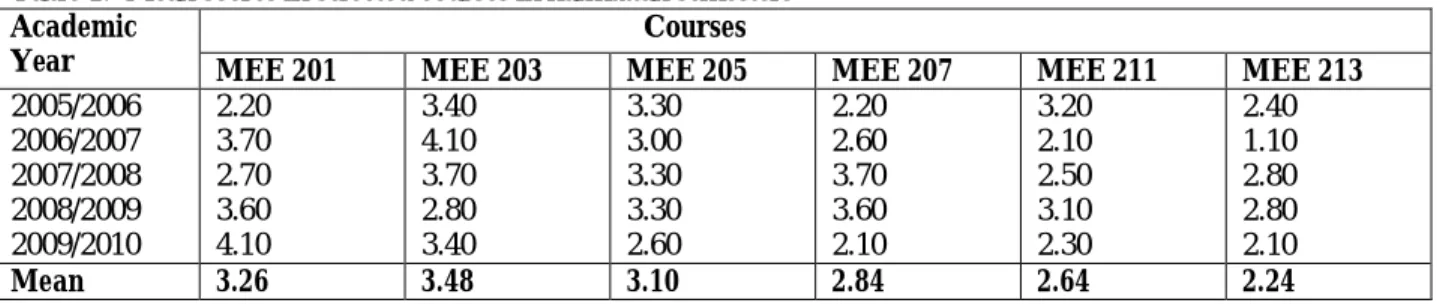
The results of performance of students in all the six courses examined over the period of five years for both harmattan and rain semesters were presented in Tables 1and 2, while Figures 1 and 2 depict comparison in the performance of students in harmattan and rain semesters respectively.
Table 1: Mean scores in selected courses in harmattan semesters Courses Academic
Year MEE 201 MEE 203 MEE 205 MEE 207 MEE 211 MEE 213
2005/2006 2006/2007 2007/2008 2008/2009 2009/2010
2.20 3.70 2.70 3.60 4.10
3.40 4.10 3.70 2.80 3.40
3.30 3.00 3.30 3.30 2.60
2.20 2.60 3.70 3.60 2.10
3.20 2.10 2.50 3.10 2.30
2.40 1.10 2.80 2.80 2.10
Mean 3.26 3.48 3.10 2.84 2.64 2.24
Table 2: Mean scores in selected courses in rain semesters Courses Academic
Year MEE 202 MEE 204 MEE 206 MEE 208 MEE 212 MEE 214
2005/2006 2006/2007 2007/2008 2008/2009 2009/2010
2.50 3.00 2.70 4.00 3.60
2.90 2.50 3.30 3.00 3.40
2.50 2.60 1.80 3.20 2.40
2.30 3.20 3.40 4.10 3.40
2.50 3.00 2.10 3.70 2.90
1.60 2.90 3.20 4.20 3.00
Mean 3.16 3.02 2.50 3.28 2.84 2.98
Academia Arena, 2011:3(4) http://www.sciencepub.net
59 From Table 5, for the period of five years examined in the harmattan semesters, the students had the best performance in MEE 203 with a mean score of 3.48, which was strictly followed by MEE 201 with a mean score of 3.26, while the lowest performance was in MEE 213 with a mean score of 2.24, which was followed by MEE 211 with a mean score of 2.64. In the rain semesters, the best performance was recorded in MEE 208 with a mean score of 3.28, which was followed by MEE 201 with a mean score of 3.16, while the lowest performance was in MEE 206 with a mean score of 2.50. The poor performance of students in courses such as MEE 211, MEE 213
and MEE 206 was not unexpected, as all these courses are mathematics based courses and as noted by Adebiyi and Oladeji (2009), poor knowledge in allied subjects such as technical drawing, mathematics and space geometry at secondary level also contributes in no small measure to poor performance of students in mechanical engineering courses.
The mean scores shown in Tables 1-2 were further subjected to Anova tests and the results were presented in Tables 3 and 4 for harmattan and rain semesters respectively.
Table 3: Performance of students in the harmattan semesters at 5%
ANOVA
Source of Variation SS Df MS F P-value F crit
Years 1.095333 4 0.273833 0.69319 0.605371 2.866081
Courses 5.042667 5 1.008533 2.553033 0.060774 2.710891
Error 7.900667 20 0.395033
Total 14.03867 29
Table 4: Performance of students in the rain semesters at 5%
ANOVA
Source of Variation SS Df MS F P-value F crit
Years 5.774667 4 1.436167 7.396567 0.000794 2.866081
Courses 1.861667 5 0.372333 1.917597 0.13625 2.710891
Error 3.883333 20 0.194167
Total 11.48967 29
From the results, it can be seen that there were no significant differences in the performance of students in the selected courses (F-calculated is less than F- critical i.e 0.69319 < 2.866081) as well as the trend of performance over the studied years (F-calculated is less than F-critical i.e 2.5503 < 2.710891) in the harmattan semesters (Table 3). However, in the rain semesters (Table 4), there was significant difference in the trend of performance of students over the years (F-calculated is higher than F-critical i.e 7.396567 >
2.866081), while there is no significant difference in the performance of students in the selected courses (F-calculated is less than F-critical i.e 1.917597 <
2.710891).
4. Conclusions
Based on the results and findings of this study, the following conclusions can be drawn: -
i. The study concluded that, there were no significant differences in the performance of students in the selected courses in both harmattan and rain semesters.
ii. While there was no significant difference in the trend of performance over the studied years in the harmattan semesters, there was significant difference in the performance of students in the selected courses in the rain semesters.
iii. Students were not at their best in mathematical related courses
References
Adebiyi, K.A., and Oladeji, J.T., (2009) Fundamentals of Engineering Drawing- A stepwise Approach, Series 2, Keller Prints Production, Ibadan pp 2-5
Anyanwu, A.C., Anyanwu, B.O., and Anyanwu, V.A., (1998) A Textbook of Agricultural Sciences
Academia Arena, 2011:3(4) http://www.sciencepub.net
60 for Schools and Colleges, Africana-FEP Publishers Limited, 5th Edition, Onitsha Khurmi, R.S., and Gupta, J.K., (2006) A Textbook of
Machine Design. Eurasia Publishing House (PVT) Ltd. Ram Nagar, New Delhi
Ogunleye, O.O., (2009) “Optimizing Raw Materials Formulation for Flexible Polyurethane Foam Production” An Unpublished Ph.D Thesis in the Department of Industrial and Production Engineering. Faculty of Technology, University of Ibadan, Ibadan Oladeji, J.T., (2011) “The Effects of Some
Processing Parameters on Physical and Combustion Characteristics of Corncob Briquettes” Unpublished Ph.D Thesis in the Department of Mechanical Engineering Faculty of Engineering and Technology, Ladoke Akintola University of Technology, Ogbomoso
Sharma, P.C., and Aggarwal, D.K., (2006) Machine Design S.K. Kataria and Sons, Nai Sarak, Delhi
4/8/2011