日本の国公立大学附属病院における注射用抗菌薬 使用の現状と課題
泉川 公一1,2)・冨田 隆志1,3)・西村 信弘1,4)・丹羽 隆1,5)・高山 和郎1,6)
大花 昇1,7)・草間 文子1,8)・飛田 征男1,9)・根ヶ山 清1,10)・松田 淳一1,11)
勝見 真琴1,12)・佐藤 智明1,13)・徳江 豊1,14)・村上 啓雄1,15)
1)国公立大学附属病院感染対策協議会
2)長崎大学医歯薬学総合研究科臨床感染症学分野*
3)広島大学病院薬剤部
4)島根大学医学部附属病院薬剤部
5)岐阜大学医学部附属病院薬剤部
6)東京大学医学部附属病院薬剤部
7)福島県立医科大学附属病院検査部
8)新潟大学医歯学総合病院検査部
9)福井大学医学部附属病院検査部
10)香川大学医学部附属病院検査部
11)長崎大学病院検査部
12)東北大学病院診療技術部検査部門
13)東京大学医学部附属病院検査部
14)群馬大学医学部附属病院感染制御部
15)岐阜大学医学部附属病院生体支援センター
受付日:2018 年 3 月 22 日 受理日:2018 年 6 月 20 日
2016 年に厚生労働省から発表された,薬剤耐性アクションプランは抗菌薬適正使用をはじめさまざ まな提言がされている。抗菌薬適正使用について,国公立大学附属病院感染対策協議会のサーベイラン ス作業部会・臨床検査技師部会ならびに,薬剤師部会でのデータをもとに日本の国公立大学附属病院に おける主要な耐性菌の検出状況と注射用抗菌薬使用の現状について経年的な変化も含めて検討した。カ ルバペネム耐性腸内細菌科細菌は 2015 年には 657 症例に検出されていた。基質特異性拡張型
β
ラク タマーゼ産生菌は経年的に増加が顕著であったが,多剤耐性緑膿菌,2 剤耐性を含む緑膿菌の検出は概 ね横ばいであった。注射用抗菌薬の使用量は全体として増加傾向にあり,なかでもペニシリン系薬の増 加が顕著で,カルバペネム系薬は顕著ではないものの増加傾向にあった。それぞれの大学病院において,カルバペネム系薬は比較的,均一に使用されている一方で,タゾバクタム/ピペラシリンは使用が少な い病院と多い病院のばらつきが強い傾向にあった。薬剤耐性アクションプランの確実な遂行により,抗 菌薬適正使用が進み,薬剤耐性菌が十分にコントロールされることが重要である。
Key words: national action plans on antimicrobial resistance,appropriate use of antimicrobials,
national and public university hospitals,current status,parenteral antimicrobials
*長崎県長崎市坂本 1―7―1 国際医療センター 3 階
Table 1. Reduction of antimicrobial use per day per 1,000 inhabitants (Outcome indices for the Japanese action plan)
in 2020 (compared to 2013)
Total 33% reduction
oral cephalosporins 50% reduction
oral quinolones oral macrolides
intravenous antimicrobials 20% reduction
Table 2. Reduction of the antimicrobial resistance rate of bacteria (Outcome indices for the Japanese action plan) resistance rate
in 2014
resistance rate in 2020 (comparing to 2013)
Penicillin-resistant Streptococcus pneumoniae 48% 15% or less
Methicillin-resistant Staphylococcus aureus 51% 20% or less
Fluoroquinolone-resistant Escherichia coli 45% 25% or less
Carbapenem (imipenem)-resistant Pseudomonas aeruginosa 17% 10% or less Carbapenem-resistant Escherichia coli and Klebsiella pneumoniae 0.1-0.2% maintain at 0.2% or less
● ● ● ● ● ● ● ● ● ● ● ● ● ● ● ● ● ● ● ● ● ● ● ● ● ● ● ● ● ● ● ● ● ● ● ● ●
はじめに
日本政府は
2016
年4
月5
日,国際的に脅威とな る感染症対策関係閣僚会議を開催し,薬剤耐性(an-timicrobial resistant:AMR)対策アクションプラ
ンを策定した。その内容として,(1)啓発・教育,(2)サーベイランス,(3)感染予防・管理,(4)抗菌薬 適正使用,(5)研究開発・創薬,(6)国際協力の
6
項目があがる。2020年までの成果指標として,ヒ トの抗微生物薬の使用量(人口1,000
人あたりの1
日抗菌薬使用量)の削減(Table 1)と,主な微生 物の薬剤耐性率の減少(Table 2)があげられた。具 体的な成果指標が定められたことは意義があるもの の,当然のことながら,削減は主目的ではなく,不 適切に使用されている可能性のある抗菌薬を適正使 用することにより,結果として削減が達成できた,というアウトカムが得られるべきである。成果指標 の達成のために,全国の大学病院が果たす責任は大 きい。大学病院は高度医療を行う病院であり,必然 的に重症や難病患者を受け入れることが多く,抗菌 薬の使用は増加することが予測される。一方,感染 制御における地域連携の重要性は自明であるが,大 学病院は地域の医療機関において,感染制御,なら びに診療について,教育的,指導的立場にあり,日 本全体の抗菌薬の使用状況について間接的に影響を 与えることになる。抗菌薬適正使用の推進には,ま
ずは,現状を把握する必要があるが,日本の感染症 診療をリードする人的資材が豊富な大学病院におい て,抗菌薬がどの程度,使用されているかについて は,まとまったデータに乏しかった。
本総説では,国公立大学附属病院感染対策協議会 のサーベイランス作業部会・臨床検査技師部会なら びに薬剤師部会によりまとめられた,全国の国公立 大学附属病院における,各種耐性菌の検出状況,薬 剤の使用量を紹介し,抗菌薬適正使用における大学 病院の役割について概説する。なお,本稿で紹介す る内容は,2017年
4
月8
日に,東京で開催された 第91
回日本感染症学会・第65
回日本化学療法学会 合同学会のシンポジウムで発表した。I. 各種薬剤耐性菌の検出状況
国公立大学附属病院感染対策協議会のサーベイラ ンス作業部会・臨床検査技師部会により調査された,
国公立大学
54
施設における,2015年1
月から12
月までの1
年間における,カルバペネム耐性腸内細 菌 科 細 菌(carbapenem-resistant enterobacteri-aceae:CRE),多剤耐性緑膿菌(multidrug-resistant Pseudomonas aeruginosa
:MDRP),2剤耐性を含 む 緑 膿 菌,基 質 特 異 性 拡 張 型β
ラ ク タ マ ー ゼ(extended-spectrum
β -lactamase:ESBL)産生菌
の検出状況は以下のとおりである。なお,各種薬剤 の感受性試験結果は,CLSI M100-S22のブレイク ポイントに準拠し判定された。CRE,MDRP
は,本 邦の感染症法の検査方法と届出基準に基づいて定義 され,2剤耐性緑膿菌はカルバペネム系薬,キノロ ン系薬,アミノグリコシド系薬のいずれかの2
薬剤 に耐性を示したものと定義された。1.CRE
2015
年にCRE
は全国の国公立大学附属病院では,657
症例において検出され,うち,137例は感染症 法に基づいて届出が行われた(Fig. 1)。一方で,届 出義務のないCRE
は520
症例に検出された。1大Fig. 1. Number of cases of carbapenem-resistant enterobacteriaceae detected in Japanese national and public university hospi- tals in 2015
Carbapenem-resistant enterobacteriaceae were isolated from a total of 657 cases in Japan. While 137 of these cases were notified to the Ministry of Health, Labour and Welfare by National Order, the remaining 520 cases were not notified as they did not satisfy the criteria for notification. The median number of cases at each Japanese national and public university hos- pital that were notified and not notified were 2.5 and 9.6, respectively. Number indicate the blind identification number of each hospital.
00 11 22 33 44 55 66 77 88 99 10 10 11 11 12 12 13 1314 14 15 15 16 16 17 17 18 18 19 19 20 20 21 2122 2223 2324 2425 2526 2627 2728 2829 2930 3031 3132 3233 3334 3435 3536 3637 3738 3839 3940 4041 4142 4243 4344 4445 4546 4647 4748 4849 4950 50 51 5152 5253 5354 5455 55 cases
60 60 55 55 50 50 45 45 40 40 35 35 30 30 25 25 20 20 15 15 10 10 median
2.5
median 9.6
national and public university hospitals notified cases to Ministry
of Health, Labour and Welfare (137)
not notified cases to Ministry of Health, Labour and Welfare (520)
学あたりの検出症例数の中央値は,届出ありの場合 は
2.5
症例で,届出がない場合は9.6
症例であった。国立感染症研究所の病原微生物検出情報 に よ る
2016
年9
月6
日の報告1)によると,2015年に,全国 で届けられたCRE
の報告数は,1,669症例であり,そのうちの
8.2% は全国の国公立大学附属病院から
検出されたことになる。また,2016年に,全国で 感染症法に基づいて報告されたCRE
の報告数は,1,581
症例であった2)。この2
年間だけの推移をみる と日本全体におけるCRE
の検出状況は必ずしも増 加傾向ではない。一方,ここで報告されているCRE
は,いわゆるカルバペネマーゼ産生腸内細菌科細菌(
carbapenemase-producing enterobacteriaceae:
CPE)であるか,あるいはカルバペネマーゼ非産生
腸内細菌科細菌であるかは不明である。さらには,感染症法の基準を満たしていないが,カルバペネ マーゼを産生する,いわゆるステルス型
CPE
につ いても把握されていないという問題点が残る。正確 なCRE
の浸淫率については,今後,より詳細なサー ベイラインスが求められる。2.MDRP,2 剤耐性を含む緑膿菌
緑膿菌は,全国の国公立大学附属病院において,
2009
年 か ら2015
年 ま で に 年 間12,000
か ら19,000
例 程 度 の 検 出 が 認 め ら れ て い る。ciprofloxacin(CPFX),amikacin(AMK),meropenem(MEPM),
imipenem
(IPM),ceftazidime(CAZ),piperacillin(PIPC)に対する感受性の経年変化を
Fig. 2
に示す。これらの薬剤のうち,AMKに関しては,感受性率 が最も保たれており,2008年から
2015
年までほぼ 変 化 が な い。CPFX,MEPM,IPM,CAZに つ いFig. 2. Annual changes in the isolation rates of drug-resistant Pseudomonas aeruginosa in Japanese national and public uni- versity hospitals from 2008 to 2015
Susceptibility of P. aeruginosa to amikacin remains high, and no annual changes in the rate of isolation of amikacin-resis- tant P. aeruginosa were detected from 2008 to 2015. A trend towards recovery of drug susceptibility to ciprofloxacin, me- ropenem, imipenem, and ceftazidime from 2008 to 2015 was noted. The rate of emergence of P. aeruginosa species show- ing intermediate resistance to piperacillin increased in 2014 and 2015.
CPFX, ciprofloxacin; AMK, amikacin; MEPM, meropenem; IPM, imipenem; CAZ, ceftazidime; PIPC, piperacillin. S, sensi- tive; I, intermediate; R, resistant.
MEPM IPM CAZ
2015 2014 2013 2012 2011 2010 2009 2008 2015 2014 2013 2012 2011 2010 2009 2008 2015 2014 2013 2012 2011 2010 2009 2008 2015 2014 2013 2012 2011 2010 2009 2008 2015 2014 2013 2012 2011 2010 2009 2008 2015 2014 2013 2012 2011 2010 2009 2008 2015 2014 2013 2012 2011 2010 2009 2008 2015 2014 2013 2012 2011 2010 2009 2008
PIPC AMK
2015 2014 2013 2012 2011 2010 2009 2008 2015 2014 2013 2012 2011 2010 2009 2008
CPFX
2015 2014 2013 2012 2011 2010 2009 2015 2014 2013 2012 2011 2010 2009
S I R (%)
ては,経年的に感受性が回復傾向にある。一方,
PIPC
については,耐性菌の検出率は変化がないが,中等 度耐性を示す株数がやや増加傾向にある。MDRP の検出率は,この7
年間で横ばいであり,IPMとCPFX
の2
剤に同時に耐性を示す緑膿菌が,IPM とAMK,あるいは,AMK
とCPFX
の2
剤に同時 に耐性を示す緑膿菌より多く検出される傾向にある ものの,MDRPと同様に,経年的な増加傾向は認 めていない(Fig. 3)。2017
年8
月に公表されたJANIS
の院内感染対策 サーベイランス検査部門の集計3)では,CLSI2007年 の判定基準に準拠すると,全国1,435
の医療機関(全 体で8,493
病院のうちの16.9% にあたる)での 2015
年の1
年間に収集したデータから,緑膿菌のPIPC,
IPM,MEPM
の感性株 は,そ れ ぞ れ89.4%(解 析
対 象 株 数:182,193株),80.6%(解 析 対 象 株 数:168,580
株),86.6%(解析対象株数:181,170株)で,AMK
では84.9%(解析対象株数:185,327
株)が感 性を示していた。これらのデータは,全国国公立大 学附属病院のデータと比較して数%の誤差に留まり ほぼ一致している。3.ESBL 産生菌
ESBL
産生菌は,大腸菌(23,153株),肺炎桿菌(10,318株),
Klebsiella oxytoca
(4,192株),Proteus
mirabillis
(1,291株)について検討され,2012年か ら2015
年のまでの監視培養で検出されたESBL
産 生菌も含めて,その検出頻度をFig. 4
に示す。大 腸菌は2009
年には13% 台であったものが,4
年間Fig. 3. Annual changes in the rate of isolation of Pseudomonas aeruginosa showing multidrug resis- tance or resistance to at least two anti-pseudomonal drugs in Japanese national and public univer- sity hospitals from 2009 to 2015
The detection rate of multidrug-resistant P. aeruginosa remained at around 1% to 2% during the last seven years of the study period. The detection rate of P. aeruginosa resistant to both imipenem and ciprofloxacin was 3% to 6%, with no trend towards increase.
MDRP, multidrug-resistant P. aeruginosa; IPM/AMK, imipenem/amikacin; IPM/CPFX, imipenem/
ciprofloxacin; AMK/CPFX, amikacin/ciprofloxacin; R, resistance.
1.1 1.1 1.1 1.1 1.2 1.7
1.0
0.4 0.4 0.5 0.7
1.1 0.5 1.2
4.7 5.5
3.2 3.2
4.6 3.9
3.0
0.7 0.8 0.5
0.8 0.9 0.7
MDRP IPM/AMK 「R」 IPM/CPFX 「R」 AMK/CPFX 「R」
2.2 6
5
4
3
2
1
0 (%)
2009 (n = 15,647) 2010 (n = 14,830) 2011 (n = 19,349) 2012 (n = 12,323) 2013 (n = 13,083) 2014 (n = 13,783) 2015 (n = 14,862)
で
3〜4%
程度の顕著な増加傾向を示している。肺 炎桿菌も含むKlebsiella
属は大腸菌ほど急激ではな いが,増加傾向にある。最近の日本の複数の疫学デー タ4〜7)から,ESBL産生菌は増加傾向にあるが,国 公立大学附属病院のデータも,それを裏付けている。一方,家畜や海外渡航者からの持ち込みや市中の健 常者における保菌状況に関する疫学データはきわめ て限られており,ESBL産生菌の正確な浸淫率につ いては,今後,サーベイランスを強化する必要があ る6)。
II. 各種注射用抗菌薬の使用状況
国公立大学附属病院感染対策協議会のサーベイラ ンス作業部会・薬剤師部会により国公立大学
52
大 学55
施設における,第4
世代セフェム系薬,カル バ ペ ネ ム 系 薬,tazobactam/piperacillin(TAZ/PIPC),キノロン系薬を含む抗菌薬の使用状況を an- timicrobial use density(AUD)(DDDs:defined daily dose/100 beds-days)と days of therapy
(DOT)にて調査された結果は以下のとおりである。
系統別抗菌薬の平均
AUD
の2008
年から2015
年 の年次推移をFig. 5
に示す。AMR対策のアクショ ンプランの成果指標とは逆に,全体として使用状況 は増加傾向にある。2008年と比較して,2015年はAUD
で約1.4
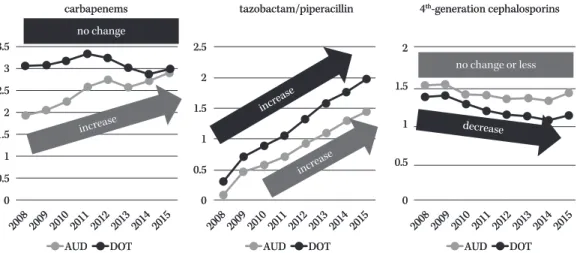
倍に増加している。ペニシリン系薬 の増加が顕著で,カルバペネム系薬は顕著ではない が増加傾向にあり,2011年から承認されたマクロ ライド系注射薬(azithromycin)はいったん増加し たあと,近年はやや減少傾向にある(Fig. 6)。さ らに,カルバ ペ ネ ム 系 薬,TAZ/PIPC,第4
世 代 セフェム系薬の 平 均AUD
とDOT
の 年 次 推 移 をFig. 7
に示す。前述のとおり,カルバペネム系薬とTAZ/PIPC
は,2008年以降,使用量は増加してい るが,治療日数について,カルバペネム系薬は増加 傾向にはないものの,TAZ/PIPCでは顕著な増加 傾向にある。一方,第4
世代セフェム系薬は,使用 量,治療日数ともに減少傾向にある。また,TAZ/PIPC
とカルバペネム系薬の各病院における使用傾 向は大きく異なることがわかる。カルバペネム系薬Fig. 4. Annual changes in the isolation rates of extended-spectrum β -lactamase-producing bacteria in Japanese national and public university hospitals from 2012 to 2015
The isolation rate of extended-spectrum β -lactamase-producing Escherichia coli was 13.4% in 2012, with a marked increase to 16.9% in 2015. The isolation rate of Klebsiella species, including K. pneu- moniae, also showed a trend towards increase.
E. coli, Escherichia coli; K. pneumoniae, Klebsiella pneumoniae; K. oxytoca, Klebsiella oxytoca; P. mira- billis, Proteus mirabillis.
result of active surveillance data excluded 20
15 10 5 0
13.4 15.5 16.5
E. coli 16.9
3.8 4.5 4.7
K. pneumoniae
4.9 3.6
2.8 2.9
K. oxytoca
3.8 6.6 6.2 6.7
P. mirabilis 6.6 2012
(%)
(%)
2013 2014 2015
20 15 10 5 0
13.8 15.2 16.4
E. coli 17.8
4.2 4.7 5.0
K. pneumoniae 5.4
3.0 3.2 3.0
K. oxytoca 3.9
7.2 6.7 7.5
P. mirabilis 6.6
2012 2013 2014 2015
result of active surveillance data included
Fig. 5. Annual changes in the rates of use of major antimicrobial drugs in Japanese national and public university hospitals from 2008 to 2015
An annual trend towards increase in the rate of use density for almost all classes of antimicrobial drugs was seen, which is totally inconsistent with the outcome indices of the Japanese action plan.
n=43 n=43 2008 2008 2009 2009 20 10
20 10 20 11 20 11
20 12 20 12
20 13 20 13
20 14 20 14
20 15 20 15
2008 2008 2009 2009 20 10
20 10 20 11 20 11
20 12 20 12
20 13 20 13
20 14 20 14
20 15 20 15 47
47 49 49 51 51 54 54 54 54 54 54 54 54
0%
0%
10%
10%
20%
20%
30%
30%
40%
40%
50%
50%
60%
60%
70%
70%
80%
80%
90%
90%
100%
100%
22 22 20 20 18 18 16 16 14 14 12 12 10 10 88 66 44 22 00
DDDs/100 bed-days proportion of antimicrobials
tetracyclines tetracyclines penicillins penicillins
1
st-generation cephalosporins 1
st-generation cephalosporins 2
nd-generation cephalosporins 2
nd-generation cephalosporins 3
rd-generation cephalosporins 3
rd-generation cephalosporins 4
th-generation cephalosporins 4
th-generation cephalosporins carbapenems
carbapenems
macrolides
macrolides
lincosamides
lincosamides
aminoglycosides
aminoglycosides
quinolones
quinolones
glycopeptides
glycopeptides
others
others
Fig. 6. Annual changes in the antimicrobial use density in Japanese national and public university hospitals relative to the AUD in 2008
The antimicrobial use density (AUD) was 1.4-fold higher in 2015 as compared to that in 2008. Significant increase in the density of penicillins was also recognized. The AUD of carbapenems is also increasing gradually, but has not reached statistical significance.
penicillins
1
st-generation cephalosporins 2
nd-generation cephalosporins 3
rd-generation cephalosporins 4
th-generation cephalosporins carbapenems
macrolides aminoglycosides quinolones glycopeptides penicillins
1
st-generation cephalosporins 2
nd-generation cephalosporins 3
rd-generation cephalosporins 4
th-generation cephalosporins carbapenems
macrolides aminoglycosides quinolones glycopeptides
n=43 n=43
2015 2015 2014 2014 2013 2013 2012 2012 2011 2011 2010 2010 2009 2009 2008 2008 3.5 3.5 3 3 2.5 2.5 2 2 1.5 1.5 1 1 0.5 0.5 0 0
47
47 49 49 51 51 54 54 54 54 54 54 54 54
Rate of DDDs/100 bed-days relative to that in 2008 set as 1
Fig. 7. Annual changes in the rates of use AUD and duration of therapy (DOT) for carbapenems, tazobactam/
piperacillin and 4
th-generation cephalosporins in Japanese national and public university hospitals from 2008 to 2015
Both the AUD and DOT for tazobactam/piperacillin increased significantly from 2008 to 2015. The AUD for carbapenems is also increasing, although the DOT showed no change during the study period of eight years.
AUD, antimicrobial use density; DOT, days of therapy.
carbapenems
carbapenems tazobactam/piperacillin tazobactam/piperacillin no change
no change
incre ase incre ase
incre ase incre ase
incre ase incre ase
decrease decrease no change or less no change or less 4
th-generation cephalosporins 4
th-generation cephalosporins
2008 2008 2009 2009 20 10
20 10 20 11 20 11
20 12 20 12
20 13 20 13
20 14 20 14
20 15 20 15
2008 2008 2009 2009 20 10
20 10 20 11 20 11
20 12 20 12
20 13 20 13
20 14 20 14
20 15 20 15
2008 2008 2009 2009 20 10
20 10 20 11 20 11
20 12 20 12
20 13 20 13
20 14 20 14
20 15 20 15 AUD
AUD DOT DOT AUD AUD DOT DOT AUD AUD DOT DOT
3.5 3.5 33 2.5 2.5 22 1.5 1.5 11 0.5 0.5 00
2.5 2.5 22 1.5 1.5 11 0.5 0.5 00
22
1.5 1.5
11
0.5 0.5
00
は比較的,均一に使用されている一方で,TAZ/
PIPC
は使用が少ない病院と多い病院のばらつきが 強い傾向にある(Fig. 8)。日本全体の注射用抗菌薬の使用状況に関するまと まったデータは少ないが,2010年における日本国 内の
203
病院,計91,147
床での注射用抗菌薬使用状況のアンケート調査では,全体の抗菌薬の
AUD
は15.49
で,その内訳はペニシリン系薬が4.27,カ
ルバペネム系薬が1.60,キノロン系薬が 0.41
であ り,病院の機能別での大きな違いはみられなかった と報告8)されている。国公立大学附属病院のデータ も,2010年当時のデータと比較すると,ペニシリFig. 8. Antimicrobial use density for tazobactam/piperacillin and carbapenems in Japanese national and public university hos- pitals in 2015
The trend of usage of tazobactam/piperacillin and carbapenems varies among Japanese national and public university hos- pitals. Carbapenems are used evenly, whereas the rate of use of tazobactam/piperacillin varies among hospitals. Numbers indicate the blind identification number of each hospital.
tazobactam/piperacillin
DDDs/100 bed-days
4.5 4 3.5 3 2.5 2 1.5 1 0.5 0
DDDs/100 bed-days
8 7 6 5 4 3 2 1 0
carbapenems
1 3 5 7 9 1113151719212325272931333537394143454749515355 1 3 5 7 9 1113151719212325272931333537394143454749515355
Fig. 9. Interventions to control use of carbapenems in Japanese national and public university hospitals in 2015
A permit system or notification system was made applicable to all Japanese national and public university hospitals in 2015.
2008 2009 2010 2011 2012 2013 2014 2015 2008 2009 2010 2011 2012 2013 2014 2015
permit system
0% 20%
12 1 25
16
1 2 21
1 2 12
1
1 2
2 20 2 15
37
47 5
50 1
1 53
40% 60% 80% 100%
notification system
use condition setting or intervention none
52
ン系薬がやや少ないものの,カルバペネム系薬,キ ノロン系薬はほぼ同様の
AUD
になっている。さら に,IMSジャパン株式会社の抗菌薬販売の卸デー タ(日本全国の98% の使用状況を反映すると考え
られる)を使用した最近の解析では,2009, 2011, 2013
年において,注射用抗菌薬のDID(defined daily doses per 1,000 inhabitants per day,DDD
と日本 の人口で補正,国民1
人あたりの使用量に相当)は,それぞれ,1.070,1.159,1.225と増加傾向にある。
中でも
β
ラクタマーゼ阻害薬配合ペニシリン系薬 のDID
は,0.257(2009年),0.316(2011年),0.389(2013年)と著明に増加し,カルバペネム系薬も
0.098(2009
年),0.105(2011年),0.109(2013年)とわずかではあるものの増加傾向にある9)。これら のデータは,直接の比較はできないが,全国のデー タと国公立大学附属病院の注射用抗菌薬の使用状況 の変化が概ね一致していることを示している。
III. 耐性菌の検出状況と注射用抗菌薬使用量の相 関について
McLaughlin
らの報告によるとカルバペネム系薬 の使用とCRE
の検出については,正の相関関係が あることが示されている10)。国公立大学附属病院における
CRE
の検出数は,2015年のみのデータであ り,前後のデータが比較できないことから,CRE の検出数とカルバペネム系薬の使用量増加との相関 は不明であるが,カルバペネム系薬の使用は確実に 増加傾向にあるので,CREの検出数の推移は今後,注意深く見守ることが重要である。
一方,大腸菌と肺炎桿菌を含む
Klebsiella
属のESBL
産生菌は,近年,著明な増加傾向にあり,本 邦の耐性菌対策における最も重大な課題の一つであ る。ESBL産生菌の検出頻度とカルバペネム系薬の 使用量(AUD)の伸び率を比較すると,2015年は2012
年と比して,いずれも約1.2
から1.3
倍の伸び 率を示しており,ほぼ相関していると考えられる。今後,ESBL産生菌が増加すると必然的にカルバペ ネム系薬の使用が増加することが予想されるが,そ の選択圧が,CREの検出率にどのような影響を及 ぼすか,きわめて重要な問題となる。
緑 膿 菌 は,PIPCに つ い て は 横 ば い で あ る が,
CPFX,MEPM,IPM,CAZ
については経年的に感受性が回復傾向にあり,MDRPの検出率も増加 傾向にはない。以前,われわれはカルバペネム系薬 をはじめとした広域
β
ラクタム薬の使用は,緑膿 菌の耐性化に相関することを報告した11)。しかし,今回の解析では,国公立大学附属病院におけるカル バペネム系薬の使用量は経年的に増加しているもの の,感受性はむしろ回復しており,相関していない ことがわかる。推察の域をでないが,感染防止対策 加算や感染防止対策地域連携加算などの施策による 全国的な感染対策の技術や実践が地域の病院におい ても向上し,院内や連携医療機関間における水平伝 播が減少したのではないか,と考えられる。
IV. 抗菌薬適正使用における大学病院の役割 病床数が多く,複雑な背景をもつ重症患者の多い 大学病院における抗菌薬適正使用には,いくつかの 課題が存在する。感染防止対策加算の要件にあげら れる広域抗菌薬の
audit
について,許可制や届出制 などにより,その使用に一定の制限をかけることに 成功はしていると考えられる。実際に,すべての国 公立大学附属病院において,許可制,届出制が導入 されている(Fig. 9)。ただし,届出制だけでは,抗 菌薬適正使用の活動としては不十分であり,本来,広域抗菌薬だけに限らず,すべての抗菌薬使用症例 に介入することが望ましい。
すべての国公立大学附属病院には,感染制御にか かわる部門があり,概ね,何らかの抗菌薬適正使用 にかかわる活動が行われ,いわゆる抗菌薬適正使用 支 援 チ ー ム(antimicrobial stewardship team:
AST)を組織している施設もある。全例介入を検
討した場合,実現は可能であろうか? 例えば,長 崎大学病院(862床)における試算では,1日の平 均抗菌薬使用患者数は173.2
人/日(2016年)にの ぼり,実に全入院患者の20% を占めている。当然
のことながら,抗菌薬の不要な不適切な症例も含ま れている可能性があるが,全例介入のために必要な 人員は,医師あるいは薬剤師が,1人あたり30
人/日の抗菌薬処方患者までフォローできると仮定する と,最大で
173.2/30=5.8
人の人員が必要となる。一 般的な感染制御部では,AST活動以外にも種々の 活動が求められており,AST
の中心となる医師,薬 剤師を十分な数だけ確保することは難しいと考えら れる。すなわち,今後の抗菌薬の適正使用の遂行の ためには,感染症医の育成が必須であり,AMR対 策アクションプランの一環として,長期的な視野に たった人材育成の方法を考えておく必要がある。日本の施策である
AMR
対策アクションプラン2016―2020
の成果指標の達成について,今回,紹介した国公立大学附属病院のデータをもとに考える と,国公立大学附属病院における注射用抗菌薬を
2020
年までに20% 削減することは,困難なことが
予想される。今後,AST活動も盛んになり,適正 使用がますます推進されることとなり,期待も大き い一方で,抗菌薬の適正使用が正しく実践されてい るか,という点に関しては,その指標がまだ確立さ れていない。すなわち,Fig. 8に示されるような,大学間における注射用抗菌薬の使用状況の差異が,
地域のアンチバイオグラムの差異による適正使用の 結果なのか,入院する患者背景によるものか,感染 制御の破綻により一時的に耐性菌が蔓延した結果な のか,あるいは,ASTによる適正な活動の結果で あるのか,さらには,この差異が,患者の予後に影 響していないか,といった点について,それを評価 する指標が存在しない。したがって,各大学におけ る抗菌薬の使用状況を適切に評価できない点が問題 点としてあがる。削減が困難であるのであれば,そ の理由について,相互に,適切に評価し,何が問題 なのか,問題点を抽出する努力が求められる。
● ● ● ● ● ● ● ● ● ● ● ● ● ● ● ● ● ● ● ● ● ● ● ● ● ● ● ● ● ● ● ● ● ● ● ● ●
おわりに
本総説では,国公立大学附属病院の主要な耐性菌 の分離頻度,注射用抗菌薬の使用状況に関して概説 した。日本には,8,500近くの病院があるが,経口,
注射用抗菌薬のすべての使用実態に関する,詳細で リアルタイムに反映されるナショナルデータは存在 しないため,今回示したデータはきわめて重要であ る。AMR対策アクションプランの中では,サーベ イランスの重要性も謳われており,大学病院に限ら ず,全国のデータが,容易に,だれでもアクセスで きるようなデータベースの開発も望まれる。
抗菌薬の適正使用は結果として,使用の削減に繋 がる可能性はあるが,AMR対策アクションプラン の成果指標にとらわれすぎて,使用の削減が主目的 となり,患者の予後に影響を与えることがあっては ならない,と考える。未来の感染症診療のためにも,
今回の
AMR
対策アクションプランが適切に,かつ,確実に遂行され,耐性菌による感染症が確実にコン トロールされることを望む。
謝 辞
2017
年4
月8
日に,東京で開催された第91
回日 本感染症学会・第65
回日本化学療法学会合同学会 のシンポジウムにおける発表にあたり,データを提 供いただいた国公立大学附属病院感染対策協議会の サーベイランス作業部会・臨床検査技師部会・薬剤 師部会の皆様に感謝する。利益相反申告:泉川公一は,ファイザー株式会社,
大日本住友製薬株式会社,MSD株式会社,アステ ラス製薬株式会社,大正富山医薬品株式会社,第一 三共株式会社から報酬(講演料,コンサルテーショ ン料など)を受けている。また,大日本住友製薬株 式会社,MSD株式会社,アステラス製薬株式会社,
ファイザー株式会社,大正富山医薬品株式会社,塩 野義製薬株式会社,杏林製薬株式会社,旭化成ファー マ株式会社より奨学寄付金を受けている。
文献
1)
国立感染症研究所:感染症法に基づくカルバペ ネ ム 耐 性 腸 内 細 菌 科 細 菌 感 染 症 の 届 出 状 況(2015年
1〜12
月)。2016年9
月6
日報告https://www.niid.go.jp/niid/ja/cre-m/cre-iasrs/
6726-439p02.html
2)
国立感染症研究所:感染症法に基づくカルバペ ネ ム 耐 性 腸 内 細 菌 科 細 菌 感 染 症 の 届 出 状 況,2016
年。2017年6
月13
日報告https://www.niid.go.jp/niid/ja/cre-m/cre- idwrs/7393-cre-20170613.html
3) JANIS:公 開 情 報 2015
年1
月〜12月 年 報(全 集計対象医療機関),院内感染対策サーベイラ ンス 検査部門【CLSI 2007版】。厚生労働省院 内対策サーベイランス事業,2017年https://janis.mhlw.go.jp/report/open̲report/
2015/3/1/ken̲Open̲Report̲201500.pdf 4) Ishii Y, Aoki K, Tateda K, Kiyota H: Multicen-
ter collaboration study on the β -lactam resis- tant Enterobacteriaceae in Japan - The 65th an- niversary public interest purpose project of the Japanese Society of Chemotherapy. J Infect Chemother 2017; 23: 583-6
5) Sugimoto N, Yamagishi Y, Mikamo H: Proposed breakpoint of piperacillin/tazobactam against extended spectrum β -lactamases producing bacteria in bacteremia. J Infect Chemother 2017; 23: 65-7
6) Hayakawa K, Nagamatsu M, Mezaki K, Sugiki Y, Kutsuna S, Takeshita N, et al: Epidemiology of extended-spectrum beta-lactamase (ESBL) producing Escherichia coli in Japan: Character- istics of community-associated versus healthcare-associated ESBL E. coli . J Infect Chemother 2017; 23: 117-9
7) Kawamura I, Ohmagari N, Tsukahara M, Kudo T, Kurai H: Surveillance of extended-spectrum β -lactamase-producing Escherichia coli and Klebsiella pneumoniae at a comprehensive can- cer center in Japan, 2009-2013. Am J Infect Control 2015; 43: 185-7
8) Muraki Y, Kitamura M, Maeda Y, Kitahara T, Mori T, Ikeue H, et al: Nationwide surveillance of antimicrobial consumption and resistance to Pseudomonas aeruginosa isolates at 203 Japa- nese hospitals in 2010. Infection 2013; 41: 415-23 9) Muraki Y, Yagi T, Tsuji Y, Nishimura N, Ta- nabe M, Niwa T, et al: Japanese antimicrobial consumption surveillance: First report on oral and parenteral antimicrobial consumption in Ja- pan (2009-2013). J Glob Antimicrob Resist 2016;
7: 19-23
10) McLaughlin M, Advincula M R, Malczynski M, Qi C, Bolon M, Scheetz M H: Correlations of an- tibiotic use and carbapenem resistance in en- terobacteriaceae. Antimicrob Agents Che- mother 2013; 57: 5131-3
11) Hirakata Y, Yamaguchi T, Nakano M, Izu-
mikawa K, Mine M, Aoki S, et al: Clinical and
bacteriological characteristics of IMP-type
metallo-β -lactamase-producing Pseudomonas
aeruginosa . Clin Infect Dis 2003; 37: 26-32
The current status and issue of usage of intravenous antimicrobial agents in national and public university hospitals in Japan
Koichi Izumikawa
1,2), Takashi Tomita
1,3), Nobuhiro Nishimura
1,4), Takashi Niwa
1,5), Kazuo Takayama
1,6), Noboru Ohana
1,7), Fumiko Kusama
1,8), Yukio Hida
1,9), Kiyoshi Negayama
1,10), Junichi Matsuda
1,11), Makoto Katsumi
1,12), Tomoaki Sato
1,13),
Yutaka Tokue
1,14)and Nobuo Murakami
1,15)1)
Japan Infection Prevention and Control Conference for National and Public University Hospitals
2)
Department of Infectious Diseases, Nagasaki University Graduate School of Biomedical Sciences, 1―7―1 Sakamoto, Nagasaki, Japan
3)
Department of Pharmaceutical Services, Hiroshima University Hospital
4)
Department of Pharmacy, Shimane University Hospital
5)
Department of Pharmacy, Gifu University Hospital
6)
Department of Pharmacy, Tokyo University Hospital
7)
Department of Clinical Laboratory Medicine, Fukushima Medical University Hospital
8)
Clinical Laboratory Medicine, Niigata University Medical & Dental Hospital
9)
Department of Clinical Laboratories, University of Fukui Hospital
10)
Department of Clinical Laboratory, Kagawa University Hospital
11)
Department of Laboratory Medicine, Nagasaki University Hospital
12)
Department of Laboratory Medicine, Tohoku University Hospital
13)
Department of Laboratory Medicine, The University of Tokyo Hospital
14)
Infection Control and Prevention Center, Gunma University Hospital
15)