【総 説】
妊産婦の抗菌薬使用の注意点
岩 破 一 博
京都府立医科大学医学部看護学科医学講座産婦人科学*
(平成28年8月25日受付・平成28年9月20日受理)
妊婦の感染症は,性器感染症,尿路感染症,性感染症,呼吸器感染症などさまざまな感染症がある。
多くの場合,妊娠している女性は,医師から処方された薬をためらうことが多く,処方する医師側でも 妊婦にはできるだけ薬剤の投与を避けたいと考えている傾向がある。
妊娠期間の薬物体内動態の変化(腎機能,肝機能,分布容積蛋白結合の変化)を考慮したうえで,処 方する必要がある。さらに母体に投与された薬物は,一部の例外を除いて胎盤を通過して胎児へ到達す る。胎盤の通過性は妊婦へ投与する薬物を選択するうえで重要な因子である。
海外の公的リスクカテゴリーとして米国FDAのリスクカテゴリー,オーストラリアADECの分類が ある。
昭和30年後半「抗生剤を母体に投与した際の胎児,新生児に及ぼす影響」の検討から出発し,妊婦に 有用でない抗生剤の選別へと進展した。日本化学療法学会の活動の一つとして母子化学療法研究会が設 立され,抗生剤の母児間移行,羊水濃度の意義,乳汁内移行などが検討された。
①安全と考えられる抗菌薬:ペニシリン系,セフェム系,マクロライド系,クリンダマイシン
②注意しながら使用可能な抗菌薬:アミノグリコシド系,メトロニダゾール,ST合剤,グリコペプチド 系
③禁忌とされる抗菌薬:テトラサイクリン系,ニューキノロン系
これらをふまえて,妊婦自身が抗菌化学療法の必要性と安全性を理解できるように服薬指導し,治療 に参加できる環境を整える必要がある。
Key words: antimicrobial chemotherapy,pregnancy,breastfeeding
妊婦の感染症は,性器感染症,尿路感染症,性感染症,呼 吸器感染症などさまざまな感染症がある。多くの場合,妊娠し ている女性は,医師から処方された薬をためらうことが多く,
処方する医師側でも妊婦にはできるだけ薬剤の投与を避けた いと考えている傾向がある。
I. 妊娠による母体の変化と薬物動態の変化 妊娠期間の薬物体内動態の変化(腎機能,肝機能,分 布容積蛋白結合の変化)を考慮したうえで,処方する必 要がある。さらに母体に投与された薬物は,一部の例外 を除いて胎盤を通過して胎児へ到達する。胎盤の通過性 は妊婦へ投与する薬物を選択するうえで重要な因子であ る。
II. 妊娠週数と胎児への影響
サリドマイドは,1956年頃西ドイツで鎮静薬として販 売され,その後つわりの治療薬としても使用された。そ の後,新生児の四肢短縮・欠損(アザラシ肢症)などの 先天奇形が急増した。1961年にオーストラリアの産婦人
科医師マクブライドと西ドイツの小児科医師レンツが相 次いで,それらの奇形と妊娠初期に母親が服用したサリ ドマイドとの関連を示唆する症例報告を行い,サリドマ イドは同年販売中止となり,その翌年以後,上記先天奇 形の発生は激減してほとんどみられなくなった。その後 の調査によって妊娠初期に母親がサリドマイドを服用し ていた子供の20〜50% に何らかの奇形が発生していた ことが判明した1)。
日本産婦人科医会によれば,薬物を服用していない健 康な妊婦であっても,1% の出生児に何らかの外表奇形 が生じていたことが報告され,その後にわかる内臓の奇 形なども含めると,少なくとも2〜3% の出生児に何らか の先天的な異常が生じている。このことは,薬物自体に 催奇形性がなくても処方例の出生児に偶発的な異常が生 じうることを意味する。
胎児の発生における危険期(Fig. 1):
①受精前〜妊娠3週:all or noneの法則,この期間に
*京都府京都市上京区河原町通広小路上る梶井町465番地
Fig. 1. Periods of susceptibility during fetal develop- ment.
䠘Before fertilization until Week 3 of pregnancy䠚 “All or none” period; no adverse influence 䠘Week 4 to end of Week 7 of pregnancy䠚
Period of formation and differentiation of important organs in the fetus; a period of extreme vulnerability to teratogens, to teratogenicity
䠘Weeks 8―15 of pregnancy䠚
Period critical for gonadal differentiation, palate closure and other important developmental processes
䠘Week 16 of pregnancy until delivery䠚
No morphological abnormalities are induced in the fetus.
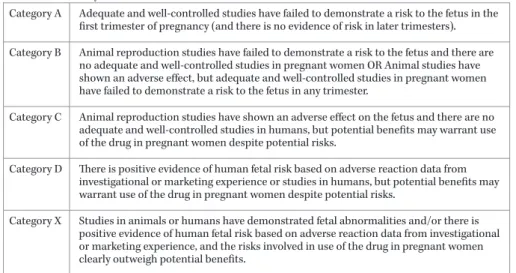
Fig. 2. Risk categories of FDA (USA).
Category A Adequate and well-controlled studies have failed to demonstrate a risk to the fetus in the first trimester of pregnancy (and there is no evidence of risk in later trimesters).
Category B Animal reproduction studies have failed to demonstrate a risk to the fetus and there are no adequate and well-controlled studies in pregnant women OR Animal studies have shown an adverse effect, but adequate and well-controlled studies in pregnant women have failed to demonstrate a risk to the fetus in any trimester.
Category C Animal reproduction studies have shown an adverse effect on the fetus and there are no adequate and well-controlled studies in humans, but potential benefits may warrant use of the drug in pregnant women despite potential risks.
Category D There is positive evidence of human fetal risk based on adverse reaction data from investigational or marketing experience or studies in humans, but potential benefits may warrant use of the drug in pregnant women despite potential risks.
Category X Studies in animals or humans have demonstrated fetal abnormalities and/or there is positive evidence of human fetal risk based on adverse reaction data from investigational or marketing experience, and the risks involved in use of the drug in pregnant women clearly outweigh potential benefits.
Fetal Risk Summary
薬剤の影響を受けた場合,受精卵は,着床しない,
流産して消失する,完全に修復されて健児を出産す る。影響しない。
②妊娠4週〜7週末:胎児の重要臓器が発生,分化す る時期であり,催奇形性の絶体過敏期である。
③妊娠8週〜15週:性器の分化や口蓋の閉鎖などが 問題となる時期で発育,分化の個人差を考慮すると 催奇形性の薬剤の使用には注意が必要である。
④妊娠16週〜分娩:胎児の形態的異常は誘起されな い。胎児の機能的発育に及ぼす影響,子宮内胎児死 亡,分娩前では胎児の適応障害などが問題となる。
III. 妊娠中の薬物治療の公的カテゴリー わが国では,医療用医薬品添付文書の使用上の注意記 載要領に「8,妊婦,産婦,授乳婦等への投与」の項「(2)」
として「動物実験,臨床使用経験,疫学的調査等で得ら れている情報に基づき,必要な事項を記載すること,」の 記載があり公的リスクカテゴリーの役割を果たしてい る。ただし,この記載は使用上の注意である。
海 外 の 公 的 リ ス ク カ テ ゴ リ ー と し て 米 国FDAの Pregnancy Categoryとオーストラリア医薬品評価委員
会の分類基準が知られている。両カテゴリーでは,カテ ゴリーA,Bが存在しわが国の医療用医薬品添付文書記 載要領とは,大きく異なっている。
米国FDAのリスクカテゴリー2)(Fig. 2)で,カテゴ リーAは,胎児への危険がない薬物である。現在,カテ ゴリーAの抗菌薬はない。カテゴリーBは,妊娠中に使 用しても比較的安全な薬物である。可能であるなら,抗 菌薬は,B類から選択されるべきである。カテゴリーC は,胎児へのリスクが不明な抗菌薬。他に安全な代用が 考えられない場合,あるいは,有効性がリスクを大幅に 上回る場合に限り使用。カテゴリーDは,胎児へのリス クがなにかしら認められている抗菌薬である。より安全 な薬物が使用できない場合や効果がないと,はっきりと 知られている命にかかわる疾患,重篤な感染症での使用 は,いたしかたない。カテゴリーXは,異常を引き起こ し,妊娠中は禁忌とされる抗菌薬である。
カテゴリー分類がBやCと書かれているだけでは,具 体的なリスクの内容がわからず,実際に薬を使うべきか どうかの判断には役立たない,同じカテゴリーに分類さ れる薬でも,情報不足しているものから,具体的なリス クが報告されているものまでさまざまな薬が混在し,リ スクに大きなばらつきが生じている。そのためFDAは 2015年6月,このカテゴリー分類を廃止し,薬を使うリ スクについて,妊娠のどの時期に,どの程度の量の薬を,
どの程度の期間使った場合,リスクがどの程度高くなる のか,といった具体的な情報を,添付文書へ個別に記述 するよう義務づけた。
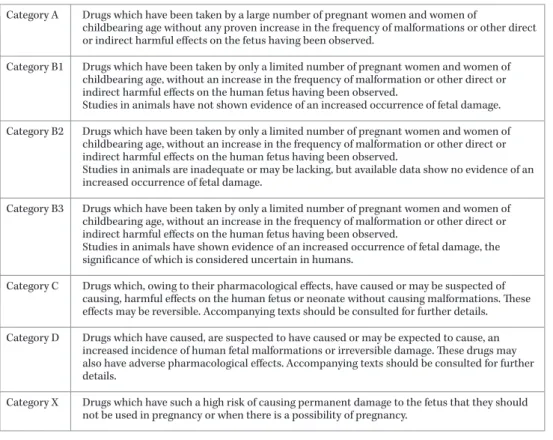
オーストラリアADECの分類3)(Fig. 3)で,カテゴリー Aは,使用実績からほぼ安全に用いることができる薬 剤。カテゴリーBは,使用経験が少なく,ヒトでの危険 性を示す証拠が見当たらない。動物実験の結果により,
B1,B2,B3のサブカテゴリー。カテゴリーCは,催奇形
Fig. 3. Therapeutic Goods Administration Pregnancy Categories (Australia).
Category A Drugs which have been taken by a large number of pregnant women and women of
childbearing age without any proven increase in the frequency of malformations or other direct or indirect harmful effects on the fetus having been observed.
Category B1 Drugs which have been taken by only a limited number of pregnant women and women of childbearing age, without an increase in the frequency of malformation or other direct or indirect harmful effects on the human fetus having been observed.
Studies in animals have not shown evidence of an increased occurrence of fetal damage.
Category B2 Drugs which have been taken by only a limited number of pregnant women and women of childbearing age, without an increase in the frequency of malformation or other direct or indirect harmful effects on the human fetus having been observed.
Studies in animals are inadequate or may be lacking, but available data show no evidence of an increased occurrence of fetal damage.
Category B3 Drugs which have been taken by only a limited number of pregnant women and women of childbearing age, without an increase in the frequency of malformation or other direct or indirect harmful effects on the human fetus having been observed.
Studies in animals have shown evidence of an increased occurrence of fetal damage, the significance of which is considered uncertain in humans.
Category C Drugs which, owing to their pharmacological effects, have caused or may be suspected of causing, harmful effects on the human fetus or neonate without causing malformations. These effects may be reversible. Accompanying texts should be consulted for further details.
Category D Drugs which have caused, are suspected to have caused or may be expected to cause, an increased incidence of human fetal malformations or irreversible damage. These drugs may also have adverse pharmacological effects. Accompanying texts should be consulted for further details.
Category X Drugs which have such a high risk of causing permanent damage to the fetus that they should not be used in pregnancy or when there is a possibility of pregnancy.
性はないものの胎児や新生児に対する有害作用(胎児毒 性)のある薬。Cに該当する薬がBより危険ということ を意味するものではない。カテゴリーDに分類される薬 は危険性があっても,治療のために使用されることがあ りえる。カテゴリーXは危険度の高い薬で絶対禁忌。
虎ノ門病院薬剤の催奇形危険度評価4)は,妊娠中におけ る薬の危険度を独自に評価し点数化。添付文書やFDA の基準は,治療上の重要度が配慮された処方判断基準と なっているが,虎ノ門病院の基準は薬の危険度だけに注 目して評価している。分類は,疫学調査を重視し,次い で症例報告,動物実験(生殖試験)の順で重みづけされ ている。さらに,服用時期が点数化され,これらの積に よる総合的な危険度の評価が可能となっている。催奇形 危険度総合得点=薬剤の危険度点数×服用時期の危険度 点数(最終月経開始日からの日数)から,無影響,注意,
警戒,危険と判定している。
IV. 母児化学療法研究会,
周産期感染症研究会検討抗菌薬
歴史的には,昭和30年後半「抗生剤を母体に投与した 際の胎児,新生児に及ぼす影響」の検討から出発し,妊 婦に有用でない抗生剤の選別へと進展した。このような 検討から,小児科領域において新生児,未熟児の化学療 法として独立していた研究との接点が見出され,妊婦,
胎児,新生児,未熟児といった一連の研究の方向づけと 協力体制ができ,日本化学療法学会の活動の一つとして 母子化学療法研究会が設立された5)。
母子化学療法研究会では,①母子間移行(経胎盤移行・
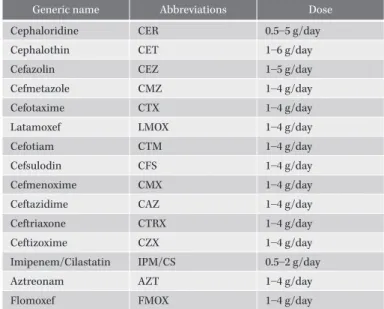
乳汁内移行),②胎児,胎盤組織内移行,③羊水中濃度の 意義(羊水中の殺菌物質),④妊婦(腎機能低下時)にお ける検討,⑤未熟児,新生児における検討,⑥周産期感 染症に対する臨床効果,⑦安全性の検討と妊産婦への適 正使用量の提言などのテーマで,母子化学療法研究会班 として全国の産婦人科9施設,小児科8施設に於いて検 討された6)。Fig. 4に母児化学療法研究会,周産期感染症 研究会で検討された抗菌薬を示す7)。妊婦に対しては,歴 史的な経過からもこれらの抗菌薬を優先して投与すべき と考える。
V. 抗 菌 薬
妊婦への抗菌薬投与の考えかたは,①ターゲットとす る感染臓器,最も多い起因菌に十分効果がある抗菌薬を 選んでいるか,②投与する薬剤の副作用を十分理解して いるか,③選択肢のなかで投与回数が少ない抗菌薬か,
④選択肢のなかで安価な抗菌薬か,⑤副作用が少ない抗 菌薬か,⑥新しさより実績・安全性が確認されている抗 菌薬か,⑦妊婦ならではの生理に可能な限り対応してい るかである。そのような観点から抗菌薬を示す。
1.安全と考えられる抗菌薬;ペニシリン系,セフェム 系,マクロライド系,クリンダマイシン
①ペニシリン系:ヒトでの使用経験が豊富で,催奇形性 を含め重大な副作用は報告されていない。妊婦に用い る抗菌薬として胎児への安全性が高い。母体のペニシ リンアレルギーが唯一の問題点である。妊娠第1三半
Fig. 4. Antimicrobial drugs studied by the Mother-Child Chemotherapy Study Group.
Generic name Abbreviations Dose
Cephaloridine CER 0.5―5 g/day
Cephalothin CET 1―6 g/day
Cefazolin CEZ 1―5 g/day
Cefmetazole CMZ 1―4 g/day
Cefotaxime CTX 1―4 g/day
Latamoxef LMOX 1―4 g/day
Cefotiam CTM 1―4 g/day
Cefsulodin CFS 1―4 g/day
Cefmenoxime CMX 1―4 g/day
Ceftazidime CAZ 1―4 g/day
Ceftriaxone CTRX 1―4 g/day
Ceftizoxime CZX 1―4 g/day
Imipenem/Cilastatin IPM/CS 0.5―2 g/day
Aztreonam AZT 1―4 g/day
Flomoxef FMOX 1―4 g/day
期にアモキシシリンまたはアンピシリンを服用した 284例の母親の児,ならびに妊娠中のいずれかの時期 にこれらの薬物を服用した1,060例の母親の児につい て,先天異常の頻度は増加しなかったと報告されてい る8)。
②セフェム系:多くの妊婦に対しての治療実績があり,
胎児への影響は認められなかったと報告され,妊娠中 に第一選択としえる薬剤,安全に投与できる抗菌薬と されている。
奇形を有する22,865例の児を対象としたケース・コ ントロールスタディで,妊娠第1三半期あるいは妊娠 中のいずれかの時期のセファレキシン使用との関連は 認められなかったという報告9)があるが,妊婦へのセ フォテタンの投与に伴う溶血性貧血の報告10)もある。
③マクロライド系:安全に投与できる抗菌薬とされてい る。性感染症で妊孕性のある女性に多いクラミジア感 染症に対して有効な薬剤として処方されている。
妊娠第1三半期にクラリスロマイシンによる治療を受 けた女性の122例の児では,先天奇形の頻度は催奇形 と関連しない抗菌薬の投与を受けた対照群と有意差は なかった11)。アジスロマイシン服用群,催奇形作用のな い抗菌薬を服用した群,催奇形作用のない薬剤服用群,
それぞれ123例で構成される3群の比較研究で,アジ スロマイシンは88例(71.5%)が第1三半期に服用し ていた。催奇形の発生頻度は,アジスロマイシン群
3.4%,催奇形作用のない抗菌薬群2.3%,催奇形作用の
ない薬剤群3.4% で統計学的に有意差はなかった。妊 娠期間,胎児切迫仮死,早産の割合,平均出生時体重 にも差は認められなかった12)。妊婦に対して,安全に投 与可能な抗菌薬である。
米国FDAのリスクカテゴリー2)で,14員環マクロライ ドのクラリスロマイシンは,カテゴリーC,15員環マ クロライドのアジスロマイシン,エリスロマイシンは,
カテゴリーBとなっている。
④クリンダマイシン:催奇形性はなく,安全。
2.注意しながら使用可能な抗菌薬:アミノグリコシ ド系,メトロニダゾール,ST合剤,グリコペプチ ド系
①アミノグリコシド系:ストレプトマイシン,カナマイ シンは児の難聴と関連しており,禁忌である。ゲンタ マイシン,トブラマイシン等のアミノグリコシド系の 薬剤についても,第8脳神経障害による聴覚毒性を生 じえるとの注意喚起がなされている。治療上,ゲンタ マイシン,トブラマイシン等のアミノグリコシド系の 薬剤が必要不可欠な妊婦では,血中濃度管理が重要と なる。
②メトロニダゾール:動物実験で催奇形性や発がん性の リスクが指摘されているが,ヒトでは関連がないとす る報告が多い。適応を十分に検討したうえで投与する ことが可能であるが,長期投与は避ける。
③ST合剤:大量投与時は葉酸を合わせて投与する。新 生児核黄疸との関連が指摘されており,早産のリスク がある場合は避ける。
④グリコペプチド系:限られたデータしかないが,標準 量のバンコマイシンは胎児に影響がないと考えられて いる。
3.禁忌とされる抗菌薬:テトラサイクリン系,ニュー キノロン系
①テトラサイクリン系:新生児にgray syndromeが生 じるおそれがあり,児の歯牙着色や長管骨の発育不全
などのリスクがあるため禁忌で,母体にも重篤な肝障 害の報告がある13)。妊娠可能年齢の女性に処方する際 には確実な避妊を指導する。
②ニューキノロン系:動物実験では,大量投与で流産や 骨成長阻害が知られていることや生殖試験で大量投与 した際に胎児毒性が知られていること14),ヒトでの使 用経験が少ないなどの理由により,わが国の添付文書 では禁忌とされている。最近,器官形成期を含む妊娠 初期にニューキノロン系の抗菌薬を使用した妊婦の児 に催奇形との関連は認められなかったとの報告があ り,妊娠と気づかずに投薬した場合に人工妊娠中絶の 適応となるほどのリスクはないことが明らかになって きている。妊娠中にキノロン系薬により治療を受けた 女性200例の児に明らかな有害作用はなかった。シプ ロフロキサシンの治療例は105例で,そのうち68% は 妊娠第1三半期の治療であった15)。さらに549例の ニューキノロン系薬使用妊婦に関する検討でも自然の 奇形発生率を上回ることはなかった16)。このように ニューキノロン系薬の位置づけは変わってきている。
VI. 授乳期における薬剤の影響
日本の薬剤添付文書:「乳汁中に分泌されるもの」は,
新生児に影響が出るかどうかとはまったく無関係に,ほ とんどすべて授乳中止になっている。しかしながら,ほ とんどの薬剤は乳汁中へと移行するが,新生児への影響 はminimalであるというevidenceである。
アメリカ小児科学会(AAP)が授乳中の薬剤について evidenceに基づく詳細なガイドライン17)を出しており,
それに準拠するのが現実的である。
母乳を介した薬物の新生児全摂取量は母体の通常1%
以下になると考えられており,ほとんどの薬剤について,
新生児への影響は小さいか無視しうる18)。 VII. 妊 娠 と 薬 外 来
2012年4月より京都府立医科大学附属 病 院 が 厚 生 労働省事業である「妊娠と薬情報センター」の拠点病院 となり,科学的に検証された医薬品情報を専門の医師・
薬剤師により妊婦,妊娠希望者に提供している。国立成 育医療研究センター・妊娠と薬情報センターのホーム ページ(http://www.ncchd.go.jp/kusuri/process/index.
html)から問診票を用意し,センターへ郵送,折り返し 連絡の後,当院「妊娠と薬外来」の予約を取る。
2005年10月 に 設 置 さ れ た 国 立 成 育 医 療 研 究 セ ン ター・妊娠と薬情報センターを中心に多施設共同で妊婦 使用薬剤と出産結果データの収集と解析が行われてお り,当院でも積極的に協力し,妊婦薬物療法の安全性情 報の充実に寄与したいと考えている。海外では,米国の OTIS(Organization of Teratology Information Special- ists)や欧州のENTIS(European Network of Teratology Information Services)のような催奇形情報の提供とカウ ンセリングを行う施設のネットワークがある。
VIII. お わ り に
妊産婦での治療の注意点は,産婦人科の性器感染症の 病原微生物は他科に比べ,細菌では好気性菌(グラム陽 性球菌,グラム陰性桿菌),嫌気性菌,およびこれらの複 数菌感染,弱毒菌感染が多く,周産期感染でも同様であ る。周産期感染症に対しては,β―ラクタム系薬を第一選 択薬として使用し,マクロライド系薬,アザライド系薬 は第二選択薬とする。原則的には,ニューキノロン系薬,
テトラサイクリン系薬は使用しない。
妊婦自身が抗菌化学療法の必要性と安全性を理解でき るように服薬指導し,治療に参加できる環境を整える必 要がある。
利益相反自己申告:申告すべきものなし。
文 献
1) Briggs G G, Freeman R K, Yaffe S J: Thalidomide.In Drugs in pregnancy and lactation: A reference guide to fetal and neonatal risk, 9thed. Lippincott Williams
& Wilkins, Philadelphia, 2011; 1416-25
2) Law R, Bozzo P, Koren G, Einarson A : FDA preg- nancy risk categories and the CPS. Can Fam Physi- cian 2010; 56: 239-41
3) Australian Drug Evaluation Committee (ADEC):
https://www.tga.gov.au/committee/australian-drug- evaluation-committee-adec
4) 佐藤孝道:虎ノ門病院の基準 実践 妊娠と薬ʼ92。日 医師会誌 2000; 124: 124
5) 松田静治:妊産婦における化学療法。最新医学 1990;
45: 1496-503
6) 山元貴雄,保田仁介,岡田弘二,岩破一博:産婦人科 領域におけるFlomoxefの基礎的・臨床的研究。Jpn J Antibiot 1991; 44: 689-96
7) 岩破一博:産科領域で重要な感染症。岡田弘二 編,産 婦人科の薬物療法,医薬ジャーナル社,大阪,1995;
301-11
8) Colley D P, Kay J, Gibson G T: Amoxycillin and am- picillin: a study or their use in pregnancy. Aust J Pharm 1983; 64: 107-11
9) Czeizel A E, Rockenbauer M, Sørensen H T, Olsen J:
Use of cephalosporins during pregnancy and in the presence of congenital abnormalities: a population- based, case-control study. Am J Obstet Gynecol 2001;
184: 1289-96
10) Garratty G, Leger R M, Arndt P A: Severe immune hemolyticanemia associated with prophylactic use of cefotetan in obstetric and gynecologic procedures.
Am J Obstet Gynecol 1999; 181: 103-4
11) Einarson A, Phillips E, Mawji F, DʼAlimonte D, Schick B, Addis A, et al: A prospective controlled multicentre study of clarithromycin in pregnancy.
Am J Perinatol 1998; 15: 523-5
12) Sarkar M, Woodland C, Koren G, Einarson A R: Preg- nancy outcome following gestational exposure to azithromycin. BMC Pregnancy Childbirth 2006; 6: 18 13) Wenk R E, Gebhardt F C, Bhagavan B S, Lustgarten
J A, McCarthy E F : Tetracycline-associated fatty liver of pregnancy, including possible pregnancy risk after chronic dermatologic use of tetracycline. J
Reprod Med 1981; 26: 135-41
14) Takayama S, Watanabe T, Akiyama Y, Ohura K, Ha- rada S, Matsuhashi K, et al: Reproductive toxicity of ofloxacin. Arzneimittelforschung 1986; 36: 1244-8 15) Loebstein R, Addis A, Ho E, Andreou R, Sage S, Don-
nenfeld A E, et al: Pregnancy outcome follwing ges- tational exposure to fluoroquinolones: a multicenter prospective controlled study. Antimicrob Agents Chemother 1998; 42: 1336-9
16) Schaefer C, Amoura-Elefant E, Vial T, Ornoy A, Gra-
bis H, Robert E, et al: Pregnancy outcome after pre- natal quinolone exposure. Evaluation of a case regis- try of the European Network of Teratology Informa- tion Services (ENTIS). Eur J Obstet Gynecol Reprod Biol 1996; 69: 83-9
17) AAP Committee on Drugs: The transfer of drugs and other chemicals into human milk. Pediatrics 2001; 108: 776-89
18) 林 昌洋:抗生物質製剤 合成抗菌剤。佐藤孝道,他 編,実践 妊娠と薬,薬業時報社,東京,1992; 422-70
Precautions in use of antimicrobial agents for pregnant/puerperal women
Kazuhiro IwasakuSchool of Nursing Division of Obstetrics and Gynecology, Kyoto Prefectural University of Medicine, 465 Kajii-cho, Hirokoji Agaru, Kawaramachi-dori, Kamigyo-ku, Kyoto, Japan
Various infections can occur in pregnant women, including sexually transmitted infection and gonadal, urinary tract, and respiratory tract infections. Pregnant women are often reluctant to take drugs prescribed by physicians, and physicians issuing prescriptions also tend to refrain from medicating pregnant women whenever possible.
When drugs are prescribed, changes in pharmacokinetics during pregnancy (changes in renal function, he- patic function, distribution volume and protein binding) need to be taken into consideration. Most drugs ad- ministered to pregnant women can reach the fetus through the placenta, with only a few exceptions. This po- tential for drug passage through the placenta is an important factor in selecting drugs for pregnant women.
Risk categories have been established by the FDA (USA), while risk classification have also been estab- lished by the ADEC (Australia).
In Japan, antimicrobial drugs studied by the Mother-Child Chemotherapy Study Group. A study entitled
“Influence of maternal use of antibiotics on fetuses and newborns,” which was conducted in the latter half of 1955, was the starting point for this study. The study later expanded to include the selection of antibiotics that should be avoided during pregnancy. The Mother-Child Chemotherapy Study Group was founded within the framework of the activities of the Japanese Society of Chemotherapy and conducts studies on mother-to-fetus transfer of antibiotics, the significance of the amniotic fluid concentration, drug transfer into milk, and so on.
1) Antimicrobial drugs that are considered to be safe include: penicillins, cephems, macrolides, and clinda- mycin
2) Antimicrobial drugs that can be used with appropriate care include: aminoglycosides, metronidazole, sulfamethoxazole-trimethoprim, and glycopeptides
3 ) Antimicrobial drugs that are contraindicated : during pregnancy include tetracyclines and, new qui- nolones
Based on the presently accumulated knowledge, pregnant women requiring medication should receive ap- propriate advice to ensure that they understand the need and safety of antimicrobial chemotherapy as well as to foster an environment allowing pregnant women to participate in treatment.