九州大学学術情報リポジトリ
Kyushu University Institutional Repository
化学合成に基づいたマイトトキシンの構造活性相関 研究
尾上, 久晃
https://doi.org/10.15017/1931710
出版情報:Kyushu University, 2017, 博士(理学), 課程博士 バージョン:
権利関係:
Doctoral Thesis
Structure-Activity Relationship Studies of Maitotoxin Based on Chemical Synthesis
化学合成に基づいたマイトトキシンの 構造活性相関研究
Hisaaki Onoue
尾上 久晃
Graduate School of Science
Kyushu University
i
Contents
Abbreviations ii
Chapter 1. Introduction
1-1. Maitotoxin 1
1-2. Identification of target proteins 3
1-3. Synthetic studies of maitotoxin 5
1-4. Structure-activity relationship studies of maitotoxin 18
1-5. Objective 22
References 24
Chapter 2. Synthesis of the QRS, LMNO and NOPQR(S) ring system of maitotoxin
2-1. Synthesis of the QRS ring system 26
2-2. Synthesis of the LMNO ring system 34
2-3. Synthesis of the NOPQR(S) ring system 41
2-4. Biological activities 45
References 48
Chapter 3. Synthesis of the WXYZA’B’C’D’E’F’ ring system of maitotoxin
3-1. Synthesis plan 51
3-2. Synthesis of the WXYZ and C’D’E’F’ ring system 53 3-3. Synthesis of the WXYZA’B’C’D’E’F’ ring system 55
References 62
Chapter 4. Conclusion 63
Experimental section 64
Spectral data 120
Acknowledgment 244
List of publications 245
ii Abbreviations
Ac acetyl
acac acetylacetonate
APCI atmospheric pressure chemical ionization ATP adenosine triphosphate
BHT dibutylhydroxytoluene
Bn benzyl
Bu butyl
COSY correlation spectroscopy CSA 10-camphorsulfonic acid
DDQ 2,3-dichloro-5,6-dicyano-p-benzoquinone DMF N,N-dimethylformamide
DMAP N,N-dimethyl-4-aminopyridine DMP Dess-Martin periodinane DIAD diisopropyl azodicarboxylate DIBALH diisobutylaluminum hydride
EE ethoxyethyl
ent enantiomer
eq equivalent
ESI electrospray ionization
Et ethyl
GI50 growth inhibition, 50%
HMBC heteronuclear multiple bond coherence HMQC heteronuclear multiple quantum coherence IC50 halfmaximal inhibitory concentration
Im imidazole
IR infrared absorption spectrometry LD50 lethal dose, 50%
LHMDS lithium bis(trimethylsilyl)amide
m meta
MAD methylaluminum bis(2,6-di-t-butyl-4-methylphenoxide) mCPBA m-chloroperoxybenzoic acid
Me methyl
MS mass spectrum
iii MS molecular sieves
Ms mesyl
MW molecular weight
n normal
NAP 2-naphthylmethyl NBS N-bromo-succinimide NCI national cancer institute NMO N-methylmorpholine N-oxide NMR nuclear magnetic resonance NOE nuclear Overhauser effect
NOESY nuclear Overhauser effect spectroscopy
p para
PFG pulsed field gradient PG protecting group
Ph phenyl
Piv pivaloyl
PMB p-methoxybenzyl
PPTS pyridinium p-toluenesulfonate
PTLC preparative thin layer chromatography
Py pyridine
quant quantitive
rt room temperature
RCM ring closing metathesis RSM recovered starting material
s secondary
t tertiary
TBAC tetrabutylammonium chloride TBAF tetrabutylammonium fluoride TBAI tetrabutylammonium iodide TBDPS t-butyldiphenylsilyl
TBS t-buthyldimethylsilyl TES triethylsilyl
Tf trifluoromethane sulfonyl TFA trifluoroacetic acid TFAA trifluoroacetic anhydride
iv THF tetrahydrofuran
THP tetrahydropyrane TIPS triisopropyl silyl
TLC thin layer chromatography
TMEDA N,N,N’,N’-tetramethylethylenediamine TMS trimethylsilyl
TOCSY totally correlated spectroscopy TOF time-of-flight
Tol tolyl
TPAP tetrapropylammonium perruthenate
Tr trityl
Ts p-toluenesulfonyl
1
Chapter 1. Introduction
1-1. Maitotoxin
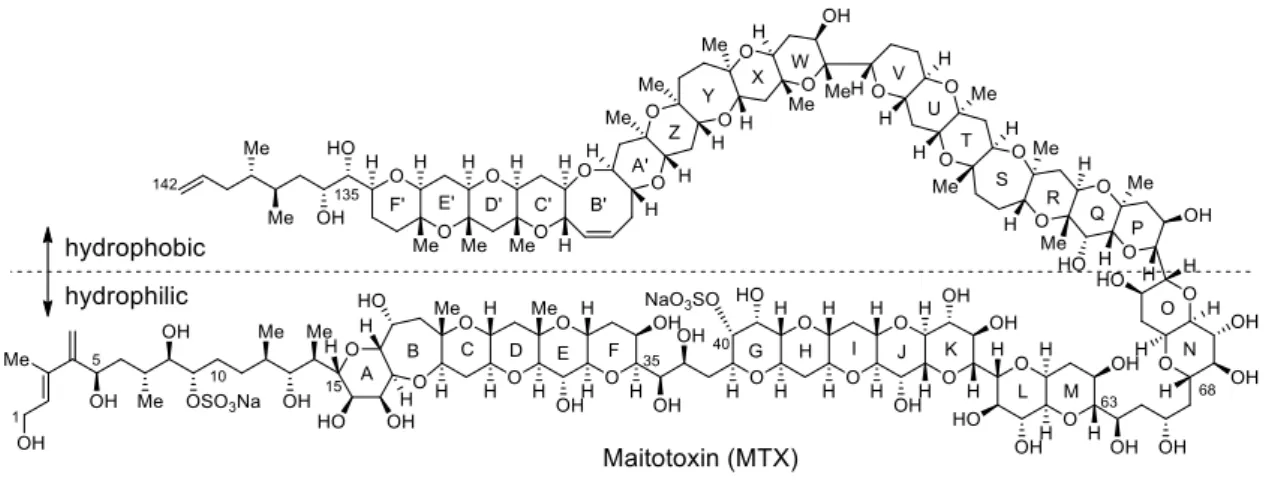
Maitotoxin (MTX, Figure 1-1-1) was found as one of the causative toxins of ciguatera, seafood poisoning suffered from consumption of fishes inhabit sea in subtropical and tropical regions.1 Ciguatera causes neurological, gastrointestinal, and cardiovascular disorders, and affects more than 50,000 people annually. MTX was first found in the sea fish “maito” living in the ocean around Tahiti island by Yasumoto and co-workers in 1976,2 and it was revealed that this toxin was produced by dinoflagellate Gambierdiscus toxicus (Figure 1-1-2) in 1997.3a
Figure 1-1-1. Structure of maitotoxin (MTX).
Figure 1-1-2. Pictures of electron microscopy (left) and clinging to the seaweed (right) of dinoflagellate Gambierdiscus toxicus.
2
It took more than fifteen years to determine the structure of MTX because of the large and complex structure.3 It was assigned by extensive instrumental analysis, particularly 1H- and 13C-NMR including 2D (1H-1H COSY, TOCSY, HMBC, NOESY) and 3D (PFG NOESY -HMQC) technique by Yasumoto and Murata groups.3b,c In 1996, the complete stereochemistry of MTX was determined based on chemical synthesis of the partial structures and degradation of the natural product by Kishi and Tachibana groups, independently.3d-g
MTX is a ladder shaped polyether compound possessing ninety-eight chiral centers and thirty-two cyclic ethers, which is one of the largest secondary metabolites reported to date (MW 3422).3a,c Interestingly, MTX has both hydrophobic and hydrophilic parts (Figure 1-1-1). The hydrophilic property is elicited by the presence of twenty-eight hydroxy groups and two sulfate esters.
MTX is known as one of the most toxic compounds toward mammals (LD50 = 50 ng/kg (mice i.p.)).3c In addition, MTX elicits potent biological activities at extremely low concentrations; for instance, it causes hemolysis of red blood cells at 15 nM.4a The most remarkable biological activities caused by MTX is a profound influx of Ca2+ into cells at extremely low concentration (0.3 nM), a phenomenon that has been demonstrated in all cell types examined to date, including rat glioma C6 cells.4b
3
1-2. Identification of target proteins
Although target proteins of MTX have been explored using biological method by a number of scientists, not only the target proteins but also its precise mode of action at the molecular level has not been elucidated. In 1982, the possibility that MTX affected the voltage depended Ca2+ channel was reported by Takahashi et al.5 They investigated the influence of Mn2+, verapamil (specific calcium channel blocker) and tetracaine (local anesthetics) for the [3H]norepinephirine release and Ca2+ influx induced by MTX, K+ and A23187 (calcium ionophore). The both effects of MTX or K+ were significantly blocked or diminished by all additives. However, the effect of A23187 was inhibited by only Mn2+. Since the Ca2+ channel in the presynaptic nerve terminals was known to be sensitive to polyvalent cations and prevented by local anesthetics, direct interaction of MTX to Ca2+
channel was indicated.
In 1998, Range et al. reported that MTX might activate a cation conductance from the result of the electrophysiological response study of Xenopus laevis oocytes to MTX.6c It was also found that conductance induced by MTX might have nonselectivity for monovalent cations by ion substitution experiments. On the other hands, Schilling et al.
revealed that MTX caused conversion of the plasmalemmal Ca2+ pump into a Ca2+- permeable nonselective cation channel.7 They were inspired by studies of palytoxin having similar structure and showed that the effect of MTX was strongly blocked by knockdown of the plasmalemmal Ca2+-ATPase (PMCA). In addition, enzymatic activity of PMCA was reduced by MTX. These results supported that PMCA was the most promising candidate of the target protein of MTX at present.
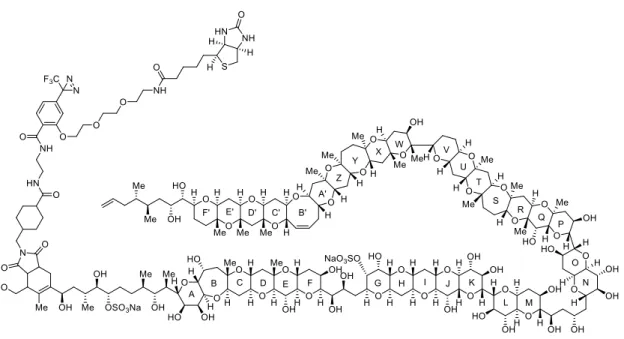
An attempt to identify the target protein of MTX using the photoactive and biotinylating probe was reported by Konoki et al (Figure 1-2-1).8 Inhibition test which was carried out prior to labeling experiments disclosed that brevetoxin B (PbTx2) blocked MTX-induced Ca2+ influx. According to the results, they evaluate specific photolabeling by the probe in the presence or absence of PbTx. As a result, it was found that one band at around 23 kDa was diminished in the presence of PbTx. However, covalently conjugation with the probe (4 kDa) prevented them from identifying the labeled protein.
Unfortunately, the lack of natural source and poor reproducibility made further investigations difficult.
4
Figure 1-2-1. Photoaffinity probe derived from MTX.
5
1-3. Synthetic studies of maitotoxin
Sasaki and Tachibana group
Synthetic studies of MTX were carried out by a number of synthetic chemists because of its attractive structure and lack of natural samples. In 1994 and 1995, Sasaki et al. reported synthesis of several partial structures of MTX for determination of relative configuration. The LMNO ring of MTX was synthesized through aldol reaction between aldehyde and methyl ketone (Scheme 1-3-1).9b These building blocks were prepared from a common intermediate which was derived from tetrahydropyrane derivative by 6-endo cyclization of vinyl epoxide.9a
Scheme 1-3-1. Synthesis of the LMNO ring.
In 1996, they synthesized the C1–C14 side chain via NHK coupling of iodo olefin with aldehyde and determined relative configuration of this region (Scheme 1-3- 2).9c
6
Scheme 1-3-2. Synthesis and determination of relative configuration of the C1–C14 side chain.
In addition, to elucidate the absolute configuration of MTX, four possible diastereomers corresponding to the C135–C142 section were synthesized via successive methylation of optically active epoxide derived from 3-butene-1-ol (Scheme 1-3-3).9d Herewith, longstanding structural determination of MTX was completed.
Scheme 1-3-3. Synthesis and determination of absolute configuration of the C135–C142 side chain.
Kishi group
Synthesis of the EFGH, LMNO, and UVWX ring systems of MTX was reported by Kishi et al. for determination of relative conformation of MTX (Scheme 1-3-4).10a The EFGH ring system was derived through coupling of lithium acetylide (GH ring) with lactone (EF ring) followed by reductive etherificaiton. Coupling of the NO ring and the LM ring via 1,3-dipolar addition followed by cleavage of the N–O bond of the resulting five-membered ring and hydrolysis by using molybdenum complex generated the LMNO ring system. In addition, synthesis of the UVWX ring system was achieved by NHK coupling between aldehyde and alkynyl iodide followed by reductive etherification.
7
Scheme 1-3-4. Synthesis of the EFGH, LMNO, and UVWX ring systems.
They also achieved synthesis of C1–C15 and C134–C142 fragment locating in both end of the molecule (Scheme 1-3-5).10b C1–C15 fragment was obtained through
8
coupling of aldehyde (C1–C11) with dibromo olefin (C11–C15) in the presence of n-BuLi followed by Wittig reaction and introduction of the sulfate ester. On the other hands, after acetylide (C135–C141) was connected to lactone (C134), reductive etherification and syn-dihydroxylation furnished C134–C142 fragment.
Scheme 1-3-5. Synthesis of C1–C15 and C134–C142 fragments.
Nicolaou group
Nicolaou et al. were one of the most energetic groups for synthetic studies of MTX. In 1996, three substructures, the JKL, OPQ, and UVW ring system of MTX, were synthesized based on a strategy via the ester–olefin methathesis reaction with Tebbe reagent (Scheme 1-3-6).11a
9
Scheme 1-3-6. Synthesis of the JKL, OPQ, and UVW ring.
The synthesis of the hydrophilic heptacyclic compound was achieved in 2007 (Scheme 1-3-7).11b The G and J rings were constructed via Achmatowicz rearrangement of furan derivatives. Then, intramolecular cyclization of THP derivative, treatment of ynone with AgOTf and intramolecular lactonization, afforded the IJK ring system. The synthesis of the GHIJK ring system was completed through Suzuki–Miyaura coupling between the G and IJK ring fragments.
Scheme 1-3-7. Synthesis of the GHIJK ring system.
10
In 2008, synthesis of the nonacyclic compound including the GHIJK ring was examined.11c The target compound was attempted to be obtained by connection of the GHIJ ring fragment and the LMNO ring fragment (Scheme 1-3-8). However, all attempts to assemble the fifth ring (K) on the tetracyclic intermediate (GHIJ) failed because of the diaxial arrangement of the tail-end substituent on the J ring and rigid polyether framework.
Therefore, this initial approach was forced to be revised.
The four key building blocks (G, J, NO, LM ring systems) for new strategy were prepared by using above strategy (Scheme 1-3-7) through assembling THP ring through Achmatowicz rearrangement of furan derivative. Finally, the elaboration of the GHIJKLMNO ring system was completed via three different couplings between each fragment (Scheme 1-3-9).
Scheme 1-3-8. First attempt to synthesize the GHIJKLMNO ring system.
11
Scheme 1-3-9. Revised synthetic route of the GHIJKLMNO ring system.
In 2010, Nicolaou group released four papers about synthetic studies of MTX.
The ABCDEFG ring system was constructed through Suzuki–Miyaura coupling, mixed- thioacetalization/methylation, reductive etherification and Hornar–Wadsworth–Emmons (HWE) reaction (Scheme 1-3-10),11d and the synthesis of the WXYZA’ ring system was achieved by the Utimoto–Takai olefination/metathesis sequence (Scheme 1-3-11). 11e
12
Scheme 1-3-10. Synthesis of the ABCDEFG ring system.
Scheme 1-3-11. Synthesis of the WXYZA’ ring system.
Synthesis of the QRSTU ring system was also reported.11f However, this route had some problems for hydroxy dithioketal cyclization/methylation (Scheme 1-3-12). It was surprising that this key reaction furnished a diastereomeric mixture contrary to their expectations. This interesting result indicated that the mechanism of methylation might be not as simple as assumed.
13
Scheme 1-3-12. Synthesis of the QRSTU ring system.
The development of a biomimetic strategy for the synthesis of the C’D’E’F’ ring system was examined (Scheme 1-3-13).11g Although this attempt was attractive challenge, the key cascade cyclization of polyepoxide was not successful because of the presence of sterically hindered methyl groups. Finally, a linear strategy was devised via hydroxy epoxide openings for the construction of the C’ and E’ ring and SmI2-induced cyclization for the D’ ring to afford the C’D’E’F’ ring.
Scheme 1-3-13. Synthesis of the C’D’E’F’ ring system.
14
Recently, the synthesis of the QRSTUVWXYZA’ ring system was reported by Nicolaou et al. (Scheme 1-3-14).11h It was the largest synthetic partial structure with eleven ether rings. Connection of the WXYZA’ ring fragment and the QRSTU ring fragment by HWE reaction afforded desired compound.
Scheme 1-3-14. Synthesis of the QRSTUVWXYZA’ ring system.
Nakata group
Nakata et al. developed the unique and powerful strategy for construction of ladder-shaped polyether framework with combination of SmI2-induced cyclization of β- alkocyacrylate and 6-endo cyclization of hydroxy vinylepoxide (Scheme 1-3-15).12a,b,c,d Syntheses of several partial structures of MTX were achieved by using this strategy. On the other hand, synthesis of the ent-ZA’B’C’D’ ring system via Suzuki–Miyaura coupling and radical reduction of the O,S-acetal was reported (Scheme 1-3-16).12e
15
Scheme 1-3-15. Synthesis of the C’D’E’F’, WXYZA’ and BCDE ring systems by useful strategy for polyether-framework construction.
Scheme 1-3-16. Synthesis of the ent-ZA’B’C’D’E’ ring system.
16 Our group
Our group has also made a great effort of synthetic studies of MTX and developed the convergent method via α-cyano ethers.13a Its utility was proven by the application to synthesize the WXYZA’B’C’ ring system.13b The key intermediate, α- cyano ether, was generated through (i) connecting of two THP derivatives having diol and aldehyde, (ii) regioselective cleavage of the resulting seven-membered ring acetal, and (iii) elimination of the primary alcohol to afford a terminal olefin by Nishizawa–Grieco method. After reduction of nitrile to aldehyde, introduction of a suitable alkenyl group and ring-closing metathesis gave seven- or eight-membered ring. Finally, construction of polyether framework was completed through mixed thioacetal formation followed by oxidation/methylation or reductive etherification (Scheme 1-3-17).
Scheme 1-3-17. Synthesis of the WXYZA’B’C’ ring system by α-cyano ether method.
17
Synthesis of the C’D’E’F’ ring system via coupling of tricyclic compound and side chain was also reported (Scheme 1-3-18).13c The tricyclic fragment corresponding to the C’D’E’F’ ring was prepared by construction of the D’ and C’ ring through SmI2- induced cyclization starting from the E’ ring fragment. After Suzuki–Miyaura coupling of the C’D’E’ ring with the side chain, the construction of the F’ ring by Pd (II)-catalyzed cyclization of an allylic alcohol furnished the C’D’E’F’ ring system.
Scheme 1-3-18. Synthesis of the C’D’E’F’ ring system.
18
1-4. Structure-activity relationship studies of maitotoxin
Tachibana and Konoki were interested in the interactions between MTX and natural- or synthetic polyether compounds with a similar structure.14 Brevetoxins (PbTx1 and PbTx2) were hydrophobic ladder-shaped polyether, and known to interact with voltage-sensitive calcium channel (VSCC). Interestingly, this structually similar natural products blocked MTX-induced Ca2+ influx (IC50 = 13 or 16 μM, respectively, Figure 1- 4-1). On the other hand, it was observed that synthetic hydrophilic partial structures of MTX, the ent-EFGH and ent-LMNO ring systems, also inhibited MTX-induced Ca2+
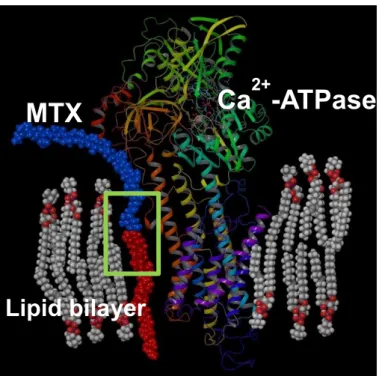
influx (IC50 = 200 μM, 500 μM, respectively, Figure 1-4-1). According to the results, it was hypothesized that hydrophobic tail of MTX penetrated into a plasma membrane, whereas its hydrophilic portion remained outside (Figure 1-4-2). A part of Ca2+-ATPase, the most promising candidate of the target protein of MTX, located outside of membrane, supporting this proposal.
Figure 1-4-1. Bioactivity of natural- or unnatural- polyether compounds.
19
Figure 1-4-2. Hypothesis of behavior of MTX in interaction with membrane proteins.
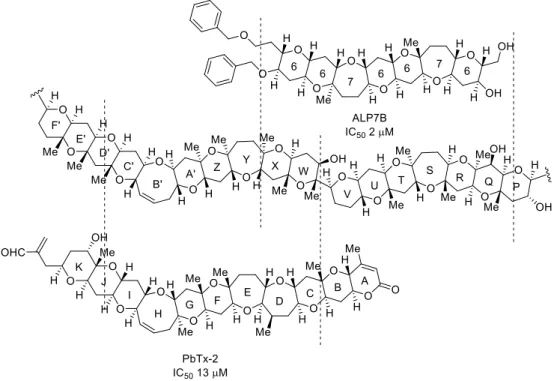
Since brevetoxins showed more potent activity than hydrophilic parts of MTX as described above, it was considered that hydrophobic region of MTX was more important for its activity. Our group obtained interesting outcomes that the synthetic fragments corresponding to the WXYZA’B’C’ and C’D’E’F’ ring system corresponding to the hydrophobic region, blocked MTX-induced Ca2+ influx (IC50 = 30 μM, 59 μM, respectively, Figure 1-4-3).13b,c In addition, it was also found that lack of Bn groups of the WXYZA’B’C’ ring caused significant reduction of this activity. On the other hand, it was reported that artificial ladder-shaped polyethers (ALPs) also showed inhibition activity and 6/7/6/7/6/6-heptacyclic compound was stronger inhibitor than tetracyclic or decacyclic compounds (Figure 1-4-4).15 This comparison implied the importance of molecular length for insertion into transmembrane region. Interestingly, potent inhibitors, ALP7B and PbTx-2, had similar structures to the Q–X ring and the W–E’ ring part of MTX, respectively. Therefore, suitable size of partial structures of MTX is expected to become more potent inhibitor.
Ca
2+-ATPase MTX
Lipid bilayer
20
Figure 1-4-3. Bioactivity of the WXYZA’B’C’ and C’D’E’F’ ring system.
Figure 1-4-4. Comparison of the structures with MTX and bioactivity of ALP and PbTx.
21
Recently, Nicolaou et al. investigated the bioactivity of synthetic compounds (Figure 1-4-5). The QRSTUVWXYZA’ ring system, which was largest partial structure, elicited the most potent inhibitory activity against MTX-induced Ca2+ influx (IC50 = 3.2 μM).11h In addition, they also examined growth inhibition (GI50) and cytotoxicity against the NCI-60 DTP Human Tumor Cell Line. As a result, the Q–A’ ring system showed significant growth inhibition against various cancer cells (e.g. leukemia, renal cancer, breast cancer and melanoma, GI50 = 1.26 ~ 4.50 μM).
Figure 1-4-5. Structure-activity relationship studies of MTX by Nicolaou group.
MTX had special bioactivity to induce intracellular Ca2+ influx, and so it was expected as a potent biological tool and a candidate of innovative drug. As described above, it was indicated that MTX contributed for development of novel antitumor agents.
Recently, Martínez et al. found the new possibility of MTX.16 It was supposed that MTX activated non-selective cation channels (NSCC) in Xenopus laecis oocytes at pM concentrations and had potential to be a selective activator of the endogenous transient receptor potential canonical type 1 (TRPC1), suggesting that MTX could become a useful pharmacological tool for investigation of TRPC.
22
1-5. Objective
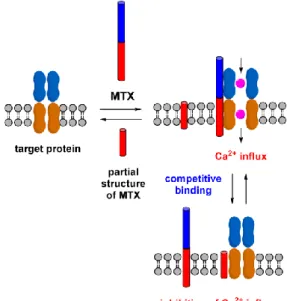
In an effort to develop inhibitors against MTX-induced Ca2+ ion influx, we hypothesized that the partial structures corresponding to the hydrophobic parts of MTX might competitively bind to the target proteins to inhibit the Ca2+ ion influx induced by MTX (Figure 1-5-1). It was supported by various reports by our group and others that hydrophobic polyether compounds including PbTx and ALPs blocked its activity.13b,c,14,15
Figure 1-5-1. Hypothetical scheme for the inhibition of MTX-induced Ca2+ influx activity by partial structures corresponding to the hydrophobic part of MTX.
In fact, the W–C’ ring and the C’ –F’ ring of MTX corresponding to hydrophobic partial structures showed inhibition activity. On the other hand, the LMNO ring and EFGH ring of MTX corresponding to hydrophilic partial structures also elicited weak inhibition, while they were antipodal natural enantiomer.14 Thus, synthetic compounds having correct stereochemistry with MTX should be evaluated.
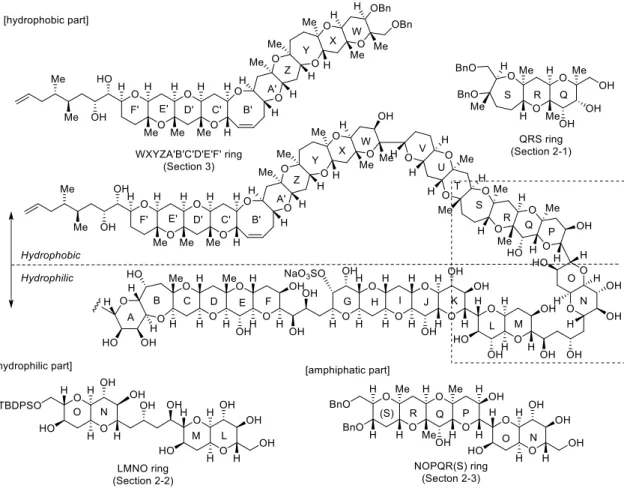
Although the amphiphilicity is the most characteristic feature of MTX among the ladder-shaped polyethers, there is no precedent to evaluate partial structures possessing both hydrophobic and hydrophilic regions. It is interesting to elucidate the combination of both the hydrophobic and hydrophilic regions could elicit biological activity in a synergistic or counteracting manner.
The objective in this study is as follows.17
23
1. Synthesis of the QRS ring and the WXYZA’B’C’D’E’F’ ring of MTX corresponding to the hydrophobic region in order to develop more potent inhibitors (Section 2-1 and 3-3).
2. Synthesis and evaluation of inhibitory activity of the LMNO ring of MTX corresponding to hydrophilic part possessing correct (natural) stereochemistry (Section 2-2).
3. Synthesis and evaluation of inhibitory activity of the NOPQR(S) ring of MTX possessing border region of the hydrophobic and hydrophilic region (Section 2-3).
This study has carried out in part in collaboration with Tomomi Baba (Section 2-1), Erina Ishikawa (Section 2-2), Yoshiki Toma and Naoya Osato (Section 2-3), and Prof.
Keiichi Konoki (evaluation of biological activity).
Figure 1-5-2. Designed compounds for evaluation of biological activity.
24
References
1. Ysumoto, T. Igaku no Ayumi 1980, 112, 886–892.
2. Yasumoto, T.; Bagins, R.; Vernoux, J. P. Bull. Jpn. Soc. Sci. Fish. 1976, 42, 359–
365.
3. (a) Yokoyama, A.; Murata, M.; Oshima, Y.; Iwashita, T.; Yasumoto, T. J. Biochem.
1988, 104, 184–187. (b) Murata, M.; Naoki, H.; Iwashita, T.; Sasaki, M.;
Yokoyama, A.; Yasumoto, T. J. Am. Chem. Soc. 1993, 115, 2060–2062. (c) Murata, M.; Naoki, H.; Matsunaga, S.; Satake, M.; Yasumoto, T. J. Am. Chem. Soc. 1994, 116, 7098–7108. (d) Zheng, W.; DeMattei, J. A.; Wu, J.-P.; Duan, JJ.-W.; Cook, L.
R.; Oinuma, H.; Kishi, Y. J. Am. Chem. Soc. 1996, 118, 7946–7968. (e) Sasaki, M.; Matsumori, N.; Maruyama, T.; Murata, M.; Tachibana, K.; Yasumoto. T.
Angew. Chem. Int. Ed. 1996, 35, 1672–1675. (f) Nonomura,T.; Sasaki, M.;
Matsumori, N.; Murata, M.; Tachibana, K.; Yasumoto, T. Angew. Chem. Int. Ed.
Engl. 1996, 35, 1675–1678. (g) Cook. L. R.; Oinuma, H.; Semones, M. A.; Kishi, Y. J. Am. Chem. Soc. 1997, 119, 7928–7937.
4. (a) Igarashi, T.; Aritake, S.; Yasumoto, T. Nat. Toxins 1999, 7, 71–79. (b) Konoki, K.; Hashimoto, M.; Nonomura, T.; Sasaki, M.; Murata, M.; Tachibana, K. J.
Neurochem. 1998, 70, 409–416.
5. Takahashi, M.; Ohizumi, Y.; Yasumoto, T. J. Biol. Chem. 1982, 257, 7287–7289.
6. (a) Takahashi, M.; Tatsumi, M.; Ohizumi, Y.; Yasumoto, T. J. Biol. Chem. 1983, 258, 10944–10949. (b) Dietl, P.; Voelkl, H. Mol. Pharmacol. 1994, 45, 300–305.
(c) Bielfeld-Ackermann, A.; Range, C.; Korbmacher, C. Pflugers, Arch. 1998, 436, 329–337.
7. Sinkins, W. G.; Estacion, M.; Prasad, V.; Goel, M.; Shull, G. E.; Kunze, D. L.;
Schilling, W. P. Am. J. Physiol. Cell. Physiol. 2009, 297, 1533–1543.
8. Konoki, K.; Hashimoto, M.; Honda, K.; Tachibana, K.; Tamate, R.; Hasegawa, F.;
Oishi, T.; Murata, M. Heterocycles 2009, 79, 1007–1017.
9. (a) Sasaki, M.; Nonomura, T.; Murata, M.; Tachibana, K. Tetrahedron Lett. 1994, 35, 5023–5026. (b) Sasaki, M. Nonomura, T.; Murata, M.; Tachibana, K.
Tetrahedron Lett. 1995, 36, 9007–9010. (c) Sasaki, M.; Matsumori, N.; Maruyama, T.; Nonomura, T.; Murata, M.; Tachibana, K.; Yasumoto, T. Angew. Chem. Int. Ed.
Engl. 1996, 35, 1672–1675. (d) Nonomura, T.; Sasaki, M.; Matsumori, N.; Murata, M.; Tachibana, K.; Yasumoto, T. Angew. Chem. Int. Ed. Engl. 1996, 35, 1675–
1678.
10. (a) Cook, L. R.; Oinuma, H.; Semones, M. A.; Kishi, Y. J. Am. Chem. Soc. 1997,
25
119, 7928–7937. (b) Zheng, W.; DeMattei, J. A.; Wu, J.-P.; Duan, J. J.-W.; Cook, L. R.; Oinuma, H.; Kishi, Y. J. Am. Chem. Soc. 1996, 118, 7946–7968.
11. (a) Nicolaou, K. C.; Postema, M. H. D.; Yue, E. W.; Nadin, A. J. Am. Chem. Soc.
1996, 118, 10335–10336. (b) Nicolaou, K. C.; Cole, K. P.; Frederick, M. O.;
Aversa, R. J.; Denton, R. M. Angew. Chem. Int. Ed. 2007, 46, 8875–8879. (c) Nicolaou, K. C.; Frederick, M. O.; Burtoloso, A. C. B.; Denton, R. M.; Rivas, F.;
Cole, K. P.; Aversa, R. J.; Gibe, R.; Umezawa, T.; Suzuki, T. J. Am. Chem. Soc.
2008, 130, 7466–7476. (d) Nicolaou, K. C.; Aversa, R. J.; Jin, J.; Rivas, F. J. Am.
Chem. Soc. 2010, 132, 6855–6861. (e) Nicolaou, K. C.; Baker, T. M.; Nakamura, T. J. Am. Chem. Soc. 2011, 133, 220–226. (f) Nicolaou, K. C.; Gelin, C. F.; Seo, J.
H.; Huang, Z.; Umezawa, T. J. Am. Chem. Soc. 2010, 132, 9900–9907. (g) Nicolaou, K. C.; Seo. J. H.; Nakamura, T.; Aversa, R. J. J. Am. Chem. Soc. 2011, 133, 214–219. (h) Nicolaou, K. C.; Heretsch, P.; Nakamura, T.; Rudo, A.; Murata, M.; Konoki, K. J. Am. Chem. Soc. 2014, 136, 16444–16451.
12. (a) Sakamoto, Y.; Matsuo, G.; Maatsukura, H.; Nakata, T. Org. Lett. 2001, 3, 2749–
2752. (b) Morita, M.; Ishiyama, S.; Koshino, H.; Nakata, T. Org. Lett. 2008, 10, 1675–1678. (c) Morita, M.; Haketa, T.; Koshino, H.; Nakata, T. Org. Lett. 2008, 10, 1679–1682. (d) Satoh, M.; Koshino, H.; Nakata, T. Org. Lett. 2008, 10, 1683–
1685. (e) Saito, T.; Morita, M.; Koshino, H.; Sodeoka, M.; Nakata, T. Org. Lett.
2017, 19, 3203–3206.
13. (a) Oishi, T.; Watanabe, K.; Murata, M. Tetrahedron Lett. 2003, 44, 7315–7319.
(b) Oishi, T.; Hasegawa, F.; Torikai, K.; Konoki, K.; Matsumori, N.; Murata, M.
Org. Lett. 2008, 10, 3599–3602. (c) Kunitake, M.; Oshima, T.; Konoki, K.; Ebine, M.; Torikai, K.; Murata, M.; Oishi, T. J. Org. Chem. 2014, 79, 4948–4962.
14. Konoki, K.; Hashimoto, M.; Nonomura, T.; Sasaki, M.; Murata, M.; Tachibana, K.
J. Neurochem. 1998, 70, 409–416.
15. Oishi, T.; Konoki, K.; Tamate, R.; Torikai, K.; Hasegawa, F.; Matsumori, N.;
Murata, M. Bioorg. Med. Chem. Lett. 2012, 22, 3619–3622.
16. Flores, P. L.; Rodríguez, E.; Zapata, E.; Carbo, R.; Farías, J. M.; Martínez, M. Mar.
Drugs 2017, 15, 198–208.
17. (a) Onoue, H.; Baba, T.; Konoki, K.; Torikai, K.; Ebine, M.; Oishi, T. Chem. Lett.
2014, 43, 1904–1906. (b) Onoue, H.; Marubayashi, R.; Ishikawa, E.; Konoki, K.;
Torikai, K.; Ebine, M.; Murata, M.; Oishi, T. J. Org. Chem. 2017, 82, 9595–9618.
(c) Osato, N.; Onoue, H.; Toma, Y.; Torikai, K.; Ebine, M.; Satake, M.; Oishi, T.
Chem. Lett. 2018, 47, 265–268.
26
Chapter 2. Synthesis of the QRS, LMNO and NOPQR(S) ring system of maitotoxin
2-1. Synthesis of the QRS ring system
Synthesis plan of the QRS ring system (1) of MTX is shown in Scheme 2-1-1.
The target molecule 1 would be obtained via the ring expansion of six-membered ring ketone 2, which is to be derived from tricyclic compound 3. α-Diol moiety on the Q ring of 3 is to be introduced through diastereoselective dihydroxylation of olefin 4. The R ring of 4 would be constructed via methylacetal formation, followed by methylation of the resulting methyl acetal derived from pyranone 5. For the synthesis of 5, Achmatowicz rearrangement and chemoselective methylation was envisaged from furfurylalchol 6, which could trace back to Weinreb amide 7 and furan derivative 8. In this strategy, it remained uncertain whether the ring expansion of six-membered ring ketone 2 would proceed successfully, and the introduction of angular methyl groups and dihydroxylation of sterically hindered olefin of 4 would proceed stereoselectively to afford desired isomer.
Scheme 2-1-1. Synthesis plan of the QRS ring fragment of MTX.
27
Synthesis of the QRS ring (1) commenced with coupling of the known Weinreb amide 71 and lithiofurane derivative prepared from 8 by treatment with s-BuLi to afford ketone 9 in 65% yield (Scheme 2-1-2). Stereoselective reduction of ketone 9 was achieved by asymmetric transfer hydrogenation with Noyori catalyst 102 to produce furfuryl alchol 6 in 77% yield as a single diastereomer with recovery of the starting material in 20% yield.
Achmatowicz reaction3 of 6 with NBS furnished dihydropyranone 11, and the resulting hemiacetal was treated with methyl orthoformate and BF3·OEt2 in Et2O at 0 °C4 to give methylacetal 12 as an inseparable mixture of C79-diastereomers (α : β = 2.5 : 1) in 93 % yield for two steps.
Scheme 2-1-2. Synthesis of pyranone 12.
Chemoselective methylation of the pyranone 12 was examined as shown in Table 2-1-1. When Me3Al was used as a reagent (entry 1), methylation occurred selectively at the carbonyl group to give tertiary alcohol 14 with an inseparable mixture of C79- diastereomers in 81% yield. In contrast, when Me3Al was used in the presence of BF3·OEt2 as a Lewis acid (entry 2), both the carbonyl and methoxy groups were methylated to furnish 13 as a single isomer (96%). Interestingly, when Me2Zn was used instead of Me3Al in the presence of BF3·OEt2 (entry 3), chemoselective methylation of the methoxy group was achieved in a stereoselective manner to afford desired enone 5 as a single isomer (81%). Thus, chemoselective and stereoselective methylation was successfully achieved by choosing appropriate reagents.
28
Next, conversion of ketone 5 to tricyclic compound 4 was carried out (Scheme 2-1-3). Removal of the NAP group with DDQ (89%), followed by treatment of the resulting hydroxyl ketone 15 with methyl orthoformate in the presence of CSA gave methyl acetal 16. Under the acidic conditions, the TBS group was removed, but the resulting primary alcohol 16 was reprotected as TBS ether by treating with TBSCl and imidazole to afford 17 quantitatively for two steps. Methylation of methyl acetal 17 with Me3Al and BF3·OEt2 at –20 °C proceeded successfully to furnish 4 as a single isomer in 77% yield. Stereochemistries of the methoxy group of 17 and the methyl group of 4 were determined by NOE and NOESY experiments, respectively.
Scheme 2-1-3. Synthesis of tricyclic compound 4.
29
Dihydroxylation of the sterically hindered olefin 4, which was one of the key steps, was examined as shown in Table 2-1-2. Although dihydroxylation of 4 by using OsO4 in the presence of TMEDA6 afforded desired diol 3 in 91% yield as a single isomer (entry 1). However, more than stoichiometric amount of OsO4 (4.8 eq) was needed.
Therefore, dihydroxylation under the standard catalytic conditions using OsO4 and NMO,7 called “Upjohn process”, was examined. Although diol 3 was obtained as a single isomer in 72% yield, the starting material was recovered in 21% yield (entry 2).
Fortunately, the reaction was accelerated in the presence of citric acid8 to furnish diol 3 in 91% yield as a single isomer (entry 3). Stereochemistry of 3 was confirmed by NOE experiments.
Synthesis of ketone 21 is described in Scheme 2-1-4. Protection of diol 3 as TBS ethers by treatment with TBSOTf and 2,6-lutidine gave 18 in 93% yield, which was followed by hydrogenolysis of benzyl ethers of 18 to afford diol 19. Then, selective protection of the primary alcohol as benzyl ether was achieved by treating with BnBr in the presence of n-Bu2SnO via stannylidene acetal to give 20 in 89% yield for two steps.9 Six-membered ring ketone 21 was obtained via oxidation of the remaining secondary alcohol by using Dess–Martin periodinane in 91% yield.
30
Scheme 2-1-4. Synthesis of ketone 21.
The protecting group of neighboring primary alcohol was important for ring expansion of the six-membered ring ketone, and it is reported that Bn group was not suitable for this reaction.10 On the other hand, it was reported that the yield was improved using TBDPS ether as protecting group.11 Therefore, the benzyl ether 21 was replaced with TBDPS ether 2 in quantitative yield via hydrogenolysis, followed by treatment of the resulting primary alcohol with TBDPSCl in the presence of imidazole in quantitatively for two steps (Scheme 2-1-5). Then, the ring expansion reaction of 2 was carried out under the same reaction conditions to give desired seven-membered ring ketone 23. After the removal of the TMS group with PPTS, seven-membered ring ketone 24 was obtained in 56% yield for two steps.
Scheme 2-1-5. Synthesis of seven-membered ketone 24.
Stereoselective introduction of the angular methyl group to the carbonyl group on the S ring was examined as shown in Table 2-1-3. Murai et al. reported that methylation of seven-membered ring ketone by treatment with methylmagnesium bromide in toluene
31
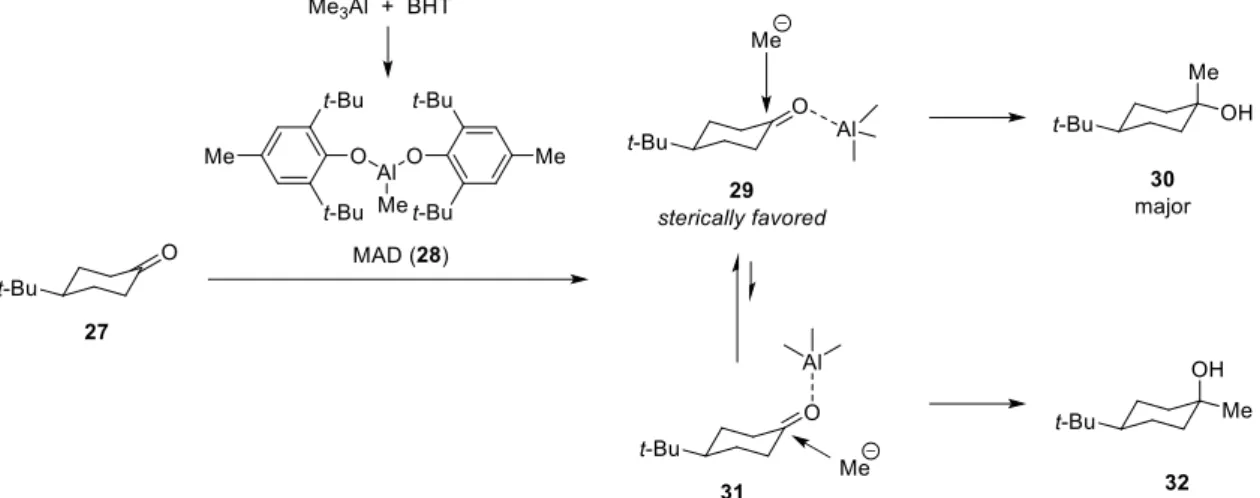
proceeded stereoselectively to afford desired trans-isomer in a 15 : 1 ratio in 97% yield.12 Therefore, the ketone 24 was subjected to the same reaction conditions. However, desired compound 25 was obtained as a separable mixture of its diastereomer 26 in a 1 : 1.3 ratio in 87% yield (entry 1). Although MeLi and Me3Al were also used, the selectivity was not improved (entries 2 and 3). On the other hand, Yamamoto et al. reported diastereoselective methylation giving equatorial alcohol (Figure 2-1-1).13 Treatment of 4- tert-butylcyclohexanone 27 with the bulky aluminum reagent (MAD, 28) prepared in situ from Me3Al and BHT in toluene, followed by addition of MeLi gave equatorial alcohol 30 in high selectivity and yield. It is considered that axial attack of MeLi to ketone precedes predominantly because the bulky Lewis acid coordinated to the carbonyl group to take equatorial position. Accordingly, methylation of ketone 24 was carried out in the same reaction conditions, and the selectivity was improved to furnish 25 as a separable mixture of its diastereomer 26 in 93% yield in a 2.1 : 1 ratio (entry 3).
32
Figure 2-1-1. Selective methylation by using MAD developed by Yamamoto et al.
Synthesis of the QRS ring system of MTX (1) is shown in Scheme 2-1-6.
Selective removal of the TBDPS group of 25 under the basic conditions using sodium hydroxide furnished 33 in 97% yield, and protection of the resulting diol as benzyl ethers gave 34 in 78% yield. Finally, removal of the TBS groups with TBAF afforded the QRS ring system 1 in 86% yield.14 The structure of 1 was unambiguously determined by NOESY experiments on benzylidene acetal 35, which was derived from diol 33 by treatment with PhCH(OMe)2 in the presence of p-TsOH·H2O in 54% yield.
Scheme 2-1-6. Synthesis of the QRS ring system 1.
33
To examine the effect on the biological activity of their ring size of the S ring, the QR(S) ring system (36) having six-membered S ring was designed and prepared (Scheme 2-1-7). Removal of TBS groups with TBAF proceeded smoothly to afford the QR(S) ring system (36) in 87% yield.
Scheme 2-1-7. Synthesis of the QR(S) ring system 36.
34
2-2. Synthesis of the LMNO ring system
Synthesis plan of the LMNO ring system (37) of MTX is shown in Scheme 2-2- 1. The target compound 37 would be derived from the LM ring aldehyde 39 and the NO ring methyl ketone 38 via an aldol reaction, followed by the 1,3-anti selective reduction15 of a β-hydroxy ketone, as reported by Tachibana et al.16 The LM ring 39, which was envisaged to be a precursor of the NO ring 38, could be derived from the L ring aldehyde 42 and the known sulfoxide 4317 through successive Nozaki–Hiyama–Kishi (NHK) reaction18 to give the α,β-unsaturated sulfoxide 41 followed by an intramolecular oxa- Michael addition19 and Pummerer rearrangement.20,21 Although similar approach was reported by Kishi et al.,22 advantage of this strategy is to use the sulfoxide, which is expected to work as both an electron-withdrawing group for the oxa-Michael addition as well as a precursor to the Pummerer rearrangement. This approach could reduce the number of steps needed to construct the M ring, while there are no precedent studies describing the use of sulfoxide 43 for the NHK reaction to our knowledge.
Scheme 2-2-1. Synthesis plan of the LMNO ring fragment of MTX.
The L-ring 60, a precursor to the aldehyde 42, was synthesized according to the procedure reported by Nicolaou et al.,23 with the exception that the secondary hydroxy
35
groups at C57 and C58 were protected with NAP rather than Bn (Scheme 2-2-2). The hydroxy group of the amide 4424 was protected as a NAP ether by treatment with NaH and NAPBr in DMF to afford 45 in 97% yield. The amide 45 was then treated with 2- lithiofuran generated from furan and n-BuLi at –78°C to furnish the furylketone 46 in 97% yield. The ketone was converted to a chiral secondary alcohol 48 in 98% yield by a Noyori asymmetric hydrogen transfer reaction using the ruthenium catalyst (S,S)-47 and HCO2Na as a reductant.25 An Achmatowicz rearrangement3,26 of the furfuryl alcohol 48 with NBS, followed by acylation of the resulting hemiacetal with PivCl, afforded pivaloate 49 in 62% yield for two steps, with the concomitant formation of its β-anomer in 28% yield. Luche reduction27 of the enone 49 resulted in the formation of the alcohol 50 as a single isomer, which was protected as the NAP ether 51 in 86% yield for two steps. Dihydroxylation of the olefin 51 furnished the α-diol 52 as a single isomer in 95%
yield, and the equatorial hydoxy group was selectively protected as a NAP ether via stannylidene to afford 53 in 90% yield.28 After removing the Piv group, the resulting diol 54 was protected as an acetate by treatment with Ac2O in pyridine to furnish 55 as a diastereomixture (α : β = 1 : 0.14) in 99% yield for two steps. C-glycosylation of the acetate 55 using allylsilane in the presence of TMSOTf proceeded stereoselectively to afford 56 in 84% yield.29 In this reaction, conversion of the Piv group to an Ac group was necessary because C-glycosylation of the corresponding pivaloate resulted in low yields.
Removal of the acetyl group of 56 using K2CO3 as a base in methanol afforded 57 in 96%
yield. Inversion of the secondary alcohol 57 via a Mitsunobu reaction,30 followed by methanolysis of the resulting 4-nitrobenzoate 58, gave the alcohol 59 in 76% yield for two steps. Protection of the secondary alcohol 59 as a TBS ether furnished the key intermediate 60 in quantitative yield.
36
Scheme 2-2-2. Synthesis of the L-ring 60.
The synthesis of the LM ring 39 is illustrated in Scheme 2-2-3. Ozonolysis of the terminal alkene 60 gave the aldehyde 42, which was subjected to unprecedented Nozaki–Hiyama–Kishi (NHK) reaction18 with the iodoolefin 4317 possessing p- toluenesulfoxide moiety. Fortunately, the coupling product 41 was obtained yield as a mixture of the diastereomers at C62, whereas preliminary attempts to achieve the asymmetric version of the NHK reaction31 were unsuccessful. Treatment of 41 with TBAF at 0 °C removed the TBS group and raising the reaction temperature to 50 °C
37
concomitantly promoted the intramolecular oxa-Michael addition of the resulting alkoxide to give the desired isomer 61 in 35% yield and its C63-epimer 62 in 25% yield for two steps, respectively. The structures of these compounds were determined by NOE experiments (Figure 2-2-1). The stereochemistry at C63 was presumably controlled by the favored transition state A compared over B, as shown in Figure 2-2-2. The epimer 62 was converted to 61 through a Dess–Martin oxidation of the alcohol, followed by reduction of the resulting ketone 63 with NaBH4 at –78 °C in 65% yield for two steps.
Thus, the M ring was constructed from the L ring 42 in only two steps (four steps, including the conversion of the C63-epimer), and the resulting sulfoxide is directly used as a precursor for the subsequent Pummerer rearrangement.20,21 After protecting the secondary alcohol 61 with NAP group in 81% yield, treatment of the resulting 40 with trifluoroacetic anhydride in the presence of pyridine,23 followed by hydrolytic workup, afforded the aldehyde 39 in 81% yield, which corresponded to not only the LM ring but also the NO ring system.
Scheme 2-2-3. Synthesis of the LM ring system 39.
38
Figure 2-2-1. NOE experiments of compound 61 and 62.
Figure 2-2-2. Stereochemical outcome of intramolecular oxa-Michael reaction of 41.
Synthesis of the methyl ketone 38 is shown in Scheme 2-2-4. Reduction of the aldehyde 39 with NaBH4 furnished the alcohol 64 in 95% yield, and the resulting primary hydroxy group was protected as a TBDPS ether 65 in 89% yield. Treatment of 65 with ZnCl2 in Ac2O/AcOH32 resulted in the selective removal of the primary NAP group with concomitant acetylation to form the acetate 66 in 91% yield. Removal of the acetyl group of 66 by methanolysis with K2CO3 furnished the primary alcohol 67 in 97% yield, which was transformed to the nitrile 69 via the mesylate 68 in 93% yield for two steps. Attempts to convert the nitrile 69 into the methyl ketone 38 by treatment with MeMgBr or MeLi, followed by hydrolytic workup, were unsuccessful. The yields were low, with significant
39
decomposition and recovery of the starting material. On the other hand, treatment of 69 with Me3Al in the presence of Ni(acac)2 as a catalyst provided 38 in 65% yield.33
Scheme 2-2-4. Synthesis of the NO ring fragment 38.
The next transformation was a crucial step in the synthesis: coupling of the LM ring (39) and the NO ring (38) by using aldol reaction (Scheme 2-2-5). The yield of a similar transformation was reported to be 37% by Tachibana et al.16 Although the aldol reaction was unsuccessful under the reaction conditions reported in the literature, after considerable experimentation, treatment of the methylketone 38 with LHMDS, followed by the addition of the aldehyde 39, furnished the desired hydroxy ketone 70 in a low yield (20%) with the concomitant formation of byproducts containing its C64-epimer (10%).
Although the yield of the aldol reaction should be improved, the stereoselective reduction of the β-hydroxyketone 70 with the Saksena–Evans reagent15 gave the 1,3-anti-diol 71 as an inseparable mixture with the C66-epimer. Finally, the global removal of NAP groups from 71 with Pd(OH)2/C under a hydrogen atmosphere afforded the LMNO ring system 37 in 53% yield for two steps as a single isomer.
40
Scheme 2-2-5. Synthesis of the LMNO ring system 37.
To verify the effect of TBDPS group for biological activity, compound 73 was prepared from 70 (Scheme 2-2-6). Removal of the TBDPS group with TBAF, followed by the global removal of NAP groups from 72 with Pd(OH)2/C under a hydrogen atmosphere afforded 73 in 30% yield for three steps as a single isomer.
Scheme 2-2-6. Synthesis of the deprotected LMNO ring system 73.
41
2-3. Synthesis of the NOPQR(S) ring system
Synthesis plan of the NOPQR(S) ring system 74 is shown in Scheme 2-3-1. The target compound 74 would be derived from dihydropyran 75 via hydroboration, which is to be synthesized from ynone 76 through 1,4-reduction and dehydration. For the construction of ynone 76, coupling of the QR(S) ring alkyne 77 derived from an intermediate in the synthesis of the QRS ring system and the NO ring aldehyde 39 (common intermediate with the LM ring) was envisaged.
Scheme 2-3-1. Synthesis plan of the NOPQR(S) ring fragment of MTX.
Synthesis of the NOPQR(S) ring system commenced with the conversion of the QR(S) ring 18 to alkyne 81 (Scheme 2-3-2). Selective removal of the TBS group of 18 with HF·Py afforded 78 in 98% yield. Oxidation of primary alcohol 78 with Dess–Martin periodinane, followed by treatment of the resulting aldehyde 79 with Ohira–Bestmann reagent (80)34 in the presence of Cs2CO3 as a base gave desired alkyne 81 in 89% yield for two steps.
42
Scheme 2-3-2. Synthesis of the QR(S) ring fragment 81.
Having obtained the QR(S) ring fragment 81, coupling reaction with the NO ring fragment (39) was examined (Table 2-3-1). Alkynyllithium prepared from 81 by treatment with n-BuLi in situ was subjected to coupling reaction with aldehyde 39 in THF at −78 °C to afford desired product 82 in 13% yield as a single isomer, but the stereochemistry of C76-hydroxy group was not determined (entry 1). Attempts to improve the yield, higher reaction temperature (entries 2 and 3) or addition of CeCl3 (entry 4),35 were unsuccessful.
43
Synthesis of hexacyclic compound 75 was attempted (Scheme 2-3-3). Oxidation of alcohol 82 with Dess-Martin periodinane gave ketone 83 in 95% yield. Although selective hydrogenation of alkyne 83 by using Pd/C(en)36 under H2 atmosphere was unsuccessful, 1,4-reduction of alkynylketone with Stryker’s reagent ([CuH(PPh3)]6)37 furnished ketone 84 in 79% yield. Since treatment of 84 with TBAF at room temperature caused no reaction, reaction temperature was elevated to 50 °C. Although removal of the TBS groups probably proceeded, complex inseparable mixture was obtained. Surprisingly, treatment of the mixture with p-TsOH·H2O afforded lactone 85. It was considered that exposure of 84 to basic conditions at high temperature caused decomposition of the substrate. Therefore, treatment of 84 with TBAF in the presence of acetic acid as buffer solution was examined, but the TBS groups were not removed. Deprotection of the TBS groups with HF·Py was also unsuccessful.
Scheme 2-3-3. An attempt to synthesize 75 from alkynylalcohol 82.
Sterically hindered silyl groups near the reactive site seemed to prevent from coupling reaction and it was difficult to remove TBS groups. Therefore, protecting group of the QR(S) ring fragment was changed to acetonide (Scheme 2-3-4). Protection of the diol 3 as an acetonide with 2,2-dimethoxypropane (97%), followed by removal of the TBS group of 86 with TBAF gave the alcohol 87 in 98% yield. Oxidation of the primary alcohol in the presence of catalytic amounts of AZADOL38 using PhI(OAc)2 as a co- oxidant afforded an aldehyde, which was then treated with the Ohira–Bestmann reagent
44
(80)34 in the presence of Cs2CO3 as a base to furnish the alkyne 88 in 77% yield for two steps. Coupling reaction of the QR(S) ring fragment 88 and the NO ring fragment 39 was then carried out. Treatment of the terminal alkyne 88 with n-BuLi to generate the corresponding lithium acetylide, followed by the addition of the aldehyde 39, afforded a secondary alcohol as a mixture of diastereomers in a 2:1 ratio, which was then oxidized with MnO2 to give the ynone 89. 1,4-reduction of 89 with Stryker reagent [CuH(PPh3)]637
gave the saturated ketone 90 in 63% yield for three steps. Methanolysis of the acetonide 90 with p-TsOH·H2O resulted in the formation of a mixture of a keto alcohol and a hemiacetal. Although dehydration to obtain the dihydropyran derivative 75 by treatment with PPTS or p-TsOH·H2O was unsuccessful, that with Nafion NR-5039 afforded 75 in 69% yield for two steps. Hydroboration of the olefin 75 with BH3·SMe2, followed by an oxidative workup, furnished the desired alcohol 91 as a single diastereomer. The stereochemistry of 91 was confirmed by NOE experiments. Finally, the synthesis of the NOPQR(S) ring system 74 was achieved through global removal of the NAP groups with DDQ in 37% yield for two steps.40
Scheme 2-3-4. Synthesis of the NOPQR(S) ring system 74.
45
2-4. Biological activities
Having synthesized the QRS, LMNO, and NOPQR(S) ring, biological activity was evaluated. A solution of 1 nM MTX induced a 10-fold increase in the Ca2+ influx, compared to the control, in rat C6 glioma cells, and this value was defined as 100% Ca2+
influx (Figure 2-5-1).
Figure 2-5-1. Evaluation of the inhibitory activities of the partial structures of MTX. The level of Ca2+ influx induced by 1 nM MTX was defined as 100%.
The QRS ring (tricyclic) system 1 blocked Ca2+ influx activity in a dose- dependent manner, and the IC50 value was estimated to be 44 μM (Figure 2-5-2).14 It is noteworthy that inhibitory activity of the tricyclic compound 1 is comparable to that of the longer partial structures, the W–C’ (heptacyclic) and the C’–F’ (tetracyclic) ring system.41 In addition, it is interesting to note that 6/6/6-tricyclic ether 36 also inhibited MTX-induced Ca2+ influx with IC50 value at 240 μM (Figure 2-5-2).
46
Figure 2-5-2. Structure-activity relationship studies of MTX.
Since the inhibitory activities of the LMNO (37) and NOPQR(S) ring systems (74) were not so potent, the values are listed as inhibition percentages at 300 μM, not IC50
values, and the values were compared with those of the QR(S) (36) and the QRS ring system (1),14 namely, 54% and 91% inhibition, respectively (Figure 2-5-3). The inhibitory activity of the LMNO ring system (37) was 36%, whereas that of its enantiomer (ent-37) which was prepared for comparison in our group40 was slightly less potent (19%
inhibition). In addition, the activity was not significantly changed by deprotection of a TBDPS group (28% inhibition). These results are comparable to those reported by Konoki et al.42 Thus, the biological activity did not depend significantly on the chirality.
Therefore, the inhibitory activity of the hydrophilic region may not be due to specific binding to the target proteins, suggesting that the hydrophilic region may not be a promising inhibitor. These results are supporting our hypothesis: the partial structures
47
corresponding to the hydrophobic region of MTX might bind competitively to the target proteins to inhibit the biological activity due to MTX.
On the other hand, it was surprising that no inhibition was observed with the NOPQR(S) ring system (74) (< 300 μM), possessing hydrophobic and hydrophilic moieties and a large number of rings (hexacyclic) than the LMNO (tetracyclic, 37) and the QRS (tricyclic, 1) ring systems. Although the mechanism underlying the activity of the NOPQR(S) ring system (74) remains a point of debate, the combination of the hydrophobic and hydrophilic regions influenced the biological activity in contradictory manners.
Figure 2-5-3. Summary of the inhibitory activity of the synthetic specimens against Ca2+
influx induced by MTX and comparison of the molecular structures with that of MTX.
48
References
1. (a) Nicolaou, K. C.; Nugiel, D. A.; Couladouros, E.; Hwang, C. –K. Tetrahedron 1990, 46, 4517–4552. (b) Nakashima, T.; Baba, T.; Onoue, H.; Yamashita, W.;
Torikai, K. Synthesis 2013, 45, 2417–2425. (c) Baba, T. Master Thesis Kyushu Univ., 2012.
2. Matsumura, K.; Hashiguchi, S.; Ikariya, T.; Noyori, R. J. Am. Chem. Soc. 1997, 119, 8738–8739.
3. (a) Achmatowicz, O. Jr.; Bukowski, P.; Szwchner, B.; Zwierzchowska, Z.;
Zamojski, A. Tetrahedron 1971, 27, 1973–1996. (b) Nicolaou, K. C.; Cole, K. P.;
Frederick, M. O.; Aversa, R. J.; Denton, M. Angew. Chem. Int. Ed. 2007, 46, 8875–
8879.
4. Takamura, H.; Tsuda, K.; Kawakubo, Y.; Kadota, I.; Uemura, D. Tetrahedron Lett.
2012, 53, 4317–4319.
5. (a) Tomooka, K.; Matsuzawa, K.; Suzuki, K.; Tsuchihashi, G. Tetrahedron Lett., 1987, 28, 6339–6342. (b) Oishi, T.; Nagumo, Y.; Hirama, M. Chem. Commun.
1998, 1041–1042.
6. Donohoe, T. J.; Moore, P. R.; Warning, M. J. Tetrahedron Lett. 1997, 38, 5027–
5030.
7. VanRheenen, V.; Kelly, R. C.; Cha, D. Y. Tetrahedron Lett. 1976, 23, 1973–1976.
8. Depau, P.; Epple, R.; Thomas, A. A.; Fokin, V. V.; Sharpless, K. B. Adv. Synth.
Catal. 2002, 344, 421–433.
9. Shanzer, A. Tetrahedron Lett. 1980, 21 221–222.
10. (a) Sakai, T.; Sugimoto, A.; Mori, Y. Org. Lett. 2011, 13, 5850–5853. (b) Sakai, T.;
Ito, S.; Furuta, H.; Kawahara, Y.; Mori, Y. Org. Lett. 2012, 14, 4564–4567.
11. Mori, Y.; Hayashi, H. Tetrahedron 2002, 58, 1789–1797.
12. Fei, F.; Murai, A. Synlett 1995, 863–865.
13. Maruoka, K.; Itoh, T.; Yamamoto, H. J. Am. Chem. Soc. 1985, 107, 4573–4576.
14. Onoue, H.; Baba, T.; Konoki, K.; Torikai, K.; Ebine, M.; Oishi, T. Chem. Lett.
2014, 43, 1904–1906.
15. (a) Evans, D. A.; Chapman, K. T.; Carreira, E. M. J. Am. Chem. Soc. 1988, 110, 3560–3578. (b) Saksena, A. K.; Mangiaracina, P. Tetrahedron Lett. 1983, 24, 273–
276.
16. Sasaki, M.; Nonomura, T.; Murata, M.; Tachibana, K. Tetrahedron Lett. 1995, 36, 9007–9010.
17. (a) Solladie, G.; Hutt, J.; Girardin, A. Synthesis, 1987, 2, 173−175. (b) Marino, J.
49
P.; Laborde, E.; Deering, C. F. J. Org. Chem. 1994, 59, 3193−3201.
18. (a) Jin, H.; Uenishi, J.; Christ, W. J.; Kishi, Y. J. Am. Chem. Soc. 1986, 108, 5644–
5646. (b) Takai, T.; Tagashira, M.; Kuroda, T.; Oshima, K.; Utimoto, K.; Nozaki, H. J. Am. Chem. Soc. 1986, 108, 6048–6050.
19. For recent reviews see: (a) Nising, C. F.; Bräse, S. Chem. Soc. Rev. 2012, 41, 988–
999. (b) Nising, C. F.; Bräse, S. Chem. Soc. Rev. 2008, 37, 1218–1228.
20. (a) Pummerer, R. Ber. Dtsch. Chem. Ges. 1909, 42, 2282–2291. (b) Pummerer, R.
Ber. Dtsch. Chem. Ges. 1910, 43, 1401–1412.
21. For recent reviews, see: (a) Feldman, K. S. Tetrahedron, 2006, 62, 5003–5034. (b) Smith, L. H. S.; Coote, S. C.; Sneddon, H. F.; Procter, D. J. Angew. Chem., Int. Ed.
2010, 49, 5832–5844.
22. Zheng, W.; DeMattei, J. A.; Wu, J.-P.; Duan, J. J.-W.; Cook, L. R.; Oinuma, H.;
Kishi, Y. J. Am.Chem. Soc. 1996, 118, 7946–7968.
23. Nicolaou, K. C.; Postema, M. H. D.; Yue, E. W.; Nadin, A. J. Am. Chem. Soc. 1996, 118, 10335–10336.
24. Li, M.; Scott, J.; O’Doherty, G. A. Tetrahedron Lett. 2004, 45, 1005–1009.
25. Lewis, M. D.; Cha, J. K.; Kishi, Y. J. Am. Chem. Soc. 1982, 104, 4976–4978.
26. (a) Achmatowicz, O.; Bielski, R. Carbohyd. Res. 1977, 55, 165–176. (b) Zhou, M.; O’Doherty, G. A. J. Org. Chem. 2007, 72, 2485–2493. (c) Deska, J.; Thiel, D.;
Gianolio, E. Synthesis 2015, 47, 3435–3450. (d) Ghosh, A. K.; Brindisi, M. RSC Adv. 2016, 6, 111564–111598.
27. Luche, J. L. J. Am. Chem. Soc. 1978, 100, 2226–2227.
28. David, S.; Hanessian, S. Tetrahedron 1985, 41, 643–663.
29. Lewis, M. D.; Cha, J. K.; Kishi, Y. J. Am. Chem. Soc. 1982, 104, 4976–4978.
30. Mitsunobu, O. Synthesis 1981, 1–28.
31. (a) Chen, C.; Tagami, K.; Kishi, Y. J. Org. Chem. 1995, 60, 5386–5387. (b) Wan, Z.-K.; Choi, H.-w.; Kang, F.-A.; Nakajima, K.; Demeke, D.; Kishi, Y. Org. Lett.
2002, 4, 4431–4434. (c) Choi, H.-w.; Nakajima, K.; Demeke, D.; Kang, F.-A.; Jun, H.-S.; Wan, Z.-K.; Kishi, Y. Org. Lett. 2002, 4, 4435–4438.
32. Yang, G.; Ding, X.; Kong, F.; Tetrahedron Lett. 1997, 38, 6725–6728.
33. Bagnell, L.; Jeffery, E. A.; Meisters, A.; Mole, T.; Aust. J. Chem. 1974, 27, 2577–
2582.
34. Ohira, S. Synth. Commun. 1989, 19, 561–564.
35. (a) Imamoto, T.; Kusumoto, T.; Tawarayama, Y.; Sugiura, Y.; Mita, T.; Hatanaka, Y.; Yokoyama, M. J. Org. Chem. 1984, 49, 3904–3912. (b) Imamoto, T.; Sugiura,
50
Y.; Takiyama, N. Tetrahedron Lett. 1984, 25, 4233–4236. (c) Fox, C. M. J.; Hiner, R. N.; Warrier, U.; White, J. D. Tetrahedron Lett. 1988, 29, 2923–2926. (d) Molander, G. A. Chem. ReV. 1992, 92, 29–68.
36. Sajiki, H.; Hattori, K.; Hirota, K. J. Org. Chem. 1998, 63, 7990–7992.
37. Mahoney, W. S.; Brestensky, D. M.; Stryker, J. M. J. Am. Chem. Soc. 1988, 110, 291–293.
38. (a) Shibuya, M.; Sasano, Y.; Tomizawa, M.; Hamada, T.; Kozawa, M.; Nagahama, N.; Iwabuchi, Y. Synthesis 2011, 3418–3425. (b) Hayashi, M.; Shibuya, Y.;
Iwabuchi, Y. Org. Lett. 2012, 14, 154–157. (c) Iwabuchi, Y. Chem. Pharm. Bull.
2013, 61, 1197–1213.
39. (a) Olah, G. A.; Iyer, P. S.; Prakash, G. K. S. Synthesis 1986, 513–531. (b) Morita, M.; Ishiyama, S.; Koshino, H.; Nakata, T. Org. Lett. 2008, 10, 1675–1678.
40. Onoue, H.; Marubayashi, R.; Ishikawa, E.; Konoki, K.; Torikai, K.; Ebine, M.;
Murata, M.; Oishi, T. J. Org. Chem. 2017, 82, 9595–9618.
41. (a) Oishi, T.; Hasegawa, F.; Torikai, K.; Konoki, K.; Matsumori, N.; Murata, M.
Org. Lett. 2008, 10, 3599–3602. (b) Kunitake, M.; Oshima, T.; Konoki, K.; Ebine, M.; Torikai, K.; Murata, M.; Oishi, T. J. Org. Chem. 2014, 79, 4948–4962.
42. Konoki, K.; Hashimoto, M.; Nonomura, T.; Sasaki, M.; Murata, M.; Tachibana, K.
J. Neurochem. 1998, 70, 409–416.
51
Chapter 3. Synthesis of the WXYZA’B’C’D’E’F’ ring system of maitotoxin
3-1. Synthesis plan
Since the synthesis of the WXYZA’B’C’ ring system was completed in our laboratory based on convergent strategy via α-cyano ethers (Scheme 3-1-1),1 the similar strategy was envisaged for the synthesis of the WXYZA’B’C’D’E’F’ ring system as shown in Scheme 3-1-2. The WXYZA’B’C’D’E’F’ ring system 92 would be derived from hydroxy ketone 93 via reductive etherification with construction of the A’ ring.
Construction of the B’ ring is to be achieved through ring-closing metathesis.2 Regioselective cleavage of acetal 95 could generate to α-cyano ether 94, and this precursor would be obtained by intermolecular acetal formation between diol and aldehyde corresponding to C’D’E’F’ ring 963 and WXYZ ring 97,1b respectively.
Scheme 3-1-1. Convergent synthesis of the WXYZA’B’C’ ring system via α-cyano ether method.
52
Scheme 3-1-2. Synthetic plan of the WXYZA’B’C’D’E’F’ ring system.
53
3-2. Synthesis of the WXYZ and C’D’E’F’ ring system
Although the synthesis of the WXYZ ring fragment was achieved by α-cyano ether protocol in our laboratory,1 novel convergent strategy to construct 6/7/6/6- tetracyclic ether system having contiguous angular methyl groups was developed (Scheme 3-2-1).4 Hydroxy ketone 100 was derived from alkyne 98 and aldehyde 99 via coupling reaction, and dehydration followed by hydroboration-oxidation afforded 101.
Ring expansion of six-membered ring ketone 101 gave seven-membered ring ketone 102, and compound 103 was obtained by mixed thioacetal formation of hydroxy ketone 102.
Synthesis of aldehyde 97 was achieved through oxidation and methylation of common intermediate 103.
Scheme 3-2-1. Synthesis of the WXYZ ring system in combination of novel and previous strategies.
However, there was a problem in preparation of mixed-thioacetal. Therefore, optimization of the reaction conditions was examined (Table 3-2-1).1b As reported, treatment of the hydroxy ketone with EtSH in the presence of Zn(OTf)2 afforded the desired mixed-thioacetal 103 (42%) with concomitant formation of dithioacetal 104 (8%) and recovery of the starting material 102 (42%) (entry 1). This reaction didn’t proceed in the presence of MS4A (entry 2), and other Lewis acids such as Sc(OTf)3 and In(OTf)3
showed no significant improvement (entries 3, 4). On the other hand, the use of TfOH furnished desired compound 103 in 66% yield (entry 5). Although the yield was decreased, reducing the amount of EtSH reduced to generate byproducts such as dithioacetal 104 or
54
rearrangement product 105. TfOH was added portionwise (0.1 eq, four times) in the presence of MS4A gave better results, and 103 was obtained in 74% yield as a mixture of diastereomers (α : β = 4.8 : 1) after protection of the partially desilylated products.
The C’D’E’F’ ring fragment 96 was prepared from known compound 106 as shown in Scheme 3-2-2.3 Thus, deprotection of a PMB group with DDQ followed by protection of the resulting primary alcohol as a TBDPS ether afforded 108. Subsequently, Bn groups were removed with Pearlman’s catalyst under hydrogen atmosphere to generate the C’D’E’F’ ring fragment 96 in 88% yield for three steps.
Scheme 3-2-2. Synthesis of the C’D’E’F’ ring fragment 96.