
近畿大学学術情報リポジトリ
25
0
0
全文
(2) ft* •1-171tiffftl--t^. —CV. with the actual market. determinants. as revealed. relational tension and balance of priority between. in questionnaire market. responses.. determinants. The. and ideas of. what might be effective pedagogically could then be examined. The initial hypothesis, which led to the cited research projects, was expanded and developed. into a comprehensive. theoretical. argument. as the projects. proceeded.. Resulting data from each of the survey projects lent significant support to the thesis, as will be shown. The basis of the enquiry and accompanying thesis give rise to the thematic core argument that, having superceded " structural-behaviourist paradigm". (what I have chosen to designate) - academically speaking. 1970 in Willis and Willis 1996: 4-9; Richards Language Teaching (CLT) is nevertheless,. the previous. (Woodward, citing Kuhn. and Rodgers,. 2001), Communicative. still influenced by it in problematic ways, in. practice; coinciding, moreover, with commercial considerations. (in CB production). that. appear to maintain and engender it. This poses challenges for CLT as an evolving " project", from which important developments like Task Based Learning (TBL) have emerged;. raising questions. about the practice. of ELT, and the nature. instructional. materials.. Hence the CB is subject. to varying,. contradictory " conventional. pressures. and influencing factors. In particular,. practice". and the need to appeal to and supply market. and use of. often conflicting. and. the powerful sway of demands. is. countered by theoretical and pedagogical notions emerging from ELT, Second Language Acquisition (SLA), Linguistics, and general education on the nature of teaching-learning, increasingly. understood. as a developmental. process. (Allwright,. 1982; Edge, 1996;. Holliday, 1994; Lange, in Richards and Nunan 1990). As White states, this has created a certain dilemma whereby a tension exists "between the linear, graded organization content,. which is such a strong. organic. growth. picture. of language. acquisition (SLA) research" Implications. tradition. resulting. in language. learning. teaching,. ... emerging. and the non-linear,. from second. from consideration. entity,. typologically representative, are rooted in a presentation. language. (1988: 36). of these factors will be discussed. regard to the "usability," effectiveness, and degree of "communicativeness" ELT CB as a generic. of. through. of the global. a focus on one specific example. in line with Willis's observation methodology". in. taken. as. that: "many coursebooks. (1996: 51).. The nature of the paradigmatic tension here referred to is one in which the central. — 184 —.
(3) The Problematic. Nature of "Global. notion of a structural-behaviourist. ELT Coursebooks. (S-B) "approach" such as the Audiolingual Method. (ALM) requires conformity to "set pattern" (teaching. methodology). and learning. assumption that what teachers. and the Challenge of Effective Teaching-Learning. both in terms of pedagogical. mode since it, "[makes]. "delivery". the over-simplified. 'do' in the classroom can be conventionalized into a set. of procedures that fit all contexts" (Brown 2001: 15). It therefore depends on "training" (the crux of behaviourist. habit-formation),. which applies both to the inducting. of. teachers and to classroom learning methodology. In direct contrast, the basis of a communicative it is to avoid being over-compromised. and diluted by methodological pre-determination,. should be posited on a developmental understanding developmental. approach, as it has evolved, and if. (in individual practitioners).. Such a. awareness involves a reflexive interaction with the multiple demands of. a variety of teaching contexts and teaching-learning. contingencies including factors such. as student profiles, learning-style variation, affect, motivation, class size, and macro and micro "cultural" (ethnic, social, institutional) concerns (Hofstede, 1986; Holliday, 1994). Thus, CLT differs recognition. significantly. of the importance. from previous. developments. in ELT in its. of variables that affect the teaching-learning. process,. again, in direct contrast to S-B approaches. The two major dichotomies of training versus development and standardized the paradigmatic. procedure versus contextual variables are the reason for. designations here chosen (the S-B and the CLT paradigms).. With this in mind, faced with the common institutional pressure to adopt a CB for a specific teaching assignment, the fundamental. question becomes: to what extent is the. CB potentially enabling (rather than limiting) for both teachers and students?. Teacher Questionnaire The objectives and research interview are reproduced. Survey and Interview. questions for the teacher. questionnaire. survey. and. below:. Objectives The main purpose in conducting the survey was to attempt the following:. 1. To. ascertain. communication. how. common. is among. a perceived. experienced. teachers,. — 185 —. dissatisfaction and. to investigate. with. CBs the. for. causes. spoken.
(4) ft* • 1-11,16ftil --t:/ —CV 2. To ascertain. what the actual limitations of such CBs are by focusing on a specific,. best-selling CB, representative. 3. To find evidence assumptions. of the "global," "communicative". of the causes of such limitations. manifested. in the CB by assessing. genre. in the underlying. the "interpretation". pedagogical of CLT they. constitute, and the influence on this of commercial considerations. Research Questions The key research questions designed to address the foregoing objectives are as follows:. 1. How communicative is the CB? - To what extent does it embody key principles of CLT?. 2. What kind of "surface" or inherent methodology does it contain? - How pedagogically effective is it?. 3. If a satisfactory, (teacher. workable methodology. adaptation),. how valuable. is only realizable is presenting. through. a design. "intervention". suggesting. a set. degree of built-in choice and "open-endedness". in the. methodology rather than a more explicitly flexible, adaptive format?. 4. How far does the CB design facilitate adaptation?. 5. How much scope for student personalization is there?. 6. Is a more explicit and greater CB desirable?. (Irrespective. of the presence. or not of options / suggestions. in the. Teacher's Manual). Regarding the question of research methods it was decided to use a qualitative approach. containing. salient quantitative. elements. Both qualitative. methods clearly have a role to play, and their interrelation. and quantitative. may be more fruitful than a. singular focus on either. Most significantly, a merely quantitative approach can limit the. — 186 —.
(5) The Problematic Natureof "GlobalELTCoursebooks and the Challenge ofEffective Teaching-Learning vital role of interpretative quantitative. statistical. exposition which allows the researcher data may lend itself only to cautious. to "say things" where hedging. (as the field. demands). and often the need for further, more rigorous studies because of perennial. contextual. limitations. This mainly practical consideration. can be viewed at a more. theoretical level with the following position providing important support for a qualitative framework. in the face of a well-established. tradition. prioritizing. the importance. of. quantitative studies: Scientific knowledge lays claim to generalizability; in positivist versions, the aim of social science was to produce laws of human behaviour that could be generalized universally. A contrasting humanistic view implies that every situation is unique, each phenomenon has its own intrinsic structure and logic. Within psychology universal laws of behaviour have been sought by natural-science oriented schools such as behaviourism, whereas the uniqueness of the individual person has dominated in humanistic psychology. In a postmodern approach the quest for universal knowledge, as well as the cult of the individually unique, is replaced by an emphasis on the heterogeneity and contextuality of knowledge, with a shift from generalization to contextualization. (Kvale 1996:232) Contextual considerations. are therefore of primary importance. to any research project. and played a major role in shaping the nature of the study. The particular the Oral English programme. context of. at Kinki University provided a number of elements that. enabled a clear focus and a solid basis from which to gather response data. As has been established,. the subject of enquiry was the global, communicative. ELT CB. For first year students. at Kinki University. there. is a choice of several. commercial ELT CBs from which teachers may select. Of these, one particular CB has proved. to be consistently. the most popular, English. Pearson Longman Asia ELT 2010) (EF/).. Firsthand. 1 (Helgesen. et al.. In 2009, for example, 57 teachers taught in. the Oral English programme at Kinki University, of which, 20 opted for EF1. Other CB choices measured in single figures. Given that EF1 was clearly a popular option it meant that there was a relatively large pool of teachers as potential survey respondents. Also, its "popularity" made it a challenging focus for critique, and if there were serious issues as to its effectiveness favourably.. less popular CBs would likely face similar scrutiny. EF1 could therefore. be taken to represent. a commercially. even less successful. typological example of the generic designation: global, communicative. The choice of CB focus led directly to the "convenience or opportunity sampling". — 187 —.
(6) ft*. . A-171,76ft11-t :/. —CV. (Dornyei 2010: 61) of the participant sample. The pool from which the sample was taken was reasonably. substantive. given that the Oral English. English language programme. programme. is the largest. at Kinki University employing up to 60 native-speaking. English teachers. It is also one of the largest English teaching programmes. within a. single institution in Japan. Kinki University is also one of the largest such institutions in Japan. The first step of the research project was to conduct an interview with a full-time NS member of staff in order to test the research questions and survey objectives, and to allow a format in which unpredicted. issues might arise and / or relevant topic features. might be explored at some length. This also served the purpose of honing and refining the questionnaire. survey subsequently. administered. to the participant. sample in line. with Brown's (2001: 78-79) recommendation that interviews are best used initially for "f ormulating research questions and specific survey questions," while "questionnaires are well suited to gathering data once the issues, research questions, and specific survey questions. have been clearly delineated.". significantly. - confirmed. the underlying. The single interview, hypothesis. additionally. (the respondent. - and. had serious. reservations about the effectiveness of EF1 and about ELT CBs in general). The main challenge in using a largely qualitative questionnaire administrator. survey is that the. is dependent upon the cooperation of potential respondents. in taking the. time required to answer open-ended questions rather than simply selecting or checking multiple-choice answers. It was therefore decided to limit the number of respondents colleagues of personal acquaintance.. 10 respondents. returned. the completed. to. survey. questionnaire in addition to the responses provided by the single interviewee. The data supplied by respondents. would, it was hoped, allow greater depth and. breadth of analysis given a qualitative format: Open-format items can provide a greater 'richness' than fully quantitative data. Open responses can yield graphic examples, illustrative quotes, and can also lead us to identify issues not previously anticipated ... LasFowler states (2002)1 respondents often like to have an opportunity to express their opinions more freely. (Dornyei 2010:36-37) The questionnaire. survey (see Appendix). the nine core questions reproduced below:. — 188 —. contained. 10 questions. elaborated. from.
(7) The Problematic Natureof "GlobalELTCoursebooks and the Challenge ofEffective Teaching-Learning The Nine Core Questions:. 1. To what extent does EF1 facilitate communicative interaction?. 2. How effective and usable are the unit design and procedures?. 3. How logically progressive and integrated is the unit design?. 4. How well do the coursebook component features work together?. 5. Are there enough opportunities for student personalization?. 6. What kind of elements mostly need adapting - How? - Why?. 7. What are the priorities of a coursebook for spoken communication?. 8. How much of the coursebook do you find usable?. 9. How satisfactory do you find it (in context of use)?. Publishing House Questionnaire Survey The second of the two research projects was a questionnaire. survey administered. to three major international publishing houses specializing in ELT materials. The nature of the research was to discover what factors actually determine the content and design of ELT CBs in the face of highly organized and sophisticated public relations strategies designed to impress the market with apparent pedagogical knowhow. It was therefore necessary. to be prepared. for possibly ambivalent,. opaque, or evasive responses. to. potentially sensitive, professionally confidential information. Two of the three publishers approached. completed. and returned. the questionnaire. informative data.. — 189 —. supplying. largely clear and.
(8) ft* • 1-171,76 ft 11-t:/ —CV The publishing industry questionnaire. is reproduced. below:. 1. What are some key reasons why English Firsthand 1 was produced. (given the range. of coursebooks on the market)?. 2. What are its main features, do any of them distinguish it from other coursebooks, and how do they serve to characterize. 3. What educational principles. it?. (within ELT or beyond) form the basis for the content. and design of English Firsthand 1, especially the organization of each unit?. 4. What commercial considerations influenced the content and design?. 5. Is English Firsthand. I designed mainly for use in private language schools or for. colleges/universities?. 6. What class size, and what age range is it designed. for? (Please. specify actual. numbers/ages). 7. Are coursebooks such as this designed and/or produced mainly with the perceived needs of the student in mind, or the perceived needs of the teacher?. 8. a) To what extent are non-native speaking teachers. (also) a potential. market. for. English Firsthand I?. b) Are there any aspects of English Firsthand 1 that take NNS teachers into account?. 9. Is English Firsthand. 1 intended. mainly for relatively. inexperienced. or relatively. experienced teachers?. 10. Is it assumed or expected that teachers use English Firsthand organization of each unit?. — 190 —. I according to the set.
(9) The Problematic Natureof "GlobalELTCoursebooks and the Challenge ofEffective Teaching-Learning 11. The "usability" of a coursebook can be judged by the kind of adjustments. that need. to be made for the classroom, and how easily these are aided by the coursebook itself (as distinct from the Teachers'. Book) - in other words how flexible and. adaptable it is:. How important is this to coursebook producers, given that coursebooks are made to be systematically. structured. and near to or complete in particulars,. therefore pre-. determining possibilities for use?. 12. Are there certain "requirements". a potential coursebook should satisfy in order to. be commissioned?. Do they include any of the following? - standardized. organization of unit content?. - a linear sequence of unit content (even if only for the purposes of layout)?. - assumed step by step linear coverage of unit content? (as indicated by the layout). - situational. presentation. settings. (through description/language. (such as dialogues). that are culturally. specific. and/or visual graphics)?. 13. a) Is English Firsthand I one of the top sellers in Japan? - and worldwide?. b) What percentage of sales of English Firsthand 1 are to colleges and universities?. c) How big is the Japanese market for ELT coursebooks?. Key Themes and Response Patterns in Survey Results (Please refer to the Appendix for the two tables showing quantitative the questions designed to elicit quantitative. data in the teacher questionnaire. results for survey -. also in Appendix - questions 6 and 10, and the two appended, concluding, un-numbered. —191 —.
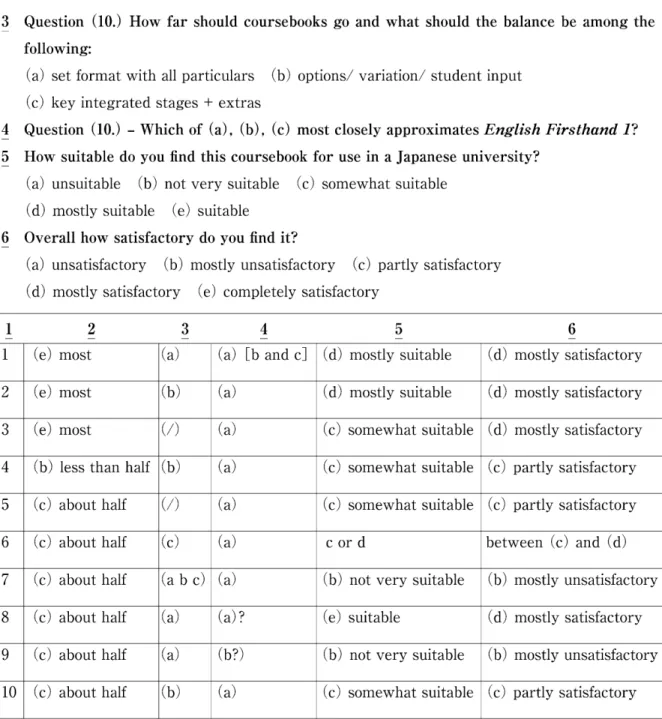
(10) ft* • 1-171,16ftil --t:/ —CV questions.) The purpose. of the quantitative. survey. questions. were to assess the overall. effectiveness and usability of EF1 (discussed below), and to help identify and confirm its typological profile in order to position it in terms of the ongoing theoretical argument. Most respondents identified it as: (a.) pre-determining situational/contextual, language, and procedural features set, repetitive unit format with all the relevant particulars supplied. Two CB types were posited. (b and c) as possible preferred. within a. options to (a) the main. generic global model. Types (b) and (c) are not mutually exclusive but complementary, with design / content features. not directly realized. (it is believed) in extant CBs; a. slight majority of respondents opted for the (b) / (c) alternatives. The qualitative questionnaire. expand. questions. constituting. the remaining,. on specific areas and underlying. themes. main body. of the. of the quantitative. questions. The initial hypothesis leading to the cited research was the belief that ELT CBs are inherently problematic in use in a particular context, irrespective of how popular or " well-received" they might otherwise be. Over half of the survey responses indicated that this is a shared perception. among experienced. teachers. in a particular. tertiary. setting (Kinki University). Context is clearly understood by the respondent of appropriate pedagogy-methodology. sample to be a key determinant. "I adapt and adjust almost everything, depending. on the class." The primary importance. of the flexibility and adaptability of CB content. was a central. survey.. theme. of the teacher. The aspects. of the CB that. require. intervention. and the ways in which it needs to be managed were the major index for. respondents. of its usability and effectiveness. Most respondents. found half, or less, of. each EF1 unit usable without having to make (significant) adjustments. Attention. was drawn to the value of the Teachers'. resource, but it was also pointed out that for teachers corresponding. Manual (TM) as a flexible in a tertiary. setting - with a. assumed degree of experience and expertise it should not be necessary. to employ it. According to this view the TM is intended for the relatively inexperienced. A major Hong Kong-based important. ELT publishing. ... the ability of inexperienced. house confirmed. this "[Defining]. teachers to use the materials". — 192 —. as. which the TM.
(11) The Problematic Natureof "GlobalELTCoursebooks and the Challenge ofEffective Teaching-Learning plays a key role in assisting. While another major publishing house stated that: The non-native teacher market is the largest market - and we have always aimed to target the NNS teacher as the primary market ... We include lots of support for NNS teachers in the TMs, including exact scripting of what the Teacher can say to introduce activities, provide correction, etc. This contrasts with the needs of experienced of survey respondents incorporating. (and qualified) teachers, with roughly half. finding such a degree of "guidance" unnecessary. more pre-determination. than is desirable.. and restrictive,. Those qualified in the field. tended to be more critical of EF1 in this and in other respects, indicating that they use pre-existing lesson plan schemata to which the CB is adapted. Others saw the CB itself as the "guide" to lesson planning. As one teacher respondent stated: A repetitive format can be helpful to students because they will be gradually "trained" in classroom procedures the teacher wants to use. On the other hand for experienced teachers who have developed their own preferred ways of dealing with these things such a textbook can be obstructive to classroomgoals and confusing to students. Such pre-determination. serves not only market demand as shaped by inexperienced and. NNS teachers, but also the familiar profile of the "busy teacher" requiring a ready-to-go, "fi nished" product with (all) content supplied, guided, and formatted in a repetitive way. This places a premium on CB designers to produce something with the appearance of "an immediate", highly usable "surface methodology". inherent in the unit design /. layout. As one publisher stated, "all the textbooks are working within the limitations of designing a book that fits everybody.". A number of respondents. size-fits-all" CB model as an expedient. compromise. between. saw this global, "onewhat appears. to be a. communicative methodology and the above-cited market determinants. The term surface methodology has been formulated in recognition of these factors, which give rise to the design and content of the ELT CB. The concept is part of the theoretical. argument. addressing. the question of the extent to which an "embedded". pedagogy helps serve market aims and, at the same time, advances the commonplace claim of "communicativeness". (a further promotional credential designed to appeal to. market expectations). The main pedagogical issue at the centre of the theoretical argument is then, the question. of the degree. to which EF1. and other. — 193 —. such. generic. CBs are in fact.
(12) ft* • 1-11,1fiftil-t^. —CV. communicative. Most respondents. believed. that a basis of controlled. practice. unit stages was. essential for any CB and that EF1 adequately provides this. However, more than half believed. it did not provide. students. with adequate. opportunities. for meaningful. communicative activity. As Ellis states: Controlled practice is designed to automatize items that are already part of the learner's interlanguage; qualitative studies suggest that it does not achieve this ... the old axiom ' practice makes perfect' may not apply to language learning ... practice may only facilitate acquisition directly if it is communicative, i.e. meaning-focused in nature. (1988:20-39) Respondents were most critical of the "freer" productive activities in EF1 because of an insufficiency of appropriate (Thornbury. 1999: 94). And because. communication,. " 'Communicative'. explicit guidelines"; students. language and / or procedural of insufficiently. guidance - scaffolding. engaging. rationales. for. activities are almost impossible without modeling or. "many of the activities. (in EF/). are not sustained. enough for. to get any benefit from them." Moreover, as Swan warns, "communicative". activities (such as the information gap) may prove not to be appropriate or motivating, "th e information conveyed should ideally have some relevance and interest for the students". rather than being "imposed" on them (Swan 1985: 84). Implying a key role. for personalization. One of the main claims the writers of English Firsthand 1 make is that it " provides a lot of personalized tasks" (2010: 4). However, this was only partially affirmed. by respondents.. Effective. personalization. requires. student. investment. (Allwright, 1982: 10) that is not pre-empted by conforming to "imposed" scenarios. CBs that supply most particulars. (situational examples, scenarios, and determining. may often work against potential personalization. by requiring. students. conform to such content, depriving them of the valuable opportunity own ideas in relation to their own circumstances. and thereby. details). to adopt and. to formulate their. generate. a motivating. curiosity and sharing vital to good classroom rapport and co-operation. The most salient reason that a number of respondents. saw the need for adaptation. was to introduce. more engaging, more extensive, and more authentic. meaning-focused). communicative activities.. Since personalization. and communicative. — 194 —. interaction. (personalized,. are inter-dependent. in.
(13) The Problematic. Nature of "Global. common topic domains. ELT Coursebooks. and the Challenge of Effective Teaching-Learning. (e.g. "experiences" ), contextual. bearing on appropriate teaching-learning. considerations. have a direct. content, which may be precluded or "imposed". by a global "all-inclusive" CB approach. Central to the issue of the degree to which EF1 is communicative. is the question. of what kind of approach informs its surface methodology. One respondent. drew direct. attention to it: A textbook is confined in scope to the expected methodology behind it. It is quite clear that a typical unit sequence in English Firsthand follows a PPP methodology. Presentation of vocabulary and target forms via Preview, Listening and Conversation, moving into " controlled" practice of target forms in Pairwork A&B and so called "free practice" in the Interaction. The Language Check and Real Stories seem to fall into the category of optional extras. The sequencing in EF1 suits the methodology it uses. It has been repeatedly Production anything. argued. and demonstrated. (PPP) falls short in regard more than opportunities. to providing. that Presentation-Practiceproductive. to practice the target language,. which realizes a notional-functional syllabus may be a presentation involves virtually. nothing in the way of genuine communication". activities. that are. "the methodology methodology which (Willis 1990: 57).. Lewis, in discussing the serious limitations of PPP, implies the firm influence of the S-B paradigm evident in the desire for "control" of what is being "taught": One of the main attractions of the PPP paradigm is that it allows teacher-training courses to introduce trainees to the idea of a neat lesson plan, with neat and distinct phases to the lesson. But language and 'the good lesson' are both organic, holistic concepts, where the success of the whole is much more than the success of the apparent component parts. Teacher training has over-valued PPP precisely because it allows teaching to focus on discrete, and apparently manageable, language items; the teacher has control over what is being 'taught'. But this control is illusory. All forms of procedural or skill-based learning are, in fact, not subject to the kind of linear sequencing intrinsic to any assertion that we know exactly what is being learned at any given moment. (Willisand Willis 1996:13) A key claim by the writers of EF1 intended as a statement "W. e learn English by using English". (2010: 4). Which begs the question: "by using. English"... to do what? - To "practice" (the target language), realizing a communicative. of its philosophy is:. aim? Nine out of eleven respondents. case of EF1, on the whole students are "basically 'practicing'. — 195 —. or to "make use" of it in considered that, in the the target language in a.
(14) ft* • 1-11,1fiftil-t:/ —CV pre-determined. way"; "they are mainly 'learning to use English' as opposed to [ 'using. English to learn it' ]" (Howatt 1984, cited in Richards and Rodgers, 2001: 155). There is a perceived. need, therefore, to significantly adapt the CB to facilitate more authentic. communicative. activities. communicative. aims based on tasks. negotiation. which,. if they are to be effective, that involve. [as] the essential or 'primary'. focus on realizing. "interpretation,. expression,. abilities within any target. and. competence". (Breen and Candlin, in Hall and Hewings 2001: 12). The designation communicative, as we have seen with the example of EF1, is often applied to a common "weak" version of CLT still showing the influence, through PPP, of the S-B paradigm.. This inhibits the proper realization of evolving CLT and the key. principles that define it. As Scrivener states: It assumes that learning is 'straight-line', that following a certain routine will guarantee the required results; in this respect it is essentially behaviourist, and therefore largely out of step both with discoveries about second language acquisition and with a lot of current classroom practice. (italics mine) (Willis and Willis 1996:80) Conclusions The S-B paradigm. and Implications. has been identified and so designated. foregoing research and argumentation. in the course of the. in order to highlight its historical position in the. evolution of ELT. It was an "approach" exported worldwide in the 1950s in the form of ALM at a time of burgeoning growth in the ELT market. (Phillipson 1992: 137-164) and. still retains an evident long-standing influence, largely because of its systematic nature; the "illusion" of "control" that it engenders, making it saleable, especially, to the novice and to NNS practitioners. The point is not to denigrate its worth wholesale in favour of CLT, it clearly still has an important role to play. However, the limits of that role need to be clearly understood. as pre-communicative. methods involving automization. (the. limits of which are indicated by Ellis (1988: 36-37) and specifically, phonology, where the use of drills typical of ALM, have an important function. S-B methods have shown some effectiveness seemingly competence. with beginner. produced. or lower-level abilities where the intensive use of drills. positive results.. For students. with developing. communicative. (Hymes, 1967, 1972; Canale and Swain, 1980) in need of productive. interaction its relevance and effectiveness encounter serious failings: The audiolingual view creates robot-like learners who ... are expected to carry out. — 196 —.
(15) The ProblematicNature of "Global ELT Coursebooksand the Challengeof EffectiveTeaching-Learning mechanical. manipulations. in order to form habits which are expected. to lead them to. fluency in the target language. Individuals take little responsibility ... students are spoon-fed and carefully. led from one step to the next with minimal room for failure, error,. experimentation.". (Dubin and Olshtain 1986: 48). A key theme determining. or. throughout. appropriate. the enquiry. has been the primacy. pedagogy-methodology. Report). As shown, it necessitates. (as well as in shaping. teacher intervention. materials in enabling a more effective teaching-learning the realization of more authentically. of context. communicative. in. the Survey. via the negotiation of teaching experience, especially regarding. interaction. As indicated, the role. that context plays has been recognized implicitly by Allwright (1982), and explicitly by Holliday (1994), and Edge (1996). It entails a necessary abandonment of the pre-determined. and formulaic in favour of the emergent, recognizing the presence. of variables influencing the teaching-learning of language. use (Widdowson,. learning outcomes. of the constraints. process and, moreover, the unpredictability. 1978; Lightbown,. (Long 1988). Consequently,. 1985), of language. uptake, and of. CBs for the ELT professional. should. provide: ... at best ... only a base or a core of materials [and be a] jumping-off point ... They should not aim to be more than that. A great deal of the most important work in a class may start with the textbook but end outside it, in improvisation and adaptation, in spontaneous interaction in the class, and development from that interaction. Textbooks ... can only provide the prop or framework within which much of this activity occurs. (O'Neill 1982: 110). O'Neill is perhaps referring. more to the way in which CBs should be "handled" rather. than how they are "put together"; given the recommendations. for the former, the latter. also needs to reflect and facilitate them to a greater degree, in ways discussed. Dubin and Olshtain (1986: 30), in assessing ELT materials, make the following point: (3.) ... Ideally materials should present teachers and learners with a jumping-off place, a stimulus for the learning process at each point. Effective materials should enable experienced teachers and autonomous learners to develop their own alternatives according to their needs and personal preferences. (italics mine). This in the. necessitates materials,. intervention and. allows. by the. the teacher irrespective kind of investment. — 197 —. of a. (Curran. ". convenience". 1972. and. 1976,. approach cited. in.
(16) ft* • 1-171 tiffftil --t^. —CV. Allwright 1982: 10) needed to engage and motivate students. Given the foregoing theoretical discussion and the contextual evidence generated via the cited research projects it would seem advisable to approach the question of what CB (?) with a degree of caution and flexibility, particularly. in regard. to the idea of. singular or prescriptive use, and particularly in a tertiary setting. One possible. outcome. of this enquiry. is the further. investigation. into, and. development of, the brief profile contained herein for a seemingly new, alternative, CB " model". Acknowledging the growing wish for a database of modifiable materials, not yet realizable in many contexts for a range of reasons including administrative would need to allow appropriate methodology to emerge naturally thus developmentally,. moreover,. (Edge, 1996: 11) and. avoiding the need for a surface methodology. At the same time. providing opportunities endedness. ones, it. for student investment,. (as profiled in the Survey incorporating. based on options, flexibility, and open-. Questionnaire:. question. elements of the "ideas resource". 10, design `b'). And,. book within a topic-based. conceptual organization it would include task-based activities, a focus on meaning, and predominantly. communicative. activities "designed to engage learners in the pragmatic,. authentic, functional use of language for meaningful purposes". (Brown 2001: 43).. BIBLIOGRAPHY. Allwright, R. (1982). What do we want teaching materials for? ELT Journal, 36/1, 5-18. Breen, M. and Candlin, C. (2001). The essentials language. teaching.. of communicative. curriculum. in. In Hall, D. and Hewings, A. (eds.) Innovation. in. English Language Teaching London: Routledge. pp. 9-26. Brown, H.D. (2001). Teaching by principles: an interactive approach to language pedagogy. New York: Addison Wesley Longman, Inc. Canale, M. and Swain, M. (1980). Theoretical. bases of communicative. approaches. to. second language teaching and testing. Applied Linguistics 1 Curran, C. A. (1972). Counseling-learning:. a whole person model for education. New. York: Grune and Stratton Curran, C. A. (1976). Counseling-learning. in second languages. Illinois: Apple River. Press Dubin, F. and Olshtain, E. (1986). Course design: developing programs and materials for. — 198 —.
(17) The Problematic Natureof "GlobalELTCoursebooks and the Challenge ofEffective Teaching-Learning language learning. New York: Cambridge University Press Dornyei, Z. (2010). Questionnaires. in second language research.. 2nd ed. New York:. Routledge Edge, J. (1996). Crossing borders: the development. parameter.. The Language teacher,. 20/10, 10-13 Ellis, R. (1988). The role of practice in classroom language learning. AILA Review 5, 20-39 Hall, D. and Hewings, D. (2001). Innovation. in English. language teaching. London:. Routledge Helgesen, M. et al. (2010). English Firsthand 1 Hong Kong: Pearson Longman Asia ELT Hofstede, G. (1986). Cultural differences in teaching and learning. International Journal of Intercultural. Relations 10, 301-320. Holliday, A. (1994). Appropriate methodology and social context. Cambridge: Cambridge University Press Howatt,. A. P. R. (1984). A history. of English. language. teaching. Oxford: Oxford. University Press Hymes, D. (1972). On communicative. competence. In Pride, J.B. and Holmes, J. (eds.). Sociolinguistics Harmondsworth: Kvale, S. (1996). Interviews:. an introduction. Penguin. pp. 269-293 to qualitative. research. interviewing.. Thousand Oaks: SAGE Publications, Inc. Kuhn, T. (1970). The structure. of scientific. revolutions.. 2nd ed. Chicago: Chicago. University Press Lange, D. (1990). A blueprint for a teacher development Nunan, D. (eds.). Second Language. program. In Richards, J and. Teacher. Education. New York:. Cambridge University press. pp. 245-268. Lightbown, P. (1985). Great expectations:. second language acquisition. research. and. classroom teaching. Applied Linguistics 6/2, 173-189 Litz, D. (2005). Textbook evaluation and ELT management: A South Korean case study. Asian EFL Journal Long, M. (1988). Instructed. interlanguage. development.. In Beebe, L. (ed.) Issues in. Second Language Acquisition: Multiple Perspectives New York: Newbury House Nunan, D. (1991b). Language teaching methodology: a textbook for teachers. New York:. — 199 —.
(18) ft* •1-171,16ftl--t^. —CV. Prentice Hall 0'. Neill, R. (1982). Why use textbooks? ELT Journal, 36/2, 104-111. Phillipson, R. (1992). Linguistic imperialism. Oxford: Oxford University Press Richards, J. and Nunan, D. (1990). Second language teacher. education.. New York:. Cambridge University Press Richards, J. and Rodgers, T. (2001). Approaches and methods in language teaching. 2nd ed. New York: Cambridge University Press Swan, M. (1985). A critical look at the communicative approach (2). ELT Journal, 39/2, 76-87 Thornbury, S. (1999). How to teach grammar. Harlow: Pearson Education Limited White, R. (1988). The ELT curriculum:. design, innovation and management.. Oxford:. Blackwell Widdowson,. H.G. (1978). Teaching. language. as communication.. Oxford:. Oxford. University Press Willis, D. (1990) The lexical syllabus: a new approach to language teaching. Birmingham: Collins COBUILD Willis, J. and Willis, D. (1996). Challenge and change in language teaching. Oxford: Macmillan Heinemann. — 200 —.
(19) The Problematic Natureof "GlobalELTCoursebooks and the Challenge ofEffective Teaching-Learning APPENDIX ELT Coursebook Questionnaire:. English. Firsthand. I. If you are able to take the time to consider and respond to the following. questions I. believe the answers will provide a useful perspective on the coursebook in question, and by extension, its possible commonality with other similar. "global," "communicative". ELT. coursebooks. The questionnaire. covers 3 main areas regarding. which it is "communicative"; how "usable"/. English Firsthand. 1: the extent to. "teachable" it is; how easy it is to adapt and. how much it needs to be adapted. The aim is to discover limitations encountered relating to these areas.. Please answers. answer. as many questions. as you can, however. briefly.. Short,. succinct. are welcome, as are longer, more detailed responses. Be assured. that answers. will be treated in strict. confidentiality. and respondents'. names will not be disclosed. It is recommended that you briefly look over all the questions prior to answering them to avoid possible duplication. [Spacing should automatically expand to accommodate answers; if possible please use a coloured font]. 1.) Given that spoken communication is the main emphasis of English Firsthand 1, does it actually contain a key unit stage where students language to communicate. for a (specified). are seriously engaged in using. purpose in a relatively. extended. and. personally involving way, or are they basically "practicing" the target language in a pre-determined way? - Are they mainly "learning to use English" or are there opportunities. for "using. English to learn it" ? (Howatt, 1984, cited in Richards and Rodgers, 2001: 155). — 201 —.
(20) ft* • 1-171,76ftil-t :/ —CV " stages",. 2.) Do the unit organization, the separate unit handling. them. seem to be effective. for. and. classroom. the use?. built-in. procedures. - Have. you. had. for any. difficulties with these features?. 3.) Are the stages of each unit fully integrated students. engaged. (and makes. sense. into a logical continuity. as a teaching-learning. allowing a lesson to take shape and build progressively, separate. and inter-changeable. (a series. continuity. relies. of "exercises"). on, for example,. sequence/cycle),. or do they seem somewhat. motivational "highs" and "lows", unless adapted/adjusted (logical. that keeps. perhaps. resulting. in some way?. preparatory. "set up" stages. consolidatory follow-up stages, before and after a communicative/productive. 4.). How. appropriate. is the. functions,. and. uniformity. of unit. topics. the. unit design. "fit". between. the. organization, and. the. topic. stages. possible. content, and. variety. the. target. procedures, of and. ways. stage). language considering. to handle. and. and the. different. and functions?. 5.) Does the coursebook. adequately. enable students. to involve aspects of their own. personal lives, experiences, knowledge, and creativity? their own frames of reference generate. much. through. (Does it allow them to apply. situational/contextual. features. any relevant language, or are they expected orrequired. determined. 6.) How. in. - and to. to relate to pre-. contexts, situations, and language?). of each. unit. in English. Firsthand. — 202 —. 1 do you. find. usable. without. making.
(21) The Problematic Natureof "GlobalELTCoursebooks and the Challenge ofEffective Teaching-Learning any changes? (a) a little. (b) less than half. (c) about half. (d) over half. (e) most. 7.) What features of the coursebook have you found it necessary to adapt? What additional features have you found it necessary to introduce? - How typical of coursebooks in general are the kinds of features that seem to need adapting or introducing?. 8.) How have you adapted the features mentioned or introduced. additional features -. and what are the main reasons you have chosen to do so? (Do you mainly adapt the coursebook. content. by making. basic adjustments. to, for example, the target. language, the situational setting, the type of unit stage/procedure, more significant. changes. or do you make. such as omitting, reformulating, introducing, or replacing. important stages?). 9.) How easy or difficult was it to adapt the coursebook the first time you used it? - Did you have to discover how best to adapt it? - Did the coursebook lend itself to such adaptation. or did you have to "think it through". and do some serious re-. jigging?. 10.) How far should. coursebooks. go and what should. the balance. be among the. following: (a.) pre-determining. situational/contextual,. language, and procedural features within. a set, repetitive unit format with all the relevant particulars supplied; (b.) providing. a degree. of option-based. content,. — 203 —. open-ended. choices/jumping-off.
(22) ft* • 1-171,76ftil --t:/ —CV points, and opportunities. for contextual/situational. and topic variation,. and. possible student input in generating language and content; (c.) providing logical continuity and integration few essential, clearly designated with possible. additional,. of coursebook unit sequences. stages, allowing more depth of engagement,. non-essential. ones specified. as optional. extras. supplements. Which of (a) , (b), (c) most closely approximates. English Firsthand. I?. How suitable do you find this coursebook for use in a Japanese university?. (a) unsuitable. (b) not very suitable. (c) somewhat suitable. (d) mostly suitable. (e) suitable. Overall how satisfactory do you find it?. (a) unsatisfactory. (b) mostly unsatisfactory. (d) mostly satisfactory. of a. (c) partly satisfactory. (e) completely satisfactory. — 204 —. or.
(23) The Problematic Nature of "Global ELT Coursebooks and the Challenge of Effective Teaching-Learning. If you with. have other. anything ELT. further. coursebooks. to add. regarding. for spoken. English. communication. — 205 —. Firsthand please. 1 or issues state. here:. in common.
(24) ft*. • 1-11,1fiftil-t :/. Table. —CV. 1: Showing. each. "closed. response". for. 1. Numbering of respondents. 2. Question (6.) How much of each unit in English. each. separate. Firsthand. respondent. 1 do you find usable without. making any changes? (a) a little. 3. (b) less than. half. (c) about. Question (10.) How far should coursebooks. half. (d) over. half. (e) most. go and what should the balance be among the. following: (a) set format with all particulars (c) key integrated. (b) options/ variation/ student input. stages + extras. 4. Question (10.) - Which of (a), (b), (c) most closely approximates. 5. How suitable do you find this coursebook for use in a Japanese university? (a) unsuitable. (b) not very suitable. (d) mostly suitable 6. 1?. (c) somewhat suitable. do you find it?. (b) mostly unsatisfactory. (d) mostly satisfactory 1. Firsthand. (e) suitable. Overall how satisfactory (a) unsatisfactory. English. 2. (c) partly satisfactory. (e) completely satisfactory 3. 4. 5. 6. 1. (e) most. (a). (a) [b and ci. (d) mostly suitable. (d) mostly satisfactory. 2. (e) most. (b). (a). (d) mostly suitable. (d) mostly satisfactory. 3. (e) most. (/). (a). (c) somewhat suitable. (d) mostly satisfactory. 4. (b) less than half (b). (a). (c) somewhat suitable. (c) partly satisfactory. 5. (c) about half. (/). (a). (c) somewhat suitable. (c) partly satisfactory. 6. (c) about half. (c). (a). cord. between (c) and (d). 7. (c) about half. (a b c) (a). (b) not very suitable. (b) mostly unsatisfactory. 8. (c) about half. (a). (a)?. (e) suitable. (d) mostly satisfactory. 9. (c) about half. (a). (b?). (b) not very suitable. (b) mostly unsatisfactory. 10. (c) about half. (b). (a). (c) somewhat suitable. (c) partly satisfactory. — 206 —.
(25) The Problematic Nature of "Global ELT Coursebooks and the Challenge of Effective Teaching-Learning. Table. 2: Showing. comparative. variation. of responses. (6.) How much of each unit in English. Firsthand. I do. usable. without. making. you. find any. B. changes?. (A) a little (B) less than half. C. C. C. C. C. C. (C) about half (D) over half (E) most (10.) How far should coursebooks go and. what. be among. should. the. A. A. E. E. E. A. /. /. B. /. /. C. C. /. /. A. A. (A). B (?). A. balance. the following:. (A) set format with all particulars (B) options/ variation/ student. B. B. B. input. (C) key. integrated. stages. +. extras. Which. of (A),. closely. approximates. Firsthand. How. (B),. (C) most. A. A. A. A. A. A. (B/C). English. I?. suitable. coursebook. do you. find. this. for use in a Japanese. B. B. university?. (A) (B) (C) (D) (E). unsuitable not very suitable somewhat suitable mostly suitable suitable. Overall. how. satisfactory. find it?. C. C. C. C— D. D. D E. do you B. B C. (A) (B) (C) (D) (E). C. C. unsatisfactory mostly unsatisfactory partly satisfactory mostly satisfactory completely satisfactory. C. C—. D. -. 207 -. D. D. D. D.
(26)
図
関連したドキュメント
This paper presents a case of material and classroom guideline design to motivate autonomous learning of kanji and vocabulary in advanced Japanese language classes. The main goal
全国の 研究者情報 各大学の.
東京大学 大学院情報理工学系研究科 数理情報学専攻. [email protected]
情報理工学研究科 情報・通信工学専攻. 2012/7/12
Research in mathematics education should address the relationship between language and mathematics learning from a theoretical perspective that combines current perspectives
Our aim was not to come up with something that could tell us something about the possibilities to learn about fractions with different denominators in Swedish and Hong
(Construction of the strand of in- variants through enlargements (modifications ) of an idealistic filtration, and without using restriction to a hypersurface of maximal contact.) At
(ed.), Buddhist Extremists and Muslim Minorities: Religious Conflict in Contemporary Sri Lanka (New York: Oxford University Press, 2016), p.74; McGilvray and Raheem,.
