Delegating Infrastructure Projects with Open
Access
journal or
publication title
Journal of economics = Zeitschrift fur
Nationalokonomie
volume
88
number
3
page range
243-261
year
2006
URL
http://hdl.handle.net/10236/496
Discussion Paper No.28
Delegating Infrastructure Projects with Open Access
Keizo Mizuno, School of Business Administration
Kwansei Gakuin University, Japan and
Tetsuya Shinkai, School of Business Administration
Kwansei Gakuin University, Japan January 6, 2006
Delegating Infrastructure Projects with Open
Access
∗
Keizo Mizuno
†School of Business Administration, Kwansei Gakuin University
Tetsuya Shinkai
‡School of Economics, Kwansei Gakuin University
December 2005
Abstract
This paper provides a simple model that examines a firm’s incentive to invest in a network infrastructure through coalition formation in an open-access environment with a deregulated retail market. A regulator faces a dilemma between inducing an incentive for efficient investment and reducing the distortion generated by imperfect competition. We show that, in such a case, the degree of cost-reducing effect of the investment is crucial from a welfare point of view. In particular, when network investment through coalition formation creates a large (small) cost-reducing effect, the regulator can (should not) delegate an investment decision to firms with an appropriate level of access charge.
Keywords: Network infrastructure; Coalition; Access Charge; Delegation JEL classification: L13, L22, L43, L90.
Running Title: Infrastructure projects
∗The authors would like to thank an anonymous referee for valuable comments. Financial support from the Telecommunications Advancement Foundation (TAF) in 2003 and MEXT (Grant No.15530199) is gratefully acknowledged.
†The corresponding author. School of Business Administration, Kwansei Gakuin University, 1-1-155 Uegahara, Nishinomiya, Hyogo, 662-8501, Japan; e-mail: [email protected]
‡School of Economics, Kwansei Gakuin University, 1-1-155 Uegahara, Nishinomiya, Hyogo, 662-8501, Japan; e-mail: [email protected]
1
Introduction
Access charges are a key factor in an entrant’s decision whether to enter in an open-access environment with a deregulated retail market. However, they are also crucial to an incumbent’s decision on an investment in a piece of infrastructure such as a gas pipeline or a local fiber-optic cable. This is especially so when construction of an infrastructure is first required in a developing region or in a rural area.
In that case, regulatory authorities have been very concerned with the question of how to determine access charges in order to induce effective competition through efficient investment incentives in network infrastructures.1 Indeed, authorities have been facing a dilemma between inducing efficient investment incentive for an incum-bent and reducing the distortion generated by imperfect competition. When a low access charge is set by a regulator, it can induce a level of potential entry sufficient to enhance consumer welfare through a reduction of a retail price. However, setting a low access charge may reduce an incumbent’s investment incentive, because it reimburses a small portion of investment costs if there is no other subsidy for the investment. When a high access charge is set, on the other hand, the opposite result occurs.
In this paper, we provide a simple model to examine a firm’s incentive to invest in a network infrastructure when faced with a regulated access charge. We assume that firms can form a coalition with other firms to build a network infrastructure and that the coalition formation has a cost-reducing effect on the firms’ production cost. In reality, we have already observed some coalitions in the construction of an infrastructure in network industries. For example, in Japan, the construction of a gas pipeline from Fuji to Gotenba in Shizuoka prefecture involved cooperation
1For example, the controversy concerning forward-looking rules as investment incentives for technological progress in telecommunications is well remembered. See Sidak and Spulber (1997), Laffont and Tirole (2000), Noam (2002), and de Bijl and Peitz (2002) for the controversy concerning forward-looking rules.
between three companies (namely, Tokyo Gas Co. Ltd., Shizuoka Gas Co. Ltd., and Teikoku Petroleum Co. Ltd.). See also InfoCom Research, Inc. (2004) for a description of cooperative telecommunication investment in the construction of local fiber-optic cabling.
Applying a simple coalition formation game in an open-access environment, we first show that the size of a coalition that an incumbent firm forms with other firms depends on the level of access charge. In particular, when the access charge is slightly below a stand-alone marginal cost (i.e., the marginal cost that results from a singleton coalition for construction of network infrastructure), a grand coalition that achieves the most efficient investment in the infrastructure cannot be established. Otherwise, a grand coalition among firms is established.
From this result, we discuss the possibility that a regulator’s setting of an access charge is not necessarily an effective tool in an open-access environment with a deregulated retail market. In fact, when the grand coalition is formed, the level of access charge cannot have any impact on total production. In this sense, the regulator may face an intrinsic dilemma between achieving a low production cost and reducing the distortion generated by imperfect competition. This is because it can indirectly control the total production in the deregulated retail market only through a change in the level of access charge, and the reduction of the marginal cost is achieved by firms’ private incentive to form a coalition. In particular, we show that, when the cost-reducing effect of the coalition is small, a grand coalition does not achieve the most efficient allocation in an open-access environment with a deregulated retail market. In this case, the initiative for an infrastructure project should be taken by the regulator.
On the other hand, when the cost-reducing effect of the coalition is large, the grand coalition that achieves the most efficient investment can also achieve the most efficient allocation in the open-access environment. Hence, in that case, the regulator
can delegate the infrastructure project through coalition formation to firms. To sum up, whether to delegate an infrastructure project to firms depends on the degree of cost-reducing effect of coalition formation on the firms’ production cost.
A coalition formation game is used in the model. (See Brown and Chiang (2003) and Demange and Wooders (2005) for surveys of a recent development of coalition formation games.) In particular, the model applies the coalition formation game of Bloch (1996) to an open-access environment of network industries.2 This paper also contributes to the “make-or-buy decision” literature in the following sense.3 When faced with an input price, many earlier studies of make-or-buy decisions focused only on entrants’ decisions. By contrast, we examine not only entrants’ decisions but also an incumbent’s decision on the size of networks that should be made by forming a coalition when faced with a given input price. That is, we deal with the effect of input prices on both make-or-buy decisions and coalition formation structure endogenously and simultaneously.
The remainder of the paper is organized as follows. Section 2 introduces the setup of a simple model with coalition formation in an open-access environment. Section 3 derives the equilibrium. Section 4 discusses the policy implications of the equilibrium in an open-access environment and shows when to delegate the infrastructure project to firms. Some concluding remarks are in Section 5.
2
The Model
We provide a model to examine a firm’s incentive to invest in a network infrastruc-ture (hereafter called a network for short) in an open-access environment with a deregulated retail market. For the purpose of analytical tractability, we consider
2Bloch (1995) applies his model to the examination of the performance of a standard oligopolistic market without open access.
3The transaction cost approach to the vertical boundaries of a firm broadly deals with this issue. See Chapter 3 of Besanko, Dranove, Shanley, and Schaefer (2004) for an introductory exposition.
the simplest market structure that allows for a coalition and access to a network, i.e., a triopolistic market where three firms produce a homogeneous good.
The inverse demand function is assumed to be linear and is given by:
P = α− Q,
where P denotes the market price, the constant α > 0, and Q ≡ P3i=1qi where qi is firm i’s output.
The three firms have linear cost functions, with firm i’s marginal cost being ci. To focus on an incentive for coalition formation, we assume that all firms can decrease their marginal cost only by forming a coalition.4 While the examples of this type of coalition include cooperation in R&D activities and a common standard that a group of firms adopt, the cooperative construction of a network is the most relevant example in network industries. In fact, as discussed in Section 1, some coalitions for the construction of networks are already found in the Japanese gas industry.
For simplicity, we represent the cost-reduction property of coalition formation by a reduced marginal cost function. That is, we assume ci ≡ λ − µd (i) where λ, µ > 0 and d (i) is the size (i.e., the number of firms) of a coalition to which firm i belongs: the larger the size of a coalition, the lower the marginal cost. The property stems, for example, from the fact that extensive cooperation between companies can achieve the construction of broad gas pipelines that carry a high-calorie gas, even though the fixed cost payment per company is not changed. This results in a reduction of gas trasnportation cost per calorie.
Suppose an access charge w is announced by a benevolent regulator, so that it
4Generally speaking, an investment made by only one firm can have a cost-reducing effect on its own marginal cost. Suppose, however, that the cost-reducing effect on a firm’s marginal cost is achieved only by construction of an infrastructure that requires a large cash flow. In that case, firms need to form a coalition to prepare for the cash flow, so our assumption is justified.
is taken as given by firms. If qji represents an output of firm j that accesses a firm i’s network when firm i constructs a network with a coalition of size d (i), firm i’s profit is: πi = (α− Q − (λ − µd (i))) qi+ [w− (λ − µd (i))] 1 d (i) X j qji, (1)
where the second term is zero if there is no access to the network. From (1) it is apparent that the effect of access to a coalition differs from participation in a coalition, in the sense that access does not reduce production cost for the coalition members but increases their profits from the payment of the access charge.
When firm i accesses firm j’s network, the profit is:
πi = (α− Q − w) qij. (2)
We consider a three-stage game. In the first stage, the regulator announces an access charge w in order to maximize social welfare. In the second stage, given a level of access charge w, each firm decides whether it builds a network by forming a coali-tion (or by itself), or accesses a network that has already been constructed. In the third stage, each firm determines output and participates in Cournot competition.
In the coalition stage, we analyze a sequential game of coalition formation that is considered to reflect cooperative agreements in many real business environments. In our model where firms are ex ante identical, the sequential game of coalition formation is formulated in a simple way.5 At first, Firm 1 is chosen as the first
5Originally, the coalition formation game is a sequential game of complete information and infinite horizon, including a response to an offer of a coalition. (If all firms in the coalition accept the offer, the coalition is formed and the procedure is repeated among the remaining firms. If one of the prospective members rejects the offer, it becomes the initiator in the next round, etc.) However, when firms are ex ante identical, the coalition structures generated by stationary perfect equilibria in the original game can be obtained by subgame perfect equilibria in the coalition-size choice game. See Propositions 4.2 and 4.3 in Bloch (1996). Note that, even when we make an additional choice of access, his result can be applied.
proposer and announces the size of coalition that it wants to form (i.e., an integer: 1, 2, or 3).6 When it offers a one-firm coalition, Firm 2 has a chance to move: it decides whether to access Firm 1’s network, and if it does not want to access it, it announces the size of coalition that it wants to form excluding Firm 1 (i.e., an integer 1 or 2). When Firm 1 offers a two-firm coalition, Firm 3 has a chance to move: it decides whether to access Firm 1’s network, and if it does not want to access it, it announces a one-firm coalition. When Firm 1 offers a three-firm coalition (i.e., a grand coalition), the game ends at this move.7
3
The Equilibrium
3.1
The Nash production and the associated reduced profit
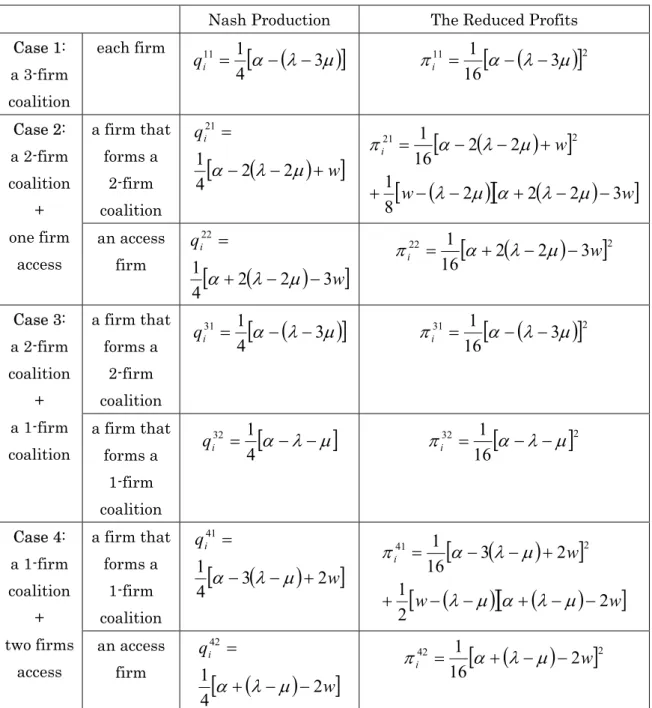
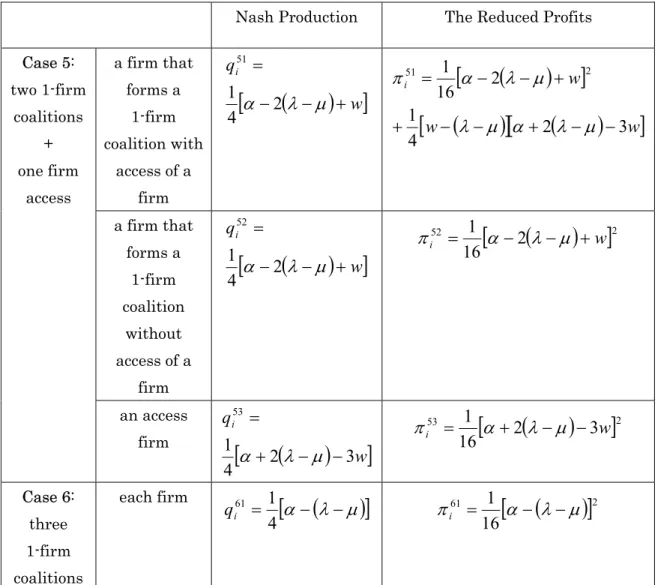
We can use a backward induction argument to derive the equilibrium. Consider the third stage in the game. Given the coalition structure with access determined in the second stage, we find the Nash equilibrium in the production stage. Since we consider a triopolistic market, Nash production and the associated reduced profits are easily derived. Firm i’s Nash production of a triopoly with a linear cost and a linear demand is generally represented by qi = (1/4)
h α− 3ci+ X j6=icj i . Sub-stituting the relevant production costs of firms in a coalition structure with access determined in the second stage, we obtain the Nash production in a given coali-tion structure with access. Table 1 shows the Nash produccoali-tion and the associated reduced profit for each coalition structure with or without accesses (i = 1, 2, 3).
[Insert Table 1 around here.]
6Note that the ordering of the firms is exogenously determined in this game. See Okada (1996) for an analysis of random proposers.
7For analytical tractability, we assume that if two one-firm coalitions already exist when Firm 3 decides to access one of them, it accesses the one that was formed first (i.e., Firm 1 ’s one-firm coalition).
Note that π11
i is identical to π31i . This is because the marginal effect of cost re-duction generated by a grand coalition (i.e., the benefit of forming a grand coalition) cancels out the marginal effect of fierce competition in the production stage (i.e., the cost of forming a grand coalition) in our model.
3.2
Coalition formation or access
Next, consider a coalition formation game in the second stage. We need to examine a firm’s decision about whether to form a coalition to build a network or to access an incumbent’s network, given an access charge determined by the regulator in the first stage. In our model, the choice of access complicates the problem. However, the following lemma is useful for deriving the equilibrium coalition formation when a firm has the choice of access.
Lemma 1Consider the last firm (i.e., Firm 3), which has only two alternatives, i.e., a one-firm coalition and access to an incumbent network. The firm chooses access (a one-firm coalition) if w ≤ (>) λ − µ, irrespective of the size of an incumbent network.
Proof. We need to consider all cases in which Firm 3 needs to make a decision. Suppose a two-firm coalition is already formed. If Firm 3 chooses access, its profit is:
π223 = 1
16[α + 2 (λ− 2µ) − 3w] 2
,
whereas if it forms a one-firm coalition, its profit is:
π323 = 1
16[α− λ − µ] 2
.
It is apparent that π22
3 ≥ (<) π323 if and only if w ≤ (>) λ−µ. When two one-firm coalitions already exist, Firm 3’s decision is determined by comparing π533 and π613 .
Similarly, when Firm 1 forms a one-firm coalition and Firm 2 accesses it, π42 3 and π52
3 should be compared. In all the cases, we ensure that Firm 3 prefers access to a one-firm coalition if and only if w ≤ (>) λ − µ.
The result of the lemma is intuitively appealing: if the level of access charge is smaller than the marginal cost achieved by a one-firm coalition, a firm that is allowed to form a one-firm coalition always prefers access. As shown below, this result is useful in our sequential coalition formation game.
Using lemma 1, we derive the equilibrium coalition formation structure according to the level of access charge. We report this result as a proposition.
Proposition 1 When a regulator announces an access charge w ∈ [0, w∗], where w∗ is defined by π111 = π211 (w∗), or w ∈ [λ − µ, + ∞), a grand coalition is formed. On the other hand, when w ∈ (w∗, λ− µ), a two-firm coalition with one-firm access holds.
Proof. See Appendix.
[Insert Figure 1]
Figure 1 illustrates the equilibrium strategy of Firm 1 for a given level of access charge w. In the figure, the horizontal axis represents the level of w, and the vertical axis represents Firm 1’s profit associated with a coalition strategy. According to Figure 1, the grand coalition that achieves the least marginal cost (i.e., the most production-efficient cost) can be established, except for w ∈ (w∗, λ− µ). In fact, for w ∈ (w∗, λ− µ), Firm 1 forms a two-firm coalition, and Firm 3 accesses its network. This means that, when the regulator announces an access charge that is a little less than the marginal cost under a one-firm coalition, a firm has insufficient incentive to reduce the marginal cost.
The intuition for Proposition 1 is as follows. Suppose the level of access charge is sufficiently low. In that case, all followers prefer access to an incumbent’s network to a coalition formed by themselves. Then, what size coalition should Firm 1 pro-pose? If it offers a one-firm or a two-firm coalition, it expects a large loss generated by access because of a sufficiently low access charge. Therefore, Firm 1, i.e., the incumbent, has an incentive to form a grand coalition that involves the other two firms, when the access charge is sufficiently low.
On the other hand, suppose the level of the access charge is sufficiently high. All followers then prefer a coalition by themselves. In that case, the result of Proposition 1 in Bloch (1995) applies to our model: there exists a unique equilibrium coalition structure in which the size of the largest coalition is the integer closest to (3n + 1) /4, where n is the number in a market. (In our model, n = 3.)
Suppose then that the level of access charge is in the intermediate range of w∈ (w∗, λ− µ) in Figure 1. Note that the access charge is lower than the marginal cost under a one-firm coalition, whereas it is higher than that under a two-firm coalition. According to lemma 1, Firm 3 prefers access to an incumbent’s network whichever size it would be. Then, the proof of Proposition 1 shows that, when λ− 2µ < w ≤ λ − µ, Firm 2 prefers a two-firm coalition, which includes Firm 3, to access to Firm 1’s network. That is, if Firm 1 proposes a 1-firm coalition, Firm 2 forms a two-firm coalition. However, this proposal is apparently not favorable for Firm 1, because it makes the other two firms more efficient than Firm 1 itself, so that Firm 1 cannot obtain a high profit in the production stage.
Therefore, we only need to consider which is better for Firm 1: forming a grand coalition or forming a two-firm coalition. If Firm 1 proposes a grand coalition, all firms can be efficient, so that the highest equilibrium production associated with the lowest equilibrium price holds in a triopoly (i.e., a fierce competition). On the other hand, if Firm 1 proposes a two-firm coalition, it obtains a positive profit generated
by access (because w > λ − 2µ and Firm 3 accesses its network), whereas the profit generated by its own production decreases.8 Then, in our triopoly model, we can find a critical level of w∗ above which a positive profit generated by access overcomes a decrease in the profit generated by its own production. Therefore, Firm 1 prefers a two-firm coalition to a grand coalition for w ∈ (w∗, λ− µ).9
3.3
Ineffectiveness of access charge
Let us turn to the first stage. What level of access charge should the regulator set in this open-access environment with a deregulated retail market? The coalition formation equilibrium derived in the previous section suggests that all the level of access charge but w ∈ (w∗, λ− µ) achieves the same level of social welfare with a grand coalition. In fact, when the grand coalition is formed, the level of access charge cannot have any impact on the total production. In this sense, the regula-tor may face an intrinsic dilemma between achieving the low production cost and reducing a distortion generated by imperfect competition. This is because it can in-directly control total production in the triopolistic market only through the change in the level of access charge, and the reduction of the marginal cost is achieved by a coalition formation among firms. Indeed, it can be shown that the grand coalition equilibrium does not always achieve the social optimum. We will discuss this point in the next section.
Before going to the next section, we should note that the social welfare (i.e., consumer welfare plus producer welfare) in the grand coalition equilibrium is still
8This is because, even though the equilibrium profit is higher than that in the case of a grand coalition, its own production decreases.
9Note that, concerning Firm 3’s decision to access Firm 1’s network for w ∈ (w∗, λ − µ), Sappington’s (2004) statement holds in the coalition formation equilibrium in our model: “because of strategic downstream considerations, entrants always undertake efficient make or buy decisions, regardless of the prices at which they are authorized to buy inputs from incumbent suppliers”. In particular, for all w ∈ (w∗, λ − µ), Firm 3, whose marginal cost is λ − µ, has access to the network of Firm 1, whose marginal cost is λ − 2µ. That is, Firm 3 makes an efficient decision from a social point of view.
larger than that in the equilibrium for a two-firm coalition with one firm access. Indeed, the social welfare in the grand coalition equilibrium (Case 1) is:
SW1 = 15
32[α− (λ − 3µ)] 2
, (3)
whereas the social welfare in the “two-firm coalition with one-firm access” equilib-rium (Case 2) is:
SW2 = 1
32[3α− 2 (λ − 2µ) − w] [5α − 6 (λ − 2µ) + w] . (4)
We can easily show that ∆SW12
≡ SW1
− SW2 > 0
for ∀w ∈ [λ − 2µ, λ − µ]. Therefore, the regulator should avoid setting the access charge w such that its level is between w∗ and λ − µ.
4
When to Delegate an Infrastructure Project to
Firms
As mentioned in Section 3.3, the regulator in our model faces an intrinsic dilemma between achieving the low production cost and reducing a distortion generated by imperfect competition.
In order to recognize the dilemma, let us consider as a benchmark the situation in which the regulator can regulate not only the access charge but also the size of coalition formation. In that situation, the regulator has to compare the levels of social welfare in all the possible coalition formation structures with access (i.e., six cases in Table 1) by adjusting the level of access charge. In fact, the social welfare in the “one-firm coalition with two-firm access” equilibrium can be larger than that in the grand coalition equilibrium by lowering the level of access charge, when the
degree of the cost-reducing effect generated by coalition formation is small.10 Let us ensure this claim in the following.
The social welfare in the one-firm coalition with two-firm access equilibrium (Case 4 in Table 1) is given by:
SW4 = 1
32{[α − 3 (λ − µ) + 2w] [7α − 5 (λ − µ) − 2w]
+8 [α + (λ− µ) − 2w] [α − (λ − µ)]} , (5)
whereas the one in the grand coalition equilibrium is represented by SW1 in (3).
[Insert Figures 2-1 and 2-2 around here.]
Figures 2-1 and 2-2 show a comparison of social welfare between SW1 and SW4. In these figures, the dotted line represents SW4, whereas the solid line represents SW1. In Figure 2-1, the vertical axis represents social welfare, while the horizontal axis represents the level of access charge, w. The other parameters are set such that α = 100, λ = 10, and µ = 0.2. As shown in Figure 2-1, when w is below 6.84, the social welfare in the one-firm coalition with two-firm access equilibrium is larger than that in the grand coalition equilibrium. This is because the welfare-enhancing effect of an increase in total production generated by a low access charge is larger than that resulting from a low production cost generated by formation of a coalition. On the other hand, when w is above 6.84, the social welfare in the grand coalition equilibrium is larger than that in the one-firm coalition with two-firm access equilibrium. This result seems to be intuitively understood.
Interestingly, the social-welfare priority between the two equilibria depends not only on the level of access charge but also on the degree of cost-reducing effect generated by coalition formation. In Figure 2-2, the vertical axis represents social
10It is easy to guess that the cases other than cases 1 and 4 cannot achieve the largest social welfare among all the cases. Indeed, a tedious calculation confirms this claim.
welfare, while the horizontal axis represents the parameter of the marginal cost, µ, with α = 100, λ = 10, and w = 0.1. As µ increases, the cost-reducing effect generated by coalition formation increases. When µ is below 0.58, the social welfare in the one-firm coalition with two-firm access equilibrium is larger than that in the grand coalition equilibrium, and vice versa.
This point is easily confirmed by comparing the total production between the two equilibria:11
∆Q41 ≡ Q4− Q1
= ¡q141+ 2q422 ¢− 3qi11 = 1
2[λ− 4µ − w] .
That is, the difference in total production between the two equilibria is a decreasing function of the parameter of the marginal cost. Hence, we can expect that, when the degree of cost-reducing effect generated by coalition formation is small, consumer welfare in the one-firm coalition with two-firm access equilibrium is sufficiently large for the social welfare in the equilibrium to overcome that in the grand coalition equilibrium.
This result is also intuitively appealing. When the cost-reducing effect generated by coalition formation is small, the only effective way to enhance social welfare is a reduction of the level of access charge. However, the incumbent’s (Firm 1’s) incentive for coalition formation does not depend on the absolute magnitude of the cost-reducing effect, but depends on the level of access charge.12 In fact, when the level of access charge is low, the incumbent has an incentive to form a grand
11Needless to say, the comparison of social welfare between SW1 and SW4 is a direct way to confirm the claim. Here, instead, we compare the total production between them in order to explain the claim intuitively.
12Remember that a firm’s incentive for coalition formation also depends on the number of firms, which is constant (i.e., three) here.
coalition, as shown in Proposition 1. This means that the effective way to enhance total production (i.e., a change in the level of access charge) does not work in the equilibrium. Therefore, when the cost-reducing effect generated by coalition formation is small, the social welfare can be increased if the regulator determines not only the level of access charge but also the level of network investments (i.e., the size of coalition).
On the other hand, when the cost-reducing effect generated by a coalition for-mation is large (i.e., when µ is above 0.58 in Figure 2-2), SW1 > SW4. In this case, the welfare-enhancing effect of coalition formation is larger than that of an access charge of w = 0.1. As shown in Figure 1, the incumbent, i.e., Firm 1, is willing to form a grand coalition. This means that the private incentive to invest in a network infrastructure is consistent with the social incentive to do so. Therefore, when the cost-reducing effect generated by coalition formation is large, the delegation of an infrastructure project to firms can achieve the socially optimal allocation in our model.
We summarize this argument as a proposition.
Proposition 2 In an open-access environment with a deregulated retail market, the delegation of an infrastructure project to firms can achieve the socially optimal allocation when the cost-reducing effect generated by a coalition formation is large.
Proposition 2 clarifies the situation in which the delegation of investment in an infrastructure to firms can be justified from a welfare point of view. As stated in the introduction, we have observed (and will observe) some coalitions among firms in the construction of an infrastructure such as gas pipelines in gas industries or local fiber-optic cables in telecommunications. In an open-access environment with a deregulated retail market, who should take the initiative to proceed with infrastructure construction through a coalition of firms depends on the degree of
cost-reducing effect generated by the formation of a coalition. In particular, with a large cost-reducing effect generated by the coalition formation, a regulator can delegate its initiative to firms, especially when the administrative cost of regulation cannot be ignored.
Lastly, we should remember one important caveat about the delegation of an infrastructure project through coalition formation. When delegating the project to firms, the regulator should avoid setting the access charge w such that its level is between w∗ and λ − µ in our model. This result suggests a policy implication for forward-looking rules when firms form a coalition to build a network infrastructure. If the regulator recognizes the marginal cost achieved by a single-firm coalition (i.e., λ−µ in our model) as a historical marginal cost and adopts the forward-looking rule, there is a possibility that she sets w ∈ (w∗, λ− µ). From our analysis, it is shown that this results in a welfare-deteriorating open-access environment, irrespective of a large cost-reducing effect generated by coalition formation. This means that the regulator should beware of setting the access charge according to the forward-looking rule.
5
Concluding Remarks
This paper has provided a simple model that examines a firm’s incentive to invest in a network infrastructure through coalition formation in an open-access environ-ment with a deregulated retail market. We have assumed that coalition formation has a cost-reducing effect on production cost. In that situation, a regulator faces a dilemma between inducing an incentive for efficient investment and reducing the distortion generated by imperfect competition. We then have shown that the in-formation concerning the degree of cost-reducing effect of the investment is crucial from a welfare point of view. In particular, when the infrastructure project through
coalition formation creates a large (small) cost-reducing effect, the regulator can (should not) delegate the project to firms by setting an appropriate level of access charge. We have also discussed a policy implication of the forward-looking rules when firms form a coalition to build a network infrastructure.
Appendix
Proof of Proposition 1
Following Lemma 1, we can divide the original problem into two cases according to the level of access charge. First, consider the case in which w > λ − µ. In this case, Firm 3 chooses a one-firm coalition whenever it has a chance to move. What about the decision of Firm 2? When Firm 2 has a chance to move (i.e., when Firm 1 offers a one-firm coalition), it has three alternatives: a two-firm coalition, a one-firm coalition, and access to Firm 1’s (one-firm) network facility. Lemma 1 can then be applied to Firm 2’s decision: when comparing the two alternatives of a one-firm coalition and access to Firm 1’s network, it prefers a one-firm coalition. It is also easy to ensure that given Firm 3’s decision to form a one-firm coalition, a two-firm coalition is preferred to a one-firm coalition by comparing π312 with π612 . Hence, Firm 2 chooses a two-firm coalition. Then, consider Firm 1’s decision. Expecting Firm 3’s and Firm 2’s decisions, it obtains π11
1 (π311 , π611 , respectively) when choosing a three-firm coalition (a two-three-firm coalition, a one-three-firm coalition, respectively). Comparing the three profits, we ensure that Firm 1 chooses a grand coalition or a two-firm coalition. Therefore, the market structure of a grand coalition, or that of a two-firm coalition with a one-firm coalition, emerges in the case where w > λ − µ.13
Next, examine the case in which w ≤ λ − µ. In this case, Firm 3 prefers access to a one-firm coalition, irrespective of the size of the incumbent coalitions. Consider
Firm 2’s decision. Since Firm 3 accesses Firm 1’s one-firm coalition even when Firm 2 forms a one-firm coalition, Firm 2 prefers access to Firm 1’s network to a one-firm coalition by applying Lemma 1. Then, Firm 2’s profit when choosing access to Firm 1’s network is: π422 = 1 16[α + (λ− µ) − 2w] 2 ,
while the profit when choosing a two-firm coalition is:
π312 = 1
16[α− λ + 3µ] 2
.
Comparing π422 with π312 gives the following result.
π422 > <π 31 2 ⇐⇒ w < >λ− 2µ
That is, when λ − 2µ < w ≤ λ − µ, Firm 2 forms a two-firm coalition. On the other hand, when λ −2µ ≥ w, Firm 2 accesses Firm 1’s network.
Lastly, consider Firm 1’s decision when w ≤ λ − µ. When choosing a three-firm coalition, it obtains a profit of π11
1 . When choosing a two-firm coalition, its profit is π21
1 , since Firm 3 chooses access. When choosing a one-firm coalition, its profit depends on Firm 2’s decision, which, in turn, depends on the level of w. When λ− 2µ < w ≤ λ − µ, Firm 1’s profit is π32
1 , since Firm 2 forms a two-firm coalition. On the other hand, when λ −2µ ≥ w, Firm 1’s profit is π41
1 , since Firm 2 and Firm 3 access its network facility. Accordingly, we need to examine the equilibrium for the two cases according to the level of access charge.
Consider the case where λ−2µ < w ≤ λ−µ. It is apparent that π11
1 is larger than π32
1 . Next, let us compare π111 and π211 . Note that π211 is an increasing function of w as long as 2α − [5w − 3 (λ − 2µ)] > 0, which is naturally assumed. As w → λ − 2µ, π21
1 → 1
16[α− λ + 2µ] 2
, which is less than π11
π21 1 →
1
16[α− λ + 3µ] 2
+ 18µ [α− λ − µ], which is larger than π11
1 . Hence, there exists a unique w∗ such that π11
1 is equal to π211 .
Next, consider where λ −2µ ≥ w. In this case, we need to compare π11 1 , π211 , and π411 . Since π211 is an increasing function of w and as w → λ − 2µ, π211 →
1
16[α− λ + 2µ] 2
(< π111 ), π211 is not chosen by Firm 1. At w = λ − 2µ, π411 = 1
16[α− λ − µ] 2
− 12µ [α− λ + 3µ], which is less than π 11
1 , as long as α −(λ−2µ) > 0, which is naturally assumed. Note that:
∂π411 ∂w = 1 4[α− 3 (λ − µ) + 2w] + 1 2[α + 3 (λ− µ) − 4w] . (6)
The sign of (6) can be assumed to be positive. Hence, we can conclude that Firm 1 chooses a three-firm coalition in the case where λ −2µ ≥ w. ¥
References
[1] Besanko, D., D. Dranove, M. Shanley and S. Schaefer (2004), Economics of Strategy, 3rd edition, Hoboken, NJ: John Wiley & Sons, Inc.
[2] Bloch, F. (1995), “Endogenous Structures of Association in Oligopolies”, Rand Journal of Economics, 26, 537—556.
[3] Bloch, F. (1996), “Sequential Formation of Coalitions in Games with External-ities and Fixed Payoff Division”, Games and Economic Behavior, 14, 90—123. [4] Brown, M. and S. H. Chiang (2003), Coalitions in Oligopolies: An Introduction
to the Sequential Procedure, Amsterdam: Elsevier B.V.
[5] de Bijl, P. and M. Peitz (2002), Regulation and Entry into Telecommunications Markets, Cambridge: Cambridge University Press.
[6] Demange, G. and M. Wodders (eds.) (2005), Group Formation in Economics: Networks, Clubs, and Coalitions, Cambridge: Cambridge University Press.
[7] InfoCom Research, Inc. (2004), The Handbook of Information and Communi-cation, Tokyo: InfoCom Research Inc.
[8] Laffont, J. J. and J. Tirole (2000), Competitions in Telecommunications, Cam-bridge, MA: MIT Press.
[9] Noam, E. M. (2002), “Interconnection Practices” in M. Cave, S. Majumdar and I. Vogelsang (eds.), Handbook of Telecommunications Economics, Amsterdam: North-Holland.
[10] Okada, A. (1996), “A Noncooperative Coalitional Bargaining Game with Ran-dom Proposers”, Games and Economic Behavior, 16, 97—108.
[11] Sappington, D. E. M. (2004), “On the Irrelevance of Input Prices for Make or Buy Decisions”, Working Paper, University of Florida, http://bear.cba.ufl.edu/sappington/PDF/Input%20Prices%20AER%2010-23-04.pdf.
[12] Sidak, G. and D. Spulber (1997). Deregulatory Takings and the Regulatory Contract, Cambridge: Cambridge University Press.
Nash Production The Reduced Profits Case 1: a 3-firm coalition each firm
[
(
)
]
µ λ α 3 4 1 11= − − i q 11[
(
3)
]
2 16 1 α λ µ πi = − − a firm that forms a 2-firm coalition(
)
[
w]
qi + − − = µ λ α 2 2 4 1 21(
)
[
]
(
)
[
w]
[
(
)
w]
w i 3 2 2 2 8 1 2 2 16 1 2 21 − − + − − + + − − = µ λ α µ λ µ λ α π Case 2: a 2-firm coalition + one firm access an access firm(
)
[
w]
qi 3 2 2 4 1 22 − − + = µ λ α(
)
[
]
2 22 2 2 3 16 1 w i = α + λ− µ − π a firm that forms a 2-firm coalition(
)
[
α λ 3µ]
4 1 31 = − − i q 31[
(
3)
]
2 16 1 α λ µ πi = − − Case 3: a 2-firm coalition + a 1-firm coalition a firm that forms a 1-firm coalition[
α −λ−µ]
= 4 1 32 i q 32[
]
2 16 1 α λ µ πi = − − a firm that forms a 1-firm coalition(
)
[
w]
qi 2 3 4 1 41 + − − = µ λ α(
)
[
]
(
)
[
w]
[
(
)
w]
w i 2 2 1 2 3 16 1 2 41 − − + − − + + − − = µ λ α µ λ µ λ α π Case 4: a 1-firm coalition + two firms access an access firm(
)
[
w]
qi 2 4 1 42 − − + = µ λ α(
)
[
]
2 42 2 16 1 w i = α + λ−µ − πNash Production The Reduced Profits a firm that forms a 1-firm coalition with access of a firm
(
)
[
w]
qi + − − = µ λ α 2 4 1 51(
)
[
]
(
)
[
w]
[
(
)
w]
w i 3 2 4 1 2 16 1 2 51 − − + − − + + − − = µ λ α µ λ µ λ α π a firm that forms a 1-firm coalition without access of a firm(
)
[
w]
qi + − − = µ λ α 2 4 1 52(
)
[
]
2 52 2 16 1 w i = α − λ−µ + π Case 5: two 1-firm coalitions + one firm access an access firm(
)
[
w]
qi 3 2 4 1 53 − − + = µ λ α(
)
[
]
2 53 2 3 16 1 w i = α + λ−µ − π Case 6: three 1-firm coalitions each firm[
(
)
]
µ λ α − − = 4 1 61 i q 61[
(
)
]
2 16 1 α λ µ πi = − −Figure 1 The Equilibrium Profit of Firm 1 41 1 π 32 1 π 0
(
31)
1 11 1 π π = µ λ−2 21 1 π µ λ− * w wFigure 2-1 The Effect of Access Charge on Social Welfare (α =100,λ =10, µ =0.2)
Figure 2-2 The Effect of Cost-Reduction on Social Welfare SW 0 1 SW 4 SW 4250 4125 4000 3875 3750 25 . 0 0.5 0.75 1 µ SW 3900 3875 3850 3825 3800 0 2.5 5 7.5 10 w 1 SW 4 SW