Impact on Export Competitiveness of East Asian
Countries : A Study of Japan’s Sewing
Machines Operating in Garment Factories during
the 1990s
journal or
publication title
International review of business
number
17
page range
27-40
year
2017-03
1. Introduction
This paper looks into the history of microelectronics (ME) equipment, focusing on the 1990s, and discusses the case of a Japanese company, namely, JUKI Corporation, which employed ME technology for developing its products. The company offered various sewing equipment that provided both high quality and high-speed sewing techniques.
In the 1970s, ME technology—a synthesis of electronic automation technology and measurement instruments—achieved significant progress. Technology advancements encouraged inventions of diversified manufacturing equipment. Many factories that shifted to adopting
of East Asian Countries: A Study of Japan’s Sewing Machines Operating in
Garment Factories during the 1990s
Satoko YASUDA*
Abstract
This paper explored whether technological innovation in microelectronics (ME) equipment, achieved by a Japanese company, contributed to building competitiveness among the East Asian countries (EA6) including China, Thailand, Indonesia, Korea, Hong Kong, and Taiwan. First, the paper highlighted data showing that the EA6 imported a considerable amount of ME equipment from Japan during the 1990s, although the cost of it was substantially high. Next, it hypothesized that Japan’s ME equipment enhanced the export competitiveness of garment factories in the EA6. A detailed investigation regarding the performance of a part of the ME equipment—a computerized high-speed sewing machine (CHSSM)—unveiled that the machine had a skilled-labor substituting effect. Thus, the paper argued that during the 1990s, ME equipment enabled garment factories in the EA6 to overcome their long-suffered problem, namely the shortage of skilled labor. The paper concluded by indicating that during the 1990s, the EA6 successfully turned their disadvantage into an advantage by using Japanese equipment. In the post-ME era, the production system based on the ME technology required many young, unskilled, or moderately skilled workers. Meanwhile, it no longer necessitated skilled workers.
Keywords: Garment industry, Computerized high-speed sewing machines, Skilled-labor substituting effects, International division of labor, JUKI Corporation.
ME manufacturing equipment successfully upgraded their processes for producing goods and services, and consequently increased their production efficiencies. Factories upgraded their production process as the newly introduced ME equipment enabled them to codify important knowledge that had previously remained tacit. Tacit knowledge is defined as “non-codified, disembodied knowhow that is acquired via the informal take-up of learned behavior and procedures (Howells, 1996, p. 92),” and significantly and positively relates to the competitiveness of individual factories or firms. However, it has been difficult to conceive of a method with which new tacit knowledge develops. Also, it has been challenging to transplant tacit knowledge to other plants in foreign countries.
Academic and managerial interest in tacit knowledge happened during the 1980s-1990s, as investigation about the competitiveness of Japanese firms grew. During that period, many scholars found that the “strength of Japanese corporations was seen to reside not so much in research and development (R&D) or the scale and performance of the specific plant and machinery (hard technology), but in the way these operations were managed and configured, and in the skills and flexibility of the workforce (i.e., soft technology) (Howells, 1996, p. 93).”
However, in the era of ME technology, in which computerized machines and low-cost digital tools became available, a significant amount of tacit knowledge and skills were embedded in the newly invented ME machines such as industrial robots and numerical control machine tools. These new machines partly, but increasingly, substituted human dexterity as well as soft technology that had been confined within the skilled workforce in the earlier decades.
Accordingly, the operating systems of the post-ME era required only assembly workers and a couple of shop-floor managers in charge of solving non-critical problems. Young workers, who had received high-school level education just a few years ago, completed these jobs assisted by the ME equipment. In short, innovation in ME technology transformed traditional foundries, in which craftsmen had worked hard with their apprentices, into well-organized production sites where assembly workers who have low or moderate skills perform routine works to achieve daily, weekly and monthly production targets.
The garment industry is among those that made major strides and upgraded production processes with ME equipment. In Japan, garment factories started to employ computer-controlled machines in the late 1970s. Industrial sewing machine companies such as JUKI Corporation (JUKI) developed various types of ME equipment including computerized high-speed sewing machines (CHSSMs) and computer-aided design (CAD) systems. Most Japanese garment manufacturers welcomed the new technology. Some of them invested heavily in ME equipment to take on the challenges caused by both the shortage of skilled workers and the demanding Japanese market. The Japanese market for garments required manufacturers
to respond promptly to increasingly short production cycles on the one hand, and to achieve high product quality on the other hand.
JUKI provided various ME equipment to the Japanese market. Also, the company has been aggressively exporting the equipment to developing or middle-income countries, especially to the six East Asian countries/regions (EA6), i.e., China, Thailand, Indonesia, Korea, Hong Kong, and Taiwan. These countries were aiming to enhance their export competitiveness by developing their garment industry during the 1980s-1990s. However, they did not have skilled workers with tacit knowledge who were indispensable for the production of high-quality garments exported to the vibrant markets in the U.S. and Japan.
This exploratory paper observes the process in which countries such as the EA6 that had previously lacked skilled labor but acquired export competitiveness, and consequently their products flooded the markets of developed countries such as Japan. The explorative investigation discusses that these countries became successful because they turned their disadvantage, i.e., shortage of skilled labor, into an advantage. Furthermore, it shows ME equipment as a key driver of their success.
Initially, this paper shows that the EA6 were powerful importers of ME equipment from Japan. However, from an economic perspective, the import data are puzzling because investment in expensive ME machines does not seem to benefit garment manufacturers in the EA6. A superficial analysis may suggest that they should have had used the low-cost labor that was abundantly available, instead of making such massive investments in capital goods, e.g., ME machines. To find a key to solve the puzzle, the paper conjectures that garment manufacturers in the EA6 recognized the benefits derived from using ME equipment, which overrode the cost disadvantage of the equipment.
A detailed survey of product brochures published by JUKI during the 1990s follows. The survey unveils that JUKI successfully embedded a variety of tacit knowledge, necessary to produce high-quality garments, into their products such as CHSSMs and CAD. In other words, microelectronics-based equipment has replaced skilled workers. To provide a basis for the argument, this paper has checked a correlation between the export competitiveness of the EA6s and the ratio of CHSSMs to all categories of sewing machines.
This paper is organized as follows. Section 2 reviews existing literature with reference to the impact of ME technologies on both the manufacturing sector and the world economic system. Section 3 shows that the EA6 imported considerable amount of CHSSMs from Japan. Section 4 surveys the brochures published by JUKI during the 1990s and discusses both the direct and indirect effects of CHSSMs brought to the factory shop floor. Section 5 assesses the relationship between EA6’s export competitiveness and ME equipment. Section 6 concludes by presenting directions for future research, specifically focusing on the impact of technological innovations on the international division of labor.
2. Literature Review
The existing body of literature indicates that ME technology affected the manufacturing sector in many countries because it contributed substantially toward the development of the “flexible manufacturing system (FMS).” An FMS is a production technology invented in response to the rapidly changing market needs. The system consists of various computer-controlled machines and digital measurement devices. It demonstrates outstanding capabilities in handling varying levels of production. Firms adopting FMS are able to reduce inventory levels, which in turn increases profits.
Hashimoto (1992a, 1992b) affirmed that ME technology contributed to establishing FMS, which enabled manufacturing companies to promptly, and at low costs, respond to market demand and varying consumer needs. He also argued that FMS is more competitive than centrally controlled systems, mainly employed by socialist economies such as the former Union of Soviet Socialist Republic (USSR), in meeting the needs of a demanding market. With the benefits of FMS becoming a prominent feature, centrally controlled systems became obsolete, eventually leading to the demise of the socialist economy. In other words, Hashimoto stated that ME technology reshaped not only all manufacturing activities, but also the world economic system, and consequently economic hegemony.
Many scholars confirmed the impact of ME technology in restructuring modern manufacturing systems, although they did not go as far as commenting on the shifts in economic hegemony. Okubayashi (1987) conducted a questionnaire survey combined with interviews on 167 Japanese companies and confirmed that ME technology facilitated a shift to small-batch production system, which met varying market needs, from a mass production model.
Some scholars believed that only big companies could serve the sizable markets and exploit the full benefits of FMS. In contrast, according to them, small- and medium-sized companies (SMCs) have not benefited from FMS (Munakata 1987). However, this argument needs further investigation since other scholars indicated that the benefit derived from FMS varied according to how skillfully each company utilized it, no matter how large or small. Kodama (1995) cited Jaikumar’s research and indicated that some companies in the U.S., the country in which FMS was initially invented, could not exploit the opportunities from the new system; while many Japanese companies enjoyed significant benefit from it.
Balconi (2002) analyzed the skills the technology replaced, and conceptualized how ME technologies reshaped the division of labor. Further, she suggested that ME technologies lowered manufacturing costs, shortened production cycles, and codified tacit skills that were previously acquired after long periods of training. She also stated that successful codification reduced firms’ transaction costs, increased outsourcing, and escalated vertical disintegration. The pursuit of codification, according to Balconi, finally transformed the status of
international and internal division of labor. Her discussion and this paper share a common perspective because the former states that ME technology reshaped international division of labor, and the latter supposes that ME equipment contributed to building competitiveness among the EA6, important players in the new international division of labor.
Further, some articles published in Japan during the 1980s-1990s had briefly predicted what Balconi conceptualized in her paper published in 2002. These articles projected that ME technology would possibly enable some companies in developing countries to improve productivity and, in consequence, would drive the change in the international division of labor among developed and developing countries.
Ogawa (1983), who studied the influence of ME technologies on the domestic division of labor in Japan, extended his perspective to the concept of international division of labor and conjectured that computer-controlled machines would solve the problem of shortages of skilled labor in the developing countries. Similarly, Fujii (1997) referred to the expensive ME equipment introduced in Chinese subsidiaries of Japanese companies despite cost disadvantages, and inferred that the equipment alleviated the problem of skill-shortages in China.
Shu (1997) conducted a case study to evaluate the impact of ME technology on the international division of labor. He focused essentially on the process of industrialization in Asian countries/region—including Korea, Taiwan, Singapore, Hong Kong, Thailand, Malaysia, Indonesia, and China—and concluded that these countries succeeded and achieved economic catch-up by importing ME machines that could alleviate skilled labor shortages.
Shu’s conclusion was derived based on in-depth case studies, and was very convincing. Yet, it is not free from downsides. Among them, the most serious one is that his research lacked detailed examination of the machines working in factories located in developing countries during the period of his study. Moreover, he did not provide strong evidence of these machines alleviating the problem of labor shortages in the countries he focused.
This paper attempts to establish accuracy of the information to validate the concept developed by Balconi and Shu, as both of them indicated that ME technology could reshape international division of labor.
3. EA6 countries’ ME equipment imports
Lower labor costs constitute a competitive advantage for the developing and middle-income countries. Therefore, most garment companies located in EA6 during the 1990s were supposed to maximize their profit by pursuing labor-intensive manufacturing techniques that employed low-wage workers working with low-tech machines.
Table 1 and 2 demonstrate a completely different inference from the abovementioned conjecture. Table 1 shows that during the period 1987-1994, Japan was the main source for
Table 2. EA6’ CHSSMs Imports
China Thailand Indonesia Korea Hong Kong Taiwan
1989 10.27% 5.88% 17.00% 16.58% 3.24% 11.37% 1990 10.65% 8.79% 11.70% 18.83% 3.44% 12.51% 1991 10.84% 19.57% 12.76% 21.92% 3.49% 10.27% 1992 16.12% 12.19% 23.80% 22.37% 4.32% 6.59% 1993 18.05% 5.50% 60.55% 23.26% 3.46% 7.09% 1994 19.28% 8.97% 28.53% 16.40% 4.24% 7.93% 1995 28.06% 16.90% 36.88% 21.75% 12.48% 6.97% 1996 30.77% 17.71% 33.45% 19.63% 16.07% 18.98% 1997 19.68% 24.34% 30.36% 18.56% 15.60% 14.88% 1998 14.42% 26.01% 26.86% 13.96% 14.84% 19.88% 1999 19.98% 28.30% 20.06% 15.22% 23.30% 平均 18.01% 15.83% 27.45% 18.95% 8.12% 12.70%
Data from the second to the seventh columns were calculated by dividing “value of imports of CHSSM” by “value of imports of all kinds of industrial sewing machines.” All values are reported in JPY terms.
Source: The author, based on Trade Statistics of Japan, Ministry of Finance.
Table 1. EA5 Countries’ Source of Imports (sewing machines only)
Japan USA EU Asia Total
1987 62.39% 2.41% 7.75% 23.58% 96.13% 1988 61.44% 3.29% 6.57% 24.76% 96.06% 1989 44.71% 4.40% 6.16% 40.55% 95.83% 1990 50.74% 3.50% 5.37% 39.64% 99.25% 1991 57.97% 2.15% 4.71% 34.56% 99.39% 1992 57.22% 1.84% 4.73% 35.80% 99.59% 1993 64.05% 2.05% 5.46% 28.01% 99.56% 1994 58.23% 2.40% 6.07% 32.81% 99.52%
Source: The author, based on UN International Trade Statistics. EA5 includes Korea, Hong Kong, Thailand, Indonesia, and China
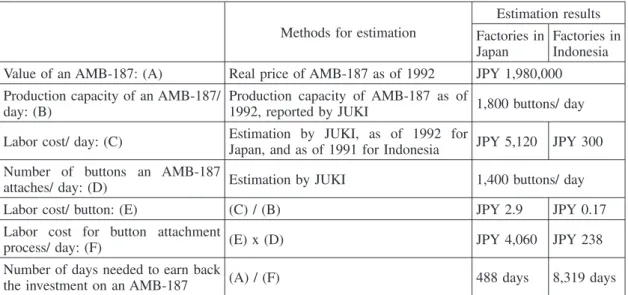
Table 3. Cost estimation when AMB-187 (button-attaching machine) is introduced to factories in Japan and Indonesia
Methods for estimation
Estimation results Factories in
Japan Factories inIndonesia Value of an AMB-187: (A) Real price of AMB-187 as of 1992 JPY 1,980,000
Production capacity of an AMB-187/
day: (B) Production capacity of AMB-187 as of1992, reported by JUKI 1,800 buttons/ day Labor cost/ day: (C) Estimation by JUKI, as of 1992 forJapan, and as of 1991 for Indonesia JPY 5,120 JPY 300 Number of buttons an AMB-187
attaches/ day: (D) Estimation by JUKI 1,400 buttons/ day
Labor cost/ button: (E) (C) / (B) JPY 2.9 JPY 0.17
Labor cost for button attachment
process/ day: (F) (E) x (D) JPY 4,060 JPY 238
Number of days needed to earn back
the investment on an AMB-187 (A) / (F) 488 days 8,319 days
Source: The Author, based on various reports published by JUKI including:
JUKI Magazine, summer 1992, pp. 52-53; JUKI Magazine 183, 1991, pp. 35.
importing sewing machines for the EA51 countries. The EA5 eagerly imported Japanese
machines that were high-tech and expensive. Despite the fact that the EA5’s advantage seemed to be on the abundant and low-cost labor available during that time, these countries preferred the expensive Japanese sewing machines than the less-expensive Asian machines.
Table 2 illustrates that garment producers in the EA6 countries introduced Japanese CHSSMs, as part of their ME equipment imports during the 1990s. Surprisingly, Indonesia, China, and Thailand, countries with lower-middle labor costs at that time, imported as positively as did countries with upper-middle labor costs, namely, Korea, Hong Kong, and Taiwan. Especially, in Indonesia, CHSSMs may have imposed heavy cost burdens on the manufacturers. Table 3 highlights a CHSSM named AMB-187 and estimates the cost of introduction the machine would impose. The table compares the cost of introducing the equipment in a factory in Japan and in Indonesia. From the table it is evident that AMB-187 did not bring cost-effectiveness to garment manufacturers in Indonesia. In fact, in Indonesia it required 8,319 days to earn any return on the investment made in an AMB-187, compared to 488 days in Japan.
The data in tables 1 to 3 imply that garment factories in the EA6 countries introduced Japanese CHSSMs on the expectation that the benefits would override the cost disadvantage of the machines. To analyze the accuracy of information, this paper reviews the product brochures published by JUKI during the 1990s. The following section examines how ME equipment including CHSSMs functioned in the manufacturing systems of garment factories during the 1990s. The examination elucidates the benefits manufactures in the EA6 countries expected to derive from the ME equipment.
4. Direct and Indirect Effects of ME Equipment
This section focuses on one of the most popular ME machines, i.e., the Automatic Pocket Welting (APW) machine. Both Japanese and the EA6 manufacturers had introduced and utilized this machine since the late 1980s.
Automatic Pocket Welting Machine (APW)
Automatic pocket welting (APW) machine is a CHSSM that supports sewing of pockets on suits, jackets, and pants. This machine can sew all kinds of common pockets including double welt and single welt pockets, straight and slanted pockets, with or without flap. The versatility of this machine substitutes the diverse skills required for pocket-welting work, one of the most difficult and time-consuming tasks in garment making. Managers in garment manufacturing appreciated that the APW contributed to a major breakthrough in clothes making (Sen-i Ryutsu Kenkyukai, 1994).
JUKI first developed this machine in 1979 when it launched APW116. However, it was only after 1984 that different types of APW machines were launched in the market. During the early phase of APW’s diffusion, JUKI marketed it as a machine that could enhance both the productivity of garment factories and the quality of their products. The report filed in the 1980s provides evidence that APW was introduced in order to reduce processing time and enhance labor productivity.
Based on an investigation on the functions of the APW that was marketed in 1988 (APW-1988), Table 4 summarizes both the direct and indirect benefits of the machine. Information about direct impact was collected from JUKI’s publicity-released sources, while data regarding indirect effects were collected from Yasuda (2004). As Table 4 implies, direct effects centered on two issues. First, reducing unbillable time wasted for no-money-making works such as refilling thread, deploying machines as well as workers, reading data, and repairing machines. The other issue is about ensuring consistent product quality. It is reasonable to think that JUKI invented APW-1988 with the apparent intention of producing the direct effects. The company aimed to help the majority of Japan’s small-sized garment manufacturers struggling to survive in a tough business environment that prevailed during
the 1980s and 1990s.
Yasuda (2004), who collected information about indirect effects, interviewed supervisors in charge of managing factories in the EA6 countries during the 1990s. She showed that the APW machine substituted human skills—dexterity as well as soft technology necessary for efficient operations—for the production of high-quality garments.
Table 4 also clarifies the conditions under which indirect effects became evident. The table shows that indirect effects contributed greatly toward smooth production, especially at a time when operational environments were less favorable. Therefore, this paper suggests that the APW machine, which is a kind of CHSSN and a part of ME equipment, had the effect of replacing skilled labor. In addition, this paper argues that these direct and indirect effects greatly contributed to enhancing the competitiveness of the EA6 countries that experienced less favorable environments, partly attributable to skilled labor shortages.
Table 4. Functions and direct/indirect effects of APW, a part of ME equipment
Functions, unique to APW series invented from late 1980s to
early 1990s.
Direct effects from functions
Indirect effects that followed direct
effects
Conditions under which indirect effects become more evident Larger-sized hook Increase in productivity
by substantially reducing time for refilling thread.
Improvement in the quality of final products because of reduced frequency of thread refilling; which consequently enables seamless sewing
When the level of sewing skills of the majority of workers is low, the indirect effects become more obvious than when it is high.
Automatically adjusting
sewing length Consistent quality of allproducts, regardless of the individually different size and design of each product.
Increase in percentage of good final products that leads to increase in productivity
Retention of data on various sewing patterns
Higher productivity because of no need for the redeployment of machines or workers.
Increase in the productivity. Improvement in the quality of final products.
Operational panel
with clear display A liquid-crystal panelprovides workers a clear view of all necessary data about the several most frequently performed operations.
When the majority of workers use language(s) different from that of inspectors or managers, and when the difference impedes smooth communication among them, the indirect effects become obvious.
Decreased number of electric/electronic parts
Increase in productivity because of the decrease in electrical problems
Increased efficiently in maintenance
operations. When the electric/electronic partsare not easily available; and when technicians are scarce, the indirect effects become obvious. Source: The author, based on information in JUKI Magazine(s) published in the 1990s; and Yasuda (2004).
Table 5. Feedback from factories that introduced APW machines
Name Yearof release
Effects reported in JUKI Magazines Feedback from factories that introduced APW machines given in the extreme
right column L-saving P-increase Q-consistent S-substitute
APW192 1990
・Significant increase in quantity of products per worker.
・Its new feature, called “automatic setting of sewing positions,” ensured consistent quality of final products. APW193 1991
・Significant increase in quantity of products per worker.
・Quick responses to changes to product specifications became easy. APW169 1994 ・Some tasks that had previously beenconducted only by skilled workers was
automated.
APW296 1995
・With this machine, young and unskilled workers are able to deal with frequent changes both in specifications and materials.
・It significantly substituted sewing skills that had been embedded in skilled workers. The machine enabled “quick response” to frequent changes in the markets of high-quality clothes such as semi-custom garments.
APW194 1997
・This machine ensured consistent quality in all products that vary in design and material.
・A significant number of difficult tasks in a manufacturing process, which had required human dexterity, was automated. ・Increased production efficiency. APW196 1997
・Automated sewing that responds to various specifications and materials. ・Enhanced quality of sewing that results in beautifully finished products. Abbreviations in Table 5:
“L-saving” refers to labor saving effects; “P-increase” refers to productivity increase effects; “Q-consistent” refers to ensuring consistent quality effects; and “S-substitute” refers to high-skilled labor substituting effects. Source: The author, based on various volumes of JUKI Magazine published in the 1990s.
Table 5 summarizes feedback provided by manufacturers who invested in APW machines. Although the feedback is from factories based in both Japan and the EA6 countries, it provides the rationale for the skill-substituting effect of APW and its impact on building competitiveness among the EA6 countries.
5. Expansion of Garment Exports and ME Technology in EA6 Countries
Figure 1 shows certain data regarding garment exports, increase in ME equipment, and labor costs in the EA6 countries. Garment exports from the EA6 countries showed a significant increase during the late 1980s to 1996, although it made a small dent in 1990 and 1991. The figure also exhibits the ratio of ME equipment (ME-ratio), which is calculated by dividing “numbers of ME machine models released by JUKI” by “numbers of all machine models released by JUKI.” Information in the figure—EA6 countries’ exports exhibited by the bar graph and the ME-ratio plotted by the bold line—show a similar shape, if we take a five-year time lag between them. Thus, a simple test was conducted to study
The bar graph indicates EA6 countries’ garment exports to Japan. Data was collected from “White Paper(s) on International Economy and Trade” published by Ministry of Economy, Trade, and Industry, Japan.
The bold line with triangles plots ratio of ME equipment, calculated by “number of ME machine models released by JUKI/numbers of all machine models released by JUKI.”
The thin line with squares plots ratio of average labor cost between EA6 and Japan, calculated by “weighted-average cost of labor in EA6/weighted-average cost in labor in Japan.” The weight of each of EA6 was decided corresponding to the export value of the respective EA6 country.
the relation between the two variables. The results showed a positive and significant relationship when we take either four- or five-year time lags2. The test used limited kinds of
data as in Figure 1; therefore, the result cannot provide empirical basis for the idea proposed in this paper. However, it may be possible to believe that advancements in ME equipment would positively relate to the enhanced export competitiveness of the EA6 countries.
6. Conclusion
This exploratory paper focused on the ME equipment developed during the 1990s, and indicated the likelihood of technological innovation facilitating the building of competitiveness among the less- or moderately-developed countries such as the EA6 during that decade. It hypothesized that Japanese ME equipment provided the solution to overcome the disadvantages of EA6. Thus, it conducted detailed investigations regarding the features and direct as well as indirect effects of computerized machines such as APW.
The results of the investigation provide a reasonable basis to conclude that the idea of this paper is accurate. To increase the validity of the outcomes of the case studies, we conducted a test to see if the increase in the EA6 countries’ exports relates to the progress in ME technology. The results are positively significant if we consider a four- or five-year time lag between exports and ME technology. However, the test used very limited kind of data; therefore, this paper does not assert that this analysis provides empirical evidence.
Nonetheless, the possibility of a positive correlation between EA6 countries’ imports of Japanese ME equipment and their enhanced competitiveness cannot be ruled out. These countries fully exploited the direct and indirect effects of the ME equipment. By importing Japanese ME equipment, the EA6 accessed gains from innovations in production systems that require young, unskilled, or moderately skilled workers. As it no longer necessitated skilled workers, innovation in ME equipment contributed to the EA6 countries’ overcoming their long-suffered problem, namely the shortage of skilled labor.
Reference
Balconi, M. (2002). Tacitness, Codification of Technological Knowledge and the Organisation of Industry. Research Policy, 31(3), pp. 357-379.
Fujii, M. (1997). Nihon Apparel Housei Sangyo no Shintenkai (Developments in Apparel and Sewing Industries in Japan). In Shimada, K., Fujii, M., Kobayashi, H. (eds.). Gendai Asia no Sangyo Hatten to Kokusai Bungyo (Development in Modern Asia and International Division of Labor), pp. 91-128, Kyoto: Minerva.
Howells, J. (1996). Tacit Knowledge, Innovation and Technology Transfer, Technology Analysis & Strategic Management, 8(2). pp. 91-106.
Hashimoto, J. (1992a). “Keizai Hatten Dankairon” to Nihon Keizaishi (“Theory of Economic Stages” and Economic History of Japan). Socio-Economic History, 58(1), pp. 60-90.
Hashimoto, J. (1992b). Daikigyo Paradigm wa Shuen Suruka? (Is the Paradigm of Large Corporations Ending?). SEKAI 568, pp. 232-243.
Jaikumar, R. (1986). Postindustrial Manufacturing, Harvard Business Review, 64(6), pp. 69-76.
Kodama, F. (1995). Emerging Patterns of Innovation: Sources of Japan’s Technological Edge. Massachusetts: HUP.
Munakata, M. (1987). “Mechatronics Gijutsu” to Keiei Seisan no Danryokusei (On the Mechatronics Technology and Flexibility of Industrial Production). Kokumin Keizai Zasshi, 156(1), pp. 73-98. Ogawa, E. (1983). Nihon Kigyo no Seisan System to Originality (Production System of Japanese
Corporations), Business Review, 30(3-4), pp. 102-119.
Okubayashi (1987). ME Gijutsu Kakushin ka no Sagyo Soshiki to Kanri Soshiki (Work Organization and Management Organization under Microelectronics Innovation). Kokumin Keizai Zasshi, 155(2), pp. 73-91.
Sen-i Ryutsu Kenkyukai. (1994). Shin Apparel Kogaku Jiten (New Handbook of Apparel Engineering). Osaka: Sen-i Ryutsu Kenkyukai.
Shu, B. (1997). Microelectronics to Shin Kokusai Bungyo (Microelectronics Revolution and Newly Emerged International Division of Labor). Kyoto: Minerva.
Yasuda, S. (2004). Microelectronics Gijutsu ni yoru Jukuren Daitai Koka: Higashi Asia ni okeru ME Hoseikiki no Jirei (Skill Substituting Effects of Microelectronics Technologies: Case Study of Automated Sewing Machines Operating in East Asian Countries). Asian Economics 45(5). pp. 34-57. URLs http://www.juki.co.jp/industrial_j/download_j/catalog_j/apw895n_896n_j.pdf http://www.juki.co.jp/industrial_e/download_e/catalog_e/apw895n_896n.pdf http://www.schips.com/files/2914/0015/6673/APW-194N_195N_196N.pdf http://www.juki.co.jp/industrial_j/products_j/alldocument.html#products_j/apparel_j/cat90/apw895n896n. html