An Examination of Intercultural Contact Opportunities
at Japanese Universities
OKUMURA Katharine
日本の大学における異文化交流機会について 奥村 キャサリン 神戸女学院大学 文学部 英文学科 准教授 連絡先:奥村キャサリン [email protected] 本研究は、神戸女学院大学研究所研究助成を受けたものである。Abstract
With a view to social changes occurring in Japan, this paper investigates the intercultural contact opportunities being provided to undergraduate university students in Japan, to ascertain how well students are being prepared for a more openly multicultural society. Interviews were conducted with educators from four universities to obtain their views on the current state and challenges in organizing intercultural contact opportunities. Findings showed a strong tendency by universities to focus on study abroad programs and attracting international students, and a lack of integrated activities with local immigrant communities. The paper concludes with recommendations that combine internationalization strategy with community outreach programs, to deliver practical intercultural contact opportunities for students.
Keywords: intercultural contact, internationalization, immigration, multicultural society, international students
要 旨 日本社会が多文化化する中、本研究では日本の大学が学生に対してどのような異文化交流の機会を 提供しているかを検証し、その内容を分析した。四つの大学の教員とのインタビューを行い、それぞ れの大学の異文化交流の取り組みの目的、内容、課題についてデータを集めた。データ分析の結果、 留学プログラムの充実と海外からの留学生の獲得が重視される反面、地域の移民社会との関わりに対 しては関心が低いことがわかった。学生に対してさらなる異文化交流機会を提供するために、地域の 移民社会との積極的な関わりを構築することを提案する。 キーワード:異文化交流、国際化、移民、多文化社会、留学生
1. Introduction
The term ‘internationalization’ (kokusaika in Japanese) has been used in reference to educational policy for at least three decades in Japan (Suematsu, 2018). Universities are facing pressure to address demands coming from two directions: the national government (a major source of funding) and the public (as embodied by current and potential students and their guardians). The former is pushing universities to ‘internationalize’, to attract international students and produce ‘globally competent’ human resources; the latter is demanding that universities equip students with the skills seen as necessary in an increasingly competitive working environment, with a strong focus on English language competency. At the same time, Japanese society is visibly changing. In addition to record numbers of tourists and international students, the expansion of immigration laws in 2019 to import labor to make up for the shrinking population is pushing up numbers of foreign residents. Japan’s society, once typically called ‘homogenous’, is becoming more visibly multicultural.
Universities therefore face a challenging mission to prepare Japanese university students for life in a rapidly changing and increasingly multicultural society. However, in the midst of pressures from government and the public to ‘internationalize’, which are mainly directed towards dealing with the world outside of Japan, to what extent are universities able to implement educational programs that help to prepare future university graduates to live in Japan’s increasingly multicultural society? How can universities equip graduates with the skills needed to adjust to a more culturally diverse living and working environment within Japan? While there are many possible methods to equip students with the skills required to live in a multicultural society, this paper focuses on intercultural contact. This concept is defined here as the provision of opportunities for interaction between people of differing cultural backgrounds. This exploratory study aims to investigate how intercultural contact is currently incorporated into undergraduate programs at Japanese universities.
2. Aims and Research Questions
The university programs targeted in this study were two national and two private universities selected for the Top Global University project on internationalization by the Japanese government (MEXT, n.d.). Rather than providing an exhaustive overview of the state of intercultural education in Japan, I focus here on the way that intercultural contact opportunities are provided to the students of the above universities, as case studies. Through interviews with the educators who are involved in course design and instruction of the intercultural education programs at each respective university, I aim to answer the following research questions:
1. How are top Japanese universities providing undergraduate students with opportunities to interact with people of different cultural backgrounds?
2. What are the challenges for Japanese university educators as they try to incorporate intercultural contact into their courses?
The overarching aim of this research is to ascertain whether or not initiatives are underway at Japanese universities to prepare undergraduate students for living in a more multicultural society. An examination of the nature and viability of intercultural contact opportunities provided is required but cannot be included in the current paper in the interests of space and clarity. As an initial step, in the current research I hope to provide some insight into the intentions and struggles of educators in this field and the feasibility or otherwise of the approaches taken here for other universities.
3. Background of Intercultural Education Initiatives at Japanese Universities 3.1 Japanese higher education policy: English-centric internationalization
The ‘knowledge society’ and ‘knowledge economy’ have long been viewed by Japanese policymakers as the key areas to pursue to lead the Japanese economy out of its stagnant state into recovery (Tsuruta, 2013). The aims of the government were implemented in the form of neoliberal reforms by the Koizumi administration from 2001-2006, part of what is seen as a long-term neoliberal education reform trend (Sugimura, 2016). In the same way as in other parts of the world (Hanushek & Wolffmann, 2007), education is seen as a means to achieve national economic growth objectives. As part of this, internationalization of postsecondary education is primarily defined as the way for Japan to develop human resources that possess the skills seen as necessary to be successful on the global stage (Stigger, Wang, Laurence, & Bordilovskaya, 2018).
The ongoing stream of policy initiatives to internationalize postsecondary education from the 1990s to date is well documented (Tsuruta, 2013). Such reforms shared the common goal of increasing the competitiveness of the Japanese economy through the development of globally-competitive higher education institutions (HEIs) and globally-competent human resources. A recent government initiative for postsecondary education reform is the Top Global University Project (TGUP), implemented in 2014 with a funding period of up to ten years. The aim of this initiative is to enhance the competitiveness of Japanese higher education, focusing on the production of world-class research and the creation of innovation in education. The universities selected for TGUP funding have developed internationalization strategies centered on student mobility and English-delivered programs, a pattern that other HEIs must follow to survive the competition.
In practice, the term ‘internationalization’ has long been used in Japan as a synonym for English education. Study abroad programs typically occupy prize position within a university’s internationalization strategy and have mainly targeted English-speaking nations. South East Asian
nations are becoming popular as destinations due to proximity and cost, but the programs offered are most often in English (for example, Mahidol University, n.d.; University of Malaya, n.d.). In terms of inbound student exchange, programs in English are often viewed as the best way to attract international students, and a higher number of international students not only provides a rich revenue stream, but also contributes to the perception that an HEI is ‘highly internationalized’ (Stigger et al., 2018). The reality for HEIs is that English-language capability is seen as the key to graduate employability — Rakuten, Shiseido and Honda have led the way in establishing English-language environments (Matsui, Onishi, & Hara, 2018), and many companies require applicants to submit their English test scores. Under these circumstances, it is not surprising that the focus of internationalization efforts is often on the measurable and attainable objective of improving English scores.
3.2 Demographic challenges: a misplaced focus?
There are two major demographic changes taking place in Japan directly impacting postsecondary education and Japanese society. The first is the combined trend of an aging, shrinking population. The population of 18-year-olds in Japan last peaked in the 1990s (National Institute of Population and Social Security Research, 2017), and since that time successive administrations have struggled with how to support the country’s labor force and social security system. Through the deregulation measures and increasingly market-based approach to higher education outlined above, the total number of HEIs increased by 26% over the twenty years to 2019, while the number of enrollments only increased by around 8% over the same period, reflecting continuing falls in the working-age population since 1995 (Ministry of Internal Affairs and Communications, N.S.C., 2019; National Institute of Population and Social Security Research, 2017). With enrollments and government subsidies as the major revenue source, universities are typically being driven in two directions: the development of apparently ‘international’ initiatives that will meet the government’s policy criteria and secure funds, and the promotion of English-language courses and English-delivered programs, to attract domestic and international students respectively. The market is fiercely competitive, and straying from the market principles that competitors are adopting is a choice that few HEIs can afford to make.
However, it is important to note that while universities are aligning themselves with government policy to develop ‘globally competent’ citizens, another important demographic trend that seems to be a lesser focus for university management is the increase in the number of foreign residents in Japan. An inevitable corollary of the need to boost the labor force to support the social infrastructure and health system, there is now a heightened interest from the mass media in the contentious immigration debate (The Asahi Shimbun, 2018; Yamawaki, 2019), particularly in light of the relaxation of immigration controls in Japan’s Immigration Control and Refugee Recognition Act in April 2019, the stated aim of which is ‘the acceptance of and coexistence with foreign human resources’ (MOFJ, 2019). The number of foreign residents in Japan exceeded 2.3
million people in 2016 (Statistics Japan, 2018). Universities may have a role to play in offering programs that promote acceptance and understanding of those who are different in society. However, it seems clear that the concept of ‘globally competent’ citizens is defined by the government and universities as citizens who are able to communicate with non-Japanese people
outside of Japan — the question of communication competence with foreign residents within Japan
does not seem to fall within the scope of ‘internationalization’ initiatives in many cases.
3.3 Social issues surrounding race — the challenges of building tolerance
Immigration is by no means a new phenomenon in Japan but its trajectory has been complicated, particularly in relation to its nearest neighbors, China and Korea, with whom it shares a long and troubled history. The word ‘immigration’ has been consciously avoided and rejected by politicians to date, even while a de facto immigration policy exists (Koido & Kamibayashi, 2018). Various reasons have been given for a general antipathy to immigrants, including sensationalist reporting by the media on crime; Japanese nationalist tendencies embodied in nihonjinron theories of Japanese superiority; and exclusionism rooted in the Japanese socio-cultural practice of clearly-defined in-groups and out-groups (Morita, 2014; Tsuneyoshi, 2019; Whitsed & Volet, 2011). The latter custom leads to the tendency to treat foreign residents as ‘temporary visitors’, who are excluded from participation as ‘legitimate’ members of society, through administrative barriers and lack of foreign-language support (Takenoshita, 2016). While there are structural issues that need to be addressed, mindset change amongst the general public towards the ‘temporary visitors’ is a challenge that universities could potentially help to tackle. This is a crucial aspect of Japan’s shift to a more diverse society. This paper proposes that the provision of increased opportunities for interpersonal contact between Japanese students and those of different cultural backgrounds (ideally those from regions with a large immigrant presence in Japan) may be one effective step towards building a positive view of immigrants in Japanese society, and contributing to social cohesion as Japan becomes a more culturally diverse nation.
4. Literature review
4.1 Interaction between international and domestic students in Japan
Kamiya and Nakagawa (2007) examined collaborative activities by Japanese and international students at a Japanese university, aiming to identify the benefits of interaction in terms of conflict resolution and communication strategies. They found students experienced positive effects from their interactions in the areas of self-growth, communication skills and the formation of interpersonal relationships. However, they also indicated certain conditions needed to be met to achieve these benefits, such as common goals in activities, equal status between the two groups, and support from teachers and other stakeholders. Their research indicates the need for intervention by university educators to ensure the content of intercultural contact is sufficient to achieve significant benefits. Other scholars have also emphasized the importance of facilitation for
meaningful intercultural interaction (Bennett, 2009; Jon, 2013), showing that the idea is by no means new, but evidently still an issue.
Morita’s extensive work (2013, 2014, 2017) investigating relations between Japanese and international students at Japanese universities casts a critical eye on the state of affairs, with a particular emphasis on two factors: attitudes of Japanese students towards international elements, and the impact of historical shortcomings in Japan’s English education system. Morita’s surveys (2014) of Japanese university students indicated a lack of interest in participating in the international community and a perception that globalization as a trend was largely irrelevant to them. In addition, Morita problematizes the adherence to an outdated grammar-translation teaching methodology that does little to equip students with useful communication skills in English (Morita, 2014). With English predominantly seen as a way to get into university or secure a job, few students envisioning a future in a multicultural environment, and inadequate opportunities for meaningful contact between Japanese and international students, Morita (2017) is unsurprised that Japanese students lack motivation for such contact.
4.2 Multicultural education in Japan
Knight (2004) counts multicultural education as one of the three key dimensions of the internationalization of educational institutions and national education policy, together with the international and global elements. Specifically, Knight defines the multicultural dimension of internationalization as the area that addresses ‘internationalization at home’. In other words, it encompasses measures that tackle and relate to the existence of diverse cultures in the local community and within the institution itself (Knight, 2004). Whitsed and Volet (2011) argue that it is this dimension that is missing from Japanese internationalization efforts at the postsecondary level. They state that the predominant focus on economic benefits and university rankings has resulted in inadequate attention paid to the intercultural aspects of internationalization of higher education in Japan, including efforts to promote reciprocal intercultural understanding. Pointing to the distinctive in-group/out-group constructs used in the Japanese socio-linguistic context, they also highlight a tendency to exclude non-Japanese people from social activities as a significant issue as Japan heads towards a more diverse society (Whitsed & Volet, 2011). Multicultural education in Japan is also critiqued by other scholars who bemoan the excessive focus on economic rationale (Hammond, 2012) and the tendency to reify foreign cultures and prioritize language studies (Morita, 2017).
Morita (2014) links the nature of intercultural education in Japan with lack of meaningful intercultural contact. She argues that ‘multiculturalism’ in the Japanese context is closer in definition to ‘assimilative social integration’, as the onus to change is on the minority groups, rather than encouraging understanding and acceptance of cultural difference by both the majority and the minority. Morita traces the exclusionism and resulting lack of meaningful interactions between Japanese and foreign residents to four areas: English-language education that does not teach
communication; a media-incited mistrust of foreigners; structural inequality between foreigners and Japanese; and an unwillingness (rooted in nihonjinron theories of Japanese ‘uniqueness’) to move away from the ‘Japanese way’ of doing things. In Morita’s analysis, education for ‘multiculturalism’ is more accurately defined in the Japanese context as the education of minorities to prevent social conflict and maintain the cohesion and integrity of Japanese society (Morita, 2014), an assimilationist tendency that has also been observed in elementary schools (Nukaga, 2003) and as a factor in the economic mobility of immigrants in Japan (Takenaka, Nakamuro, & Ishida, 2016).
In summary, research to date has problematized the nature of Japanese internationalization efforts, a lack of focus on the intercultural dimension, English language education issues, and challenges related to Japanese culture, including exclusionist tendencies. To my knowledge there have been no case studies that provide first-hand accounts of the challenges faced by universities in this field, focusing in particular on the provision of intercultural contact opportunities as a possible solution. This research aims to fill that gap and disseminate information on potentially effective methods for intercultural contact.
5. Research Participants and Methodology 5.1 Participants
The participants in the study were selected based on their known involvement in intercultural education activities, and their position in universities participating in the Japanese government’s Top Global University project, outlined above. They were contacted via email by the researcher to participate in the study and signed consent forms regarding participation.
The interviewees each possess experience and expertise in internationalization and intercultural education, and the potential to provide valuable insights on the themes covered in this paper. All interviewees have extensive study abroad experience and currently work with international students on campus. It must be noted that while the participants all possess relevant expertise and experience in the topic at hand, the comments recorded in this paper reflect the individual perceptions of the participants, and are not intended as an objective representation of the situation of each HEI studied here.
5.2 Data collection
This research aims to understand the experiences of the subjects, investigate contextual elements that influence their actions, and identify new elements relevant to the aims of the project. For these reasons, a qualitative approach was deemed to be appropriate for this study (Maxwell, 2013). Semi-structured interviews conducted in a responsive interviewing style were used to enable in-depth investigation of the topics in question; follow-up questions and prompts were added to obtain detail (Rubin & Rubin, 2012). Following a case study approach, the four universities were selected as potentially exemplary cases of educational initiatives in the field being studied
(Lichtman, 2013). The four participants were interviewed and a class at National University A was observed, the latter arranged ad hoc by the interviewee. Notes were taken during the class and recorded as data. The one-on-one semi-structured interviews were audio recorded and conducted in Japanese on the campus of each of the respective universities. Interview questions and overall structure were designed in advance, but the interviews themselves took the form of dialogue in order to pursue lines of inquiry that appeared during the interview and to ensure understanding of the interviewees’ perspective on key points. The interviews were each around sixty minutes in duration. They were transcribed verbatim by a Japanese transcription service, which I then translated into English. The translations were checked for accuracy by a NAATI1)— accredited
translator. The Japanese and English versions of the transcripts were sent to interviewees who were invited to provide additional comments. The interview protocol is provided upon request.
5.3 Data analysis
To facilitate efficiency of coding and data analysis, the transcribed files were uploaded to the Quirkos coding tool. In keeping with the inductive nature of the study, codes were defined based on concepts, examples and categories discovered in repeated reading of the transcripts and during the coding work. These were then organized into overarching themes. As far as possible, the content of interview transcripts was cross-checked against publicly-available quantitative and qualitative data, to ensure rigor of methods and credibility of results (Patton, 2002). In line with the critical intent of the study, the themes identified in coding work were positioned within Japan’s current social context and an historical analysis of Japanese education policy (Lawless & Chen, 2019). Given the format of the project as a case study of a small number of elite universities, results are not expected to be generalizable. Rather, the objective was to conduct an in-depth investigation with the aim of providing constructive commentary on practices that may be insightful for other universities in Japan and elsewhere.
6. Research findings 6.1 Universities examined
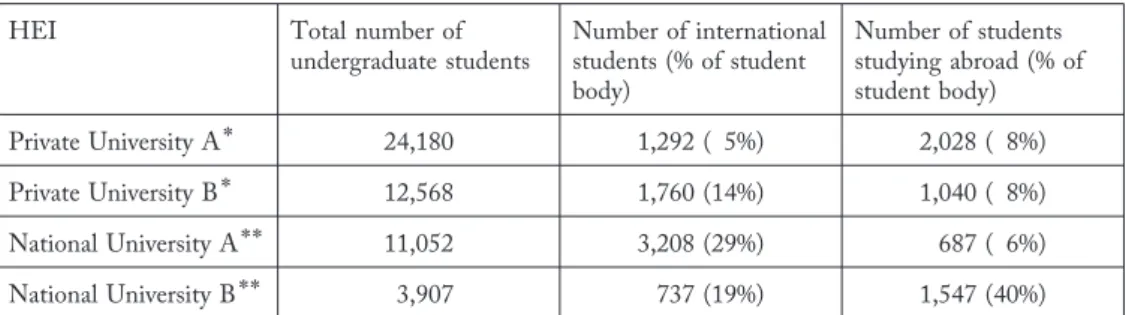
A brief description of the universities examined in this study is provided in Table 1.
6.2 Intercultural contact initiatives
In this section I review findings related to Research Question 1 — how are top Japanese universities providing undergraduate students with opportunities to interact with people of different cultural backgrounds? Through data collection and the interviews conducted for this study, the elements of each university’s initiatives related to intercultural contact opportunities were identified and are described below. Pseudonyms are used for all participants.
6.2.1 Private University A
Private University A is a large, private university located in the Kansai region. The centerpiece of the university’s internationalization strategy is outbound student mobility. Student mobility goals are 2,700 outbound students and the acceptance of 1,500 international students on campus per year (MEXT, n.d.). Current figures in Table 1 show that while progress is being made towards outbound mobility goal, the number of international students on campus is relatively low, considering the large student body.
The focus on outbound mobility and the value of the study abroad experience was evident in the interview conducted with Professor Kamitani, himself an experienced beneficiary of study abroad and positive about its merits. When asked about the best way for students to develop the ‘global skills’ that are seen to be in demand in Japan, Professor Kamitani stated that he sees study abroad as ‘the most direct method’. Reflecting this perspective, the department to which Professor Kamitani belongs has set participation in study abroad as a condition for graduation. Students in the department are required to participate in either short-, medium- or long-term study abroad programs, which range in length from one week, to one semester, up to a year. Scholarships are offered for some programs, but the majority of students are required to pay for their overseas sojourn. The total study abroad figure in 2018 was 2,028, which represents 8% of the student body; if the target of 2,700 is achieved, this will be roughly 11% of the student population, based on the current figures.
In terms of intercultural contact opportunities offered on campus, Private University A offers an English-based degree program, open to a total of fifteen international students per year. The program is comprised of classes and seminars in either the North American Studies or Asian Studies course streams. Professor Kamitani told me that the current number of Japanese students taking the English-based degree program is twelve students, showing that only a very small section of the domestic student body is benefiting from possible intercultural interaction through these particular courses. In all, roughly half of the classes offered in his department are held in English, including a recent increase in the number of seminars offered in English. Open also to
Table 1. Information on universities
HEI Total number of
undergraduate students Number of internationalstudents (% of student body) Number of students studying abroad (% of student body) Private University A* 24,180 1,292 ( 5%) 2,028 ( 8%) Private University B* 12,568 1,760 (14%) 1,040 ( 8%) National University A** 11,052 3,208 (29%) 687 ( 6%) National University B** 3,907 737 (19%) 1,547 (40%) *Current May, 2018.**Current May, 2017.
international students, these classes represent further possible opportunities for Japanese and international students to interact.
Overall, Professor Kamitani states that while the Japanese students enrolled in his department tend to have a high English level, this is not the case in other faculties, and is a factor limiting the number of Japanese students likely to participate in classes delivered in English. In any case, the English-language ability of Japanese students may be irrelevant, given the fact that of the 944 international students on campus in 2019, 51% were from China and 22% were from Korea. While data could not be found on the Japanese language capabilities of international students by nationality, in my personal experience and according to anecdotal evidence from all interviewees in this study, international students from China and Korea traditionally have advanced Japanese language skills and have often come to Japan to study in Japanese. Professor Kamitani also says that the international students who join his seminar tend to be proficient in Japanese. Noting this trend, in 2010 Private University A established Chinese and Korean language studies as alternatives to English as a first foreign language choice for students. This seems to have been misjudged, as he says the overwhelming majority of Japanese students still choose to study English. We may surmise that the general climate in Japan for ‘globalized’ citizens who can compete in the global labor market, combined with the perceived need for high English scores in the domestic labor market, continues to have significant influence over students and their subject choices.
6.2.2 Private University B
Private University B is a mid-sized private university located in Tokyo, and is one of the most highly reputed private universities in Japan. The key elements of their internationalization strategy are to become a ‘pioneer in global education’, promote on-campus diversity, and offer a variety of high-quality programs in English. The promotion of diversity on campus is given as one element to achieve this strategy, alongside enhanced global academic networks, pedagogical initiatives and the promotion of greater mobility amongst teachers, staff and students. In terms of concrete goals, by 2023 Private University B aims to send 2,000 students per year to study abroad and accept 3,000 international students each year to the Tokyo campus (MEXT, n.d.). Contrasting the situation of Private University A above, Private University B currently seems to be making greater progress toward the inbound than the outbound goal, with a relatively high proportion of on-campus students from overseas, as noted in Table 1.
This focus on increasing the number of international students and therefore diversity on campus was reflected in my interview with Professor Manabe, who highlighted initiatives to facilitate interaction between Japanese and international students and create a vibrant, diverse campus. The centerpiece of efforts to internationalize are the extensive courses offered in English. Currently the Faculty of Liberal Arts and the Faculty of Science and Technology offer degree programs delivered entirely in English, and from the autumn semester of 2020 a new program will be launched, an English-based undergraduate program that offers a bachelor’s degree in seven
fields, including journalism, education and economics. Both Japanese and international students are able to enroll in these programs, but data was not available on the ratio of Japanese to international students enrolled.
A key element of Private University B’s strategy is maintaining a high level of quality of programs delivered in English. Professor Manabe explained that the entrance scores set for such courses effectively limit the number of Japanese students who are able to take the classes, but that this is a sacrifice that the university is willing to make to maintain their reputation for high-quality education in English:
If we want to increase the number of students, we know that we could do so by lowering the requirement. But, honestly, it’s not satisfactory to just teach in English. To teach in English but also maintain a high quality level is the point.
Private University B’s focus on maintaining a high level of education in English presents an attractive option for international students looking to obtain their degree in Japan, and indicates potential for extensive interaction with Japanese students who choose to enroll in the English-delivered degree programs. Similar to the situation at Private University A, however, a large proportion of the international students have come to Japan to study in Japanese. As with Private University A, it seems important to recognize that English does not need to be the main medium for intercultural contact, and that there is possibly great potential for the development of interpersonal relationships in Japanese and educational intervention in classes held in Japanese that are open to international students.
On-campus initiatives to encourage interaction between domestic and international students are another key feature of Private University B’s internationalization strategy. Professor Manabe says that the university recognizes not all students can go overseas for financial reasons or because their curriculum does not allow it, and so is proactively promoting an ‘internationalization at home’ strategy that aims to facilitate ‘integration’ between Japanese and foreign students. She says that even with a relatively high ratio of international students on campus, ‘the Japanese students and international students seem to somehow move in separate groups’. For this reason, the university plans various on-campus events and activities, mainly centering around social and cultural activities, and also including events, symposiums, special culturally-specific menus at the cafeteria and special lectures on ‘global’ topics. Professor Manabe mentioned examples such as ‘African week’, ‘Russian week’, a UN careers seminar and various symposiums that aim to encourage joint participation by Japanese and international students. Some small-scale ideas to promote interaction have come from the students themselves. Professor Manabe showed me a bright pink wristband that students can wear as an indication that they would like to be involved in intercultural activities but are too shy to approach people themselves.
6.2.3 National University A
National University A differs from the other HEIs examined in this study in that it belongs to the Type A group of Top Global Universities — those that are renowned as research institutions and ‘have the potential to be ranked among the world’s top 100 universities’ (MEXT, n.d.). TGUP goals that may potentially contribute to the provision of intercultural interaction opportunities for undergraduate students include the increase of Japanese students participating in study abroad programs to 8. 1% of the student population; the adoption of the International Baccalaureate entrance examination; and the increase of the number of international double/joint degree programs (MEXT, n.d.). The university also offers three degree courses in English in science and engineering fields, with rigorous English requirements set. The ratio of international students on campus at National University A is high at 29% (see Table 1).
Given the large international population at National University A, there is understandable emphasis on maximizing opportunities for student interaction. The educational program that was examined in detail for this study is the Intercultural Co-Learning Class, an initiative introduced around thirteen years ago by Professor Ishido, who experienced the lack of contact between international and domestic students during her own study abroad experience in the USA. As part of her PhD studies there she established a mentor system to connect the two groups. She found that there was learning and benefits on both sides, and applied that idea upon her return to Japan. The concept of the Intercultural Co-Learning Class is ‘meaningful interaction’, which Professor Ishido defines as interaction where participants learn from one another. In the classes, international and Japanese students work together in teams, participating in learner-centered activities where the aim is to collaborate to find answers to social or community issues through establishing a project, participating in group discussions and giving presentations. National University A currently offers around seventy such classes on subjects ranging from ‘Establishing a Sustainable Society’ and ‘Cultural Diversity in Japanese Society’ to ‘Global Business Leadership’. Roughly half of the classes are held in English and half in Japanese, catering to the needs of the Japanese-speaking international students as well as those looking for a class in English. The classes are set as an ‘open’ subject, and may be taken by any student in the university. This is a model that has been researched extensively with a focus on instructor intervention, and is gradually being implemented in other HEIs throughout Japan and elsewhere (Arkoudis et al., 2013; Suematsu, 2019).
The need for intervention by teachers is a point that was emphasized by Professor Ishido. According to her, around one-quarter of the university’s annual intake of around 2,500 students take an Intercultural Co-Learning Class each year. The main benefit for students from her perspective are that the Japanese and international students have ample opportunities to learn from one another. She also sees it as a way to connect with the local community. One class, for example, had the Japanese and international students taking field trips to the community to provide advice to a department store on how to make its signage clearer for English-speaking tourists. Rather than simply delivering educational programs in English or having domestic and international
students attend the same classes, the university’s International Co-Learning Classes are designed with the explicit aim of facilitating meaningful contact between students of different cultures. They present a strong case for strategic instructor intervention incorporated into learner-centered classes.
6.2.4 National University B
National University B is a small, national, highly competitive university specializing in foreign language and international studies. The main project objectives for the TGU Project are to double the number of both inbound international students and outbound study abroad students. In particular, Professor Seo spoke about the university’s study abroad initiative, whereby students are encouraged to participate in a three-month study sojourn in their second year, and then a longer study abroad program in their third year. This effort is devised to achieve the university’s TGUP objective of developing ‘multilingual, competent, global human resources’ (MEXT, n.d.).
The TGUP strategy proposed by National University B is overwhelmingly outward-facing and focused on the global. In the same way as the other HEIs examined here, study abroad and expanding the international student body are key elements of its internationalization strategy, particularly as it pertains to the TGU Project and therefore public promotion activities. The number of Japanese students participating in study abroad programs is particularly high for the small student body (see Table 1). Japanese students are also given the opportunity to study in the same classes with international students. I was unfortunately not able to observe joint classes and therefore cannot comment on the nature of in-class interaction opportunities provided. Professor Seo told me that the number of Japanese students taking classes with international students is not monitored.
While there is a strong focus on study abroad and on-campus activities with international students, a closer look at National University B indicates that the university’s point of differentiation from other Japanese HEIs is its awareness of the local; in particular, the university’s work with immigrants in the local community. Using its specialty in foreign languages as a strength, the university seems to have paid greater attention to the increasingly multicultural nature of Japanese society than the other HEIs studied here. One initiative that demonstrates this focus was the establishment by the university of a multicultural education and research center. Established in 2006, the explicit aim of the Center was to address social issues arising from multilingualism and multiculturalism in Japan. Activities included a course to train multilingual students to use their skills to coordinate amongst various parties involved in solving common issues faced by non-Japanese community members, and an introductory course to provide students with a thorough grounding in Japan’s immigration history. According to Professor Seo, there were around three hundred students taking the course each year in the period to 2015, and a similar course is offered at the present time.
This focus on Japanese society is reflected in the type of intercultural contact opportunities that National University B offers to its students. Many intercultural contact activities at the
university are centered on work with the community. Through the multicultural education and research center, for example, students had the opportunity to register as community interpreters to provide language support to public entities; the courses offered included a service learning element where students were involved in service to the local immigrant community; and students were encouraged to participate in volunteer activities, including working with children of non-Japanese ethnicity and collaborating with international students to promote intercultural understanding among community members. Such promising activities were curtailed, however, when government funding for the Center ran out in 2015, and the university management decided not to pursue further funding. Although there is currently a de facto successor of the former Center, according to Professor Seo the cut in funding support means that activities have also been reduced significantly, there is no longer a full-time coordinator employed, and the community interpreting course offered at the time has now been renewed as a legal interpreter course jointly run with another university. The issue of financial support is discussed in the Challenges section below. The lack of support for the continuation of the Center means that the bulk of the intercultural contact opportunities for National University B students are being offered through study abroad programs. Professor Seo indicated that while students are enthusiastic about study abroad, they are noticeably less proactive regarding participation in English-delivered classes or events on campus.
6.3 Challenges
The following section summarizes findings related to Research Question 2 on the challenges for Japanese university educators as they try to incorporate intercultural contact into their courses. Rather than providing individual descriptions of each university studied, here I synthesize the data into two themes that were observed across campuses.
6.3.1 University management support
Perhaps not surprisingly, it was the two national universities examined for this study that cited management support as an issue in providing intercultural contact opportunities, possibly indicating greater pressure to conform to government directives on internationalization. Professor Ishido of National University A spoke about the long process to persuade university decision-makers of the need for joint classes involving both Japanese and international students.
At first the university questioned what I did, they had no idea what I was doing. Because at that time international students were seen as a separate group. I’m sure they thought I was crazy. No matter where I went or what I did, it was opposed.
Professor Ishido’s work to build understanding of the importance of the Intercultural Co-Learning Class spanned years, a period where she continued to present at academic conferences on her method, communicating its value to people inside and outside the university.
The class eventually became one of the university’s most popular classes, won awards, and was supported with funding by the university’s management, to allow its current expansion.
Management support — and subsequently, funding — was also brought up as a major issue by Professor Seo of National University B. As mentioned above, the activities of the multicultural education and research center were enabled by a government grant. This allowed Professor Seo to employ a full-time coordinator and English teacher at the Center, and implement a range of activities linking the student body with the local foreign community.
Even though we developed a great program like this, ultimately, we couldn’t continue it. Maybe we were unlucky, but also we didn’t really have enough understanding or support from the executive levels of the university. We continued to tell them that it was necessary, but in the end the budget stopped from that year.
Professor Seo says that initiatives to prepare students for multiculturalism in Japanese society were no longer a priority of university management at that time. Considering that the timing — 2015 — coincides with the start of the Top Global University Project, it seems possible that university management at the time was feeling pressure from the Ministry of Education to implement the predominantly outwardly-focused internationalization goals of the TGU Project. In any case, Professor Seo is hopeful that a recent change in university management and the government’s relaxation of immigrant restrictions in April 2019 (MOFJ, 2019) will help garner support for a revival of what he views as important and necessary activities of the previous Center.
6.3.2 English communication skills
Offering classes in English is one thing, but persuading Japanese students to take them is another. Most interviewees noted that while their students may have higher-than-average English scores, they are often not proactive about participating in classes delivered in English. Professor Kamitani pointed out that there is a reticence on the part of some students because of the perceived difficulty of studying in English:
Of course, there are students who are not strong in English, and even if they have a high level of English, studying a specialist subject in English is not easy, is it? So, for those reasons there are only a limited number of Japanese students who want to take the classes in English.
Professor Manabe spoke of the ‘courage’ needed by some students to approach an international student and try out their communication skills:
Japan. They have come to Tokyo for the first time, and they’re surprised that there are so many foreigners in Tokyo. And to be honest, they say that they don’t have the courage to act like foreigners.
Professor Ishido said that she typically needs to provide more support to Japanese students participating in English than international students participating in Japanese — she says that the Japanese students are initially overwhelmed by the communicative and participatory nature of the class in English, and find it hard to keep up.
In the class I do in English, the Japanese students get really depressed at the start. They can’t communicate what they want to say, and the project just keeps moving on. And although it’s not the case for all the international students, the students from Western nations in particular just keep moving on quite quickly.
Professor Seo also mentioned that Japanese students lack enthusiasm about studying in English:
When the class is in English, both Japanese and international students can join. That’s the ideal, but unfortunately the Japanese students are not very enthusiastic about taking classes in English, which is a problem.
The important point is that the HEIs examined here are some of the top universities in the country. If English communication is an issue for students at these universities, it may be a more critical barrier at smaller and less prominent universities where students have even less confidence in their English and fewer international students with whom to interact and practice communication. Students’ lack of motivation to interact and participate in intercultural activities has been documented in research reported above (Morita, 2014; Whitsed & Wright, 2013), and seems to be driven by a lack of confidence in foreign language skills. Professor Kamitani stated as such:
Japanese people are not good at foreign languages. They’re not confident. They feel inferior.
If English is seen as the medium through which to communicate with non-Japanese people, then this is a crucial area to address. The English-centric initiatives to produce ‘global’ human resources will only be successful if there is a concomitant effort to boost the English communicative capabilities of Japanese students. Further recommendations are provided below.
7. Discussion
This study investigated the kinds of intercultural contact opportunities provided to Japanese undergraduate students, and the perspectives of faculty members involved in the provision of such opportunities. The data gathered highlighted three important practical aspects of the educational initiatives in this field. These are reviewed below, identified as issues worthy of further attention.
7.1 An overwhelming focus on ‘global’ over ‘local’
As shown above, the four interviewees showed a strong awareness of and concern for how their students will fare in a more multicultural society. However, based on the perceptions of the interviewees, there was limited evidence of this concern in the initiatives implemented by each university. The activities of National University B’s multicultural education and research center were deemed as promising, but their unfortunate curtailment in 2015 seems to signal that university priorities shifted toward more ‘global’ aspects, in line with the TGU Project. In all four cases, there was little connection made between the large number of international students from China and Korea and the fact that the same nationalities represent the largest immigrant groups in Japan. In fact, this affords universities the opportunity to organize programs and initiatives that connect Japanese students to foreign cultures that are actually close to home, tap into communities that exist within Japanese society, and form relationships with international students from these groups, enhancing understanding, acceptance and tolerance. There is potential for the formation of interpersonal intercultural relationships that go beyond stereotypical images of immigrant groups and recognize culture at the individual level. The possibility of alleviating or avoiding potential social conflict is significant. This apparent ‘goldmine’ of intercultural contact opportunities remains untapped, suggesting that it may be difficult to obtain university management support for initiatives that are not directly linked to the government’s goal of outward-facing internationalization. It is only when the government starts to look toward its domestic population and move away from English-centric policies toward the development of intercultural values that universities will begin to do the same.
7.2 International students do not grow on trees
International students are still a rare commodity in Japan. In 2018, they accounted for 7% of all tertiary students in Japan (JASSO, 2019; Ministry of Internal Affairs and Communications N.S.C., 2019), compared with an average of 21% across universities in Australia (Australian Department of Education and Training, 2018), for example. The universities examined in this study are all elite universities and as such have a relatively large body of international students. In contrast, the majority of HEIs in Japan have a significantly smaller number of international students on campus at any one time, and therefore their domestic students are far less likely to have any contact with international students.
Given these circumstances, the dependence on the international student body for on-campus intercultural contact initiatives seen in this study is concerning. The Intercultural Co-Learning Class implemented at National University A, for example, is an exemplary case of quality intercultural interaction opportunities. However, at a small university with a total international student body of under twenty people, the impact of such a class would be significantly limited, purely in terms of the numbers of international students with whom Japanese students could interact. The same may be said for on-campus activities such as those organized at Private University B to encourage international and domestic students to socialize with one another. In sum, at smaller universities, there are just not enough international students to go around.
In addition to forging connections with local immigrant communities, as recommended above, another potential option is online exchange activities. Given the financial struggles of smaller private universities and the continuing attraction of the large universities for international students, such activities may be a more viable way for small universities to provide their Japanese students with intercultural contact experience. As numerous studies have shown, many innovative educational initiatives using online tools are underway overseas (Parrott & Jones, 2018) and in Japan (Kansai University, 2016). This is an area that requires further exploration and research.
7.3 English skills or communication skills?
The overwhelming focus of HEIs and the government on study abroad to English-speaking nations and the provision of programs in English seems to be misplaced. Firstly, as noted above, most Japanese students do not participate in study abroad programs (MEXT, 2015). Secondly, the vast majority (93.2%) of inbound international students come from Asia — mainly China, Korea and Taiwan (JASSO, 2019). According to the participants in this study, these students are often seeking Japanese-language programs, rather than English. Under these circumstances, offering joint classes delivered in English as a means to facilitate interaction between domestic and international students may not be the most effective way to develop intercultural understanding. Rather, offering more regular classes held in Japanese to international students may be the more productive way of creating an environment where Japanese and international students can share learning and interaction opportunities, benefiting from teacher intervention to create positive learning conditions.
Based on the fact that English is not the mother tongue of the vast majority of international students, nor the immigrant community in Japan, it seems that a renewed focus on communication studies and public speaking as practical, useful subjects may attract those students who currently have an ‘allergy’ to English caused by years of study as an academic subject. It may also be a way to guide such students to understand the personal and professional benefits to be gained from interacting with and learning from people different from themselves.
8. Conclusion
This research has reviewed the current state of intercultural contact opportunities provided to undergraduate students at selected universities and explored the intentions of and issues faced by educators involved in organizing such opportunities. There is a need to further assess the effectiveness of the various initiatives offered by the HEIs, to evaluate the significance of continuing and further expanding to other HEIs the activities that have been reported here. Online educational activities are also an area rich with potential that is as yet underdeveloped in the Japanese higher education sector, and future research on innovative online methods of intercultural interaction should be extremely valuable for smaller HEIs with less capacity to attract international students to their campuses.
Domestic circumstances all point to the need for a mindset shift in Japan. The continued focus on internationalization aimed at securing economic prosperity through the development of English-speaking and globally-skilled resources, with a strong emphasis on study abroad, comes at the expense of developing intercultural competence vis-à-vis the growing population of non-English speaking immigrants within Japan’s borders. This deprives university students of the opportunity to connect with people from immigrant communities that they are more likely to encounter after graduation than people from wealthy nations that have small representation in Japan. This research suggests that universities potentially have two crucial roles: to provide intervention in educational programs that involve international and domestic students learning together, and to link domestic university students with members of multicultural communities with whom they are likely to share living and working spaces after graduation. Whether interacting with international students or with local immigrants, the desired outcomes are the same: acceptance of difference, enjoyment of diversity, and a redefinition of multicultural Japan.
REFERENCES
Arkoudis, S., Watty, K., Baik, C., Yu, X., Borland, H., Chang, S., Lang, I., Lang J., Pearce, A. (2013). Finding Common Ground: enhancing interaction between domestic and international students. Teaching
in Higher Education, 18(3), 222-235.
Australian Department of Education and Training. (2018). Onshore higher education international students as a
proportion of all onshore students by university, 2017.
Bennett, M. J. (2009). Defining, measuring, and facilitating intercultural learning: a conceptual introduction to the Intercultural Education double supplement. Intercultural Education, 20, S1-S13.
Hammond, C. (2012). An Analysis of Dilemmas Impeding Internationalization of Japanese Higher Education. Kwansei Gakuin University Social Sciences Review, 17, 7-22.
Retrieved from www.21stcenturyskills.org
Hanushek, E. A., & Wolffmann, L. (2007). Education Quality and Economic Growth. Washington: The World Bank.
JASSO. (2019). Japan Student Services Organization: International Students in Japan 2018.
data18_brief_e.pdf
Jon, J.-U. (2013). Realizing Internationalization at Home in Korean Higher Education: Promoting Domestic Students’ Interaction with International Students and Intercultural Competence. Journal of Studies in
International Education, 17(4), 455-470.
Kamiya, Y., & Nakagawa, K. (2007). Mutual Change along Cross-Cultural Contact among International students and Japanese university students: Interactive Effects through the Collaborative Activities.
Hokkai-Gakuen Research Journal, 134, 1-17.
Retrieved from http://hokuga.hgu.jp/dspace/handle/123456789/1143
Kansai University. (2016). Kansai University Collaborative Online International Learning. Retrieved October 29, 2019, from http://www.kansai-u.ac.jp/Kokusai/coil_2/
Knight, J. (2004). Internationalization Remodeled: Definition, Approaches, and Rationales. Journal of Studies
in International Education, 8(1), 5-31. Retrieved from https://doi.org/10.1177/1028315303260832
Koido, A., & Kamibayashi, C. (2018). Nihon shakai to kokusai imin—Ukeire ronso sanjunengo no genjitsu ni yosete [Japanese Society and International Immigration: Reality of the Acceptance Debate 30 years Later]. Japanese Sociological Review, 68(4), 468-478.
Lawless, B., & Chen, Y.-W. (2019). Developing a Method of Critical Thematic Analysis for Qualitative Communication Inquiry. Howard Journal of Communications, 30(1), 92-106.
Lichtman, M. (2013). Qualitative Research in Education. A User’s Guide. (3rd ed.). SAGE Publications, Inc. Mahidol University. (n.d.). Mahidol University. International Programs. Retrieved October 27, 2019, from
https://op.mahidol.ac.th/ea/en/program_profile-en/
Matsui, M., Onishi, A., & Hara, Y. (2018). Japanese companies try gentler approach to adopting English.
Nikkei Asian Review.
Retrieved from https://asia.nikkei.com/Business/Business-trends/Japanese-companies-try-gentler-approach-to-adopting-English
Maxwell, J. A. (2013). Qualitative Research Design. An Interactive Approach. (3rd ed.). SAGE Publications, Inc.
MEXT. (n.d.). Japan Ministry of Education Top Global University Project. Retrieved from https://tgu.mext.go.jp/en/about/index.html
MEXT. (2015). Ministry of Education, Culture, Sports, Science and Technology. Overseas Study by Japanese
Nationals.
Ministry of Internal Affairs and Communications, N. S. C. (2019). University Statistics.
Retrieved from https://www.e-stat.go.jp/stat-search/files?page=1&layout=datalist&toukei=00400001& tstat=000001011528&cycle=0&tclass1=000001021812
MOFJ. (2019). Ministry of Foreign Affairs of Japan. Specified Skill Worker. Retrieved from https://www.mofa.go.jp/mofaj/ca/fna/ssw/us/index.html
Morita, L. (2013). Japanese University Students’ Attitudes towards Globalisation, Intercultural Contexts and English. World Journal of English Language, 3(4). Retrieved from https://doi.org/10.5430/wjel.v3n4p31 Morita, L. (2014). Factors contributing to low levels of intercultural interaction between Japanese and
international students in Japan. Journal of International Communication, 36.
Morita, L. (2017). Why Japan isn’t more attractive to highly-skilled migrants. Cogent Social Sciences, 3. Retrieved from https://doi.org/10.1080/23311886.2017.1306952
National Institute of Population and Social Security Research. (2017). Population Projections for Japan (2017):
2016 to 2065. Retrieved from http://www.ipss.go.jp/index-e.asp
Nukaga, M. (2003). Japanese Education in an Era of Internationalization: A Case Study of an Emerging Multicultural Coexistence Model. International Journal of Japanese Sociology, 12, 79-94.
Parrott, S., & Jones, S. (2018). Virtual Mobility: Flipping the Global Classroom Through a Blended Learning Opportunity. In Hall T., Gray T., Downey G., & Singh M. (Eds.), The Globalisation of Higher
Education: Developing Internationalised Education Research and Practice. Palgrave Macmillan.
Patton, M. Q. (2002). Qualitative Research and Evaluation Methods. (3rd ed.). Sage Publications, Inc. Rubin, H. J., & Rubin, I. S. (2012). Qualitative Interviewing. The Art of Hearing Data. (3rd ed.). SAGE
Publications, Inc.
Statistics Japan. (2018). Statistical Handbook of Japan 2018.
Retrieved from https://www.stat.go.jp/english/data/handbook/index.html
Stigger, E., Wang, M., Laurence, D., & Bordilovskaya, A. (2018). Internationalization within Higher
Education: Perspectives from Japan. Singapore: Springer.
Suematsu, K. (2018). Internationalization at Home — Enhancing Students’ Intercultural Competence in “Intercultural Collaborative Co-Learning Class.” In The Asian Conference on Education 2018.
Retrieved from www.iafor.org
Suematsu, K. (2019). Reviewing Intercultural Collaborative Learning: What does Literature Indicate? JASSO
Web Magazine Ryugaku Koryu, 95.
Sugimura, M. (2016). Transformation of Higher Education Systems in the Dynamics of Contemporary Globalization: The Case of Japan. In Collins C. S., Lee M. N. N., Hawkins J. N., & Neubauer D. E. (Eds.), The Palgrave Handbook of Asia Pacific Higher Education. Palgrave Macmillan.
Takenaka, A., Nakamuro, M., & Ishida, K. (2016). Negative Assimilation: How Immigrants Experience Economic Mobility in Japan. International Migration Review, 50(2), 506-533.
Retrieved from https://doi.org/10.1111/imre.12129
Takenoshita, H. (2016). Immigration Challenges in Japan: How Has Japanese Society Coped with Immigration. In Healy E., Arunachalam D., & Mizukami T. (Eds.), Creating Social Cohesion in an
Interdependent World: Experiences of Australia and Japan (pp. 95-114). Palgrave Macmillan.
The Asahi Shimbun. (2018). Immigration TV shows criticized as prime-time prejudice. The Asahi Shimbun. Retrieved from http://www.asahi.com/ajw/articles/AJ201811040003.html
Tsuneyoshi, R. (2019). Discussing the “Multicultural” in Japanese Society. In Education in Japan: A
Comprehensive Analysis of Education Reforms and Practices (pp. 177-195). Singapore: Springer.
Tsuruta, Y. (2013). The knowledge society and the internationalization of Japanese higher education. Asia
Pacific Journal of Education, 33(2), 140-155.
Retrieved from https://doi.org/10.1080/02188791.2013.780674
University of Malaya. (n.d.). University of Malaya. Academics. Retrieved October 27, 2019, from https://www.um.edu.my/academics
Whitsed, C., & Volet, S. (2011). Fostering the Intercultural Dimensions of Internationalisation in Higher Education: Metaphors and Challenges in the Japanese Context. Journal of Studies in International
Education, 15(2), 146-170. Retrieved from https://doi.org/10.1177/1028315309357941
Whitsed, C., & Wright, P. (2013). English language learning in the Japanese higher education sector: towards internationalisation. Intercultural Education.
Retrieved from https://doi.org/10.1080/14675986.2013.793033
Yamawaki, K. (2019). Is Japan becoming a country of immigration? The Japan Times.
Retrieved from https://www.japantimes.co.jp/opinion/2019/06/26/commentary/japan-commentary/ japan-becoming-country-immigration/#.XbPwh5P7RD1