Studies on Synthetically Useful Carbon Carbon
Bond Forming Reactions via Photoinduced
Electron Transfer
著者
Ohashi Maki
内容記述
学位授与大学: Osaka Prefecture University(大阪
府立大学), 学位の種類: 博士(工学), 学位記番号:
論工第1247号, 学位授与年月日: 2010-03-31, 指導
教員: 水野一彦.
Studies on Synthetically Useful Carbon–Carbon Bond
Forming Reactions via Photoinduced Electron Transfer
MAKI OHASHI
February 2010
CONTENTS
GENERAL INTRODUCTION 1
CHAPTER 1. Synthesis of α-Monoalkylated Active Methylene Compounds by Use of Photochemical Polar Addition
1.1. Introduction 10
1.2. Results and Discussion 12
1.3. Conclusion 22
1.4. Experimental Section 23
1.5. References and Notes 31
CHAPTER 2. Synthesis of Active Methylene Compound-Incorporated Dimers by Use of Oxidative Photodimerization
2.1. Introduction 35
2.2. Results and Discussion 37
2.3. Conclusion 44
2.4. Experimental Section 45
2.5. References and Notes 49
CHAPTER 3. Synthesis of Tandem α-Monoalkylated Active Methylene Compounds by Use of Photochemical Three-Component Coupling Reaction
3.1. Introduction 51
3.2. Results and Discussion 52
3.3. Conclusion 58
3.4. Experimental Section 59
CHAPTER 4. Spectroscopic and Quantum Chemical Analyses on Enhancement Effect of Magnesium Salts on Photoinduced Electron Transfer Reaction
4.1. Introduction 69
4.2. Results and Discussion 72
4.3. Conclusion 80
4.4. Experimental Section 81
4.5. References and Notes 86
CONCLUSION 89 ACKNOWLEDGMENTS 91
GENERAL INTRODUCTION
“Green and Sustainable Chemistry” and Photochemical Reactions
Green and sustainable chemistry is one of the most urgent research topics in the field of chemistry.1 Development and improvement of the processes, so that which can meet the principles of the green chemistry,1a is crucial for the survival of human beings and all other organisms on the earth.
Photochemical reaction is believed to be one of the most promising organic reactions to reduce the environmental load. It might be able to cleanly convert chemicals using light energy—like photosynthesis in chloroplast2—instead of fossil fuel combustion. In addition, highly distorted molecules such as cubane (eq. 1)3 and prismane (eq. 2)4 can be easily synthesized by the reaction that proceeds via high-energy species like electronically-excited molecules and radical ions.
O 4 steps Br O O Br O O Br Br O O hν 7 steps 95% C6H6 cubane (1) 2 steps N N hν Me3CH prismane (1.8%) (2)
The fact, however, is usually not so elegant as desired. The highly reactive intermediates often cause non-selective reactions and secondary reactions, including degradations, which results in the formation of complex mixture of photoproducts. Many efforts have been made to improve the selectivity to develop synthetically
useful photochemical reactions. Among them, the author has noticed the following three photoinduced electron transfer (PET) reactions: photochemical polar addition (PPA), oxidative photodimerization, and photo-NOCAS (Nucleophile–Olefin Combination, Aromatic Substitution) reaction.
Synthetically Useful Photoinduced Electron Transfer (PET) Reactions (1): Photochemical Polar Addition (PPA) Reaction
Photochemical polar addition (PPA), the addition of nucleophiles into photochemically-generated reactive species, is one of the most fundamental as well as synthetically-useful photoreactions.5
Arnold and his coworker first reported this type of photochemical reaction in 1973, in which methanol adds to 1 in anti-Markovnikov manner selectively to form 2 in the presence of methyl p-cyanobenzoate (MCB) (Scheme 1).6 The reaction is initiated via PET process from 1 to the excited singlet state of MCB (1MCB*), and the resulting 1·+ is trapped by methanol to afford 3·. The stability of the resulting benzylic radical over primary alkyl one is responsible for the anti-Markovnikov selectivity of the methanol addition. Back electron transfer (BET) from MCB·– to the benzylic radical 3· followed by protonation complete the reaction to yield adduct 2.7
Scheme 1. Mechanism of PPA Reaction
1MCB* MCB hν MCB H Ph Ph 1 1 Ph Ph OMe Ph Ph OMe 2 Ph Ph OMe 3 PET BET 3 MeOH CO2Me CN MCB = H
Synthetically Useful Photoinduced Electron Transfer (PET) Reactions (2): Oxidative Photodimerization Reactions
The PPA-type reaction also proceeds with aliphatic alkadiene 4. In this photoreaction, the radical intermediate derived from 4 does not undergo BET pathway, but dimerizes (oxidative photodimerization). This type of photoreaction was first reported by Mizuno and coworkers, in which 4·+ is trapped by methanol and then dimerizes to give 5 (Scheme 2).8
Scheme 2. Mechanism for Oxidative Photodimerization
19-CP* 9-CP hν 9-CP 4 PET dimerization 4 5 (90%) MeO 2 MeO MeOH CN 9-CP = H
Synthetically Useful Photoinduced Electron Transfer (PET) Reactions (3): Photo-NOCAS (Nucleophile–Olefin Combination, Aromatic Substitution) Reaction
In some cases, the electron acceptors such as polycyanobenzenes can be also included in the PPA products, which lead to one-step formation of more complicated compounds. The key step of this photoreaction is the ipso-attack of radical to the radical anion of polycyanobenzenes. It is called “photo-NOCAS (nucleophile–olefin combination, aromatic substitution)” reaction.9
Scheme 3 shows the general mechanism of the photo-NOCAS reaction. Photoexcitation of biphenyl causes tandem single-electron transfer, which results in the formation of radical ion pair, [6·+ ··· p-DCB·–].7 The radical cation 6·+ is trapped by a
nucleophile such as an alcohol or an amine10 and then the resulting radical 7· couples with p-DCB·– to form 8–. The aromaticity of the benzene ring is regenerated by the elimination of cyanide ion11,12 to form the ipso-substituted product 9.
Scheme 3. Mechanism for Photo-NOCAS Reaction
9 (52% when Nu = OMe) Nu Nu NC Nu 6 CN p-DCB 6 p-DCB - CN 1biphenyl* biphenyl hν PET 7 8 SET CN CN CN biphenyl
(NuH = alcohol, amine) NuH
H
Introduction of Carbon-Nucleophiles in the PET Reactions
The carbon–carbon bond forming reactions play key roles in organic syntheses, constructing carbon frameworks, and introducing functional groups to them. However, the introduction of carbanions in the above-mentioned PET reactions has been rarely reported so far.
To the best of our knowledge, cyanide ion was the sole carbon-nucleophile to be used in PPA. As for aromatic alkenes, the addition of cyanide ion into 10 to form 11 was reported by Arnold and his coworkers (eq. 3).13 Mizuno and coworkers also reported the hydrocyanations of phenanthrene (Phen) to yield 9-cyano-9,10- dihydrophenanthrene (dihydro-9-CP) and its rearomatized compound, 9-cyano- phenanthrene (9-CP) (eq. 4).14 Kitamura and coworkers reported similar photoreaction of pyrene (13) in an oil-in-water emulsion system to obtain 1-cyanopyrene (14) in high yield of 83% (eq. 5).15
Ph Ph hν 1-cyanonaphthalene KCN, 18-crown-6 CF3CH2OH, MeCN Ph Ph CN 10 11 (48%) Ph Ph 12 (18%) + (3) hν p-DCB NaCN DMF, H2O CN CN + Phen dihydro-9-CP (49%) 9-CP (6%) (4) hν p-DCB NaCN PhCN, H2O 14 (83%) CN 13 (5)
Recently, the author demonstrated in his master’s thesis that cyanide ion can also be introduced to an aliphatic diene 4 (eq. 6),16 which is the only known case for which carbanion takes part in oxidative photodimerization reaction.
hν 9-CP (33 mol%) KCN, Bu4NClO4 MeCN, H2O 4 15 (23%) NC 2 (6)
As for photo-NOCAS reactions, again, only a few examples of introducing carbon-nucleophiles have been reported: the uses of cyanide ion and active methylene compounds. As for the former, Arnold and his coworker reported the use of diene 4 to give 16 (eq. 7).17 Mizuno and his coworkers employed phenylcyclopropane 17 instead of olefins to obtain 18 (eq. 8).18 The latter is a use of the enol forms of β-dicarbonyl compounds as nucleophiles in the presence of 1,2,4,5-tetracyanobenzene (TCNB), which is reported by Xu and coworkers (eq. 9).19
+ CN CN hν biphenyl KCN 18-crown-6 MeCN CN p-DCB CN 4 16 (80%) (7) + CN CN hν NaCN MeCN, H2O CN p-DCB 17 18 (5%) Ph CN Ph 19 (8%) Ph CN + (8) 21 (78%) Ph 20 hν + + TCNB CN CN NC NC CH2Ac2 MeCN CN NC NC Ph O O CN NC NC Ph 22 (10%) (trans : cis = 1:1) (9)
Overview of the Thesis
In this thesis, the author has tried to employ the anions of various active methylene compounds20 in the above three PET reaction systems to extend the synthetic usefulness of them. The dissertation consists of general introduction, four chapters, and conclusion.
Chapter 1 deals with the development of a novel synthetic method for α-monoalkylation of active methylene compounds using PPA, and its application to the intramolecular reaction to produce cycloalkane derivatives.
Chapter 2 deals with the use of oxidative photodimerization reaction to synthesize active methylene compound-incorporated dimers.
Chapter 3 deals with the development of tandem α-monoalkylation method for active methylene compounds by use of photo-NOCAS type three-component coupling
reaction.
Chapter 4 deals with more mechanistic aspects of PET reaction: the mechanism of the enhancement effects of magnesium salts on PET reaction is discussed through analyses of steady-state and time-resolved absorption spectra, fluorescence spectra and their quenching, and quantum chemical calculations.
References and Notes
1. (a) Anastas, P. T.; Warner, J. C. Green Chemistry: Theory and Practice; Oxford University Press: New York, 1998. (b) Noyori, R. Chem. Commun. 2005, 1807–1811.
2. Asimov, I. Photosynthesis; Basic Books: New York, 1968.
3. (a) Eaton, P. E.; Cole, T. W., Jr. J. Am. Chem. Soc. 1964, 86, 962–964. (b) Eaton, P. E.; Cole, T. W., Jr. J. Am. Chem. Soc. 1964, 86, 3157–3158.
4. Katz, T. J.; Acton, N. J. Am. Chem. Soc. 1973, 95, 2738–2739.
5. Yasuda, M.; Mizuno, K. In Handbook of Photochemistry and Photobiology; Nalwa, H. S. ed.; American Scientific Publishers: Los Angeles, 2003; Vol. 2, Chap. 8.
6. Neunteufel, R. A.; Arnold, D. R. J. Am. Chem. Soc. 1973, 95, 4080–4081.
7. Redox photosensitizer: (a) Pac, C.; Nakasine, A.; Sakurai, H. J. Am. Chem. Soc. 1977,
99, 5806–5808. (b) Majima, T.; Pac, C.; Nakasone, A.; Sakurai, H. J. Am. Chem. Soc. 1981, 103, 4499–4508.
8. Mizuno, K.; Pac, C.; Sakurai, H. J. Am. Chem. Soc. 1974, 96, 2993–2994.
9. (a) Mangion, D.; Arnold, D. R. Acc. Chem. Res. 2002, 35, 297–304. (b) Mangion, D.; Arnold, D. R. In CRC Handbook of Organic Photochemistry and Photobiology
2nd ed.; Horspool, W. M., Lenci, F. eds.; CRC Press: Florida, 2004; Chap. 40. (c)
Mizuno, K.; Otsuji, Y. Top. Curr. Chem. 1994, 169, 301–346. (d) Frolov, A. N.
Russ. J. Org. Chem. 1998, 34, 139–161; Zh. Org. Khim. 1998, 34, 167–189.
10. Yamashita, T.; Itagawa, J.; Sakamoto, D.; Nakagawa, Y.; Matsumoto, J.; Shiragami, T.; Yasuda, M. Tetrahedron 2007, 63, 374—380.
11. For reviews on C–CN bond cleavage using organometallic catalysts, see: (a) Tobisu, M.; Chatani, N. Chem. Soc. Rev. 2008, 37, 300–307. (b) Bonesi, S. M.; Fagnoni, M.; Albini, A. Angew. Chem. Int. Ed. 2008, 47, 10022–10025; Angew. Chem. 2008,
12. Iron complex-catalyzed photochemical C–CN bond cleavage has been reported: (a) Nakazawa, H.; Kamata, K.; Itazaki, M. Chem. Commun. 2005, 4004–4006. (b) Nakazawa, H.; Itazaki, M.; Kamata, K.; Ueda, K. Chem. Asian J. 2007, 2, 882–888. 13. Maroulis, A. J.; Shigemitsu, Y.; Arnold, D. R. J. Am. Chem. Soc. 1978, 100,
535–541.
14. Mizuno, K.; Pac, C.; Sakurai, H. J. Chem. Soc., Chem. Commun. 1975, 553–553. 15. Kitagawa, F.; Murase, M.; Kitamura, N. Chem. Lett. 2001, 30, 786–787.
16. Ohashi, M. Master’s Thesis, 2007, Osaka Prefecture University. 17. McManus, K. A.; Arnold, D. R. Can. J. Chem. 1994, 72, 2291–2304. 18. Mizuno, K.; Ogawa, J.; Otsuji, Y. Chem. Lett. 1981, 741–744.
19. Lu, Z.-F.; Shen, Y.-M.; Yue, J.-J.; Hu, H.-W.; Xu, J.-H. J. Org. Chem. 2008, 73, 8010–8015.
20. Introduction of active methylene compounds into α-positions of amines, ethers, and aryl groups via chemical one-electron oxidation is reported: (a) Li, C.-J. Acc. Chem.
Res. 2009, 42, 335–344. (b) Nishino, H.; Kamachi, H.; Baba, H.; Kurosawa, K. J. Org. Chem. 1992, 57, 3551–3557. (c) Qian, C.-Y.; Hirose, J.-I.; Nishino, H.;
CHAPTER 1. Synthesis of α-Monoalkylated Active Methylene Compounds by Use of Photochemical Polar Addition
1.1. Introduction
Processes that directly transform carbon–hydrogen bonds into carbon–carbon bonds are important synthetic methods.1 However, from an ecological viewpoint,2 most of these reactions are problematic owing to the fact that they rely on the use of noble metal catalysts. Among various substrates explored for these processes, active methylene compounds (1) including enolizable β-dicarbonyl compounds are perhaps the most prominent owing to the relatively high acidities of their methylene groups.3—5 Treatment of these substances with strong bases, such as sodium hydride, results in the formation of the corresponding anions, which undergo C–C bond forming reactions with alkyl halides via nucleophilic substitution (Scheme 1, path a).6–8 The use of β-ketoesters in this fashion comprise well-known synthetic methods to obtain methyl ketones (acetoacetic ester synthesis)4 and carboxylic acids (malonic ester synthesis).5 The alkylation reactions, however, do not always afford the desired products in high yields owing to the intervention of side reactions. For example, over alkylation
Scheme 1. Conventional Monoalkylation Reactions of Active Methylene Compounds
EWG1 EWG2 base EWG1 EWG2 X EWG1 EWG2 R EWG1 EWG2 R EWG1 EWG2 R R (c) oligomers (b) overalkylation H - H+ 1 base - H+ X (c) oligomers (a) intended reaction
R
easily occurs to give undesirable symmetrically disubstituted products (Scheme 1, path
b).6 Also, the anions of active methylene compounds tend to oligomerize (path c).3 Even the highly efficient dimerization of β-dicarbonyl compounds via one-electron oxidation by cerium(IV) ammonium nitrate (CAN) has been reported (eq. 1).9
O O CAN MeOH 5 oC, 1 h O O O O 80% (1)
Methods have been explored to circumvent problems inherent in base-promoted alkylation reactions of β-dicarbonyl compounds that are associated with the severe control of reaction conditions6 and side reactions.10,11
In this chapter, the author describes the first photochemical method for direct alkylation of 1 to produce α-monoalkylated propanedinitrile derivative 3 under mild conditions and in a highly regioselective manner (eq. 2).
hν sensitizer base rt EWG1 EWG2 + R1 R2 R4 R3 EWG1 EWG2 R2 R1 R3R 4 1 2 3 (2)
1.2. Results and Discussion
1.2.1. Photochemical α-Monoalkylation of Active Methylene Compounds
Photoirradiation of an aqueous acetonitrile solution containing propanedinitrile (1a, malononitrile), 1,1-diphenylethene (2a), lithium carbonate and a catalytic amount of 9-cyanophenanthrene (9-CP) leads to selective high yielding (91%) formation of the
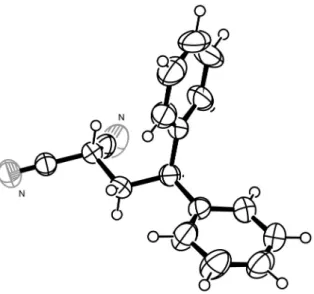
anti-Markovnikov photochemical polar addition (PPA) product, α-monoalkylated propanedinitrile 3aa (Table 1, entry 1).12 Importantly, an α,α-dialkylated product is not generated in this process. The structure of 3aa was determined by the analyses of 1H- and 13C-NMR, MS, HRMS, and IR spectra, and by a single-crystal X-ray crystallographic analysis. An ORTEP diagram for 3aa is shown in Figure 1.
The reaction described above is a novel method for alkylation of 1. It should find utility as a safe and environmentally friendly synthetic method, since it proceeds under mild (ambient temperture and in the presence of weak base) and halogen-free conditions, in contrast to the conventional SN2 alkylation.3–8 Besides, it is also the first example of a process in which a nucleophilic carbon species other than cyanide anion13,14 is used in PPA.12,15
Chart 1. Active Methylene Compounds (1a–1h) NC CN 1a NC CN 1h MeO2C CO2Me 1b Me Ac CO2Et 1c NC CO2Et 1d Ac Ac 1e 1f MeNO2 1g O O O O
Chart 2. Alkenes (2a—2k)
Ph Ph Ph Ph Me Ph Ph Et Ph Ph Me Me An An Ph Ph Me p-t-Bu-C6H4 p-Br-C6H4 p-ClCH2-C6H4 Ph 2a 2b 2c 2d 2e 2f 2g 2h 2i 2j 2k Chart 3. Photosensitizers CN 9-CP 9,10-DCA CN CN Phen CN CN DCB (o, m, p-) CO2-(l)-Ment CO2-(l)-Ment 4 (l)-Ment =
The author has found that the efficiency of this reaction strongly depends on the base used. Specifically, lower yields of 3aa are observed when heavier alkali metal carbonates are used (entries 2–5). In addition, strong bases, such as sodium hydroxide and potassium tert-butoxide, are not effective in promoting the reaction (entries 6 and 7). In the absence of a base, the photoreaction does not take place in aqueous acetonitrile (entry 8) but it does proceed in dry dimethyl sulfoxide (DMSO) in the presence of
Table 1. Photochemical Polar Addition of 1 into 2 hν conditionsa EWG1 EWG2 + R1 R2 R4 R3 EWG1 EWG2 R2 R1 R3R 4
1a-1h 2a-2k 3aa-3hk
entry active methylene
compound alkene sensitizer(s) base product yield b / % 1 1a 2a 9-CP Li2CO3 3aa 91 2 Na2CO3 66 3 K2CO3 68 4 Rb2CO3 23 5 Cs2CO3 15 6 NaOH 13 7c KO-t-Bu trace 8 none 0 9d 31 10 9,10-DCA Li2CO3 27 11 o-DCB, Phen 71 12 m-DCB, Phen 60 13 p-DCB, Phen 44 14 TCNB, Phen 3 15 2b 9-CP Li2CO3 3ab 52 16 2c 3ac 19 17 2d 3ad 0 18 2e 3ae 46 19 2f 3af 40 20 2g 3ag 33 21 2h 3ah 38 22 2i 3ai 0 23 2j 3aj 0 24 2k 3ak 0 25 1b 2a 9-CP Li2CO3 3ba 0 26 Cs2CO3 38 27c KO-t-Bu 100 28c 2b KO-t-Bu 3bb 12 29c 2f 3bf 78 30c 2g 3bg 77 31c 2h 3bh 72 32 1c 2a 9-CP NaOH 3ca 51
Table 1. (Continued)
33 1d 2a 9-CP Na2CO3 3da 63
34 2b 3db 13e
35c 1e 2a 9-CP KO-t-Bu 3ea 0
36c 1f 2a 9-CP KO-t-Bu 3fa complex
37c 1g 2a 9-CP KO-t-Bu 3ga 0
38 1h 2a 9-CP Na2CO3 3ha 22
39 2b 3hb 0
a Conditions: 300-W high-pressure mercury lamp, Pyrex filter, active methylene compound (2.5 mmol), alkene (75 µmol), sensitizer(s) (25 µmol each), base (1.25 mmol), in MeCN (4 mL)–H2O (1 mL), under Ar, rt, 20 h. b Determined by 1H NMR based on the amount of 2 used. c In dry MeCN (5 mL). d In dry DMSO (5 mL) with MS4A (250 mg). e Mixture of diastereomers.
molecular sieves (MS) 4A. The author proposes that DMSO acts as the “base” in this case (entry 8).16 While the use of 9-CP results in the highest yield of 3aa (entry 1), other photosensitizers, including phenanthrene (Phen) which participates as a redox photosensitizer,17 can be used for the reaction (entries 10–14).
The results of studies exploring the scope of alkenes that can be employed in the reaction showed that alkyl substituents on the vinylic positions of 1,1-diphenylethene lead to lower yields of the products 3ab–3ad (entries 15–17). The dimethoxy derivative of 1,1-diphenylethene 2e, styrene (2f), and its alkylated derivatives 2g and 2h also particpate in reactions that form the corresponding photoproducts 3ae–3ah (entries 18–21). On the other hand, reactions utilizing halogen-containing styrene derivatives (e.g., 2i and 2j) afford polymeric mixtures and none of the desired adducts (entries 22 and 23). Finally, alkyne 2k does not react under the conditions employed (entry 24). The photoinduced monoalkylation reaction takes place with a variety of active methylene compounds, but in each case a different base-dependence is observed. For example, 2,2-diphenylethylation of dimethyl malonate (1b) proceeds efficiently in the presence of stronger bases (entries 25–27), as exemplified by the formation of 3ba in
quantitative yield when potassium tert-butoxide is used (entry 27). Other alkenes (2b, 2f–2h) also react with 1b (entries 28–31). Ethyl acetoacetate (1c) and ethyl cyanoacetate (1d), which react in a manner similar to 1a and 1b (entries 32–34), can be applied in mild photochemical β-ketoester (e.g., acetoacetic4 and malonic5 ester) synthetic procedures. However, adducts are not formed in reactions of acetylacetone (1e) and Meldrum’s acid (1f)18 (entries 35 and 36) and the active “methyl” compound nitromethane (1g) does not participate in this process (entry 37). While introduction of the second alkyl group into the active “methine” compound, 2-methylpropanedinitrile (1h) is accomplished in 22% yield by using 2a as the alkene, reaction of 1h with the more highly substituted alkene 2b does not take place (entries 38 and 39).
1.2.2. Enantioselective Formation of α-Monoalkylated Propanedinitrile
The development of photosensitized (catalytic) stereoselective reactions that proceed via electron transfer pathways is a challenging research topic.11c,19–22 A comprehensive study on enantiodifferentiating PPA reactions of alcohols with 1,1-diphenyl-1-alkenes has been carried out by Inoue et al.,20 but knowledge is lacking on the use of carbon nucleophiles in these processes.
Here, the first enantiodifferentiating PPA of carbon nucleophile is shown in Table 2. A slight enantiomeric excess (ee) of 0.7% for the product 3ab is observed in the product 3ab of the PPA reaction of 1a with 2b photosensitized by the di-l-menthyl ester of 1,4-naphtalenedicarboxylic acid 4 (entry 2).20a A small increase of ee and a severe decrease of yield take places when a solvent system with lower polarity is employed (entry 3). This result suggests that lower solvent polarity causes an enhancement in the face selective complexation between the excited chiral photosensitizer 4 and the prochiral alkene 2b.
Table 2. Enantiodifferentiating Photochemical Polar Addition of 1a into 2b
hν conditionsa NC CN + Ph Ph Me NC CN Ph Ph Me 1a 2b 3ab *
entry sensitizer solvents yieldb / % eec / %
1 9-CP MeCN/H2O = 4/1 38 –
2 4 MeCN/H2O = 4/1 25 0.7
3 PhH/MeCN = 3/1 0.8 4.2
a Conditions: 300-W high-pressure mercury lamp, Pyrex filter, 1a (2.5 mmol), 2b (75 µmol), sensitizer (25 µmol), Na2CO3 (1.25 mmol), solvents (5 mL in total), under Ar, rt, 20 h. b Determined by 1H NMR based on the amount of 2b used. c Determined by chiral GC.
1.2.3. Fluorescence Quenching of 9-Cyanophenanthrene (9-CP) by 1,1-Diphenylethene (2a)
Fluorescence of 9-CP in acetonitrile was efficiently quenched by the addition of 2a (Figure 2). No apparent rise of exciplex emission was observed during the addition. A Stern–Volmer plot23 of the quenching at 361 nm showed linear correlation of the reciprocal of relative fluorescence intensity Io/I with the concentration of 2a with a gradient of 9.0 M–1, from which the quenching rate constant (k
q) was determined as 3.8 × 10⁸ M–1 s–1.24 An electrochemical analysis was also performed to demonstrate that the photoinduced electron transfer (PET) from 2a to the excited singlet state of 9-CP (19-CP*) occurs exergonically (∆GPET = –0.29 eV).25 These results indicate that PET occurs from 2a to 19-CP* at the initial stage of the photoreaction.
0 50 100 320 360 400 440 480 wavelength / nm intensity / a.u. [2a] 0.000 M 0.007 M 0.014 M 0.021 M 0.029 M 0.036 M
Figure 2. Fluorescence spectral change of 9-CP (1.04 × 10⁻⁴ M, λex = 311 ± 2.5 nm) in MeCN by the addition of 2a. The inset is a Stern–Volmer plot at 361 nm.
1 1.1 1.2 1.3 0 0.01 0.02 0.03 [2a] / M I0 / I
1.2.4. Plausible Mechanism
In mechanistic investigations, we observed that a deuterium was incorporated into the benzylic position of 3aa with a d-content of 90% when deuterium oxide was used instead of water in the mixed solvent system for reaction of 1a and 2a (eq. 3). This result clearly shows that protonation of the anion intermediate proceeds at its benzylic position. hν 9-CP Li2CO3 MeCN, D2O NC CN + Ph Ph NC CN Ph Ph 1a 2a 3aa-d1 (d-content: 90%) D (3)
Based on this result, we propose that the reaction is promoted by PET from 2 to the excited singlet state of an electron-accepting photosensitizer (1Sens*) (Scheme 2). This affords 2·+, which reacts with the anion of 1 to form benzylic radical intermediates A·. An alternative pathway might involve SET from the anion of 1 to Sens·+, followed by a coupling of the resulting radical with 2 to form A· (Scheme 3). The back electron
transfer (BET) from Sens·– to A· is highly exothermic (e.g., –1.45 eV with (U)B3LYP/6-31G* when the reaction is initiated from 1a, 2a, and 9-CP) and fast, and the resulting anion A– is protonated to give an anti-Markovnikov adduct 3. In the redox-photosensitized process,17 Phen acts as an electron mediator between alkene and an electron-accepting cosensitizer and the resulting radical ion pair reacts in a similar manner as described above.
To elucidate whether PET occurs dominantly from 2 (Scheme 2) or from the anion of 1 (Scheme 3), the concentration of the anion of 1a was estimated as follows. An ICP–AES (Inductively Coupled Plasma–Atomic Emission Spectrometry) analysis was performed to determine the solubility of lithium carbonate in acetonitrile as
Scheme 2. Plausible Mechanism for the Formation of 3 1Sens* Sens hν Sens CN NC H R2 R1 R4 R3 2 2 R2 R1 NC CN R4 R3 R2 R1 NC CN R4 R3 3 R2 R1 NC CN R4 R3 A PET BET A CN NC base 1 Sens
Scheme 3. Alternative Pathway for the Formation of A·
1Sens* Sens hν Sens EWG2 EWG1 R2 R1 R4 R3 2 R2 R1 EWG1 EWG2 R4 R3 A PET EWG2 EWG1 base 1 EWG2 EWG1
1.0 × 10⁻⁵ M. From this value and known pK
a values for the carbonate and 1a,26 the concentration of the anion of 1a was calculated to be around 5.2 × 10⁻⁶ M. Since this concentration is about 2900 times lower than that of 2a (15 mM) and efficient exergonic electron transfer is predicted for both paths,27 we concluded that PET from 2 is the major path, although these pathways are in competition. In fact, the PET reaction occurs even in the absence of 1, producing water adduct 5a (eq. 4); that is, 2a·+ formed by PET is captured by water (or formally hydroxide ion) as a weak nucleophile, and the resulting radical undergoes BET–protonation pathway to give 5a.
hν Ph Ph Ph OH Ph 2a 5a (30%) p-DCB, Phen Na2CO3 MeCN, H2O (4)
The low concentration of the anion of 1 described above is the feature of this photoreaction system. Nucleophilic species usually have lower oxidation potential than that of alkenes. Therefore, their coexistence at similar concentration in the reaction mixture results in exclusive one-electron oxidation of nucleophiles, not alkenes, and the resulting radicals tend to dimerize or give complex product mixtures.3,9 One of the solutions for this problem presented from electroorganic chemists is the separation of active sites, or control of concentration,28 which uses, for example, adsorption of alkenes on anodes, diffusion of the alkene radical cations over a boundary of two liquid phases, or solid-supported nucleophiles to localize the existence of nucleophilic species. Our reaction system employs in situ generation of nucleophilic anion species by use of weak base, which can also be classified as an example of the active-site separation.
1.3. Conclusion
A novel, safe, and environmentally friendly synthetic method for the direct α-monoalkylation of active methylene compounds, using PPA with electron-rich alkenes, has been developed (eq. 5). The enantiodifferentiating addition of propanedinitrile was also accomplished by the use of a chiral photosensitizer, although the enantiomeric excess of the photoproduct was low.
hν sensitizer base rt EWG1 EWG2 + R1 R2 R4 R3 EWG1 EWG2 R2 R1 R3R 4 1 2 3 up to 100% H (5)
This reaction might be synthetically important since it proceeds in safe and environmentally friendly conditions (ambient temperature, in the presence of weak base, and halogen-free). It also represents the first example in which a carbon nucleophile, other than cyanide anion, is used in PPA process.
1.4. Experimental Section 1.4.1. General
Melting points were taken on YANACO MP-500 apparatus and uncorrected. NMR spectra were recorded on Varian Mercury 300 spectrometer (300 and 75 MHz for 1H and 13C, respectively) using tetramethylsilane as an internal standard. MS (EI+) were measured by Shimadzu QP-5050 mass spectrometer with Shimadzu GC-17A gas chromatograph. MS (FAB+) and HRMS (EI+ and FAB+) were measured by JEOL JMS-700 mass spectrometer. IR spectra were obtained from JASCO FT/IR-230 spectrophotometer. Elemental analyses were carried out on YANACO MT-6 or J-SCIENCE LAB JM-10 elemental analyzer. Single crystal X-ray crystallographic analyses were performed on Rigaku RAXIS-RAPID diffractometer. UV–vis absorption spectra were measured by JASCO HMC-358 spectrophotometer. Fluorescence spectra were obtained from JASCO FP-6300 spectrofluorometer. Cyclic voltammograms were recorded on CH Instruments ALS600C analyzer. Chiral gas–liquid chromatographic analyses (chiral GC) were performed on Shimadzu GC-2014 gas chromatograph with SPELCO GAMMA DEX 225 column, and recorded on Shimadzu C-R8A data processor. Preparative HPLCs (GPC) were performed by use of JASCO Megapak GEL 201C column, JASCO PU-986 pump, and Shodex RI-72 detector. Photoreactions were conducted under irradiation of Eikohsha EHB-W-300 high-pressure mercury lamp (300 W) through a Pyrex filter. Quantum chemical calculations were performed on the software Spartan ’0429 (for geometry optimizations) and Gaussian 9830 (for vibrational and TD-DFT calculations) on Microsoft Windows XP Home Edition.
1.4.2. Materials
Acetonitrile was distilled over calcium hydride and then phosphorus(V) oxide before use. Water was deionized by ion-exchange regin. Benzene was distilled over
calcium hydride and then over sodium wire. 9-Cyanophenanthrene (9-CP) and di-l-menthyl naphthalene-1,4-dicarboxylate (4) was synthesized as follows. The other materials were purchased and used without further purification.
9-Cyanophenanthrene (9-CP)
To a 200-mL round-bottomed flask equipped with a Dimroth condenser and a magnetic stirring bar were added 9-bromophenanthrene (5.0 g, 19 mmol), copper(I) cyanide (5.2 g, 58 mmol), and N-methyl-2-pyrrolidone (NMP, 40 mL). The mixture was refluxed under Ar atmosphere with stirring for 15 min by dipping into preheated oil bath (180–200 oC). After cooling, the crude mixture was added a large excess of aqueous ammonia, and extracted with toluene–diethyl ether. The organic extract was dried over anhydrous sodium sulfate and concentrated under reduced pressure, and then a vacuum distillation was performed to remove NMP. Purification of the residue by silica gel column chromatography and following recrystallization afforded 9-CP as white powder (2.5 g, 64%): 1H NMR (300 MHz, CDCl3) δ = 7.60–7.86 (m, 4H), 7.93–7.99 (m, 1H), 8.27–8.36 (m, 2H), 8.69–8.76 (m, 2H) ppm; MS (EI+) m/z = 203 (100, M+), 175 (10), 102 (13), 88 (22), 75 (12); UV (MeCN) λmax (log ε) = 299 (4.10), 311 (4.11), 339 (2.99), 356 (2.95) nm; fluorescence (MeCN, λex = 311 nm) λmax = 362, 378 nm; reduction potential (MeCN, n-Et4N+ClO4–) Ered1/2 = –1.08 V (vs Ag/Ag+) = –1.25 V (vs Fc/Fc+) = –0.87 V (vs SCE).
Di-l-menthyl naphthalene-1,4-dicarboxylate (4)20
The chiral photosensitizer 4 was synthesized from the condensation reaction between naphthalene-1,4-dicarboxylic acid and (–)-l-menthol in refluxed thionyl chloride.
White powder; 1H NMR (300 MHz, CDCl3) δ =0.85 (d, J = 7 Hz, 6H), 0.93 (d, J = 7 Hz, 6H), 0.97 (d, J = 7 Hz, 6H), 1.07–1.27 (m, 4H), 1.50–1.69 (m, 4H), 1.69–1.81 (m, 4H), 2.02 (qqd, J = 7, 7, 2 Hz, 2H), 2.25 (dm, J = 11 Hz, 2H), 5.35 (ddd, J = 11, 11, 4
Hz, 2H), 7.61–7.68 (m, 2H), 8.06 (s, 2H), 8.78–8.86 (m, 2H) ppm; MS (EI+) m/z = 492 (M+, 3), 337 (6), 216 (14), 199 (35), 138 (100, menthene (C10H18)).
1.4.3. Determination of the Solubility of Lithium Carbonate in Acetonitrile
50 mL of saturated solution of lithium carbonate in acetonitrile at 18 oC was evaporated in vacuo, and to the residue was added deionized water to give 5 mL of the aqueous solution. An ICP–AES analysis was performed on the sample solution using 4.94 × 10⁻⁵ and 4.94 × 10⁻⁶ M aqueous solutions of lithium carbonate as external standards (correlation coefficient: 0.9999) to determine the concentration of lithium ion as 1.05 × 10⁻⁴ M, hence the solubility in acetonitrile was elucidated as 5.25 × 10⁻⁶ M. 1.4.4. Photochemical Reactions
Typical Procedure for the Photoreactions (Table 1, entry 1)
To a Pyrex-made glass tube (1 cmφ) was added an acetonitrile (4 mL)–water (1 mL) solution containing 1a (165 mg, 2.5 mmol), 2a (13.5 mg, 75 µmol), 9-CP (5.1 mg, 25 µmol), and lithium carbonate (92.4 mg, 1.25 mmol). Argon gas was bubbled through the solution for 5 min in order to reduce molecular oxygen dissolved in, and then the tube was sealed with a rubber septum. After 20-h irradiation by 300-W high-pressure mercury lamp, the reaction mixture was neutralized by dilute hydrochloric acid and extracted with diethyl ether. The organic extract was concentrated in vacuo giving a crude mixture, for which a 1H-NMR analysis was performed using dibromomethane as an internal standard to determine the yields of 3aa as 91%. Purification by silica gel chromatography (ethyl acetate after toluene) then HPLC (GPC column, chloroform) gave pure 3aa as colorless blocks (mp 92–94 oC).
2-(2,2-Diphenylethyl)propanedinitrile (3aa)31
Colorless blocks, mp 92–94 oC; 1H NMR (CDCl3, 300 MHz) δ = 2.76 (dd, J = 8.1, 8.1 Hz, 2H, -CH2-), 3.44 (t, J = 8.1 Hz, 1H, -CH(CN)2), 4.22 (t, J = 8.1 Hz, 1H, -CHPh2), 7.22–7.43 (m, 10H, aromatic) ppm; 13C NMR (CDCl3, 75 MHz) δ = 21.8,
37.0, 48.4, 112.5 (2C, -CN), 127.7 (4C), 127.8 (2C), 129.4 (4C), 140.7 (2C, ipso) ppm; MS (EI+) m/z = 246 (18, M+), 168 (15), 167 (100, Ph2CH+), 165 (10); HRMS (EI+) calcd for C17H14N2 246.1157, found 246.1165; IR (NaCl) ν = 703, 1451, 1496, 2255 (m, -CN), 2900, 3029 cm–1.
Crystallographic data: monoclinic, P21/c (#14), Z = 4, R = 0.0669, Rw = 0.1569, a = 6.8830(8), b =23.231(3), c = 9.5793(13) Å, β = 112.639(3)o, V = 1413.7(3) Å3, Dcalcd = 1.157 g/cm3.
2-(1-Methyl-2,2-diphenylethyl)propanedinitrile (3ab)
Pale yellow oil; 1H NMR (CDCl3, 300 MHz) δ = 1.30 (d, J = 6.7 Hz, 3H), 2.97–3.04 (m, 1H), 3.64 (d, J = 3.4 Hz, 1H), 3.80 (d, J = 11.8 Hz, 1H), 7.21–7.37 (m, 10H) ppm; 13C NMR (CDCl3, 75 MHz) δ = 16.1, 28.5, 40.4, 56.4, 111.0 (-CN), 113.0 (-CN), 127.5 (2C+1C), 127.8 (2C), 128.1, 129.2 (2C), 129.8 (2C), 140.7, 140.8 ppm; MS (EI+) m/z = 260 (4, M+), 167 (100, Ph2CH+); HRMS (EI+) calcd for C18H16N2 260.1313, found 260.1290; IR (NaCl) ν = 2253 (C≡N) cm–1.
2-(1-Ethyl-2,2-diphenylethyl)propanedinitrile (3ac)
MS (EI+) m/z = 274 (3, M+), 167 (100, Ph2CH+), 165 (18), 152 (12). 2-[2,2-Bis(4-methoxyphenyl)ethyl]propanedinitrile (3ae)
Pale yellow oil; 1H NMR (CDCl3, 300 MHz) δ = 2.67 (dd, J = 8.3, 8.0 Hz, 2H), 3.44 (t, J = 8.0 Hz, 1H), 3.77 (s, 6H), 4.11 (d, J = 8.3 Hz, 1H), 6.86 (AA’XX’, J = 8.8 Hz, 4H), 7.13 (AA’XX’, J = 8.8 Hz, 4H) ppm; 13C NMR (CDCl3, 75 MHz) δ = 21.8, 37.4, 46.9, 55.7 (2C), 112.7 (2C, -CN), 114.8 (4C), 128.6 (4C), 133.2 (2C), 158.9 (2C) ppm; MS (EI+) m/z = 306 (17, M+), 240 (1, M+ – CH2(CN)2), 228 (18), 227 (100, (MeOC6H4)2CH+); HRMS (EI+) calcd for C19H18N2O2 306.1368, found 306.1378; IR (NaCl) ν = 579, 833, 1033, 1179, 1249 (C-O-C), 1509, 1609, 2255 (m, C≡N), 2838, 2905 cm–1.
2-(2-Phenylethyl)propanedinitrile (3af)32
Pale yellow powder, mp 42–43 oC; 1H NMR (CDCl3, 300 MHz) δ = 2.35 (dt, J = 7.3, 7.3 Hz, 2H), 2.94 (t, J = 7.3 Hz, 2H), 3.57 (t, J = 7.3 Hz, 1H), 7.18–7.38 (m, 5H) ppm; 13C NMR (CDCl 3, 75 MHz) δ = 22.1, 32.7, 33.0, 112.6 (2C, -CN), 127.5, 128.6 (2C), 129.3 (2C), 137.4 ppm; MS (EI+) m/z = 170 (36, M+), 91 (100, PhCH2+); IR (NaCl) ν = 2257 (C≡N) cm–1. 2-(2-Phenylpropyl)propanedinitrile (3ag) Colorless oil; 1H NMR (CDCl3, 300 MHz) δ = 1.38 (d, J = 6.9 Hz, 3H), 2.15–2.42 (m, 2H), 3.00–3.05 (m, 1H), 3.20–3.33 (m, 1H), 7.19–7.39 (m, 10H) ppm; 13C NMR (CDCl3, 75 MHz) δ = 21.6, 22.4, 38.0, 39.4, 112.5 (2C, -CN), 127.0 (2C), 127.9, 129.5 (2C), 142.2 ppm; MS (EI+) m/z = 184 (27, M+), 118 (11), 105 (100, Ph(Me)CH+); HRMS (EI+) calcd for C12H12N2 184.1000, found 184.0974; IR (NaCl) ν = 2255 (C≡N) cm–1.
2-{2-[4-(1,1-Dimethylethyl)phenyl]ethyl}propanedinitrile (3ah)
Pale yellow oil; 1H NMR (CDCl3, 300 MHz) δ = 1.36 (s, 9H), 2.34 (dt, J = 7.3, 7.3 Hz, 2H), 2.90 (t, J = 7.3 Hz, 2H), 3.56 (t, J = 7.3 Hz, 1H), 7.12 (AA’XX’, J = 8.5 Hz, 2H), 7.36 (AA’XX’, J = 8.5 Hz, 2H) ppm; 13C NMR (CDCl3, 75 MHz) δ = 22.0, 31.8 (3C), 32.1, 33.0, 35.0, 112.7 (2C, -CN), 126.2 (2C), 128.3 (2C), 134.2, 150.5 ppm; MS (EI+) m/z = 226 (10, M+), 211 (100, M+ – Me ); HRMS (EI+) calcd for C15H18N2 226.1470, found 226.1448; IR (NaCl) ν = 2218 (C≡N) cm–1.
Dimethyl 2-(2,2-diphenylethyl)malonate (3ba)
Pale yellow oil; 1H NMR (CDCl3, 300 MHz) δ = 2.67 (dd, J = 8.1, 7.4 Hz, 2H, -CH2-), 3.28 (t, J = 7.4 Hz, 1H, -CH(CO2Me)2), 3.94 (t, J = 8.1 Hz, 1H, -CHPh2), 7.15–7.31 (m, 10H, aromatic) ppm; 13C NMR (CDCl3, 75 MHz) δ = 34.7, 48.9, 50.2, 52.8 (2C, -CO2Me), 126.5 (2C), 127.8 (4C), 128.6 (4C), 143.0 (2C), 169.5 (2C, C=O) ppm; MS (EI+) m/z = 312 (2, M+), 180 (100), 167 (23, Ph2CH+); IR (NaCl) ν = 1736
(C=O) cm–1.
Dimethyl 2-(2-phenylethyl)malonate (3bf)33
Colorless oil; 1H NMR (300 MHz, CDCl3) δ = 2.23 (td, J = 7.7, 7.5 Hz, 2H, -CH2-), 2.65 (t, J = 7.7 Hz, 2H, -CH2Ph), 3.38 (t, J = 7.5 Hz, 1H, -CH(CO2Me)2), 3.73 (s, 6H, -CO2Me), 7.14–7.23 (m, 3H, aromatic), 7.23–7.32 (m, 2H, aromatic) ppm; 13C NMR (75 MHz, CDCl3) δ = 30.9 (2o), 33.8 (-CHPh2), 51.3 (-CH(CO2Me)2), 53.0 (2C, -CO2Me), 126.4, 128.6 (2C), 128.7 (2C), 140.6 (ipso), 169.8 (2C, C=O) ppm.
Dimethyl 2-(2-phenylpropyl)malonate (3bg)34
Pale yellow oil; 1H NMR (300 MHz, CDCl3) δ = 1.28 (dd, J = 7.0, 0.4 Hz, 3H, -CHMePh), 2.10–2.30 (m, 2H, -CH2-), 2.64–2.78 (m, 1H, -CHMePh), 3.21 (dd, J = 8.9, 6.2 Hz, 1H, -CH(CO2Me)2), 3.63 (s, 3H, -CO2Me), 3.74 (s, 3H, -CO2Me), 7.13—7.23 (m, 3H, aromatic), 7.25—7.33 (m, 2H, aromatic) ppm; 13C NMR (75 MHz, CDCl3) δ = 23.0 (-CHMePh), 37.5 (-CH2-), 38.4 (-CHMePh), 50.5 (-CH(CO2Me)2), 52.8 (2C, -CO2Me), 126.6, 127.2 (2C), 128.7 (2C), 145.3 (ipso), 169.77 (-CO2Me), 169.85 (-CO2Me) ppm; MS (EI+) m/z = 250 (3, M+), 132 (91, CH2(CO2Me)2·+), 118 (100, PhCHMe=CH2·+), 105 (51, PhC+HMe); IR (NaCl) ν = 702, 1154, 1237, 1436, 1739 (C=O), 2956 cm–1.
Ethyl 2-(2,2-diphenylethyl)-3-oxobutyrate (3ca)
Colorless oil; 1H NMR (CDCl3, 300 MHz) δ =1.26 (t, J = 7.1 Hz, 3H, -OCH2Me), 2.15 (s, 3H, -Ac), 2.55–2.71 (m, 2H, -CH2-), 3.36 (dd, J = 7.1, 7.1 Hz, 1H, -CH(Ac)CO2Et), 3.94 (dd, J = 8.1, 8.1 Hz, 1H, -CHPh2), 4.17 (q, J = 7.1 Hz, 2H, -OCH2Me), 7.15–7.38 (m, 10H) ppm; 13C NMR (75 MHz, CDCl3) δ = 14.7 (-OCH2Me), 29.8 (-C(=O)Me), 34.1 (-CH2-), 49.2 (-CHPh2), 58.2 (-CH(Ac)CO2Et), 61.9 (-OCH2Me), 126.7, 126.8, 128.0 (2C), 128.1 (2C), 128.7 (2C), 128.8 (2C), 143.56 (ipso), 143.62 (ipso), 169.6 (-CO2Et), 202.7 (-C(=O)Me) ) ppm; MS (EI+) m/z = 292 (1), 265 (1, M+ – OEt), 180 (100, Ph2C=CH2·+), 167 (16, Ph2CH+), 165 (38); IR (NaCl) ν = 702, 1718 (C=O), 1736 (C=O), 2981 (C≡N) cm–1.
Ethyl 2-cyano-4,4-diphenylbutyrate (3da)
Pale yellow oil; 1H NMR (CDCl3, 300 MHz) δ = 1.28 (t, J = 7.1 Hz, 3H, -OCH2Me), 2.53–2.62 (m, 1H, -CH2-), 2.72–2.81 (m, 1H, -CH2-), 3.29 (dd, J = 10.0, 5.5 Hz, 1H, -CH(CN)CO2Et), 4.19 (q, 2H, J = 7.1 Hz, -OCH2Me), 4.19–4.25 (m, 1H, -CHPh2), 7.18–7.35 (m, 10H, aromatic) ppm; 13C NMR (CDCl3, 75 MHz) δ = 14.1, 35.4, 36.3, 48.4, 62.9 (-OCH2Me), 116.1, 126.7, 127.0, 127.3 (2C), 127.6 (2C), 128.5 (2C), 128.8 (2C), 141.2, 142.3, 165.5 (C=O) ppm; MS (EI+) m/z = 293 (6, M+), 180 (100, Ph2C=CH2·+), 167 (29, Ph2CH+); IR (NaCl) ν = 2249 (C≡N) cm–1.
Ethyl 2-cyano-3-methyl-4,4-diphenylbutyrate (3db)
Mixture (86:14) of diastereomers, pale yellow oil; 1H NMR (300 MHz, CDCl3) δ = 1.03 (d, J = 6.6 Hz, 3H, -CHMe-, major isomer), 1.12 (d, J = 6.7 Hz, 3H, -CHMe-, minor isomer), 1.31 (t, J = 7.1 Hz, 3H, -CH2Me), 3.10–3.24 (m, 1H, -CHMe-), 3.49 (d, J = 3.0 Hz, 1H, -CH(CN)CO2Et, major isomer), 3.54 (d, J = 3 Hz, 1H, -CH(CN)CO2Et, minor isomer), 3.83 (d, J = 12.1 Hz, 1H, -CHPh2), major isomer), 4.08 (d, J = 12 Hz, 1H, -CHPh2), minor isomer), 4.26 (q, J = 7.1 Hz, 2H, -CO2CH2Me), 7.12–7.42 (m, 10H) ppm; MS (EI+) m/z = 307 (0.4, M+), 194 (65, Ph
2C=CHMe·+), 167 (100, Ph2CH+). HRMS (FAB+) calcd for C20H22NO2 ([M+H]+) 308.1651, found 308.1616.
2-(2,2-Diphenylethyl)-2-methylpropanedinitrile (3ha)
Pale yellow powder, mp 96—97 oC; 1H NMR (CDCl3, 300 MHz) δ = 1.67 (s, 3H, -Me), 2.64 (d, J = 7.5 Hz, 2H, -CH2-), 4.28 (t, J = 7.5 Hz, 1H, -CHPh2), 7.16–7.29 (m, 10H, aromatic) ppm; 13C NMR (CDCl3, 75 MHz) δ = 26.7 (-Me), 31.2 (-CMe(CN)2), 44.3 (-CH2-), 48.9 (-CHPh2), 115.5 (2C, -CN), 127.4, 127.7, 128.9, 141.7 ppm; MS (EI+) m/z = 260 (14, M+), 167 (100, Ph2CH+); IR (NaCl) ν = 2248 (C≡N) cm–1.
2,2-Diphenylethanol (5a)35
Pale yellow oil; 1H NMR (CDCl3, 300 MHz) δ = 1.6 (brs, 1H, -OH), 4.10–4.24 (m, 3H), 7.16–7.36 (m, 10H) ppm; 13C NMR (CDCl3, 75 MHz) δ = 54.1, 66.5, 127.0 (2C),
1.5. References and Notes
1. For reviews, see: (a) Li, C.-J. Acc. Chem. Res. 2009, 42, 335–344. (b) Ritleng, V.; Sirlin, C.; Pfeffer, M. Chem. Rev. 2002, 102, 1731–1770. (c) Dyker, G. Angew.
Chem. Int. Ed. 1999, 38, 1698–1712; Angew. Chem. 1999, 111, 1808–1822. (d)
Arndtsen, B. A.; Bergman, R. G.; Mobley, T. A.; Peterson, T. H. Acc. Chem. Res. 1995, 28, 154–162. (e) Naota, T.; Takaya, H.; Murahashi, S.-I. Chem. Rev. 1998, 98, 2599–2660.
2. (a) Anastas, P. T.; Warner, J. C. Green Chemistry, Theory and Practice; Oxford University Press: New York, 1998. (b) Noyori, R. Chem. Commun. 2005, 1807–1811.
3. For reviews, see: (a) Freeman, F. Chem. Rev. 1969, 69, 591–624. (b) Fatiadi, A. J.
Synthesis 1978, 165–204. (c) Fatiadi, A. J. Synthesis 1978, 241–282.
4. (a) Adams, R.; Kamm, R. M. Org. Synth. 1925, 4, 11–12. (b) Krapcho, A. P.
Synthesis 1982, 805–822. (c) Krapcho, A. P. Synthesis 1982, 893–914.
5. (a) Cope, A. C.; Holmes, H. L.; House, H. O. Org. React. 1957, 9, 107–331. (b) McMurry, J. E.; Musser, J. H.; J. Org. Chem. 1975, 40, 2556–2557. (c) Tiete, L.-F.; Kiedrowski, G. V. Tetrahedron Lett. 1981, 22, 219–222. (d) Trost, B. M.; Conway, W. P.; Strege, P. F.; Dietsche, T. J. J. Am. Chem. Soc. 1974, 96, 7165–7167. 6. Díez-Barra, E.; de la Hoz, A.; Moreno, A.; Sánchez-Verdú, P. Synthesis 1989,
391–393, and references cited therein.
7. Hurtley, W. R. H. J. Chem. Soc. 1929, 1870–1873.
8. (a) Hutchins, R. O.; Maryanoff, B. E. Org. Synth. 1973, 53, 21–25. (b) Mukae, H.; Maeda, H.; Mizuno, K. Angew. Chem. Int. Ed. 2006, 45, 6558–6560; Angew. Chem. 2006, 118, 6708–6710.
9. Cho, L. Y.; Romero, J. R. Tetrahedron Lett. 1995, 36, 8757–8760.
59–62; Chem. Abstr. 1966, 64, 14125. (b) Cardarelli, A. M.; Fagnoni, M.; Mella, M.; Albini, A. J. Org. Chem. 2001, 66, 7320–7327.
11. (a) Mizuno, K.; Ikeda, M.; Otsuji, Y. Chem. Lett. 1988, 1507–1510. (b) Hayamizu, T.; Ikeda, M.; Maeda, H.; Mizuno, K. Org. Lett. 2001, 3, 1277–1280. (c) Hayamizu, T.; Maeda, H.; Mizuno, K. J. Org. Chem. 2004, 69, 4997–5004.
12. Neunteufel, R. A.; Arnold, D. R. J. Am. Chem. Soc. 1973, 95, 4080–4081. 13. Ohashi, M., Master’s Thesis, 2007, Osaka Prefecture University.
14. (a) Mizuno, K.; Pac, C.; Sakurai, H. J. Chem. Soc., Chem. Commun. 1975, 553–553. (b) Maroulis, A. J.; Shigemitsu, Y.; Arnold, D. R. J. Am. Chem. Soc. 1978, 100, 535–541. (c) Kitagawa, F.; Murase, M.; Kitamura, N. Chem. Lett. 2001, 786–787. 15. Yasuda, M.; Mizuno, K. In Handbook of Photochemistry and Photobiology; Nalwa,
H. S., Ed.; American Scientific Publishers: Los Angeles, 2003; Vol. 2, Chap. 8. 16. (a) Watahiki, T.; Ohba, S.; Oriyama, T. Org. Lett. 2003, 5, 2679–2681. (b)
Kakinuma, T.; Chiba, R.; Oriyama, T. Chem. Lett. 2008, 37, 1204–1205. (c) Chiba, R.; Oriyama, T. Chem. Lett. 2008, 37, 1218–1219.
17. Majima, T.; Pac, C.; Nakasone, A.; Sakurai, H. J. Am. Chem. Soc., 1981, 103, 4499–4508.
18. (a) Meldrum, A. N. J. Chem. Soc. 1908, 93, 598–601 (with misidentified structure). (b) Davidon, D.; Bernhard, S. A. J. Am. Chem. Soc. 1948, 70, 3426–3428 (with corrected structure).
19. For reviews, see: (a) Molecular and Supramolecular Photochemistry; Ramamurthy, V.; Schanze, K., Eds.; Marcel Dekker: New York, 1999. (b) Inoue, Y. Chem. Rev. 1992, 92, 741–770. (c) Inoue, Y. Nature 2005, 436, 1099–1100.
20. (a) Asaoka, S.; Kitazawa, T.; Wada, T.; Inoue, Y. J. Am. Chem. Soc. 1999, 121, 8486–8498. (b) Nishiyama, Y.; Kaneda, M.; Asaoka, S.; Saito, R.; Mori, T.; Wada, T.; Inoue, Y. J. Phys. Chem. A 2007, 111, 13432–13440. (c) Fukuhara, G.; Mori, T.;
Inoue, Y. J. Org. Chem. 2009, 74, 6714–6727.
21. Bauer, A.; Westkämper, F.; Grimme, S.; Bach, T. Nature 2005, 436, 1139–1140. 22. (a) Hayamizu, T.; Maeda, H.; Ikeda, M.; Mizuno, K. Tetrahedron Lett. 2001, 42,
2361–2364. (b) Mizuno, K.; Hayamizu, T.; Maeda, H. Pure Appl. Chem. 2003, 75, 1049–1054.
23. Stern, O.; Volmer, M. Physikal. Z. 1919, 20, 183–188.
24. Fluorescence lifetime of 9-CP is reported as 24 ns: Tsujimoto, Y.; Hayashi, M.; Miyamoto, T.; Odaira, Y.; Shirota, Y. Chem. Lett. 1979, 613–616.
25. Rehm, D.; Weller, A. Isr. J. Chem. 1970, 8, 259–271.
26. Matthews, W. S.; Bares, J. E.; Bartmess, J. E.; Bordwell, F. G.; Cornforth, F. J.; Drucker, G. E.; Margolin, Z.; McCallum, R. J.; McCollum, G. J.; Vanier, N. R. J. Am.
Chem. Soc. 1975, 97, 7006–7014.
27. ∆GPET = –0.29 (PET from 2a) and –0.92 eV (PET from 1a), according to the redox potentials of the reactants; Cf. Ref. 25.
28. (a) Chiba, K; Fukuda, M.; Kim, S.; Kitano, Y.; Tada, M. J. Org. Chem. 1999, 64, 7654–7656. (b) Chiba, K.; Kono, Y.; Kim, S.; Kitano, Y.; Tada, M. Organic
Electrochemistry 2002, 9–12. (c) Horii, D.; Fuchigami, T.; Atobe, M. J. Am. Chem. Soc. 2007, 129, 11692–11693. (d) Tajima, T.; Kurihara, H.; Fuchigami, T. J. Am. Chem. Soc. 2007, 129, 6680–6681.
29. Spartan ’04, Wavefunction, Inc., Irvine CA: Kong, J.; White, C. A.; Krylov, A. I.; Sherrill, C. D.; Adamson, R. D.; Furlani, T. R.; Lee, M. S.; Lee, A. M.; Gwaltney, S. R.; Adams, T. R.; Ochsenfeld, C.; Gilbert, A. T. B.; Kedziora, G. S.; Rassolov, V. A.; Maurice, D. R.; Nair, N.; Shao, Y.; Besley, N. A.; Maslen, P. E.; Dombroski, J. P.; Daschel, H.; Zhang, W.; Korambath, P. P.; Baker, J.; Byrd, E. F. C.; Van Voorhis, T.; Oumi, M.; Hirata, S.; Hsu, C.-P.; Ishikawa, N.; Florian, J.; Warshel, A.; Johnson, B. G.; Gill, P. M. W.; Head-Gordon, M.; Pople, J. A. J. Computational Chem. 2000, 21,
1532.
30. Gaussian 98 (Revision A.11.4), Gaussian, Inc., Pittsburgh PA: Frisch, M. J.; Trucks, G. W.; Schlegel, H. B.; Scuseria, G. E.; Robb, M. A.; Cheeseman, J. R.; Zakrzewski, V. G.; Montgomery, J. A.; Stratmann, R. E.; Burant, J. C.; Dapprich, S.; Millam, J. M.; Daniels, A. D.; Kudin, K. N.; Strain, M. C.; Farkas, O.; Tomasi, J.; Barone, V.; Cossi, M.; Cammi, R.; Mennucci, B.; Pomelli, C.; Adamo, C.; Clifford, S.; Ochterski, J.; Petersson, G. A.; Ayala, P. Y.; Cui, Q.; Morokuma, K.; Malick, D. K.; Rabuck, A. D.; Raghavachari, K.; Foresman, J. B.; Cioslowski, J.; Ortiz, J. V.; Stefanov, B. B.; Liu, G.; Liashenko, A.; Piskorz, P.; Komaromi, I.; Gomperts, R.; Martin, R. L.; Fox, D. J.; Keith, T.; Al-Laham, M. A.; Peng, C. Y.; Nanayakkara, A.; Gonzalez, C.; Challacombe, M.; Gill, P. M. W.; Johnson, B. G.; Chen, W.; Wong, M. W.; Andres, J. L.; Head-Gordon, M.; Replogle, E. S.; Pople, J. A.
31. Tomioka, H.; Kanda, M. Chem. Lett. 1990, 2223–2226.
32. (a) Williams, J. K.; Martin, E. L.; Sheppard, W. A. J. Org. Chem. 1966, 31, 919–922. (b) Wu, Z.-L.; Li, Z.-Y. Tetrahedron: Asymmetry 2003, 14, 2133–2142.
33. Curran, D. P.; Chen, M. H.; Spletzer, E.; Seong, C. M.; Chang, C. T. J. Am. Chem.
Soc. 1989, 111, 8871–8878.
34. Swoboda, G.; Eitel, A.; Swoboda, J.; Wessely, F. Monatsh. Chem. 1964, 95, 1355–1375.
CHAPTER 2. Synthesis of Active Methylene Compound-Incorporated Dimers by Use of Oxidative Photodimerization
2.1. Introduction
Oxidative and reductive photodimerization reactions have been a subject of diverse studies among organic chemists not only from mechanistic interests but also from their potentiality to form complicated skeletons, in particular that of natural compounds, from rather simple moieties. For example, pinacol coupling1 is one of the most well-known reductive photodimerization reactions (eq. 1). Becker has reported the case of acetophenones, which both oxidative and reductive dimerizations occur concomitantly to produce 1,2-dibenzoylethanes and acetophenone pinacols, respectively (eq. 2).2 Johnson and coworker have revealed oxidative photocoupling of phenols at ortho- and
para-positions (eq. 3).3 In terms of natural compounds, Hino and coworkers have succeeded in synthesizing folicanthine, chimonanthine, calycanthine, and ditryptophenaline using ring closing photodimerization reactions of indoles for their key steps (eq. 4).4 Ph O Ph hν alcohol HO OH Ph Ph PhPh (1) Ph O Me hν phenol HO OH Ph Me PhMe + Ph O Ph O (2) Me OH i-Pr Me hν O2 alcohol Me OH i-Pr Me 2 (3)
N H NHCO2Me hν proflavine hemisulfate O2, HCO2H N N CO2Me CHO 2 Et2O reflux LiAlH4 N N Me Me 2 folicanthine (4)
Mizuno and coworkers have also reported a kind of oxidative photodimerization reaction: photoirradiation of a methanol solution of 2,5-dimethylhexa-2,4-diene (1) in the presence of 9-cyanophenanthrene (9-CP) gives dimethoxy-substituted dimer of the diene (2,9-dimethoxy-2,5,5,6,6,9-hexamethyl-3,7-decadiene) and 9-cyano-9,10- dihydrophenanthrene (dihydro-9-CP).5 Recently, the author has found out and reported in his master’s thesis6 that 9-CP performs as a catalyst for the formation of the dimer and that various nucleophiles such as alcohols, acetate,7 ammonia,8 and cyanide9 can be introduced to 1 (eq. 5).
+ Nu H Nu 2 hν 9-CP (cat.) r.t., 20 h Nu = OMe, OEt, O-i-Pr, O-t-Bu, OAc, NH2, CN 1 (5)
In this chapter, the author describes that the anions of active methylene compounds can take part in the above-mentioned photoreaction to form the dimers of the corresponding α-monoalkylated active methylene compounds 3 (eq. 6).
hν sensitizer base rt EWG1 EWG2 + 2 1 3 EWG2 EWG1 2 H (6)
2.2. Results and Discussion 2.2.1. Photochemical Reactions
Photoirradiation of an aqueous acetonitrile solution containing propanedinitrile (2a, malononitrile), 1, lithium carbonate and a catalytic amount of 9-CP afforded the oxidative dimer of α-monoalkylated propanedinitrile (3a) in 52% yield (Table 1, entry 1). Since the 1H- and 13C-NMR spectra of 3a are very simple and no molecular ion peak (but a signal corresponds to M+/2) is observed in the mass spectrum of 3a, its structure was assigned by analogy with the dimethoxy-incorporated dimer6,9 and
Figure 1. ORTEP diagram for 3a.
Chart 1. Active Methylene Compounds (2a–2g)
NC CN 2a MeO2C CO2Me 2b Ac CO2Et 2c NC CO2Et 2d Ac Ac 2e 2f MeNO2 2g O O O O Chart 2. Photosensitizers CN 9-CP 9,10-DCA CN CN Phen CN CN DCB (o, m, p-) TCNB NC NC CN CN
Table 1. Oxidative Photodimerization of 1 with 2 hν conditionsa EWG1 EWG2 + 2a-2g 1 3a-3g EWG2 EWG1 2
entry active methylene
compound sensitizer(s) base product yield b / % 1 2a 9-CP Li2CO3 3a 52 2 Na2CO3 50 3 K2CO3 46 4 Cs2CO3 46 5 none 0 6c 31 7 9,10-DCA Na2CO3 43 8 m-DCB, Phen 47 9 o-DCB, Phen 37 10 p-DCB, Phen 25 11 TCNB, Phen 22 12 2b 9-CP Na2CO3 3b 0 13 NaOH 0 14d KO-t-Bu 57 15 2c 9-CP NaOH 3c 41 16d 2d 9-CP KO-t-Bu 3d 41 17 2e 9-CP NaOH 3e 45 18 Mg(acac)2 none 3e 11 19d 2f 9-CP KO-t-Bu 3f (18)e 20d 2g 9-CP KO-t-Bu 3g complex
a Conditions: 300-W high-pressure mercury lamp, Pyrex filter, active methylene compound (2.5 mmol), 1 (75 µmol), sensitizer(s) (25 µmol each), base (1.25 mmol), in MeCN (4 mL)–H2O (1 mL), under Ar, rt, 20 h. b Determined by 1H NMR based on the amount of 1 used. c In dry DMSO (5 mL) with MS4A (250 mg). d In dry MeCN (5 mL). e Isolated yield (1H-NMR spectrum of the crude mixture was too complex to determine the yield).
by a single-crystal X-ray crystallographic analysis (Figure 1).
The above-mentioned photoreaction proceeds under mild conditions such as at ambient temperature, in the presence of weak base, and halogen free. Thus, the author
believes that it might be a useful synthetic method to extend carbon chains and to link two building blocks.
The strength of the base used in this process affects the yield of 3a. Accordingly, reactions with heavier alkali metal carbonates result in slightly lower yields of 3a (entries 2–4). The reaction does not proceed in the absence of base (entry 5) unless dry dimethyl sulfoxide (DMSO) is used as a solvent (entry 6).10 Lastly, photosensitizers other than 9-CP can be used to promote the reaction albeit with lower yields (entries 7–11).
Other active methylene compounds undergo monoalkylaion as well. Stronger bases, such as potassium tert-butoxide, promote alkylation of 2b with diene 1 (entries 12–14) and similar reactions take place with 2c–2f to form 3c–3f (entries 15–17, and 19). Instead of the acetylacetone (2e)–sodium hydroxide pair (entry 17), magnesium acetylacetonate serves as a participant in this reaction in the absence of base (entry 18). A use of active “methyl” compound, nitromethane (2g), afforded complex mixture of photolysates (entry 20).
2.2.2. Fluorescence Quenching of 9-Cyanophenanthrene (9-CP) by 2,5-Dimethylhexa-2,4-diene (1)
Efficient quenching of the fluorescence of 9-CP and a rise of a very weak exciplex emission with an isoemissive point of 480 nm was observed along with the addition of diene 1 (Figure 2). A Stern–Volmer plot at 362 nm exhibited a second-order correlation of the reciprocal of relative fluorescence intensity (I0/I) with the concentration of 1 (Figure 2b, and eq. 7), from which the first-order quenching rate constant (kq) was determined as 5.3 × 10⁹ M-1 s-1.11 This second-order correlation indicates that not only one-to-one but also one-to-two quenching of the excited singlet state of 9-CP (19-CP*) with 1 is involved in the system.
2 3 2 0 =1+1.28×10 [1]+1.49×10 [1] I I (7)
An electrochemical analysis was also performed to demonstrate that the photoinduced electron transfer (PET) from 1 to 19-CP* occurs highly exergonic manner (∆GPET = –1.37 eV).12
These results indicate that PET occurs from 1 to 19-CP* at the initial stage of the photoreaction.
0 5 10 15 20 25 300 350 400 450 500 550 600 wavelength / nm in tens ity / a. u. 0.0000 0.0035 0.0070 0.0105 0.0140 0.0175 0.0210 0.0246 0.0281 0.0316 0.0351 [1] (M) I0/I = 1 + 127.7[1] + 1494[1]2 0.00 4.00 8.00 0.000 0.010 0.020 0.030 0.040 [1] (M) I0 / I (b) 0 0.5 1 400 450 500 550 600 wavelength (nm) int e ns ity ( a .u .) (a)
Figure 2. Fluorescence spectral change of 9-CP (1.02 × 10⁻⁴ M, λex = 311 ± 2.5 nm) in MeCN by the addition of 1. The insets are (a) a magnification of the spectra around the isoemissive point of 480 nm and (b) a Stern–Volmer plot at 362 nm.
2.2.3. Plausible Mechanism
The author proposes the reaction mechanism as follows (Scheme 1). PET from 1 to excited singlet state of 9-CP (19-CP*) affords radical ion pair (1·+ and 9-CP·–).13 The radical cation of 1 reacts with the anion of active methylene compounds and the resulting allylic radical A· dimerizes regioselectively at its terminal position to produce to give 3, a result that correlates with the relative stabilities of the three possible dimers. Another possible pathway for the consumption of A· is BET from DCB·–, but the resulting anion A– dissociates spontaneously (∆G‡ ~ 2 kcal/mol by HF/3-21G) to form the starting materials (i.e., 1 and the anion of 2).
The radical anion of 9-CP is protonated on 9- or 10-position, and the resulting radicals undergo disproportionation or further reduction and subsequent protonation to produce dihydro-9-CP.14 Dihydro-9-CP is stable enough to isolate under dark conditions but reacts rapidly under irradiation conditions with small amount of molecular oxygen remaining in the system to reproduce 9-CP, hence 9-CP has the catalytic ability for the formation of 3.15
Similar mechanisms are estimated for the photosensitizers other than 9-CP, although their reproduction pathways are yet unknown.
Scheme 1. Plausible Mechanism for the Formation of 3 1 hν, O2 9-CP dihydro-9-CP 19-CP* CN H H 9-CP 1 9-CP H and hν CN H H disproportionation H e CN CN H H H 2 3 dimerization A EWG2 EWG1 EWG2 EWG1 EWG1 EWG2 base 2 EWG1 EWG2 H
2.3. Conclusion
Photochemical synthetic method for oxidative dimers of diene 1 incorporating active methylene compounds was developed, by use of oxidative photodimerization (eq. 8). The reaction, which proceeds under mild conditions in up to 57% yield, might be a useful synthetic method.
hν sensitizer base rt EWG1 EWG2 + 2 1 3 up to 57% EWG2 EWG1 2 (8)
2.4. Experimental Section 2.4.1. General
Experimental instruments are described in Chapter 1. 2.4.2. Materials
2,5-Dimethylhexa-2,4-diene (1) was distilled under reduced pressure before use. Preparations and pretreatments of other materials are described in Chapter 1.
2.4.3. Photochemical Reactions
Typical Procedure for the Photoreactions (Table 1, entry 1)
To a Pyrex-made glass tube (1 cmφ) was added an acetonitrile (4 mL)–water (1 mL) solution containing 2a (165 mg, 2.5 mmol), 1 (8.3 mg, 75 µmol), lithium carbonate (92.4 mg, 1.25 mmol), and 9-CP (5.1 mg, 25 µmol). Argon gas was bubbled through the solution for 5 min in order to reduce molecular oxygen dissolved in, and then the tube was sealed with a rubber septum. After 20-h irradiation by 300-W high-pressure mercury lamp, the reaction mixture was neutralized by addition of dilute hydrochloric acid and extracted with toluene–diethyl ether. The organic extracts were concentrated in vacuo giving a residue (52% yield, determined by 1H-NMR analysis using dibromomethane as an internal standard), which was chromatographed on silica gel (ethyl acetate after toluene) to give a crude product mixture. Further purification by HPLC (GPC column, chloroform) gave pure trans,trans-2,11-dicyano-3,3,6,6,7,7,10,10- octamethyldodeca-4,8-dienedinitrile (3a) as colorless blocks (mp 111–112 oC).
trans,trans-2,11-Dicyano-3,3,6,6,7,7,10,10-octamethyldodeca-4,8- dienedinitrile (3a)
Colorless blocks, mp 111–112 oC; 1H NMR (CDCl3, 300 MHz) δ = 1.00 (s, 12H), 1.36 (s, 12H), 3.61 (s, 2H), 5.36 (d, J = 15.8 Hz, 2H, olefin), 5.80 (d, J = 15.8 Hz, 2H, olefin) ppm; 13C NMR (CDCl3, 75 MHz) δ = 23.4 (4C), 25.9 (4C), 35.9 (2C), 40.8 (2C), 41.5 (2C), 112.3 (4C, -CN), 129.8 (2C, olefin), 140.1 (2C, olefin) ppm; MS (EI+) m/z =
175 (39, M+/2), 110 (100, M+/2 – CH(CN)2), 109 (35, M+/2 – CH2(CN)2), 95 (30, M+/2 – MeCH(CN)2); MS (CI+) m/z = 351 (5, [M+H]+), 203 (5), 175 (100, M+/2), 137 (11), 111 (12), 110 (30, M+/2 – CH(CN)2), 109 (8, M+/2 –CH2(CN)2), 83 (6); HRMS (CI+) calcd for C22H31N4 ([M+H]+) 351.2549, found 351.2555; IR (NaCl) ν = 800, 1019, 1093, 1261, 1459, 2238 (w, C≡N), 2252 (w, C≡N), 2928, 2968 cm–1; Anal. calcd for C22H30N4 C 75.39, H 8.63, N 15.98, found C 75.15, H 8.47, N 15.86.
Crystallographic data: monoclinic, P21/n (#14), Z = 2, R = 0.0905, Rw = 0.1121, a = 6.305(3), b = 26.491(18), c = 6.608(4) Å, β = 99.89(3)º, V = 1087.4(10) Å3, Dcalcd = 1.070 g/cm3.
Dimethyl trans,trans-2,11-bis(methoxycarbonyl)-3,3,6,6,7,7,10,10-octa- methyldodeca-4,8-dienedioate (3b)
Pale brown oil; 1H NMR (300 MHz, CDCl3) δ = 0.89 (s, 12H), 1.23 (s, 12H), 3.36 (s, 2H, -CH(CO2Me)2), 3.68 (s, 12H, -CO2Me), 5.45 (d, J = 16.1 Hz, 2H, olefin), 5.49 (d, J = 16.1 Hz, 2H, olefin) ppm; 13C NMR (75 MHz, CDCl3) δ = 23.5 (4C, 1o), 26.3 (4C, 1o), 38.9 (2C, 4o), 40.9 (2C, 4o), 52.4 (4C, -CO
2Me), 61.4 (2C, -CH(CO2Me)2), 133.8 (2C, olefin), 135.8 (2C, olefin), 168.4 (4C, C=O) ppm; MS (EI+) m/z = 241 (41, M+/2), 209 (10, M+/2 – MeOH), 183 (17), 177 (26), 149 (13), 121 (28), 110 (19, M+/2 – CH(CO2Me)2), 109 (100, M+/2 – CH2(CO2Me)2), 101 (10), 95 (12, M+/2 – MeCH(CO2Me)2); HRMS (EI+) calcd for C13H21O4 (M+/2) 241.1440, found 241.1435; IR (NaCl) ν = 1142 (C–O), 1243, 1736 (C=O), 1758 (C=O), 2967 cm–1.
Diethyl trans,trans-2,11-diacetyl-3,3,6,6,7,7,10,10-octamethyldodeca- 4,8-dienedioate (3c)
Light yellow oil; 1H NMR (CDCl3, 300 MHz) δ = 0.91 (s, 12H), 1.19 (s, 6H), 1.20 (s, 6H), 1.26 (t, J = 7.1 Hz, 6H, -CO2CH2Me), 2.19 (d, J = 0.3 Hz , 6H, -Ac), 3.41 (brs, 2H, -CH(Ac)CO2Et), 4.15 (q, J = 7.1 Hz, 4H, -CO2CH2Me), 5.46 (d, J = 17 Hz, olefin), 5.52 (d, J = 17 Hz, olefin) ppm; 13C NMR (CDCl3, 75 MHz) δ = 14.7 (2C,
-CO2CH2Me), 23.4 (2C), 23.6 (2C), 26.5 (4C), 32.0 (2C), 39.3 (2C), 41.0 (2C), 61.3 (2C), 68.9 (2C), 133.9 (2C, olefin), 135.6 (2C, olefin), 168.8 (2C, -CO2Et), 202.9 (2C, -C(=O)Me) ppm; MS (EI+) m/z = 239 (42, M+/2), 121 (47), 110 (67, M+/2 – CH(Ac)CO2Et), 109 (100, M+/2 – CH2(Ac)CO2Et), 95 (77, M+/2 – MeCH(Ac)CO2Et), 67 (99); HRMS (EI+) calcd for C14H23O3 (M+/2) 239.1647, found 239.1649; IR (NaCl) ν = 1142, 1366, 1718 (C=O), 1734 (C=O), 2973 cm–1.
Diethyl trans,trans-2,11-dicyano-3,3,6,6,7,7,10,10-octamethyldodeca- 4,8-dienedioate (3d)
Mixture (1:1) of dl- and meso-isomers, brown oil; 1H NMR (CDCl3, 300 MHz) δ = 0.95 (s, 12H), 1.27 (s, 6H), 1.28 (s, 6H), 1.31 (dd, J = 7.1, 7.1 Hz, 6H, -OCH2Me), 3.367 (s, 2H, -CH(CN)CO2Et, one of the isomers), 3.373 (s, 2H, -CH(CN)CO2Et, the other isomer), 4.20 (dq, J = 10.9, 7.1 Hz, 2H, -OCH2Me, one of the isomers), 4.23 (dq, J = 10.9, 7.1 Hz, 2H, -OCH2Me, the other isomer), 5.37 (d, J = 16.1 Hz, 2H, olefin), 5.64 (d, J = 16.1 Hz, 2H, olefin) ppm; 13C NMR (CDCl3, 75 MHz) δ =14.6 (2C, -OCH2Me), 23.41 (2C, 1o, isomer A), 23.46 (2C, 1o, isomers A and B), 23.50 (2C, 1o, isomer B), 26.2 (2C, 1o), 26.4 (2C, 1o), 39.9 (2C, 4o), 41.2 (2C, 4o), 49.6 (2C, -CH(CN)CO2Et), 62.7 (2C, -OCH2Me), 116.1 (2C, -CN), 131.7 (2C, olefin), 137.7 (2C, olefin), 165.0 (2C, C=O) ppm; MS (EI+) m/z = 222 (45, M+), 176 (12, M+ – EtOH), 148 (11), 110 (29, M+ – C·H(CN)CO2Et), 109 (100, M+ – CH2(CN)CO2Et), 95 (13, M+ – MeCH(CN)CO2Et); HRMS (EI+) calcd for C13H20O2N (M+/2) 222.1494, found 222.1472; IR (NaCl) ν = 1037, 1189 (C–O), 1250 (C–O), 1370, 1467, 1742 (C=O), 2247 (w, C≡N), 2973 cm–1.
trans,trans-3,12-Diacetyl-4,4,7,7,8,8,11,11-octamethyltetradeca-5,9- diene-2,13-dione (3e)
Colorless oil; 1H NMR (CDCl3, 300 MHz) δ = 0.92 (s, 12H), 1.16 (s, 12H), 2.18 (d, J = 0.4 Hz, 12H, -Ac), 3.72 (brs, 2H, -CHAc2), 5.45 (d, J = 16.2 Hz, 2H, olefin), 5.52 (d, J = 16.2 Hz, 2H, olefin) ppm; 13C NMR (C6D6, 75 MHz) δ = 23.2 (4C), 26.2 (4C), 31.8