
SHIBAURA INSTITUTE OF TECHNOLOGY
Automatic Initialization System for
Home-based Robotics
Service Environment
By
Nur Safwati binti Mohd Nor
A thesis submitted in partial fulfillment for the degree of
Doctor of Engineering
in the
Division of Functional Control Systems
Graduate School of Engineering and Science
Declaration of Authorship
I, NUR SAFWATI BINTI MOHD NOR, declared that this thesis titled, ‗ AUTOMATIC INITIALIZATION SYSTEM FOR HOME-BASED ROBOTICS SERVICE ENVIRONMENT‘, and the work presented in it are my own. I confirm that:
This work was done mainly while in candidature for a research degree at Shibaura Institute of Technology, Tokyo.
Where any part of this has previously been submitted for a degree or any other qualification at this university or any other institution, this has been clearly stated. Where I have consulted the published work of others, this is always clearly
attributed.
Where I have quoted from the work of others, the source is always given. With the exception of such quotations, this thesis is entirely my own work.
I have acknowledged all main sources of help.
Where the thesis is based on work done by myself jointly with others, I have made clear exactly what was done by others and what I have contributed myself.
Signed: ______________________
ABSTRACT
This research introduced an initialization system for robot service in order to support
human daily-life activities at every individual home environment. Nowadays, robot
service has become significant solution to the rising of elderly people in the sense that
robot may help to ease or support their daily routines at home such as bring an object
from one place to another or tidy-up the living space as well as storing the objects to the
right place. Because of elderly people mostly spend their time at home daily, service
robot is expected to co-exist with human so that robot can give assistive service to them.
However, robot has to acknowledge the information embedded in the environment itself
before introduce the robot service at actual 3D spaces. For instance, information on
furniture location and arrangement at home may help the robot to perceive and recognize the object‘s location that is located on or near the furniture surface. By using sensors attached to the objects in order to identify object‘s location and along with service robot
system itself, it is time and cost consuming to setup database of the first seen
environment. This is one of the essential issues of daily life service robot. If the furniture‘s information can be initialized before introducing robot service, it would be easy and effective to demonstrate it at first-seen environment which suits individual
life-styles.
Apparently, vision technology is one way for robot to understand the environment thus
obtain required information related to robot service. By using robot-mounted camera, the
images for an environment can be analyzed by employing image processing technique.
For example, the 3D information of objects in the living environment can be acquired
cloud data for robot service is that it represents the external surface of an object. In other
words, the point cloud is able to describe the shape and corners for objects like furniture
in the living space. Meanwhile, exact furniture dimension is crucial whenever to generate
robot service to human safely. A reference database which has the actual furniture 3D
structure can be used as the information sources thus confirm on the estimation
measurements from depth camera. Online database like furniture catalogue contains
complete information about a product such as color, size/dimension and assembly
instruction. Since online catalogue is updated regularly, it is easy and appropriate to be
referred to. As a result, robot is able to perceive human 3D space according to their living
lifestyles and preferences especially on the furniture list.
Therefore, by using above ideology, this research is proposing to initialize the first-seen
human living environment which implementing consumer-level depth camera such as
Microsoft Kinect Xbox as well as the floor layout software, Microsoft Office Visio. The
result showed that this initialization system is able to give several number of candidates
for the furniture based on its category such as sofa, TV bench and so on from the online
catalogue. Besides, this research also develops a system plug-in to link the information
from depth camera and online catalogue in one platform for building up the 3D individual
environment model.
Finally, the method presented in this dissertation may benefit the robot service by need
not to measure furniture dimension to get its physical 3D attributes since information
such as size and number of drawers can be automatically extracted from the furniture
catalogue. In addition, this initialization system could be a basis to many robot service
Dedicate to Akio and Hiro.
i
ACKNOWLEDGEMENTS
Alhamdulillah. Foremost, I would like to express my deepest gratitude to Professor Makoto Mizukawa, who has been the main supervisor for my doctoral research and provided me with many great points to include and gave me advice whenever it was required.
Dr. Haeyeon Lee of Division of Partner Robot, Toyota Tokyo was able to offer me fruitful discussions, and so thank you for your insightful comments. Thesis reviewers, Prof. Yoshimi, Prof. Ohkura, Prof. Hasegawa and Prof. Yamaguchi. Many thanks for the constructive comments and suggestions to improve the readability of this thesis.
I also would like to thank Dr. Ngo Lam Trung for his suggestions and helping me to make demonstration video. My sincere thank also goes to all members of Human Robot Interaction Laboratory (11Q32).
I would like to take this opportunity to thank Shibaura Institute of Technology, Japan for all the research funding in order to make this thesis possible. I also would like to thank Kementerian Pengajian Tinggi Malaysia and Universiti Teknologi Malaysia for the living expenses given to me and my family throughout our stay in Japan.
Finally, and most importantly, I would like to thank my whole family (Jusri, Akio, Hiro, Mak/Abah, Mama/Bapak) because they were there for me in so many ways. Their love, patience and endless support have made my journey more meaningful.
ii
Table of Contents
Acknowledgements ⅰ Table of contents ⅱ List of figures ⅳ List of tables ⅶ Abbreviations ⅷ Chapter 1: Introduction 1 1.1 Research background……….... 1 1.2 Motivation………. 61.3 Goals and objectives………. 8
1.4 Research scope……….. 10
1.5 Assumption………... 13
Chapter 2: Literature review 14
2.1 Intelligent space……… 14
2.2 Human-robot interaction and robotics service………... 19
` 2.3 Environmental map generation………... 22
2.4 Semantic object mapping………... 25
2.5 KnowRob………. 28
2.6 Summary……….. 30
Chapter 3: Initializing the environment for robotics service 32
3.1 System………. 33
3.1.1 Segmentation………. 34
3.2 Object association………... 38
3.2.1 Filtering of candidates……….. 38
3.2.2 Filtering result based on 2D data……….. 40
iii
3.2.4 Categorization of 3D Space candidates………. 47
3.2.5 Evaluation……….. 50
3.3 Representation……….……… 53
3.3.1 Map construction……… 54
3.3.2 Furniture 3D properties and custom stencil……… 56
`Chapter 4: Application for robotics service at home 59 4.1 Augmented reality feedback system……… 60
4.1.1 Introduction………... 60
4.1.2 Marker-based augmented reality………... 62
4.1.3 Viewing candidate‘s information……….. 64
4.2 Locating object in the 3D space……….. 66
4.2.1 Estimation of hand pointing direction……… 67
4.2.2 Evaluation and comparison……… 69
4.3 Object‘s location monitor………... 70
Chapter 5: Discussion 72 5.1 Mapping Environmental Data from Depth Camera with Catalogue Database………. 73
5.2 System Challenges and Limitations………... 76
Chapter 6: Conclusion 78 6.1 Summary……….. 78
6.2 Future work………. 80
References 82
iv
List of Figures
1.1 Population aged 60 years or over by development region ………….... 2
1.2 Trends of elderly persons living alone ……….. 3
1.3 Basic idea of the research ………. 5
1.4 Positioning of the research ……….... 7
1.5 The structure of this research ……… 9
1.6 Building up of initialization system for robotic services environment ……….. 10
1.7 Object position monitor in the initialized environment ……… 11
1.8 Kukanchi old object monitor by using RT case ………... 12
2.1 Kukanchi system ……….. 16
2.2 Kukanchi components to generate robotics service ………. 18
2.3 The position of robotic service in human robot interaction …………. 20
2.4 Characteristic of unknown environment ………. 23
2.5 An example of approach based on SOM ………. 27
2.6 The KnowRob perception module ……….. 30
3.1 System hardware ………. 33
3.2 (a) Coordinate system (b) Robot positioning ………... 34
3.3 3D point cloud image with floor plane (left image) and without floor plane (right image) ………. 35
3.4 Segmentation process of the depth image ……… 37
3.5 The segmented image showing the candidate‘s occupancy area ……. 37
3.6 Automatic process to filter the 3D spsce candidates ……… 38
v
3.8 The blob‘s boundary image ……….. 40
3.9 2D plot of all data for candidate 1 ……… 41
3.10 2D plot of all data for candidate 2 ……… 41
3.11 2D plot of all data for candidate 3 ……… 42
3.12 2D plot of all data for candidate 4 ………. 42
3.13 Data accuracy based on width value ………. 44
3.14 Data accuracy based on length value ………. 45
3.15 Data accuracy based on height value ………. 46
3.16 Example of filtered furniture using 3D dataset ……….. 50
3.17 Comparison of 2D filtering result for different robot position in the living room ……….. 51
3.18 Comparison of 3D filtering result for different robot position in the living room ……….. 52
3.19 Kukanchi experimental area ……… 55
3.20 2D occupancy map showing the candidate‘s area ……….. 57
3.21 Creation of new plug-in Visio to link online catalogue, furniture space layout and 3D viewer layout ……… 57
3.22 3D environment model from the ViXAM 3D viewer ………. 58
4.1 Robotic service scenario of ‗Bring Service‘ ……….. 60
4.2 Architecture of HMD based feedback system ……….. 63
vi
4.4 A HMD based augmented reality for furniture in 3D space ………….. 65
4.5 An augmented reality application for furniture in 3D space ……… 65
4.6 Setup to estimate pointing angle ……….. 67
4.7 Angular error of user‘s pointing direction ………... 69
vii
List of Tables
2.1 Comparison of recent related research in HRI for robotics
service environment ……… 21
2.2 Comparison of semantic map research ……… 31
3.1 Comparison of candidate‘s 2D size ……… 44
3.2 Comparison of candidate‘s 3D size ……… 46
3.3 Result using AtLocation relation ……… 47
3.4 Result using IsA relation ……… 48
3.5 Number of furniture candidate after each filtering ……… 49
3.6 Number of furniture candidate at another robot position ………….. 51
3.7 Ratio of filtering result (2D and 3D) belongs to each candidate‘s category ……….. 53
4.1 Object positions in pointing direction estimation experiment ……… 68
viii
Abbreviations
RT Robot Technology
SOM Semantic Object Mapping
KnowRob Knowledge Processing for
Autonomous Personal Robot
Kukanchi Interactive Human Space Design
and Intelligence
RFID Radio Frequency Identification
HRI Human Robot Interaction
SLAM Simultaneous Localization and Mapping
FOV Field of View
ECD Equivalent Circular Diameter
1
Chapter 1
INTRODUCTION
This dissertation proposes and explains the research work on automatic initialization
system for robotics service environment at home. This is one of the most important
requirements in order to bring Robot Technology (RT) to a living environment such as
our home. The main idea of this research is to prepare the initial setup information which
is essential and inevitable for robot to introducing service to human at home environment
easily. This chapter describes the overview of this research as well as research objectives
and goals.
1.1 Research Background
In these recent years, the worrying rise of senior citizens or elderly people in a
country has become global issue in world population discussion (Figure 1.1). Reported in
2013, a record-high 30.79 million people or about a quarter of Japan were over 65 years
old, increase 1.04 million from previous year according to an estimate released by the
Japan government. In addition, the National Institute of Population and Social Security
Research expecting 1 in 2.5 people in Japan will be over 65 years old and 1 in 4 people
will be over 75 years old by 2060. As a result of this aging situation, the number of older
2
Figure 1.1 Population aged 60 years or over by development region [1]
The increase in elderly people in Japan living alone is remarkable for both males and
females as shown in Figure1.2. Percentage of elderly people living alone against the total
population of elderly people was 4.3% for males and 11.2% for females in 1980.
However in 2010, these numbers turned out to be 11.1% for males and 20.3% for
females. To face this aging problem, it is crucial to provide a daily-life support system
using service robot to ease and help human especially these elderly people at home so
that they can enjoy a more independent life.
Normal individual home environment can be considered as a very dynamic and
challenging environment for robot system. This is due to the distributed information or
knowledge embedding in the environment depending to variety of individual life-styles.
In order to support human daily-life activities at home, the robotic service has to be easily
3
Figure 1.2: Trends of elderly persons living alone [2].
Due to robot is expected to co-exist and lives with human, symbiosis between human
and robot is very important. Symbiosis is the shared understanding between human and
robot. There are many aspects of human-robot symbiosis, but this research focuses on the
scenarios where robot is able to understand human activities and provide assistive service
when necessary. To realize it, information in human home environment must be
populated so that service robot will be able to execute the robotic tasks safely and
effectively.
Environmental information can be achieved by an individual home environment
model. The generation of three-dimensional model of the environment is an advantage
4
able to locate objects in 3D space and knows its correct location to be stored [4]. Hence,
an appropriate robotics services can be delivered by the robot to user for their daily life
activities referring to object locations in the environment. Specifically to provide a
robotics service at home, robotics system needs to be aware and detect the main aspects
in each individual house such as floor plan, room type and furniture arrangement. To
counter this problem, it will be costly to build every home with RT functionalities like
sensor or camera and at the same time along with service robot system itself, it is not
appropriate to design different robot software for each house. According to the view point of HRI Laboratory‘s approach, I extend this approach by proposing the method to initialize the unknown or first-seen living environment thus create 3D environment model
contains useful information for robotics service which can be applied at every home. In
this research, the 3D information of furniture structure and storing functionalities is
measured by using image segmentation method. Based on several algorithms in image
processing, the 3D data can be measured as an estimation dataset for robot to determine
the exact furniture 3D information.
In the robotic service context, this research defines the word ―initialization‖ as a process to provide initial information about object‘s location at home environment to the robot before introducing robot service. This process can be done by embedding the useful
information to environment map thus make robotic service can be easily realized in
human daily-life environment. Also, this initialization system may represent an
initialized environment with several candidates of furniture based on data from the depth
camera and furniture catalogue. Figure 1.3 illustrates our approach and research
5
which their positions are often unchanged. Due to this, furniture position can be set as 3D
referenced coordinates for the robot to locate small objects in the living environment.
And since the furniture is static or rarely changed, this initialization of robotics service
environment may be done only once or a few times. In addition, by using furniture‘s
catalogue database for this initialization system, crucial information like the position and
total numbers of drawers present can be extracted and need not to be measured.
Consequently, this initial information of environment setup of furniture could be used in many robot service‘s applications in order to define the commonsense knowledge for robot like object-place relationship. Hence, robot is able to identify the object‘s location
in 3D space and provide appropriate service in human daily-life intuitively.
6
1.2 Motivation
Despite the progress made so far in the related research area, little attention has
been given to acquire the environment information beforehand and embed it to the
environment map. Most of the research realized robotics service in real 3D space by
using pre-defined demonstration environment. This method caused problem which it
was time consuming as well as costly to setup database for first-seen environment
since it involves human intervention as well as many type of sensors. In addition, it
will create a messy and tiring setup process especially when the environment is
unknown to the robot. Besides, environment map mostly is being used for robot
navigation and obstacle detection purpose [5]. Rather than map the free and occupied
space, this research develops the initialization system that maps the objects (furniture)
in the 3D space. For navigation, the robot just requires information about the
unmapped area and either there is obstacle or not in the robot‘s path. However, in
robotic service scenario, 3D location or coordinates of large object like furniture is
essential information in the sense that it helps to track small objects in the
environment (Figure 1.4). Furthermore, initialization of the environment allows
automatic reconfiguration to suit user‘s preferences [6]. In this way, this initialization
system may bring a standard configuration robot system to the complex daily-life
environment and can be applied to every house.
How this initialized environment affects human robot interaction in the intelligent
7
Figure 1.4 Positioning of the research
However, the trend of research activities in human robot interaction field, useful
information of the living environment is extracted through distributed sensors thus
provides various services to user [7]. From this environment observation or object
manipulation, physical objects are manipulated by storing computerized information
to the real world. Based on this observed information, robot may know what to do
and where to go if user gives request by gesture or other ways. However, this method
is not appropriate whenever to apply the concept of intelligent space to every
individual homes which is unique. Also, it is difficult to attach sensor to each
household furniture and appliances in order to obtain the 3D object information.
Instead of using physical sensor to define the objects, a more effective and easier way
to initialize the environment for robotic service is needed. Moreover, object database
8
1.3 Goals and Objectives
The main goal of this research is to provide initial information of the object
(furniture) location with attributes such as structure and storing functionalities hence
to prepare the unknown living environment with this information for delivering
robotic service to human. This research also aims to achieve several objectives. The
primary objective is
To initialize human real 3D space with several candidates of furniture by considering unknown or first-seen living environment.
While the secondary goal is
Object localization for ‗Bring Me Something‘ service generation in the initialized environment
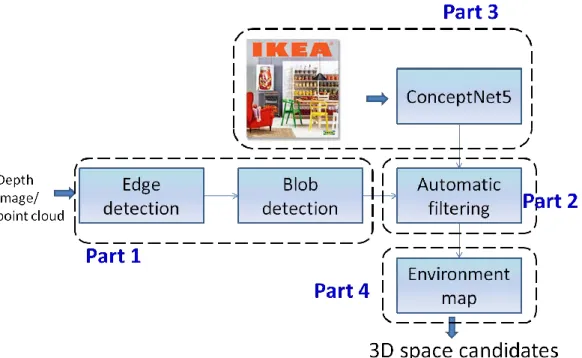
To achieve these objectives, I organize the research work into several parts which
each part has their own function as below (Figure 1.5)
Part 1: Segmentation of furniture occupied area on the floor based on the depth and point cloud image.
Part 2: Filtering the candidates for furniture by using online catalogue database.
Part 3: Categorization of 3D space candidates by using ConceptNet5 Part 4: Representation of individual environment model in Microsoft
9
Figure 1.5 The structure of this research
From the set-up goals and objectives, this research hopes to expect these research
outcomes
First, an environment map can be obtained by a robot with depth sensor mounted
Second, the candidates of a standard individual living environment can be sensed and initialized by using online catalogue automatically.
Third, natural and intuitive robotics service in actual living environment can be realized from this initialization system easily.
Finally, this initialization of robotics service environment may be able to reduce the cost and effort to develop intelligent space.
10
1.4 Research Scope
The research outcomes will be accomplished by employing the following scope of
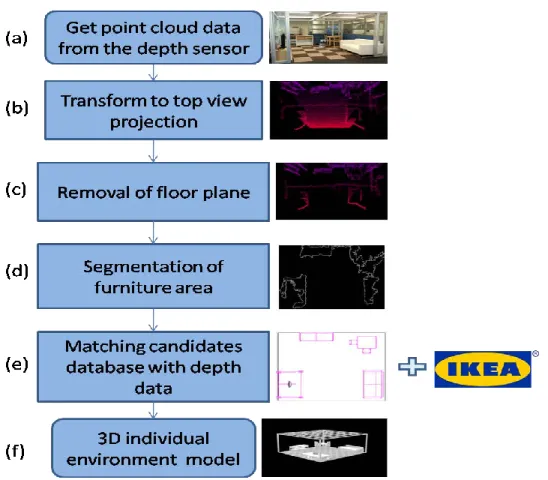
research (Figure 1.6)
Sensing the floor map of the 3D space consisting furniture
Obtaining the 2D occupancy map of the 3D space together with furniture dimensional information
Filtering the online furniture database to be matched with the data from the depth sensor
11
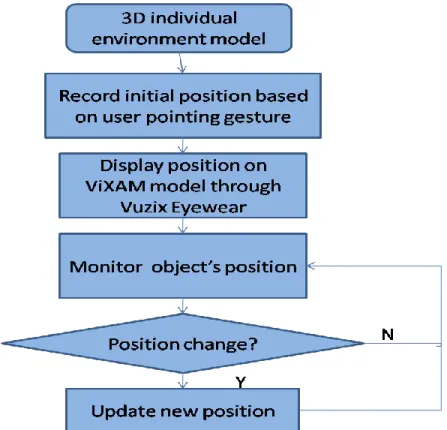
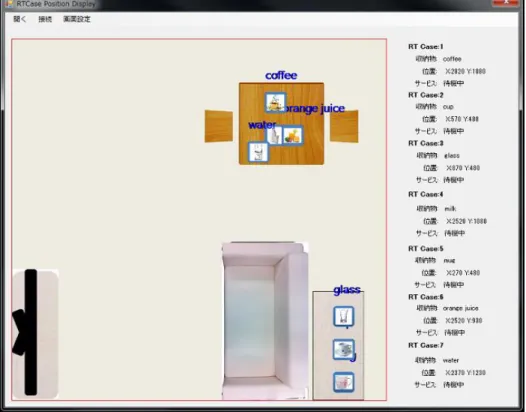
Meanwhile, this research also develops an application known as ―Change Detection‖ that
can detect the object new position after pickup by the service robot at its initial position.
The application can be describe in the following Figure 1.7 and 1.8.
Figure 1.7: Object position monitor in the initialized environment
The remainder of this dissertation is organized into six chapters as follows
Chapter 1: Introduction – explains the background and gap of knowledge for our research.
12
Chapter 3: Initialization system for robotics service environment – contains the details of our major contribution to construct this initialization system.
Also discusses the use of depth sensor and online catalogue to build the 3D
environment model.
Chapter 4: Application of robotic service at home – describes the application which has been built using the initialized environment.
Chapter 5: Discussion – highlights the idea and usage as well as its significance to human robot interaction.
Chapter 6: Conclusion and future work.
13
1.5 Assumption
In order to demonstrate the proposed initialization system to the home environment, few
assumptions have to be made. They are:
i. Our world contains large and horizontal surfaces on which holding huge
objects like furniture.
ii. Furniture can be as the supporting surface and has daily-life objects either
in or on them.
14
Chapter 2
LITERATURE REVIEW
This chapter contains some of the current research which related to this work.
Although research on initializing of robotics service environment is relatively new, work
on 3D modeling of space and environment analysis have been the laborious task of many
researchers. Most of the current research deals with information sensing of the
environment since it can be populated easily by attaching active or physical sensor into the robot‘s surroundings. In addition, this thesis will address the knowledge gap in the most related research known as ‗Semantic Object Mapping‘ (SOM) as well as ‗Knowledge Processing for Autonomous Personal Robot‘ (KnowRob). Meanwhile, the environment which has been initialized beforehand may greatly improve the service
generation by the robot to user in a natural and intuitive interaction between them.
2.1 Intelligent Space
This research is conducted in the robotics framework known as ‗Kukanchi‘. ‗Kukanchi‘ is a Japanese word means Interactive Human-Space Design and Intelligence. This framework was developed in our laboratory since 2007 focusing at sensing
15
middleware for integrating robots and sensors. The core idea of ‗Kukanchi‘ is the structured environment in which system components is spatially distributed and
interconnected through middleware platforms [8]. Figure 2.1 describes this ‗Kukanchi‘
concept for human daily living environment. In this figure, two important characteristics
of Kukanchi system design are highlighted.
Distributed system: all system components such as sensors, robots and corresponding software component are designed as part of distributed system.
Software components are modularized and interconnected by RT middleware [9].
Home appliances are built as RT devices manipulated by RT components. This
architecture provides easy system integration with multiple components which
can be acquired from various sources.
Distributed knowledge: knowledge in Kukanchi is decentralized and embedded into environment using tagging technologies such as RFID, ucode, image marker
and etc. based on these tagging technologies, knowledge will be provided to robot
only when and where robot needs [10].
Based on the above concept of Kukanchi system, the embodiment of robot can be
extended to the whole environment. Furthermore, the whole environment can also be
considered as one robot. In this way, a simple mobile robot can interconnect with other
16
Figure 2.1 Kukanchi system
There are three main components in ‗Kukanchi‘ namely human, environment and robot. Human represent the user at home which is using service robot to assist them in
their daily life activities. While, environment defines the 3D living space which
intentionally not be designed to accommodate robot together with human. And robot
is the agent who provides daily life service to human at home. Therefore, robot needs
to interact not only with human but environment as well in order to complete the
robot services.
The operation of intelligent space is based on the interaction between these three
17
Interaction between robot and environment: this is the first fundamental issue to help robot exists and functions in human‘s living space. Robot is required to navigate around user‘s house [11], avoid obstacles [12], as well as manipulate objects and home appliances [13]. To reduce the robot‘s burdens,
research has been proposing to make environment become more
robot-friendly by employing tagging technologies [14] and special design of object‘s
container such as RT case [15].
Interaction between human and robot: this is the second fundamental issue for robot‘s usability. Human needs to give command to robot in easy and natural way. Many human robot interactions have been proposed using gesture
recognition [16], voice recognition [17] and tablet devices [18]. On top of
that, multimodal interaction was also introduced in the intelligent space [19]. Interaction between human and environment: this is the daily life scenario for
human as they interact with objects and surrounding environment based on
18
Figure 2.2 Kukanchi‘s components to generate robotics service
This research will address the issue arises from the interaction between robot and
environment thus how it can influence human robot interaction at home. To achieve
natural interaction between human and robot, we believe that the environmental
information must be created beforehand or in other words, at the early stage of robot
interacts with the environment. The domain of the home is worlds away from the
laboratory or battlefield where most assumptions and requirements from these domains
do not readily translate to the home [20]. This problem has been seen in Kukanchi system framework as user has to predefine every location‘s information in the environment in order for the completion of robotics service. For that reason, initialization of the
environment is proposed in this research.
19
2.2 Human-robot Interaction and Robotic Services
Human-robot interaction by definition is a study which focuses on interaction
between humans and robots. Nowadays, most researchers eventually work on how to deal
with interaction problems which will be emerged when a robot is placed in human‘s daily
living environment. This scenario will create a daily life support system by robotics
technology in order to help and ease human especially for elderly and handicapped
people. This is supported by the fact that the number of elderly people in many countries
is increasing every year. For instance, about 42% of Japanese population is predicted to
be over 65 years old in 2055[21]. Meanwhile, in Europe the elderly people population of
65 years old or over will increase by 29.5% by 2060[22]. This figure shows that there
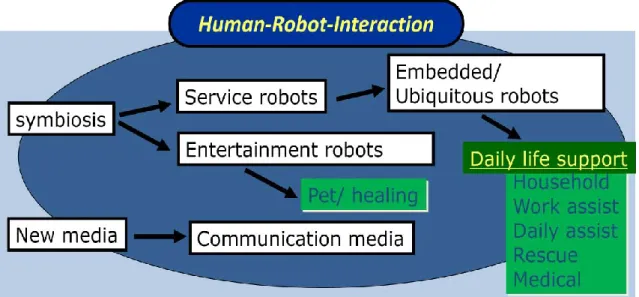
will be not enough caregivers in future hence many old people will be living alone. Therefore, as a solution, robot is placed in human‘s house to serve for many purposes such as service robot, entertainment robot as well as communication media (Figure 2.3).
While entertainment robot and robot as communication media will improve human psychology and lead to unstressed life, service robot may enhance human‘s household work. A service robot which can integrate the information in human living environment
will solve the physical constraints of human while completing their daily life or
household activities. Furthermore, by adopting service robot into human 3D space like
home may also improve the quality of life to those who need assistance for handling tasks
at home.
For that reason, many aspect of research have been conducted by academician in
this field such as study on knowledge database for human-robot environment, study about
20
following Table 2.1 to show the recent development or achievement done by other
researchers in human-robot interaction field generally and robotic services specifically.
By referring to this table, most of the research makes observation of possible interactions
might occur between entities like objects, robot and human.
Figure 2.3 The position of robotic service in human-robot interaction
From this observation, knowledge database is created and user interface is developed
as well with the target to provide simple robotic service such as bring object from one
place to another place. Nonetheless, it is important to address the problem which might
21
Table 2.1: Comparison of recent related research in HRI for robotics service
environment
User interface Observation of human activities in the 3D space through spatial interface thus provide robotics service based on that observed information[23]
Focuses on interface to gather environmental info based on the place where the robotics service took place[24]
Assist visually impaired person by creating mental maps and provide information to user via sound[25]
Knowledge database
Study on relationship between objects, location and event to create commonsense for bring something robotics service.[26] Specifying of appropriate places of daily-life objects for tidy up
robotics service.[27] Distributed
sensors
Focuses on sensory data distributed in the environment to create data management system thus complete the robotics task[28] Study on self sensing the environment specifically home to
sense its contents like furniture and keep track the changes in the environment[29]
Environmental map
Propose resolution information to describe movement history of humans and object[30]
Using depth camera for robust localization and reliable obstacle avoidance in complex indoor environment [31][32][33]
User model / data mining
Filtering user information based on motion logs and life logs[34]
Developed Service Proposal System (SPS) to generate ‗Tsuide Service‘ based on service history information and environment information[35]
Modeling
language design
Adoption of certification schemes of modeling language to design dependable intelligent system in uncontrolled environment[36]
Designing robot management system which manages and controls information-structured environment with robots, everyday objects and ambient intelligent system [37]
Development of collaborative design framework for analyzing system behavior [38]
Interaction mechanism
Developing human-mimetic hand-arm system by applying appropriate grasping force when handling objects in daily-life environment[39]
22
2.3 Environment Map Generation
The complexity of the environment in which service robots would need to operate
and the number of issues that such robots have to overcome pose significant challenges
for the development of robot control architecture that can handle them appropriately[41].
This scenario is an example when service robots have to autonomously function in a
dynamic environment like 3D space. Any changes in the 3D space may affect the robot‘s
current plan to deliver service to user. Therefore, the robot must be capable of adapting to
the new or unknown environment and be able to use the underlying information to
generate services as shown in Figure 2.4. Map building of a 3D environment is an
important prerequisite for many robotics applications such as object search [42] as well
as robot navigation [43]. To make sure the generation of robotics service in living
environment, service robot must have the ability to access the environmental information,
to move in the space according to the planned path and to localize the target
autonomously [44]. To realize this task, robot needs to acquire the environment map where human ‗lives‘ together with the robot.
This environment map can be considered as a model to robot‘s operation environment
that serve as information resources for better task performance [45]. Hence, this research
would like to initialize 3D living space for the purpose of robotic service environment by
using this environment map. This initialization system aims to provide furniture‘s 3D
information of appearance and articulation to the map thus used with RT ontology to
23
functional object mapping, firstly this research needs to solve the acquisition of the
environment map.
Figure 2.4 Characteristic of unknown environment
For example, automatically providing additional semantic information to the map
such as location and type of furniture, are still an unsolved problem [46]. Secondly, based
on the environment map, this initialization system has to build up the individual 3D space
model which represents the database and knowledge source for robot systems. To attain
this environment model, there are two requirements
First, the main aspect of the environment such floor plan and furniture arrangement need to be detected.
24
To meet the first requirement, research on sensing the 3D space was conducted by
other researchers using autonomous robot mounted with laser range finder [47], stereo
camera and so on to produce Simultaneous Localization and Mapping (SLAM) [48]. This
methodology is widely employed to robotics technology application such as robot
localization in the 3D space [49], obstacle detection [50], robot‘s path planning [51] and
so on. However, mostly robots map the 3D space for navigation purpose. Nevertheless,
the map may have variety to store and display the information to users which depends on
its purpose. Within an unknown environment, robot will build up the map, store its
information into an environment representation and display to the users. Besides, the
emerging technology in the consumer products like Kinect Xbox and Asus Xtion Pro also
become an option to do the environment sensing. These cameras are relatively accurate
and provide dense, three-dimensional information directly from hardware which may
solve the limitation of high algorithmic complexity in the conventional cameras [52].
Another advantage, this consumer level depth camera capable to capture 3D point cloud
data of the real environment to be used for many applications like object recognition,
tracking and scene interpretation [53]. In addition, their lightweight property makes it
easier to put these cameras on board.
Meanwhile, in order to initialize the real environment with several candidates as to
meet the second requirement, an informational database needs to be referred. So far,
research done to solve this issue by using a predefined method to demonstrate in real 3D
space. Most of the researches done were using physical sensors such as RFID [54],
pressure sensors, mechanical switch and RT-Case [55]. Using this type of sensor,
25
whenever required. For example in a typical RFID system, individual objects are
equipped with a small tag. The antenna package on it emits a signal activating the RFID
tag so it can read and write data to it. When an RFID tag passes through electromagnetic zone, it detects the reader‘s activation signal. The reader decodes the data encoded in the tag‘s integrated circuit and the data is passed to the host computer. The application software on the host computer processes the data. In a situation when robot needs to
provide service to human, these tags are used as location tag which is attached to the
drawer of the furniture. Then, in the database the structure and position of the drawer is
defined manually [56]. This predefined technique suffers from a need for quick database
setup and less messy or laborious work whenever to demonstrate in real 3D space.
Therefore, it will be great advantage for robot system if the robot can obtain the
information automatically especially when robot coming into 3D space for the first time.
The closest researches which dealing with this problem is found in ‗Semantic Object
Mapping‘ (SOM) and ‗Knowledge Processing for Autonomous Personal Robots
(KnowRob).
2.4 Semantic Object Mapping (SOM)
Semantic mapping seeks to move the study of robotic mapping beyond two- or
three-dimensional occupancy and towards higher-level map constructs like objects,
rooms and available actions [57]. Instead of robot maps the free and occupied spaces, the
robot will map the objects in the 3D space (Figure 2.5). Even though robotic mapping has
26
information in the environment to the map automatically. An early example has been
shown by Nüchter et al. [58], in which three-dimensional points in the map are labeled as
floor, ceiling or object points. On the other hand, Rusu et al. [59] present the
segmentation of objects at close range in tabletop settings, combining heuristic and
model-fitting techniques. Meanwhile, Trevor et al. [60] study based on the idea that the observation which flat surfaces such as tabletop tend to support ‗interesting‘ objects.
In all the above mentioned research works, their systems either using
Simultaneous Localization and Mapping (SLAM) technique or using consumer-level
sensor like Microsoft Kinect RGB-D camera. While the conventional SLAM using
sensor like laser range finder and 2D camera, the emergence of low cost and quite
accurate 3D camera like Microsoft Kinect has open a new and wide research field related
to robotic mapping. Recently, the semantic mapping research has taking advantage of the
RGB-D point cloud data from Microsoft Kinect Sensor to add additional information
such as objects structure into the map for dealing with generation of robotic services in
human daily-life. A point cloud is a set of data points in some coordinate system. In a
three-dimensional coordinate system like our living environment, these points are defined
by X-Y-Z coordinates thus represent the surface of an object like floor and furniture.
Three-dimensional construction using point cloud and Kinect sensor for example may
optimize the robotic system to performing SLAM or other environment mapping
software. Oliver et. al [61] has proven in his research that Kinect data is most valuable to
robots with unreliable odometry data or no such information (e.g., unmanned aerial
vehicles) and applications where a 3D map is required and precise measurements are not
27
Figure 2.5 An example of approach based on SOM [56]
On the other hand, in object recognition, the usage of point cloud data can reduce
the need for labeled training data for classification tasks in robotics. The difference
between web-based data and real data collected by a robot is even more obvious in the
context of classifying 3D point cloud data [62], which domain adaptation method is
applied to the problem of object detection in 3D point clouds. Specifically for indoor
living space, environmental data can be populated to scan the floor plane and furniture
plane thus create the individual home environment model. While web database such as
online catalogue may provide additional information on the environment model so that
natural and intuitive robotics service can be achieved in real home environment.
In the context of semantic mapping, Vasudevan et al. [63] and Zender et al. [64]
were using SIFT features for object matching while Blodow et al. rely on
three-dimensional point features. On top of that, Rusu et al. [65] exploiting the structure of
28
[66] shows a SLAM system that also tracks object poses. This feature-based technique
has the limitation such that it requires a high resolution data and an accurate database of
objects to be recognized. An alternative to this problem, an approach is seen in [67] as
objects in the environment are observed at long distance (low resolution) and does not
need access to database of object models. Rather than rely on recognition, they
demonstrate it by applying object segmentation which includes easily-computed semantic
labels like color and size to build up the semantic mapping. In the meantime, the
initialization system in this research depend on attribute-based approach like the two- or
three-dimension of the furniture that can be acquired from the occupancy map based on
point cloud data from depth sensor. Without need to focus on segmenting the object
itself, this research uses the occupied map which describe furniture dimension attribute,
applying occupied area segmentation and finally select several candidates for the
furniture with the help of online catalogue database. While this research demonstrate in
living room environment contains IKEA furniture, the map-object matching is done
automatically by computing the Equivalent Circular Diameter (ECD) and centroid in the
pre-processing image from 3D Sensor.
2.5 KnowRob
KnowRob is a knowledge processing system particularly designed for
29
as resource that works directly on the data structures used for robot control such as 3D
environment model and symbolic representation. It is specifically designed for
autonomous robots that are to perform everyday manipulation tasks. Based on several
sensors like RFID, laser range finder, cameras and magnetic sensor attached to kitchen
environment, perception module creates 3D environment maps, track human motions and record log data of robot‘s activities. This may explain the scenario when a robot is looking for objects in order to deliver service to human at home. Service robot needs to
locate objects for a task it is about to perform. An example shown by Tenorth et al. which
by combining the environment map with encyclopedic and commonsense knowledge, the
robot can query for objects by their functionality (Figure 2.6). For instance, the
encyclopedic knowledge returns the concept ‗Oven‘ as object used for heating or boiling
and the semantic map locates an oven and in order to operate the oven, the robot has to
know which part to manipulate to cause a heating/boiling process.
Rather than dealing with data structures from the perception system that involves
computation of observation system and loading observations into knowledge
representation of the environment map, this research focus on filtering the candidates
automatically by combining the point cloud data with online database like IKEA
catalogue into single layout software such as Microsoft Office Visio. In Microsoft Office
Visio, the 3D environment model can be created applying custom stencil which have the
furniture attributes like number of drawers in the cabinet as well as position of each
drawer on the furniture structure. This information will be helpful for service robot to
30
Figure 2.6 The KnowRob perception module.[68]
2.6 Summary
Approach presented in this thesis would like to overcome the drawback of using
predefined method to demonstrate robotic service environment in real 3D space. This
research also using online database to match the furniture 3D information to the point
cloud data and presents several candidates for the 3D space. Rather than using object
recognition which requires training dataset, this research applying segmentation
algorithm to image from depth camera and measure the dimensional values to be matched
with online catalogue. Moreover, this initialization for robotic services at home focus on
automatically filtering the candidates and build up the 3D environment model. Finally,
this research allows the addition of object structural information (furniture) to the 3D
environment map (robotic map) with minimal effort. The following Table 2.2 illustrates
31
Table 2.2: Comparison of semantic map research
Rusu et al. Mason et al. Tenorth et al. This research Sensor Laser range
finder (robot-mounted) 3D depth camera (robot-mounted) RFID, laser range finder, magnetic sensor (sensor-equipped environment) 3D depth camera (robot-mounted) Mapping method Object recognition and classification Object segmentation Perception system (robot log data, human motion tracking and environment information) Occupied area segmentation and blob detection
32
Chapter 3
INITIALIZING THE ENVIRONMENT FOR ROBOTICS
SERVICE
This chapter describes in detail our approach to initialize the robotics service
environment and how the candidates are filtered automatically. The main parts of this
chapter are
Building the 2D occupancy map based on data from depth sensor
Filtering candidates from online furniture database based on 2D and 3D data Build up of 3D individual environment model
As in chapter 1, the initialization of service and generation of real living environment
model is significant to many robotics systems such as daily robotics service at home. This
characteristic becomes the requirement if robotic service is needed in every individual
home. In the first part of this work, a floor projection map of Kukanchi 3D space is
33
3.1 System
Based on the depth and point cloud data, we can create a static environment map which
is consisting furniture candidates. The occupancy map of the space floor is drawn by using
floor layout software such as Microsoft Office Visio. To conduct the experiment, I use the
consumer level depth sensor, Asus Xtion Pro live as the depth camera. On top of that, a
low-cost personal robot kit, TurtleBot 2 running open-source software like OpenNI and
OpenGL are used. Figure 3.1 describes the hardware configuration showing depth camera
setup on the TurtleBot 2. One of the objectives of this research is to determine the floor
plane or top view projection map of the 3D space. This approach is applied to indoor
living space and therefore I use depth camera mounted on the robot to capture the depth
map of the floor. The advantages of taking depth data is that, it may provide useful
information such as the furniture three-dimensional properties or attributes like its size
(width, length and height).
34
3.1.1 Segmentation
From the depth map, this research measures the point cloud data based on OpenNI
built-in calibration. To obtain the top view floor projection, I apply transformation matrix
including two times of translation matrix and a rotation matrix. I mount the depth camera
on the robot with distance of 72cm from the floor. While to produce the floor projection,
the robot position is fixed at 200cm from location defined as [0,0,0] reference point. Also,
this research applies a perspective projection with depth camera Field of View (FOV) 58
degree vertical. Figure 3.2 illustrates in detail the 3D coordinate setup of the depth camera.
The camera is positioned at [0, 720,-2000] and aimed at [0, 0, 3000] in the world
coordinates. In other words, the depth camera is looking in the positive z direction.
Figure 3.2: (a) Coordinate system (b) Robot positioning
Meanwhile, this research specifies the upright direction of the depth camera in the positive
35
the floor projection, the ground plane that the robot standing on is estimated. The ground
plane which is the floor as the surface where huge object such as furniture lying on can be
represented by 3D coordinates. During the calibration process, I clear the floor from any
object except for furniture in the FOV of the depth sensor and capture a single
instantaneous point cloud.
The procedure to get top view floor projection, this research uses a simple
algorithm to remove the points belong to the floor plane. By referring to [4], the equation
of floor plane in the camera coordinate system can be represented as followed
𝜌𝑧 = −𝛼𝜌𝑥 − 𝛽𝜌𝑦 − 𝛿 (1)
where (𝜌x, 𝜌y, 𝜌z) are the 3D coordinates of a point on the floor plane. Once α, β and have been calculated, the floor plane may be determined thus remove it so that only the furniture occupancy area can be seen on the floor. Figure 3 shows the point cloud image of the 3D space with and without the floor plane.
Figure 3.3: 3D point cloud image with floor plane (left image) and without floor plane
36
From the point cloud data of depth sensor, these two depth images are analyzed
and applied image processing algorithm to segment the area of candidates. To get these candidates‘ area, the size of the floor plan is measured beforehand and the depth images are converted to gray scale image. After that, Sobel edge detection was applied where the
edges of the image are detected with a threshold value of 0.5. Sobel edge detector will
highlight regions in the image that have high spatial gradients. In addition, Sobel operator
performs a 2D spatial gradient measurement on an image and emphasized regions with
high spatial frequency correspond to edges. This Sobel edge detection algorithm
produced a binary gradient mask image. This binary gradient mask image contains
objects in the 3D space that have been partitioned. However, this image does not accurately represent the contour of the candidates‘ area. By using a structuring element in the longitudinal direction, the binary gradient mask image is expanded thus produced
dilated gradient mask image. Then, small objects in the binary image are removed by
controlling the pixel value of the objects. Finally, the image is smoothened to obtain final
segmented image which contains only candidates‘ area. Figure 3.4 illustrates the steps
involved to segment the depth image. Also, this research is using Sobel edge detector due
to its characteristic which less sensitive to noise compared to other edge detector.
After that, the segmented image is analyzed with Hough transform algorithm to
identify lines of each candidates in the image. Since by using Sobel edge detector is not
enough to remove the unwanted objects in the image, this research add Hough transform
algorithm to recognize the furniture‘s occupied area. It is important to obtain accurate
occupied area since it will be used to measure the 2D data in order to match with
37
following Figure 3.5 shows the segmented image describing shape and size of the candidate‘s occupancy area on the floor.
Figure 3.4: Segmentation process of the depth image. (a) binary image (b) dilated
gradient mask image (c) removes small objects (d) final segmented image
38
3.2 Object Association
Several candidates of furniture in the 3D space are passed to the object
association by using a filtering method. This object association reflects or returns the
result of matching data from catalogue database to actual measured of occupied area in
the segmented image. An attribute-based approach is using to filter the candidates
automatically and hence produce the semantic map with furniture 3D structural
information. By using blob detection algorithm to measure 2D size of occupied area, this
initialization system can filter the database based on width and depth values.
3.2.1 Filtering of Candidates
The attribute-based approach describes the using of furniture 2D size on the
occupied area which can be obtained from the segmented image before. Figure 3.6
explains the process to filter the candidates based on these 2D measured values.
Figure 3.6: Automatic process to filter the 3D space candidates.
Blob detection is used to detect region in an image that differ in properties such as
brightness and color by comparing to areas surrounding those region. Meanwhile, a blob
is a region which the properties are constant or varies within a prescribed range. These
39
about the previous segmented image which cannot be obtained from Sobel edge detector
as well as Hough transform. In this research, the blob detection is applied to measure the blob‘s centroid and Equivalent Circular Diameter (ECD). The candidate filtering algorithm finds the matching data IKEA online catalogue by referring to furniture‘s width and depth. From the segmented image obtained by Hough transform, numbers of blob is
detected and recognize. For easy visualization, each blob is labeled with different color
that describes the number of furniture present in the actual living space. Figure 3.7 shows
the result from the blob labeling process.
Figure 3.7: Pseudo colored labels of each blob.
To measure the blob‘s centroid and ECD, the boundary of the blobs have to be detected in order to trace the furniture occupied region on the floor. Figure 3.8 shows the
blobs with boundary traced algorithm. After that, the size of the blobs is determined by
indicating its two significant attributes which are centroid and ECD. In other words, the
40
Figure 3.8: The blob‘s boundary image
3.2.2 Filtering Result Based on 2D Data
It is important to validate the candidate data which are obtained from the point
cloud data as well as depth data. This analysis is needed in order to set the threshold of candidate‘s filtering algorithm from online database like IKEA catalogue. Thus, to validate the camera image data acquired, few additional experiments were conducted to
analyze the accuracy of experiment data versus actual data gathered from furniture
catalogue. In these experiments, we divided into two steps. First, the data is read from
another position of the robot and secondly, I swapped the furniture position in the 3D
space. The result which contains 2D data of the candidates are then plotted and compared
to the actual one. Figure 3.9 until figure 3.12 illustrates the result of these experiments for
41
Figure 3.9: 2D plot of all data for candidate 1
42
Figure 3.11: 2D plot of all data for candidate 3
43
Based on the above graphs, the ‗Data 1‘ in the x-axis represents the first data given by the depth camera while the ‗Data 2‘ in the y-axis represents the second data given. ‗Data 1‘ and ‗Data 2‘ resemble the width and length of the candidates in the online catalogue database. The area under the graph shows the occupancy area of the candidates
on the floor. The blue rectangular area shows the actual 2D size of the candidates in the
online catalogue. While the other three 2D plots show the experiment data from the depth camera. The plot with ‗light blue mark‘ is the actual or calibration position of the furniture and ‗red mark‘ is the position when I swapped the furniture. Meanwhile, the ‗green mark‘ is the data at a different robot position in the 3D space. Table 3.1 shows the measured and actual value of furniture in the 3D space based on this experimental
analysis. In candidate 1 dataset, the accuracy of the experiment data varies from 5% to 50% for both ‗Data 1‘ and ‗Data 2‘ which ‗Data 2‘ much more accurate than ‗Data 1‘. Also, in candidate 2 dataset, the same accuracy applied as candidate 1 dataset.
Meanwhile, candidate 3 dataset, the accuracy much better which varies from 2% to 23%
of error. Finally, in candidate 4 dataset, the percentage of error can be seen varies from 2% to 20%. Same as candidate 1 dataset, ‗Data 2‘ has better accuracy compared to ‗Data 1‘ in candidate 4 dataset. This result is also has been analyzed with respect to each dataset for width and length values in the catalogue. From figures 3.13 and 3.14, the
width dataset experiences high percentage error compared to depth dataset.
Finally, based on this experiment to validate the depth camera data, the
44
from the camera data. It means this initialization system finds and matches the camera
data to catalogue data by 20% above the blob size and 20% below the blob size. Equation
2 and 3 describe the threshold to blob‘s centroid and ECD of filtering algorithm. In
conclusion, regardless the size of online catalogue database, robot may extract several
candidates that match with the 3D living environment measurement data.
𝐹𝑖𝑙𝑡𝑒𝑟𝑒𝑑 𝑑𝑎𝑡𝑎1 ∶
𝑑𝑎𝑡𝑎1 ≥ 𝑐𝑒𝑛𝑡𝑟𝑜𝑖𝑑 – 20% ∗ 𝑐𝑒𝑛𝑡𝑟𝑜𝑖𝑑 & 𝑑𝑎𝑡𝑎1 < 𝑐𝑒𝑛𝑡𝑟𝑜𝑖𝑑 + (20% ∗ 𝑐𝑒𝑛𝑡𝑟𝑜𝑖𝑑) (2)
𝐹𝑖𝑙𝑡𝑒𝑟𝑒𝑑 𝑑𝑎𝑡𝑎2:
𝑑𝑎𝑡𝑎2 ≥ 𝐸𝐶𝐷 – 20% ∗ 𝐸𝐶𝐷 & 𝑑𝑎𝑡𝑎2 < 𝐸𝐶𝐷 + (20% ∗ 𝐸𝐶𝐷) (3)
Table 3.1: Comparison of candidate‘s 2D size
Measured Actual
Width (cm) Length (cm) Width (cm) Length (cm)
Candidate 1 192.1895 85.6677 146 78
Candidate 2 120.8367 50.0772 118 42
Candidate 3 192.1895 74.4987 120 60
Candidate 4 74.5 74.5 74 74
45
Figure 3.14: Data accuracy based on length value.
3.2.3 Filtering Result Based on 3D Data
As the 3D data can be easily obtained from the depth camera, the analysis on
filtering result of 2D dataset is compared with the 3D dataset. The measured 3D dataset
has additional information of furniture which represents the depth of furniture above the
floor plane. By applying 3D filtering, candidates of furniture from IKEA catalogue are
extracted based on width, length and height of the furniture. In order to get the input
measured data for the furniture height, the average value of camera‘s depth array values
is calculated. It can be described as in the following equation.
𝐵 = 𝑚𝑒𝑎𝑛 𝐴, 𝑑𝑖𝑚 (4)
Where;
B is the resulting average
46 dim is the dimension to average over
Meanwhile, the 3D data for the furniture based on camera‘s measurement and actual dimension in IKEA catalogue is illustrated as in Table 3.2 and Figure 3.15.
Table 3.2: Comparison of candidate‘s 3D size
Measured Actual
Width (cm) Length (cm) Height (cm) Width (cm) Length (cm) Height (cm) Candidate 1 192.1895 85.6677 83.0982 146 78 72 Candidate 2 120.8367 50.0772 68.4728 118 42 51 Candidate 3 192.1895 74.4987 67.3421 120 60 74 Candidate 4 74.5 74.5 95.4444 74 74 75
47
3.2.4 Categorization of 3D Space Candidates
In order to initialize the robotic service environment, the candidate‘s name and type
should be properly categorized. A more general name and type of these candidates should
be assigned to make sure this initialization system can be applied to every home. To solve
this problem, by using Conceptnet5, the candidates in the living room are categorized.
Conceptnet5 is one of the biggest databases available to show the relationship between
object, place and activity. Conceptnet5 uses a semantic network with a large number of
concepts interconnected by relations. Therefore, by using Conceptnet5 database, this
study extracts the information of its two relations:
AtLocation: represent the spatial relationship between objects and spaces. This relation is used to find the list of common objects or candidates at the specific
locations. For example, objects available in living room.
IsA: represent the general information of certain object. This relation is used to find another name for a specific object. For example, ‗work table‘ and ‗coffee table‘ can be considered as ‗table‘ in general.
Table 3.3 shows some sample objects which can be found in living room using
AtLocation relation in conceptnet5. From this information generated by Conceptnet5, the
type of furniture in IKEA online catalogue is categorized accordingly hence present
48
Table 3.3: Result using AtLocation relation
No. Object 1. Table 2. Couch 3. Sofa 4. Human 5. Chair 6. Coffee table 7. Carpet 8. Tv set 9. Cabinet 10. cup
Meanwhile, Table 3.4 shows the IsA relation for object ‗table‘.
Table 3.4: Result using IsA relation Object Coffee table Work table Desk Breakfast table Conference table Tea table Booth Console
There are four categories of candidates in our actual robotic service environment
as follows:
i. Sofa: include all types of sofa which available in catalogue such as
two-seater or three-two-seater sofa. Also either it is armchair or not.
![Figure 1.1 Population aged 60 years or over by development region [1]](https://thumb-ap.123doks.com/thumbv2/123deta/9766167.1850171/15.918.212.792.108.481/figure-population-aged-years-development-region.webp)
![Figure 1.2: Trends of elderly persons living alone [2].](https://thumb-ap.123doks.com/thumbv2/123deta/9766167.1850171/16.918.212.795.151.505/figure-trends-elderly-persons-living.webp)


![Figure 2.5 An example of approach based on SOM [56]](https://thumb-ap.123doks.com/thumbv2/123deta/9766167.1850171/40.918.256.717.124.454/figure-example-approach-based-som.webp)
