Instructions for use T itle Magnetic clusters and fold energies
A uthor(s ) Giga,Y oshikazu; K ubo,Motohiko; T onegawa,Y oshihiro
C itation Hokkaido University Preprint S eries in Mathematics, 666: 1-22
Is s ue D ate 2004
D O I 10.14943/83817
D oc UR L http://hdl.handle.net/2115/69471
T ype bulletin (article)
Magnetic clusters and fold energies
Yoshikazu Giga, Motohiko Kubo and Yoshihiro Tonegawa
Department of Mathematics, Hokkaido University, Sapporo 060-0810, Japan
Abstract: We are concerned with variational properties of a fold energy for a unit, dilation-invariant gradient field (called a cluster) in the unit disk. We show that boundedness of a fold energy impliesL1-compactness of clusters. We also show that a fold energy isL1-lower semicontinuous. We characterize absolute minimizers. We also give a sequence of stationary states and discuss its stability. Surprisingly, the stability depends upon q, the power of modulus of the jump discontinuities, in the definition of the fold energy.
1
Introduction
H. A. M. van den Berg [8] studies magnetic thin film by proposing a model described as follows. A magnetic field M on a domain Ω of R2 is called a magnetic clusterif
M ∈L∞(Ω) satisfies
div M = 0 in Ω,
|M|=C in Ω, M ·n= 0 on∂Ω,
where C is a given constant and n is the unit outer vecter on ∂Ω. He provided many examples of magnetic clusters. We use a ‘fold energy’ to characterize several important magnetic clusters and study its variational properties. For example, we studyL1-compactness and the stability of dilation-invariant clusters with respect to the fold energy defined formally by the form
Eq(
∇u) =
Σ∇u
[∇u]
q dS.
HereM = (∇u)⊥ is a cluster, q is a given positive number anddS denotes the line
element. Roughly speaking, Σ∇u denotes the jump discontinuities of ∇u and [∇u]
represents the jump on Σ∇u. This fold energy is formally an asymptotic limit of the
Ginzburg-Landau type energy
Ω
Closely related topics include [1], [2], [3], [5]. In general case without dilation invariance, we do not know the existence of global minimizers of the fold energy on the set of solutions of the 2-dimensional eikonal equation under suitable boundary conditions. There are examples showing that the distance function from ∂Ω is not a minimizer of the fold energy [2], [7]. The papers [1] and [5] establish compactness if q=3. We conjecture that compactness does not hold if q>3 [1], [5]. The paper [1] also showed that the fold energy is not lower semicontinuous for q>3 while Aviles and Giga [3] proved a lower semicontinuity result for the fold energy for q=3 .
In this paper we are concerned with variational properties for a fold energy in the unit disk for a unit gradient field when a cluster is dilation invariant. To simply the wording from now on we call a unit, dilation-invariant gradient field a cluster. Our main results are
(1)L1-compactness summarized as follows. If {Eq(∇u
j)}j∈is bounded, then there
is an L1-convergent subsequence of {∇u
j}j∈.(Theorem 3)
(2)L1-lower semi-continuity of Eq with respect to∇u.(Lemma 2.8, Lemma 4.1)
Our compactness and lower semi-continuity results do not depend on a positive number q. These results are significantly different from the case including general configuration as mentioned in a previous paragraph.
(3)Characterization of absolute minimizers such that Eq(∇u) = 0.(Theorem 5.1)
(4)Stability of ‘saddle point’ type stationary configurations is studied.(Theorem 5.3) We have given examples of stationary state whose stability depends on certain pos-itive number q. There is a tendency that more configurations are stable for larger q. We conjecture that our examples of local minimizers exhaust all local minimizers but we did not touch this problem here.
We first define a fold energy for a finite wall cluster and consider its lower semi-continuous envelope for a limit cluster which is approximated by finite wall clusters. We show a lower semicontinuity of a fold energy for a finite wall cluster by character-izing a cluster by its argument function. This implies that the lower semicontinuous envelope is the same as original fold energy in a space of finite wall clusters. Un-fortunately, we do not have an explicit representation of the envelope for a general limit cluster.
Our space of limit clusters are not included in the space of functions of bounded variation (Lemma 3.2). Our example also shows that the Aviles-Giga space [1] is strictly larger than the space of functions of bounded variation, another example (non-cluster) is provided in [1]. For a seemingly smaller space than Aviles-Giga space but strictly large than the space of functions of bounded variation the notion of trace at jump discontinuities are extended by a recent paper of C. De Lellis and F. Otto [4].
Our characterizetion of global minimizers says that global minimizers are either a constant cluster or ‘free cluster’ (in the sense) that arg∇u(x) = argx or arg
∇u(x) = arg(−x). Similar results (among all configurations) are proved by P.-E. Jabin, F. Otto and B. Perthame [7] for zero-limit (ε → 0) state of the Ginzburg-Landau energy given in the begining of the introduction.
The authors are grateful to Professor Robert Kohn for informative remarks. This work was partly supported by the Grant-in-Aid for formation of COE ‘Mathematics of Nonlinear Structures via Singularities’. The work of the first au-thor was partly supported by the Grant-in-Aid for Scientific Research, No.14204011, No.1563408, the Japan Society for the Promotion of Science. The work of the third author was partly supported by the Grant-in-Aid for Scientific Research, No.14702001.
2
Limit clusters and its fold energy
To state our results precisely we prepare several spaces and notations. Let B1 be the unit open disk centered at the origin in R2.
2.1. Clusters. We shall introduce a notion of a cluster and show that all cluster has a potential.
Definition 2.1. We call a vector field V on B1 a cluster if V ∈ L∞(B1) satisfies
curl V = 0 in B1\{0}
|V|= 1 in B1
V(x) = V(x′) if argx= argx′.
x1
x2
Figure 1. One of the examples of clusters.
Lemma 2.2. For any cluster V there exists a function u ∈ W1,∞(B1) with
∇u=V and u|(xx|) depends only on argx. Here, ∇ denotes the gradient operator.
Proof. By the definition ofV ∈K there exists g ∈L1
loc(R) such that g(θ+ 2π)≡g(θ) modulo 2π
and
argV(x) =g(argx) forx∈B1. We set
a(θ)≡cos(g(θ)−θ) forθ∈(0,2π]. Since curlV = 0, we have that
cosθ ∂
∂θ(cosg(θ)) + sinθ ∂
∂θ(sing(θ)) = 0, where x= (x1, x2)∈R2, x1 =rcosθ, x2 =rsinθ. Since
∂
∂θ(cos(g(θ)−θ)) = ∂
= cosθ ∂
∂θ(cosg(θ)) + sinθ ∂
∂θ(sing(θ)) + sing(θ) cosθ−cosg(θ) sinθ
= sing(θ) cosθ−cosg(θ) sinθ
= sin(g(θ)−θ),
we conclude
a(θ) cosθ− ∂a(θ)
∂θ sinθ = cosg(θ) and
a(θ) sinθ+ ∂a(θ)
∂θ cosθ= sing(θ). So if we take
u(x) =|x|a(argx),
then V =∇u. ✷
2.2. Finite wall clusters. In this section we shall introduce a notion of a finite wall cluster and discuss its properties. The set of all finite wall clusters are denoted byKf(⊂K). We shall define aq-fold energyEfqonKf and prove thatEfq isL1-lower
semicontinuous in Kf.
Definition 2.3. For a cluster ∇ulet ˜Σ∇u be the set of all points inB1 where∇u is not smooth.
By the definition a cluster ∇u satisfies ∇u(x) =∇u(x′) for argx= argx′. So there
exists a unique set ˜J∇u ⊂ (0,2π] such that ˜Σ∇u = ∪θ∈J˜∇ul(θ), where l(θ) ≡ {x ∈
B1 | argx=θ}. We call such l(θ) a wall of ∇u.
Definition 2.4. We call a cluster ∇u a finite wall cluster if ∇u has finitely many walls. We denote the set of finite wall clusters byKf. In particular, we denote
the set of finite wall clusters which has no walls by K0
f.
Notice that the cluster in figure 1 is one of finite wall clusters. This cluster has five wallsl(π
4),l(
π
2),l(π),l( 3
2π) andl(2π). By the definition of cluster ∇uthere exists a function g such that
∇u(x) = (cosg(argx),sing(argx)).
Definition 2.5. Letg be a function on [0,2π] such that g ∈C∞((0,2π)\α j=1θj)
with finitely many{θj}αj=1 ⊂(0,2π). We sayg ∈Y if g satisfies the following (A 1)-(A4).
(A1) θ−π < g(θ)≤θ+π forθ ∈[0,2π],
(A2) g(0 + 0) + 2π =g(2π−0) or |g(0 + 0) + 2π−g(2π−0)|
2 = 2π,
where g(θ±0)≡ lim
ε→0+0g(θ±ε).
(A3) g ≡C org(θ)≡θ or g(θ)≡θ+π on (θj, θj+1) for j ∈[0, α],
where θ0 ≡0 and θα+1 ≡2π. (A4) For j ∈[0, α],
g(θj−0) = g(θj+ 0) if g ≡x+π on (θj−1, θ(jg))
and
g(θj−0) +g(θj+ 0)
2 =θj if otherwise.
Since
∂g(θ)
∂θ sin(g(θ)−θ) = 0 and
∂
∂θ(cos(g(θ)−θ)) = sin(g(θ)−θ), we are able to prove
Lemma 2.6. Following two statements are equivalent. (a)∇u∈Kf.
(b)There exists g ∈Y such that ∇u(x) = (cosg(argx),sing(argx)) a.e. x∈B1.
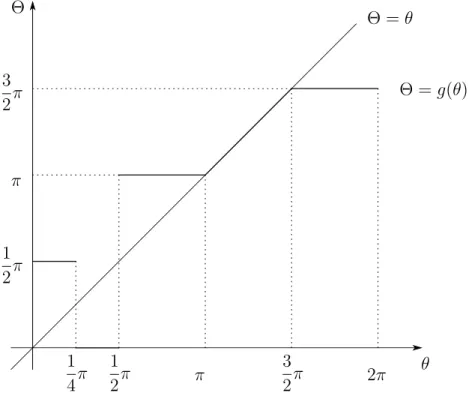
If a cluster has a walll(θ) then the argument functiongof function∇uis not smooth at θ. By Lemma 2.6 we see that the graph of g has symmetric jump with respect to Θ =θ if g jumps at θ. See Figure 2.
We shall define a q-fold energy Efq for q >0.
Definition 2.7. For a given q >0 we define the q-fold energy Efq on Kf by
Efq(∇u)≡
∪l(θ)|
[∇u](x)|qd
θ Θ
π 3
2π 2π 1
2π 1
4π π
1 2π 3 2π
Θ =θ
Θ = g(θ)
Figure 2. The graph of the argument functiong ∈Y of the cluster in figure 1
for ∇u∈Kf, where [∇u](x) denotes the jump of ∇uat x= (rcosθ, rsinθ) i.e.,
[∇u](x) =∇u(x+ 0e)− ∇u(x−0e)
with e= (−sinθ,cosθ). In fact
|[∇u]|(x) = 2|sin(g(θ−0)−θ)−θ|.
Next lemma asserts that this fold energy Efq is L1-lower semi-continuous on K
f.
Lemma 2.8. For any cluster ∇u∈Kf and for any positive number ε >0 there
exists δ∗ >0such that
Efq(∇u′) +ε > Efq(∇u)
for any ∇u′ ∈K
f with ∇u− ∇u′L1 < δ∗.
Proof. Step 1. For ε >0 we shall determine desired δ∗>0.
There exists a function g on (0,2π] such that
g(argx) = arg∇u(x) and θ−π < g(θ)≤θ+π.
Without loss of generality it is enough to prove in the case ∇u ∈ Kf\Kf0 because Efq(∇u) = 0 if ∇u∈Kf0. There exists ˜α∈Nand there exists{θk}αk˜=1 ⊂(0,2π] such that
θ1 < θ2 <· · ·< θα˜ and ˜Σ∇u =
˜
α
By a translation of θ we may assume that
0< θ1 < θ2 <· · ·< θα˜ <2π.
We set θ0 = 0, θα˜+1 = 2π and
δ0 ≡ 1
41≤mink≤α˜+1{θk−θk−1}.
If Σ∇u =∅, i.e. ∇uhas no jump, thenEfq(∇u) = 0. So we may assume that Σ∇u =∅
where
J∇u ={θ ∈J˜∇u |
l(θ)|
[∇u](x)|q
dS >0}
and
Σ∇u =
θ∈J∇u
l(θ).
There exists α ∈N and {θk(j)}αj
=1 ⊂ {θk}αk˜=1 such that
θk(1) < θk(2) <· · ·< θk(α) and Σ∇u = α
j=1
l(θk(j)).
Sincey= 2qsinqX is continuous onR, for any ε >0 and for anyX
∈Rthere exists
δ(X, ε)>0 such that|2qsinqX
−2qsinqX′|< ε if |X−X′|< δ(X, ε). We set
δ1 ≡ 1
41min≤j≤α{(θk(j)+π)−arg∇u(θk(j)), |arg∇u(θk(j))−θk(j)|
,arg∇u(θk(j))−(θk(j)−π), δ0, δ(|arg∇u(θk(j))−θk(j)|, ε α)}. It is clear that δ2≡ sinδ1 >0 because 0< δ1 ≤π/4. We set
δ∗ ≡
1 2δ1δ2.
Step 2. We assume that a finite wall cluster∇u′ satisfies ∇u− ∇u′L1 < δ∗.
We will show that a cluster ∇u′ has a wall l(θ′
j) near a wall l(θk(j)) of ∇u.
For any j ∈ {1,2,· · · , α} there existsξj ∈ {x∈Ω0 |θk(j)−δ1 <argx < θk(j)} such that |∇u′(ξ
j)− ∇u(ξj)|< δ2, because ∇u′− ∇uL1 < δ∗. We note that
∇u≡ ∇u(ξj) on [argξj, θk(j)] (1)
becausel(θk(j))⊂Σ∇uand argξj ∈(θk(j)−δ0, θk(j)). Similarly for anyj ∈ {1,2,· · · , α}
there exists ηj ∈ {x∈Ω0 |θk(j) <argx < θk(j)+δ1}such that |∇u′(ηj)− ∇u(ηj)|< δ2, and we obtain that
We will argue that
|∇u(ξj)− ∇u(ηj)| ≥2 sin 2δ1. Since
2δ1 ≤min{(θk(j)+π)−arg∇u(θk(j)), |arg∇u(θk(j))−θk(j)|, arg∇u(θk(j))−(θk(j)−π)} ≤π/2,
we see
sin|g(argθk(j))−θk(j)| ≥sin 2δ1.
Since l(θk(j))⊂Σ∇u, (1) and (2), we have
|∇u(ξj)− ∇u(ηj)|= 2 sin|
arg∇u(ξj)−arg∇u(ηj)|
2
= 2 sin|arg∇u(θk(j))−θk(j)|
≥2 sin 2δ1. From the discussion above, we can easily check that
∇u′ ≡ ∇u′(ξj) on {x∈Ω0 | argξj ≤argx≤ argηj}.
So there exists θ′
j ∈[argξj,argηj] such thatl(θj′)⊂Σ˜∇u′. Without loss of generality
we may assume that
θ′j = min{θ′j ∈[argξj,argηj] |l(θj′)⊂Σ˜∇u′}.
Let us check that
g′(θ′j) =g′(argξj). (3)
where g′ is the argument function of ∇u′
satisfying θ−π < g′(θ)≤θ+π.
Since
|g′(argξ
j)−g(argξj)|
2 < π−
3 2δ1 and
2 sin |g
′(argξ
j)−g(argξj)|
2 =|∇u
′(ξ
j)− ∇u(ξj)|< δ2 <2 sinδ1, we find that
|g′(argξj)−g(argξj)|<2δ1. (4) So we can get g′(argξ
j)= argξj because
|g′(argξj)−argξj| ≥ |g(argξj)−argξj| − |g(argξj)−g′(argξj)|
>4δ1−2δ1 >0. Similarly we can get g′(argξ
j)= argξj±π.Hence θ
′
j = argξj. Moreover
We can get g′(θ′
j)=θ
′
j because
|g′(θ′j)−θ′j|=|g′(argξj)−θj′|
≥ |g(θk(j))−θk(j)| − |θj′ −θk(j)| − |g(argξj)−g′(argξj)| >4δ1 −δ1−2δ1 >0
by definitions of δ1 and θ′j and by (1), (3) and (4). Similarly we can show that g′(θ′
j)=θ
′
j ±π.
Since l(θ′
j)⊂Σ˜∇u′, g′(θ ′
j)=θ
′
j and g′(θ
′
j)=θ
′
j ±π, we obtain that
l(θ′j)|
[∇u](x)|qd
S >0
This is equivalent to l(θ′
j)⊂Σ∇u′.
Step 3. We will show that the value of the fold energy of ∇u′ on l(θ′j) is nearly equal to one of ∇u onl(θk(j)). i.e. we will establish that
|
l(θk(j))
|[∇u]|q d
H1 −
l(θ′ j)
|[∇u′]|q d
H1|< ε α.
By definitions ofδ1 and θ′j and by (4),
||g(θk(j))−θk(j)| − |g(θ′j)−θ ′
j|| ≤ |g(θk(j))−g(θj′)|+|θk(j)−θ′j| <2δ1+δ1 < δ(|g(θk(j))−θk(j)|,
ε α). Hence
|
l(θk(j))
|[∇u]|q
dH1−
l(θ′ j)
|[∇u′]|q
dH1|=|2q
sinq|g(θk(j))−θk(j)|−2qsinq|g(θ′j)−θ′j||
< ε α
using the definition of δ(|g(θk(j))−θk(j)|, ε/α).
Step 4. For any positive numberε >0 there exists δ∗ >0 such that
Efq(∇u′) +ε > Efq(∇u)
for any ∇u′ ∈K
f with ∇u− ∇u′L1 < δ∗.
Because
Efq(∇u′) +ε≥
α
j=1
l(θ′ j)
|[∇u′]|q
dH1+ε
> α
j=1
l(θk(j))
|[∇u]|q d
H1 − ε
α +ε = ˜ α k=1
l(θk)
|[∇u]|q dH1 =Eq f(∇u).
2.3. Limit clusters. In this section we shall define a limit cluster and its fold energy, and discuss the stability of limit clusters with respect to its fold energy.
Let
Kq
∞ ≡ {∇u∈K | ∃{∇uj}j∈⊂Kf s.t. ∇uj → ∇u in L
1
supEfq(∇uj)<∞}.
We call this set Kq
∞ the set of all limit clusters. We consider the L1-lower
semi-continuous relaxation Eq ∞ of E
q f on K
q
∞. In fact, for a limit cluster ∇u ∈K∞q , the
fold energy of ∇uis defined by
Eq
∞(∇u) = inf{limE q
f(∇uj) | {∇uj}j∈⊂Kf with ∇uj → ∇u in L
1
Efq(∇uj)<∞}.
We are able to prove
Eq ∞=E
q
f onKf
by similar way to prove Lemma 2.8.
3
Compactness theorem
3.1. Compactness theorem on the set of limit clusters. In this section we shall give compactness theorem which is one of our main results. Note that this theorem satisfies for all q >0.
Theorem 3. Assume that {∇uj}j∈ ⊂ K q
∞ and that E∞q (∇uj) is bounded in j. Then there exists a subsequence {∇uj(k)}k∈ of {∇uj}j∈ and there exists a
∇u0 ∈K∞q such that ∇uj(k) converges to ∇u0 in L1(B1).
If we admit lemma 3.1, then it is easy to prove theorem 3 by using diagonal method.
Lemma 3.1. Assume that {∇uj}j∈ ⊂ Kf and that E q
f(∇uj) is bounded in j.
Then there exists a subsequence {∇uj(k)}k∈ of {∇uj}j∈and there exists ∇u0 ∈
Kq
∞ such that ∇uj(k) converges to ∇u0 in L1(B1).
Proof. The key point in this proof is to pay attention to properties of argument of finite wall clusters.
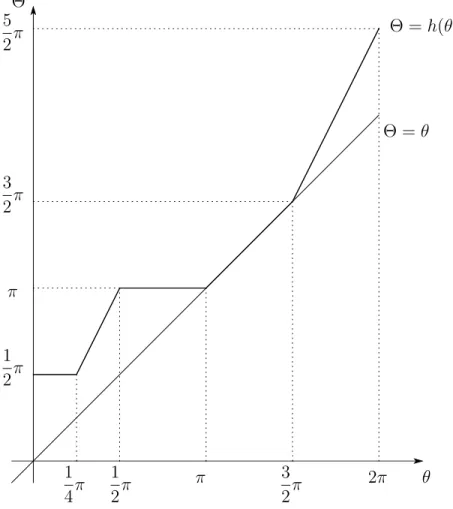
Step 1. We will introduce a continuous function hj which are made from the
argument function gj of ∇uj.
bygj. We set
hj(θ)≡
gj(θ) if gj(θ)≥θ
2θ−gj(θ) if gj(θ)< θ,
thenhj is continuous function. Moreover,{hj}j∈is uniformly bounded and
equicon-θ Θ
π 3
2π
2π 1
2π 1
4π π
1 2π 3 2π
Θ =θ Θ = h(θ) 5
2π
Figure 3. The graph ofh of g in figure 1.
tinuous because of lemma 2.6. By Ascoli-Arzel´a Theorem, there exists {hj(k)}k∈⊂
{hj}j∈and there exists a continuous function h0 such that hj(k) uniformly
contin-uous to h0.
Step 2. We will show properties of such h0 which are h0 is a piecewise smooth function on certain domain andh′ = 0 or h′ = 2.
For any n∈N we set
Dn≡ {(x1, x2)∈R2|x1∈[0,2π], x1+ 1
and
Un ≡ {θ∈(0,2π)|(θ, h0(θ))∈Dn}.
Since Un is open, there exists a sequence {It(n)}j∈ of open interval sets such that
∞
t=1
It(n) =Un.
Notice thathj(k)is piecewise smooth function onIt(n)andhj′(k) ≡0 orh′j(k) ≡2.Since the energy bounded assumption supj∈E
q
∞(∇uj)< ∞ and since hj(k) converges to h0, h0 is piecewise smooth function on It(n), too. Moreover h′0 ≡ 0 or h′0 ≡2. So h0 is piecewise smooth function on Un and h′0 ≡0 or h′0 ≡2.
Step 3. We will introduce∇u0 which satisfies ∇uj tending to ∇u0 in L1(B1). We set
g0(θ)≡
h0(θ) if θ ∈
∞
t=1
Un and h′0(θ)≡0
2θ−h0(θ) if θ ∈
∞
t=1
Un and h′0(θ)≡2
h0(θ) if θ /∈
∞
t=1
Un
and
∇u0 ≡(cosg0(argx),sing0(argx)).
Then there exists {∇uj(k)}k∈⊂ {∇uj}j∈such that
∇uj(k) → ∇u0 a.e. x∈B1
because hj(k) converges to h0. So by bounded convergence theorem, we see that
∇uj(k)→ ∇u0 in L1. ✷
3.3. Comments for Compactness theorem. In Lemma 3.2 if q0=r=1 then
∇u0 ∈ K∞q belongs to Aviles-Giga space but ∇u0 is not a function of bounded variation [1]. In [1], Ambrosio, DeLellis and Mantegazza suggest one example which belongs to Aviles-Giga space and which is not a function of bounded variation. Our example is graphically easier to understand than theirs.
Lemma 3.2. Assume that q0 ≥ 1/2 and assume that q > q0 and r ≤ q0. Then there exists {∇uj}j∈ ⊂ K
q
f with E q
f(∇uj) is bounded in j and there exists
∇u0 ∈K∞q such that ∇uj → ∇u0 inL1(Ω0)and supj∈E r
Proof. We will suggest a example of∇uj and∇u0 as required. We set
A(l)≡
l−1
k=1
{ 1
k2 + ( 1 k)
1
q0 −( 1
k+ 1)
1
q0}.
Forj ≥2 let
gj(θ)≡
−1 if θ ∈[0,1 2),
2 if θ ∈[1
2,2−( 1 2)
q),
A(l)−(1 l)
1
q0 if θ ∈[A(l), A(l) + 1
2l2),
A(l+ 1) + ( 1 l+ 1)
1
q0 if θ ∈[A(l) + 1
2l2, A(l+ 1)), l = 2,3,· · · , j,
A(j+ 1) + ( 1 j + 1)
1
q0 if θ ∈[A(j+ 1), A(j+ 1) + ( 1
j+ 1)
1
q0),
θ if θ ∈[A(j+ 1) + ( 1
j+ 1)
1
q0,2π−1),
2π−1 if θ ∈[2π−1,2π],
g0(θ)≡
−1 if θ∈[0,1 2),
2 if θ∈[1
2,2−( 1 2)
q),
A(l)−(1 l)
1
q0 if θ∈[A(l), A(l) + 1
2l2),
A(l+ 1) + ( 1 l+ 1)
1
q0 if θ∈[A(l) + 1
2l2, A(l+ 1)), l≤2,
θ if θ∈[∞
k=1 1
k2 + 1,2π−1),
2π−1 if θ∈[2π−1,2π].
We set
∇u0(x)≡(cosg0(argx),sing0(argx)).
Then we easily check that
∇uj → ∇u0 in L1.
If q > q0≥ 1/2, since
Efq(∇uj)≤2q j
k=1 (1
k) 2q
+ 2q(q+ 1) sup 0≤l≤q
q l
j
k=1 (1
k)
q q0,
we obtain
sup
j∈
Efq(gj)<∞.
If r≤q0, since
Efq(∇uj)≥2q j
k=1 (1
k)
r q0,
we get
sup
j∈
Efq(gj) =∞. ✷
4
Remark on
L
1-lower semi-continuity theorem
4.1. L1-lower semi-continuity theorem on the set of limit clusters. By the definition of limit clusters it is clear that the fold energy Eq
∞ is L1-lower
semi-continuous on the set of limit clusters. Moreover we prove that the fold energy Eq ∞
is exactly semi-continuous in this section.
Lemma 4.1. The fold energy Eq
∞ is lower semicontinuous but not continuous on
Kq ∞.
Proof. It is enough to prove that the fold energy Efq is not continuous on Kf.
gj(θ)≡ 1
2π on [0,
1 4π],
0 on [1
4π, 1 4π+
1 4jπ],
1 2π+
1
2jπ on [ 1 4π+
1 4jπ,
1 2π+
1 2jπ],
θ on [1
2π+ 1 2jπ,
3 2π],
3
2π on [
3 2π,2π],
g0(θ)≡
1
2π on [0, 1 2π],
θ on [1
2π, 3 2π],
3
2π on [ 3 2π,2π], then gj, g0 ∈Y. And we set
∇uj(x)≡(cosgj(argx),singj(argx)),
and
∇u0(x)≡(cosg0(argx),sing0(argx)).
Then ∇uj and ∇u0 are finite wall clusters. We can easily check that
∇uj → ∇u0 in L1, Efq(∇u0) = 2,
Efq(∇uj) = 2(
√
2 2 )
q+ 2 + 2 sinq
|gj(
1 4π+
1 4jπ)−
1 4π+
1 4jπ|. Then for any j
Efq(∇u0)−Efq(∇uj)≥2(
√
2 2 )
q >0
5
Global minimizers and examples of local
mini-mizer
In this chapter we present global minimizers and examples of local minimizers.
5.1. Global minimizers. Global minimizers are sorted into three patterns as follows.
Theorem 5.1. Following two statements are equivalent. (a)∇u∈Kq
∞ is a global minimizer onK∞q of E∞q .
(b)∇u∈Kq
∞ is either arg∇u(x)=arg(x) or arg∇u(x)=arg(−x) or arg∇u≡C.
Proof. If (b) holds then we can get (a) because a fold energy of any clusters with (b) is zero. On the other side if (a) holds then a global minimizer∇u has zero energy. So∇uhas no energy on all walls of ∇u. Therefore∇uis a finite wall cluster and by the feature of finite wall clusters ∇u satisfies (b).✷
5.2. Examples of local minimizer. We consider a typical series of configura-tions which is expected to be stationary for Eq
∞.
Definition 5.2. For given{θ∗
j}2jn=1 ⊂(0,2π] satisfying 0< θ∗
1 < θ∗2 <· · ·< θ∗2n ≤2π
and
θ∗
j+1 =θj∗+
1 nπ for
∀j = 1,2,· · · ,2n−1
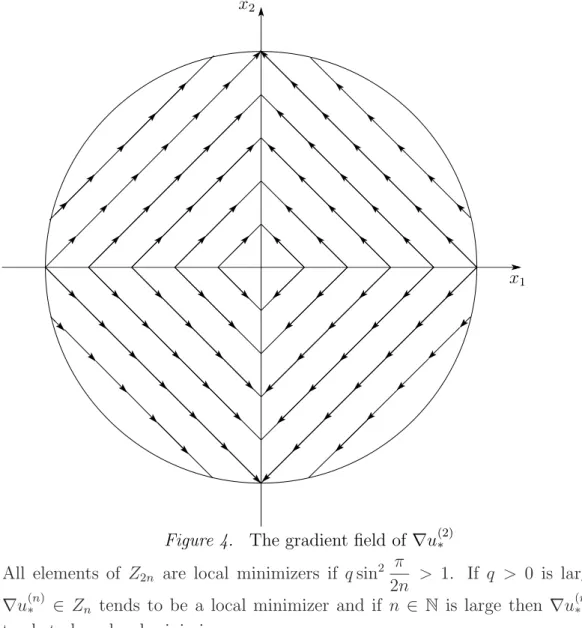
we define ∇u(∗n)∈Kfq as follows.
∇u(∗n)∈Kfq has 2n walls {l(θ∗j)}2jn=1 and satisfies for all x∈Ω0 with argx∈(θ∗1, θ2∗)
∇u(∗n)(x) = (cos(θ∗1+ n+ 1
2n ),sin(θ
∗
1+ n+ 1
2n )) or
∇u(∗n)(x) = (cos(θ∗1− n+ 1
2n ),sin(θ
∗
1 − n+ 1
2n )).
x1
x2
Figure 4. The gradient field of ∇u(2)∗
All elements of Z2n are local minimizers if qsin2 π
2n > 1. If q > 0 is large then
∇u(∗n) ∈ Zn tends to be a local minimizer and if n ∈ N is large then ∇u
(n)
∗ ∈ Zn
tends to be a local minimizer.
Theorem 5.3. Assume thatq >0 and n ∈N\{1}satisfy qsin2 π
2n >1and that
∇u(∗n) ∈ Z2n. Then there exists ε0 > 0 such that E∞q (∇u
(n)
∗ ) < E∞q (∇u) for any
∇u ∈ Kq
∞ with ∇u
(n)
∗ − ∇uL1 < ε0. Moreover, if q > 0 and n ∈ N\{1} satisfy
qsin2 π
2n <1then ∇u (n)
∗ ∈ Z2n are not local minimizers.
If we admit lemma 5.4, then it is easy to check theorem 5.4. so it is enough to prove lemma 5.4.
Lemma 5.4. Assume that q > 0 and n ∈ N\{1} satisfy qsin2 π
2n > 1 and that
∇u(∗n) ∈ Z2n. Then there exists ε′0 > 0 such that Efq(∇u(∗n)) < Efq(∇u) for any
Proof. Step 1. It is enough to check that finite wall clusters∇u(∗n)are minimizers
of fold energyEfq on the set of finite wall clusters∇u′ which have 2n walls{l(θ′
j)}2jn=1 with 2
n
j=1 l(θ′
j) = Σ∇u′ = ˜Σ∇u′ because of next Claim.
Claim . Letε∗∗≡sinq(
1 2π+
11
16nπ) and letδ∗ =δ∗(ε∗∗) as Lemma 2.8. If∇u
′ ∈K f
with ∇u(∗n)− ∇u
′
L1 < δ∗ has a wall l(θ2′n+1) ⊂ Σ∇u′ besides 2n walls {l(θ ′
j)}2j=1n , then
Efq(∇u′)> Efq(∇u(∗n)) +ε∗∗.
Proof of Claim. By the definition of ∇u(∗n) and by ∇u∗− ∇u
′
L1 < δ∗, we are
able to check thatl(θ′
2n+1) ⊂Σ˜∇u′. Without loss of generality we can assume that
θ′
1 < θ2′n+1 < θ2′. Let
θmax′ ≡max{θ′ ∈(θ′1, θ2′) | l(θ′)⊂Σ˜∇u′\
2n
j=1 l(θ′j)}
and let g′ be a function on (0,2π] satisfying θ−π < g′(θ) < θ+π and g′(argx) =
arg∇u′(x) on Ω. Because
0< 1 2π+
5
16nπ < θ
′
max−g′(θ′max+ 0)< 1 2π+
11
16nπ < π we can get
l(θ′
max)
|[∇u′]|q
dH1 = 2 sinq|g′(θmax′ + 0)−θ′max|
>2 sinq
1 2π+
11 16nπ
= 2ε∗∗.
Consequently
Efq(∇u′)≥ 2n
k=1
l(θ′ k)
|[∇u′]|q d
H1+
l(θ′
max)
|[∇u′]|q d
H1
>(Efq(∇u(n)
∗ )−ε∗∗) + 2ε∗∗ =Efq(∇u
(n)
∗ ) +ε∗∗.
This complete the proof of Claim.
Step 2. By Step 1, for any clusters ∇u′ with ∇u(∗n) − ∇u
′
L1 < δ∗ we will
represent the fold energy Efq of ∇u′ by 2n−1 parameters.
A routine calculation yields
l(θ1)
|[∇u′]|q d
H1 = 2qsinq(α
l(θ2n)
|[∇u′]|q
dH1 = 2q
sinqα
and for any k ∈[2,2n−1]
l(θk)
|[∇u′]|q dH1 = 2qsinq(−1)k{(−1)kα+θ k+ 2
k−1
h=1
(−1)hθ k−h}.
where g′ is the argument function of ∇u′,α =g′(0 + 0) and{l(θ′
j)}2jn=1 are all walls of ∇u′.
The other side 2n−1
l=1
(−1)l+1θ
2n−l = 2π because
g(θ2n−0) +g(θ1−0) + 2π
2 = 2π.
So
l(θ2n−1)
|[∇u′]|q dH1 = 2qsinq(
2n−1
h=2
(−1)h+1θ
2n−h−α).
Therefore the fold energy of∇u′is represented by 2n−1 parametersα,θ1,θ2,· · ·,θ2n−2.
i.e.
Efq(∇u′) = 2qsinq(α
−θ1) + 2q 2n−2
k=2 sinq(
−1)k
(−1)kα+θ k+ 2
k−1
h=1
(−1)hθ k−h
+2qsinq
2n−1
k=2
(−1)h+1θ
2n−h−α
+ 2qsinqα.
Step 3. We set
Rq(α, θ1,· · · , θk,· · · , θ2n−2) =
Efq(∇u′)
2q for ∇u
(n)
∗ − ∇u
′
L1 < δ∗
and
P =
n+ 1 2n π,
1
nπ,· · · , k
nπ,· · · ,
2n−2
n π
.
A routine calculation yields that
Efq(∇u(n)
∗ ) = 2qRq(P),
and
HessRq(P) =q{q(sin π 2n)
2−1}(cos π 2n)
q−2(a
ij)1≤i,j≤2n−1
where
aij =aji, a11= 2n,
amm = 8n−2−4m if m = 1,
a1m = (−1)m+1(4n−2m) if m = 1,
atm= (−1)m+t(−8n−4t−1) if t > m > 1.
In this step we will prove that HessRq(P)>0.
We set
Dk ≡(aij)1≤i,j≤k.
Because ifk is odd then
Dk ∼
2n−(k−1) 3 0 0 0 · · · 0 3 6 −1 0 0 · · · 0 0 −1 2 −1 0 · · · 0 0 0 −1 2 −1 · · · 0
0 0 0 −1 2 . .. 0
..
. ... ... . .. ... ... −1
0 0 0 0 0 −1 2
and because if k is even then
Dk∼
2n−k −2 0 0 0 · · · 0
−2 6 −1 0 0 · · · 0 0 −1 2 −1 0 · · · 0 0 0 −1 2 −1 · · · 0
0 0 0 −1 2 . .. 0
..
. ... ... . .. ... ... −1
0 0 0 0 0 −1 2
we are able to get
detDk =
−5k2+ 5 + 10nk−8n >0 if k is odd,
−5k2+ 4 + 10nk−8n >0 if k is even
where 1 ≤k ≤ 2n−1. Therefore HessRq(P) >0 because (a
References
[1] L. Ambrosio, C. DeLellis and C. Mantegazza,Line energies for gradient vector fields in the plane, Calc. Var. 9(1999), 327-355
[2] P. Aviles and Y. Giga,The distance function and defect energy.Proc. Roy. Soc. Edinburgh Sect, A, 126(1996), 923-938
[3] P. Aviles and Y. Giga, On lower semicontinuity of a defect energy obtained by a singular perturbation of a Ginzburg-Landau type energy for gradient fields, Proc. Roy. Soc. Edinburgh Sect. A, 129(1999), 1-17
[4] De Lellis, Camillo and Otto, FelixStructure of entropy solutions to the eikonal equation, J. Eur. Math. Soc. (JEMS) 5 (2003), no. 2, 107–145.
[5] A. DeSimone and R. V. Kohn, S. M¨uller and F. Otto, A compactness result in the gradient theory of phase transitions, Proc. Roy. Soc. Edinburgh Sect. A, 131(2001), 833-844
[6] P. -E. Jabin, F. Otto and B. Perthame, Line-energy Ginzburg-Landau models: zero-energy states, Ann. Sc. Norm. Super. Pisa Cl. Sci. (5) 1 (2002), no. 1, 187–202.
[7] W. Jin and R. V. Kohn, Singular perturbation and the energy of folds J. Non-linear Science. 10 (2000), 355-390.