【原著論文】
Characteristics of University Students' Values and Ideas of Mathematical Models through Comparison with Those of Elementary School Students and
Junior High School Students
Isao SHIMADA (Nippon Sport Science University)
Bishop (1988) pointed out the importance of research on values in mathematics education.
Based on this idea, Shimada and Baba (2012) developed three “socially open-ended problems.”1 Shimada and Baba (2015) gave them to fourth graders, and examined how students appreciated others’ values2 and transformed their own values during a lesson. Furthermore, Shimada and Baba (2016) studied the issue of the long-term transformation of values and mathematical models across grades. As an extension of this long-term transformation, Shimada (2017) compared the values and ideas of mathematical models of elementary school students with those of university students.
Similarly, Shimada and Baba (2018) compared the values and ideas of mathematical models of elementary school students with those of junior high school students.
Following these studies, the aim of this paper is to study university students' values and ideas of mathematical models3 through comparison with those of elementary school students and junior high school students,4 and the research results reveal four characteristics.
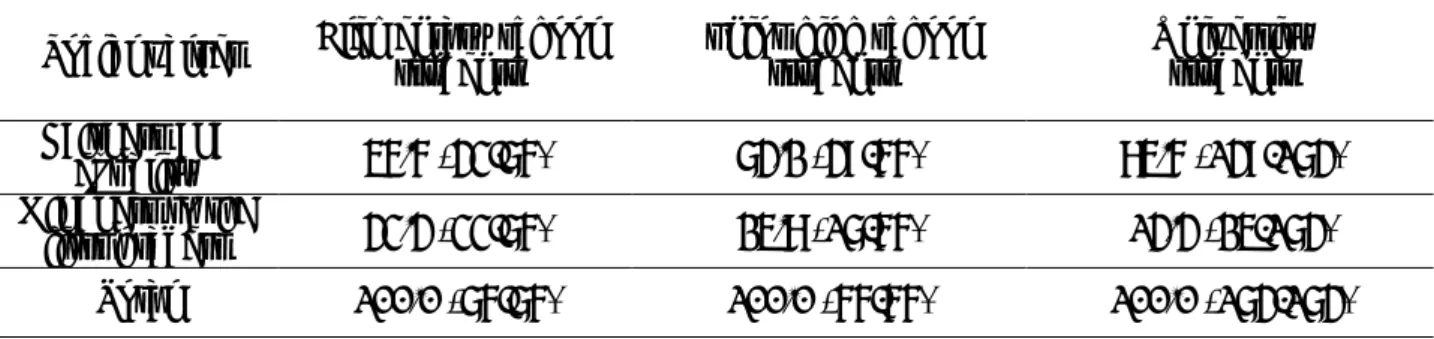
The first characteristic is that the ratio of students who express the value “fairness and equality”
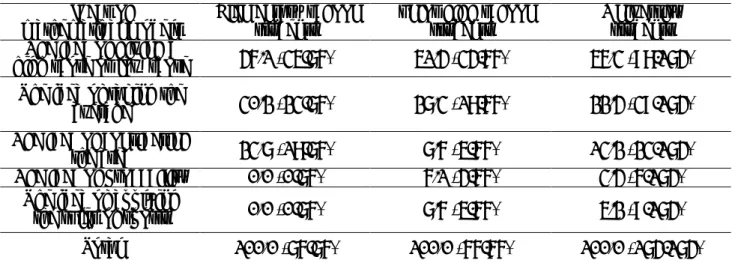
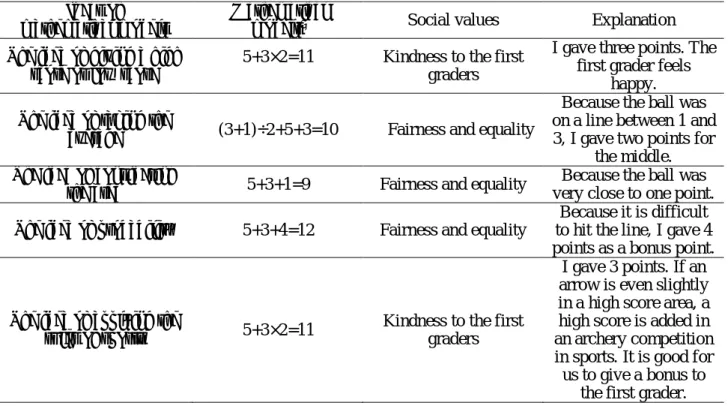
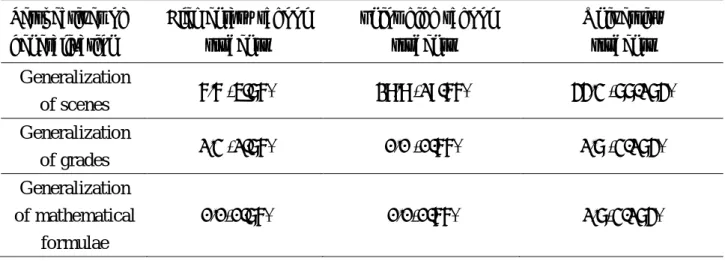
increases as they (elementary school students, junior high school students, and university students) became older (Table 1). This can be expressed statistically.5 The second characteristic is that the ideas of mathematical models of the university students are the same as those of the junior high school students, and there is no uniqueness in the university students (Table 2). However, there are some explanations according to “the perspective of a school teacher,” which can be slightly seen only among the university students (Table 4). The third characteristic is that “Generalization of scenes” tends to increase as students became older (Table 5). This can be expressed statistically.6 The fourth characteristic is that “Generalization of mathematical formulae” is not seen in junior high school students or elementary school students (Shimada, 2017), but is slightly seen only in university students, and it became clearer that this is particular to university students (Table 6).
Key Words: socially open-ended problems, university students’ values, ideas of mathematical models, elementary school students, junior high school students
小学生や中学生との比較を通した大学生に見られる価値観と 数学的モデルの特徴
島田 功(日本体育大学)
Shimada and Baba (2012,2015)では,社会的オープンエンドな問題(的当て問題)を用い
て,小学4年生の子ども達の社会的価値観や数学的モデルの実態とその変容(1時間の問題 解決過程に於ける変容)を明らかにした。また,Shimada and Baba (2016)では,縦断的研究 法を用いて小学4年生時の価値観と数学的モデルを記録しておき,その子ども達が6年生卒 業時にどのような価値観や数学的モデルに変容しているかの比較研究を行った。更には,
島田 (2017)では,小学生と大学生との価値観と数学的モデルの比較研究をし,Shimada and
Baba (2018) では,小学生と中学生との価値観と数学的モデルの比較研究を行った。今回
の研究は,これらの研究を更に発展させ,中学生と大学生の価値観と数学的モデルの比較 を中心に,小学生と中学生と大学生の価値観と数学的モデルの比較をし,大学生の思考の 特徴を明らかにすることを目的とした。研究の結果,4つの知見を得た。
① 平等・公平の価値観は小学生,中学生,大学生と年齢を重ねると増えていく傾向が見ら れる。これは統計的にも言える(表1)。
② 大学生の考える数学的モデルの背景となる考えは中学生と同じで大学生独特のものは 見られないが(表2),中学生や小学生には見られない大学生特有の「小学校教師の視 点」による説明が見られる(表4)。
③ 場面の一般化は大学生になるにつれて増えていく傾向が見られる。これは統計的にも 言える(表5)。
④ 数式の一般化は,小学生同様(島田,2017),中学生にも見られず,大学生特有なもの であることがより明確になった(表6)。
キーワード:社会的オープンエンドな問題,比較研究,大学生の価値観と数学的モデルの 考え,中学生,小学生
RESEARCH BACKGROUND
Integration of cognitive science and design science is said to be beginning in Japan. Cognitive science is a science that excludes values, and it is an academic field that pursues factual propositions related to human intellectual activities. On the other hand, design science is an academic field that emphasizes human values (Science Council of Japan, 2007). Furthermore, in Japanese mathematical education, it has been pointed out that values were expressed with mathematical solutions in the process of problem-solving in certain socially open-ended problems (Iida et al., 1995). We can observe that these values can be found in the reasons provided for the mathematical solutions. It is important for students to associate mathematical solutions with values in order to develop problem-solving abilities related to issues such as environmental problems, so as to produce the different value judgments that are seen in modern society. Therefore, there is a demand for teachers to think about how to treat different mathematical solutions together with the reasons in the background. Shimada and Baba (2012, 2015) conducted a lesson and discussed these mathematical solutions and values in the classroom.
Through such discussions, we identified that students actively expressed their mathematical solutions and the reasons for them, and refined their solutions and transformed their values by listening to those of others. This transformation was examined by comparing values and mathematical models between the beginning and end of a class. Furthermore, in the subsequent study (Shimada and Baba, 2016), we analyzed the long-term transformation for two years between the fourth grade and the sixth grade, and identified three characteristics. After those studies, we regarded it is important to check the transformation of values and mathematical models in an even longer period. However, in the Japanese education system, it is not possible to investigate the transformation of values and mathematical models by tracing the same group of students. This is because they proceed to different junior high schools after elementary school.
As an alternative to this long-term transformation, Shimada (2017) compared the values and the ideas of mathematical models of elementary school students with those of university students by giving the same problem (Fig. 1, “Hitting the target”). Similarly, Shimada and Baba (2018) compared the values and mathematical models of junior high school students and those of elementary school students by giving the same problem (Fig. 1), and the research results revealed three characteristics. In this paper as well as Shimada’s research (2017) and Shimada and Baba’s research (2018), a cross-sectional research method is used. In other words, this paper focuses on comparing the values and the ideas of mathematical models of junior high school students with those of university students.
LITERATURE REVIEW ON VALUES IN MATHEMATICS EDUCATION Three types of values in mathematics education can be identified according to the literature. The first is directly related to the values in mathematics and the second is related to society or societal events. The third, which is closely related to social values, consists of the values that correspond to individual preferences. These values will be discussed in detail below.
Figure 1: Problem-solving task “Hitting the target”
Mathematical values
The UNESCO report (1979) is one of the earliest studies which cite values in mathematics education. The five mathematical values are intelligibility, brevity, accuracy, relevance, and normality. A milestone in the research on values is Bishop (1988), which advocated the importance of the theme from a cultural perspective. He stated three pairs of values, including rationalism and empiricism, control and progress, and openness and mystery. The open-ended approach was a teaching approach in Japan that aimed to enhance the mathematical thinking abilities of generalization and application through various solutions in open-ended problems (Shimada, 1977; English translation: Becker and Shimada, 1997). “Mathematical values as a basis of three characteristics (abstractness, logicalness and formality) … are related with conciseness, clarity and integration as a driving force” (Nakajima, 1981).
Social (human) values
Brown (1984) has stated that real-world problems unavoidably involve values in decision- making, and issues of ethics and values become a central component in this. In the process of research on the open-ended approach, Iida et al. (1995) recognized that moral problems or ethical values may occur beyond mathematics discussions when students deal with melon division and room assignment. More recently, Greer (2007) has pointed out that mathematical modeling for proportion problems prompts recognition of social equity. Mechanistic division in a real-world context of proportion may create issues related to fairness, and thus equity. Nishimura et al.
(2011) classified social values into fairness, diversity and cooperation, responsibility and autonomy, sustainability, efficiency, and so on. In mathematics lessons to date, only mathematical values have been prized and social (human) values have not been taken up to the same extent.
On the other hand, when dealing with real-world problems, the student may express social values, and in order to ensure their meaningful learning we cannot simply ignore them. In this paper, these moral and ethical values are to be taken up as social values.
Personal values
The third category is values related to individual taste. For example, when selecting a new car, you may choose it based on the price, color, design, and functionality. These reasons of economy, design, and functional importance are referred to as personal values. These values are certainly not just personal, but they are also under the influence of society at a given time. In that sense, the second and third categories may be interrelated.
“Hitting the target:” At a school cultural festival, your class offers a game of hitting a target with three balls. If the total score is more than 13 points, you can choose three favorite gifts. If you score 10 to 12 points, you get two prizes, and if you score 3 to 9 points, you get only one prize. A first grader threw a ball three times and hit the target in the 5-point area, the 3-point area, and on the border between the 3-point and 1-point areas. How do you give the score to the student?
RESEARCH OBJECTIVE AND METHODOLOGY Research Objective
Following these studies, the aim of this paper is to study university students' values and mathematical models through comparison with those of elementary school students and junior high school students when giving university students the same problem (Fig. 1, “Hitting the target”). The assumption is that university students have more social and learning experience than elementary school students and junior high school students, and that this would cause differences in values and mathematical models.
Research Methodology
Overview of the class: A problem-solving lesson using the socially open-ended problem “Hitting the target” was carried out with first-year university students (174 students) in a private university in Tokyo on July 14, 2017 for 15 minutes. We carried out a problem-solving lesson using the same problem“Hitting the target” in the same private elementary school in Tokyo with the fourth graders on March 12, 2013 for 20 minutes, and with the sixth graders on March 10, 2016 for 20 minutes, and also with the third graders in the junior high school students in Hyogo prefecture on June 8, 2017 for 15 minutes. The data for the elementary school students are for fourth graders (38 students) and sixth graders (38 students), and that for junior high school students are for third-year students in two classes (66 students). Considering the time necessary to solve the problem, we set a time lag. As a result, all the students were able to solve it.
Research method on comparison of students’ values
Seah (2012), who is one of the leaders of the Third Wave international research project on values, stated the following in an overview of research on values:
The researching of values in the mathematics classroom has traditionally been approached using the research methods of questionnaires, observation, and/or interviews. … By the late 2000s, values were also identified through content analyses of artefacts such as photographs and drawing, often followed by participant interviews which served to clarify initial findings or questions. (Seah, 2012, pp. 2–3) In our previous study (Shimada and Baba, 2016), the same problem “Hitting the target” (Fig. 1) was given to fourth and sixth graders, and the values and ideas of mathematical models of the sixth graders were compared with those of the fourth graders by analyzing worksheets written by the students. As a result of this analysis, we found that students in both grades showed two values, but the fourth graders expressed the value “kindness to the first grader” more than the sixth graders, whereas the sixth graders expressed the value “fairness and equality” more than the fourth graders. We conjectured that the sixth graders might have transformed from the value
“kindness to the first grader” to the value “fairness and equality” as they grew older. In addition, we noted that the students expressed a greater variety of ideas of mathematical models, some of which were more advanced, as they learned more mathematical content. We speculated that the sixth graders might have developed their knowledge of mathematical expressions in quantity and quality as they became older. As an alternative to this long-term transformation, Shimada (2017) compared the values and the ideas of mathematical models of elementary school students with those of university students by giving the same problem (Fig. 1, “Hitting the target”). Similarly, Shimada and Baba (2018) gave junior high school students the same problem “Hitting the target”
and compared the results with the values and ideas of mathematical models of junior high school students and those of elementary school students, using the same method of analysis as in our previous study (Shimada and Baba, 2016). As a result of comparison between junior high school students and elementary school students, it was found that the above two conjectures on values and ideas of mathematical models showed increasingly validity. Concurrently, expanding the scope of research to university students, this paper focused on the above two conjectures to research how university students express the values of “kindness to the first grader” and “fairness and equality” as they become older; and second, to clarify how university students express various ideas of mathematical models as they have learned much more mathematical content.
The reason for using university students as a subject of research is that they have a wealth of living and learning experience. In addition, university students are the last stage of school education, and the goal was to see how they transformed their values and ideas of mathematical models. The analysis of values and ideas of mathematical models on a worksheet for the university students revealed four characteristics.
ANALYSIS OF STUDENTS’ DATA
The percentage of the value “fairness and equality” increases as students become older: university students expressed the most support for the value
“fairness and equality.” This can be expressed statistically.
The first characteristic is that the ratio of students who express the value “fairness and equality”
increases as they become older. Specifically, university students expressed the most support for the value “fairness and equality.” Table 1 shows the ratios of students who expressed each value.
The fractions inside the parentheses show (the numbers of students who expressed the values such as “fairness and equality” or “kindness to the first graders” on a worksheet) / (the numbers of all students in the respective school). All ratios in front of the parentheses show the converted percentages. For example, the percentage of university students expressing the value “fairness and equality” is 85.6%, whereas the percentage expressing the value “kindness to the first graders”
is 14.4%. From the data in Table 1, it can be understood that students tend to choose the value
“fairness and equality” more than the value “kindness to the first graders” as they get older. It can be assumed that the students’ values were affected by their social and cultural experience along with their growth, and thus they choose the value “fairness and equality” more. This can be expressed statistically.
Table 1: Values in school and university students Social values Elementary school
students Junior high school
students University
students Fairness and
equality 56.6 (43/76) 74.2 (49/66) 85.6 (149/174)
Kindness to the
first graders 43.4 (33/76) 25.8 (17/66) 14.4 (25/174)
Total 100.0 (76/76) 100.0 (66/66) 100.0 (174/174)
The ideas of mathematical models of the university students are the same as those of the junior high school students, but there are some explanations that can be seen only with university students.
The second characteristic is that the ideas of mathematical models of the university students are the same as those of the junior high school students, and there is no uniqueness in the university students (Table 2). However, there are some explanations that can be seen only with university students, such as “The perspective of a school teacher” (Table 4). Table 2 shows the ideas of mathematical models expressed by elementary school students, junior high school students, and university students, such as “The idea of giving a high score or low score,” “The idea of taking the average,” “The idea of considering the area,” “The idea of probability,” and “The idea of applying the rules of sports.” Table 3 shows examples of the ideas of mathematical models among the university students. A detailed examination of the ideas of mathematical models clarifies the following points. The ideas of mathematical models found in junior high school students could also be seen among university students. There was no idea of a mathematical model only for the university students. Table 4 below shows three examples of “The perspective of a school teacher.”
Some university students explained the reasons for their mathematical models from “The perspective of a school teacher,” such as “I think a practical and good opportunity to study a calculation arises for elementary school students.” The explanation from “The perspective of a school teacher” is not seen in the elementary school students and junior high school students.
Why is it seen in only the university students? We can speculate that it is because the university students here will become elementary school teachers in the future. This is an example in which living experience affects the explanations of mathematical models.
As a result of analysis from the perspective of generalization, generalization of scenes, generalization of grades, and generalization of mathematical formulae were seen in the worksheets. Among these generalizations, generalization of scenes tends to increase as students get older. Furthermore, generalization of mathematical formulae was not seen in junior high school students or elementary school students (Shimada, 2017),8 but was slightly seen only in university students.
Table 2: Ideas of mathematical models in school and university students Ideas of
mathematical models Elementary school
students Junior high school
students University
students The idea of giving a
high score or low score 46.1 (35/76) 51.4 (34/66) 56.3 (98/174) The idea of taking the
average 30.2 (23/76) 27.3 (18/66) 22.4 (39/174)
The idea of considering
the area 23.7 (18/76) 7.6 (5/66) 13.2 (23/174)
The idea of probability 0.0 (0/76) 6.1 (4/66) 3.4 (6/174) The idea of applying
the rules of sports 0.0 (0/76) 7.6 (5/66) 5.2 (9/174)
Total 100.0 (76/76) 100.0 (66/66) 100.0 (174/174)
Table 3: Examples of ideas of mathematical models in university students
Table 4: Examples of explanations depending on “The perspective of a school teacher”
Ideas of
mathematical models Mathematical
models7 Social values Explanation
The idea of giving a high
score or low score 5+3×2=11 Kindness to the first graders
I gave three points. The first grader feels
happy.
The idea of taking the
average (3+1)÷2+5+3=10 Fairness and equality
Because the ball was on a line between 1 and 3, I gave two points for
the middle.
The idea of considering
the area 5+3+1=9 Fairness and equality Because the ball was very close to one point.
The idea of probability 5+3+4=12 Fairness and equality
Because it is difficult to hit the line, I gave 4 points as a bonus point.
The idea of applying the
rules of sports 5+3×2=11 Kindness to the first graders
I gave 3 points. If an arrow is even slightly in a high score area, a high score is added in an archery competition in sports. It is good for us to give a bonus to
the first grader.
Ideas of
mathematical models Mathematical
models Social values Explanation
The idea of giving a
high score or low score 5+3×2=11 Kindness to the first graders
We should give 3 points. In addition,
the students in elementary school feel that a high score
calculation is more difficult. Therefore, I
think a practical and good opportunity to study a calculation arises for students.
The idea of giving a
high score or low score 5+3×2=11 Kindness to the first graders
When I give 3 points, elementary school students study the
calculation of addition greater than
10.
The idea of taking the
average 5+3+2=10 Fairness and equality
I gave two points for the middle. I give the
students an opportunity to think
about what the number between 1 and 3 is. As a result, I give the students an
opportunity to raise their mathematical
abilities.
Table 5: Perspectives of generalization in school and university students
Table 5 shows perspectives of generalization such as “Generalization of scenes,” “Generalization of grades,” and “Generalization of mathematical formulae.” Generalizations are important perspectives in mathematics education. “Generalization of scenes” means thinking about what happens regarding the other line when students consider the score for the boundary line between one point and three points. For example, there is the following example: “I gave 3 points on the boundary line between 1 and 3. I thought that the score for the boundary line between 1 and 3 is 2 points, but in that case, it becomes 0.5 points on the line between 0 and 1, and it can not be represented by an integer, so I made the score for the boundary line the larger score.” We can conjecture that “Generalization of scenes” increases as students get older, and this generalization constitutes the third characteristic observed in this research. In other words, the third characteristic is that “Generalization of scenes” tends to increase as students get older. This can be expressed statistically. “Generalization of grades” means to think about what happens regarding other grades such as a third-grade student or a sixth-grade student when students consider the boundary line between 1 point and 3 points. For example, there is the following example: “I gave 3 points as a first-grade student threw the ball. If the students in the fourth, fifth, or sixth grades threw, I think I would give lower than 3 points.” “Generalization of mathematical formulae” means to express them using 1 or 0, such as 3 × 1 or 3 × 0. This generalization can be thought as generalization of numbers.This is shown in detail below, and in Table 6 as the fourth characteristic. “Generalization of mathematical formulae” such as “5 × 1 + 3 × 1 + 2 × 1 = 10” or “0 × 0 + 1 × 0 + 3 × 2 + 5 × 1 = 11” is seen only in the university students.
The fourth characteristic is that “Generalization of mathematical formulae” is not seen in junior high school students or elementary school students (Shimada, 2017),and it became clearer that this is particular to university students (Table 6).Table 6 shows expressions of mathematical formulae. We can speculate that elementary school students and junior high school students used multiplication when balls were in the same place more than twice, and that university students have acquired sufficient learning experience of mathematics expressions and thus are able to use
“Generalization of mathematical formulae.” This generalization comes when we are thinking about other numbers and points on other lines. Generalizations are thoughts born when
Perspectives of generalization
Elementary school students
Junior high school students
University students Generalization
of scenes 6.6 (5/76) 28.8 (19/66) 44.3 (77/174)
Generalization
of grades 1.3 (1/76) 0.0 (0/66) 1.7 (3/174)
Generalization of mathematical
formulae
0.0(0/76) 0.0(0/66) 1.7(3/174)
broadening the scope of consideration and are important ideas in mathematics education.
Table 6: Generalization of mathematical formulae
CONCLUSION AND FUTURE ISSUES
This paper has analyzed university students' values and ideas of mathematical models through comparing them with those of elementary school students and junior high school students when giving the same problem “Hitting the target.”
(1) The first characteristic is that the ratio of students who express the value “fairness and equality” increased as they (elementary school students, junior high school students, and university students) became older (Table 1). This could be expressed statistically. From this result, it can be hypothesized that students might transform from the value “kindness to the first grader” to the value “fairness and equality” as they became older. This may be because society places more importance on “fairness and equality.” (2) The second characteristic is that the ideas of mathematical models of the university students are the same as those of the junior high school students, and there is no uniqueness in the university students (Table 2). However, there are some explanations according to “the perspective of a school teacher,” which can be slightly seen only among the university students (Table 4). (3) The third characteristic is that the percentage for the perspective of “Generalization of scenes” increased as students became older (Table 5). This could be expressed statistically. From this result, it can be hypothesized that they become able to construct mathematical models while considering other cases (on other lines) as they get older.
Ideas of the mathematical models
Mathematical
models Social values Explanation
The idea of giving a high score or low score
0×0+1×0+3×2+5×1
=11 Fairness and equality
I gave 3 points because I would like participants to have a
pleasant feeling.
The idea of taking the average
5×1+3×1+2×1=10 Kindness to the first graders
I gave 2 points because the ball is on
the boundary of 3 points and 1 point.
The first grader is happy.
The idea of considering the area
5×1+3×1+1×1=9 Fairness and equality
A ball is on the boundary of 5 points,
a ball is on the boundary of 3 points,
and a ball is on the boundary of 1 point.
(4) The fourth characteristic is that “Generalization of mathematical formulae” is not seen in junior high school students or elementary school students (Shimada, 2017), and it became clearer that this is particular to university students (Table 6). “Generalization of mathematical formulae”
is slightly seen only among the university students. This supports the conjecture that university students have acquired sufficient learning experience of mathematics expressions, and have internalized them and use them more freely in any situation. Reflecting on the above results establishes the next issues to be tackled. The first remaining issue is to consolidate the findings of this research by increasing the amount of data. Especially for (2) and (4), it is necessary to verify these points based on extensive data. The second issue is to investigate what values and ideas of mathematical models are expressed when giving other “socially open-ended” problems.
The third issue is to clarify why students might transform from the value “kindness to the first grader” to the value “fairness and equality” as they became older.
Notes
1 A “socially open-ended problem” is a particular type of problem (Baba, 2010) which has been developed to elicit students’ values by extending the traditional open-ended approach (Shimada, 1977; Becker and Shimada, 1997).
2 Shimada and Baba (2012) pointed out the importance of mathematical values, social values, and personal values in mathematics education. Shimada and Baba's researches (2012, 2015, 2016, 2018) and Shimada’s researches (2009, 2017) focus on social values among these three values.
The social values in this paper refer to the values of “fairness and equality” and “kindness to the first grader.”
3 “Mathematical models” generally refers to diagrams, graphs, mathematical words, and mathematical formulae. However, in this paper, “mathematical models” means mathematical formulae. The ideas of mathematical models are the ideas that produce mathematical models.
The reason for focusing on ideas of mathematical models is to respect not only the resulting mathematical models, but also the ideas creating them.
4 In particular,this paper focuses on comparing junior high school students’ values and ideas of mathematical models with those of university students. Furthermore, this paper focuses on the transformation of long-term values and ideas of generalization through elementary, junior high school, and university students. These were not seen in Shimada’s research (2017) and Shimada and Baba’s research (2018).
5 To investigate this point, the author performed the chi square test (flexibility 2; 1% level of significance: 9.21) with the data for the values of elementary school students, junior high school students, and university students to clarify the difference in values among them. The results indicate that the x2 level was 24.77, and the null hypothesis (the incidence of values among them does not have a difference) was dismissed, because x2 (24.77) was greater than 9.21, and the incidence of values among them shows that it could not be said that there was no difference. In other words, statistically, the older students tended to express the value “fairness and equality”
more than the younger students, and the opposite tendency is true for the value “kindness to the
first grader.”
6 To investigate this point, the author performed the chi square test (flexibility 2; 1% level of significance: 9.21) with the data for
“
Generalization of scenes”
of elementary school students, junior high school students, and university students to clarify the difference in values among them. The results indicate that the x2 level was 34.95, and the null hypothesis (the incidence of generalization of scenes among them does not have a difference) was dismissed, because x2 (34.95) was greater than 9.21, and the incidence of“Generalization of scenes” among them
shows that it could not be said that there was no difference. In other words, statistically, the older students tended to be able to express“
Generalization of scenes”
more than the younger students.7 To explain the mathematical model written in Table 3, for example, the meaning of the mathematical formula 5 + 3 × 2 = 11 is a mathematical formula that adds 5 points, 3 points, and 3 points. Here, 3 points mean that the score for the boundary line between 1 and 3 is 3 points.
8 The previous research (Shimada, 2017) only qualitatively analyzed generalization, but the current paper compares the data on generalization by elementary school students, junior high school students, and university students using quantitative analysis and clarifies the perspective of generalization. New generalization perspectives such as “Generalization of grades” and
“Generalization of scenes” tend to increase as students get older. These were not seen in the previous study (Shimada, 2017).
REFERENCES
Baba, T. (2009). Analysis of Socially Open-Ended Problems in Mathematics Education from the Perspective of Values. Journal of JASME Research in Mathematics Education,16, 247–252 (in Japanese).
Baba, T. (2010). Socially Open-Ended Approach and Critical Mathematics Education. Paper presented at EARCOME 5, Tokyo.
Becker, J.P. & Shimada, S. (Eds.) (1997). The Open-Ended Approach in Mathematics Education: A New Proposal for Teaching Mathematics. Reston: National Council of Teachers of Mathematics.
[Translation of Shimada, Ed. (1977).]
Bishop, A. (1988). Mathematical Enculturation: A Cultural Perspective on Mathematics Education.
Dordrecht: Kluwer Academic Publishers.
Brown, S.I. (1984). The Logic of Problem Generation: from Morality and Solving to De-Posing and Rebellion. For the Learning of Mathematics, 41, 9–20.
Greer, B. (2007). “A sense of proportion for social justice”, Philosophy of Mathematics Education Journal, 21. Retrieved from http://people.exeter.ac.uk/PEenest/pome21/
Iida, I., et al. (1995). Study on Perceptions of Values with Open-Ended Problems in Mathematics Learning. Journal of Mathematical Education in Kyushu No. 1, 32–43.
Nakajima, K. (1981). Mathematical Thinking and Mathematics Education. Tokyo: Kaneko Shobo Press (in Japanese).
Nishimura et al. (2011) Research on Formation of Mathematical Judging Ability: Its Significance and Framework of Lesson, Proceeding of JSME 44th Annual Conference, 237–242.
Science Council of Japan (2007). Integration of knowledge: Towards science for society (in Japanese).
Retrieved from www.scj.go.jp/ja/info/kohyo/pdf/kohyo-20-t34-2.pdf
Seah, W.T. (2012). Identifying Values in Mathematics Learning and Teaching. Document in the stud y group of values in Hiroshima University.
Shimada, I. (2009). Research on Lesson to Grow Ability of Decision Making in Mathematics. Journal of Japan Society of Arithmetic Education, 91(12), 20–30 (in Japanese).
Shimada, I. (2017). Study of diverse values in mathematics education: Through socially open-ended problems. Tokyo: Toyokan Press (in Japanese).
Shimada, I. & Baba, T. (2012). Emergence of Students’ Values in the Process of Solving Socially Open- Ended Problems. Proceedings of the 36th Conference of the International Group for the Psychology of Mathematics Education, Vol. 4, 75–82.
Shimada, I. & Baba, T. (2015). Transformation of Students’ Values in the Process of Solving Socially Open-Ended Problems. Proceedings of the 39th Conference of the International Group for the Psychology of Mathematics Education, Vol. 4, 161–168.
Shimada, I. & Baba, T. (2016). Transformation of Students’ Values in the Process of Solving Socially Open-Ended Problems (2). Proceedings of the 40th Conference of the International Group for the Psychology of Mathematics Education, Vol. 4, 187–194.
Shimada, I. & Baba, T. (2018). Junior High School Students’ Values and Mathematical Models through Comparing with those of the Fourth Grade Students and the Sixth Grade Students in Elementary School. ICMI-EARCOME 8 Proceedings of the 8th ICMI-EAST Asia Regional Conference on Mathematics Education, Vol. 2, 298–305.
Shimada, S. (Ed.) (1977). Open-Ended Approach in Mathematics Education: A Proposal for Lesson Improvement. Tokyo: Mizuumi Press (in Japanese).
Silver, B.A. (1993). On Mathematical Problem Posing. Proceedings of 17th Psychology of Mathematics Education, Vol.1, 66–85.
UNESCO. (1979). New Trends in Mathematics Teaching. Retrieved from unesdoc.unesco.org/images/0012/001248/124827Eo.pdf