
Ls in L and Sphinxes in Sphinx
3
0
0
全文
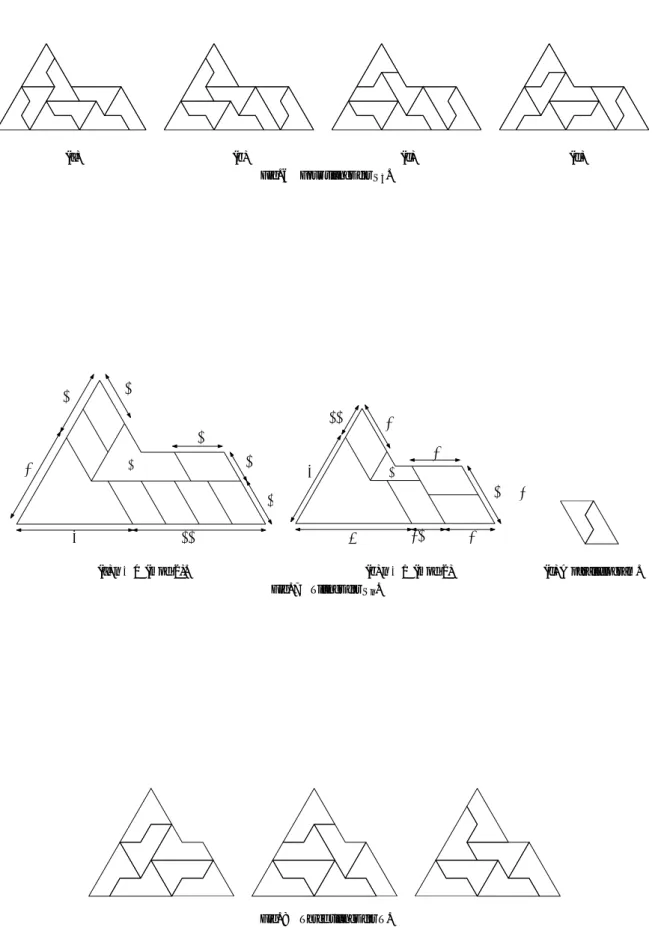
(2) Vol.2015-AL-154 No.9 2015/9/28. IPSJ SIG Technical Report. 4. n−2. n+2 n. 2. 2. 4. 2 2. 2 2n. 2n − 2. 2. 2n − 4 n−2. Ln 4. 2 4. Ln. n. n+2. 4. 2n (a) n ≡ 0 (mod 3).. Ln 4. 2n − 2. 4. 2. (b) n ≡ 1 (mod 3).. 4 2n − 4. 4. 4. (c) n ≡ 2 (mod 3).. Tilings for Ln .. Fig. 3. 3. Sphinxes in Sphinx. Fig. 4. Two ways of tiling the rectangle of dimension 2 × 3.. Fig. 5. A marked unit square in L1 . 2. That is, we can conclude that these functions are of type cn √ with some constant c. Note that 2 ≥ 1.41, 12e ≤ 32.62 and 36e ≤ 97.86.. 2. Ls in L We first prove that L1 can tile Ln for any n ≥ 1. Theorem 2 N(Ln , L1 ) ≥ 1 holds for any n ≥ 1. Proof. We have N(L1 , L1 ) = 1, N(L2 , L1 ) = 1, and N(L3 , L1 ) = 4. Therefore, it is sufficient to show that N(Ln , L1 ) ≥ N(Ln−2 , L1 ) for every n > 3. For each of three cases n ≡ 0, 1, 2 (mod 3), we use three patterns as in Fig. 3. The rectangles in Fig. 3 can be tiled in the way in Fig. 4. □ Now, we prove Theorem 1(1). First, we show the lower bound using the patterns in Fig. 3. Each pattern contains at least 2n − 6 rectangles of dimension 2×3. Moreover, each rectangle has two ways of tiling as shown in Fig. 4, which means that the number of ways to tile these rectangles is 22n−6 . Therefore, we obtain N(Ln+2 , L1 ) ≥ 22n−6 N(Ln , L1 ). √ 2 n2 Thus, we have a lower bound of N(Ln , L1 ) = Ω(2 2 ) = Ω( 2n ). Next, we turn to the upper bound. We put a mark in a unit square of L1 as shown in Fig. 5. We will fill Ln by n2 L1 s. Therefore, the number of ways to choose n2 marked unit squares ( 2) from 3n2 unit squares in Ln is bounded from above by 3n n2 . At each marked unit square, we have at most four ways( to )put 2 2 = L1 . Therefore, N(Ln , L1 ) is bounded from above by 4n 3n n2 2. 2. As we have already shown, N(S 1 , S 1 ) = 1, N(S 2 , S 1 ) = 1, N(S 3 , S 1 ) = 4, N(S 4 , S 1 ) = 16, N(S 5 , S 1 ) = 153, N(S 6 , S 1 ) = 71, 838. Especially, N(S 3 , S 1 ) = 4 is given in Fig. 6. First, we prove the tilability. Theorem 3 N(S n , S 1 ) ≥ 1 holds for any n ≥ 1. Proof. We have N(S 1 , S 1 ) = 1, N(S 2 , S 1 ) = 1, and N(S 3 , S 1 ) = 4. Therefore, it is sufficient to show that N(S n+3 , S 1 ) ≥ N(S n , S 1 ) for every n > 0. For each of two cases n ≡ 0, 1 (mod 2), we use two patterns as in Fig. 7(a) and Fig. 7(b). Now each parallelogram in Fig. 7(a) and (b) can be tiled in the way in Fig. 7(c), and the area T is filled in one of the three ways in Fig. 8. □ Here we note that each parallelogram in Fig. 7(a) and (b) is tiled in a unique way in Fig. 7(c). Therefore, we need a further trick to prove Theorem 1(2). First, we show the lower bound using the patterns in Fig. 7. Since N(T, L1 ) = 3 as shown in Fig. 8, we have N(S n+3 , S 1 ) ≥ 3N(S n , S 1 ). Now we split each unit equilateral triangle into 36 small equilateral triangles. Then, we obtain N(S 6n+18 , S 6 ) ≥ 3N(S 6n , S 6 ). On the other hand, N(S 6 , S 1 ) = 71838, and at least 6n + 2 S 6 ’s are located around S n in both of Fig. 7(a) and (b). Therefore, we obtain N(S 6n+18 , S 1 ) = 3 · 718386n+2 N(S 6n , S 1 ), 3 2 2 which implies that N(S n , S 1 ) = Ω(71838 18 n ) = Ω(6.44n ). The upper bound can be obtained in a similar way in the case of Ln , which concludes the proof of Theorem 1(2). References [FAN2010] Koji Fushimi, Mitsumasa Anno, and Gisaku Nakamura. Bi no Kikagaku (Geometry in Beauty). Hayakawa Shobo, 2010. (in Japanese) [Gardner1989] Martin Gardner. Penrose tiles to trapdoor ciphers ... and the return of Dr. Matrix. W.H. Freeman & Company, 1989. [Gardner2014] Martin Gardner. Knots and Borromean Rings, Rep-Tiles, and Eight Queens. Cambridge University Press, 2014.. 2. O(4n (3e)n ) = O((12e)n ), which concludes the proof of Theorem 1(1).. ⓒ 2015 Information Processing Society of Japan. 2.
(3) Vol.2015-AL-154 No.9 2015/9/28. IPSJ SIG Technical Report. (a). (b). (c) Fig. 6. (d). Four tilings for S 3 .. 3. 2n. 2n. 3. 3. T 7. 3. n. Sn. 6. 3 3n + 2. n+3. T 3n − 1. 7. (a) n = 0 (mod 2).. (b) n = 1 (mod 2) Fig. 7. Fig. 8. ⓒ 2015 Information Processing Society of Japan. Sn. 6. 3 (c) A parallelogram.. Tilings for S n .. Three tilings for T .. 3.
(4)
図


関連したドキュメント
3 Department of Respiratory Medicine, Cellular Transplantation Biology, Graduate School of Medicine, Kanazawa University, Japan. Reprints : Asao Sakai, Respiratory Medicine,
*2 Kanazawa University, Institute of Science and Engineering, Faculty of Geosciences and civil Engineering, Associate Professor. *3 Kanazawa University, Graduate School of
Katsura (Graduate School of Informatics, Kyoto University) Numerical simulation of the transport equation by upwind scheme..
* Department of Mathematical Science, School of Fundamental Science and Engineering, Waseda University, 3‐4‐1 Okubo, Shinjuku, Tokyo 169‐8555, Japan... \mathrm{e}
French case system has a case called tonic in addition to nominative, accusative and dative, and all French nominal SFs appear in tonic forms, regardless of what case their
The purpose of the Graduate School of Humanities program in Japanese Humanities is to help students acquire expertise in the field of humanities, including sufficient
Amount of Remuneration, etc. The Company does not pay to Directors who concurrently serve as Executive Officer the remuneration paid to Directors. Therefore, “Number of Persons”
INTERNATIONAL MASTER’S PROGRAM IN JAPANESE HUMANITIES INTERNATIONAL DOCTORATE IN JAPANESE HUMANITIES
JAPAN STUDIES PROGRAMS IN ENGLISH AT THE GRADUATE SCHOOL OF HUMANITIES THE INTERNATIONAL MASTER’S PROGRAM (IMAP) IN JAPANESE HUMANITIES AND THE INTERNATIONAL DOCTORATE (IDOC)
