Aluminum Hydroxide. V. Zinc
journal or
publication title
福井大学工学部研究報告
volume
15
number
2
page range
195-200
year
1967-09
URL
http://hdl.handle.net/10098/4908
Studies on Coprecipitation of Metal Ions with
Aluminum Hydroxide. V. Zinc
Tatsuo YONEKUBO
(Received Dec. 1, 1966)
Coprecipitation of zinc ions with aluminum hydroxide was investigated, using ammonium hydroxide or sodium hydroxide as precipitant. In this study, precipitate of aluminum hydroxide was usually prepared directly in the solution containing zinc salt, but in some case. it was pre~formed and zinc salt solution was added to it later on. The relation between percentage of zinc coprecipitated and pH value was investigated in detail. Effects of concentrations of aluminum salt and ammonium salt were also examined. The amounts of zinc in precipi~
tate or filtrate were determined polarographically.
1 Introduction
As was described in the previous paperl). a series of studies has been attempted to obtain fundamental information on coprecipitation of metal ions with hydroxide.2) In this paper. zinc was chosen as the metal to be coprecipitated with aluminum hyd~ roxide. and was determined polarographically.
The relation between percentage of zinc coprecipitated with aluminum hydroxide(y)3) and pH value of the solution must be investigated in detail, because the former. y, may be greatly affected by the latter. as has been recognized in the cases of copper4), nickePl. ironS) and cobalt.3) Zinc. as copper or nickel. forms ammine complex in ammoniacal solution. whereas iron does not; therefore. the form of curve derived from the re~
lation between y and pH in this case is supposed to be similar to that of copper or nickel. but different from that of iron. The pH values of the solutions were adj~
usted with ammonia water or hydrochloric acid, in some case with sodium hydroxide. The effects of concentrations of aluminum salt, zinc salt, and ammonium salt were examined as well as the efficiency of pre~formed carrier. Thus. the conditions for obtaining sufficient value of coprecipitation percentage of zinc were discussed
2 EXperimental Method
2 • 1 Reagents All chemicals used in this work were reagent grade materials. Standard zinc salt solution( 1 x lO-2M) was prepared using zinc chloride and was kept slightly acidic with hydrochloric acid. Working solutions of zinc were prepared before each experiment by diluting the standard solution with pure water. Aluminum salt solution( 5 x lO-2M) were prepared using aluminum chloride or sulfate. and were kept slightly acidic with hydrochloric acid and sulfuric acid, respectively.
2 • 2 Apparatus The employed polarogrph and glass electrode pH meter were the identical as described in the previous paper.
2· 3 Procedure An aliquot of aqueous solution of ammonia (or sodium hydroxide) was added with a pipette to the mixture of the solutions of zinc salt, aluminum salt, and ammonium chloride (or sodium chloride) in a lob ml beaker, final volume of solution being
100 mI. The solution was heated on a water bath for 10 minutes and kept for more than 8 hours in a thermostat at 25.0±0.I°C, and the pH value of the solution was measured. Then the precipitate was filtered through a filter paper Toyo-Roshi No.5 A, and was dissolved with 10 ml of 6 N hydrochloric acid, washed with water. The whole solution was evaporated on a water bath and transferred into a 50 ml volumetric flask, then 25 ml of 2 M ammonia-ammonium chloride and 5 ml of O. 1% gelatin were added, and dilu-ted to the mark with water. The amounts of zinc in the solution were measured polaro-graphically after deaeration with hydrogen, half wave potential being -1.35V vs S.C.E., and the percentage of zinc coprecipitated with aluminum hydroxide was calculated.
3 Results and Discussion
3 • 1 Calibration Curve To the solutions containing various amounts of zinc chloride in 50 ml volumeteric flasks, 25 ml of 2 M amrnonia- ammoniun chloride and 5 ml of O. 1% gelatin were added, and diluted to the mark with water. The amounts of zinc in the solu-tions were determined polarographically after dearation by passing pure hydrogen. From the polarogrm of each solution, the calibration curve was obtained as shown in Fig. 1; the limiting current and the concentration of the solutions were in a good linear relation-ship. 6 4
/
100I
80 '*60 .~ 2 40 20 o o 2 (Z~JX10+ t Mie. o 2.~--~4~--~6----~8---1~0---1~2~ 6 pH Fig. 1 Calibration curve of zinc. Fig. 2 Effect of pH.IM-NHg-NH4Cl, 0.01% gelatin, 25°C 4 X 10⁻⁴M ZnClz, 5 X 1O-3M AIClq,2 X 1O-2M NH 4Cl
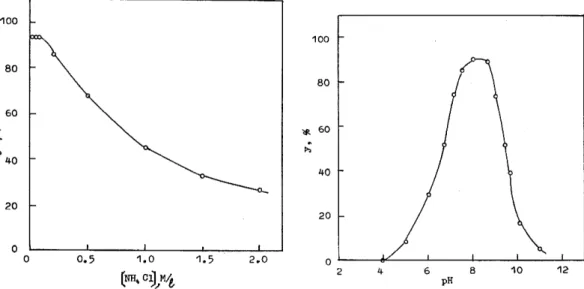
3 • 2 Effect of pH of the Solution The relation between y and pH values of the solutions was investigated, using zinc chloride solution. The obtained results are shown in Fig. -2; the maximum value of y appeared at pH 7.5-9.5, reaching over 90%, and the y
values decreased rapidly outside this range, and at last y was zero at pH 4. At such pH, zinc hydroxide and aluminum hydroxide may be completely soluble. Decrease in y on the right hand of the curve may be attributed to the formation of soluble compounds of aluminum and zinc, namely, aluminate and ammine complex, respectively. Thus, it has been proved that the curve showing the relation between y and pH in this case is similar to that of copper, nickel, and cobalt, but is different from that of iron.
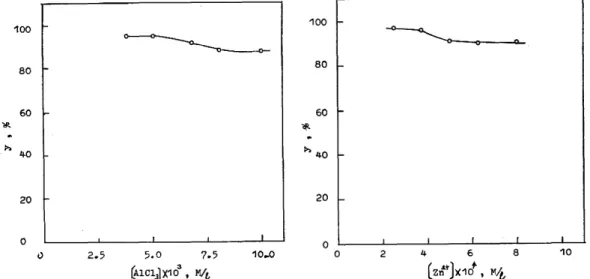
3 • 3 Effect of Concentration of Aluminum Salt While keeping the other variables constant, zinc was coprecipitated in various concentrations of aluminum ,chloride. The concentration of aluminum salt affected y a little as shown in Fig. 3; it showed a tend-ency of decrease in y value with increase in the concentration of aluminum salt, indicat-ing that existence of too much aluminum hydroxide is disadvantageous to the determina-tion of zinc, owing to the difficulties of dissoludetermina-tion of zinc from the carrier.
100 I-80 60 ~ ~ p,. 40 20 0 I I t> 5.0 7.5 10..0 (AlCl3)X103 , Mit.
Fig. 3 Effect of concentration of aluminum salt. 4 X lO-4M ZnClz, 2 X 1O-2M NH4Cl, pH S .2-S.4
3 • 4 Effect of Concentration of Zinc Salt
100 I80 -60 ~ I>.. 40 I-20 I-o I I I [ o 2 4 6 8 10
(ZJ-tJX1c!' ,
MIt.Fig.4 Effect of concentration of zinc salt.
5XlO-3M AlC1a• 2XIO-2 M NH4Cl, pHS.3-S.5
While keeping the other variables cons-tant, zinc was coprecipitated in various concentrations of zinc salt. The obtained results are shown in Fig. 4 ; increase in concentration of zinc salt affected a little to decrease y values.
3 • 5 Effect of Concentration of Ammonium Chloride While keeping the other vari-abIes constant, zinc was coprecipitated in various concentrations of ammonium chloride, as shown in Fig. 5 ; the y values were very large in the range of small concentration-less than 0.1 molar-of ammonium chloride, but decreased rapidly as the concentration of ammonium salt increased. In Fig. 6. the relation between yand pH values in 0.2 molar ammonium chloride is shown ; the y values are smaller than that of Fig. 2, which was obtained in 0.02 molar ammonium chloride. and so the width between both side of this curve is narrower than that of Fig. 2, Thus, it has been proved that ammonIum chloride disturbs coprecipitation of zinc with aluminum hydroxide, as was seen in copper4) or
cob-alta) this may be attributed to the formation of soluble zinc-ammine complex. 100 80 60 ~ 40 20 o o 0.5 1.0 1.5 (NH~ C~}i
Fig. 5 Effect of concentration of ammonium salt. NO.1
4X10⁻⁴M ZnCh, 5XlO-BM AIClg, pHS.O-S.5
100 80 '<It 60
:.:
40 20 0 2 4 6 8 10 12 pHFig. 6 Effect of concentration of ammonium chloride. NO.2.
4X 10⁻⁴ M ZnClz, 5X lO-BM AICl
a, 2X lO-'M NH4CI
3· 6 Effect of Precipitant In the above experiments, ammonia water was used as precipitant of aluminum hydroxide. Now. sodium hydroxide was tried instead of ammonia water, the pH values of the solutions being adjusted with sodium hydroxide or hydrochlo-ric acid. The results are shown in Fig. 7 ; the y value was maximum above pH 7.5, sho-wing nearly 95%. and decreased rapidly in
acidic range, at last zero at pH 4. but it did not decrease in alkaline range. This is a remarkable difference from the case of ammoniacal precipitant ; formation of soluble compound (zinc-ammine complex) in ammoniacal solution, but not in sodium hydroxide solution may explain this diffe-rence. Thus. it has been proved that sodium hydroxide is effective to coprecipitate zinc ions in broader pH range than ammoniacal precipitant.
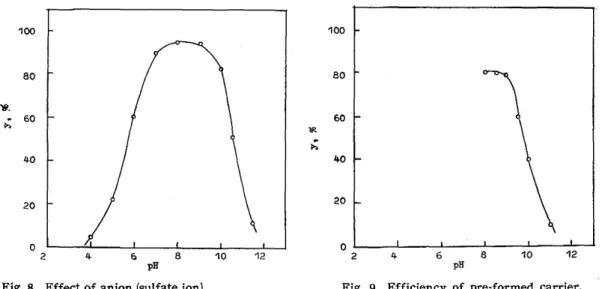
S • 7 Effect of Anion When alumin-urn sulfate was used instead of chloride, the relation between y and pH was such as shown in Fig. 8 ; the y values were
gene-100 80 60 40 20 o 2 4 6 8 10 12 pH
Fig. 7 Effect of precipitant (sodium hydroxide). 4X10⁻⁴M ZnClz, 5XlO-8M AICta, 2X10⁻²M NaCI
rally larger than in the case of chloride over the whole range of pH, indicating that sulfate ions favour coprecipitation of zinc. as was seen in the cases of copper, cobalt, etc .. The width between both side of curve in this case is narrower than that of Fig. 2. The y value was maximum in the range of pH 7-9. and was nearly zero at pH 4.
100 100 80 80 "8. h 60 lR. 60 t!: 40 40 20 20 0 0 2 4- E) 8 10 12 2 4- 6 8 10 12 pH pH
Fig. 8 Effect of anion (sulfate ion). Fig. 9 Efficiency of pre-formed carrier. 4 X lO-4M ZnClz, 2 X lO-zM NH4Cl 4X10⁻⁴M ZnCh. 5XlO-8M Ah(S04)a, 2XlO-zM NH
4CI
3· 8 Efficiency of Pre-fonned Carrier. In the above experiments, the precipitate of aluminum hydroxide was prepared directly in the solution containing zinc salt. Now, an experiment was tried to examine the efficiency of pre~formed aluminum hydroxide that was prepared as described in the previous paperY The obtained precipitate of aluminum hydroxide was washed three times with water, and poured into a 100 ml beaker, then 10 ml of 4 x 10⁻³ molar zinc chloride, 10 ml of 2 molar ammonium chloride, and an aliquot of 0.1 N or 1 N ammonia water were added into the beaker, thus adjusting pH of the solutions in various values. The solutions were kept at 25.0 ± 0.1 °C for more than 8 hours, and pH values were measured. The amounts of zinc in the precipitate were de~
termined polarographically in the same way as described above, and y values were calc~
ulated. The results are shown in Fig. 9 ; the y value was maximum at pH 8-9, and it de~
creased rapidly above this range. as was seen in Fig. 2. Thus, it has been proved that the pre~formed carrier is fairly effective for coprecipitating zinc ions.
4 Summary
The coprecipitation of minute amounts of zinc ions in the solution was studied, using aluminum hydroxide as carrier. The precipitants used were ammonia water and sodium hydroxide. The percentages of zinc coprecipitated were greatly affected by pH values of solutions, and their maximum values were obtained in the range of pH 8-9, and above 7.5, in the cases of ammonia water and sodium hydroxide, respectively. The concentrations of aluminum salt and zinc salt affected a little to coprecipitation as well as the kind of anions (chloride and sulfate ions). The maximum value of y reached over 95% under proper con~
ditions. The pre-formed carrier proved to be effective to obtain fairly good results. Thus. it has been proved that. zinc ions can be satisfactorily coprecipitated with alum· inurn hydroxide from the solutions of proper pH range and proper concentrations of rea~
gents, and were suited for polarographic determination.
fessor Taitiro Fujinaga for their kind advice and encouragement. References
1) T. Yonekubo, Bulletin Chern. Soc. Japan, to be published.
2) M. H. Kurbatov, G. B. Wood, J. D. Kurbatov, J. Phys. & Colloid Chern., 55, 1770 (1951). 3) T. Yonekubo, This Memoirs, 15, 189 (196M)