Integrated Reporting : Evidence from Japan
journal or
publication title
産研論集
number
46
page range
109-128
year
2019-03-23
URL
http://hdl.handle.net/10236/00027732
. In o uc ion
Global corporate reporting practices have been undergoing significant changes as stakeholders make increasing demands on companies to communicate i fi a cia i a i as a s a as ssi (Rensburg and Botha, 2014). Companies have also been obliged to publish reports on corporate governance (CG) so that users can understand their level of good governance. Besides, many companies are producing sustainability reports to demonstrate their responsible corporate behavior to society as a whole (Garcia-Sanchez et al., 2013; KPMG, 2017). Increased public awareness of environmental, social and governance (ESG) issues has led to increased adoption of corporate social responsibility (CSR) reporting by companies
i si c fi a cia c isis
observed difficulties in integrating CSR information with traditional financial reporting has led to the emergence of the idea of integrated reporting. Although there are debates on the reporting structure and target groups for CSR reports and integrated reports (IR), some leading companies have begun to integrate corporate information into single documents constituting integrated reporting as a sustainable strategy (Eccles and Kruz, 2010).
i c ica i fi s i
relevance of this form of sustainability reporting has been increasing. However, the research conducted so far has been mostly limited to theoretical investigations
* Acknowledgements: We express our sincere thanks to Prof. Ishihara for helpful discussions. And we gratefully acknowledge the work of past and present members of our laboratory. Finally, the authors wish to thank the anonymous reviewers for comments on earlier version of this paper.
and stand-alone case studies (Eccles and Krzus, 2010). Most of the research presents normative arguments for IR and research examining real practice is scarce (Dumay et al., 2016). Unlike traditional sustainability reporting, which has been widely examined in terms of the patterns, determinants and motivations of its use, it remains unclear why firms adopt integrated reporting (Jensen and Berg, 2012). However, integrated reporting might replace CSR reporting in the long run (Velte and Stawinoga, 2016) if it could become a useful business reporting practice that properly combines regulatory standards and voluntary disclosure (Sierra-Garcia et al., 2013). In this view, it would be of great interest to a i ac s a c ai a fi ’s decision to employ integrated reporting as the reporting norm.
The Japanese corporate governance system has been distinctly different from its Western counterpart for decades, conventionally characterized by unique features such as its main bank system, large inter-corporate shareholdings, lifetime employment and boards of directors selected from insiders. Economic and
fi a cia s s s c a
governance restructuring by leading corporations due to extreme global competition, and a rise in foreign ownership have led to the adoption of many Western-like governance features by Japanese firms (Bauer et al., 2008; Sueyoshi et al., 2010). Miyamoto (2018)
i ifi ac s a i c a a c
reform in Japanese firms: increasing shareholder
Corporate-Level Determinants of Integrated Reporting:
Evidence from Japan
*AKHTER Taslima
SEKISHITA Hiroki
pressure due to the liquidation of stock markets and managerial crisis due to a significant decline in
c a fi s i i i a i c isis
in the late 1990s. Since then, Japanese firms started reforms in the two institutional areas of corporate governance and human resource management. There has been a move from traditional stable shareholders to dispersed foreign shareholding. According to CGES data, the mean percentage of foreign ownership in Tokyo Stock Exchange First Section firms increased from 9.95% in 2004 to 15.18% in 2014. These foreign investors, being based in countries following Anglo-American corporate governance systems, have actively encouraged their investees to change their CG and disclosure practices (Aman et al., 2017). Continuous pressure to adopt Anglo-American CG was not the only product of globalization for Japanese business. Globalization, whether through Japanese
fi s a i i a i a s c a i s
operating in Japan ̶ and notably, including banking and business scandals and resulting demands by governmental and non-governmental organizations ̶ created a discussion regarding the use of Western-style CSR practices by Japanese firms (Eweje and Sakaki, 2015). Awareness of Western-style CSR has been evident in Japan since the early 21st century. It can be assumed that big Japanese corporations might have been aware of the notion of CSR long before the issue was actively discussed within Japan due to listing requirements on disclosure for companies cross-listed on North American or European exchanges (Eweje and Sakaki, 2015). However, according to Fukukawa and Teramoto (2009), CSR was formally adopted by Japanese businesses in 2003, and that year is referred to as ‘CSR ganmen’ fi s a ci i Eweje and Sakaki, 2015; p. 133). A recent KPMG Survey (2017) found that in 2017 the global average for corporate responsibility reporting was 72%, but 99% for Japan. Another survey by KPMG on Japan revealed that while the number of companies issuing IR in Japan was only 26 in 2010, it increased to 341 in 2017 (KPMG, 2018). Not only in Japan but throughout the
world, corporate responsibility reporting is increasing due to pressures from governments, regulators and stock exchanges. Of the various practices of corporate responsibility or sustainability reporting, IR is slowly but steadily growing worldwide, including Japan. Preparing an IR is a voluntary practice for companies in most countries, except for South Africa and Denmark (Sierra-Garcia et al., 2013).
In a report on competitiveness and incentives for sustainable growth in 2014 (also known as the Ito Review) by the Japanese Ministry of Economy, Trade and Industry (METI), integrated reporting was seen as a useful tool for promoting dialogue between companies and investors. The Japanese Financial Services Agency (FSA) published a Stewardship Code (2014) for institutional investors. This Code along with the Corporate Governance Code (2015) by the Tokyo Stock Exchange encourages companies to adopt integrated reporting. Based on the above background, this study attempted to understand the possible determinants of IR adoption by Japanese listed firms. As the newest form of reporting, very little is known about the practice of integrated reporting and motives for its adoption. A limited number of empirical studies have investigated country-level features such as political and legal systems, economic development, and cultural characteristics, and company-level
a s i si fi a i i i s a a
characteristics (Vaz et al., 2016). However, none of these studies has examined the possible determinants of integrated reporting adoption for Japanese firms. This study wants to extend the existing integrated i i a c si a a fi is objective, the effects of some selected company-level features upon IR adoption have been examined, namely
c a si fi a i i i s s i s a
board characteristics including board size, and board independence. The remainder of this article is structured as follows. Section 2 develops a number of research hypotheses based on existing literature in this field. Section 3 discusses the research methods used. Section 4 analyses the research findings. Section 5 concludes
the study.
2. o hesis e elo en
The scarce literature on factors determining the
a i i a i fi s as i c
investigation of the influence of some country-level features (legal system, investor protection, economic development, cultural characteristics) as well as some company-level features (size, industry, verification of the sustainability report). Companies operating in countries with some integrated reporting regulation or from collectivistic societies are more likely to practice integrated reporting (Vaz et al., 2016). Other research showed that integrated reporting is determined by the financial system, educational and labor system, and cultural and economic system of a country, whereas political factors had no significant effect (Jensen and Berg, 2012; Garcia-Sanchez et al., 2013). A comprehensive literature review of integrated reporting studies by Velte and Stawinoga (2016) showed that the
cisi i i a i is i c
by firm characteristics (for example, industry, size and profitability), internal corporate governance variables (for example, board size and board diversity) and external corporate governance variables (for example, legal environment and investor base). While IR preparation by firms can be stimulated by a good number of factors, the present study investigates the influence of some selected firm characteristics and corporate governance variables upon the adoption of
i a i a a s is fi s
2. Bo Si e
Board size refers to the total number of executive and non-executive directors on the board of directors at the date of the annual meeting in each fiscal year (Wang and Hussainey, 2013). Board size influences the way directors perform their tasks, and smaller boards increase the participation of board members and the freedom of communication among them (Zahra et al., 2000). A large board having directors with multifunctional backgrounds and
experiences facilitates effective monitoring activities of the board. But an excessively large board might hinder information processing and slow the decision-making process due to rivalry and dysfunctional conflicts among members (Zahra et al., 2000). Based on a cross-sectional study of 113 companies from 12 countries in the Asia-Pacific region, Amran et al. (2014) found no si ifica ass cia i s s ai a i i i quality and board size. Meanwhile, many studies found that larger boards may reduce information asymmetry and provide more voluntary information than smaller ones (Akhteruddin et al., 2009; Said et al., 2009). The above discussion suggests the following hypothesis: H1: There is a significant relationship between board size and adoption of integrated reporting.
2.2 Bo In e en ence
Inclusion of independent non-executive directors on the corporate board received much attention during the 1980s (Fama, 1980, cited in Chen and Jaggi, 2000). Many studies assumed board independence (measured by the proportion of outside directors) to be positively associated with voluntary disclosure (Jizi, 2017; Lim et al., 2007). Outside directors who are less associated with management are
sias ic i c a i fi s isc s information to investors (Akhtaruddin et al., 2009) as a means to protect their own reputations (Lim et al., 2007). However, based on a sample of 158 Singapore an
is fi s a a a a i c as
in outside directors decreases voluntary information. This was in contrast to some prior research. Haniffa and Cooke (2005) found that in Malaysian companies, boards dominated by non-executive directors play a limited role in influencing CSR disclosure, due to the non-executive directors’ lack of knowledge and experience and indifferent attitudes towards societal concern. Said et al. (2009), on the other hand, did not
fi a si ifica a i s i i
independent directors and CSR disclosure. Chen and Jaggi (2000) argued that a higher ratio of independent non-executive directors on the board would result in
more effective monitoring of managerial decisions and limit managerial opportunism. Their study on 87
a fi s s s a si i ass cia i
between the proportion of independent non-executive
i c s c a a s fi s a
the comprehensiveness of disclosure quality. Based on the above discussion, the following hypothesis is proposed.
H2: There is a significant relationship between board independence and adoption of integrated reporting. 2.3 In es o s
According to the IIRC (2013), integrated reporting primarily aims to provide information to investors “to enable a more efficient and productive allocation of capital” (p. 2). This is consistent with increased demand for non-financial information by investors (Solomon and Solomon, 2006). An increasing number of market-based researches have observed a positive relationship between CSR reporting and firm value (Dhaliwal et al., 2011, Plumlee et al., 2015). Based on a sample of 1094 manufacturing firms in Japan, Saka and Oshika (2014) also documented that disclosure of carbon management has positive impact on the market value of equity. In a review
s ic a s a i ifi as s
for a such relationship. First, voluntary disclosure reduces information asymmetry between management and investors. This is because improved disclosure regarding environmental initiatives and performance ca c c ai i s a fi ’s future return. is a c s i i i fi ’s shares, thereby lowering transaction costs for investors. Second, CSR can have significant cash flow effects. For example, certain CSR initiatives including environmental protections, reductions in material and energy consumption, and improvements to employee health and safety have direct implications on positive cash flow. Companies can also reduce compliance costs by engaging in voluntary CSR activities. In addition, increased demand for socially and environmentally sensitive products can have an indirect impact upon
companies’ fi a cia a c i a ic a s et al. (1999) argued that socially responsible investors (SRIs) will always value responsible companies above others. These investors are willing to accept lower market returns from investments in firms that reflect their social values. One of the reasons to develop environmental reporting is the increased demand for non-financial disclosure by SRIs. However, empirical studies also documented contrasting relationship between CSR reporting and shareholder value. Richardson and Welker (2001) in their study on Canadian firms found significant positive relationship between social disclosures and cost of equity capital, which implies that improved social disclosures increase cost of equity capital. In an international comparative study, Cormier and Magnan (2007) showed moderate positive impact of voluntary environmental disclosures on the stock market valuation of German companies,
i c as si ifica a a ia a
French companies. Researchers argued that market reaction to CSR disclosure is contextual and depends on the socio-political environment of the country, types of CSR disclosures, and country’s stakeholder orientation (Brammer et al., 2006; Richardson and Welker, 2001; Dhaliwal et al., 2014). Friedman and Heinle (2016) further argued that the relationship is driven by investors’ preferences and related shareholders base effect. The stock market will react positively only when a substantial portion of company’s investors prefers CSR.
A number of empirical studies, on the other hand, have considered ownership structure as an explanatory variable for corporate social and environmental performance and related disclosure. Taking debt-equity ratio as a proxy for the relative importance of debt holders and stock holders, Belkaoui and Karpik (1989), Cormier and Magnan (1999), Higashida et al. (2005), Prado-Lorenzo et al. (2009), Liu and Anbumozhi (2009) found a negative relationship while Roberts (1992) showed a positive relationship with CSR disclosure. In a recent study on stakeholders’ influence on CSR disclosure, Saka
and Noda (2013) also found a significant positive relationship between creditors and CSR disclosure in Japan. Extant literature also investigates the effects of institutional investors such as pension funds, mutual funds, and socially responsible investments upon corporate social performance (Johnson and Greening, 1999; Motta and Uchida, 2018). Because investment i s i i a i s s as i c as si ifica i recent years, they have assumed more power to change
ac ic s i s fi s i s i i a
investors prefer firms with better social performance, as is i s i fi a cia a c i long run (Johnson and Greening, 1999).
Using Japanese corporate data, Motta and Uchida (2018) investigated the relationship between institutional investors and firms’ corporate social performance (CSP) as measured by the Toyo Keizai CSR ranking. They studied this relationship in the context of adoption of “soft law” to advance CSP. As an example, in 2006, the United Nations Global Compact launched the Principles for Responsible Investment (PRI), which encourages institutional investors to follow ten principles related to social and environmental issues in their investment decisions. In the same year, the Japanese Ministry of the
i a s asi fi a cia c a is s
promote environmental protection. Motta and Uchida found that institutional investors, especially domestic institutional investors, have significant influence in improving corporate environmental performance. However, a robust relationship is not seen in social performance such as social engagement, corporate governance, or employee relations. They concluded that “national government measures play an effective role in diffusing PRI and promoting good business practices” through increased monitoring by institutional investors i i s s a s a a si ifica i institutionalization of CSR practice in Japan (Suzuki et al., 2010). Tanimoto and Suzuki (2005) investigated the GRI adoption of the largest 300 Japanese companies, finding that GRI adoption in Japan is positively
ass cia i i s i i c
of ownership by traditional large investors such as big business groups and domestic companies are not significant. They concluded that globalization of business operations including ownership, production and sales could better explain the CSR reporting than the traditional domestic system. In another study,
i a c fi is fi i
Historically, corporate ownership in Japan has been dominated by cross shareholding among banks, financial institutions and non-financial corporations. However, the ownership structure has c a si ifica i as ca s c as investment by foreign investors has dissolved the cross shareholding and reduced the domination of banks and financial institutions. Nishitani (2009) examined the influence of long-term stockholders, including ownership by other companies, upon corporate decisions to adopt ISO 14001 and found a positive relationship. Tanimoto and Suzuki (2005), however, did not find any significant relationship between GRI adoption and ownership by other listed domestic companies. Based on the above discussion, the following hypotheses are proposed:
H3: There is a significant relationship between corporate debt and adoption of integrated reporting. H4: There is a significant relationship between institutional investment and adoption of integrated reporting.
H5: There is a significant relationship between the dissolution of cross shareholding and adoption of integrated reporting.
is a si ifica a i s i i
shareholding and adoption of integrated reporting. 2.4 o o e Si e
Firm size is the most widely used determinant to measure the extent and quality of sustainability reporting (Dienes et al., 2016). Extant literature uses a number of proxies for firm size, including total assets, sales revenue, number of employees, market capitalization and number of geographical segments. Almost all studies have observed a positive influence
of firm size on corporate reporting practice (Fifka, 2013). Legitimacy theory considers firm size as a proxy for public visibility. Due to their high visibility, larger companies and especially those listed on stock exchanges are subject to public scrutiny that may come in the form of concerns of the general public, regulatory burden or political intervention (Patten, 1991). As stakeholders’ concern for corporate social and environmental performance has increased significantly in recent years, these larger companies need to publish sustainability reports to show their commitment to sustainability issues. Ho and Taylor
ai a i s i fi
size and corporate disclosure by using agency theory.
a a a fi s a i a c c s s
because of their larger amounts of outside capital. These companies will be interested in disclosing more information to reduce their agency costs. In addition, Ho and Taylor (2007) also noted that the cost of
isc s is a i a fi s ca s
economies of scale. This understanding suggests the following hypothesis.
H7: There is a significant relationship between corporate size and adoption of integrated reporting. 2. In us A li ion
Previous studies classify industries as environmentally sensitive or environmentally non-sensitive and investigate the relationship between industry classification and environmental disclosure. More than 90% of these studies have found that environmentally sensitive industries have more incentive to disclose environmental information (Fifka, 2013). Because of their high pollution intensity, these industries receive public scrutiny including regulatory pressure, media attention and public criticism (Brammer and Pavelin, 2006). In one of the earliest studies, Patten (1991) considered industry as a public pressure variable and observed a positive relationship between industries and social disclosure in the USA. Patten concluded
a fi s i i fi i s i s s c as
chemical, and forest and paper use social disclosure
as a a s a ss s s fi s ac i
the social environment. Cho and Patten (2007) also examined the effect of industry type (environmentally sensitive vs. non-sensitive) upon the relationship between environmental performance and environmental disclosure. They found that environmentally sensitive
fi s i i a a c a
likely to disclose monetary information to enhance their legitimacy. In an international comparative study on assurance in CSR reports, Simnett et al. (2009) also argued that industries having greater environmental and social impacts are more likely to adopt assurance in CSR reports to enhance credibility of the reported information. They categorized the mining, production, utilities and finance industries as environmentally sensitive and found a positive relationship with assurance in CSR reports. The above understanding leads to the following hypothesis.
is a si ifica a i s i i s
a fi ia i a a i i a i
2. o ili
Existing literature does not show any consistent
s a i a i s i fi fi a cia
performance and social or environmental reporting. Patten (1991) distinguished between economic legitimacy and social legitimacy. He argued that the profitability of a firm can ensure its economic legitimacy; however, social disclosure should be a function of social legitimation. The study supports the view that “social disclosure is more closely related to public pressure variables than economic ones” (Patten, 1991:300). In a study on Canadian firms, Neu et al. (1998) also found a negative relationship between profitability and environmental disclosure.
a a fi a fi s a i “to
use environmental disclosures either to indicate that environmental investments will result in long-term competitive advantages or to distract attention from fi a cia s s” (p. 275). In contrast, other studies considered profitability as a public visibility variable.
and need to be more careful about their legitimacy.
s fi s s a a a i i i
the norms of society and that their profits are not at the expense of society. This suggests the following hypothesis.
is a si ifica a i s i fi a cia performance and adoption of integrated reporting. 3. ese ch esi n
3. S le esi n n ollec ion
This study is based on a sample of Nikkei 225 companies listed on the Tokyo Stock Exchange (TSE). The sample was taken from March 18, 2018 from the Nikkei NEEDS Financial Quest database. The Nikkei 225 index is Japan’s most widely watched index of stock market activity at the TSE. Its constituents are the most actively traded companies in the stock exchange, with balanced representation of a wide range of Japanese industries. Given that IR is in an early stage of development, this cross-sectional study focused on integrated reporting practice in the latest available year, 2017. Consistent with other studies (Garcia-Sanchez et al., 2013; Frias-Aceituno et al., 2014), banks and other financial institutions were excluded from the sample because of their different accounting and reporting practices. We also removed companies from the sample that do not contain required data for the analysis. Thus, the final sample consists of 169 companies. Annual reports and/or sustainability reports of 169 companies were collected from the websites of individual companies. Corporate governance data were collected from the Nikkei NEEDS CGES of 2017 and corporate characteristics related data were taken from the NEEDS Financial Quest database.
A a a fi i i s
exist (Hughen et al., 2014). In this study, we examined whether the sample companies have published integrated reports or not. The dependent variable IR is a binary variable, taking the value 1 if the company is s a i i s A fi s i s i a i ac cas as i a fi a cia
and non-financial information into a single document or not. This idea is consistent with the definition of IIRC (IIRC, 2013). We also checked the contents of all the selected reports and read their editorial policy statements (if it is included in the report or on the website of the company). Each report was evaluated based on the following contents: a) management commentary, b) overview of business operations c) corporate strategies and risks d) the value creation process e) governance and remuneration policies, and f) sustainability related disclosure. After examining the incorporation of all this information into the report, the editorial policy section was read carefully to understand the awareness or viewpoint of the management on
i a i fi a cia a fi a cia i a i A
editorial policy perspective can be useful to understand the motive of the management on preparing IR (KPMG, 2018). Based on the above scrutinizing process, we considered 96 of our sample companies as integrated reports in 2017.
3.2 e ession Mo el n Me su e en s o i les
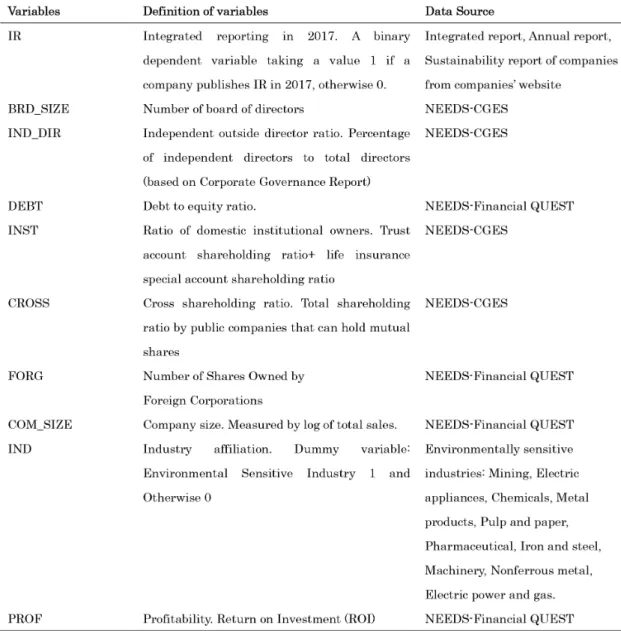
The following logit model was used to test the relationship between the dependent and independent variables.
IR= β_0 + β_1 BRD_SIZE + β_2 IND_DIR + β_3 DEBT + β_4 INST + β_5 CROSS + β_6 FORG + β_7 COM_SIZE + β_8 IND + β_9 PROF + ε
4. esul s n An l sis
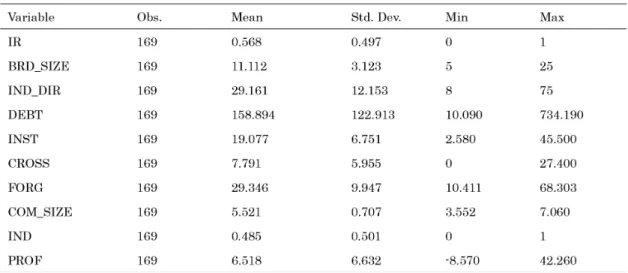
4. esc i i e S is ics n o el ion l M i Table 2 reports the descriptive statistics for the
a ia s i s fi a sa c sis
companies from the Nikkei 225 index. In our sample, the average adoption rate of integrated reporting was
56.8% fi i s a s a i c
on debt of these firms and the significant stakes of
foreign owners in these companies. The average of the foreign shareholding ratios of the sample firms was 29.35%. The average board size was 11 with minimum and maximum sizes of 5 and 25. The average of the ratio of independent outside directors to total directors on the board was 29.16%. The sample contains 48.5%
i a s si i fi s
Table 3 is a correlation matrix of the variables. In general, the independent variables were not highly
correlated. The highest correlation coefficient among independent variables was 0.385, between board size and ratio of independent directors. Therefore, there was no multicollinearity problem among the independent variables. Roberts (1992) noted that bivariate correlation above 0.80 could indicate a harmful level of multicollinearity.
4.2 e ession esul s n An l sis
Table 4 lists estimation results of the logit model, showing the relationship between corporate characteristics and integrated reporting. The results i ica a a si as a a i a i si ifica relationship with integrated reporting adoption. Hence, H1 was rejected. This finding is consistent with that
reported by Kilic and Kuzay (2018) and Amran et al. a i si ifica a i s i board size and corporate disclosures. According to Akhteruddin et al. (2009), larger boards can reduce information asymmetry and provide more voluntary information than the smaller ones. However, this benefit might be outweighed by the costs related to ineffective communication and lack of coordination in the decision-making process (Kilic and Kuzay, 2018). Moreover, even a larger board would not direct much effort to sustainability and CSR issues, if their interests are not aligned to those issues (Amran et. al., 2014).
The coefficient for the ratio of independent directors to total directors was positive at the 5%
directors upon IR adoption decision. Therefore, H2 was accepted. This result implies that the greater the board independence, the more likely that firms will emphasize on integrating financial and sustainability information. Some other studies also support that a higher proportion of independent directors is related to higher levels of disclosure (Jizi, 2017; Lim et al., 2007; Wang and Hussainey, 2013) and quality of disclosure (Chen and Jaggi, 2000). This finding may have an important implication, particularly, in the context of Japan. Regulatory authorities should work for improved board independence in Japanese listed companies.
Our regression results showed that debt to equity ratio was not significantly associated with IR adoption in Japan. Therefore, H3 could not be supported. It implies that creditors may not have strong preferences for integrating financial and
non-fi a cia i a i is s a a
they are not interested in sustainability information. Creditors may use other communication tools such as
CSR reports or sustainability reports of the firms, as Japan is one of the leading countries of the world in CSR reporting (KPMG, 2017). In accordance with our analysis, institutional shareholding, cross shareholding, and foreign shareholding have a negative association with IR adoption in Japan. We therefore, rejected H4, H5, and H6. Wang and Hussainey (2013) found an insignificant relationship between institutional ownership and forward-looking disclosure in a study on UK companies. The authors argued that as powerful investors, institutional shareholders might have other efficient means of communicating with the firm’s management such as, one-to-one meetings. In a study on Japanese listed companies, Saka and Noda (2013) demonstrated an insignificant influence of stable shareholders on the firm’s CSR disclosure. In Japan, the domestic institutional investors or the so-called ‛affiliated investors’ have long-term relationships with the firms in which they invest (Miyajima et al., 2016). These investors might have access to the private
i a i i s i fi s
Our finding of insignificant relationship between foreign shareholding and IR adoption decision contrasted with earlier studies on sustainability reporting (Tanimoto and Suzuki, 2005; Suzuki, et al., 2010). Foreign investment in Japan mainly consists of institutional investment from western countries such as the USA. It could be possible that some of these investors would prefer short term profit rather than long term sustainability of the investee companies (Suzuki, et al., 2010). In a recent study, Motta and Uchida (2018) also failed to document any robust evidence that foreign ownership has affected the improvements in environmental ratings of Japanese companies. In addition, integrated reporting is in an early stage of development. Without any authoritative guideline, investors may not consider this document as a credible source of information. Alternatively, these powerful investors might have access to other private and public sources of information. Our findings also
ai c a si ifica a i s i
cross shareholding ratio and publication of IR. This implies that cross shareholding cannot explain the firm’s integrated reporting adoption decision. This is consistent with Tanimoto and Suzuki (2005), who showed that ownership by other listed companies, was
si ifica i a i i i s i a a Consistent with many other quantitative studies on sustainability reporting (Saka and Noda, 2013) and integrated reporting (Frias-Aceituno et al., 2014; Kilic and Kuzay, 2018), in the present study corporate size was found to be positively associated with adoption of IR. The coefficient for company size was positive at the 5% significance level. Therefore, we accepted H7. Larger companies usually face higher agency costs and problems of information asymmetry. In order to reduce such costs, these companies are likely to disclose a higher level of voluntary information to their stakeholders (Frias-Aceituno et al., 2014). On a different note, Kokubu et al. (2001) confirmed that environmental disclosure in Japan is positively influenced by company size, because “the greater the
size of a company, the more political visibility and the more positive about information disclosure that a company becomes” (p. 17).
s fi i s a s s a i s
affiliation does not have any significant influence upon companies’ preferences for IR. So, we could not accept H8. This finding is consistent with Kilic and Kuzay (2018), who revealed an insignificant relationship between industry affiliation and forward looking disclosure. This implies that the involvement of environmentally sensitive industries in sustainability disclosure, as evidenced in earlier literature, is diminishing. In other words, the gap in the disclosure practices between environmentally sensitive and environmentally non-sensitive industries is reducing. KPMG (2017) observed that all sectors have made significant improvements in CSR reporting, including the lagging ones such as technology, media and telecommunication, transport and leisure.
The regression results showed that ROI has a negative and insignificant effect on the adoption of IR. Thus, H9 was rejected. This is consistent with Al-Najjar and Abed (2014) who documented a negative relationship between firm performance and forward-looking disclosure. Siregar and Bachitar (2010) also
a fi a c s a si ifica
influence on CSR. This means that less profitable companies often attempt to save their reputation in the market by disclosing more voluntary information or to divert the attention of the market from their poor
fi a cia a c a
. onclusions
This study examined the associations between some selected corporate characteristics and adoption of integrated reporting by Japanese listed firms. The sample was taken from the Nikkei 225 companies listed on the Tokyo Stock Exchange. This study provides some important insights based upon logit regression analyses. It examined the impacts of firm size, board independence, industry affiliation and
fi i s is s i c a fi si as a significant positive influence on IR adoption whereas profitability has a negatively influence on it. Industry classification has no significant influence upon the
i a i fi a cia a fi a cia i a i
a s a fi s a i i i a
sensitive industries are also making improvement in integrated reporting practice. This paper also found that institutional investment, cross shareholding, and foreign shareholding have negative associations with the adoption of IR. Japanese corporate boards are usually large and dominated by insiders. We failed to prove any significant relation between board size and integrated reporting adoption. Finally, greater independence of the
a a a i c s i a i c a
information.
The study has a number of limitations. The sample of the study was taken from the Nikkei 225 companies and it is a cross sectional study based on the year 2017 only. So, the results presented and their implications should not be generalized. Besides, the main objective of this paper was to understand the effects of some selected corporate characteristics on integrated reporting disclosure. In this study, we have taken publication of integrated report as a binary variable (giving the value 1 if a company publishes an
i a as fi i i a is
Future research can focus on the extent and quality of disclosure of these reports. Future research can also extend this study by considering multiple years and larger samples.
e e ences
Akhtaruddin, M., Hossain, M. A., Hossain, M. and Yao, L. (2009), “Corporate governance and voluntary disclosure in corporate annual reports of Malaysian listed firms”,
Journal of Applied Management Accounting Research,
Vol. 7 No. 1, pp. 1-19.
Al-Najjar, B. and Abed, S. (2014), “The association between disclosure of forward-looking information and corporate governance mechanisms: Evidence from the UK before
fi a cia c isis i ”, Managerial Auditing Journal, Vol. 29 No. 7, pp. 578-595.
Aman, H., Beekes, W., and Brown, P.R., (2017), “Corporate Governance and Transparency in Japan” (November 20, 2017). Available at SSRN: https://ssrn.com/ abstract=1874611 or http://dx.doi.org/10.2139/ ssrn.1874611.
Amran, A., Lee, S.P. and Devi, S.S. (2014), “The influence of governance structure and strategic corporate social responsibility toward sustainability reporting quality”,
Business Strategy and the Environment, Vol. 23 No. 4, pp.
217-235.
Bauer, R., Frijns, B., Otten, R. and Tourani-Rad, A. (2008), “The impact of corporate governance on corporate performance: Evidence from Japan”, Pacific-Basin
Finance Journal, Vol. 16, pp. 236-251.
Belkaoui, A. and Karpik, P.G. (1989), “Determinants of the corporate decision to disclose social information”,
Accounting, Auditing & Accountability Journal, Vol. 2
No. 1, pp. 36-51.
Brammer, S. and Pavelin, S. (2006), “Voluntary environmental disclosure by large UK companies”, Journal of Business
Finance & Accounting, Vol. 33 No. 7-8, pp. 1168-1188.
Brammer, S., Brooks, C. and Pavelin, S., (2006), “Corporate social performance and stock returns: UK evidence from disaggregate measures”, Financial Management, Vol. 35 No. 3, pp. 97-116.
Chen, C.J.P. and Jaggi, B. (2000), “Association between independent non-executive directors, family control and financial disclosures in Hong Kong”, Journal of
Accounting and Public Policy, Vol. 19 No. 4, pp. 285-310.
Cho, C. and Patten, D. M. (2007), “The role of environmental disclosures as tools of legitimacy: a research note”,
Accounting, Organizations and Society, Vol. 32, pp.
639-647.
Cormier, D. and Magnan, M. (2007), “The revisited contribution of environmental reporting to investors’ valuation of a firm’s earnings: an international perspective”, Ecological Economics. Vol. 62 No. 3-4, pp. 613-626.
Cormier, D. and Magnan, M. (1999), “Corporate environmental disclosure strategies: Determinants, costs and benefits.
Journal of Accounting”, Auditing and Finance, Vol. 14, pp. 429-455.
Dhaliwal, D. S., Li, O.Z., Tsang, A. and Yang, Y.G. (2014), “Corporate social responsibility disclosure and the cost of equity capital: the roles of stakeholder orientation and fi a cia a s a c ”, Journal of Accounting and Public
Policy, Vol. 33 No. 4, pp. 328-355.
Dhaliwal, D., Li, OZ., Tsang, AH. and Yang, YG. (2011), “Voluntary non-financial disclosure and the cost of equity capital: the case of corporate social responsibility reporting”, Accounting Review, Vol. 86 No. 1, pp. 59-100. Dienes, D., Sassen, R. and Fischer, J. (2016), “What are the
drivers of sustainability reporting? A systematic review”,
Sustainability Accounting & Management Policy Journal,
Vol. 7, pp. 154-189.
Dumay, J., Bernardi, C., Guthrie, J. and Demartini, P. (2016), “Integrated reporting: a structured literature review”,
Accounting Forum, Vol. 40 No. 3, pp. 166-185.
Eccles, R.G and Kruz, M.P. (2010), One Report-Integrated Reporting for a Sustainable Society, Wiley: New Jersey Eng, L.L. and Mak, Y.T. (2003), “Corporate governance and
voluntary disclosure”, Journal of Accounting and Public
Policy, Vol. 22, pp. 325-345.
Eweje, G., and Sakaki, M. (2015), “CSR in Japanese companies: Perspectives from managers”, Business
Strategy and the Environment, Vol. 24 No. 7, pp. 678-687.
Fama, E. and M. Jensen (1983), “Separation of Ownership and Control”, Journal of Law and Economics, Vol. 26, pp. 301-325.
Fifka, M. S. (2013), “Corporate responsibility reporting and its determinants in comparative perspective-a review of the empirical literature and a meta-analysis”, Business
Strategy and the Environment, Vol. 22 No. 1, pp. 1-35.
Frias-Aceituno, J.V., Rodríguez-Ariza1, L. and Garcia-Sánchez, I.M. (2014), “Explanatory factors of integrated s s ai a i i a fi a cia i ”, Business Strategy
and the Environment, Vol. 23, pp. 56-72.
Friedman, H.L. and Heinle, M., (2016), “Taste, Information, and Asset Prices: Implications for the Valuation of CSR”, Review of Accounting Studies, Vol. 21 No. 3, pp. 740-767.
Fukukawa K. and Teramoto Y. (2009), “Understanding
a a s c i s a a s i fi global operations”, Journal of Business Ethics, Vol. 85 No.1, pp. 133-146.
García-Sánchez, I.M., Rodríguez-Ariza, L. and Frías-Aceituno, J.-V. (2013), “The cultural system and integrated reporting”, International Business Review, Vol. 22, pp. 828-838.
Haniffa, R.M. and Cooke, T.E. (2005), “The impact of culture and governance on corporate social reporting”, Journal of
Accounting and Public Policy, Vol. 24 No. 5, pp. 391-430.
Higashida, A., Kokubu, K. and Kawahara, C. (2005), “A study of the environmental disclosure in environmental report and its determinants in Japanese firms (in Japanese)”,
Shakai Kanren Kaikei Kenkyu, Vol. 17, pp. 29-38.
Ho, L., and Taylor, M.E. (2007), “An empirical analysis of triple bottom-line reporting and its determinants: Evidence from the United States and Japan”, Journal of
International Financial Management and Accounting,
Vol. 18 No. 2, pp. 123-150.
Hughen, L., Lulseged, A. and Upton, D.R. (2014), “Improving stakeholder value through sustainability and integrated reporting”, The CPA Journal, March, pp. 57-61. IIRC. (2013), The International <IR> Framework. The
International Integrated Reporting Council.
Jensen, J.C. and Berg, N. (2012), “Determinants of traditional sustainability reporting versus integrated reporting. An institutionalist approach”, Business Strategy and the
Environment, Vol. 21 No. 5, pp. 299-316.
Jizi, M. (2017), “The Influence of Board Composition on Sustainable Development Disclosure”, Business Strategy
and the Environment, Vol. 26, pp. 640-655.
Johnson, R.A. and Greening, D.W. (1999), “The effects of corporate governance and institutional ownership types on corporate social performance”, Academy of Management
Journal, Vol. 42, pp. 564-576.
KPMG (2017), The KPMG Survey of Corporate Responsibility Reporting 2017, KPMG.
KPMG (2018), Survey of Integrated Reports in Japan 2017, KPMG in Japan.
Kokubu, K., Noda, A., Onishi, Y. and Shinabe, T. (2001), “Determinants of environmental report publication in Japanese companies”, presented in third APIRA
conference, July 2001.
Lim, S., Matolcsy, Z. and Chow, D. (2007), “The association between board composition and different types of voluntary disclosure”, European Accounting Review, Vol. 16 No. 3, pp. 555-583.
Liu, X. and Anbumozhi, V. (2009), “Determinant factors of corporate environmental information disclosure: An empirical study of Chinese listed companies”, Journal of
Cleaner Production, Vol. 17 No. 6, pp. 593-600.
Miyajima, H., Hoda, T., and Ogawa, R. (2016), “Does Ownership Really Matter?: The Role of Foreign Investors in Corporate Governance in Japan”, INCAS Discussion Paper Series 2016 #03.
a i a s a looking disclosures in integrated Reporting, Managerial Auditing Journal, Vol. 33 No. 1, pp. 115-144.
Miyamoto, M. (2018), The new Japanese Firm as a Hybrid Organization, Springer.
Motta, E.M. and Uchida, K. (2018), “Institutional investors, corporate social responsibility, and stock price performance”, available at https://papers.ssrn.com/sol3/ papers.cfm?abstract_id=2909307.
Neu, P., Warsame, H. and Pendwell, K. (1998), “Managing public impressions: environmental disclosures in Annual Reports”, Accounting, Organizations and Society, Vol. 23 No. 3, pp. 265-82.
Nishitani, K. (2009), “An empirical study of the initial a i i a a s a ac i fi s”,
Ecological Economics, Vol. 68 No. 3, pp. 669-679.
Patten, D.M. (1991), “Exposure, legitimacy, and social disclosure”, Journal of Accounting and Public Policy, Vol. 10, pp. 297-308.
Plumlee, M., Brown, D., Hayes, R., and Marshall, R. (2015), “Voluntary environmental disclosure quality and firm value: Further evidence”, Journal of Accounting and
Public Policy, Volume 34 No. 4, pp. 336-361.
Prado-Lorenzo, J.M., Gallego-Alvarez, I. García-Sánchez, I.M., (2009), “Stakeholder engagement and corporate social responsibility reporting: the ownership structure effect”,
Corporate Social Responsibility and Environmental Management, Vol. 16, pp. 94-107.
Rensburg, R. and Botha, E. (2014), “Is integrated reporting the
silver bullet of financial communication? A stakeholder perspective from South Africa”, Public Relations Review, Vol. 40, pp. 144-152.
Richardson, A. and Welker, M. (2001), “Social disclosure, financial disclosure and the cost of equity capital”, Accounting, Organizations and Society, Vol. 26 No. 7-8, pp. 597-616.
Richardson, A., Welker, J.M. and Hutchinson, I.R., (1999), “Managing capital market reactions to corporate social responsibility”, International Journal of Management
Reviews, Vol. 1 No. 1, pp. 17-43.
Roberts, R.W. (1992), “Determinants of corporate social responsibility disclosure”, Accounting, Organizations and
Society, Vol. 17 No. 6, pp. 595-612.
Said, R., Zainuddin, Y.H. and Haron, H. (2009), “The relationship between corporate social responsibility disclosure and corporate governance characteristics in Malaysian public listed companies”, Social Responsibility
Journal, Vol. 5 No. 2, pp. 212-26.
Saka, C. and Oshika, T. (2014), “Disclosure effects, carbon emissions and corporate value”, Sustainability Accounting,
Management and Policy Journal, Vol. 5 No. 1, pp. 22-45.
Saka, C. and Noda, A. (2013), “The effects of stakeholders on CSR disclosure: evidence from Japan”, http://ssrn. com/ abstract=2239469 or http://dx.doi.org/10.2139/ ssrn.2239469
i a a cia i i a A a a c a a M.A. (2013), “Stakeholder engagement, corporate social responsibility and integrated reporting: an exploratory study”, Corporate Social Responsibility and
Environmental Management, Vol. 22 No. 5, pp. 286-304.
Simnett, R., Vanstraelen, A. and Chua W. F. (2009), “Assurance on Sustainability reports: An International Comparison”,
The Accounting Review, Vol. 84 No. 3, pp. 937-967.
Siregar, S.V. and Yanivi Bachtiar, Y. (2010) “Corporate social reporting: empirical evidence from Indonesia Stock Exchange”, International Journal of Islamic and Middle Eastern Finance and Management, Vol. 3 No.3, pp. 241-252.
Solomon, J.F. and Solomon, A. (2006), “Private social, ethical and environmental disclosure”, Accounting, Auditing &
Sueyoshi, T., Goto, M. and Omi, Y. (2010), “Corporate governance and firm performance: evidence from Japanese manufacturing industries after the lost decade”,
European Journal of Operational Research, Vol. 203 No.
3, pp. 724-736.
Suzuki, K., Tanimoto, K. and Kokko, A. (2010), “Does foreign investment matter? Effects of foreign investment on the institutionalisation of corporate social responsibility by a a s fi s”, Asian Business and Management, Vol. 9, pp. 379-400.
Tanimoto, K and Suzuki, K. (2005), “Corporate Social Responsibility in Japan: Analyzing the Participating Companies in Global Reporting Initiative”, European Institute of Japanese Studies Working Paper; 208, Stockholm: European Institute of Japanese Studies. Vaz, N., Fernandez-Feijoo, B. and Ruiz, S. (2016), “Integrated
reporting: An international overview”, Business Ethics: A
European Review, Vol. 25 No. 4, pp. 577-591.
Velte, P. and Stawinoga, M. (2016), “Integrated reporting: The current state of empirical research, limitations and future research implications”, Journal of Management Control, Vol. 28 No.3, pp. 275-320.
Wang, M. and Hussainey, K. (2013), “Voluntary forward-looking statements driven by corporate governance and their value relevance”, Journal of Accounting and Public
Policy, Vol. 32 No. 3, pp. 26-49.
Zahra, S. A., Neubaum, D. O. and Huse, M. (2000), “Entrepreneurship in medium-size companies: Exploring the effects of ownership and governance systems”,