[Regular Paper]
Coke Deposition on Furnace Tubes of the Vacuum Distillation
Unit Estimated by Stability of Atmospheric Residue Oil
Osamu SUZUKI*, Shinjiro YAMANO, Hirokazu KONISHI,
Hiroshi UMINO, and Makoto INOMATA
Technologies Research Center, JGC Corp., 2205 Narita-cho, Oarai-machi, Ibaraki 311-1313, JAPAN
(Received August 16, 2001)
The stability of residual oil is considered to be one of the major factors in coke deposition onto the inner sur-faces of furnace tubes in distillation units, such as the vacuum distillation unit (VDU). This preliminary study investigated the stability of a Middle East atmospheric residue oil and the coke deposition tendency on type 304 stainless steel surfaces and chromium molybdenum steel surfaces. The latter materials are widely used as fur-nace tube materials. Coke deposition rates were determined using a laboratory scale test apparatus at atmospher-ic pressure. The oil was fed in once-through mode into the inlet of the test section of the apparatus for 24h. During the feeding of the oil, the temperature of the metal surface of the test tube was controlled within a range
from 500 to 600℃. The stability of the feed oil and effluent oil was evaluated by the P-value based on the
Heithaus evaluation method, which indicates the tendency of asphaltene flocculation to form sludge. A decrease of P-value indicates decreased oil stability with the formation of sludge. Coke deposition experiments were car-ried out at higher temperatures than the conventional VDU operation to promote coke deposition. The results showed that the coke deposition rate was slightly lower for stainless steel than for chromium molybdenum steel. The coke deposition rates increased exponentially regardless of the materials. The P-values of the effluent oil
gradually increased with the effluent temperature from 415 to 450℃. This indicates an increase of oil stability
with heating temperature. The changes in P-values correspond to removal of unstable aggregates of asphaltenes from the oil. The unstable aggregates are thought to be one of the predominant precursors for coke deposition. The results suggest that the analysis of P-values of the feed and effluent oils together with coke deposition is use-ful to estimate the quantity of deposited coke on the furnace tubes before operation.
Keywords
Vacuum distillation unit, Furnace tube, Coke deposition, Atmospheric residue, Oil stability
1. Introduction
Coke deposition in furnace tubes has recently become a problem for refineries because of the require-ments for deep cut and long-term continuous operation of vacuum distillation units (VDUs)1),2). Deep cut operation tends to raise the skin temperature of the fur-nace tube and promote coke deposition, which makes it difficult to attain long-term operation, as periodic shut-down maintenance of furnace is needed at short inter-vals. Great efforts have been made to manage furnace tube coke deposition during operation1)-3). Such meth-ods include direct measurement of the skin temperature of the furnace tube, control of the coil outlet tempera-ture, differential pressure between the coil inlet and the outlet, and control of the temperature of the slop oil-pull out zone4).
Asphaltenes in petroleum are present as micelles in which light components stabilize the asphaltenes in oil5)-8). Coke formation in residual oils such as vacu-um residue from thermal cracking, proceeds via floccu-lation of asphaltenes resulting from the destabilization of the residual oil9),10)
The present study experimentally simulated VDU furnace tube coke deposition to investigate the tenden-cy of coke deposition associated with asphaltene floc-culation in a Middle East atmospheric residue using a laboratory scale test apparatus. The effect of oil sta-bility was investigated on coke deposition from the residual oil onto metal surfaces, such as stainless steel. The oil stability can be evaluated by measuring asphal-tene flocculation in the residual oil11)-13) The Heithaus stability evaluation method11),13), based on a solvent titration technique, was used to measure the oil stabili-ty. This preliminary study was the first step aiming at estimating coke deposition in the VDU furnace tube. Quantitative analyses of the oil stability in various * To whom correspondence should be addressed.
crude feedstocks and associated coke deposition could be valuable as a database for the production control of residual refinery products and also used as a design basis for the furnace.
2. Experimental
2.1. Experimental Apparatus and Measurement of Coke Deposition
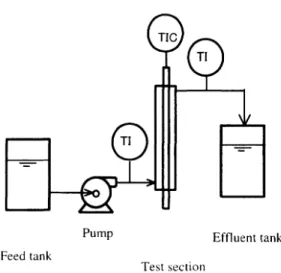
The amount of coke deposited was evaluated using a laboratory scale test apparatus, Alcor Inc. Hot Liquid Process Simulator (San Antonio, TX, USA) at atmos-pheric pressure. The experiment was carried out at various temperatures including higher temperatures than the conventional VDU operation to promote cok-ing. The schematic view of the test apparatus is shown in Fig. 1. Detail of the test section containing the test tube is shown in Fig. 2. The oil preheated at
about 60℃ in feed tank was fed in once-through mode
at a flow rate of 1ml/min, which corresponds to a lin-ear velocity of 1.7mm/sec, into the inlet of the test sec-tion of the apparatus for 24h. During oil feeding, the temperature of the metal surface of the test tube was
controlled over a range from 500 to 600℃ using a
ther-mocouple installed on the inner wall of the test tube (TIC in Fig. 2). The test tubes were hollow tubes with 1.5mm inner diameter, outside diameter of 3.2 mm and wall thickness of 0.85mm. The fluid was designed to flow along the outside of the test tube in the test section. The length of the test tube in contact with the fluid was 60mm. The test tube was designed to be heated as a resistance coil by current flow. During the experiment, temperatures were monitored at the inlet and the outlet of the fluid and the metal
sur-face of the inside the wall of the test tube (TI-1, TI-2 and TI-3 in Fig. 2, respectively). In the present study, the temperature of the inside wall was defined as the surface metal temperature. The metal temperature had a gradient from the inlet to the outlet and reached the maximum around the outlet. The maximum tem-perature was used as the surface metal temtem-perature in the series of tests. The amount of coke deposited was measured by comparing the weight of the test tube before and after the experiment and expressed as weight of coke deposited per unit time. Each test tube was washed with acetone and dried in air before the experiment. The test tube was washed thoroughly with hexane before weighing to remove sticky oil bound to the test tube without dissolving the coke deposited. The effluent oil was collected for the determination of the flocculation tendency (P-values) of asphaltene in comparison with the fresh feed. 2.2. Property of Feedstock
A Middle East atmospheric residue, originating from Kuwait and Basrah crude, was used as feedstock. General properties including the oil stability are shown in Table 1. Details about P-values are described below.
2.3. Test Materials
Type 304 stainless steel and chromium molybdenum steels (5Cr-1/2Mo and 9Cr-1Mo) were used as the test tube materials. Stainless steel test tube was commer-cially available. Chromium molybdenum steel test
Fig. 1 Schematic View of the Laboratory Test Apparatus (Alcor Hot Liquid Process Simulator) for Coke Deposition of Atmospheric Residue Oil
TI, Temperature indicator; TIC, Temperature controller.
Fig. 2 Detail of Test Section Containing the Specimen in the Laboratory Test Apparatus Shown in Fig. 1
TIC, Temperature controller for inside wall of specimen; TI-1, Temperature indicator for feed inlet; TI-2, Temperature indica-tor for fluid outlet (effluent oil); TI-3, Temperature indicator inside wall of specimen, defined as surface metal temperature.
tubes were prepared for the present study by cutting down furnace tubes used in VDUs. The surfaces of the test tubes were mechanically polished to an average roughness of 1.6μm.
2.4. Analysis of Oil Stability
The stability of the feed and the effluent oil was analyzed by the Heithaus evaluation method11) accord-ing to the recent methods usaccord-ing solvent titration tech-nique12),13). This method is generally used to predict the stability of heavy oils and is carried out by titration of a solution of aromatic solvent and a solution of paraffinic solvent into the oil to determine the floccula-tion tendency of asphaltene. The flocculation tenden-cy of the asphaltene was measured by monitoring the particles that become visible with the onset of floccula-tion under a Nikon DIAPHOT TMD300 microscope (Tokyo). In the present study, the solvents used for
measurements of oil stability were α-methylnaphtha-lene as an aromatic solvent and n-hexadecane as a paraffinic solvent. The ratios of α-methylnaphthalene
to hexadecane were in the range of 0.15-0.49. The measurement procedures were as follows: dilution of sample oils with different volumes by aromatic solvent; titration by paraffinic solvent into the diluted sample oils with aromatic solvent; monitoring of the onset of the asphaltene flocculation under a microscope; since the solvent ratio (aromatic solvent versus parafinic sol-vent) against the reciprocal of the dilution ratio by paraffinic solvent should be a straight line, the intersec-tion point at x-axis and y-axis by extrapolaintersec-tion cone-sponds to the dilution ratio at which flocculation starts and the minimum aromaticity required to prevent floc-culation, respectively. The minimum aromaticity or maximum flocculation tendency, FTmax, can be expressed as follows:
P=po/(FTmax)=po/(1-pa)
From these measurements, the three parameters of pa, po and P were obtained as an evaluation of the stability
of sample oil. The parameters of pa and po are the peptizability of asphaltene and the peptizing power or available aromaticity of maltene in heavy oils, respec-tively. The parameter P indicates the overall state of peptization of the system. A decrease in P-values generally means a decrease in the oil stability11)-13) Sludge formation is accelerated by asphaltene floccula-tion when the P-value is below 1 in case of marine fuels12). Compositions of the fresh feed and the
efflu-ent oils were analyzed by thin-layer chromatography with a FID detector (TLC-FID) to determine the amounts of saturates, aromatics, resins and asphaltenes. The H/C atomic ratio and the carbon aromaticity fa were also determined using a YANAKO MT-5 CHN CORDER (Tokyo) and a JEOL JNM-GS-X270 1H-NMR spectrometer, respectively.
3. Results and Discussion
3.1. Analysis of Coke Deposition
Figure 3 shows the coke deposition rate versus metal surface temperature for Middle East atmospheric residue over stainless steel and chromium molybdenum steel. The coke deposition increased within the whole range of metal surface temperatures, but coke deposi-tion was slightly lower on stainless steel than on chromium molybdenum steel. The difference in the coke deposition rate became more significant by plot-ting the amount of the coke deposited against the recip-rocal of the metal surface temperature as shown in Fig. 4. Linear relationships were obtained for the tested materials, but with different slopes. The results sug-gest that coke deposition is inhibited by stainless steel compared to chromium molybdenum steels, but the same mechanisms of coke deposition occur over the whole metal surface temperature for both materials. In the case of coke deposition on the furnace tube in ethylene production, the coke may be produced during pyrolyses by a complicated sequence of metal-cat-alyzed reaction and non-catalytic reaction14),15). The metal-catalyzed coke was produced at temperatures
over about 400℃15). Metal-catalyzed coke formation
apparently does not occur in the case of heavy oils. In the present test, assuming no catalytic function to accelerate coke deposition on the surface of the furnace
Table 1 Properties of Feedstock
Fig. 3 Effect of Metal Surface Temperature on Coke Deposi-tion Rate for a Middle East Atmospheric Residue
tube, the inhibition in the coke deposition observed over stainless steel may be attributable to a difference in adsorption affinities of the precursors for coke deposits onto the metal surfaces. Filamentous coke is reported to grow by the metal-catalyzed reaction14),15) However, electron microscopy observed no such fila-mentous coke (data not included).
Adsorption models, such as the Langmuir adsorption model, assume reversible adsorption for the adsorbate16),17). Adsorption affinity is expressed as a function of the ratio of adsorption to desorption of adsorbate. Stainless steel has relatively good corro-sion resistance due to the formation of a chromium-rich oxide surface film called the passive film18). On the other hand, chromium molybdenum steels do not form such a passive film and the surfaces are susceptible to sulfurization of surface iron in contact with heavy oils. Therefore, the surfaces of the chromium molybdenum steel test tubes may have been sulfurized during the experiment. Such distinct structures of the metal sur-faces may have caused differences in adsorption affini-ties for the precursors of the coke deposits. A full understanding of the mechanism of coke deposition requires information about the surface properties, such as the surface affinities in relation to coke deposition in heavy oils during heating.
3.2. Asphaltene Flocculation and Coke Deposition The mechanisms of coke deposition occurring in residual oils are thought to differ from those in light components, such as pyrolysis of ethane19), as described above. The most prominent feature of coke deposi-tion from residual oils in furnace tubes seems to be related to asphaltene flocculation, which leads to the formation of the coke precursor'. It is generally accepted that coke deposition is affected, regardless of type of oil components, by the mass velocity of the fluid, fluid viscosity, temperature of the fluid film
formed adjacent to the furnace inner surfaces, and
equipment design1)-3). The present study investigated
asphaltene flocculation as an indicator of oil stability
that leads to the formation of the coke precursor. The
stability of the feed and the effluent oils in the case of
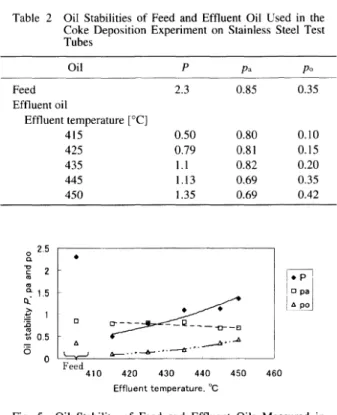
the stainless steel test tube are summarized in Table 2.
The stability is also illustrated in Fig. 5. The
Heithaus stability evaluation method shows that the
critical value of parameter P at which asphaltene
floc-culation initiates was about 1 in marine fuels12).
According to this criterion, the feed oil in the present
study, with a P-value of 2.2, should be classified as a
stable oil. However, the effect of the effluent
temper-ature on P-values should be noted, since the coke
depo-sition rate increased with metal surface temperature.
The P-values increased with effluent temperature
although these values were smaller than that of the
fresh feed oil. These trends also coincided with
change in the parameter po. However, the change in
parameter pa according to the effluent temperature was
independent of the other parameters, P and po, showing
values relatively close to that of the fresh feed. These
changes could result from the improved oil stability
caused by the removal of unstable aggregates of
asphaltenes from the oil. The decreased oil stability
was probably due to the change in the peptizing power
of maltene rather than the change in the peptizability of
the asphaltene in the heated oil. The occurrence of
asphaltene flocculation is the result of reduced
solubili-Fig. 4 Amount of Coke Deposited vs. Reciprocal of Metal Surface Temperature
Table 2 Oil Stabilities of Feed and Effluent Oil Used in the Coke Deposition Experiment on Stainless Steel Test Tubes
Fig. 5 Oil Stability of Feed and Effluent Oils Measured in Stainless Steel Test Tubes (values also shown in Table 2)
ty of the asphaltene in maltene, especially the decrease in compatibility between asphaltene and resin compo-nents. The marked change in po during heating indi-cates that the effect of maltene to stabilize asphaltene is
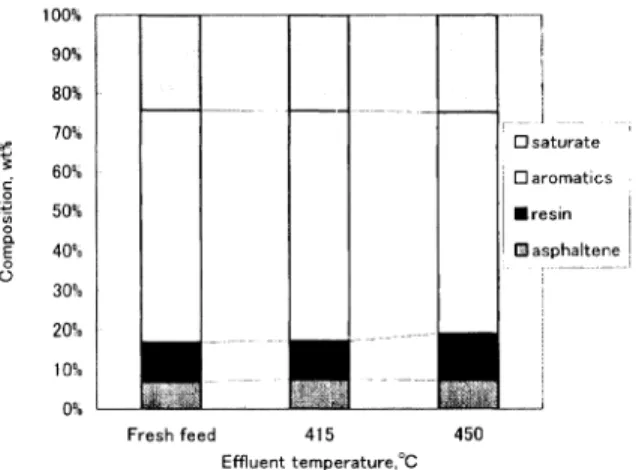
susceptible to change during heating. Figure 6 shows the compositional analysis of the feed and the effluent oils in the stainless steel test tube. The com-positional change was not conspicuous in the respective components, although the resin component increased slightly with heating temperature. Possibly the
change in the amount of resin may reflect the release of resin bonded to the asphaltene before flocculation. The chemical composition (C, H, N) and the carbon aromaticity (fa) remained practically unchanged during heating, as shown in Table 3. The measurements of oil stability suggest that the P-value is more useful to detect the overall state of the oil than other chemical characteristics, such as the composition and the carbon aromaticity, in particular the sensitivity to detect the stability of asphaltene in the oil.
A possible mechanism for the coke deposition asso-ciated with stability of the atmospheric residue oil is depicted in Fig. 7. The asphaltene micelles are desta-bilized by heating and flocculation of the asphaltenes is initiated, which provides the precursors for deposited coke; the flocculated asphaltenes are adsorbed onto the metal surface as a result of the equilibrium between adsorption and desorption of the precursors; the deposited precursors are converted to coke at the metal surfaces by dehydrogenation, which is the main mecha-nism of formation of the deposited coke; and the coke precursors continue to be deposited onto the surfaces of the matured coke at the metal surface as well as onto the metal surfaces. Based on this coke deposition mechanism, the trends of coke seen in the present study could be interpreted through two processes; the coke precursor/metal surface interaction; and the coke pre-cursor/mature coke deposit interaction. The former interaction would affect the difference in the coke deposition rates between the test tube materials due to the difference in adsorption affinities. The latter inter-action would affect the enhancement of coke deposition onto the test tube materials as the metal surface temper-ature increases, as shown in the exponential increase of the coke deposition rates.
3.3. Prediction of Coke Deposition
The thickness of the coke deposited onto the inner surface of the coil can be calculated from difference between the maximum tube metal temperature and bulk fluid temperature based on the following equation of API recommended practice 53020):
Fig. 6 Composition of Feed and Effluent Oil Analyzed by TLC-FID, for Stainless Steel Test Tubes
Table 3 Chemical Compositions and Carbon Aromaticity (fa) of Feed and Effluent Oil Used in the Coke Deposition Experiment on Stainless Steel Test Tubes
a) Atomic ratio.
Fig. 7 Presumed Mechanism of Coke Deposition onto Metal Surfaces from Atmospheric Residue Oil
(a) Feed oil containing stable micelles consisting of asphaltenes and resins; (b) flocculation of asphaltenes, leading to for-mation of precursors for coke deposition; (c) deposition of coke precursor onto the metal surface and desorption of coke precursor from the metal surface; (d) coking of the precursor on the metal surface and deposition of the coke precursor onto both the coke formed at the metal surface and the metal surface.
Tm=Tb+ΔTf+ΔTc+ΔTw
where Tm is the maximum tube metal temperature, Tb is
the bulk fluid temperature, ΔTf is the temperature dif-ference across the fluid film ΔTc is the temperature dif-ference across the deposited coke and ΔTw is the
tem-perature difference across the tube wall. In practice, the coke thickness can be obtained by considering the maximum radiant heat flux and the fluid heat transfer coefficient, and the thermal conductivities of the deposited coke and the tube metal. The API method is useful for the prediction of the coke growth during operation and for planning operation. On the other hand, oil stability evaluation of the feed and the outlet oils, as examined in the present study, is an effective
approach for the prediction of coke deposition before operation. Although the present study was carried out
as a preliminary investigation of the prediction of the coke deposition, it is likely that the quantitative ana-lyses of the stabilities of the feed and effluent oils for various types of crude oil could be used as a database for the production control of the residual refinery prod-ucts and also as the design basis for the furnace.
The present study demonstrated that P-values in the oils increased with the effluent temperature. This indicates that oil stability increases with heating tem-perature, probably through removal of unstable aggre-gates of asphaltene from the oil. These results suggest that the coke deposition trends for the oils from differ-ent crude types could be experimentally analyzed by comparing the P-values for the feed oils and the efflu-ent oils. The target of our present experimental approach is to fully understand the properties of the crude oil type-dependent coke deposition, which can then be reflected in furnace design. Despite the wealth of information about the structure of asphaltene molecules in various crude oils6)-8), there is still little information about how the coke precursor from the heavy oil in the distinct crude type is formed and whether the coke precursor adheres onto the surface of the tube and forms coke on the surface or desorbs from the surface, thus affecting the effluent properties after the heavy oil passes through the furnace tube. The coke deposition trends obtained from the residual oils can help to determine the optimal conditions of furnace operation to prevent coke deposition. Further study using other heavy oils, such as different types of atmos-pheric residue oils, is under way to evaluate coke depo-sition in furnace used to upgrade residual oils.
4. Conclusion
The present study investigated the trends of the coke deposition in furnace tubes handling residual oils, such as atmospheric residue. Coke deposition increased
exponentially with metal surface temperature. The
coke deposition rate was slightly lower for stainless steel compared to chromium molybdenum steel. The change in the oil stability associated with asphaltene flocculation for the feed and the effluent oils was relat-ed to the quantity of the coke deposited on the metal surfaces. These results suggest that quantitative ana-lyses of P-values for the feed oils and effluent oils together with the coke deposition tendency could be useful to estimate the quantity of coke deposited on fur-nace tubes before operation and also in the design basis of the furnace.
Acknowledgments
The authors thank Drs. Hiromitsu Shibuya and Shinichiro Suhara of JGC for their helpful suggestions and valuable criticism during the experiments and the preparation of the manuscript.
References
1) Golden, S. W., PTQ SUMMER, 107, (1998).
2) Martin, G. R., Hydrocarbon Processing, 1998, May, 103. 3) Wiehe, I. A., Ind. Eng. Chem. Res., 32, 2447 (1993).
4) The Japan Petroleum Institute, The minutes of the 18th Refinery Panel Discussion, Session 1, "Atmospheric and Vacuum Distillation," Tokyo, 1993, p.1-31.
5) Syunyaev, Z. I. (ed.), "Petroleum Carbon," Khimya, Moscow (1980).
6) Strauz, O. P., Mojelsky, T. W., Lown, E. M., Fuel, 71, 1355 (1992).
7) Kowalewski, I., Vandenbroucke, M., Huc, AY., Energy & Fuels, 10, 97 (1996).
8) Tanaka, R., PETROTECH, 22, (11), 898 (1999).
9) Storm, D. A., Barresi, R. J., Sheu, E. Y., Fuel Sci. Technol. Int'l, 14, (1&2), 243 (1996).
10) Takatsuka, T., Kajiyama, R., J. Chem. Eng. Jpn., 57, 178 (1993).
11) Heithaus, J. J., J. Inst. Petrol., 48, 45 (1962).
12) Lewis, C. P. G., Johonson, E. K., Berryman, T. J., Oil & Gas J., 1985, April 8, 10.
13) Tojima, M., Suhara, S., Imamura, M., Furuta, A., Catal. Today, 43, 347 (1998).
14) Albright, L. F., Marek, J. C., Ind. Eng. Chem. Res., 27, 755 (1998).
15) Albright, L. F., Marek, J. C., Ind. Eng. Chem. Res., 27, 743 (1998).
16) Moreno, E. C., Kresak, M., Hay, D. I., Calcif Tissue Int., 36, 48 (1984).
17) Moreno, E. C., Kresak, M., Hay, D. I., Arch. Oral Biol., 23, 523 (1978).
18) Davis, J. R. et al., "Surface engineering of stainless steel. Surface Engineering. ASM Handbook," eds. by Cotell, C. M., Sprague, J. A., Smidt, F. A. Jr., ASM International, Material Park, OH (1994), Vol. 5, p.741-761.
19) Albright, L. F., Marek, J. C., Ind. Eng. Chem. Res., 27, 751 (1998).
20) API STANDARD 530, API Recommended Practice 530, in Appendix C-Calculation of maximum tube skin temperature, American Petroleum Institute, Washington, D.C. (1996), p.101-106.
要 旨
常 圧 残 さ油 の安 定 性 か ら見 た加 熱 炉 管 へ の コ ー ク付 着 傾 向
鈴木 治, 山野 紳 二郎, 小 西 裕和, 海野 洋, 猪俣 誠
日揮(株)技 術 研 究 所, 311-1313茨 城 県 大 洗 町成 田 町2205
Vacuum distillation unit (VDU) など, 残さ油の処理装置にお け る加 熱 炉 の コ ー キ ン グで は, 油 の安 定 性 が そ の促 進 要 因 の 一 つ で あ る と考 え られ て い る。 油 安 定 性 か ら コー ク付 着 を予 測 す る手 法 を確 立 す る た め の 第1段 階 の 研 究 と して, こ の 論 文 で は, 小 型 実 験 装 置 を用 い た実 験 に よ っ て, 中東 系常 圧 残 さ油 の アス フ ァル テ ン凝 集 と加 熱 炉 管 の コ ー ク付 着 傾 向 との 関 連 を調 べ た。 実 験 で はVDUの 深 絞 りの領 域 と な る450℃程 度 まで の 流 体 出 口温 度 が 達 成 さ れ る よ う に試 験 片 を加 熱 して原 料 油 を供 給 し, コー ク付 着 速 度 と原 料 油 な らび に通 油 後 の 油 の性 状 を測 定 した。 コー ク付 着 に 関 して は, SUS304ス テ ン レス 鋼 と, 比 較 の た め に加 熱 炉 管 材 質 と して採 用 され て い る クロ ム モ リブ デ ン鋼 (5Cr-1/2Moあ るい は9Cr-1Mo) も検 討 した。 コ ー ク付 着 速 度 は 材 質 に よ らず 試 験 片 の加 熱 温 度 と と もに 指 数 関 数 的 に 増 加 した。 材 質 間 の 付 着 速 度 は ク ロ ムモ リ ブ デ ン鋼 よ りも ス テ ン レス 鋼 の 方 が 幾 分 抑 制 され る結 果 と な っ た。 アス フ ァ ル テ ンの 凝 集 性 の評 価 は, Heithaus 法 に準 じ, P値 を測 定 す る こ と に よ って 行 っ た。P値 は そ の値 が小 さい ほ ど油 が 不 安 定 で あ り, ア ス フ ァル テ ンが 凝 集 して コ ー ク前 駆 体 を形 成 しや す い こ と を示 す。 こ の 油 の 安 定 性 の 評 価 で は, 通 油 後 の油 のP値 が 流 体 出 口 温 度 と と も に逆 に大 き くな る こ とが 示 さ れ た。 通 油 後 の 油 に お け るP値 の 増 加 は, コ ー ク付 着 に よ っ て 流 体 か ら不 安 定 な コー ク前 駆 体 が 除 去 され, 油 が 安 定 化 した ため に生 じた変 化 と 考 え られ る。 以 上 の結 果 は, 原 料 油 と通 油 後 の 油 のP値 お よ び コー ク付 着 傾 向 の 評 価 が 加 熱 炉 管 の コ ー ク付 着 の指 標 と して 利 用 で き る可 能 性 を示 して い る。