C11
El Ni˜
no
の日本冬季気候への影響
Influence of El Ni˜
no on Winter Climate of Japan
⃝ 塩崎公大1· 高谷康太郎2· 榎本剛3
⃝Masahiro SHIOZAKI, Kotaro TAKAYA, Takeshi ENOMOTO
Influence of the ENSO (El Ni˜no/Southern Oscillation) on East Asian winter monsoon is examined. It is widely accepted that the El Ni˜no tends to bring warm climate in December-January-February (DJF) winter season in Japan. However, our study reveal that in the DJF-averaged fields the ENSO has little impacts on the near-surface temperature anomalies in there. In particular, near-surface temperature anomaly fields in the late winter show neutral signals. Simultaneously, the Pacific-Northern American (PNA) patterns are dominant in the upper troposphere while no strong signals can be found near Japan. In contrast, in the early winter, the WP patterns with positive phase are dominant so that winter tends to be warm in Western Japan. The opposite is true for La Ni˜na. Dynamical mechanisms of such seasonal evolutions in the upper-level height field from early winter to late winter are not clarified yet and thus remain for future work.
1 はじめに
以前より異常気象の原因の 1 つとして、El Ni˜no(エル
· ニーニョ) 現象や La Ni˜na(ラ · ニーニャ) 現象といった
熱帯の海面水温 (sea surface temperture, SST) 変動が注 目されている。El Ni˜no現象や La Ni˜na現象は大気と海 洋の相互作用により熱帯太平洋全域に引き起こされる、 発生から収束するまでの 1∼2 年程度の海面水温の変動 現象である。熱帯の SST は、熱帯大気の対流活動を通 じて全球の大気循環に大きな影響を及ぼしている。その ため、熱帯の SST の変動の大気への影響は、熱帯だけ にとどまらず中高緯度にまで及ぶ。このような遠隔影響 をテレコネクションと呼ぶ。 大気への影響としては中高緯度域の北太平洋東部から 北米大陸にかけて顕著な大気循環偏差を伴うことが知ら れている。また、最近では熱帯インド洋や熱帯大西洋の SST偏差が中高緯度に影響を与えている可能性も指摘さ れている (例えば Saji et al., 1999)。また、熱帯· 中高緯 度間だけでなく、中高緯度内においても大気循環の遠隔 影響が見られ、気候や天候変動に大きな影響を及ぼして いる。テレコネクションを違った見方をすると偏西風の 蛇行として見ることができる。また最近の研究 (例えば、 Takaya and Nakamura, 2013)では、対流圏上層の偏西 風の蛇行と極東域の対流圏下層の冬季モンスーンの変動 に密接な関係があることが分かってきた。そのため、テ レコネクションを考えることは非常に重要である。 日本の気候との関係として経験則的に El Ni˜no時には 暖冬に、La Ni˜na時には寒冬になると言われている。し かしながら、実はそのメカニズムについて明確に示した 研究はほとんどない。また El Ni˜no研究では冬平均 (12 月、1 月、2 月全ての平均) を取り扱っていることがほと んどで、月ごとの特徴や時間変化に注目した研究はほと んどない。 2 目的及び解析方法
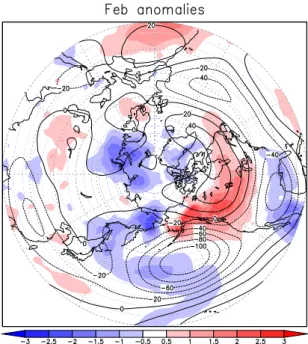
本研究の目的は、El Ni˜no現象や La Ni˜na現象が日本 の冬季気候へどのような影響を及ぼすのかを明らかにす ることである。上記でも触れたが、El Ni˜noや La Ni˜na 発生時において、冬季北半球の対流圏上層にどのような 大気循環偏差が卓越するかについて、極東域への影響と いう視点から調査を行う。そのために、主に気象庁より 提供された 1979 年 1 月∼2013 年 6 月の JRA/JCDAS 再解析データを用いて、合成図(コンポジット)解析を 行った。本研究 (2015 年 12 月時点) では冬平均、及び、 12、1、2 月の各月の月平均データをもとに解析した。 3 結果 このような解析の結果から、次のことが分かった。El Ni˜no時には暖冬に、La Ni˜na時には寒冬になるという 傾向は、冬平均図 (Fig. 1) では見られなかった。しか しながら、12 月では WP パターンが卓越し極東域の気 温場に大きな変化がある (Fig. 2)。1 月、2 月になれば 中緯度において卓越している循環場は PNA パターンの みとなり、3ヶ月平均図とよく似た様相となる (Fig. 3)。 したがって、El Ni˜noや La Ni˜naの影響は極東域におい て季節内変動が示唆される。発表では 2014/15 年の冬、 さらに可能であれば 2016 年 1 月までの解析結果を提示 する。 1京都大学大学院 理学研究科 地球惑星科学専攻 2京都産業大学 理学部 物理科学科 3京都大学防災研究所 気象· 水象災害研究部門 災害気候研究分野
Fig. 1: Contours of the height anomalies at 250hPa surface are superimposed on the shades of the temper-ature anomalies in the Northern Hemisphere (> 20◦N) at 925 hPa surface in DJF during El Ni˜no. Note that the ENSO has little impacts on the near-surface tem-perature anomalies around Japan.
Fig. 2: As in Fig. 1 but for December. The Japanese winter climate is warm due to WP patterns.
Fig. 3: As in Fig. 1 but for February. This figure sug-gests that the temperature fields around Japan become neutral signals due to PNA pattens become dominant and WP pattens disappear.
参考文献
[1] Saji, N. H., B. N. Goswami, P. N. Vinayachandran, and T. Yamagata: A dipole mode in the tropical Indian Ocean. Nature, 401, 360–363, 1999.
[2] Takaya, K. and H. Nakamura: Interannual variabil-ity of the East Asian winter monsoon and related modulations of the planetary waves. J. Climate, 26, 2013, 9445–9461.
[3] Wallace, J. M., and D. S. Gutzler: Teleconnections in the geopotential height field during the Northern Hemisphere winter. Mon. Wea. Rev., 109, 784–812. 1981