居村啓子 IMURA Keiko ・ 清水崇文 SHIMIZU Takafumi
Development of Formulaic Language in Adult Second Language Learners’ Lexicon through
Study Abroad Experience
IMURA Keiko, SHIMIZU Takafumi
Key words: チャンク、留学、用法基盤モデル、語彙目録、第二言語習得 formulaic language, study abroad, usage-based theory, lexicon, SLA
Abstract
Study abroad programs enable the learners to receive language input in a pseudo- naturalistic context, and today it is widely accepted as an ideal way to obtain fluency. There have been numerous studies on lexical gains through study abroad, and this study explores how the use of formulaic language (FL) by Japanese learners of English changes during their study abroad program. Discourse completion test was used for data collection, and 19 Japanese college students and 47 native speakers of English participated in this study. By statistical analysis of the results of pretest and posttest, we found out that there was no significant difference in the learners’ use of FL. However, by item-based analysis, we found some interesting phenomena indicating the learners’ progress through the exposure to the real world. We hypothesize that the entire data reveals a process of second language acquisition, in which the learners use a dual approach, whole to parts and parts to whole in the usage-based theory (Tomasello, 2000).
1. Introduction
Today, many international exchange programs make it possible for second language learners to take part in study abroad programs, and they enable the learners to follow a course of instruction in a pseudo-naturalistic environment. Numerous studies have revealed the effect of such programs in terms of linguistic impact, and fluency is one of the features which have frequently been investigated. Pawley and Syder (1983) introduced the link between fluency and formulaic language (FL) use. FL is now widely accepted as a prefabricated chunk which decreases cognitive demand and functions as a device of fluency. The current study focuses on the change in use of FL by Japanese learners of English during their study abroad program, and explores how it develops through exposure to the study abroad environment.
2. Study abroad research on lexical gains
Milton and Meara’s (1995) study reports that European learners of English spending six months at a British institution acquired vocabulary five times faster than those who took classes at home. Collentine (2004) fails to show significant lexical differences in his study of classroom learners of Spanish in the U.S. and learners who studied in Spain although differences were evident in terms of the occurrence of semantically dense lexemes. Howard (2002) shows the study abroad learners as compared to classroom learners’ use of more expansive lexical verb repertoire. Considering these results, the linguistic benefits of study abroad are suggested although the results vary depending on the type of lexemes.
Dewaele and Regan (2001) report the gain of FL by learners of French. They point out that while studying abroad, learners go through a stage of using a great deal of unanalyzed chunks of language in certain social contexts, and the use of frozen forms by advanced speakers actually increased. However, there is very limited empirical data which describes the effect of study abroad on lexical development in general, and the present study aims to further explore the field by focusing on learners’ holistic language production before and after the study abroad program.
3. Nature of formulaic language 3. 1. Definitions
Researchers have given various terms to FL including, for example, ‘chunks,’ ‘formulaic language,’ ‘idioms,’ ‘collocations,’ ‘prefabricated routines and patterns,’ ‘ready-made
居村啓子 IMURA Keiko ・ 清水崇文 SHIMIZU Takafumi
expressions,’ ‘formulas,’ ‘frozen phrases,’ ‘conventional forms,’ ‘fixed expressions,’ ‘gambits,’
‘gestalt,’ and ‘holistic’. According to Schmitt and Carter (2004), it is presently difficult to develop a comprehensive definition of the phenomenon. In short, FL is usually ready- made and reduces strain on our working memory. The term which generally describes this aspect will be ‘formulaic sequences’:
A sequence, continuous or discontinuous, of words or other elements which is, or appears to be, prefabricated: that is, stored and retrieved whole from memory at the time of use, rather than being subject to generation or analysis by the language grammar.
(Wray, 2002, p. 9)
Nattinger and Decarrico (1992) emphasizes the functional role of FL, and state that these phrases exist somewhere between the two poles, syntax and lexicon, and occur more frequently than language that is put together each time. Ellis (2001) adds to this, stating that FL enhances automaticity and fluency in second language learners’ language production.
3. 2. Usage-based perspective
From the constructivists’ point of view, language constructions share usage-based perspective on language, as Ellis (2003) noted:
Structural regularities of language emerge from learners’ lifetime analysis of the distributional characteristics of the language input and thus, that the knowledge of a speaker / hearer cannot be understood as an innate grammar, but rather as a statistical ensemble of language experiences that changes slightly every time a new utterance is produced. (p. 64)
Braine (1976) and Bowerman (1976) found item based patterns in corpora of children’s language. Thirty years later, recent research suggest that most of young children’s early language is not based on abstractions of any kind; rather, it seems to derive from item based structures with highly constrained ‘slots.’ Tomasello (2000) in his usage-based theory of language acquisition explains the nature of FL as being subject to reduction into its constituents and reconstruction to create larger units so that the speaker can express his or her communicative intentions. Thus, what a child or learner needs to do to become a competent language user is to become able to move in both directions: from parts to whole and from whole to parts. He found that his daughter’s
multiword speech revolved around specific verbs, and also found ‘entrenched verbs’ which are less likely to be broken-down. From the usage-based point of view, language develops through both holistic and analytic approaches, and FL plays an essential role as a language unit which can either be broken down or become another candidate for fusion (Peters, 1983). Wray’s needs-only analysis (2002, 2008) explains that nothing is broken down unless there is a specific reason and what remains frozen becomes FL. This study hypothesizes that this whole to parts and parts to whole approach as well as needs-only analysis applies to the development of adult learners’ FL use, and examines how these phenomena appear in their second language acquisition.
3. 3. Formulaic language in adult second language acquisition
It is more than natural to make a distinction between infants in their L1 acquisition and adults in their L2 acquisition. Wray (2002) explains that ‘in the second language, both the linguistic resources and the needs which they meet are different, particularly in the classroom’ (p. 205). She points out that the classroom learners lack the opportunity to communicate genuine messages, so there is no drive to use FL for manipulative purposes.
Moreover, grammar-translation or Focus on Forms which is now used commonly in language classrooms employs an analytic approach, consisting of deliberate instruction of new words and grammar teaching. Thus, the learner might feel uncomfortable not knowing how a memorized string breaks down, and consequently fail to store thousands of FL in their lexicon as native speakers do.
All in all, after literacy, the second language learner is increasingly likely to deliberately aim to acquire a lexicon of word-sized units. The relative balance of words to formulaic word strings will be quite different from those of a native speaker. (Wray, 2002, p. 206)
In the light of this view, second language learners in classroom settings are less likely to maintain a huge amount of FL in their mental lexicon. However, the chance that they store them to a certain extent still remains. The question is how, what, and in what way it remains or develops.
4. Research questions
The research questions of this study are as follows: 1. Does the FL use of adult Japanese learners of English differ from that of native speakers? 2. If so, is there any salient feature? 3. How does it develop through study abroad program?
居村啓子 IMURA Keiko ・ 清水崇文 SHIMIZU Takafumi
5. Method 5. 1. Participants
Nineteen Japanese students who enrolled in the department of intercultural communication at a private university in Tokyo and 47 international students who were studying at another private university in Tokyo participated in this study.1) At the beginning of the study, the Japanese students were sophomores who studied abroad from the fall semester of 2010 as part of the compulsory curriculum. Seven were males and twelve were females, and their mean age was 19.28. The average length of stay was 175.82 days (SD = 39.09). Their study abroad destinations were as follows: New Zealand 5, America 3, Canada 3, Australia 2, England 2, Ireland 2, Scotland 1, and France 1. Sixteen students stayed with a host family, one stayed in a dormitory, one stayed with a roommate and one stayed in another environment. The mean age of the international students was 21.47, and of these, 23 were males and 24 were females. They were all native speakers of American English, who were raised in 27 different states in the U.S.
5. 2. Instruments
A discourse completion test (DCT) was used in this study. A DCT is a written questionnaire consisting of a number of brief situational descriptions, followed by a short dialogue with an empty slot which participants are asked to fill in with what they think fits the given context (Kasper and Dahl, 1991). DCT has been predominantly used in cross- cultural and interlanguage pragmatics research, since Blum-Kulka (1982) first employed it for a speech act study.
The current study employed DCT as data collection instrument because it enables researchers to strictly control the social and contextual variables of the situations in which participants produce FL. These variables are crucial factors for a cross-linguistic comparison, but they are very difficult to control in ethnographic observation of real conversations. Since the major goal of the study is to contrast learners (before and after overseas education) and native speakers of English in their production of FL for appropriate language use in a particular communicative situation, DCT, which allows all participants answer in identical situations, makes the best format to gather production samples for the study. Some doubts have been raised about the reliability of DCT for speech act studies based on an argument that the DCT data do not represent several important characteristics of natural oral speech, such as complexity and length of utterance (Beebe and Cummings, 1996; Bodman and Eisenstein, 1988; Rintell and Mitchell, 1989). However, we believe that there is no problem in using DCT for the current study because we do not focus on the structure or intention of the entire responses, but rather
on FL which appears as a part of the responses.
The DCT questionnaire for the study consisted of nine conversational situations in which an exchange of a compliment and a response to it occur (see Appendix for the complete scripts of the DCT). Each situation, which was described in a couple of sentences, contained an encounter with someone, such as a professor, a supervisor or a close friend. In each situation, a compliment was paid to the participants who were then asked to respond accordingly.2) Following Shimizu (2004, 2009) and Yokota (1986), the complimenter’s gender was specified as being the same as the participant’s. Thus, there were two types of DCT questionnaire: one for females and another for males. An identical DCT including situations and compliments given in English was created for both Japanese students and native speakers of English, but for the former group a description of the situation was also given in their L1 to eliminate their possible misunderstanding of the situation.
6. Analysis
6. 1. Extraction of formulaic language
Salient patterns were first extracted from the answers on the DCT questionnaires as candidates of FL. Then, patterns which appeared more than twice in the data of native speakers, Japanese learners at the pretest, or at the posttest, were chosen as the subjects of analysis. These patterns comprised fixed phrases such as I know, I guess so, It was nothing, and semi-fixed phrases with slots such as should have ( ), I’ve been ( ) for, I didn’t expect ( ). Difference in tense was ignored. Therefore, for instance, I can’t believe ( ) and I couldn’t believe ( ), were treated as an identical pattern. Different pronouns, such as This is my favorite. vs. It’s my favorite, were treated individually, as long as they appeared more than twice. Since the DCT elicits Thank you. as a norm of compliment response, the study ignores this phrase. However, Oh, thank you. is treated as an object term. Since the initial filler Oh has a pragmatic meaning which discriminates Oh, thank you. from bald Thank you., it should be treated differently. Therefore, for instance, from a response of ‘Thank you.
But, I’m not satisfied with my presentation. Next, I’ll do my best.’, the patterns extracted would be I’m not satisfied and do my best, if they are also seen in other question items.
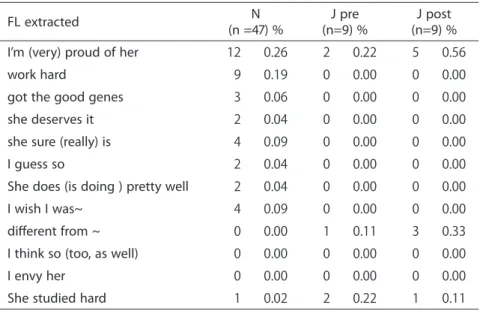
6. 2. Frequency count and results
The frequency count of nine question items in the DCT was conducted by the two learner groups with different proficiency levels based on their TOEFL scores (Group 1:
300~439, Group 2: 440~500). The following charts are samples of the results.
居村啓子 IMURA Keiko ・ 清水崇文 SHIMIZU Takafumi Table 1. Frequency count of Q3 Group 1 (TOEFL score 300~439)
FL extracted N
(n =47) % J pre
(n=9) % J post (n=9) %
I’m (very) proud of her 12 0.26 2 0.22 5 0.56
work hard 9 0.19 0 0.00 0 0.00
got the good genes 3 0.06 0 0.00 0 0.00
she deserves it 2 0.04 0 0.00 0 0.00
she sure (really) is 4 0.09 0 0.00 0 0.00
I guess so 2 0.04 0 0.00 0 0.00
She does (is doing ) pretty well 2 0.04 0 0.00 0 0.00
I wish I was~ 4 0.09 0 0.00 0 0.00
different from ~ 0 0.00 1 0.11 3 0.33
I think so (too, as well) 0 0.00 0 0.00 0 0.00
I envy her 0 0.00 0 0.00 0 0.00
She studied hard 1 0.02 2 0.22 1 0.11
Table 2. Frequency count of Q3 Group 2 (TOEFL score 440~500)
FL extracted N
(n=47) % J pre
(n=10) % J post
(n=10) %
I’m (very) proud of her 12 0.26 5 0.50 3 0.30
work hard 9 0.19 0 0.00 0 0.00
got the good genes 3 0.06 0 0.00 0 0.00
she deserves it 2 0.04 0 0.00 0 0.00
she sure (really) is 4 0.09 0 0.00 0 0.00
I guess so 2 0.04 0 0.00 0 0.00
she does (is doing ) pretty well 2 0.04 0 0.00 0 0.00
I wish I was~ 4 0.09 0 0.00 0 0.00
different from ~ 0 0.00 1 0.10 1 0.10
I think so (too, as well) 0 0.00 2 0.20 2 0.20
I envy her 0 0.00 0 0.00 2 0.20
She studied hard 1 0.02 2 0.22 1 0.11
A statistical analysis was also conducted to find out whether there was any significant difference between pretest and posttest in both groups. All nine question items in the DCT were combined to indicate the overall picture of the data.
Table 3. T- test result of Japanese learner’s pretest and posttest
Group t df sig (2-tailed)
1 -.469 122 .640
2 -.027 122 .978
The result of the T-test shows that there was no significant difference between the average scores of pretest and posttest, and it seems that in a loose scope there is no progress in the use of FL during the learners’ study abroad experience.
Finally, a correlation analysis was conducted among native speakers, Group 1 (lower level group)’s pretest, posttest, Group 2 (upper level group)’s pretest and posttest.
Table 4. Pearson’s correlation analysis between native speakers, Group1 pretest, Group 1 posttest, Group 2 pretest, and Group 2 posttest
Group1 pretest Group1 posttest Group 2 pretest Group 2 posttest
Native .316** .187** .265** .168
(n=122) ** p< 0.01 level, *p<0.05 level
This result seems to contradict that of Dewaele and Regans’ (2001) research on the gain of FL by learners of French. They pointed out that while studying abroad, learners went through a stage of using a large amount of FLs. In the present study, in contrast, the learners did not appear to go through a similar stage, as compared to the native speakers’ use of FL. Conversely, there seems to be a certain shift from using FLs to not using them, and this tendency appears more pronounced in upper level learners, since these learners were using more FLs in the pretests than in the posttests.
Going back to Tomasello’s usage-based theory, language development is driven by a dual approach, whole to parts, and parts to whole. Thus, it is possible to say that the upper level learners could be on the way of breaking down their FLs for further development under the analytic approach. If this is the case, the possibility of acquisition of those FLs through the process of reconstruction with productive analyses in the future may still remain. In contrast, in the case of the lower level group, the holistic approach still appears dominant, and the process of breaking-down FLs may not yet have started with most of the FLs in their lexicon.
6. 3. Item-based qualitative analysis
In accordance with Wray’s argument on the acquisition of FL by adult second language learners, it can be assumed that in general, there is a critical difference between
居村啓子 IMURA Keiko ・ 清水崇文 SHIMIZU Takafumi
the FL of native speakers and that of second language learners in terms of amount as well as quality. Adult second language learners have already gone through the process and have acquired FLs in their first language. Thus in Wray’s model, it is expected that adult second language learners hardly rely on FLs in the course of their lexical development. In other words, FLs may not exist in the Japanese second language learners’
lexicon from the first place. But is this really the case?
Looking into the raw number of FL production, native speakers used 355 FLs in total (7.55 per person), while Group 1 used 72 FLs (8 per person) in the pretest, 78 FLs (8.6 per person) in the posttest, and Group 2 used 83 FLs (8.3 per person) in the pretest, 86 FLs (8.6 per person) in the posttest. Surprisingly, the raw number of the FL used individually by the learners surpasses the number of native speakers.
This datas show that learners seem to have some set phrases stored in their lexicon.
However, it is premature to conclude that the learners have acquired the same FLs as native speakers’ unless we examine the structure and elements of these set phrases.
6. 3. 1. Differences in the quality of formulaic language
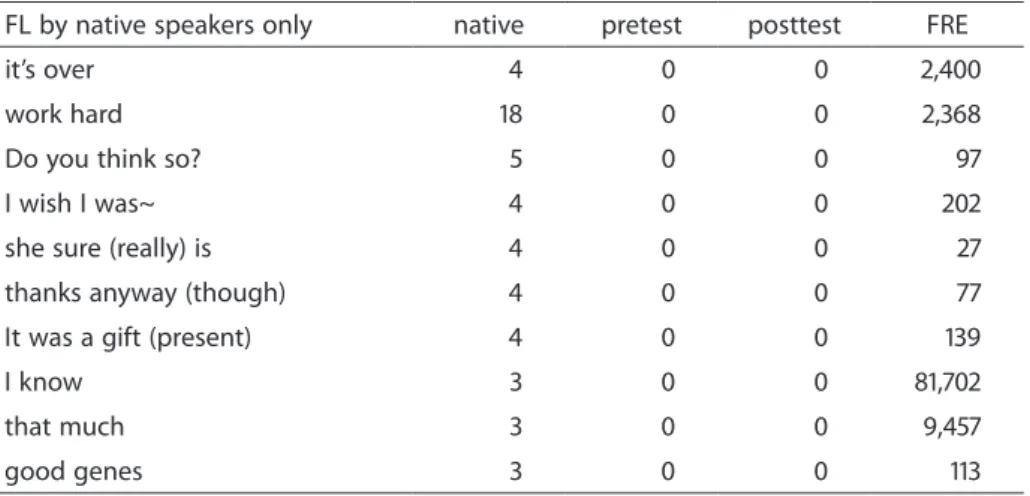
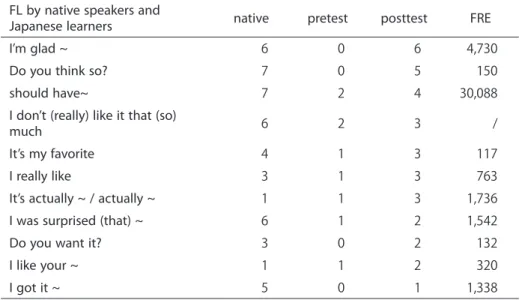
The following lists are the samples of three types of FLs. The first type (Table 5) shows the FLs which appeared most frequently only in the native speaker data. The second type (Table 6) consists of the FLs which appeared in the data of both native speakers and learners. The third type (Table 7), an interesting finding, is the FLs which were used only by the Japanese learners.
In order to examine how often these FLs appear in natural English, a frequency counting was conducted using Corpus of Contemporary American English, which consists of 425 million words.
Table 5. Formulaic language appearing only in the native speaker data (Frequency extracted from the interface by Mark Davis http://corpus.byu.edu/coca/)
FL by native speakers only native pretest posttest FRE
it’s over 4 0 0 2,400
work hard 18 0 0 2,368
Do you think so? 5 0 0 97
I wish I was~ 4 0 0 202
she sure (really) is 4 0 0 27
thanks anyway (though) 4 0 0 77
It was a gift (present) 4 0 0 139
I know 3 0 0 81,702
that much 3 0 0 9,457
good genes 3 0 0 113
Table 6. Formulaic language appearing in the native speaker and learner data (Frequency extracted from the interface by Mark Davis http://corpus.byu.edu/coca/)
FL by native speakers and
Japanese learners native pretest posttest FRE
I’m glad ~ 6 0 6 4,730
Do you think so? 7 0 5 150
should have~ 7 2 4 30,088
I don’t (really) like it that (so)
much 6 2 3 /
It’s my favorite 4 1 3 117
I really like 3 1 3 763
It’s actually ~ / actually ~ 1 1 3 1,736
I was surprised (that) ~ 6 1 2 1,542
Do you want it? 3 0 2 132
I like your ~ 1 1 2 320
I got it ~ 5 0 1 1,338
Table 7. Formulaic language which appearing only in the learner data (Frequency extracted from the interface by Mark Davis http://corpus.byu.edu/coca/)
FL by Japanese learners only native pretest posttest FRE
This is my favorite (watch) (one) 0 3 5 158
not satisfied 0 8 4 702
I don’t (didn’t) like 0 12 3 /
I’m happy 0 5 2 635
do my best 0 3 2 477
Are you kidding? 0 0 2 824
study hard 0 4 1 94
In Corpus of Contemporary American English, the averages of FL frequency are 59,658.2 times for the first type (i.e., native only group), 10,013.6 times for the second type (native and learner group), and 507.5 times for the third type (learner only group).
Obviously, these frequency rates of FL in the large corpus vary. The FLs which were used only by the native speakers in our data showed greater frequency scores in the large corpus in comparison with the other two types. In the same manner, the FLs used by both groups in our data came in the second place, and those used only by the learners in our data came in last with much smaller frequency counts in the large corpus. Based on this observation, it can be said that the FLs used only by the learners in our data are the ones native speakers hardly use in their daily lives.
居村啓子 IMURA Keiko ・ 清水崇文 SHIMIZU Takafumi
Structure of each type of FLs seems to vary as well. The FLs in Table 5, such as it’s over, work hard and I know, are mostly fixed and idiomatic, while the FLs in Table 6, such as shoud have ( ) and I was surprised ( ), are practically semi-fixed because they have open slots for another element. Compared to these FLs, those in Table 7, such as do my best, and study hard, are quite unique, and can be classified as pseudo FLs, because they were not used by the native speakers. This type could have been introduced to the learners in classroom settings at secondary schools.
6. 3. 2. Development of formulaic language
According to the usage-based model, children’s early linguistic competence is organized by item-based constructions (Tomasello, 2000). Following this view, a closer look was taken at each FL item, and found some salient features in the learner data.
The first feature is the ‘newly acquired FL’ by the learners. This simply means that a certain phrase appeared only in the learner’s posttest. For example, observing the total number of FLs in Q 1, Q2 and Q6, Do you think so? (which was used eight times by native speakers in total) was never used in the learners’ pretest, but in the posttest it was used five times. Other FLs of this kind are, I’m glad~ and It’s my favorite (instead of this is my favorite) in Q5.
The second feature is the ‘replacement of FL.’ This denotes that a FL appeared in the pretest was replaced by a similar, but more native-like FL in the posttest. A good example which explains this feature is do my best being replaced by do the best by the same learner. By using the large corpus frequency count, we found that the frequency of do the best was 839 while the frequency of do my best was 477. We assume that frequency count is a signal of predisposition of the natural language, and that the emergence of do the best indicates that the learner acquired a more native-like expression during his or her time abroad. Another example of this type of FL is the use of I’m happy replaced by I’m glad. According to the large corpus frequency count, the frequency of the former was 1,780 and for the latter, 4,730.
The third feature is the ‘extension of FL’ by means of correct insertion of an adverb.
For example, I don’t like it. was replaced by I don’t really like it. In the case of Q6, the phrase I don’t like was used only by the Japanese learners. Native speakers inserted really, or so much perhaps to avoid being too straightforward. Japanese learners in their posttests also seemed to have learned to control the intensity of utterance being able to insert the adverbs in the correct position. The same phenomenon appears in I’m proud of her being replaced by I’m really proud of her, I’m not satisfied with what I did being replaced by I’m not satisfied with it at all and I don’t like the sweater being replaced by I don’t like it much.
The fourth feature is the ‘deletion of FL.’ The most salient example is I’m not satisfied in Q1, which the native speakers never used. In contrast, the learners in the pretest used it eight times. However, in the posttest, the number decreased to four times. A similar phenomenon is seen for the phrase I don’t like in Q8, which never appeared in the native speakers’ list. Learners used this phrase eight times in the pretest and used only once in the posttest. A similar case is seen in the deletion of this (it) cost in Q4 and Q7, and I’m happy to in Q5. These examples show that the learners came to realize that they perhaps overused these particular frozen phrases or they now had alternative expressions.
The last feature is the ‘freezing of FL’ which indicates a particular FL too completely fixed, and never broken down nor replaced by a different one. A typical phenomenon found in our data is study hard. Study hard was a phrase typically used by Japanese learners. Native speakers used work hard instead, and study hard never appeared in their list. Japanese learners failed to replace study hard with work hard, due to the freezing of the previously learned FL. A similar phenomenon can be seen in I envy her, I think so, too and I’m different from her in Q3, and ~ gave me this in Q7.
7. Discussion
This study conducted both quantitative and qualitative analyses on FL production by the Japanese learners of English as well as that of native speakers. By comparing the data of before and after the study abroad program, we found that there was no significant progress in the learners’ use of FL. The correlation analysis between the FL of native speakers and that in the pretest and posttest of the learners with different proficiency levels showed that the upper level group’s FL in the posttest did not correlate with that of the native speakers. One of the implications for this phenomenon could be that the learners with higher proficiency began to break down the set phrases in their lexicon instead of applying readymade formula, or in some cases, overusing them. Thus at the panoptic level, it seems that the acquisition of FL did not progress during the learners’
study abroad.
However, the qualitative analysis showed a substantial change in the learners’
production of FL. By a closer examination of each FL items, we found out that firstly, Japanese learners stored some frozen phrases in their lexicon. However, those phrases were somewhat different from those of native speakers, in the sense that they were semi- fixed and some were overused or wrongly-fixed frozen formula which had probably been acquired in classroom settings.
Secondly, although there does not seem to be a change in use of FL at the overall level, the study detected some possible evidence for a change through study abroad.
居村啓子 IMURA Keiko ・ 清水崇文 SHIMIZU Takafumi
These features were: newly acquired FL, replacement by naturalistic FL, extension of FL (i.e., insertion of adverbs), deletion of wrongly-fixed FL, and freezing of FL.
Referring again to the usage-based model of language acquisition, it is possible to conclude that the whole to parts and parts to whole approaches were both online. Newly acquired FL can be considered as a phenomenon of parts to whole, simply because FL itself is the product of the holistic approach. (P→W) Replacement of FL could be the product of both approaches. For instance, in the case of do my best being replaced by do the best, it is possible to say that the learner broke down the former into pieces, do + my + best, and succeeded in replacing my with the. Or it could be viewed as that the whole chunk was replaced by another item. (P→W) (W→P) Insertion of an adverb in the correct position seemed to show that segmentation occurred. Since we hypothesize that if the FL is solidly frozen, insertion will not occur. Thus, this phenomenon can be interpreted as whole to parts approach. (W→P) A unique feature is the deletion of wrongly fixed FL. Since the target FL disappears, there is no evidence of any strategy used by the learner. However, we can assume that the learners gained a better sense of the nature of FL, and started to realize that certain FLs are not used in a particular situation.
In this sense, the learners are being more analytic and more aware of the nature of the FL. (W→P) As for the last feature FLs are stable, and this can be explained by Wray’s needs-only analysis. Nothing is broken down unless there is a specific reason, and therefore, certain FLs remain as they are. In sum, at the more specific level, most of the FLs are transmuting in both directions, P→W and W→P, but at the overall level, or so to say statistically, it seemed as though nothing occurred.
8. Conclusion
This study sheds light on Japanese learners’ development of FL in L2 English lexicon during their study abroad programs. A T-test showed that there was no significant difference between the pretest and the posttest in total, and a correlation analysis revealed the fact that the use of FL by the upper level learners in the posttest did not correlate with that of native speakers. Thus the development was not statistically visible.
However, we detected some differences in quality between the FL production before and after the study abroad program. The learners seemed to use both gestalt and analytic strategies in acquiring a new FL, breaking it down for appropriate use, replacing it with a native-like FL.
It is also true that there are many limitations in this study. Due to the small number of subjects and question items, it is difficult to generalize our findings. Therefore, a larger collection of data is required for further research. This study depicted a partial picture of
the break-down of FL and we hypothesize that this is a part of the process of development. However, there is no corroborating evidence, and therefore calls for more empirical data. The possibility of a more detailed investigation lies in the fact that the data of this study was open ended. In the next phase, we would like to set up some target chunks to depict a concrete picture of segmentation and recreation of FL.
Finally, we would like to address an implication of the results to English education in Japan. The study showed that although Japanese learners of English used some fixed phrases, those phrases were somewhat unique in nature, and we speculate that these phrases were introduced to learners in classroom settings. We also found that some FLs which appeared with very high frequency in the large corpus of English were never used by the learners. English textbooks should be reexamined in the light of more native-like usages of vocabulary and phrases.
Acknowledgements
We would like to express our thanks to the students in the College of Intercultural Communication at Rikkyo University for their contribution to this study and would also like to thank the international students in Sophia University for their sincere effort in providing data for this research.
Notes
1) There were 32 Japanese participants at the beginning of the study. However, as is often the case with a longitudinal study, nine participants withdrew from the study at the time of the posttest. Additionally, the data of four participants who failed to answer to all the questions in the posttest were deleted. Thus, the data of the learners analyzed in this study were collected from 19 students.
2) The reason why responses to compliments were chosen for this study is twofold: 1) Since compliments are exchanged on a daily basis in English speaking countries (Barnlund and Araki, 1985), learners may have faced many opportunities to observe how to respond to compliments while they are studying abroad. 2) Since compliments are salient in a flow of discourse due to the restriction at both the syntactic and semantic levels (Manes and Wolfson, 1981), the learners with low proficiency can notice what is going on when they encounter such a speech act. In this manner, learners may enjoy frequent opportunities for learning FLs used in responses to compliments.
居村啓子 IMURA Keiko ・ 清水崇文 SHIMIZU Takafumi
References
Barnlund, D. C., & Araki, S. (1985). Intercultural encounters: The management of compliments by Japanese and Americans. Journal of Cross-Cultural Psychology, 16, 9-26.
Beebe, L. M., & Cummings, M. C. (1996). Natural speech act data versus written questionnaire data: How data collection method affects speech act performance. In S. M. Gass & J. Neu (Eds.), Speech acts across cultures: Challenges to communication in a second language (pp.
65-86). Berlin: Mouton de Gruyter.
Blum-Kulka, S. (1982). Learning how to say what you mean in a second language: A study of the speech act performance of learners of Hebrew as a second language. Applied Linguistics, 3 (1), 29-59.
Bodman, J. & Eisenstein, M. (1988). May God increase your bounty: The expression of gratitude in English by native and non-native speakers. Cross Currents, 15 (1), 1-21.
Bowerman, M. (1976). Semantic factors in the acquisition of rules for word use and sentence construction. In D. Morehead & A. Morehead (Eds.), Normal and deficient child language (pp. 99-180). Baltimore, MD: University Park Press.
Braine, M. D. S. (1976). The ontogeny of English phrase structure: The first phase, In C. A.
Ferguson & D. I. Slobin (Eds.), Studies of child language development (pp. 407-420). New York: Holt, Rinehart and Winston.
Collentine, J. (2004). The effects of learning context on morphosyntactic and lexical development. In J. Collentine & B. Freed (Eds.), Learning context and its effects on second language acquisition. Special issues of Studies in Second Language Acquisition, 26, 227-248.
Davis, M. (2011). The corpus of contemporary American English. Retrieved from http://corpus.
byu.edu/coca/.
Dewaele, J-M. & Regan, V. (2001). The use of colloquial words in advanced French interlanguage.
Eurosla Yearbook I, 51-68.
Ellis, N. C. (2001). Memory for language. In P. Robinson (Ed.), Cognition and second language instruction. Cambridge: Cambridge University Press.
Ellis, N. C. (2003). Constructions, chunking, and connectionism: The emergence of second language structure, In C. J. Doughty & M. H. Long (Eds.), The handbook of second language acquisition (pp. 63-103). Cambridge, MA: Blackwell.
Howard, M. (2002). Prototypical and non-prototypical marking in the advanced learner’s aspectuo-temporal system. Eurosla Yearbook II, 87-113.
Kasper, G., & Dahl, M. (1991). Research methods in interlanguage pragmatics. Studies in Second Language Acquisition, 13 (2), 215-247.
Manes, J., & Wolfson, N. (1981). The compliment formula. In F. Coulmas (Ed.), Conversational routine: Explorations in standardized communication situations and prepatterned speech (pp.
115-132). The Hague: Mouton.
Milton, J. & Meara, P. (1995). How periods abroad affect vocabulary growth in a foreign language. International Review of Applied Linguistics, 107 (8), 17-34.
Nattinger, J. R. & DeCarrico, J. S. (1992). Lexical phrases and language teaching. Oxford: Oxford
University Press.
Pawley, A. & Syder, F. H. (1983). Two puzzles for linguistic theory: Native like selection and native like fluency. In J. C. Richards & R. W. Schmidt (Eds.), Language and communication (pp. 191-226). New York: Longman.
Peters, A. M. (1983). The units of language acquisition. Cambridge: Cambridge University Press.
Rintell, E., & Mitchell, C. J. (1989). Studying requests and apologies: An inquiry into method. In S. Blum-Kulka, J. House & G. Kasper (Eds.), Cross-cultural pragmatics: Requests and apologies (pp. 248-272). Norwood, NJ: Ablex.
Schmitt, N. & Carter, R. (2004). Formulaic sequences in action: An introduction. In N. Schmitt (Ed.), Formulaic sequences: Acquisition, processing and use (pp. 1-22). Amsterdam &
Philadelphia: John Benjamins.
Shimizu, T. (2004). Interlanguage compliment responses: A bi-directional investigation of learners’
first and second languages (Unpublished doctoral dissertation). University of London, London.
Shimizu, T. (2009). Influence of learning context on L2 pragmatic realization: A comparison between JSL and JFL Learners’ compliment responses. In N. Taguchi (Ed.), Pragmatic competence (pp. 167-198). Berlin: Mouton de Gruyter.
Tomasello, M. (2000). First steps toward a usage-based theory of language acquisition.
Cognitive Linguistics, 11 (1/2), 61-82.
Wray, A. (2002). Formulaic language and the lexicon. Cambridge: Cambridge University Press.
Wray, A. (2008). Formulaic language: Pushing the boundaries. Oxford: Oxford University Press.
Yokota, A. (1986). Homerareta toki no hentoo ni okeru bokokugo kara no shakaigengogakuteki ten’i [Sociolinguistic transfer from the native language in the responses to compliments].
Nihongo Kyoiku [Journal of Japanese Language Teaching], 58, 203-223.
居村啓子 IMURA Keiko ・ 清水崇文 SHIMIZU Takafumi
Appendix: DCT questionnaires
1. You gave a class presentation, but you were not satisfied with it. After the class, your close classmate came to you and said:
Friend: That was a great presentation.
YOU:
2. You have a beautiful girlfriend. You brought her photo to the office where you have been working part-time and showed it to your boss whom you know well. Looking at it, the boss said:
Boss: Wow! Your girlfriend’s so cute.
YOU:
3. Your sister goes to Tokyo University’s School of Medicine, and you are proud of it. At the office where you have been working part-time, you are talking with other section’s chief whom you met for the first time. He asked about your family. So, you told him about your sister. Upon hearing it, he said:
Other section’s chief: Wow! Your sister’s so smart.
YOU:
4. You are wearing your favorite luxurious watch. A good friend of yours noticed it, and said:
Friend: What a nice watch!
YOU:
5. You won a prize in a newspaper-sponsored photo contest, and your photo appeared on today’s morning paper. On campus, you ran across your seminar professor who was talking about your photo with another professor you met for the first time. When you greeted the professor, he said:
Professor: That was a really great photo.
YOU:
6. You came to an interview for a part-time job, wearing a sweater that you do not like much. The interviewer saw you, and said:
Interviewer: What a nice sweater!
YOU:
7. You came to the office where you have been working part-time, wearing your favorite luxurious watch. Your boss whom you know well noticed it, and said:
Boss: What a nice watch!
YOU:
8. You won a prize in a newspaper-sponsored photo contest, and your photo appeared on today’s morning paper. On campus, you ran across your friend who was talking about your photo with a student you met for the first time. When you greeted the student, he said:
Student: That was a really great photo.
YOU:
9. You are wearing a sweater that you do not like much. On campus, you ran across your friend who was with a student you met for the first time. When you greeted the student, he said:
Student: What a nice sweater!
YOU: