Comparative Efficacy and Safety of Anti-Interleukin-5 Therapies and Placebo in Patients with Uncontrolled Eosinophilic Asthma :
A Systematic Review and Meta-analysis of Phase 3 Trials
Koichi A
NDO*1, 2), Akihiko T
ANAKA1), Sojiro K
USUMOTO1), Toshimitsu Y
AMAOKA3), Tohru O
HMORI3), Tsukasa O
HNISHI1),
Shin I
NOUE2)and Hironori S
AGARA1)Abstract : The overall efficacy and safety of anti-interleukin (IL) -5 therapies at currently recommended dosages and administration remain to be fully character- ized. The present study was a meta-analysis of Phase 3 trials of the efficacy and safety of anti-IL-5 therapies at the currently recommended dosages and administra- tion compared with placebo in patients with uncontrolled eosinophilic asthma.
This meta-analysis complied with the PRISMA guidelines. The primary efficacy outcome was asthma exacerbation rate, and the primary safety outcomes included the incidence rates of all adverse events, asthma worsening, and injection site reac- tions. A subgroup analysis was also performed according to the type of anti-IL-5 agent. Pooled estimates are presented as rate ratios or relative risks (RRs) with 95% confidence intervals (CIs) . Analyses included intention-to-treat cases. Six randomized controlled trials of anti-IL-5 therapies met the inclusion criteria. The overall rate ratio for asthma exacerbation was 0.54 (95% CI 0.47-0.61) . The RRs
(95% CIs) for the incidence of all adverse events, asthma worsening, and injection site reactions compared with placebo were 0.93 (0.89-0.96) , 0.63 (0.56-0.72) , and 1.59 (0.95-2.65) , respectively. The subgroup analysis revealed that the incidence of injection site reactions was significantly higher among mepolizumab- than placebo- treated patients, with an RR of 2.56 (95% CI 1.15-5.68) . These results suggest that anti-IL-5 therapies at the currently recommended dosages and administration are effective and generally well tolerated in patients with uncontrolled eosinophilic asthma. However, the occurrence of injection site reactions warrants specific atten- tion, especially concerning mepolizumab administration.
Key words : asthma, benralizumab, interleukin-5, mepolizumab, reslizumab
Introduction
Increased global use of inhaled corticosteroids (ICS) has contributed to a significant reduction in the frequency of hospitalization for acute exacerbation in patients with bronchial asthma
1, 2). Review
1)Department of Medicine, Division of Respiratory Medicine and Allergology, Showa University School of Medicine, 1—5-8 Hatanodai, Shinagawa-ku, Tokyo 142-8666, Japan.
2)Showa University Dental Hospital Medical Clinic.
3)Institute of Molecular Oncology, Showa University.
* To whom corresponding should be addressed.
However, there are still many patients whose asthma is not optimally controlled by a combina- tion of ICS and systemic glucocorticoids
3). Therefore, there is an unmet medical need for additional treatment options for those patients with uncontrolled asthma
1-3).
Previous Phase 3 studies revealed that mepolizumab, an anti-interleukin (IL) -5 monoclonal antibody (mAb) , significantly reduced the incidence of asthma exacerbation and improved pulmo- nary function and patient-reported outcomes compared with placebo in uncontrolled eosinophilic asthma
4-6). Moreover, the frequencies of drug-related adverse events with mepolizumab were almost the same as those with placebo. Based on these results, mepolizumab is now considered to be an effective and well-tolerated treatment option for patients with uncontrolled eosinophilic asthma
7, 8). Several Phase 3 trials of benralizumab, an anti-IL-5 receptor mAb, and reslizumab, an anti-IL-5 mAb, have been completed, with the results showing that both anti-IL-5 agents are effective and well tolerated in patients with uncontrolled eosinophilic asthma, similar to mepo- lizumab
9-11). However, the overall efficacy and safety of anti-IL-5 therapeutic agents at recom- mended dosages and administration has not been completely evaluated and data are lacking.
Several recent meta-analyses assessed the overall efficacy and safety of anti-IL-5 therapeutic agents, including mepolizumab and other agents, such as benralizumab and reslizumab. These studies have highlighted the overall efficacy and safety of anti-IL-5 therapies; however, the dos- age and administration of anti-IL-5 therapeutic agents varied among the randomized controlled trials (RCTs) included in these meta-analyses
12, 13). Therefore, we believe that an evaluation of the overall efficacy and safety profiles of anti-IL-5 therapies, at the currently recommended dosages and administration, via a meta-analysis of RCTs is essential to confirm the efficacy and safety of these treatments.
The aim of the present study was to compare the efficacy and safety profiles between anti- IL-5 therapies, at recommended dosages and administration, and placebo in patients with uncon- trolled eosinophilic asthma by performing a meta-analysis of Phase 3 RCTs.
Methods
Literature search
The present meta-analysis of Phase 3 trials of the efficacy and safety of anti-IL-5 therapies at currently recommended dosages and administration compared with placebo in patients with uncon- trolled eosinophilic asthma complied with the Preferred Reporting Items for Systematic Reviews and Meta-Analyses (PRISMA) guidelines. The MEDLINE (PubMed) , Scopus, and Cochrane library databases were searched (up to December 2016) using the terms “mepolizumab”,
“reslizumab”, “benralizumab”, and “asthma”. PubMed was primarily used in the search for publications because it is an open access database suitable for comprehensive literature searches.
Scopus was used to ensure that all eligible articles were detected in PubMed. The Cochrane
Library database was searched for additional references. EMBASE was not searched because
it is not available in our institute. No restrictions were imposed on the search language. The
reference lists of retrieved articles were also searched to identify any additional relevant publica-
tions. The electronic databases were independently searched by two investigators (KA and AT) .
When discrepancies occurred between the two investigators, a third investigator (HS) conducted an additional evaluation of the articles in question, or the discrepancies were resolved by discus- sion within the research team.
Inclusion and exclusion criteria
Studies were considered eligible for inclusion in the present meta-analysis if they met the following criteria : 1) Phase 3 studies that assessed the clinical efficacy and safety of currently recommended dosages and administration of mepolizumab, reslizumab, or benralizumab in adolescents or adults aged ≥ 12 years with a diagnosis of uncontrolled eosinophilic asthma ; and 2) studies in which the outcomes included asthma exacerbation, pulmonary function, any adverse event, asthma worsening, injection site reaction, headache, nasopharyngitis, or bronchitis. Obser- vational, case-control, cohort, and non-blinded clinical trials were excluded from the analysis. All references were independently screened by KA and AT in accordance with the inclusion and exclusion criteria. Discrepancies were resolved by a third investigator (HS) or discussion within the research team.
Data extraction
Data from eligible studies were extracted on the basis of the predefined criteria. The pre- defined primary efficacy outcome was the asthma exacerbation rate. The predefined primary safety outcomes were the incidence rates of all adverse events, asthma worsening, and injection site reaction, because these adverse events have frequently been reported in previous studies of anti-IL-5 therapies. The predefined secondary efficacy outcome was change in forced expiratory volume in 1 s (FEV
1.0) . The predefined secondary safety outcomes were headache, nasopharyn- gitis, bronchitis, and death, because these adverse events have also been frequently reported in previous studies of anti-IL-5 therapies.
Risk of bias assessments
Cochrane-recommended methodology was used to examine each study included in the present meta-analysis for: random sequence generation ; allocation concealment; blinding of the partici- pants, personnel, or outcome assessment ; incomplete outcome data; selective reporting ; and other forms of potential bias
7). The methodological quality of the trials included in this analysis was also evaluated using the Jadad score, which grades studies based on their randomization, blinding, and dropout results
8).
Currently recommended dosages and administration of each anti-IL-5 agent
The currently recommended dosage and administration (referring both of routes of administra-
tion and the treatment regimens) of mepolizumab is 100 mg administrated subcutaneously every
4 weeks
4, 5). For benralizumab and reslizumab, based on previous studies
9-11), the currently
recommended dosages and administration are 30 mg administrated subcutaneously every 8 weeks
and 3 mg/kg, i.v., every 4 weeks, respectively.
Statistical analysis
Statistical heterogeneity among trials was assessed using the I
2statistic, which measures the degree of heterogeneity in outcome measures by calculating the percentage of the total variation among the included studies
9). I
2values of 50% or higher indicate significant heterogeneity, and the significance of heterogeneity was tested with χ
2statistics. Random
10)and fixed effects
11)models were planned for cases with and without statistically significant heterogeneity, respectively.
Differences in the efficacy and safety outcomes between anti-IL-5 therapy and placebo groups were assessed, and pooled estimates are presented as the rate ratio (asthma exacerbation rate) , the standardized mean difference (SMD ; change in FEV
1.0) , or risk ratio (RR ; any adverse events, asthma worsening, injection site reactions, headache, nasopharyngitis, bronchitis, and death)
with 95% confidence intervals (CIs) . Subgroup analysis by anti-IL-5 agent was also performed.
Publication bias was evaluated with a funnel plot and analyzed statistically using Beggʼs and Eggerʼs tests. All p-values are two-sided, and p < 0.05 was considered significant. All analyses were performed using RevMan version 5.3 (Cochrane Corporation, Oxford, UK) and STATA version 14.0 (StataCorp, College Station, TX, USA) .
Results
Study selection, Jadad scores, and study characteristics
The study selection process is shown in Fig. 1. In all, 662 potentially relevant citations were retrieved from the databases; 596 studies were excluded because they did not fulfill the inclu- sion criteria. Of the remaining studies, 49 were excluded because they were not RCTs, 13 were excluded because they were not Phase 3 studies, and one was excluded because outcome mea- sures included the glucocorticoid-sparing effect. Thus, five studies were included in the present meta-analysis, of which one reported the results of two independent RCTs; therefore, six studies were finally included in the meta-analysis
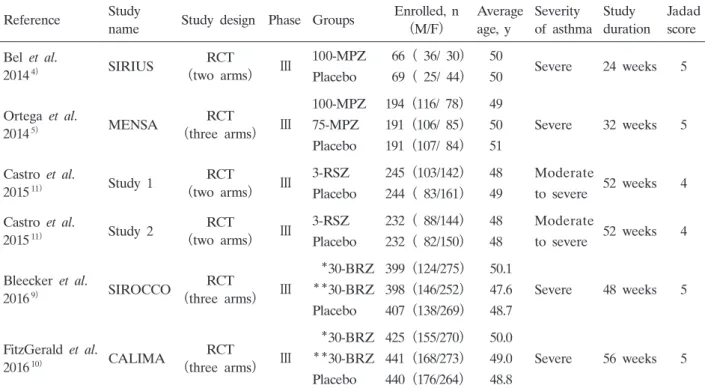
4, 5, 9-11). Four studies had a Jadad score of 5, whereas one had a score of 4, which confirmed their high quality. The study characteristics are listed in Table 1.
Risk of bias
The risk of study bias was evaluated on the basis of : random sequence generation; allocation concealment ; blinding of the participants, personnel, and outcome assessment ; incomplete out- come data ; selective reporting; and other forms of potential bias. Each study was considered to have a low risk of bias for all factors, expect for performance bias in three studies and detection bias in two studies. The authorsʼ determinations of these assessments are shown in Fig. 2.
Asthma exacerbation and change in FEV
1.0Asthma exacerbation was assessed in all six of the RCTs and change in FEV
1.0was assessed in five. There was no inter-study heterogeneity, as measured using the I
2statistic, and all analy- ses in the present study were performed using the fixed-effect model.
The results of the present meta-analysis of anti-IL-5 therapies revealed a significant reduction
Fig. 1. Study selection process
Table 1. Characteristics of the studies included in the meta-analysis
Reference Study
name Study design Phase Groups Enrolled, n
(M/F) Average age, y
Severity of asthma
Study duration
Jadad score Bel et al.
20144) SIRIUS RCT
(two arms) Ⅲ 100-MPZ Placebo
66 ( 36/ 30)
69 ( 25/ 44)
50
50 Severe 24 weeks 5
Ortega et al.
20145) MENSA RCT
(three arms) Ⅲ
100-MPZ 75-MPZ Placebo
194 (116/ 78)
191 (106/ 85)
191 (107/ 84)
49 50 51
Severe 32 weeks 5
Castro et al.
201511) Study 1 RCT
(two arms) Ⅲ 3-RSZ Placebo
245 (103/142)
244 ( 83/161)
48 49
Moderate
to severe 52 weeks 4 Castro et al.
201511) Study 2 RCT
(two arms) Ⅲ 3-RSZ Placebo
232 ( 88/144)
232 ( 82/150)
48 48
Moderate
to severe 52 weeks 4 Bleecker et al.
20169) SIROCCO RCT
(three arms) Ⅲ
*30-BRZ
**30-BRZ Placebo
399 (124/275)
398 (146/252)
407 (138/269)
50.1 47.6 48.7
Severe 48 weeks 5
FitzGerald et al.
201610) CALIMA RCT
(three arms) Ⅲ
*30-BRZ
**30-BRZ Placebo
425 (155/270)
441 (168/273)
440 (176/264)
50.0 49.0 48.8
Severe 56 weeks 5
F, female ; M, male ; RCT, randomized controlled trial ; 100-MPZ, 100 mg mepolizumab administrated subcutaneously every 4 weeks ; 75-MPZ, 75 mg benralizumab administrated intravenously every 4 weeks ; 3-RSZ, 3 mg/kg reslizumab administrated intravenously every 4 weeks ; *30-BRZ, 30 mg benralizumab administered subcutaneously every 4 weeks ; **30-BRZ, 30 mg benralizumab administered subcutaneously every 8 weeks
in asthma exacerbation rates compared with placebo, with a rate ratio of 0.54 (95% CI 0.47- 0.61) . The subgroup analysis of mepolizumab, reslizumab, and benralizumab also revealed a significant reduction in the incidence of asthma exacerbation compared with placebo, with rate ratios (95% CIs) of 0.55 (0.43-0.69) , 0.46 (0.36-0.58) , and 0.59 (0.47-0.71) , respectively (Fig. 3) . The results of the present meta-analysis of anti-IL-5 therapies also revealed a significant
Fig. 3. Forest plots of the rate ratio of asthma exacerbation showing comparisons between anti- interleukin (IL)-5 therapies and placebo. SE, standard error; CI, confidence interval.
Fig. 2. Bias assessment summary. (A) Risk of bias graph showing author judgments of risk of bias items, presented as percentages in each study included. (B) Risk of bias summary showing author judgment of risk of bias items for each study included.
improvement in FEV
1.0compared with placebo, with an SMD of 0.12 (95% CI 0.08-0.15) . The subgroup analysis of mepolizumab, reslizumab, and benralizumab also revealed a significant improvement in change in FEV1.0 compared with placebo, with SMD (95% CIs) of 0.10 (0.01- 0.19) , 0.11 (0.06-0.15) , and 0.14 (0.07-0.20) , respectively (Fig. 4) .
All adverse events, asthma worsening, injection site reaction, headache, nasopharyngitis, bronchitis, and death
There was a significant reduction in the incidence rate of all adverse events with anti-IL-5 ther- apies compared with placebo, with an RR of 0.93 (95% CI 0.89-0.96) . The subgroup analysis of reslizumab and benralizumab also revealed a significant reduction in the incidence rate of all adverse events compared with placebo, with RRs (95% CIs) of 0.92 (0.86-0.97) and 0.93 (0.88- 0.98) , respectively. However, there were no significant differences in the incidence of all adverse events between mepolizumab and placebo, with an RR of 0.93 (95% CI 0.86-1.01 ; Fig. 5) . The results of the present meta-analysis of anti-IL-5 therapies revealed a significant reduction in asthma worsening compared with placebo, with an RR of 0.63 (95% CI 0.56-0.72) . The sub- group analysis of mepolizumab, reslizumab, and benralizumab also revealed a significant reduction in the incidence rate of asthma worsening compared with placebo, with RRs (95% CIs) of 0.40
(0.22-0.70) , 0.67 (0.57-0.77) , and 0.64 (0.50-0.81) , respectively (Fig. 6) .
There were no significant differences in the incidence rates of injection site reaction, headache, and death between anti-IL-5 therapies and placebo, with RRs (95% CIs) of 1.59 (0.95-2.65) , 1.18 (0.86-1.62) , and 1.01 (0.33-3.12) , respectively. However, the subgroup analysis revealed that the incidence of injection site reaction was significantly increased in the mepolizumab compared with placebo group, with an RR of 2.56 (95% CI 1.15-5.68 ; Figs. 7, 8) .
There was a significant reduction in the incidence rate of nasopharyngitis with anti-IL-5 thera- pies compared with placebo, with an RR of 0.85 (95% CI 0.73-0.99) , although there were no
Fig. 4. Forest plots of changes in forced expiratory volume in 1 s (FEV1.0) showing comparisons between anti-interleukin (IL)-5 therapies and placebo. SMD, standard mean difference ; SE, standard error ; CI, confidence interval.
significant differences for mepolizumab, reslizumab, and benralizumab compared with placebo, with RRs (95% CIs) of 0.75 (0.53-1.07) , 0.82 (0.62-1.08) , and 0.91 (0.73-1.13) , respectively (Fig. 9) . There was also a significant reduction in the incidence rate of bronchitis with anti-IL-5 thera- pies compared with placebo, with an RR of 0.64 (95% CI 0.45-0.90) , although there were no
Fig. 6. Forest plots of asthma worsening showing comparisons between anti-interleukin (IL)-5 therapies and placebo. CI, confidence interval.
Fig. 5. Forest plots of all adverse events showing comparisons between anti-interleukin (IL)-5 therapies and placebo. CI, confidence interval.
significant differences for mepolizumab, reslizumab, and benralizumab compared with placebo on the subgroup analysis, with RRs (95% CIs) of 0.69 (0.31-1.51) , 0.33 (0.09-1.18) , and 0.78 (0.57- 1.06) , respectively (Fig. 10) .
There was no significant difference in the incidence rate of death between anti-IL-5 therapies and placebo, with an RR of 1.01 (95% CI 0.33-3.12 ; data not shown) .
Publication bias
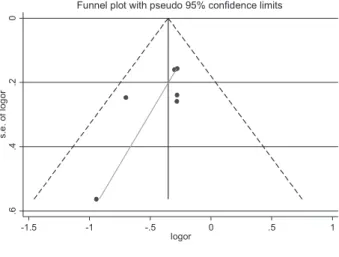
Differences in incidence of all adverse events between patients receiving anti-IL-5 therapies and those receiving placebo were evaluated with an Eggerʼs funnel plot in six studies, suggesting
Fig. 8. Forest plots of headache showing comparisons between anti-interleukin (IL)-5 therapies and placebo. CI, confidence interval.
Fig. 7. Forest plots of injection site reaction showing comparisons between anti-interleukin (IL)-5 therapies and placebo. CI, confidence interval.
no publication bias (p = 0.142 ; Fig. 11) . Similarly, no publication bias was observed for any of the other outcomes as determined by Beggʼs and Eggerʼs tests (all p > 0.05 ; data not shown) . These results suggest that publication bias did not substantially affect the conclusions. Therefore, the results of the meta-analysis are considered valid.
Fig. 10. Forest plots of bronchitis showing comparisons between anti-interleukin (IL)-5 therapies and placebo. CI, confidence interval.
Fig. 9. Forest plots of nasopharyngitis showing comparisons between anti-interleukin (IL)-5 therapies and placebo. CI, confidence interval.
Discussion
In the present meta-analysis we compared the efficacy (asthma exacerbations, pulmonary function) and safety (all adverse events, asthma worsening, injection site reactions, headache, nasopharyngitis, bronchitis, and death) of recommended dosages and administration of anti-IL-5 therapies compared with placebo. The aim of the present study was to assess the overall effi- cacy and safety of anti-IL-5 therapies.
The results indicate that the risk of asthma exacerbation was significantly reduced in the anti- IL-5 group compared with placebo, and that pulmonary function was significantly improved following treatment with the anti-IL-5 agents compared with placebo. The subgroup analysis also demonstrated that risk of asthma exacerbation was significantly reduced and that pulmonary function was significantly improved in the mepolizumab, reslizumab, and benralizumab groups compared with placebo.
The incidence of all adverse events, asthma worsening, nasopharyngitis, and bronchitis was significantly lower in the anti-IL-5 than placebo group. Although not significant, the incidence rates of injection site reactions and headache were more likely to be higher in the anti-IL-5 group than in the placebo group. There were no significant differences in the incidence of death between the two groups. The subgroup analysis demonstrated that the incidence rate of all adverse events in the reslizumab group was significantly reduced compared with placebo, whereas there were no significant differences compared with placebo in the mepolizumab and benrali- zumab groups. The incidence of asthma worsening was significantly lower in the mepolizumab, reslizumab, and benralizumab groups than in the placebo group. The incidence rate of injection site reactions was significantly higher in the mepolizumab than placebo group, whereas there were no significant differences between the benralzumab or reslizumab groups and the placebo group. Although there were no significant differences in the incidence of headache between the mepolizumab, reslizumab, or benralizumab groups and the placebo group, there was a trend for
Fig. 11. Eggerʼs funnel plot of the six studies evaluated in the present meta-analysis : effects of anti- interleukin (IL)-5 therapies and placebo on all adverse events. OR, odds ratio ; SE, standard error.
a higher incidence of headache in the benralizumab compared with placebo group. There were no significant differences in the incidence of nasopharyngitis, bronchitis, and death between the mepolizumab, reslizumab, or benralizumab groups, and placebo.
Although previous RCTs and meta-analyses of anti-IL-5 therapies have shown similar results regarding efficacy and safety outcomes, there was variability in the degree of the efficacy and safety (e.g. risk of asthma exacerbation or incidence of all adverse events) among these studies, not only due to differences in asthma severity and definitions of complications, but also due to differences in dosage and administration
4, 6, 9-13).
As expected, the present meta-analysis assessing the efficacy of the currently recommended dosages and administration of anti-IL-5 therapies in patients with uncontrolled eosinophilic asthma showed results similar to those of previous Phase 3 studies. The results of the present study strongly support the theory that anti-IL-5 therapies are an effective treatment option for patients with uncontrolled eosinophilic asthma.
Regarding safety outcomes, the results of the present meta-analysis indicate that the incidence rate of all adverse events was significantly lower in the anti-IL-5 than placebo group. Although the difference in incidence rate of 0.07 was statistically but not clinically significant, this result indicates the safety of anti-IL-5 therapies.
The results of the present meta-analysis also indicate that the incidence rates of nasophar- yngitis and bronchitis are significantly lower in the anti-IL-5 than placebo group, although the subgroup analysis of mepolizumab, reslizumab, and benralizumab did not reveal any significant differences between the individual anti-IL-5 agents and placebo. This may also suggest that anti-IL-5 therapies for nasopharyngitis and bronchitis are safe. Furthermore, this could indicate the efficacy of anti-IL-5 therapies for nasopharyngitis and bronchitis due to a therapeutic effect against eosinophilic airway inflammation.
In addition, the incidence rate of asthma worsening was significantly lower in the anti-IL-5 than placebo group. Subgroup analysis also revealed that the incidence rate of asthma worsen- ing was significantly lower in the mepolizumab, benralizumab, and resulizumab groups compared with placebo. These results suggest that anti-IL-5 therapies are not only safe for the treatment of asthma worsening, but are also effective in preventing exacerbation of asthma.
In contrast, the results of the present study also demonstrated that, although not significant, there was tendency for the incidence rates of injection site reactions and headache to be higher in the anti-IL-5 therapy group than in the placebo group. Moreover, subgroup analysis revealed that the incidence rate of injection site reactions was significantly higher in the mepolizumab group than in the placebo group. This may be biologically plausible because enhanced levels of IL-5 are observed not only in the airway, but also in subcutaneous tissue after elevation of serum IL-5
20), whereas enhanced levels of eosinophils are observed primarily in the airways rath- er than in subcutaneous tissue in patients with eosinophilic asthma
21, 22). These results suggest that special attention is warranted regarding the occurrence of injection site reactions, especially with the administration of mepolizumab.
To the best of our knowledge, the present study is the first meta-analysis to compare the
efficacy and safety profiles between anti-IL-5 therapies, at the recommended dosages and admin- istration, and placebo in patients with uncontrolled eosinophilic asthma. As expected, we found that anti-IL-5 therapy was effective and generally well tolerated. We also report a novel finding in that the incidence of injection site reactions was significantly increased at the recommended dosage and administration of mepolizumab compared with placebo.
The present study has several limitations. First, we only considered published studies and it is possible that publication bias may be present, although this was not apparent in the funnel plot.
Second, a meta-analysis is a form of retrospective research that is subject to the same method- ological limitations as retrospective studies. For example, all six studies included in the present meta-analysis were supported by a pharmaceutical company, and the authors of those studies reported receiving grant support or uncompensated support. Therefore, the source of fund- ing may have influenced the outcomes. Moreover, outcome selection bias may have occurred.
Third, the criteria for asthma worsening, injection site reactions, and headache were not detailed in the studies included the present analysis, and may vary among studies, although consensus criteria for these outcomes have been established. Fourth, the total dosage of anti-IL-5 agents varied among studies included in the present meta-analysis due, in part, to different study dura- tions, although dosages and administration were standardized to those currently recommended.
The treatment duration of anti-IL-5 therapy remains to be standardized, and this may affect the final conclusions. Finally, we only included a small sample of studies (six) in the present meta- analysis. Although meta-analyses involving a small sample of studies are not uncommon in orphan disease, they may be confounded by the presence of heterogeneity
23), although heteroge- neity was not observed in the present meta-analysis.
In conclusion, we assessed the efficacy and safety profiles of anti-IL-5 therapies, at the cur- rently recommended dosages and administration, compared with placebo. The results indicated that the risk of asthma exacerbation was significantly reduced and that pulmonary function was significantly improved in the anti-IL-5 compared with placebo group, and that the incidence of all adverse events, asthma worsening, nasopharyngitis, and bronchitis was significantly lower in the anti-IL-5 than placebo group. However, the subgroup analysis results originally demonstrated that the incidence of injection site reactions was significantly higher in the mepolizumab group than in the placebo group. These results suggest that anti-IL-5 therapies, at currently recom- mended dosages and administration, are effective and generally well tolerated in patients with uncontrolled eosinophilic asthma, but there is a need for special attention regarding the occur- rence of injection site reactions, in particular regarding the administration of mepolizumab. The identification of some limitations in this meta-analysis indicates that further studies are necessary to confirm the efficacy and safety profiles of anti-IL-5 therapies, at recommended dosages and administration, in patients with uncontrolled eosinophilic asthma.
Acknowledgements
The authors are indebted to the authors of the original studies. The authors thank Ian Michael Adcock
(Respiratory Cell & Molecular Biology, National Heart and Lung Institute, Imperial College London, London, UK)
for scientific editorial assistance in the preparation of this report.
Conflict of interest disclosure
None of the authors have any conflicts of interest to disclose.
References
1) Carr TF, Kraft M. Update in asthma 2014. Am J Respir Crit Care Med. 2015;192:157-163.
2) Horne R. Compliance, adherence, and concordance: implications for asthma treatment. Chest. 2006;130
(1 Suppl):65S-72S.
3) Moore WC, Peters SP. Severe asthma: an overview. J Allergy Clin Immunol. 2006;117:487-494; quiz 495.
4) Bel EH, Wenzel SE, Thompson PJ, et al. Oral glucocorticoid-sparing effect of mepolizumab in eosinophilic asthma.
N Engl J Med. 2014;371:1189-1197.
5) Ortega HG, Liu MC, Pavord ID, et al. Mepolizumab treatment in patients with severe eosinophilic asthma. N Engl J Med. 2014;371:1198-1207. Erratum in: N Engl J Med. 2015;372:1777.
6) Pavord ID, Korn S, Howarth P, et al. Mepolizumab for severe eosinophilic asthma (DREAM): a multicentre, double-blind, placebo-controlled trial. Lancet. 2012;380:651-659.
7) Varricchi G, Bagnasco D, Ferrando M, et al. Mepolizumab in the management of severe eosinophilic asthma in adults: current evidence and practical experience. Ther Adv Respir Dis. 2017;11:40-45.
8) Canonica GW, Senna G, Mitchell PD, et al. Therapeutic interventions in severe asthma. World Allergy Organ J.
2016;9:40. (accessed 2017 Sep 27) Available from: https://waojournal.biomedcentral.com/track/pdf/10.1186/s40413-016- 0130-3?site-=waojournal.biomedcentral.com
9) Bleecker ER, FitzGerald JM, Chanez P, et al. Efficacy and safety of benralizumab for patients with severe asthma uncontrolled with high-dosage inhaled corticosteroids and long-acting beta2-agonists (SIROCCO): a randomised, multicentre, placebo-controlled phase 3 trial. Lancet. 2016;388:2115-2127.
10) FitzGerald JM, Bleecker ER, Nair P, et al. Benralizumab, an anti-interleukin-5 receptor alpha monoclonal antibody, as add-on treatment for patients with severe, uncontrolled, eosinophilic asthma (CALIMA): a randomised, double- blind, placebo-controlled phase 3 trial. Lancet. 2016;388:2128-2141.
11) Castro M, Zangrilli J, Wechsler ME, et al. Reslizumab for inadequately controlled asthma with elevated blood eosinophil counts: results from two multicentre, parallel, double-blind, randomised, placebo-controlled, phase 3 trials.
Lancet Respir Med. 2015;3:355-366.
12)Wang FP, Liu T, Lan Z, et al. Efficacy and safety of anti-interleukin-5 therapy in patients with asthma: a system- atic review and meta-analysis. PLoS One. 2016;11:e0166833. (accessed 2017 Sep 17) Available from: http://journals.
plos.org/plosone/article?id=10.1371/journal.pone.0166833
13) Wang FP, Xiong XF, Liu T, et al. Anti-interleukin 5 therapy for eosinophilic asthma: a meta-analysis of randomized clinical trials. Clin Rev Allergy Immunol (Internet). 2016 Sept 27;54:318-330. (accessed 2017 Sep 27) Available from: https://link.springer.com/article/10.1007%2Fs12016-016-8588-x
14) Higgins JP, Green S. Cochrane handbook for systematic reviews of interventions (Internet). Chichester, UK: John Wiley & Sons; 2008. (accessed 2017 Sep 28) Available from: http://onlinelibrary.wiley.com/
book/10.1002/9780470712184.
15) Jadad AR, Moore RA, Carroll D, et al. Assessing the quality of reports of randomized clinical trials: is blinding necessary? Control Clin Trials. 1996;17:1-12.
16) Higgins JP, Thompson SG, Deeks JJ, et al. Measuring inconsistency in meta-analyses. BMJ. 2003;327:557-560.
17) DerSimonian R, Laird N. Meta-analysis in clinical trials. Control Clin Trials. 1986;7:177-188.
18) Mantel N, Haenszel W. Statistical aspects of the analysis of data from retrospective studies of disease. J Natl Cancer Inst. 1959;22:719-748.
19) Egger M, Davey Smith G, Schneider M, et al. Bias in meta-analysis detected by a simple, graphical test. BMJ.
1997;315:629-634.
20)Joseph J, Benedict S, Safa W, et al. Serum interleukin-5 levels are elevated in mild and moderate persistent asthma irrespective of regular inhaled glucocorticoid therapy. BMC Pulm Med. 2004;4:2. (accessed 2017 Sep 27) Available from: https://www.ncbi.nlm.nih.gov/pmc/articles/PMC394333/
21) Bousquet J, Chanez P, Lacoste JY, et al. Eosinophilic inflammation in asthma. N Engl J Med. 1990;323:1033-1039.
22) Weller PF. The immunobiology of eosinophils. N Engl J Med. 1991;324:1110-1118.
23) Friede T, Rover C, Wandel S, et al. Meta-analysis of two studies in the presence of heterogeneity with applications in rare diseases. Biom J. 2016;59:658-671.
[Received October 1, 2017 : Accepted November 6, 2017]