VOL. 61 NO. 4 切除可能大腸癌肝転移に対するSOX+BV併用療法 343
【原著・臨床】
切除可能大腸癌肝転移に対する術前
S-1+Oxaliplatin
+Bevacizumab併用療法の使用経験
高橋大五郎・平松 和洋・加藤 岳人・柴田 佳久・吉原 基 豊橋市民病院一般外科*
(平成25年2月14日受付・平成25年4月16日受理)
大腸癌肝転移は大腸癌症例の予後を規定する重要な因子であり,その治療の第1選択は肝切除である。
進行大腸癌に対するkey drugとしてS-1,oxaliplatin,bevacizumabは使用されているが,切除可能肝 転移に対しての術前S-1+Oxaliplatin+Bevacizumab併用療法(以下,SOX+BV療法)の有効性や安全 性についての十分なエビデンスはない。
今回われわれは,切除可能大腸癌肝転移に対して術前にSOX+BV療法を施行し肝切除を施行した6 例を経験した。投与方法は,bevacizumab:7.5 mg!kg,oxaliplatin:130 mg!m2を第1日目に点滴静注 し,S-1:80 mg!m2を14日間内服投与後,7日間休薬(SOX+BV療法)を3コース施行し,4コース目
はbevacizumabを抜いたSOX療法を施行するスケジュールとした。最終のbevacizumab投与からは
35日以上あけ,最終のSOX療法からは21日以上あけて肝切除を行った。化学療法の効果判定としては CR 1例,PR 4例,SD 1例と増悪した症例は認めなかった。副作用としては,1例でgrade 3の好中球減
少,1例でgrade 3の下痢を認めた。全例でR0手術を施行でき,術後合併症は,創感染を1例で認めた
が重大な合併症は認めなかった。切除後の病理検査では,1例で背景肝に脂肪性肝炎を認めた。
今回,切除可能大腸癌肝転移に対する術前SOX+BV療法を6例に施行し,安全に手術を行うことが できた。今後さらなる症例の集積が必要で,再発率や全生存期間などを含め検討が必要であると考えら れた。
Key words: S-1,oxaliplatin,bevacizumab,neoadjuvant chemotherapy,colorectal cancer
大腸癌の転移形式として最も多い の は 肝 転 移 で あ り,
Leporrierら1)の検討によると,1,325例の大腸癌患者のうち 358例(27.0%)に肝転移が認められる。欧州で行われたEuro- pean Organization for Research and Treatment of Cancer
(EORTC)40983試験2)では,肝切除術前後に化学療法を行っ た群では手術単独群と比較し,有意に無増悪生存期間が延長 することが報告されている。これを受けて,米国National Comprehensive Cancer Network(NCCN)のガイドライン3)で は,切除可能な肝転移に対する肝切除前・後の全身化学療法 を推奨している。一方,本邦の大腸癌治療ガイドライン4)では,
術前の科学療法の安全性が確立されていないため,適正に計 画された臨床試験として実施するべきとし,慎重な姿勢を とっている。
切除可能大腸癌肝転移に対する術前化学療法(NAC)の安 全性は現在のところ確立されておらず,抗癌剤による肝障害 などの副作用発現に関する検討,抗腫瘍効果の精密な判定,切 除のタイミングなどを考慮した治療戦略の確立が重要であ る。今回われわれは,切除可能大腸癌肝転移に対して術前に
SOX+BV療法を施行し安全に肝切除を施行できた6例を経
験したので報告する。
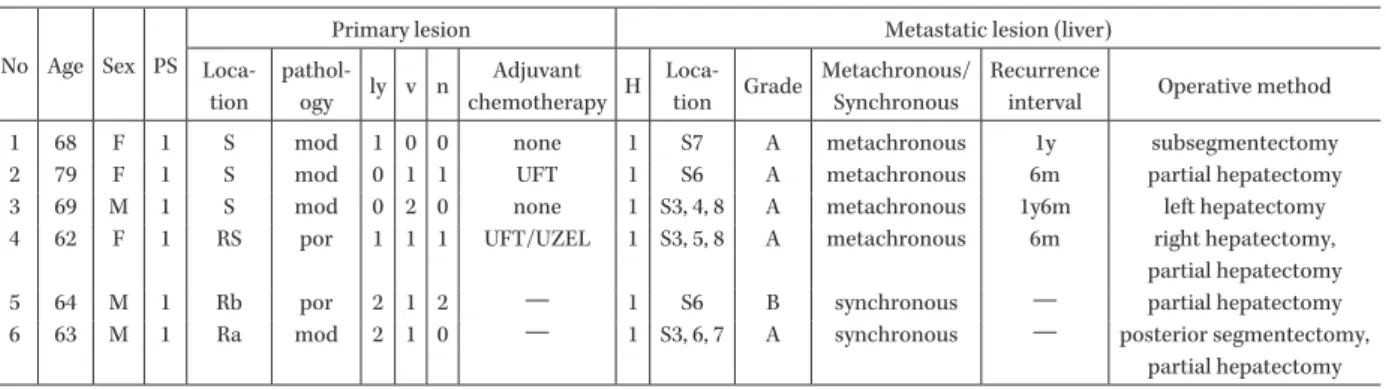
I. 対 象 と 方 法(Table 1)
前治療にoxaliplatinまたはirinotecanを使用してい ない症例とし,①十分な臓器機能が保たれていること,
②ECOG Performance Status(PS)score:0―1であるこ と,③Informed Consentを文書で取得した症例とした。
臨床的に治癒切除可能な,大腸癌術後の異時性肝転移例 および大腸癌同時性肝転移例の6例を対象とした。
原則として化学療法は外来治療とした。投与方法は,
bevacizumab:7.5 mg!kg,oxaliplatin:130 mg!m2を第 1日目に点滴静注し,S-1:80 mg!m2を14日間内服投与 後,7日間休薬(SOX+BV療法)を3コース施行し,4 コース目はbevacizumabを抜いたSOX療法を施行す るスケジュールとした。有害事象や肝転移巣縮小による 評価困難が危惧された場合は途中で手術へ移行すること とした。最終のbevacizumab投与からは35日以上あけ,
最終のSOX療法からは21日以上あけて肝切除を行っ た。
*愛知県豊橋市青竹町字八間西50番地
344 日 本 化 学 療 法 学 会 雑 誌 J U L Y 2 0 1 3
Table 1. Material and Method
No Age Sex PS
Primary lesion Metastatic lesion (liver)
Loca- tion
pathol-
ogy ly v n Adjuvant
chemotherapy H Loca-
tion Grade Metachronous/
Synchronous
Recurrence
interval Operative method
1 68 F 1 S mod 1 0 0 none 1 S7 A metachronous 1y subsegmentectomy
2 79 F 1 S mod 0 1 1 UFT 1 S6 A metachronous 6m partial hepatectomy
3 69 M 1 S mod 0 2 0 none 1 S3, 4, 8 A metachronous 1y6m left hepatectomy
4 62 F 1 RS por 1 1 1 UFT/UZEL 1 S3, 5, 8 A metachronous 6m right hepatectomy, partial hepatectomy
5 64 M 1 Rb por 2 1 2 ― 1 S6 B synchronous ― partial hepatectomy
6 63 M 1 Ra mod 2 1 0 ― 1 S3, 6, 7 A synchronous ― posterior segmentectomy,
partial hepatectomy
Table 2. Result
No Adverse events Grade Protocol (course)
Post-operative complication
Chemotherapy
Primary lesion Liver metastasis Drug hepatopathy
1 neuropathy G1
4 none ― CR none
neutropenia G3
2 neuropathy G1
4 none ― PR none
neutropenia G1
3 neuropathy G1 2 none ― PR none
4 neuropathy G1
4 none ― SD none
neutropenia G1
5 none ― 3 none PR PR steatohepatitis
6 diarrehea G3 2 wound infection PR PR none
II. 結 果(Table 2)
化学療法の効果判定としては6例中,CR 1例,PR 4 例,SD 1例で,奏効率83.3%(5例!6例),腫瘍制御率は
100%(6例!6例)であった。副作用としては,1例で
grade 3の好中球減少,1例でgrade 3の下痢を認めた。
その他,grade 1の痺れを4例に,grade 1の好中球減少 を3例に認めた(重複含む)。3例は4コース完了し,1 例は有害事象である下痢のため2コースで中止,1例は 患者の希望のため2コースで終了,1例は腫瘍縮小のた めに3コースで完了とし,肝切除を施行した。全例でR0 手術を施行でき,術後合併症は,創感染を1例で認めた が重大な合併症は認めなかった。切除後の病理検査でも,
CR 1例,PR 4例,SD 1例であった。1例で背景肝に脂肪 性肝炎を認めた。症例3は,術後6カ月目に多発肝転移 再発を認めたが,その他の症例は術後1年現在無再発生 存中である。
III. 考 察
切除可能な肝転移に対し術前化学療法を行う利点とし ては,①微小転移の早期治療,②腫瘍縮小による肝切除 体積比の低下および残肝容積の増大とR0切除の可能性 が高まること,③早期に増悪する患者に対する局所療法 の回避,④薬剤感受性の評価ができること,⑤術前のほ うが術後より化学療法の忍容性が高いなどが挙げられ る5〜7)。一方,問題点として,非奏功例が切除不能となる 可能性,正常肝組織に対する毒性のため肝切除後合併症
が増加する可能性,化学療法が奏功し,画像上CRとなっ た時,切除すべき肝転移巣部位がわからなくなることな どが挙げられ,本邦の大腸癌治療ガイドライン(2010 年版)4)では術前化学療法は臨床試験としてすべきと位置 づけられている。一方,EORTC 40983試験2)により,肝 切 除 前・後 の 周 術 期fluorouracil!calcium folinate!ox- aliplatin(FOLFOX)療法は,切除可能な肝転移例の予後 向上を示唆する結果が報告され,切除可能肝転移に対し ても積極的に術前化学療法が行われつつあり,Abdalla ら8)やNordlingerら9)もその有効性について報告してい る。
本邦でFOLFOXの代替療法としての可能性を検討し
て,28例を対象に行われたSOX療法の第I!II相試験で は,奏効率50%,無病増悪期間196日,1年生存 率:
78.6% と良好な成績が報告されている10)。韓国で行われ
た進行再発大腸癌の1次治療を対象とした第III相試験 で,SOX療法のXELOX療法に対する非劣性が示され た11)。また,NO16966試験12)では,Saltzらが,FOLFOX
またはXELOX群に対して,BVを併用する群で無増悪
生存期間が有意に延長することが示された。一方,SOX に対するBVの上乗せ効果に対する十分なエビデンスは
ないが,L-OHPベースのレジメンにBVを併用すること
で類洞拡張が減少したとの報告13,14)もあり,BVにはL- OHPの肝障害に対する肝庇護作用があることが期待さ れている。現在,本邦において進行再発大腸癌の初回治
VOL. 61 NO. 4 切除可能大腸癌肝転移に対するSOX+BV併用療法 345
療 例 を 対 象 と し て,mFOLFOX6+BV療 法 に 対 し て
SOX+BV療法の非劣性を検証する第III相試験(SOFT
試験)が行われている。
L-OHPの用法・用量変更(2009年9月)に伴い,SOX 療法は一般臨床でも投与可能となった。われわれは,切 除可能な肝転移に対し術前化学療法として本療法を行う ことのInformed Consentを文書で取得した症例に対し
SOX+BV療法を施行した。
今回検討した6例において,奏効率83.3%(5例!6例),
腫瘍制御率は100%(6例!6例)であり,oxaliplatinベー スの化学療法+bevacizumab療法と比較しても劣るも のではなかった12,15〜17)。
術前化学療法が正常肝に及ぼす影響については薬剤に より異なり,irinotecanでは脂肪性肝炎が,oxaliplatin では類洞拡張が起こりやすいとされており18),脂肪性肝 炎については術後90日以内の肝不全死亡に相関がある と報告されている18)。今回検討した6例中,1例では病理 学的に脂肪性肝炎が認められたが,周術期に合併症は認 めなかった。
SOX療法におけるgrade 3!4の有害事象として,Zang ら19)は,血小板減少が13%,好中球減少が10%,貧血が 6% と 報 告 し て お り,Yamadaら10)は,血 小 板 減 少 が
27%,好中球減少が14%,貧血,下痢が3% と報告して
いる。今回検討した6例中,1例にgrade 3の好中球減少 を,1例に下痢を認めている。
今回,切除可能大腸癌肝転移を対象に,術前SOX+BV 療法を6例に施行し,全例で安全にR0切除を施行する ことができた。今後さらなる症例の集積が必要で,再発 率や全生存期間などを含め検討が必要であると考えられ た。また,術前化学療法後の肝切除術について現在進行 中の臨床試験がいくつかあり,今後の展開が期待される。
利益相反自己申告:申告すべきものなし。
文 献
1) Leporrier J, Maurel J, Chiche L, Bara S, Segol P, Launoy G: A population-based study of the incidence, management and prognosis of hepatic metastases from colorectal cancer. Br J Surg 2006; 93: 465-74 2) Nordlinger B, Sorbye H, Glimelius B, Poston G J,
Schlag P M, Rougier P, et al: Perioperative che- mothetapy with FOLFOX4 and surgery versus sur- gery alone for resectable liver metastases from col- orectal cancer ( EORTC Intergroup trial 40983 ) : a randomised controlled trial. Lancet 2008; 371: 1007-16 3) Engstrom P F, Arnoletti J P, Benson A B 3rd, Chen Y J, Choti M A, Cooper H S, et al: NCCN Clinical Practice Guidelines in Oncology: colon cancer. J Natl Compr Canc Netw 2009; 7: 778-831
4) 大腸癌研究会 編:大腸癌治療ガイドライン医師用,
2012年版,金原出版,東京,2010
5) Adam R, Delvart V, Pascal G, Valeanu A, Castaing D, Azoulay D, et al: Rescue surgery for unresectable colorectal liver metastases downstaged by chemo-
therapy: a model to predict long-term survival. Ann Surg 2004; 240: 644-57
6) Parikh A A, Gentner B, Wu T T, Curley S A, Ellis L M, Vauthey J N: Perioperative complications in pa- tients undergoing major liver resection with or with- out neoadjuvant chemotherapy. J Gastrointest Surg 2003; 7: 1082-8
7) Zorzi D, Laurent A, Pawlik T M, Lauwers G Y, Vauthey J N, Abdalla E K: Chemotherapy-associated hepatotoxicity and surgery for colorectal liver me- tastases. Br J Surg 2007; 94: 274-86
8) Abdalla E K, Vauthey J N: Chemotherapy prior to hepatic resection for colorectal liver metastases : helpful until harmful? Dig Surg 2008; 25: 421-9 9) Nordlinger B, Van Cutsem E, Gruenberger T,
Glimelius B, Poston G, Rougier P, et al: Combination of surgery and chemotherapy and the role of tar- geted agents in the treatment of patients with col- orectal liver metastases: recommendations from an expert panel. Ann Oncol 2009; 20: 985-92
10) Yamada Y, Tahara M, Miya T, Satoh T, Shirao K, Shimada Y, et al: Phase I!II study with oxaliplatin with oral S-1 as first-line therapy for patients with metastatic colorectal cancer. Br J Cancer 2008; 98 : 1034-8
11) Hong Y S, Park Y S, Lim H Y, Lee J, Kim T W, Kim K P, et al: S-1 plus oxaliplatin versus capecitabine plus oxaliplatin for first-line treatment of patients with metastatic colorectal cancer : a randomised, non- inferiority phase 3 trial. Lancet Oncol 2012; 13: 1125- 32
12) Saltz L B, Clarke S, Díaz-Rubio E, Scheithauer W, Figer A, Wong R, et al: Bevacizumab in combination with oxaliplatin-based chemotherapy as first-line therapy in metastatic colorectal cancer: a random- ised phase III study. J Clin Oncol 2008; 26: 2013-9 13) Ribero D, Wang H, Donadon M, Zorzi D, Thomas M
B, Eng C, et al: Bevacizumab improves pathologic response and protects against hepatic injury in pa- tients treated with oxaliplatin-based chemotherapy for colorectal liver metastases. Cancer 2007 ; 110 : 2761-7
14) Rubbia-Brandt L, Lauwers G Y, Wang H, Majno P E, Tanabe K, Zhu A X, et al: Sinusoidal obstruction syn- drome and nodular regenerative hyperplasia are fre- quent oxaliplatin-associated liver lesions and par- tially prevented by bevacizumab in patients with he- patic colorectal metastasis. Histopathology 2010; 56:
430-9
15) Hochster H S, Hart L L, Ramanathan R K, Childs B H, Hainsworth J D, Cohn A L, et al: Safety and efficacy of oxaliplatin and fluoropyrimidine regimens with or without bevacisumab as first-line treatment of me- tastatic colorectal cancer : results of the TREE Study. J Clin Oncol 2008; 26: 3523-9
16) Hecht J R, Mitchell E, Chidiac T, Scroggin C, Hagen- stad C, Spigel D, et al: A randomized phase IIIB trial of chemotherapy, bevacizumab, and panitumumab compared with chemotherapy and bevacizumab alone for metastatic colorectal cancer. J Clin Oncol
346 日 本 化 学 療 法 学 会 雑 誌 J U L Y 2 0 1 3
2009; 27: 672-80
17) Doi T, Boku N, Kato K, Komatsu Y, Yamaguchi K, Muro K, et al: Phase I!II study of capecitabine plus oxaliplatin (XELOX) plus bevacizumab as first-line therapy in Japanese patients with metastatic col- orectal cancer. Jpn J Clin Oncol 2010; 40: 913-20 18) Vauthey J N, Pawlik T M, Ribero D, Wu T T, Zorzi
D, Hoff P M, et al: Chemotherapy regimen predicts
steatohepatitis and an increase in 90-day mortality after surgery for hepatic colorectal metastases. J Clin Oncol 2006; 24: 2065-72
19) Zang D Y, Lee B H, Park H C, Song H H, Kim H J, Jung J Y, et al: Phase II study with oxaliplatin and S- 1 for patients with metastatic colorectal cancer. Ann Oncol 2009; 20: 892-6
Evaluation of S-1+Oxaliplatin+Bevacizumab combination chemotherapy as neoadjuvant chemotherapy for patients with
resectable liver metastases from colorectal cancer
Daigoro Takahashi, Kazuhiro Hiramatsu, Takehito Kato, Yoshihisa Shibata and Motoi Yoshihara
Department of General Surgery, Toyohashi Municipal Hospital, 50 Hakken-Nishi, Aotake-cho, Toyohashi, Aichi, Japan
Liver metastasis of colorectal cancer is one of the important prognostic factors for cancer treatment. Sur- gical resection for patients with colorectal liver metastases is currently considered the only potentially cura- tive option for these patients. S-1, oxaliplatin and bevacizumab have been used as key drugs in the treatment of advanced colorectal cancer, but there has been no report on the feasibility and efficacy of these three drugs (SOX+BV) as neoadjuvant chemotherapy (NAC) for resectable colorectal liver metastases.
We report herein on 6 cases of SOX+BV as NAC for patients with resectable liver-only metastases from colorectal cancer and evaluate the safety and the short-term outcome of SOX+BV chemotherapy. Bevacizu- mab (7.5 mg!kg) and oxaliplatin (130 mg!m2) were administrated intravenously on day 1, whereas S-1 was administrated orally (80 mg!m2!day, b.i.d.) for 14 days followed by a 7-day rest. The overall response rate was 83.3% (CR, 1 patient; PR, 4 patients; SD, 1 patient) and disease control was 100% (6!6 patients). Grade 3! 4 side effects were observed in 2 patients (1 patient each with neutropenia and diarrhea).
In this study, we perfomed R0 hepatectomy for all cases, and had no major complications. Our results sug- gest that preoperative SOX+BV chemotherapy for hepatectomy of metastatic colorectal cancer is safe and has no adverse effect on surgery. In future, further studies on SOX+BV chemotherapy, involving such fac- tors as PFS, OS, and QOL, need to be addressed.