ENTREPRENEURSHIP IN EMERGING MARKETS : AN
EXAMINATION OF CAUSAL AND EFFECTUAL APPROACHES
TO ENTREPRENEURIAL DECISION MAKING
著者(英)
Nader Abdo Mohammed AlJuma’i
学位名
博士 (先端マネジメント)
学位授与機関
関西学院大学
学位授与番号
34504甲第612号
Doctoral Dissertation
for Doctoral Degree
Kwansei Gakuin University
ENTREPRENEURSHIP IN EMERGING MARKETS:
AN EXAMINATION OF CAUSAL AND EFFECTUAL APPROACHES
TO
ENTREPRENEURIAL DECISION MAKING
Advisor: Professor David T. Methé
June, 2016
Graduate Department of Advanced Management (Ph.D)
Institute of Business and Accounting
73013951
Nader Abdo Mohammed AlJuma’i
ABSTRACT
ENTREPRENEURSHIP IN EMERGING MARKETS:
AN EXAMINATION OF CAUSAL AND EFFECTUAL APPROACHES
TO
ENTREPRENEURIAL DECISION MAKING
Nader Abdo Mohammed AlJuma’i
Advisor: Professor David T. Methé Institute of Business and Accounting
Kwansei Gakuin University
Decision-making is constantly at the center of the entire entrepreneurial process. In a dynamic process as entrepreneurship, the entrepreneur always finds himself urged to make decisions that eventually impact business operation. This study intends to conceptualize how a certain set of structural control factors and entrepreneurial characteristics are at play in such a dynamic manner, eventually impacting the entrepreneurial approach which is followed by the entrepreneur throughout his entrepreneurial venturing. We hypothesized this decision making process is affected by some entrepreneurial characteristics; i.e., entrepreneurial self-efficacy, entrepreneurial identity, and fear of failure. The research suggests conceptual links between these entrepreneurial characteristics and a certain set of structural control factors; which consequently impact the decision to whether the entrepreneur follows a causal or effectual approach to start and run an entrepreneurial venture. We test in our study how entrepreneurial characteristics impact our dependent variable; entrepreneurial approach. We then test the same variables controlling for the structural control factors. Before we test our hypotheses, we conduct a factor analysis that tests whether causation and effectuation are distinct constructs. Our results confirm Sarasvathy (2001) and Chandler et al. (2011) definitions of effectuation as a construct comprising of four sub-dimensions. However, we contribute to the field through confirming that these sub-dimensions are distinct in that they all load separately to the contrary of Chandler et al. (2011) findings that one sub-dimension appears within both causation and effectuation. Our hypotheses receive strong support and we discuss the implications of such relationship especially when we control for the structural control variables and other demographics.
Acknowledgement
I would like first to acknowledge the direct guidance and support of my advisor, Professor David T. Methé, throughout my whole doctoral research journey. Your great knowledge, patience, and coaching throughout my doctoral studies journey made it a very fruitful, inspiring, and precious gift to hold for the rest of my life. I’m overwhelmingly indebted to you for all of your sincere dedication to teach me everything that you could and guide me through this whole journey. Listening to all your advices and wisdom is something I will always cherish for they have changed the way I see everything and changed me to the better. I really cannot find the words to express how grateful I am to have you as a professor, a mentor, and a friend. I also acknowledge and appreciate the guidance and efforts of my second supervisor Professor Schumpeter Tamada who has also help guide my research throughout my study through his advices and discussions. Thank you also to Professor Mohammad Badrul Haider my third sitting committee chair for his support and guidance.
I dedicate this work to my father, mother, and wife who made all this come true. If it was not for you I would have not accomplished any of this. You took all the hardships and suffering just to see me succeed through your great belief in my capabilities which made me excel beyond all of my expectations.
I also sincerely acknowledge the great help of my friend Dr. Sultan AlShihri who was always there for me offering great help and guidance right from the beginnings of this study and has always been a brother to me and will remain. My sincere gratitude goes to all my family and friends for all their assistance and support that made this thesis come to light.
Table of Contents
CHAPTER ONE: INTRODUCTION ... 1
1.1
Research Objectives & Questions ... 2
1.2
Research Methodology ... 2
1.3
Research Significance ... 3
1.4
Assumptions ... 5
CHAPTER TWO: LITERATURE REVIEW ... 6
2.1
Entrepreneurial Behavior ... 6
2.2
Entrepreneurial Characteristics ... 10
2.2.1
Entrepreneurial Self-efficacy (ESE) ... 10
2.2.2
Fear of Failure ... 12
2.2.3
Entrepreneurial Identity ... 14
2.3
Structural Control Factors ... 17
2.3.1
Knowledge Source ... 17
2.3.2
Experiential Source ... 20
2.3.3
Access to Resources Through Network ... 22
2.3.4
Institutional Context ... 24
2.3.5
Environmental Trigger ... 26
2.4
Research Conceptual Model ... 28
CHAPTER 3: RESEARCH METHODOLOGY ... 30
3.1
Research Development & Implementation ... 30
3.2
Study Population and Sample ... 30
3.3
Data Collection ... 31
3.4
Instrumentation ... 32
3.5
Variables, Conceptual Definitions and Measure Questions ... 34
CHAPTER 4: RESULTS ... 42
4.1
Respondents’ Characteristics Analysis ... 42
4.2
Entrepreneurial Characteristics & Entrepreneurial Behavior ... 49
4.2.1
Entrepreneurial Behavior Factor Analysis ... 49
4.2.2
Entrepreneurial Characteristics & Causation ... 54
4.2.3
Entrepreneurial Characteristics & Effectuation ... 56
4.2.3.1.
Entrepreneurial Characteristics & Pre-commitments ... 56
4.2.3.2.
Entrepreneurial Characteristics & Flexibility ... 59
4.2.3.3.
Entrepreneurial Characteristics & Affordable Loss ... 61
4.2.3.4.
Entrepreneurial Characteristics & Experimentation ... 63
4.3
Structural Control Factors, Entrepreneurial Characteristics & Entrepreneurial Behavior ... 65
4.3.1
Structural Control Factors, Entrepreneurial Characteristics & Causation ... 66
4.3.2
Structural Control Factors, Entrepreneurial Characteristics & Effectuation ... 69
4.3.2.1
Structural Control Factors, Entrepreneurial Characteristics & Pre-commitments... 69
4.3.2.2
Structural Control Factors, Entrepreneurial Characteristics & Flexibility ... 72
4.3.2.3
Structural Control Factors, Entrepreneurial Characteristics & Affordable Loss... 74
4.3.2.4
Structural Control Factors, Entrepreneurial Characteristics & Experimentation ... 76
CHAPTER 5: DISCUSSION ... 78
5.1.2.2
Entrepreneurial Characteristics & Flexibility ... 81
5.1.2.3
Entrepreneurial Characteristics & Affordable Loss ... 83
5.1.2.4
Entrepreneurial Characteristics & Experimentation ... 84
5.2
Major Research Contributions & Suggestions for Future Research ... 85
5.3
Limitations ... 87
LIST OF REFERENCES ... 89
APPENDIX (1): RESEARCH TEST INSTRUMENT ENGLISH VERSION... 94
APPENDIX (2): RESEARCH TEST INSTRUMENT ARABIC VERSION ...
APPENDIX (3): ENTREPRENEURIAL BEHAVIOR FACTOR ANALYSIS RESULTS ...
APPENDIX (4): STRUCTURAL CONTROL FACTORS & ENTREPRENEURIAL
SELF-EFFICACY (ESE) REGRESSIONS’ EXPLORATORY RESULTS ...
LIST OF TABLES
Table 1: Comparison of Causation and Effectuation ... 7
Table 2: Extended Comparison of Causation and Effectuation Logics ... 8
Table 3: Conceptual Definitions and Measure Questions ... 35
Table 4: Entrepreneurial Behavior Factor Analysis Rotated Component Matrixa ... 50
Table 5: Entrepreneurial Characteristics & Causation Model Summary ... 55
Table 6: Entrepreneurial Characteristics & Causation ANOVA ... 55
Table 7: Entrepreneurial Characteristics & Causation Coefficients ... 55
Table 8: Entrepreneurial Characteristics & Pre-commitments Model Summary ... 57
Table 9: Entrepreneurial Characteristics & Pre-commitments ANOVA ... 57
Table 10: Entrepreneurial Characteristics & Pre-commitments Coefficients ... 58
Table 11: Entrepreneurial Characteristics & Flexibility Model Summary ... 60
Table 12: Entrepreneurial Characteristics & Flexibility ANOVA ... 60
Table 13: Entrepreneurial Characteristics & Flexibility Coefficients ... 60
Table 14: Entrepreneurial Characteristics & Affordable Loss Model Summary ... 62
Table 15: Entrepreneurial Characteristics & Affordable Loss ANOVA ... 62
Table 16: Entrepreneurial Characteristics & Affordable Loss Coefficients ... 62
Table 17: Entrepreneurial Characteristics & Experimentation Model Summary ... 64
Table 18: Entrepreneurial Characteristics & Experimentation ANOVA ... 64
Table 19: Entrepreneurial Characteristics & Experimentation Coefficients ... 64
Table 20: Structural Control Factors, Entrepreneurial Characteristics & Causation Model Summary ... 67
Table 21: Structural Control Factors, Entrepreneurial Characteristics & Causation ANOVA ... 67
Table 22: Structural Control Factors, Entrepreneurial Characteristics & Causation Coefficients ... 68
Table 23: Structural Control Factors, Entrepreneurial Characteristics & Pre-commitments Model Summary 70 Table 24: Structural Control Factors, Entrepreneurial Characteristics & Pre-commitments ANOVA ... 70
Table 25: Structural Control Factors, Entrepreneurial Characteristics & Pre-commitments Coefficients ... 71
Table 26: Structural Control Factors, Entrepreneurial Characteristics & Flexibility Model Summary ... 73
Table 27: Structural Control Factors, Entrepreneurial Characteristics & Flexibility ANOVA ... 73
Table 28: Structural Control Factors, Entrepreneurial Characteristics & Flexibility Coefficients ... 73
Table 28: Structural Control Factors, Entrepreneurial Characteristics & Affordable Loss Model Summary .. 75
Table 29: Structural Control Factors, Entrepreneurial Characteristics & Affordable Loss ANOVA ... 75
Table 30: Structural Control Factors, Entrepreneurial Characteristics & Affordable Loss Coefficients ... 75
Table 31: Structural Control Factors, Entrepreneurial Characteristics & Experimentation Model Summary . 76 Table 32: Structural Control Factors, Entrepreneurial Characteristics & Experimentation ANOVA ... 76
LIST OF FIGURES
FIGURE 1: DYNAMIC MODEL OF EFFECTUATION ... 9
FIGURE 2: RESEARCH CONCEPTUAL MODEL ... 29
FIGURE 3: RESPONDENTS BY GENDER ... 42
FIGURE 4: RESPONDENTS BY AGE ... 43
FIGURE 5: RESPONDENTS BY NATIONALITY ... 44
FIGURE 6: RESPONDENTS BY COUNTRY OF BUSINESS OPERATION ... 45
FIGURE 7: RESPONDENTS BY LEVEL OF EDUCATION ... 46
FIGURE 8: RESPONDENTS BY BACHELOR’S & PHD FIELD OF STUDY ... 47
CHAPTER ONE: INTRODUCTION
Interest in entrepreneurship as a universal human trend is widely established in the literature. As the impact of entrepreneurship on economic development is significant, what factors affect the entrepreneurial desire and how entrepreneurial development occurs is still a matter of debate in the field. According to the recent entrepreneurship literature, entrepreneurs follow one of two prevalent approaches when embarking upon new ventures; the synoptic or rational approach ‘causal reasoning’ and the spontaneous and improvised approach ‘effectual reasoning’ (Dew et al., 2009; Perry et al., 2012). Sarasvathy (2001) suggests in her theory of effectuation that most entrepreneurs, when trying to set up their new startups, instead of careful strategic planning and rigorous competitiveness analysis they revert to instinctive and effectual reasoning. Such entrepreneurs would make decisions based on available and accessible means and resources without necessarily having certain preset goals in mind. The theory of effectuation developed by Sarasvathy (2001) constitutes a paradigmatic shift in our perceptions of entrepreneurship but its literature is still nascent, as very few researchers have carried out empirical research and testing of the effectuation approach (Perry et al., 2012). Therefore, the need for further conceptual development and empirical testing and incorporating effectuation into existing entrepreneurial models and within different institutional contexts, other than the mainstream western context, is essentially significant.
We lay forth in this study our conceptualization by developing on several aspects of an earlier hypothesized model developed by the researcher (Al-Juma’i, 2014), testing our model through a series of relevant statistical tests, and eventually discussing and interpreting the results of these tests in light of the relevant literature. This study intends to investigate how a certain set of structural control factors; i.e., entrepreneurs’ knowledge sources, sources of experience, motivation behind seeking entrepreneurship, institutional environment where they start and operate their ventures, and finally their access to needed resources through their networks, impact different entrepreneurial characteristics inside entrepreneurs; i.e., their entrepreneurial self-efficacy, identity, and fear of failure. We argue that the interaction between these structural control factors and entrepreneurial characteristics eventually affects the entrepreneurial approach entrepreneurs follow, whether causal or effectual. We test our conceptual model by sampling entrepreneurs from different emerging markets, mainly from the Middle East and North Africa (MENA) markets. According to the Global Entrepreneurship Monitor (GEM-MENA, 2010), respondents from several MENA
both entrepreneurial self-efficacy and fear of failure but low entrepreneurial intention to start up new entrepreneurial ventures (Rosinaite, 2013; GEM-MENA, 2010). We expect that such contrasting attributes make studying such population of entrepreneurs very interesting and relevant for the research knowledge base of effectuation theory in particular and the whole entrepreneurship research.
1.1 Research Objectives & Questions
This study will attempt to answer one broad research question. This question mainly investigates the decision making process impacting the entrepreneurial approach that entrepreneurs in emerging markets follow when starting up their entrepreneurial ventures. It examines such process through exploring the impact of several entrepreneurial characteristics on entrepreneurial behavior. We identify in our literature review chapter three entrepreneurial characteristics; i.e., the entrepreneurial self-efficacy (ESE), the entrepreneurial identity, and fear of failure. We then test how these entrepreneurial characteristics impact entrepreneurial behavior controlling for a set of structural control factors that we see previous research arguing they would have some effect on the entrepreneurial characteristics. These structural control factors as discussed later towards the end of our literature review are; the knowledge source, the experiential source, the access to resources through networks, the institutional context, and the environmental trigger. It is through testing our conceptual model, controlling for demographics and also these structural control factors, that we explore the entrepreneurial decision making process as all these variables interact within our model. Determining the nature of such decision making process and any existing relationships between the defined research variables will be accomplished by answering our research questions; how do the entrepreneurial characteristics, controlling for demographics and structural control factors influence the entrepreneurial approach entrepreneurs in emerging markets follow to start up entrepreneurial ventures?
1.2 Research Methodology
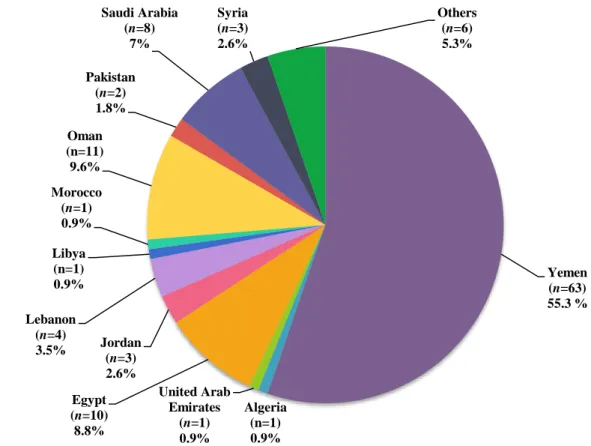
The process of this research is quantitative as it includes conducting analyses of primary data recorded through the distribution and collection of a number of descriptive questionnaires. Surveys were administered to a sample of 114 entrepreneurs from different emerging economies and mostly from within the Middle East and North Africa region. They were current and former entrepreneurs who are or have been founders, cofounders, owners, or serving on the boards of entrepreneurial ventures in the region. The data acquired through the completed questionnaires helped the researcher investigate the respondents’
perceptions of their decision making process upon embarking and operating their ventures. The research methodology could be summarized in the following steps:
a. Conducting an extensive review of all the relevant research literature to construct our conceptual framework and model as explained and illustrated earlier in previous chapter.
b. Developing of a robust research test instrument (attached herewith in Appendices 1 & 2) which included, among other questions, two validated scales that could allow for a reliable measurement of our dependent variable; entrepreneurial behavior (Chandler et al., 2011), and one of our main independent variables; entrepreneurial self-efficacy (McGee et al., 2009).
c. Building the research survey in one of the most reliable and user friendly online survey websites; surveygizmo.com, and uploading the survey questions in English and Arabic languages to be able to reach the research sample.
d. Validating the research instrument through conducting a pilot survey of 23 entrepreneurs from different countries in the region, which allowed for testing the instrument before final launch of the survey and after incorporating minor modifications in the wording of a few questions.
e. Launching the final research survey in English and Arabic languages on the online surveying website through a big scale campaign that followed a snowball approach to benefit from the use of several marketing channels including email databases and social media websites and applications.
f. Conducting a series of statistical tests that included a factor analysis and a series of multiple regressions, to test the research hypotheses and explore the relationships between all the control, dependent, and independent variables.
1.3 Research Significance
With the objective of examining what entrepreneurial characteristics and structural control factors affect entrepreneurial decision making and behavior in light of the causation and effectuation research stream, our research significance originates from the fact that it is an exploratory study where we expect to find out how these factors interact with each other. This study is a modest attempt to help add to the literature knowledge base about entrepreneurship in emerging markets, in particular, in the Middle East and North
Africa region. The research base knowledge about entrepreneurship and entrepreneurial decision making, especially with regard to recent theories such as effectuation theory is essentially nascent itself (Perry et al., 2012) let alone research within the MENA region. To our knowledge and through an exhaustive literature review, we were unable to find any literature on effectuation as an entrepreneurial approach in MENA. Therefore, our study could be considered a tipping point for researchers to further study the research subject based on a bigger sample that includes more entrepreneurs from different countries in the region.
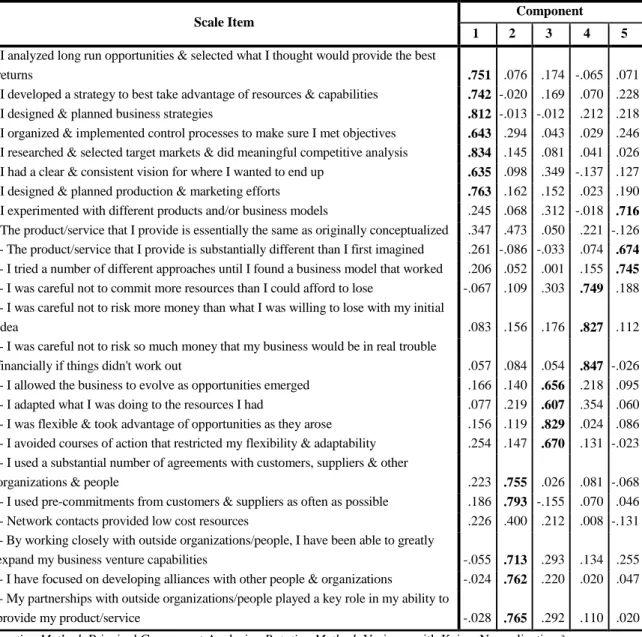
One significant contribution of our study is our factor analysis test that we ran to further examine the entrepreneurial behavior constructs and to confirm the multidimensionality of our dependent variable, entrepreneurial behavior. Our factor analysis test results showed that causation and effectuation are two different constructs composed of multiple scale items that represent each construct and relevant sub-dimensions; 22 items in total with factor loadings above 0.5. Entrepreneurial behavior have been empirically proven in the literature by Chandler et al. (2011) through their development of the entrepreneurial behavior scale by running several factor analyses tests which finally showed that the entrepreneurial behavior is defined by two distinct formative constructs; causation and effectuation. Causation emerged as one construct; whereas the effectuation construct was found to be composed of three sub-dimensions; flexibility, affordable loss, and experimentation, and another shared sub-dimension of pre-commitments that loads on both causation and effectuation constructs as discussed later in our literature review. However, to the contrary from Chandler et al. (2011) definition of the effectuation sub-dimensions, our results showed that all items loaded distinctively on five components with the pre-commitment sub-dimension loading as a distinct construct and not being loaded on both causation and effectuation. Our factor analysis does not only confirm Chandler et al. (2011) definition of entrepreneurial behavior which is the most vetted empirical measure of causation and effectuation as entrepreneurial approaches in the field to date, but also expand on this definition and contribute by addressing a major issue that Chandler et al. (2011) and Perry et al. (2012) suggested for future research through showing that effectuation is made of four independent constructs.
Finally, as a Yemeni citizen, this study is very important to the researcher as it helps him contribute to the development of entrepreneurship in the country through the knowledge he gained from investing time and energy in pursuing his doctoral studies in Japan. We believe this study would help shed some light on
entrepreneurs’ decision making process upon starting up and operating entrepreneurial ventures in emerging economies and what might determine or affect such process especially under the highly uncertain environments of these type of economies.
1.4 Assumptions
Prior to conducting this study, the researcher made the below main assumptions:
1. The respondents are going to provide, through the research test instrument, reliable and correct information that honestly reflect their personal perceptions on their entrepreneurial decision making behavior, their entrepreneurial characteristics and the relevant structural control factors.
2. The research methodology and the instrument that we developed for this study are reliable and valid to measure how the respondents’ personal perceptions reflect and explain for the interaction between all studied relationships, controlling for the set of several conceptual factors, within the whole entrepreneurial process.
3. As the main unit of analysis in this research is the entrepreneur, the research sample selected and tested in this study is going to be representative of entrepreneurs in emerging markets which will provide solid grounds for exploring possible answers and implications of our research question.
CHAPTER TWO: LITERATURE REVIEW
We start our review of the literature by first looking at our main dependent variable; the entrepreneurial behavior, which deals with the approach entrepreneurs follow throughout their entrepreneurial endeavors. We then move to our independent variables which constitute the remaining parts of our conceptual model that we lay forth towards the end of this chapter.
2.1 Entrepreneurial Behavior
We define entrepreneurial behavior or approach as the state which exists within the entrepreneur and is triggered by entrepreneurial intention leading to the actual starting of the enterprise. Recent research in the field of entrepreneurship suggests that most entrepreneurs, when trying to set up their new startups, are reverting to instinctive and effectual reasoning instead of careful strategic planning and rigorous competitiveness analysis (Sarasvathy, 2001, 2008). As suggested by the literature, there are two approaches for starting up new ventures; the synoptic or rational approach (causal reasoning) and the spontaneous and improvised approach (effectual reasoning) (Dew et al., 2009; Perry et al., 2012). It is suggested that entrepreneurs either follow the standard approach of establishing their businesses after thorough planning which leads to the achievement of their preset goals, or they would improvise and make decisions based on available and accessible means and resources without necessarily having certain preset goals in mind.
Causal reasoning indicates that entrepreneurs follow, in the creation process of their new ventures, a synoptic approach of rational planning (Methé et al., 2000; Methé, 2014). This synoptic approach significantly includes the notion of planning for an ultimate goal to be achieved. This planning is mostly done through rigorous market research that entails the availability of organizational resources and time to be conducted. We assume that entrepreneurs in emerging markets will usually have a very limited access to the necessary resources needed when a causal approach is followed to start up new businesses. Tables (1) and (2) in the following pages provide us with two extensive conceptual comparisons of both causal and effectual logics. The entrepreneur in such uncertain market environments exploits a set of means when following an effectual approach (Sarasvathy, 2008) as follows:
- Who they are; (their personal traits, tastes, and abilities)
- What they know; (their knowledge, not necessarily about subject matter only), and; - Whom they know (their social networks and connections)
Table 1: Comparison of Causation and Effectuation
Source: Sarasvathy (2001)
According to Sarasvathy (2008), the decision to start a new venture based on effectual reasoning is contingent on several principles that influence the decision making process towards seeking entrepreneurial action. These principles are:
- The bird-in-hand principle; a means-driven action, contrary to causal goal-driven, where the entrepreneur creates something new with existing means rather than finding new ways to accomplish given goals.
- The affordable-loss principle; a pre-commitment by the entrepreneur of what he could afford to lose rather than investing in calculations of expected returns to the venture.
- The crazy-quilt principle; forming partnerships with the stakeholders and garnering their pre-commitment to support the business venture, rather than carrying out rigorous competitive analyses. - The lemonade principle; acknowledging and seizing contingency by leveraging surprises rather
than trying to avoid and overcome them.
Table 2: Extended Comparison of Causation and Effectuation Logics
Causation Effectuation
Nature of unknowns Focus on predictable aspects of an uncertain future.
Focus on controllable aspects of an unpredictable future.
Market definition Using techniques of analysis and estimation to explore and exploit existing and latent markets.
Using synthesis and imagination to create new markets that do not already exist.
Goal orientation Seeking to identify the optimal alternative to achieve a given goal.
Allowing goals to emerge contingently over time. Relation to uncertainty Avoiding uncertain situations to the
greatest possible extent.
Seeking uncertain situations in the hope of being able to exploit them. Stakeholder
relationships
Goal-oriented relationships with strategically- selected stakeholders
Means-oriented relationships with self-selected stakeholders Market research Pre-calculated and detailed
competitive analyses for
investigating the need for or interest in product or service.
Informal methods for investigating the need for or interest in product or service.
Source: Gabrielsson & Politis (2011) based on Sarasvathy (2001, 2008) and Sarasvathy & Dew (2005)
Although the recent entrepreneurship literature suggests that theoretically it is more logical to study causal and effectual approaches as a strict dichotomy (Sarasvathy, 2008: 16), we assume entrepreneurs would usually use both causal and effectual approaches combined together where the preference for a specific approach might depend on the entrepreneurial expertise. Experienced entrepreneurs will usually tend to use a combination of both approaches whenever it fits their business model, to the contrary of novice entrepreneurs who arguably follow a causal approach (Dew et al., 2009). We intend to study the entrepreneurial approach dependent variable based on the dimensions that Chandler et al. (2011) identified as illustrated in Table (3) in chapter 3. The following dynamic model of effectuation in Figure (1) as adopted from Sarasvathy (2008) will also help inform our conceptual work in this research.
Figure 1: Dynamic Model of Effectuation
Source: Adapted from Sarasvathy (2008)
According to Perry et al. (2012) extensive literature review on the theory of effectuation, the significance of the theory emanates from its proposition of individuals’ behavior in situations where causal approach assumptions are absent. They stated that very few researchers have empirically tried to test the theory ever since its introduction. Nevertheless, they concluded that the lack of research could be greatly attributed to how the concept of effectuation challenges the conventional established body of research around the causal approach in entrepreneurship field, and how difficult it would be for researchers to develop and validate effectuation measures. Chandler et al. (2011) developed one of the very few available, reliable and valid scales of causation and effectuation in the literature, with Chronbach alphas ranging between 0.70 and 0.86. They defined and examined both causation and effectuation as two distinct formative constructs, where the effectuation construct was found to be composed of three independent sub-dimensions; experimentation, affordable loss, and flexibility, and also another sub-dimension; pre-commitments and alliances, that loads on both effectuation and causation constructs. We included Chandler et al. (2011) scale in our research instrument as illustrated later in chapter three in order to solicit our sample perceptions on their decision making process in their entrepreneurial endeavors. Therefore, we define our dependent variable,
entrepreneurial behavior, in line with the research as comprised of five dimensions; Causation, Pre-commitments, Flexibility, Affordable Loss, and Experimentation.
2.2 Entrepreneurial Characteristics
The main research focus of our study is concerned with how a certain set of entrepreneurial characteristics affect entrepreneurs approach to strategic decision making. We first turn our attention to examining and defining these entrepreneurial characteristics before we move to examine what factors may shape these characteristics. These factors will act as control variables in our study.
2.2.1 Entrepreneurial Self-efficacy (ESE)
Based on the premises of social learning theory (Bandura, 1977, 1982), the concept of self-efficacy deals with the individual’s perception of how competent they are to “execute courses of action required to deal with prospective situations” (Bandura, 1982, p. 122). Self-efficacy beliefs can influence the thought patterns and emotional reactions, as well as the choice and preparation for activities (Ajzen, 1991). It becomes more accurately predictable when studied in a social system where the behavior is evaluated (Bandura, 1977) and this behavior, i.e., entrepreneurship, is culturally legitimate (Klyver & Thornton, 2010). Ajzen (1991) contended that the perceived behavioral control, one of the antecedents of intention he identified in his theory of planned behavior, is most compatible with the concept of self-efficacy suggested by Bandura (1977, 1982). In his studies he would rather use the term Self-efficacy interchangeably with the term Perceived Behavioral Control. The other antecedents of intention are attitude towards behavior and subjective norms.
Entrepreneurial self-efficacy (ESE), the individual’s perceived competence to start a new entrepreneurial venture, is a construct that could measure the confidence and belief of an entrepreneur in his ability to successfully start up a new business (Boyd & Vozikis, 1994; McGee et al., 2009; Karlsson & Moberg, 2013). However, the literature of entrepreneurial self-efficacy includes different definitions, dimensions, and also scale instruments that could measure it (McGee et al., 2009). McGee et al. developed a multi-dimensional, reliable and valid instrument, with Chronbach alphas of 0.80 to 0.91, to help measure entrepreneurial self-efficacy through identifying five ESE dimensions which could explain for the behavior of nascent entrepreneurs. They found that nascent entrepreneurship and these dimensions were positively
related and that the increased confidence of nascent entrepreneurs could be measured through entrepreneurial self-efficacy. These dimensions that we will use for our ESE variable are broadly defined as follows:
a. Searching
(1) Creating new ideas for products/services (2) Identifying the need for them
(3) Designing them to the satisfaction of potential customers (4) Making a sale
b. Planning
(1) Estimating customer demand for new products/services (2) Determining competitive prices
(3) Estimating necessary funds to start business (4) Designing effective marketing campaigns c. Marshaling
(1) Getting others on board (2) Networking
(3) Clear communication
d. Implementation of human resources (1) Hiring
(2) Supervising and training (3) Managing and delegating
(4) Leading and motivating employees e. Implementation of financial resources
(1) Keeping financial records (2) Managing financial assets (3) Reading financial statements (4) Finding financial resources/ funds
enhanced by experiences of mastery, vicarious or observational learning, verbal or social persuasion, and judgments of emotional or physiological states (Bandura, 1977, 1982; Boyd & Vozikis, 1994). Mastery experiences appear to be the most effective method to develop self-efficacy, as individuals tend to learn from the recurrence of their achievements (Bandura, 1977, 1982; Boyd & Vozikis, 1994). However, when their achievements are easily attained, failure tends to quickly discourage them and affect their self-efficacy (Boyd & Vozikis, 1994). Also, as learning about entrepreneurship enhances individuals’ self-efficacy, it could concurrently decrease their intent to start up new businesses (Krueger & Carsrud, 1993).
2.2.2 Fear of Failure
Failure is usually defined as the condition or fact where some desired result or end could not be achieved due to insufficient performance of a significant task by an individual or the fact that things in a certain situation did not go well as expected (Politis & Gabrielsson, 2009). Fear could have a significant influence on individuals’ motivation to achieve their goals and might also inhibit their business aspirations (Burnstein, 1963). Although the recurrence of failure in the process of new venture creation should be seen as an accepted and natural outcome (Politis & Gabrielsson, 2009), the decisions that lead to exploiting a business opportunity or not are affected by fear of failure (Welpe et al., 2012). Such fear varies based on entrepreneurial experience, as habitual entrepreneurs view failure as an integral aspect of the entrepreneurial process (Politis, 2008).
Cope (2011) indicated that previous entrepreneurial experience, particularly with venture failure, could constitute a distinctive learning experience where entrepreneurs learn to positively view failure. He argued that such learning experiences strongly impact the entrepreneur’s knowledge leading to his recovery and re-emergence from failure. Cope also argued that Learning from failure also increases the readiness of the entrepreneur for future entrepreneurial activities. Politis & Gabrielsson (2009) used theories of experiential learning to examine why and how some entrepreneurs view failure more positively than others. Through surveying entrepreneurs who have already started new ventures, they found that prior startup experience is strongly associated with a more positive attitude towards failure. The experience from a previous business closure, according to Politis & Gabrielsson, was also found to positively affect entrepreneurs’ attitude towards failure, and entrepreneurs’ experiences with closure out of poor performance were deemed very valuable to their learning compared to closure for personal reasons.
McGregor & Elliot (2005) argued that fear of failure is a self-evaluative framework in which failure is an indicator of overall incompetence where the self is feared to be rejected and abandoned by significant others. Recognizing that experiencing shame causes severe distress, the individual learns to orient toward failure and seeks to avoid it in achievement situations. According to McGregor & Elliot, individuals high in fear of failure reported more shame upon a perceived failure experience than did individuals with low fear. Furthermore, shame was found to be a distinct emotional outcome of perceived failure for those high in fear of failure. They also argued that, when possible, individuals with high fear of failure will tend to avoid achievement situations, as they recognize failure as an unacceptable event that negatively impact their self-worth and relational security. Such individuals are thought to view achievement events not as learning opportunities that could improve their competence or competition against others, but rather as intimidating experiences where the whole self is at stake. Such view is responsible for the vigilant orientation to failure and recurrent avoidance of it in achievement situations (McGregor & Elliot, 2005).
We define fear of failure in line with Atkinson’s definition (1957) as the capacity or propensity to experience shame or humiliation as a consequence to failure. However, we expand the definition to include experiencing not only emotional consequences but also financial and entrepreneurial risks. Therefore, we intend to study three dimensions of the fear of failure variable as follows:
a. Reputational consequences risks and fears
(1) Shame or humiliation in front of significant others (2) Shame or humiliation in front of close social circles
(3) Shame or humiliation in front of business peers and competitors b. Financial consequences risks and fears
(1) Suffering substantial financial losses of personal possessions and assets (2) Suffering substantial financial losses of family possessions and assets c. Entrepreneurial death risks and fears
Hence, we expect that, based on the reviewed literature, fear of failure will directly affect the preference for a certain entrepreneurial approach as the entrepreneur delves into the unknown, uncertain world of business venturing and attempts to minimize the risks of any potential failure.
2.2.3 Entrepreneurial Identity
Entrepreneurial identity is mostly studied based on the premises of the social identity theory (Tajfel & Turner, 1979), which provides a social psychological analysis of how an individual cognitively identifies himself as a member of a social group (Hogg, 2006). Social identity theory could help better explain how entrepreneurs share different identities that affect not only the creation process but also the outcomes of their entrepreneurial ventures (Fauchart & Gruber, 2011). While what motivates entrepreneurs to seek entrepreneurial endeavors is still a matter of debate in the field (Murnieks & Mosakowski, 2007) and almost unexamined (Sarasvathy, 2008), the classical entrepreneurship theory contends that entrepreneurs are mainly motivated by monetary gain and profit maximization (Schumpeter, 1942; Stanworth & Curran, 1976; Fauchart & Gruber, 2011). Yet another key motivation could be their need to realize their unique self-conceptions and identities as entrepreneurs (Murnieks & Mosakowski, 2007). Entrepreneurs usually associate their decisions and behaviors based on who they are and what entrepreneurial roles they identify with (Sarasvathy, 2008).
Fauchart & Gruber (2011) proposed, based on the social identity theory, that entrepreneurs or “founders” share three pure social identities as Darwinians, Communitarians, or Missionaries, that explain the different meanings and motivations those entrepreneurs associate with their entrepreneurial endeavors. Darwinians are typical classic entrepreneurs who seek monetary gain by seizing opportunities and competing with others and accordingly feel successful as they maximize profits for their ventures. Communitarians are those entrepreneurs who start up their ventures around a certain community based on perceived opportunities of mutual benefit, as they serve their community and receive support in their entrepreneurial endeavors. Success to communitarians is gained from creating value for their communities and therefore feeling respected as useful members. The third identity; missionaries, are entrepreneurs who seek opportunities that help them realize their mission or cause to serve the common good of their society. Missionaries view their success in terms of constantly getting their vision across to more members of their society who support its implementation leading to a better world for all. Although these identities are
distinct from one another, some founders are believed to have “hybrid” identities with combined elements from more than one identity. Also, Fauchart & Gruber (2011) argued that entrepreneurs’ type of identity affect their decisions on what they view as relevant, based on their meanings, of market segments, customer needs, resources and capabilities.
Based on Fauchart & Gruber (2011) typology, Alsos et al. (2016) in one of the first studies in the recent effectuation literature to examine how entrepreneurs’ social identities could affect their preference for causal and effectual approaches upon pursuing entrepreneurial endeavors. They studied a sample of 350 Norwegian new firms that were registered in 2013, only one year before they collected their data. Their results suggested that both darwinians and missionaries have a predominant preference for causal approach, whereas Communitarians follow an effectual approach in their entrepreneurial decisions and actions. They contended that although both darwinians and missionaries seek entrepreneurial endeavors for different motivations and meanings, they pursue a predefined end goal which could explain their preference for following a causal reasoning. While darwinians work towards monetary gains and missionaries strive towards political causes, communitarians seek mainly to serve their communities and would rather change courses of action to achieve mutually beneficial ends. Nevertheless, Alsos et al. found that communitarians would also adopt some causal behaviors, which they attributed to the fact that causation has been an established reasoning when embarking upon new ventures. Their last finding was in line with Fauchart & Grubers’ (2011) that identities are not mutually exclusive and would rather overlap making for hybrid social identities of entrepreneurs.
Stanworth & Curran (1976) contended that entrepreneurs define their entrepreneurial roles in terms of different sets of meanings, forming the following latent social identities:
a. The ‘Artisan’ Entrepreneur
Artisan entrepreneurs are mainly intrinsically motivated as they are mostly focused on coming up with the best quality product or service, being autonomous and free to choose whoever joins their team, and enjoying some status within their workplace. While these meanings predominate the artisans’ entrepreneurial roles, other aspects such as income, monetary gain, and growth are secondary motives,
as artisans will still need to generate income and profit to be able to continue providing value to their customers.
b. The ‘Classic’ Entrepreneur
Classic entrepreneurs share the classical definition of entrepreneurs who are mainly motivated by monetary gain and profit maximization (Schumpeter, 1942; Fauchart & Gruber, 2011). They basically define their entrepreneurial roles in terms of how much profits they could make while maintaining the growth and expansions of their ventures as well, which implies that intrinsic motivation is secondary to classic entrepreneurs.
c. The ‘Manager’ Entrepreneur
Manger entrepreneurs are mainly concerned with being recognized as excellent managers by significant others, not only their team but also other business partners and competitors. They are also most motivated by the idea of passing on such legacy of excellence in their ventures and subsequent success to their heirs, guaranteeing their heirs security.
We define entrepreneurial identity based on Stanworth & Curran (1976) typology of such identity into three latent identities that we expect to find in entrepreneurs as they seek entrepreneurial endeavors. As previous research suggests (Alsos et al., 2016), we expect to find that identity would come to directly affect entrepreneurs’ decisions and actions and therefore following either causal or effectual approaches.
Based on the reviewed literature, we present below our first main research hypothesis and its sub-hypotheses.
H1 Entrepreneurial Characteristics will have a direct effect on the Entrepreneurial Behavior of entrepreneurs in emerging markets
H1a Entrepreneurial Characteristics will have a direct effect on the Causation dimension of Entrepreneurial Behavior
H1b Entrepreneurial Characteristics will have a direct effect on the Pre-commitments sub-dimension of Effectuation
H1c Entrepreneurial Characteristics will have a direct effect on the Flexibility sub-dimension of Effectuation
H1d Entrepreneurial Characteristics will have a direct effect on the Affordable Loss sub-dimension of Effectuation
H1e Entrepreneurial Characteristics will have a direct effect on the Experimentation sub-dimension of Effectuation
2.3 Structural Control Factors
As you recall, the main research focus of our study on how entrepreneurial characteristics impact the decision making approach that entrepreneurs follow. After examining and defining our entrepreneurial characteristics earlier, we must examine what factors may shape these characteristics. These factors will act as control variables in our study.
2.3.1 Knowledge Source
The first of our structural control factors is the entrepreneur’s source of entrepreneurial knowledge from which he had learned and might still be learning how to pursue entrepreneurship. As Drucker (1985) suggests, entrepreneurship is a “practice of innovation” that is “neither a science nor an art” but rather a knowledge base that can be learned like any other professional practice. A broader definition of the domain of entrepreneurial education according to Hindle (2007) reads as “the knowledge transfer about how, by whom, and with what effects opportunities to create future goods and services are discovered, evaluated and exploited”. Fayolle et al. (2006a) also suggest that it is any pedagogical program or educational process that deals with the enhancement of certain entrepreneurial skills and personal attitudes, without necessarily focusing only on the immediate creation of new ventures.
Aldrich and Ruef (2006) identified three key entrepreneurial knowledge sources of nascent entrepreneurs; learning from work experiences, learning from experts, and learning by copying and imitating others. Previous work experiences help entrepreneurs build important connections and relevant organizational knowledge while also allowing for accumulating an industry-related knowledge base. Learning from working with experts, including those from entrepreneurs’ network ties, provides nascent entrepreneurs with a
copying and imitating existing practices and capabilities that have already proven to be successful, common, and coming from incumbent organizations in the environment.
Research indicates that entrepreneurship could be taught or at least encouraged through entrepreneurial education (Gorman et al., 1997). Although, according to Ronstadt (1990), the way entrepreneurial or other traditional business education impacts entrepreneurs remains ambivalent, yet there are still valid indications that entrepreneurs who receive such education could perform better than others, as it expands their knowledge and informs their decisions when they embark on their entrepreneurial activities. For the purposes of this paper, we define the knowledge source as any form of entrepreneurial and/or business education or learning that the entrepreneur might have already attained or is currently receiving through different knowledge sources. We break these sources into two main categories:
a. Entrepreneurial learning through education
(1) Formal education (school, undergraduate, graduate studies)
(2) Specialized training (business & entrepreneurship courses, online courses) b. Entrepreneurial learning through work
(1) Working at family business
(2) Working with/ helping close friends in their businesses (3) Working at other companies and organizations
We intend to study two dimensions of the knowledge source variable. The first dimension deals with determining the type of knowledge source to which the entrepreneur attributes most of his entrepreneurial knowledge prior to starting his first business venture. The second dimension deals with determining the type of knowledge source the entrepreneur perceives as being instrumental to his business operation subsequent to starting his venture.
To study the impact of entrepreneurship education on actual entrepreneurial activity, entrepreneurial intention, and self-efficacy, Noel (2001) surveyed three groups of university graduates who graduated within a period of 8 years. They were entrepreneurship majors, non-entrepreneurship business majors, and non-business majors. Entrepreneurship graduates were found to have opened more businesses than graduates from other groups. Although entrepreneurial intention was also higher among entrepreneurship
graduates as they intended to start new ventures within two to five years, self-efficacy was associated with neither actual entrepreneurial activity nor intention. Another study by Farashah (2013) examined the process of impact of entrepreneurship education and training on attitudes toward entrepreneurship, perception of social norms, self-efficacy and entrepreneurial intention of Iranian individuals. He argued that the likelihood of entrepreneurial intention increases by 1.3 times after completion of one entrepreneurship course. He also demonstrated that education and training, self-efficacy, fear of failure, entrepreneurs’ status in society, and desirability of entrepreneurial career, are significant predictors of entrepreneurial intention.
Fayolle et al. (2006a) modeled the development of entrepreneurial intention through pedagogical processes and learning contexts using a framework developed mainly on the basis of the theory of planned behavior (Ajzen, 1988, 1991). They found that while entrepreneurship education had a strong measurable impact on the entrepreneurial intention of students, it had a positive yet not very significant impact on their perceived behavioral control or self-efficacy. In another study and also based on the theory of planned behavior, Fayolle et al. (2006b) assessed how entrepreneurship education programs could influence students’ entrepreneurial attitudes and intentions. They surveyed students before and after a 3-day seminar on entrepreneurship following a Specialized Master in Management at a business school. Their results suggested that entrepreneurship education programs could have varying strong positive effects on some students, depending mainly on their background (i.e., age, gender, entrepreneurial background and exposure) and initial perspectives on entrepreneurial intention. Entrepreneurship education had the most positive impact on students with the lowest entrepreneurial intentions, and negatively impacted the students with highest entrepreneurial intentions. Entrepreneurship education also actually decreased the level of entrepreneurial intention for students with no exposure to entrepreneurship or entrepreneurial situations.
Learning about entrepreneurship enhances individuals’ self-efficacy (Krueger & Carsrud, 1993), as when a person has relatively little knowledge about the behavior, self-efficacy may not be particularly relevant or realistic (Ajzen, 1991). Entrepreneurial learning may have a positive impact on self-efficacy (Fayolle et al., 2006a; Karlsson & Moberg, 2013) while the impact of entrepreneurial self-efficacy may depend on several factors such as age, gender, entrepreneurial background and exposure (Wilson et al., 2007; Fayolle et al.,
pedagogical path that encourages entrepreneurs to rigorously plan for their new or existing business ventures (Dew et al, 2009; Sarasvathy, 2001, 2008). Hence, such education impacts the preference of these entrepreneurs of causal reasoning over effectual logic when they consider starting their new ventures. In reality, entrepreneurs would usually use both causal and effectual approaches combined together where the preference for a specific approach might depend on the entrepreneurial expertise, yet, theoretically it is more logical to study causal and effectual approaches as a strict dichotomy (Sarasvathy, 2008: 16). Based on the reviewed literature, we note a conceptual link between the knowledge sources and the levels of entrepreneurial self-efficacy.
2.3.2 Experiential Source
Entrepreneurial Experience is broadly defined as the level of experience and knowledge the entrepreneur has accumulated prior to starting up a new venture or after setting up multiple businesses. Such experience varies from one entrepreneur to another; those setting up their first or second business venture are usually considered novice entrepreneurs, while others with three or more ventures are habitual entrepreneurs (Politis, 2008). Exposure to entrepreneurial situations, and acquisition of management tools and experiences impact entrepreneurial self-efficacy (Krueger & Carsrud, 1993; Fayolle et al., 2006a). Other aspects of entrepreneurial experience such as experiences of mastery and vicarious or observational learning could also substantially develop and enhance entrepreneurial self-efficacy (Bandura, 1977, 1982; Boyd & Vozikis, 1994). Mastery experience is the most effective method to develop self-efficacy, since individuals tend to learn from the recurrence of their achievements (Bandura, 1977, 1982; Boyd & Vozikis, 1994).
Politis (2008) studied a sample of 231 Swedish entrepreneurs (101 novice and 130 habitual) to examine how prior entrepreneurial experience could act as a learning source in terms of how both types of entrepreneurs would cope with liabilities of newness, prefer to follow an effectual approach, and view failure. Novice entrepreneurs showed higher preference for creating new ventures in industries were they had prior experience compared to habitual entrepreneurs. Nevertheless, habitual entrepreneurs were found capable to cope better with liabilities of newness such as the uncertainty associated with new organizational functions in their new businesses. Most importantly, habitual entrepreneurs showed higher preference for the effectual approach in terms of favoring uncertainty and informal approaches of
marketing their new products and services. Politis cautiously argued that preference for effectuation increases as the number of entrepreneurs’ ventures increases. Finally, habitual entrepreneurs viewed failure more favorably considering it a key learning source that helped them in later stages of their entrepreneurial endeavors, whereas novice entrepreneurs showed higher yet not significant avoidance of failure.
Prior experience in setting up new businesses is considered a major learning source for entrepreneurs in the literature (Politis, 2008). We define the experiential source as the source or combination of the following sources from which the entrepreneur might have accumulated his entrepreneurial and/or professional experience:
a. Experience through working at family business
b. Experience through working at previous personal business
c. Experience through working at other companies and organizations
Further, we intend to study four dimensions of the experiential source variable. The first dimension deals with determining the source or sources of entrepreneur’s experience prior to starting up his business venture. The second dimension deals with determining the level of entrepreneur’s business experience; his experience in founding one business venture or more, and his success and failure experiences in running businesses based on the number of successful and closed businesses.
Following effectuation as an entrepreneurial approach, entrepreneurs will revert to exploit any available means including their experience to start up and maintain business ventures (Sarasvathy, 2001 & 2008). Nonetheless, the causation approach compels entrepreneurs to carefully set plans for their new or existing ventures (Dew et al, 2009; Sarasvathy, 2008). These approaches are not mutually exclusive, entrepreneurs usually use a combination of both approaches; however, their entrepreneurial experience might be pivotal to the preference of a certain approach (Sarasvathy, 2008). Novice entrepreneurs would follow a causal approach, while habitual entrepreneurs would rather use both causal and effectual approaches together as deemed fit (Dew et al., 2009).
2.3.3 Access to Resources Through Network
Acquiring resources required for the creation of new business ventures is inherently a difficult task for entrepreneurs, let alone those in environments where resources are scarce and unattainable without heavy negotiation and convincing of resources owners by the entrepreneur (Zhang et al., 2010). In environments that are characterized by institutional voids and corruption such as emerging markets, access to resources through social networks provide cost-effective alternatives to seeking economic endeavors at marginal or no cost (Granovetter, 2005). Connections within social networks among other aspects eventually shape the entrepreneur’s knowledge about seeking entrepreneurial endeavors, as nascent entrepreneurs mainly rely on their networks’ knowledge when navigating and selecting feasible opportunities and variations of potential products or services (Aldrich & Ruef, 2006). However, according to Aldrich & Ruef (2006) such dependence may hinder these entrepreneurs’ ability to pursue “entrepreneurial departures from the norm” or unique methods of doing business and offering value.
Social networks and their influence on economic behavior and outcomes are broadly studied in the literature based on the social network and strength of social ties theories (Granovetter, 1973, 2005; Zhang et al., 2010; Kozan & Akdeniz, 2014). Granovetter (1973) defines the strength of interpersonal ties; strong and weak, in terms of the time spent, emotional intensity, mutual trust, and reciprocal services between individuals within that social tie. Such strength of ties become very important as it affects the flow of information within networks and therefore knowledge regarding opportunities (Granovetter, 1983). According to Granovetter’s concept of strength of weak ties (1973, 1983 & 2005), weak ties allow for the exchange of and access to new ideas, information, and resources more efficiently than stronger ties. He contends that strong ties such as close family and friends typically share the same overlapping knowledge as they spend much time together and move in the same social circles. In contrast, weak ties of distant friends and acquaintances move within different social circles and networks and therefore share unique information and have access to other contacts than those of strong ties.
One of the means identified by effectuation theory; “whom I know”, defines how the entrepreneur’s social network helps him gain access to resources, opportunities, and alternatives, irrespective of the strength of such social ties, eventually impacting new businesses performance (Sarasvathy, 2008). Entrepreneurs tend to build
new social networks as they progress in growing their businesses, since they need access new resources, markets, investors and information which are mostly reached by expanding their networks and connections (Aldrich & Ruef, 2006). Although strong ties could provide access to finance and low-cost human resources particularly at the early stages of venture creation, such contribution could be highly institutionally and culturally context dependent (Peng, 2004; Aldrich & Ruef, 2006).
In addition to strong and weak ties of family, friends, and acquaintances, entrepreneurs build their networks through relationships with formal entities and channels of banks, public and private entities, chambers of commerce, and other professional agencies (Veciana, 2007). According to Veciana, building and maintaining such inclusive network is essential for entrepreneurs as they seek to acquire access to a diverse set of resources in their entrepreneurial endeavors. We define entrepreneurs access to resources through network in line with the literature, as the extent to which the entrepreneur depends on his social network to acquire resources. We examine such dependence in terms of the strength of the entrepreneur’s following social circles:
(1) Close Family (e.g., parents, spouse, siblings, close cousins, close in-laws) (2) Close friends (e.g., close colleagues, classmates)
(3) Extended Family (e.g., distant relatives, distant in-laws)
(4) Distant Friends (e.g., distant colleagues, friends of friends, acquaintances)
(5) Formal channels (e.g., public & private institutions, banks, chambers of commerce)
Although it is not of this study objectives to study the access to resources variable through conducting a network analysis, we intend to study this variable by analyzing the following dimensions:
a. Network running businesses (Network connection as owner or cofounder of a business venture) b. Access to finance through network (Acquiring financial resources through network)
c. Access to human resources through network (Acquiring human resources through network)
d. Access to market & customers through network (Entering markets & attracting customers through network)
(2009) deals with the entrepreneur’s confidence about his competence to carrying out the tasks of searching, planning, marshaling, and implementing ideas and resources. We tend to believe that a relationship exists between the level and breadth of entrepreneurs’ dependence on their networks to access resources and their entrepreneurial efficacy. With this we note a conceptual link between network and entrepreneurial self-efficacy.
2.3.4 Institutional Context
Institutions, according to North (1990), are formal constraints; laws & rules, and informal constraints; norms and conventions, that are created by human beings as ‘rules of the game’ to govern and structure the economic, social or political incentives for human interaction. Scott (1995) define these rules as regulative; formal codes and laws, normative; norms and conventions established by relevant institutions, and cognitive; culturally accepted beliefs and behaviors. Institutions are different from organizations; e.g., banks, regulatory bodies, as organizations emerge and function in the environmental context that institutions govern and could also act as governing bodies of rules of the game (Ugur, 2010).
Institutional environment is one of the major determinants of economic performance and growth (Veciana, 2007; Ugur, 2010) as it affects human interaction and its associated costs through structuring such interaction and reducing the inherent uncertainty (North, 1990). Institutional theory, through North’s definition of institutions, provide the most appropriate conceptual lens to examine how the environment affects seeking entrepreneurial endeavors (Veciana, 2007), as it explains how the institutional context may affect organizations’ emergence and development (Palthe, 2014). Consequently, the institutional context could affect individuals’ decision to become entrepreneurs and therefore their motivations to seek entrepreneurial endeavors within a particular environment (Veciana, 2007). Markets with institutional environments that are highly uncertain, corrupt, and weak on protecting property rights and enforcing legal contracts, discourage entrepreneurs from seeking economic activity (Brunetti et al., 1998).
Klyver & Thornton (2010) analyzed the Global Entrepreneurship Monitor (GEM) data from 51 countries for the period of 2003-2006 to investigate how the relationship between self-efficacy and entrepreneurial intention is dependent on institutional or cultural legitimacy. They studied how this relationship could generally depend on the status of and respect towards successful entrepreneurs. Together, self-efficacy and