Countries : The Guns Butter Ratio Matters
journal or
publication title
Journal of policy studies
number
58
page range
71-90
year
2019-03-20
I
ntroductIonWith regard to the distribution problem that faces governments when dividing their limited resources between military and economic well-being,1 the liter-ature has provided two types of explanations: “guns versus butter” and “guns yield butter”. To select the explanation that is most appropriate, numerous empirical comparative studies have been conducted.
Previous research has dealt with the “guns versus butter” problem by focusing on whether a govern-ment’s trade-off between social and national security can be identified (Clayton 1976; Russett 1969, 1982;
Domke et al. 1983; Mintz 1989; Palmer 1990). In this line of research, the chief concern is the exis-tence of the negative impacts of economic growth or welfare spending on military expenditures, or the negativeimpacts of military spending on the economy, which can be determined through regres-sion analyses. In many works, however, the expected negative influences have rarely been reported (Russett 1982; Domke et al. 1983; Mintz 1989) or have been confirmed in only a few studies (Russett 1969; Palmer 1990).
With regard to the “guns yield butter” explana-tion, some researchers have argued that the military 1 In the literature dealing with the guns-and-butter problem, whereas the perception of what “guns” means is almost uniformly treated as military
expenditure, no consensus seems to have been reached on the definition of “butter.” Butter is meant, in the theoretical models, to refer to the remaining resources to be allocated after the amount for guns has been determined (Powell 1993; Garfinkel and Skaperdas 2000); and in defense economics, economic growth itself tends to be equated with butter in order to pursue “the defense-economic growth nexus.” The ideal is to adopt the measurement representing the livelihood as a whole, including education, public health, and other measurements of social well-being (e.g. Mintz and Huang 1991). Recent research, however, has come to contrast the military sphere with the welfare sphere, since welfare spending is thought to occupy the largest amount of government expenditure, and can mostly reflect the government’s orientation toward domestic politics (e.g., Whitten and Williams 2011; Hooker and Knetter 2001). Hence, for the purposes of this paper the author simply defines butter as welfare (social security).
Government Distribution Politics and
Public Opinion in Developed Countries:
The Guns–Butter Ratio Matters
大 村 華 子
Hanako Ohmura
Despite many scholars having a strong interest in determining whether the “guns versus butter trade-off” or the “guns yield butter” of government decision making is more valid, identification of the factors that determine resource allocation for guns and butter has largely been neglected. This article directly analyzes the attributions for this distribution per se by employing the guns–butter ratio as the dependent variable. The fidings are 1) left–right composition is the robust determinant; 2) when median voter is located toward the left and the leftist increases in congress, the ruling parties’ welfare policy tends to more influence the rise in butter; 3) when the median voter moves to the right, though the coun-terintuitive results, and leftist increases in congress, defense policy more influence the rise in guns.
Key Words : Guns and Butterproblem, Redistribution Policy, Defense Policy,
mechanisms by which civilians are induced to spend money or receive payment for services (e.g., in military construction, employment and educational costs for military personnel, compensation for the economy around bases) may lead to an increase in military spending as a whole and that it can also cause an economic upturn (Caputo 1975; Mintz and Stevenson 1995; Hooker and Knetter 2001; Whitten and Williams 2011). Thus, these studies assume that military expenditure has a positive impact on economic growth; in the political science field in particular, the “guns yield butter” mechanism is thought to be more plausible than the “guns versus butter” (Whitten and Williams 2011).
No consensus has been achieved about the validity of these mechanisms, however, because of the range of dependent variables (military expen-diture, social spending, educational spending, economic growth), the empirical models’ specifica-tions (whether to include international variables), and the numbers of countries examined (single or multiple). However, even if the literature does not enable us to determine which mechanism is more valid, we can say at least that this unquestioned fact exists: every government allocates constrained assets into social and national spending (Domke et al. 1983; Romer and Rosenthal 1978; Key 1940). In this regard, despite the fact that the fundamental issue of the guns and butter problem is the distribution and allocation of limited resources, the aspect of distribu-tion per se seems to be disregarded.
Based on the theoretical models, distribution itself has been focused (Powell 1993). In these models, not assuming the temporal priority of decision making in regards to either welfare or military spending, it is presupposed that a government simultaneously decides the allocation of resources. This contempora-neous decision making infers that a government does not a priori which to emphasize: public goods (guns) or private goods (butter)2. Although this concept does not enable us to postulate that guns could embrace some aspect of private goods and vice versa, it does capture the fact that government faces a dilemma as to whether to disburse resources constrained by international security and the domestic economy into
the public and private spheres. And theoretical model concentrates on this dilemma directly. If replacing the narrowly-focused guns and butter problem into the broadly-expanded public and private goods dilemma problem, the research design merely reveals whether private goods enhance public goods and vice versa, and is considered to be insufficient. The government relative emphasis on deciding between guns or butter at a specific moment in time should be directly depicted. Further, factors to mediate this dilemma should be sought.
This theoretical perspective evokes the new type of setting for empirical models. Concentrating on the “versus”-“yields” nexus, empirical models in previous research tend to rely on the single equation to iden-tify a negative or positive relation between guns and butter (Huang and Mintz 1992). Although empirical studies based on the single equation can clearly iden-tify the relationship between two elements, it seems to have two problems. Firstly, such a scenario might elicit the decision that military spending be priori-tized over welfare spending and that military aspects determine welfare. Realistically, a government tries to allocate limited resources through a simultaneous decision making process: welfare budget decisions are not always temporally antecedent to defense budget decisions and vice versa. Further, a research design that relies on a simple form of dependent variable is designed to identify the determinants of defense or welfare spending, rather than to identify the explanatory factors that govern distribution itself. As explained later, if for example public opinion is newly added as a key independent variable in the single equation, the estimated coefficient of public opinion refers only to the effect on welfare or mili-tary spending, not to government decision making for distribution via her dilemma.
Given these points, the research question should be, “What are the determinants of the distribution problem for governments?” rather than, “Which is the best explanation, “guns versus butter” or “guns yield butter”? In order to show the attributions of distribution politics, in this paper I try to shed light on another approach to the guns-and-butter problem by identifying the domestic and international deter-2 Although the military sphere does embody policy areas relating to private goods such as construction of military bases, welfare for military per-sonnel and pork barrel spending on arms manufacturers. Still, its main aim is to provide defense to a nation and this purpose leads directly to the element of public goods. Thus, the author broadly classifies military spending as spending on public goods and welfare spending as spending on private goods.
minants of government resource allocation rather than examining whether the “guns versus butter” mechanism fits the facts better than the “guns yield butter” mechanism does. To this end, two depar-tures from the previous research are proposed in this paper.
The first, regarding the dependent variable, is that the ratio between guns and butter (the guns– butter ratio, hereinafter referred to as the GB Ratio) will be adopted rather than the simple approach used in previous research (e.g., military or welfare expen-diture, economic growth). Thus, to operationalize the distribution per se, I will employ the GB Ratio as the dependent variable.
The second departure will take voters’ prefer-ences into account as the independent variable; that is, public opinion will be incorporated into the empirical model (Eichenberg and Stoll 2003, see also Wlezien 1995). Almost all the existing empirical studies have focused solely on a government’s (or party’s) decision making; however, any govern-ment’s decision is closely linked to voters’ prefer-ences, as in the notable theoretical models (Powell 1993; Garfinkel and Skepardes 2000). In modeling the strategic interaction between countries that have domestic distribution problems, some theories of guns and butter are founded on the utility functions of the preferences of the party in power, as well as those of the voters. More substantively, the legisla-tors who form a government cannot neglect their constituencies’ preferences. Therefore, my second purpose is to identify the effect of public support and its contingent effect on a party’s policy position.
In the next section, I will briefly review the two branches of literature concerning the “guns versus butter” and “guns yield butter” viewpoints and will examine the reasons behind the lack of consensus. In the third section, as a way of reconciling these opposing views, I will explain the importance of identifying the determinants of resource allocation itself rather than trying to determine whether “guns versus butter” or “guns yield butter” provides a better fit. I will outline the two modifications on previous approaches and will set forth the empirical models for this research. Through a reanalysis carried out within this new context, the main finding, namely, that public support significantly contributes to
parties’ positions, will be presented in the empirical section.
t
heL
Iterature: t
rade-
offorG
uns ase
conomIcs
tImuLI?
We can assume that members of parliament are motivated to seek election and that one of the means by which they pursue office is the distribution of state resources among voters (Cox and McCubbins 1986). However, given the requirement to maintain a certain level of defense capability and the occurrence of international armed conflicts, government parties also face the distribution problem of allocating some proportion of the finite state resources to the security sphere. With respect to this distribution phenomenon, the academic findings have been controversial.
The earliest empirical studies, which assumed a trade-off between guns and butter (the “guns versus butter” explanation), attempted to measure the negative relationship between military and social expenditure (Russett 1969). In these works, two types of research design were used, one to explain the volatility of military expenditure and the other to explain the volatility of welfare expenditure or economic growth. These types of empirical models served as the foundation for the research that followed. For instance, Russett (1969) asserts that, “it is quite apparent that defense expenditures have been negatively correlated with government spending for civilian needs” (423). Palmer (1990) shows, however, that the impact of social spending on defense spending is negative only when the country is classified as “the small allies,” such as Benelux and Norway.3 An indirect link is also identified by Mintz and Huang (1990): a decrease in military spending promotes economic investment and results in economic growth.
However, these authors’ findings are thought to be anomalous. Other studies come close to seeing no trade-off (Benoit 1973; Caputo 1975; Clayton 1976; Russett 1982; Domke et al. 1983; Eichenberg 1984; Mintz 1989; Huang and Mintz 1990, 1991). On the basis of a comparison of welfare and military expenditure in the United States over time, Clayton (1976: 377) argues, “World War II did depressc [social 3 His work also shows right-wing governments as inclined to spend proportionately more on defense than left-wing governments do.
welfare spending] somewhat, but thereafter there simply is no correlation between defense spending and public welfare spending.” Later, operationalizing education and health spending as the main social expenditure, Russett tried to replicate the tradeoff, but because the trade-off appears in only one estima-tion model of the changing rate of health expendi-ture, he concludes, “I could find no regular pattern of trade-offs in the data for the last four decades of American history” (Russett 1982: 775). Mintz (1989) also reveals that only in the Reagan administration can a trade-off be confirmed, and, through refine-ment of the estimation methodology, Huang and Mintz (1990, 1991) conclude that no trade-off exists. Not limiting their examination to the U.S. case, Domke et al. (1983) analyze models the dependent variables of which are both military and welfare spending, and confirm no significant negative rela-tionship other than in the simple linear regressions between both military and welfare expenditures.
In defense-related economic studies, the negative impact of defense expenditures on economic growth, called the defense-growth nexus, has been partially confirmed. As Ram (1995: 266) says, “[t]here is very little evidence of an overall positive effect of defense outlays on growth in a typical case.”4 Mintz and Huang (1990, 1991) focus on the indirect effect of the depression of military activity on economic outcome (Mintz and Huang 1990, 1991). In recent studies, dealing with more than 100 developed and developing countries, some researchers have empha-sized that the relationship between defense and economic growth is nonlinear. Crespo Cuaresma and Reitschuler (2006) reveal, for example, that defense expenditure prevents economic growth in smaller countries, whereas, in other countries, military demand may have positive growth effects. Thus, in developing countries, the “guns versus butter” theory appears to be validated, but in developed countries, the “guns yield butter” concept seems to fit. Thus, the authors emphasize that the relationship between economic growth and military expenditure results in
an inverse U-shape.
While economic studies of defense spending do partially confirm the negative relationship— that is, a trade-off between the military and the economy— in political science it is generally accepted that such a negative relationship cannot be clearly identified (Whitten and Williams 2011). Instead, some research argues that guns promote the increase of butter through personnel employment (Hooker and Knetter 2001), personnel education (Huang and Mintz 1991), defense investment (Brauer and Marlin 1992), and so forth.5 The “guns yield butter” explanation has thus been much more common in the political science field, connecting domestic electoral studies and international relations.
In a recent seminal work, Whitten and Williams (2011) attempt to demonstrate the validity of “guns yield butter”, setting military expenditure as the dependent variable and estimating the effects of the interaction between the domestic and international variables. The “guns yield butter” family of research usually sets butter as the regressand, but in these authors’ work, the factors for military expenditure are explored through a cross-national analysis. Whitten and Williams argue that while the determi-nants of defense spending have long been explored in the research, the critical variables influencing military expenditure—international conflict involve-ment, parties’ ideological positions (not the simple left-right continuum but combinations of Hawk-Dove and Austerity-Generous)—have been dismissed.6 The authors include such domestic and interna-tional variables (as well as their interaction) into their models, revealing that both influence military spending. In light of this review, we can classify the literature as shown in Table 1.
4 The research evaluating the link between defense expenditure and economic growth is well reviewed in Ram (1995) and Deger and Sen (1995). As shown in these reviews, the basis of the theoretical background for the empirical model, which stems from Feder’s (1983) two-sector framework— “assuming that the economy consists of two distinct sectors, that are labor and capital” (Ram 1995: 259)— is broadly shared.
5 These findings contrast sharply with those of Mintz and Huang (1990, 1991), which argue that a depression of military expenditure leads to eco-nomic growth and education spending, though the effect is indirect.
6 The authors show how party ideology affects the mechanism by which guns yield butter under the contingency of crisis involvement. Their work uses multiple datasets, including the Comparative Manifesto Project dataset for party ideology and the Correlates of War dataset for conflict. This paper relies on almost same framework except the setting of dependent variable and incorporating public opinion as a major variable of interest.
r
econsIderInGtheG
uns–B
utterP
roBLemThe New Explained Component: Guns–Butter Ratio
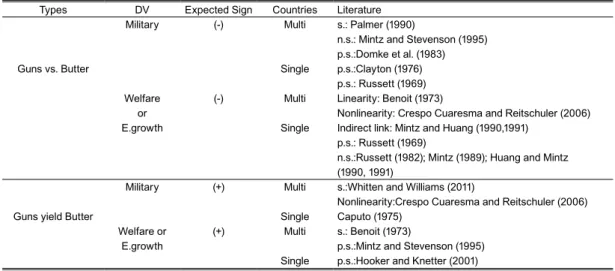
After reviewing the previous research, we can conclude that while the “guns yield butter” explana-tion is thought to be predominated in the political science field, the “guns versus butter” is partially confirmed in economic studies of defense spending. The greatest problem here is, further, that no consensus exists on whether the “guns versus butter” or “guns yield butter” mechanism is valid (Table 1).
W hat causes the controversial empirical evidence? As demonstrated in Table 1, the dependent variables take the various forms of the spending itself (military/welfare/educational expenditure) as a percentage of Gross Domestic Product (GDP) or of economic growth.7 In order to identify the real selection process involved in resource allocation, is it appropriate simply to adopt each economic or mili-tary variable as the regressand? With respect to this question, two problems should be considered.
First, models that adopt military expenditure as the dependent variable appear to have the ultimate aim of identifying the determinants of military spending. Inversely, if the regressand is economic growth, this model is intended as an economic
growth model, including military aspects. Hence, these types of models cannot directly analyze the distribution problem per se, even if welfare spending or GDP is emphasized as the key independent vari-able when assessing the resource allocation problem. If based on the setting that gun is a function of butter, meaning under the single equation model, effects of main independent variables (left-right balance of congress and public opinion) and covariates (electoral system, international environment, economic condi-tions) do represent effects only on defense spending, not on distribution per se. If the research aim is clearly limited to which of “guns versus butter” or “guns yield butter” is valid, a single equation model can not directly fit to the further research topic as to why does the resource allocation between guns and butter differ across time and country.
The second problem is one of temporal priority. In employing, for instance, a military-dependent variable or a welfare-independent variable, one is committed to an assumption that decisions regarding welfare spending precede those made for military expenditure. However, in the case of actual policy making, we cannot presuppose that the budget for the civilian sector always antedates and determines the one for the military sector in every government, or vice versa. Furthermore, we can assume that the emphasis of each government will vary because 7 As the notable example, Ram (1995: 267–268) shows that the result changes with different proxies for economic growth.
Table 1: Types of Literature
Types DV Expected Sign Countries Literature Military (-) Multi s.: Palmer (1990)
n.s.: Mintz and Stevenson (1995) p.s.:Domke et al. (1983)
Guns vs. Butter Single p.s.:Clayton (1976)
p.s.: Russett (1969) Welfare (-) Multi Linearity: Benoit (1973)
or Nonlinearity: Crespo Cuaresma and Reitschuler (2006) E.growth Single Indirect link: Mintz and Huang (1990,1991)
p.s.: Russett (1969)
n.s.:Russett (1982); Mintz (1989); Huang and Mintz (1990, 1991)
Military (+) Multi s.:Whitten and Williams (2011)
Nonlinearity:Crespo Cuaresma and Reitschuler (2006)
Guns yield Butter Single Caputo (1975)
Welfare or (+) Multi s.: Benoit (1973)
E.growth p.s.:Mintz and Stevenson (1995)
Single p.s.:Hooker and Knetter (2001)
of interdepartmental politics, the seriousness of domestic and international issues, the political composition of the congress/parliament, and so on.
This fact is also reflected in the parties’ utility functions of theoretical models (Garfinkel and Skaperdas 2000). In conflict-resolution models, the two parties confronting a military crisis face domestic constraints from both the voters’ and their own preferences for resource allocation. Managing these constraints is a key element that shadows the negotiating process; parties are supposed to allocate resources simultaneously, and the proportion of the legislature that belongs to one party or another always matters. Hence, the fact that the estimations do not necessarily reflect the actual process may contribute to the variation in the empirical results.8
Given these limitations in the previous research, how can we introduce an alternative approach for the guns–butter distribution problem? In this paper, I accomplish this by focusing on distribution per se and in order to capture it properly in the study, I adopt the ratio (proportion) between welfare and military expenditure of each country, the GB Ratio, as the dependent variable, instead of using a simpler vari-able, such as military spending, welfare spending, or economic growth. In literature, for example, Eichen-berg and Stoll’s (2003) study is thought to be the one to adopt the ratio of military expenditure to non-military expenditure instead of simple expenditure. However, the authors use the ratio type of dependent variable only for the sensitivity analysis and do not report the result (406). Further, the ratio itself seems not to be adopted directly; rather, the dummy vari-able representing whether a negative change occurs for the public (whether defense spending increases relative to public consumption and cash transfers to individuals) appears to be estimated9. In this study, the main purpose is to consider directly the distribu-tion itself; I use the GB Ratio per se. And I then try to identify the determinants of resource allocation
through a cross-national analysis.
The New Explanatory Component: Public Opinion
Whether the public can understand advanced knowl-edge on foreign policy issues and thereby have consis-tent attitudes has long been a controversial topic (Aldrich et al. 2006; Baum and Potter 2008). This paper does not discuss this topic directly, although studies of the American electorate show that “voters appear to have held reasonable and coherent attitudes about America’s foreign military economic policies” (Aldrich et al. 2006: 496).10 Moreover, on the basis of the political representation view (Erikson et al. 2002), it is assumed that political parties care about public preferences concerning resource allocation in order to achieve better electoral consequences and to be responsive to their constituents. Thus, a cyclical relationship is supposed to exist: voters pay attention to foreign policy during elections, the political parties consider such voters’ foreign policy preferences, and eventually the right balance (equilibrium) between social and national security policy is determined.
How has this relationship between voters and political parties (or political elites) been reflected in the previous research? The conflict-resolution models concerning the domestic distribution problem incorporate the political parties’ consciousness of the median voter’s preferences (Powell 1993; Garfinkel and Skaperdas 2000; Ishida 1998). The interaction between the voters’ and parties’ goals is what matters in these models. This approach reflects the substan-tive idea that parties cannot set either the military budget or the welfare budget without considering their domestic audiences’ preferences (Fearon 1997).
Moreover, the impact of public opinion on welfare spending and defense spending has been confirmed through the literature. As for the welfare spending and public opinion, public support is revealed to influence on welfare expansion11. Based 8 The ambiguity of the empirical knowledge generated can hardly be avoided because of the various configurations of the estimation models. Three types of explanatory variables are used, the combinations of variables are not uniform in the respective models, and the numbers of countries and years included in datasets vary across the studies. It is no surprise that we cannot reach a consensus about whether “guns versus butter” or “guns yield butter” is valid.
9 As an independent variable, Carrubba and Singh (2004) and Gifford (2006) employs, notably, the ratio between government expenditure and mili-tary expenditure. Its main aim, however, seems to compute the proportion, not to directly operationalize welfare component.
10 However, Aldrich et al. (2006: 496) also qualify their argument with the following: “their ability to express those attitudes in their electoral choices has depended on attitude accessibility and party platforms—both of which are strongly influenced by elite strategic behavior.”
11 Regarding the research on welfare state and public opinion, two types of research designs are taken: the opinion-policy nexus and the policy-opinion nexus. Relating to this paper, the policy-opinion-policy nexus should be focused. And the mention is limited to this are of literature.
on Brooks and Menza (2006), as mass public prefer-ence allows more income distribution and govern-ment’s responsibility, the governgovern-ment’s welfare effort is predicted to be enhanced. As the varied research designs, focusing on the case of United States (Shapiro and Young 1989; Wlezien 1995; Erikson et al. 2002), comparativists’ approach to an individual country such as Canadian case (Soroka and Wlezien 2004), and cross-national studies like Brooks and Menza’ seminal works (Hicks and Swank 1992; Manza and Brooks 2008). Summarizing the above, public pref-erence moves toward the expansion of welfare i.e. moving toward the left-ward, government’s welfare efforts is predicted to increase.
In terms of defense spending, a shift towards a right-ward tendency in public opinion is also likely to influence the increase in defense (e.g., Bartels 1991; Hartley and Russett 1992; Eichenberg and Stoll 2003). The representative work, Eichenberg and Stoll (2003), which uses data from polls admin-istered in the United States, the United Kingdom, France, Germany, and Sweden, attempts to deter-mine whether public support significantly regulates defense expenditure. On the basis of the question, “Do you think spending for defense is too much, too little, or just about right?” the net public support, or “thermostat” (see also Wlezien 1995), is operation-alized and the effect on spending is analyzed. The authors concluded that “[t]he striking feature of the analysis is the predominance of the ‘thermostat’. In all countries but France, opinion reacts negatively and significantly to a change in defense spending” (Eichenberg and Stoll 2003: 408).
Taking these theoretical presumptions and the empirical knowledge seriously, voter preference should be included in any estimation model that deals with defense spending as the dependent vari-able in some form. However, in the empirical litera-ture of the guns–butter problem, political parties’ preferences are very much a focus, but the effect of public opinion tends not to be incorporated into the empirical models. In order to operationalize voter preference, as in this comparative macro-level analysis, it seems to be difficult to reflect aggregated policy preferences directly, such as policy mood (Stimson 1999; Kim and Fording 1998; Stevenson
2001), because of the limitations for comparative use of the data from the polls.12 Both the policy mood variable and government/presidential/prime ministe-rial approval data are difficult to collect for all the countries observed, so, as an alternative, as a vari-able representing public opinion in the broader sense, a left-right scale computed from the comparative social survey must be employed.
Further, to reflect the theoretical model’s setting in the empirical model, the most important consider-ation is the parties’ policy positions as conditioned (or confined) by public support and political elite’s pres-sures. That is, how shifts in public opinion and the legislative component affect party policy postures, specifically for matters in this analysis. As the afore-mentioned, public opinion seems to influence both welfare and defense spending. Importantly, however, public opinion can be reflected to policy outcome, the GB ratio, through the conversion at the legisla-tive process. If the left predominates in congress, the expansion of butter relative to guns is likely to be realized (e.g., Korpi 1983; Hicks and Swank 1992; Iversen and Cusack 2000), while if the right prevails then vice versa (e.g., Whitten and Williams 2011; Klingemann, Hofferbert, and Budge 1994).13 Thus, along the lines of the previous research, I will test the following hypotheses: (i) when the govern-ment stresses welfare over defense, in response to a leftward move in public opinion and legislative balance, the more the proportion of welfare spending increases, and (ii) when the government stresses defense over welfare, in response to a rightward move in public opinion and legislative balance, the more the proportion of defense spending increases.
Finally, relating to the electoral aspect, the mechanism to connect public preference and legisla-tive politics. For this purpose, an impact of electoral system on the GB ratio should be considered seri-ously. Under the electoral institution allowing to represent broader policy interest , i.e. proportional representation (PR) system, legislatures are predicted to necessarily concern butter rather than defense. In other words, particularistic-targeted private goods which can be directly delivered to voters are assumed to be favored. Against this, under the small member district (SMD) system, each legislator should cover 12 In Eichenberg and Stoll (2003), the countries included are limited to five, whereas in this research the number of nations expands to seventeen. 13 In regad to defense spending, the result should be more nuanced, as in Whitten and Williams (2011) and Williams and Whitten (2012).
more of the broader policy spheres, including public goods such as national security rather than under the PR system (Cox 2008; Cox and McCubbins 2001; Cox 1997). Not leads directly to public opinion, as the major mediated component from public mass to government, this paper will further focus on the effect of the electoral institution.
e
mPIrIcaLa
naLysIsEmpirical Strategy: Data, Variable Settings, and Estimations
According to the previous theoretical argument, by employing the GB Ratio as the dependent variable and the domestic and international factors (including public opinion) as the independent variables, I will conduct an empirical analysis of the country-year data for the 17 OECD countries14 from 1960 to 2000.15In the following section, the variables will be set.
GB Ratio
The dependent variable, the GB Ratio, is computed as the proportions of social security transfers as a percentage of GDP and military expenditure as a percentage of GDP,16 derived from the Comparative Welfare States (CWS) dataset (Huber et al. 2004).
GB Ratio =Welfare ExpenditureMilitary Expenditureit (1)
it
According to this equation, when the government emphasizes social security (butter) more than national security (guns), the value will be larger, and when the latter is emphasized, it will be smaller.
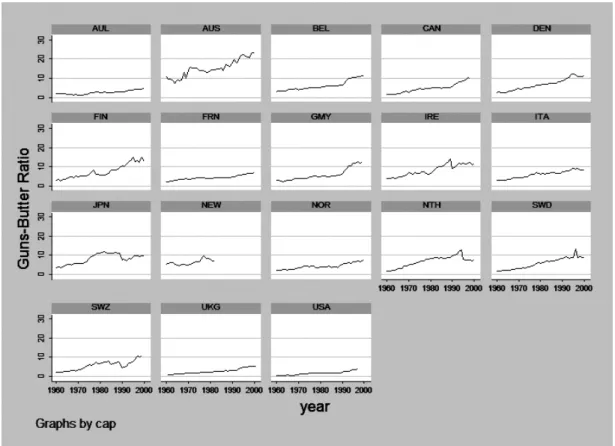
The GB Ratio is supposed to contain unit-roots with the natural growth of both social and military
expenditures, as seen in Figure 1. According to a Fisher-type unit-root test, GB Ratio significantly includes unit-roots in all groups (Inverse normal 𝑍-value=4.9152, 𝑝-value=1.000). To cope with it, the following estimation attempts to determine whether co-integration is met, that is, whether the residuals of estimations embrace unit-roots will be tested through the Fisher-type unit-root test against the residuals computed from the Ordinary Least Square (OLS), with panel-corrected standard errors (PCSE) (Beck and Katz 1995)17.
As presented in Table 2, the countries with the higher values are likely to exhibit a welfarestate tendency, such as Austria. Nations with the lower values, by contrast, incline to the defense oriented. In addition, it seems to be the case that countries stressing defense expenditure use a single-member district (SMD) electoral system, whereas the welfare-oriented nations tend to use proportional representa-tion (PR). The relarepresenta-tionship between GB Ratio and electoral systems is thus flagged for further examina-tion.
The key independent variables regarding domestic politics are as follows: public support for the government parties, the left-right composition of each parliament, parties’/governments’ policy positions on welfare and the military, the number of coalition parties, election year, and electoral system.
Public opinion
As mentioned before, the data on public aggregated policy preferences available for comparative anal-ysis are not abundant. The ideal variable would be something like policy mood or level of government approval in the OECD countries, but it is difficult to unify the sets of approval data in the main dataset because of each poll’s uniqueness. As an alterna-tive, to capture the electorate’s aggregated policy 14 Sweden, Norway, Denmark, Finland, Belgium, Netherland, France, Italy, German, Austria, Switzerland, the United Kingdom, Ireland, the United States, Canada, Australia, New Zealand, and Japan are examined. Some studies, especially economic studies of defense spending, include more than 100 countries; the use of CMP data for OECD nations restricts the applicability of the observations.
15 The period under examination is determined by the availability of CMP data, one of the main datasets.
16 The social welfare variable is “SSTRAN,” and the military variable is “MIL” in the codebook. Based on guns and butter theory directly, we must rely on guns
butter index, not butterguns index. However, the direct GB ratio (butterguns) cannot avoid to be so small, ranging from 0.0426 to the max value of 1.78, and causes the fragile estimation results, even after logarithmizing index. Thus, as the alternative without losing substantive understanding of re-source distribution, the BG-ratio is used as the GB ratio in this research.
17 As an alternative, Feasible Ordinary Least Square (FGLS) and OLS with the fixed effect model can be applied for this analysis. In this research, however, the main concern is to expose the overall estimators, not just the within estimators. Thus, a PCSE model is employed here. Further, in order to correct the first order condition of Autoregression (AR(1)), the restriction that AR(1) of the error term is equal within all countries is im-posed, as Beck and Katz (1995) suggest.
Figure 1: Transitions and Unit-roots of GB Ratio in All Panels Table 2: The GB Ratio of Each Country
Tendency Country Mean Min Max Std.Div.
USA 1.708 .562 3.832 .885
Australia 2.659 1.063 5.345 1.008
UK 2.738 1.046 5.338 1.352
↑ France 4.345 2.109 6.922 1.189
Defense oriented Norway 4.361 2.212 7.695 1.491
Canada 4.789 1.581 10.33 2.342 Switzerland 5.733 2.229 10.829 2.399 Germany 5.808 2.308 12.63 3.050 Sweden 5.826 2 13.540 2.878 Italy 6.010 2.932 9.286 1.914 Belgium 6.148 3.139 11.202 2.494 NZ 6.370 4.624 9.906 1.423 Denmark 6.737 2.567 12.152 2.971 Welfare-oriented Netherland 6.874 1.756 12.670 2.809 ↓ Finland 7.614 2.708 15.019 3.5090 Japan 8.229 3.455 12.184 2.672 Ireland 8.274 3.857 14.210 2.976 Austria 15.197 7.487 23.490 4.332 total 6.094 .562 23.490 3.808
preferences, the left-right scale computed by Kim and Fording (1998) will be adopted. Since Kim and Fording’s measurement is founded on the median voter’s preferences, a voter ideology index clearly fits the past theoretical models’ implications18. Kim and Fording’s voter ideology index is calculated on the basis of parties’ share of the vote, which corresponds to the voters’ policy preferences as reflected in their selection of the nearest party located on the left- right scale. The authors “conceive of elections as large-scale opinion polls (8),” and compute the voter’s ideological position from each party’s ideological posture19. The median voter is taken to be located between those parties immediately to the right and the left of the most supported party. According to the defined intervals between left and right parties, the median voter’s ideological position is computed as below (Kim and Fording 1998: 81):
𝑀 = 𝐿 + [(50 − 𝐶)/𝐹)] × 𝑊, (3) where 𝑀 denotes median voter position (ideological score), 𝐿 denotes the lower end (ideological score) of the interval containing the median, 𝐶 denotes the cumulative frequency (vote share) up to but not including the interval containing the median, 𝐹 denotes the frequency (vote share) in the interval containing the median, and 𝑊 denotes the width of the interval containing the median.
Left-right composition
Partisan politics is one of the critical motivations
of government behavior. Partisan theory assumes that parties of the left are more willing to disburse welfare expenditure than are parties of the right (Hibbs 1977). Thus, the larger the proportion of left representatives in parliament, the more the GB Ratio is likely to be enhanced. Inversely, when the right comprises the majority in parliament, the more the GB Ration is likely to decrease, because the right is assumed to be pro-military. In addition, fluctua-tions in the strength of left and right should make it possible to predict the GB Ratio’s up-and-down movements, in line with the left-right composition of parliament.20
Further, as stated above, the interaction between the left-right composition and public opinion will be also estimated.
The parties’ policy posture
I will employ two types of variables on policy posi-tion, with one focusing on the government parties’ posture and the other referring to the sort of policy mood that is shared by all the parties in a particular nation.21
First, since they directly affect the outcome of the distribution, the political parties’ positions need to be analyzed as the key independent variables. In Whitten and Williams (2011), the parties’ ideological positions are set as one of the main regressors. Whitten and Williams argue for combining the hawk-dove scale for defense ideology and the small-big-government scale for welfare ideology, rather than assuming a single left-right scale. To operationalize 18 Kim and Fording’s measurement is based on three assumptions:(1) the left-right ideology dimension can be adopted everywhere in industrial democracies, (2) the left-right ideology determines voters’ choices, and (3) this dimension is comparable across countries (Kim and Fording 1998: 75–80).
19 On the basis of CMP data, a party’s ideological position is calculated as follows (Kim and Fording 1998: 79–80):
Party′s LeftRightscale = ΣΣProLeft statement + ΣProRight statementProLeft statement − ΣProRight statement. (2) The above value has a range of -1 to 1. The greater the value is, the further left the political view.
20 The left-right composition is calculated as follows.
Left Right Ratio =Right Seat PercentageLeft Seat Percentageitit (4) Data comes from CWS. The variables are labeled “LEFTSEAT” and “RTSEAT” to indicate left seat percentage and right seat percentage, respec-tively. In calculations for the United Kingdom, however, the left party’s posture is not classified as “LEFTSEAT”; instead, the ratio between “RT-SEAT” and “CNSEAT,” which is a percentage of total seats in parliament for center secular parties, is employed to impute the missing party. In Germany, too, the right-wing party’s value does not exist, so the ratio used is between “LEFTSEAT” and “CNSEAT”.
21 In Whitten and Williams (2011), government ideology is further detailed by using the same data here, CMP. Their method is to classify the parties into four dimensions, combining the parties’ welfare (austere and generous) and defense (hawk and dove) positions. In addition, the conflict in-volvement effect conditioned by these positions is investigated. Whereas their approach ultimately attempts to clarify the determinants of defense spending and the contingent effects of international factors, in this study the main focus is on distribution per se so that domestic factors receive greater attention (the combination of two policy dimensions are downplayed), and the conditioning variables are different (public opinion rather than international factors).
the government parties’ ideologies specifically, they use the CMP data. In this paper, I adopt the same operationalization of Whitten and Williams (2011) for the government parties’ policy posture to begin with,22 but go a step further in attempting to find out its marginal effect when conditioned by public support.
Second, to consider the direct link between the governing party’s ideology and policy output, Whitten and Williams’s approach is necessary, but is a concern solely with the ruling party’s ideology sufficient to capture the aggregated preferences of the political elites? At the least, the opposing parties’ positions affect the ruling parties’ positions during and after elections. It would seem that the parties’ macro-policy trends, including those of the ruling and opposition parties23 should be specified. To do so, the computation of the policy mood by Stimson (1999), which introduces the common movement underlying the multivariable-time-series, will be applied. By imputing the missing values for a non-election period through Stimson’s algorithm, the time-series variable for each party’s position is established and the factor score is computed. This score represents the common movement of all parties’ policy positions; we can refer to it as the party policy mood. In this paper, I will set the party welfare policy mood and the party military policy mood as variables. Thus, the two models, “the Government Party Policy model” and “the All Parties’ Policy Mood model,” will be estimated separately.
With respect to the two types of party position variables, we can predict the following: When the government parties claim more spending for welfare or the party welfare policy mood is enhanced, then the GB Ratio will increase, and when the govern-ment parties argue for more military expenditure and the party military policy mood rises, the GB Ratio will decrease.
Interactions among major domestic variables As the most important, the above-raised four vari-ables (left-right tendency in public opinion, left-right composition in congress, government welfare policy, and government defense policy) of interests are
assumed to be interacted. What we mostly want to know is the marginal effect of the ruling party/-ies’ policy positions on GB ratio, moving the left-right tendency of public preference. The party policy’s marginal effect is, however, not merely conditioned with public policy preference, but also differed along the left-right composition in congress. Under the situation in which the median policy preference is located on the left-side and the leftist is preceded in the congress, government is expected to emphasize butter, social welfare than guns, defense. Against this, when the median voter is allocated around the right ward and the rightist prevails in congress, the government is predicted to shift her focus on defense. To completely assess the interactions among public opinion, party posture and left-right composition in congress, interaction terms among them should be fully specified in one estimation model. Accu-rately, the interaction terms should be composed of following four variables: the median voter’s left-right position, party’s welfare and defense policy posi-tions, and left-right proportion in legislature. Inter-action terms among four variables yield 6 patterns of two-way, 4 three-way and 1 four-way, in total 11 patterns of interaction terms.
With these interactions, the coming estimations will try to figure out the marginal effects of welfare and defense policy at two different transitions of the left-right scales of political mass and elite, i.e. public opinion and legislatures. Two types of figures will be represented, which is firstly about the welfare policy’s marginal effect and secondly the defense policy’s marginal effect.
Other variables for domestic politics
Composition of the government is expected to have varying effects on the GB Ratio. The more parties there are in a government, the more the number of veto points increases and the higher the probability of a policy split becomes. Resource allocation may be affected by whether parties that have extreme preferences for military or for welfare issues take part in the government. The numbers of parties in a government are included in the model, and the sign is expected to be positive; that is, when the coalition 22 When a coalition government is in power, the average value among parties is used.
23 In the phase of the parties’ policy-making process (especially the manifesto-making process before election), it is unclear whether the policy posi-tions of the parties are reflected in one another’s posiposi-tions. Thus,it makes sense to examine the shared movement among all the parties, rather than that of the party that subsequently forms the government.
expands, the GB Ratio increases (i.e., the proportion of welfare spending rises).
As described in the literature on the political business cycle, the government party tries to increase social expenditure in an election year to appeal to the electorate. If this is the case, the GB Ratio will likely increase before an election (Mintz 1988). Thus, the dummy variable for the pre-election year is estimated as the control, and a positive sign is predicted for it.
In addition, the PR system is assumed to promote more welfare spending, and the SMD inversely, to promote military spending. Thus, the electoral insti-tution dummy, in which 1 represents the PR system and 0 represents other systems, is expected to show a positive sign.
Other variables for international politics
For the key variables of international relations, I will adopt the four that arise in the works of Eichenberg and Stoll (2003) and Whitten and Williams (2011). With regard to the importance of the international environment, Eichenberg and Stoll argue that, “[t]he external conflict and alliance dynamic variables are the same as those specified in the analysis of change in public support.” These include the variables of “war involvements, MIDs [the Militarized Interstate Disputes], and the gap in defense spending change between the United States and each state” (2003: 413). On the basis that, “[t]his literature has largely overlooked the possibility of interactive relation-ships between domestic and international factors in shaping military spending” (Whitten and Williams 2011: 119), Whitten and Williams include nations’ capabilities, an alliance with the U.S. dummy, and conflict involvement (the sum of hostility score). In this study, drawing on both works, I will use national capability, alliance with the United States, a Cold War dummy, risk attitude, and conflict involvement.
National capability is defined as, “an index of a state’s proportion of total system capabilities in 6 areas” (Bennett and Stam 2000: 15). To control for a nation’s international positions, the effect of
national capability will be added; its sign is expected to be negative, which means that the major countries are apt to spend more on defense.24 In dealing with an alliance with the United States, the two studies’ approaches differ: Eichenberg and Stoll (2003) use the gap in defense spending between the United States and other members of the alliance, whereas Whitten and Williams (2011) adopt a dummy repre-senting the U.S. alliance. This study concerns itself with how U.S. military assumptions work for the reduction of military expenditure and ultimately affect the GB Ratio. Thus, following Whitten and Williams (2011), a U.S. alliance dummy will be included. In addition, the Cold War dummy25 is introduced to deal with its critical effect on military expenditure.
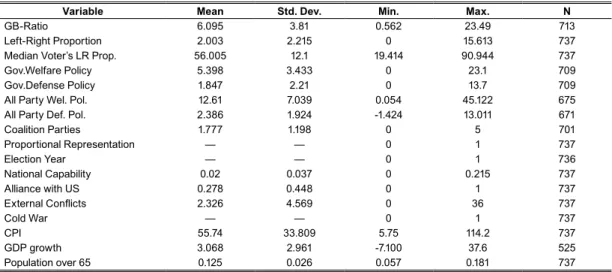
To control for a nation’s conflict involvement, I employ the MIDs used in both studies. According to the empirical model shown above, the degree to which the effect of conflict involvements is included. For this purpose, numbers of military conflicts facing a country increases is predicted to enhance the portion of guns. Descriptive statistics of all variables are in the Table 3.
Empirical Results
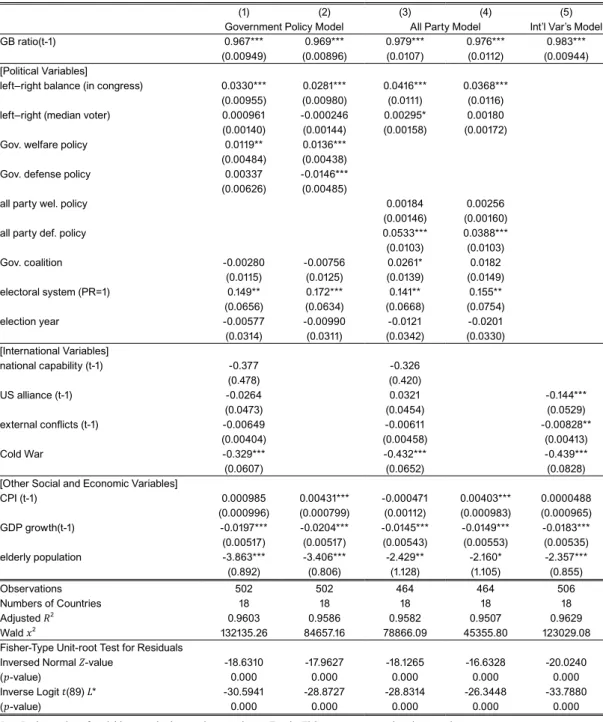
The estimation results are reported in Table 4, which shows (i) the Government Party Policy model and (ii) the All Parties Policy Mood model, without interac-tion with public opinion in order to gauge the main variables’ effects in a straightforward manner. An initial look at Table 4 suggests that the significance of lagged dependent variables implies the existence of unit-roots in all models. Most significant, however, is the finding that co-integration is met in all models when the results of Fisher-type unit-root tests for residuals are taken into consideration.26 Thus, the possibility of a spurious causality from the non-stationary is likely to be rejected.
It is clear that the proportion of butter increases when the ratio of seats obtained by the left rises in parliament and, inversely, that the proportion of 24 “CINC” is the name of the variable in the Correlates of War (COW). National capability has already embraced the component of military
expen-diture. It may cause partially endogeneous relationships between the independent and dependent variable. As an alternative, GDP per capita can be adopted to represent national capability. But, its measurement also causes the strong correlation between the left-hand side variables: GDP per capita and GDP growth rate. Taking either operationalization, a certain level of correlation or an endogeneous problem should occur. To this end, in order to make the result compatible with previous research, the author employs “CINC”.
25 The dummy receives a score of 1 for the Cold War period and 0 for after the Cold War.
26 The null hypothesis is that all panels contain unit-roots. Although unit-root tests for TSCS data vary, the TSCS data are imbalanced, so a test based on unit-roots in each panel is employed.
guns increases with an increase in the ratio of seats obtained by the right. This outcome accords with expectations and holds significant for all remaining specifications. With respect to policy positions, a government’s welfare position significantly deter-mines the increase of butter relative to defense. It also appears, though it is not significant in the full model, that the effect of the government’s defense position allows the GB Ratio to decrease. According to these results, partisan politics seem to determine resource allocation strongly.
With regard to the effect of public opinion, we can infer that butter is increasingly emphasized as the public mood moves toward the left, especially as indicated in Model 4. Interestingly, Model 4 comprises international factors without the party’s policy position. If we eliminate the effect of the government party’s policy posture, the effect of public opinion looks like the other domestic effect. The median voter’s location seems to promote butter to some extent, and in the next analysis, we need to specify further the detailed transition in the marginal effects of government policy preconditioned by public opinion.
For the political control variables, in the PR system, butter is likely to be emphasized through all models. This institutional finding has not been confirmed by the guns-and-butter study. The back-ground to this finding is supposed to be that in the
countries adopting the PR system, such as North Europe and the Benelux countries, redistribution rather than expansion of the armed forces forms the basis of the domestic welfare issue. By contrast, election year and number of coalition parties are not statistically significant, although their effects do show a tendency to enhance the welfare proportion. Furthermore, it should be noted that the effect of public opinion alone cannot be significantly verified. It can at least be safely asserted that public support may not influence the enhancement of both military and welfare simultaneously.
Next, in terms of international factors, a nation’s position and its alliance with the United States signif-icantly promotes guns, though risk attitudes and conflict involvement do not show the sign and statis-tical significance predicted. We can say, at least, that the major power countries are required to enhance their armies and that the U.S. alliance compels part-ners to share the burden (e.g., military construction, sympathetic budget allocation) to some extent.27 Finally, the Cold War dummy clearly shows a signifi-cant negative effect on the GB Ratio. During the Cold War, every developing country tended to increase guns rather than butter, which can be understood in line with the influence of the major power. In the last model, focusing solely on international factors, though the risk finding is against expectations, the alliance with the U.S. is shown to promote guns. 27 This finding does not agree with that presented by Whitten and Williams (2011).
Table 3: Summary Statistics for All Samples
Variable Mean Std. Dev. Min. Max. N
GB-Ratio 6.095 3.81 0.562 23.49 713
Left-Right Proportion 2.003 2.215 0 15.613 737
Median Voter’s LR Prop. 56.005 12.1 19.414 90.944 737
Gov.Welfare Policy 5.398 3.433 0 23.1 709
Gov.Defense Policy 1.847 2.21 0 13.7 709
All Party Wel. Pol. 12.61 7.039 0.054 45.122 675
All Party Def. Pol. 2.386 1.924 -1.424 13.011 671
Coalition Parties 1.777 1.198 0 5 701 Proportional Representation — — 0 1 737 Election Year — — 0 1 736 National Capability 0.02 0.037 0 0.215 737 Alliance with US 0.278 0.448 0 1 737 External Conflicts 2.326 4.569 0 36 737 Cold War — — 0 1 737 CPI 55.74 33.809 5.75 114.2 737 GDP growth 3.068 2.961 -7.100 37.6 525 Population over 65 0.125 0.026 0.057 0.181 737
Table 4: The Determinants of The GB-Ratio (without interaction terms)
(1) (2) (3) (4) (5)
Government Policy Model All Party Model Int’l Var’s Model
GB ratio(t-1) 0.967*** 0.969*** 0.979*** 0.976*** 0.983***
(0.00949) (0.00896) (0.0107) (0.0112) (0.00944) [Political Variables]
left–right balance (in congress) 0.0330*** 0.0281*** 0.0416*** 0.0368*** (0.00955) (0.00980) (0.0111) (0.0116) left–right (median voter) 0.000961 -0.000246 0.00295* 0.00180 (0.00140) (0.00144) (0.00158) (0.00172)
Gov. welfare policy 0.0119** 0.0136***
(0.00484) (0.00438)
Gov. defense policy 0.00337 -0.0146***
(0.00626) (0.00485)
all party wel. policy 0.00184 0.00256
(0.00146) (0.00160)
all party def. policy 0.0533*** 0.0388***
(0.0103) (0.0103) Gov. coalition -0.00280 -0.00756 0.0261* 0.0182 (0.0115) (0.0125) (0.0139) (0.0149) electoral system (PR=1) 0.149** 0.172*** 0.141** 0.155** (0.0656) (0.0634) (0.0668) (0.0754) election year -0.00577 -0.00990 -0.0121 -0.0201 (0.0314) (0.0311) (0.0342) (0.0330) [International Variables] national capability (t-1) -0.377 -0.326 (0.478) (0.420) US alliance (t-1) -0.0264 0.0321 -0.144*** (0.0473) (0.0454) (0.0529) external conflicts (t-1) -0.00649 -0.00611 -0.00828** (0.00404) (0.00458) (0.00413) Cold War -0.329*** -0.432*** -0.439*** (0.0607) (0.0652) (0.0828)
[Other Social and Economic Variables]
CPI (t-1) 0.000985 0.00431*** -0.000471 0.00403*** 0.0000488 (0.000996) (0.000799) (0.00112) (0.000983) (0.000965) GDP growth(t-1) -0.0197*** -0.0204*** -0.0145*** -0.0149*** -0.0183*** (0.00517) (0.00517) (0.00543) (0.00553) (0.00535) elderly population -3.863*** -3.406*** -2.429** -2.160* -2.357*** (0.892) (0.806) (1.128) (1.105) (0.855) Observations 502 502 464 464 506 Numbers of Countries 18 18 18 18 18 Adjusted 𝑅2 0.9603 0.9586 0.9582 0.9507 0.9629 Wald 𝑥2 132135.26 84657.16 78866.09 45355.80 123029.08
Fisher-Type Unit-root Test for Residuals
Inversed Normal 𝑍-value -18.6310 -17.9627 -18.1265 -16.6328 -20.0240
(𝑝-value) 0.000 0.000 0.000 0.000 0.000
Inverse Logit 𝑡(89) 𝐿 * -30.5941 -28.8727 -28.8314 -26.3448 -33.7880
(𝑝-value) 0.000 0.000 0.000 0.000 0.000
Note: In the section of variables, standard errors in parentheses. For the Fisher-type test, 𝑝-values in parentheses.
As a complementary analysis to check for robust-ness, let us show the results of the parties’ policy moods. It can be confirmed that the left-right propor-tion determines the distribupropor-tion as predicted. While party defense mood is statistically significant against the prediction, party welfare mood still yields the significant predicted result in both models including the welfare policy mood. In this model, we can confirm that guns expand when the government believes there is a greater risk of involvement in international conflict.
In light of the above models, we can briefly conclude that (i) a parliament’s left-right composi-tion strongly influences distribucomposi-tion along the line of conventional knowledge; (ii) the major powers tend to enlarge their military forces; (iii) the PR system is likely to promote redistribution relative to milita-rization; and (iv) only the effect of public opinion on resource allocation cannot be well confirmed.
As for the models that investigate the marginal effect with the changing conditions of left-right balance in legislature and public opinion, as the second analysis, the substantive interpretation will be guided by Braumoeller (2004) and Bramber et al. (2004), as presented in Figures 2–3.
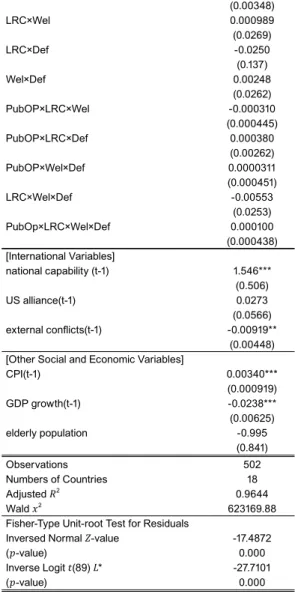
Figure 2 represents the marginal effects of government welfare policy modified with left-right composition in congress. The upper line represents the case in which a median voter locates on left-ward and the lower line indicates the case in which a median voter locates right-ward. In Figure 2, as the proportion of leftist increases in congress, the government welfare position is more likely to enhance the proportion of butter relative to guns. And, as the upper line implies, when the median voter is located towards the left (one standard devia-tion higher than the mean of public opinion variable),
Table 5: The Determinants of The GB-Ratio (with interaction terms)
(1)
Lagged GB ratio 0.969***
(0.00858) [Political Variables]
left-right balance in congress -0.323
(LRC) (0.210)
left-right of median voter -0.0122*
(PubOp) (0.00677)
Gov. welfare policy 0.0416
(Wel) (0.0524)
Gov. defense policy 0.0350
(Def) (0.188) Gov. Coalition -0.0136 (0.0114) Eectoral System(PR=1) 0.233*** (0.0736) election year -0.0234 (0.0371) [Interaction Terms] PubOp× LRC 0.00758* (0.00389) PubOp× Wel 0.00000149 (0.000956) PubOp× Def -0.00102 (0.00348) LRC×Wel 0.000989 (0.0269) LRC×Def -0.0250 (0.137) Wel×Def 0.00248 (0.0262) PubOP×LRC×Wel -0.000310 (0.000445) PubOP×LRC×Def 0.000380 (0.00262) PubOP×Wel×Def 0.0000311 (0.000451) LRC×Wel×Def -0.00553 (0.0253) PubOp×LRC×Wel×Def 0.000100 (0.000438) [International Variables] national capability (t-1) 1.546*** (0.506) US alliance(t-1) 0.0273 (0.0566) external conflicts(t-1) -0.00919** (0.00448) [Other Social and Economic Variables]
CPI(t-1) 0.00340*** (0.000919) GDP growth(t-1) -0.0238*** (0.00625) elderly population -0.995 (0.841) Observations 502 Numbers of Countries 18 Adjusted 𝑅2 0.9644 Wald 𝑥2 623169.88
Fisher-Type Unit-root Test for Residuals
Inversed Normal 𝑍-value -17.4872
(𝑝-value) 0.000
Inverse Logit 𝑡(89) 𝐿 * -27.7101
(𝑝-value) 0.000
Note: In the section of variables, standard errors in parentheses. For
the Fisher-type test, 𝑝-values in parentheses. * (𝑝 <0.10), ** (𝑝 <0.05), *** (𝑝 <0.01)
the ruling parties’ welfare policy tends to more influ-ence the rise in butter. When, for example, the leftist in congress is 2.2 times as much as the rightist and public leans toward left-direction, the GB ratio rises by 0.216 percent as a ruling party/parties provokes welfare policy in manifesto by 1 percent.
The lower line, however, indicates the marginal effect of welfare policy shows a negative sign. Thus, when the median preference is on towards the right (one standard deviation lower the mean), even if the left-ists are about 1.75 times as prominent as rightleft-ists (with 95 percent confident intervals) in congress, the GB ratio still skews to guns. Contrasted with the above example, when the leftists in congress are 2.2 times more than the rightist, but the public orients to the right, the GB ratio decreases by -0.074 percent, as a ruling party/parties emphasize welfare policy by 1 percent. In any case, Figure 2 clearly shows govern-ment welfare policy reflects the emphasis of butter relative to guns, when the left wing prevails both in the political mass and elite.
Secondly, as seen in Figure 3, the marginal effects of defense policy are modified with the left- right composition in congress, and the upper and lower lines refer to the same as Figure 2. Clearly,
when the left-wing prevails in the legislature and the median voter is located towards the left, even though government stresses defense policy, the GB ratio skews to the left. Against this intuitive result, the case in which the public leans to the right is difficult to interpret. At least, it can be read out that even the left prevails in the legislature, guns are emphasized as long as the median voter orients to the right.
However, the result is a bit counterintuitive, as the proportion of the left increases in the legisla-ture, a proportion of guns increase relative to butter. Superficially thinking, when the proportion of the left increases in the legislature, the defense policy is not necessarily predicted to enhance the propor-tion of defense spending. It suggests, in Figure 3, the lower line should be located in the area of negative sign, and depict the downward trend to the left (pres-ently downward trend to the right).
This counterintuitive result, however, critically fits to the knowledge in previous research: the dovish government generously expanding its fiscal expen-diture is apt to expense more for military spending rather than the hawkish government austerely retrenching finance, to reduce military spending (Williams and Whitten 2012). The right-prevailed
legislature tries to recuse the unregulated military spending in the light of fiscal discipline.28 This mech-anism is thought to influence the relative emphasis on defense spending when compared to the-right-skewed-legislature whose foundational roots are in the right-ward oriented voters.
Finally, with regard to economic controls, the result of the CPI is fragile in Models 3 and 5 in Table 4, in both gun and butter directions. It can be said a rise of prices is likely to stimulate butter, as in Models 2 and 4, which are significant. By way of contrast, economic growth seems to enhance defense spending.
As for an increase in the elderly population, contrary to the prediction, it suggests, significantly, an increase in guns, not butter. For this results, the author did the sensitivity check in “Supplementary Materials” to confirm the multicollinearity and its influence on the substantial interpretation among public opinion, balance in legislature and govern-ment policy. Values of variance inflation factors
(VIFs) indicates the existence of multicollinearity in the model with interaction terms in Table 5 (not in the one without interaction terms in Table 4). Thus in the supplementary analysis, the author tries to figure out whether inserting and removing the suspected variables, i.e. CPI and elderly population, changes the marginal effects of government welfare/ defense policy modified with public opinion and left-right proportion in congress. The results imply no substantial change of interpretations regarding marginal effects both with and without CPI and elderly population. In the line of Brambor et al. (2006), Braumoeller (2004) and Allison (1977), all effects of major variables and constitutive terms among them should be emphasized, sacrificing a brittle result with multicollinearity.
Concluding Remarks
There are three principal findings of this research into the attributions of distribution politics. First, parliamentary partisanship strongly affects resource 28 If this rationale might be applicable to welfare spending, the marginal effect on GB ratio should not be so much downward trend, since welfare spending is not so much constrained by the fiscal discipline. It can be said that in this situation, even in the case of generous doves with the major-ity of the left, the government defense policy does not heavily impact on guns’ enhancement relative to butter. Relating to this point, why gener-ous leftists prefer the enhancement of guns should be a future research concern.
allocation (when the left constitutes the majority, the proportion of butter increases, and when right consti-tutes the majority, the proportion of guns increases). Second, the public left-right scale modifies the effect of parties’ policy positions on distribution in the cases of both welfare and defense positions: when the median voter is located to the left and the left-wing prevails in congress, the government’s welfare policy naturally contributes to a shift toward butter, and when the median voter is located to the right and the leftist predominates in congress, the government’s defense policy contributes to a shift toward guns. Regarding this result, however, conclusion should be withheld in terms of the counterintuitive result: while a generous dovish government who is founded on the left-oriented voters prefers guns, a strict hawkish government who seeks the tight fiscal discipline tries to apply its austerity to the defense sphere. Third, the electoral system influences distribution: in a PR system, butter tends to be stressed. Finally especially in the model limited to international factors, national capability, Cold War, and external conflicts are found to contribute to an increase in guns, intuitively.
These findings can be obtained by adopting the GB Ratio as the dependent variable and by employing the public left-right scale as a conditioned variable, perspectives that have generally been dismissed in the literature.
What implications can be drawn from the above evidence? At the least, we can infer that mainly domestic and partially internal conditions determine government decision making regarding defense vs. welfare output. In addition, both party elites and the general public have a certain level of influence on distribution politics, although the extent of this influ-ence is limited, as the results show: public opinion can restrict the effects of a government’s policy state-ment (i.e., manifesto), but its direct impact cannot be identified. All that can be said is that, through some route, public opinion affects the government’s distri-bution politics by restricting its available policy posi-tions.
Furthermore, we can conclude that domestic politics influence distribution far more than do inter-national concerns. Even if interinter-national factors show a partially direct effect, any effect on the GB Ratio is limited, except for the effect of the Cold War.
In order to improve this paper’s approach, some modifications should be made. For the contingency of
public support, it was not possible to capture various aspects of public support, such as “macropartisanship” (MacKuen et al. 1989) and “policy mood” (Stimson 1999). At the very least, the left-right tendency, which is included under public opinion here, requires assessment in any future analysis, so that its effects on policy outcome, including its contingency effect, can be computed.
Although some external (environmental) factors, such as international conflict involvement, have been taken into consideration, other crucial attribu-tions affect resource allocation politics significantly. Natural disasters are the most striking of these factors at present. The probability of crisis caused by natural calamities seems to be more frequent and serious for developed countries, as the case of the recent Japan earthquake shows. In such cases, the distribution for guns and butter is thought to be strongly influenced by military mobilization for disaster relief and by social spending for reconstruc-tion. Thus, a future analysis of the impact of natural disasters on resource allocation may be indispens-able.
Furthermore, even for studies of just one nation, we could use another approach for the analysis of the complicated endogenous relationships among public opinion, party policies, external events, and final policy outcomes. This kind of work requires an advanced statistical method such as “modeling the macro polity,” as advocated by Brandt and Freeman (2009). If we can successfully capture the cyclical relationship among these political variables, it might also speak to issues of political representation (e.g., Stimson et al. 1995; Erikson et al. 2002), from voters’ preferences to government parties’ accountability and responsiveness to them (Manin et al. 1999). To complete this work, an advanced method, such as Bayesian statistical inference and the application of the dynamic stochastic general equilibrium model, should be considered. Analyses of greater detail and depth might be expected from such approaches.