大規模並列計算による乱流中の高分子モデルの挙動解析
名古屋工業大学大学院創成シミュレーション工学専攻 渡邊 威 (Takeshi WATANABE) [email protected] 後藤 俊幸 (Toshiyuki GOTOH) [email protected]Department ofScientific and Engineering Simulation, Nagoya Institute ofTechnology
Abstract
The effects of polymer additives on decaying isotropic turbulence were numeri-cally investigated using ahybrid approach. The approachconsisted ofaBrownian dynamicssimulationwithanenomousnumber ofdumbbellsandaturbulence DNS with large-scale parallel computations. A reduction of the energy dissipation rate and modification ofthe kineticenergy spectrum wereobserved when the reactions of the polymers were incorporated into the fluid motion. It was shown that the increase of concentration of polymersorofWeissenberg number yieldedmore mod-ifications of turbulence statistics. We also observed that the generationof intense vortices was suppressed by polymer additives, being consistent with the previous studies using constitutive equations. It wasfound that the field structures of
poly-mer stress field depended on the intensity of fluctuation, sheet-like stmctures for the intermediate intensity region or filamentary ones forintense region. We found theresults with few polymersandlarge replicascouldapproximate those withmany polymersand smaller replicas as far asthelarge-scale statistics wereconcerned.
1
Introduction
It is well known that small amounts of polymers added to a fluid significantly affect the
large-scale flowstructures, i. e., turbulence dragreduction[1, 2, 3] orenhancing the mixing
in the microchannel devices [4, 5, 6]. The later is due to the generation of random flows
with low Reynolds numbers caused by elastic instability, so called the elastic turbulence
[7, 8, 9]. On the other hand for larger Reynolds numbers, it is shown that the bulk of
turbulenceisaffected by polymer additives, suggesting the modification ofenergytransfer
dynamics over the inertial range scales [10].
It is vital toexamine the meso-scale dynamicsof polymers in turbulent flows for deep
insight intothe peculiarflow nature of dilutepolymersolutions. Thepreviousstudies have
been investigating the single polymer dynamics in
a
simple shear [11, 12, 13] and randomflows [14, 15, 16, 17, 18, 19, 20]. The coil-stretch transition is
an
important concept tounderstand the polymer dynamics in turbulence [21]. In the
case
for simple shear flow, the polymer takes the coiled configuration if the shear intensity $S$ is smaller than $1/\tau_{s}$ where$\tau_{\epsilon}$ is the characteristic relaxation time ofpolymer chain. Wlule for $S\tau_{s}>1$, it prefers
to be an extended configuration by the action of local flow. Because the direction and
amplitudeof the localshear in turbulence fluctuates intime randomlyand intermittently,
the polymers in turbulence manifest the complicated behavior moving along the fluid
particle trajectories, indicating the difficulty for understanding their interactions.
In a previous study, we investigated single polymer chain dynamics in isotropic
tur-bulence [22]. We found that the coil-stretch transition occurred for characteristic
Weis-senberg numbers $W_{i}=3\sim 4$, where the Lagrangian correlation time ofthe velocity
We also found that the statistical nature of the polymer chain
was
well approximated bythe dumbbell model. Moreovertherelationshipbetween thepolymer elongation and local
flowtopology
was
discussedby analyzingthe statistics ofpolymer elongation conditionedonthe invariants of$\nabla u$
.
Although several implications could be drawn from these results,we did not consider the effects ofpolymer dynamicson turbulence (we considereda
one-way coupling regime only). To discuss turbulence modification by polymer additives, we
must incorporate the reaction from the
enormous
number ofpolymers tothefluid motion.In the past, turbulent dilute polymersolutionflow hasmainlybeen investigated using
the constitutive equations like the Oldroyd-B or FENE-P equations [23]. These
are
theevolution equations for the field ofpolymer conformation tensor and constructed on the
basisofthe simple polymer model [23]. The constitutive equations have widely been used
for the investigations of turbulence drag reduction [24, 25, 26, 27, 28, 29]
or
the elasticturbulence [30] because of the easiness to handle the polymers effects
on
turbulence bythe numerical simulations. Recent study pointed out that the resolution condition much
more
stringent than that of velocity field is required for the adequate computation ofFENE-P equation [31].
The hybrid approach, the fluid motion is computed using the Navier-Stokes (NS) equation while the polymers dynamics is done by the molecular dynamics or Brownian
dynamics simulations of the appropriate polymer model [23, 32], is the new trend for
investigating the dilute polymer solution flow. There were several studies for this issue
using the combination of computational fluid dynamics with particle-based simulations
ofpolymer model with/without the reaction to fluid motion [33, 34, 35, 36, 37, 38]. The advantage ofhybrid approach is that we canconstruct the polymersolution modelhaving
rich variety ofrheological properties by introducingseveral interacting forces among beads.
Moreover it may besuitable to investigate thephenomena that the Lagrangian viewis
an
intrinsic; the diffusion ofpolymer solution in turbulent boundary layer [39]
or
the effectsof the degradation of polymers on turbulence [40]. While the disadvantage is that the
computational cost becomes muchlarger
as
the number ofpolymer is increased. Howeverwe can
neglecttheinteraction among polymersinthecasefor the dilute solution, implyingthe computational cost for evaluating forces among particles is proportial to the number ofpolymers. Then we
can
perform the efficient simulations for the enormous number ofpolymers in turbulence using the large-scale parallel computations.
The purpose of the present study is to explore two-way coupled simulation methods
using the hybrid approach. The Brownian dynamics simulation for the polymer chain
model coupled with the direct numerical simulation (DNS) of turbulent flow were
per-formed usinglarge-scale parallel computations. We used the dumbbell model for thelong
chainpolymerbecausethe dumbbell model
can
satisfactorily reproduce the overallresultsobtained by the chain model [22, 31]. To gain the significant reaction from polymers to
fluid,
we
needed a much large number of dumbbells in the flow domain. In this studythe
enormous
number $(O(10^{9}))$ of dumbbells were dispersed in turbulent flow, and theiradvections and deformations were strictly tracked during the time evolution. Then
we
examined the degree of modification of turbulent flow by investigating the concentration
and Weissenberg numbereffects onthefundamental quantities and the vortical structures in the case for decaying isotropicturbulence. Because there is no mean shear in isotropic turbulence, it is suitable to investigate the effects ofpolymers on the bulk of turbulence by analyzing the interaction between polymers and the velocity gradient fluctuations.
Modification
of isotropic turbulenoe by polymer additives have been investigated by theDNS
of FENE-P model [27, 28, 29]. Makinga
comparison between the present resultsand the previous
ones
obtainedby FENE-P model may be useful toassess
the hybridap-proach introduced in this study. Moreoverweexaminedthe validation for theassumption
introduced for evaluating the polymer stress field which is added to the NS equation
as
the reactionterm from dumbbells.
This paper is organized as follows. We briefly describe the model equations and
numerical method in Secs. 2 and 3. The effects of the polymer additives on decaying
turbulence
are
examined by varying the parameters like concentration and Weissenbergnumber in Sec. 4. Section 5 is assigned for examining the nature of coherent structures
with and without polymers, where the specific structures in the polymer stress field
are
discussed. The variation of results when the number of polymers is changed
are
alsodiscussed
inSec.
6.
We summarized the main results obtained in this study inSec. 7.
2
Polymer solution model
2.1
Governing equations
We used the dumbbell model to represent the polymer dynamics dispersed in the flow
domain. In this method, each polymeris represented by two beads connected by a
non-linear spring [23]. The interaction among different dumbbells is neglected because we
considered dilute polymer solutions. Moreover, we neglected the inertia of the particles
because the inertia of the coiled polymer was very small. Thus, the equations of
mo-tion for the end-to-end vector $R^{(n)}(t)=x_{1}^{(n)}(t)-x_{2}^{(n)}(t)$ and the center of
mass
vector$r_{g}^{(n)}(t)=(x_{1}^{(n)}(t)+x_{2}^{(n)}(t))/2$ ofthe n-th dumbbell
are
respectively given by$\frac{dR^{(n)}}{dt}=u_{1}^{(n)}-u_{2}^{(n)}-\frac{1}{2\tau_{\epsilon}}f(\frac{|R^{(n)}|}{L_{m}})R^{(n)}+\frac{r_{eq}}{\sqrt{2\tau_{s}}}(W_{1}^{(n)}-W_{2}^{(n)})$ , (1)
$\frac{dr_{g}^{(n)}}{dt}=\frac{1}{2}(u_{1}^{(n)}+u_{2}^{(n)})+\frac{r_{eq}}{\sqrt{8\tau_{s}}}(W_{1}^{(n)}+W_{2}^{(n)})$ , $(u_{\alpha}^{(n)}\equiv u(x_{\alpha}^{(n)}(t), t))$ , (2)
where $u(x, t)$ denotes the velocity field of the solvent fluid. We adopted the finitely
extensible nonlinear elastic (FENE) model [23] givenby$f(z)=1/(1-z^{2})$
.
The dumbbellcannot extendbeyondthe maximum length $L_{mm}$
.
The term$W_{1,2}^{(n)}(t)$ indicatesa
Brownianrandom force acting on the particles from the solvent fluid, obeying Gaussian statistics
with awhite-in-time correlation as $\langle W_{\alpha,i}^{(n)}(t)\rangle=0,$ $\langle W_{\alpha,i}^{(m)}(t)W_{\beta,j}^{(n)}(s)\rangle=\delta_{\alpha\beta}\delta_{ij}\delta_{mn}\delta(t-s)$
.
Here, $6_{ij}$ denotes the Kronecker delta and $\delta(t)$ is the delta function. $\tau_{s}$ and $r_{eq}$
are
therelaxation time and the equilibrium length of the dumbbell under $u(x,t)=0$
.
The turbulent velocity fieldobeys the incompressible Navier-Stokes equation
$\nabla\cdot u=0$, $\frac{\partial u}{\partial t}+u\cdot\nabla u=-\nabla p+\nu\nabla^{2}u+\nabla\cdot T^{p}$, (3)
where $\nu$ is the kinematic viscosity. $T^{p}(x, t)$ is the polymer stress tensor due to the force
acting
on
the fluid from the disperseddumbbells. It is defined by$\eta\equiv(3r_{eq}/4a)^{2}\Phi_{V}$ isthe
zero
shearcontribution ofpolymersto thetotal solution viscosity,$a$ is the radius of the bead, and $\Phi_{V}\equiv(8\pi N_{t}/3)(a/L_{box})^{3}$ represents the volume fraction
ofthe ensemble of dumbbells. Thus $\eta$ is proportional to the polymerconcentration.
2.2
Parameter setting
We evaluated how many polymers were required to realize a significant turbulence
mod-ification. According to an experimental study using polyacrylamide $(M_{p}=18\cross 10^{6}$
a.m.u.), the number of polymers per box with volume $l_{K}^{3},$ $l_{K}$ being the Kolmogorov
length, can be estimated by $N_{K}=3.6\cross 10^{6}$ when $R_{\lambda}\simeq 50$ with
a
5 ppm solution[10]. Therefore, the total number of polymers in the computational box
was
estimatedas
$N_{t}=N_{k}(L_{box}/l_{K})^{3}=O(10^{13})$ when using adequateDNS
conditions $(\Delta x=l_{K})$ forsmall-scale statistics. The order $N_{t}=O(10^{13})$ is much too large, even for using a
state-of-the-art supercomputer. Thus an approximate method
was
required to represent theinteraction between the fluid and polymers. We supposed that $N_{t}$
was
represented by$N_{t}=b\tilde{N}_{t}$, where $\tilde{N}_{t}$ indicates the total number ofdumbbells in the computation and $b$ is
an artfficial parameter representing the number of“replica dumbbells” per a dumbbell.
In this case, the polymer stress tensor
was
approximated by replacing $N_{t}$ in (4) by $\tilde{N}_{t}$.
Dumbbellparameters$r_{eq},$ $a$, and$L_{mm}$
were
determined using experimentalparameters[10] under fixed $l_{K}$
.
It is shown in [10] that $R_{g}=0.5\mu m,$ $L_{mm}=77\mu m$ for polymersolution using Polyacrylamide. Then
we
evaluatedas
$L_{\max}/l_{K}=0.3,$ $r_{eq}/l_{K}=3.0\cross 10^{-3}$and $a/l_{K}=(3\Phi_{V}/4\pi N_{K})^{1/3}=7.0\cross 10^{-5}$, where we use the relationship $\sqrt{3}r_{eq}\simeq\sqrt{6}R_{g}$
for Gaussian coil and $l_{K}\simeq 280\mu m$ when $R_{\lambda}=50$
.
The Weissenberg number $W_{i}$ controlsthe elastic nature of the polymer model. It is defined by $W_{i}=\tau_{S}/\tau_{K}$, where $\tau_{K}$ is the
Kolmogorov time. In this study $W_{i}$ is used for the control parameter to determine the
elastic nature of dumbbell, i.e. $\tau_{s}$ is determined by using the values of$W_{i}$ and$\tau_{K}$
.
3
Numerical
simulations
Direct numerical simulations (DNSs) ofEqs. (3) were performed in a periodic box with
periodicity $2\pi$ usingthe pseudo-spectralmethod inspace and the 2nd order Runge-Kutta
method in time. The initial conditions ofthe velocity field were set to random, obeying
Gaussianstatistics with an energy spectrum
$E(k, 0)=16\sqrt{2/\pi}(u_{0}^{2}/k_{0})(k/k_{0})^{4}\exp(-2(k/k_{0})^{2})$ $(u_{0}=1, k_{0}=2)$
.
(5)The total number ofgrid points for DNS were set to $N^{3}=128^{3}$. The Taylor micro-scale
Reynolds number $R_{\lambda}(t)$
was
$R_{\lambda}(O)=52$, whichmonotonicallydecayed with time. In thisprocess, the decaying turbulence
was
approximately regardedas
statisticallyisotropicandhomogeneous. $l_{K}(t)=(\nu^{3}/\epsilon(t))^{1/4}$, where $\epsilon(t)$ is the energy dissipation rate,
was
alwayslarger than the grid spacing $\Delta x$, i. e., the velocity field
was
adequately smooth at smallscales. $\tau_{K}=(\nu/\epsilon(t))^{1/2}$ and $l_{K}$ used for determining several parameters are evaluated
using the maximum value $\epsilon_{\max}$ of$\epsilon(t)$ in the one-way coupling
case.
Initial positions of dumbbells were uniformly distributed
over
the computationalTable
1:Parameters
forDNS
ofdecaying turbulence and Brownian dynamics simulation for dispersed dumbbells. Run $0$means
the one-waycase.
set by $R^{(m)}(0)=r_{eq}n^{(m)}$ where $n^{(m)}$
was
the unit random vector takenover
the allorien-tations. Time integration ofeqs. (1) and (2)
were
performed by using the similar schemeproposed in [11], where the velocity components at each bead position
were
interpolatedusing
a
TS13 scheme [41]. Multi-scale methodwas
used for the temporal evolution of$R^{(n)}(t)$, where the time increment $\Delta t_{p}$ for $R^{(n)}(t)$
was
chosen by $\Delta t_{p}=\Delta t_{DNS}/5$ when $|R^{(n)}(t)|>0.9L_{mm}$, while $\Delta t_{p}=\Delta t_{DNS}$ for $|R^{(n)}(t)|<0.9L_{R}$.
Parallel computations
were
used to evaluate the convection and deformation of thedispersed dumbbells. The total number of dumbbells $\tilde{N}_{t}$
was
divided into$m$ groups, and
theirtemporalevolution
was
individually computedfor each node. Onenodewas
assignedtotheDNSof the solventfluid,sothatweused$m+1$ processes for theparallel computation
ofthefluid-particle system. $u(x, t)$computed inthefluid node
was
transferred to the othernodes for the polymer computations. The
program
codewas
parallelized by using MPI,where the 256 processer elements
were
used for the parallel computations. The reactionfrom the polymers
was
evaluatedas
follows. 1) The polymer stress field $T_{node}^{p}(x)$was
computed according to Eq. (4) in each process. 2) These
were
gathered to the process forfluid computation and summed. 3) The obtained $T^{p}(x)$
was
incorporated into the DNSscheme. In the step1), because the center of
mass
vector$r_{g}^{(n)}$ foreachdumbbellswere
noton
thegrid points for DNScomputation, weneededsome
approximateexpression insteadof Eq. (4). The deltafunction in Eq. (4)
was
approximated by the weight function whichwas the function of surrounded 8 grid points around $r_{g}^{(n)}$ and determined by the weights
used for linear interpolation scheme [42].
Elastic nature of dumbbells is controlled by changing $W_{i}$, and the concentration of
polymer solution is determined by the value of$\eta$
.
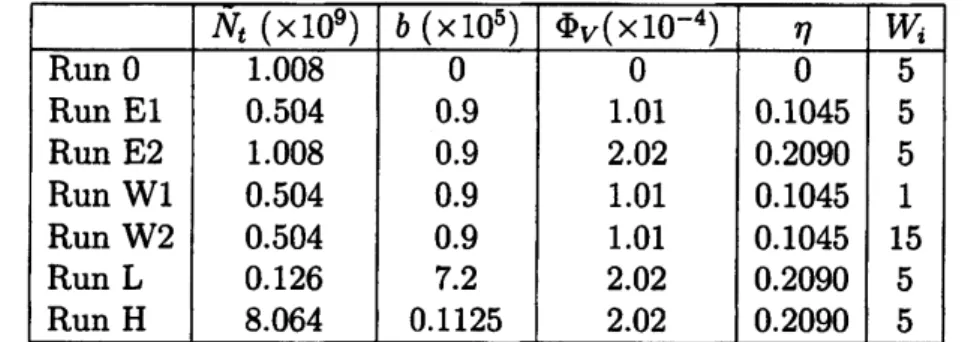
In this study we performed the seriesof simulations as 1) $\eta$ dependence under fixed $W_{i},$ $2$) $W_{i}$ dependenceunder fixed $\eta$, and
3$)$ $N_{t}$ dependence under fixed $W_{i},$ $\eta$ and $N_{t}$
.
The parameters used for simurationsare
summarized in Table 1.
4
Modification of
decaying
isotropic turbulence
4.1
Concentration effect
Weexamined themodification of the turbulentpolymersolutionflowbychanging$\eta$under
$0$ 1 2 3 $\ovalbox{\tt\small REJECT}$ 5
6 7 8
$t$
$0$ 1 2 3 4 5 6 7 8
$t$
Figure 1: $\eta$ effect on the temporal evolution Figure 2: $\eta$ effect on the temporal evolution
ofthe kinetic energy $E(t)$
.
of the energy dissipation rate $\epsilon(t)$.$10^{0}$ $10^{1}$ $10^{0}$ $10^{1}$ $10^{0}$ $10^{1}$
$k$ $k$ $k$
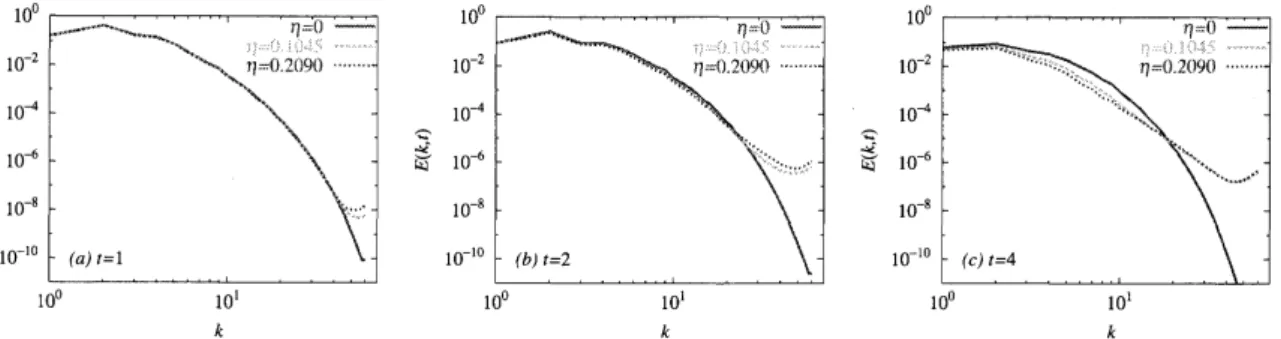
Figure 3: Comparison of the behavior of the kinetic energy spectrum $E(k, t)$ obtained by Runs $0$, El and E2; (a) $t=1,$ $(b)t=2$ and (c) $t=4$
.
in the
cases
for $\eta=0$ (Run $0$), 0.1045 (Run El) and 0.2090 (Run E2). Kinetic energymonotonically decayed withtime, andthe decay rateincreased with increase of$\eta$
.
Figure2 indicates the temporal evolutions for the energy dissipation rate $\epsilon(t)$
.
Peak positionslocated around $t=1$ irrespective of $\eta$, and $\epsilon(t)$ decayed with time for $t>1$ , where
the reduction rate of$\epsilon(t)$ became larger as
$\eta$ increased. These observations suggest that
the extension of dumbbells affected to the scales of turbulent motions over the entire
wavenumber range, being qualitatively consistent with the DNS results using a FENE-P
model [27].
To
see
these modifications inmore
details, we investigated the behavior of the kineticenergy spectrum $E(k, t)$. Figure 3 indicates the comparison of $E(k, t)$ for Runs 0-2 in
the
cases
for (a) $t=1,$ $(b)t=2$ and (c) $t=4$.
The spectral behaviorwas
deformed by the polymer additives within its tail part up to $t=1$, and the deviation from theone-way result became larger with increase of$\eta$
.
At
the final period ofdecay, thespec-tral modffication
was
observedover
the entire wavenumber range, suggesting the energytransferdynamics
was
affectedevenin the largerscales bythemodification ofdissipationmechanism in the smaller
ones.
As shown in the aforementioned results, turbulence modification
was
originated $hom$the reaction due to the dumbbell dynamics which
was
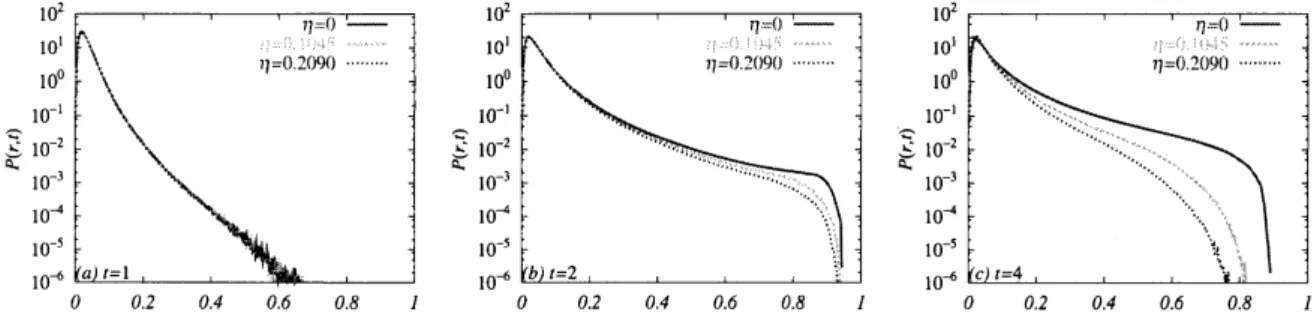
characterized by the statisticalnature of the ensemble of dumbbells. Next we investigate the temporal evolutions of the
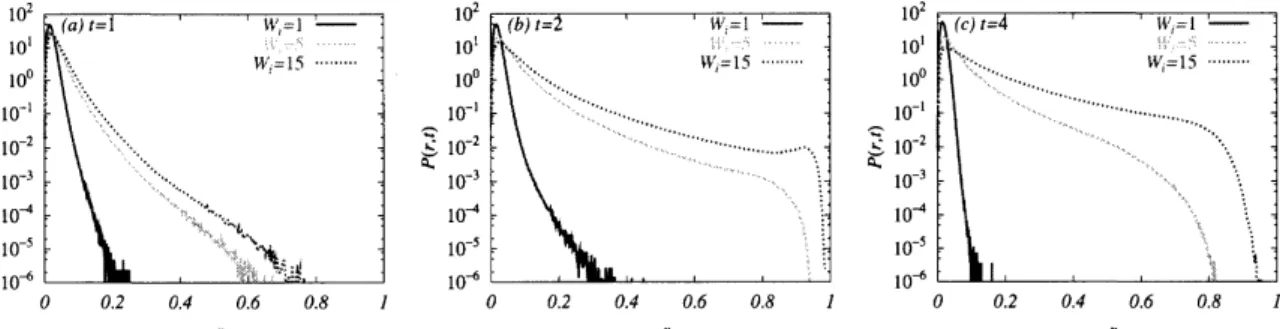
probability density function (PDF) for the dumbbell end-to-end distance $|R^{(n)}|$
.
These$0$ 0.2 0.4 0.6 $0.s$ $l$ $r$ $0$ 0.2 0.4 0.6 0.8 $l$ $r$ $0$ 0.2 0.4 0.6 0.8 $l$ $r$
Figure 4: $\eta$ effect on the temporal evolution of the polymer extension PDF $P(r, t);(a)$
$t=1,$ $(b)t=2$ and (c) $t=4$
.
$0$ 1 2 3 $\ovalbox{\tt\small REJECT}$ 5 6 7 8
$0$ 1 2 3 $\ovalbox{\tt\small REJECT}$ 5 6 7 8
$t$ $t$
Figure5: Variation of thetemporalevolution Figure 6: Variation of thetemporalevolution
ofmean extension $\langle|R|\rangle_{p}/r_{eq}$ against $\eta$
.
of reduction rate of$\epsilon(t)$ against $\eta$.
where $|R^{(n)}|$
was
normalized by $L_{mw}$.
Thecurves
in (a)were
almost thesame
irrespectiveof $\eta$ and the peak position located
near
zero, indicating the reaction to turbulencewas
almost negligible when $t\leq 1$
.
We could observe a lot ofstretched dumbbellsas
the timegoes on, where they were morestretched
as
decreasing$\eta$.
The reduction of the number ofstretched dumbbells with increase of$\eta$ is explained bythe fact that the velocity gradient
fluctuation is
more
suppressedas
$\eta$ increases,as
shown in Fig. 2. Figure 5 indicates thetimeevolutions of the
mean
dumbbellextensionnormalizedby$r_{eq}$.
Thecurve
obtainedbyRun $0$ represented that the passively advected dumbbells
were
more stretched thantwo-way
cases.
Thisobservationwas
almost consistent withthe resultsbyDNSof constitutiveequations [24, 27]. It is interesting to notice that the time $|R^{(n)}|$ approaches to their
maximum values is later than those for the energy dissipation rate $\epsilon(t)$ (Fig. 2).
We examined the percentagereduction rate of$\epsilon(t)$
.
This isdefinedby $1-\epsilon_{2way}/\epsilon_{1way}$.
The resulting
curves are
shownin Fig.6. More reductionswere
observedinthefinalperiodofdecay, irrespectiveof$\eta$
.
The reduction rate increased with increaseof$\eta$, suggestingtheintensity ofreaction bydumbbells became bigger
as
$\eta$ increased.4.2
Weissenberg number
effect
In this subsection, we examined the degree of turbulence modification by changing
Weis-senberg number $W_{l}$ under fixed $\eta(=0.1045)$
.
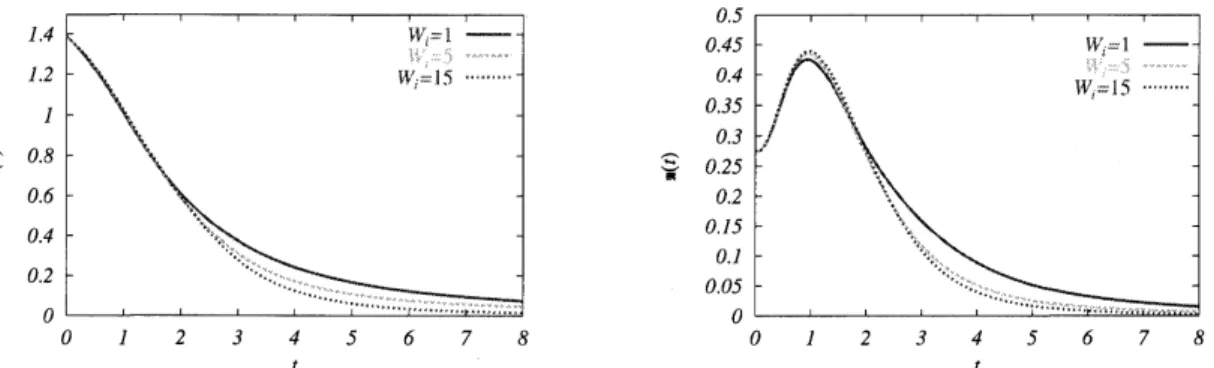
Figure 7 shows the temporal evolutions$0$ 1 2 3 4 5 6 7 8
$t$
$0$ 1 2 3 4 5 6 7 8
$t$
Figure7: $W_{i}$effectonthe temporal evolution Figure8: $W_{i}$effect onthe temporalevolution
ofthe kinetic energy $E(t)$
.
of theenergy dissipation rate $\epsilon(t)$.
$10^{0}$ $10^{1}$ $10^{0}$ $10^{1}$ $10^{0}$ $10^{1}$
$k$ $k$ $k$
Figure 9: Comparison of the behavior of the kineticenergy spectrum $E(k, t)$ obtained by
Runs Wl, El and W2; (a) $t=1,$ $(b)t=2$ and (c) $t=4$
.
almost collapsed on the same when $t<2$
.
Whilefor $t>2$, the larger $W_{i}$ cases decayedfaster than the smaller
ones.
Comparison of the temporal evolutions of the energydissi-pation rate $\epsilon(t)$ isshown in Fig. 8. MOre energy dissipationreduction in the
case
for thelarger $W_{i}$ could be clearly
seen
for $t>2$.
These facts suggest that the dumbbellswere
more
stretched for larger $W_{i}$, leading to themore
significant reactions.Weissenberg number effecton the spectral modification were examined by comparing
the behavior of kinetic energy spectrum $E(k, t)$ for various $W_{i}$
.
Figure 9 shows there-sulting
curves
for the cases (a) $t=1,$ $(b)t=2$ and (c) $t=4$.
As the time increased,the collapsing region
was
shrinking in the high wavenumber range. It should be notedthat W-dependence at $t=4$
was
very similar to the DNS results of FENE-P model with isotropic steady turbulence [28]. The spectral behavior at $t=4$ for $W_{i}=1$was
entirely different from that for $W_{i}=15$which had the
near
powerlaw decay in the wholewavenumber range. Because the turbulence adequately decayed while the
mean
elonga-tion of dumbbells had the maximum value around $t=4$, wethink the spectral dynamics
is dominatedbythe elastic nature of the ensemble ofdumbbellsratherthan the nonlinear
term ofNS equation. We may need
more
detailed analysis to draw the definite statementby investigating the transfer properties in the wavenumber space.
Comparison of the PDF behavior for the dumbbell elongation are shown in Fig. 10
for (a) $t=1,$ $(b)t=2$ and (c) $t=4$
.
Extension of dumbbells became largeras
$W_{i}$increased. For $W_{i}=15$, it was seen that there were a lot of dumbbells having more
$0$ 0.2 0.4 0.6 $0.s$ 1 $0$ 0.2 0.4 0.6 $0.s$ $l$ $0$ 0.2 0.4 0.6 $0.s$ $l$
Figure 10: $W_{1}$ effect
on
the temporal evolution$oi$the polymerextension PDF $P(r, t);(a)$$t=1,$ $(b)t=2$ and (c) $t=4$
.
$0$ $l$ 2 3 4 5 6 7 8 $0$ 1 2 3 4 5 6 7 8
$t$ $t$
Figure 11: Variation of the temporal evolu- Figure 12: Variation of the temporal
evolu-tionofmeanextension $\langle|R|)_{p}/r_{eq}$ against $W_{i}$. tionof reduction rate of$\epsilon(t)$ against $W_{i}$
.
shrunk toward equilibrium state. This was clearly seen in Fig. 11 where the temporal
evolutions ofthe
mean
end-to-end distance of dumbbell normalized by $r_{eq}$were
plotted.The
mean
extension for $W_{i}=1$was
near
$r_{eq}$ in the whole time region, while for $W_{i}=15$it sharply increased until $t=4$ and gradually decayed for $t>4$
.
Because the largerextensions of dumbbells
can
lead to the largereffectson
turbulence, it was plausible thatthe
more
energy dissipation reduction was observed for larger $W_{i}$.
The percentage ofenergy dissipation reduction rate
was
plotted in Fig. 12as
the function of$t$ for various$W_{i}$. The reduction rate becamelarger
as
$W_{i}$was
increased for$t>2$.
Thus we concludedthat the larger $W_{1}$ solution flow
was more
efficient reducer of the intensity of turbulentvelocity gradient fluctuations, being consistent with the results in [28].
5
Comparison of coherent
structures
The intuitive way to examine the impact of polymer additives
on
turbulence is tosee
the modificationofcoherent stmctures appeared in theturbulent field. Inthis section
we
investigate the$\eta$ and $W_{i}$effects on thevortical structures. Moreover the specffic character
offield structure in the polymer stress tensor is discussed.
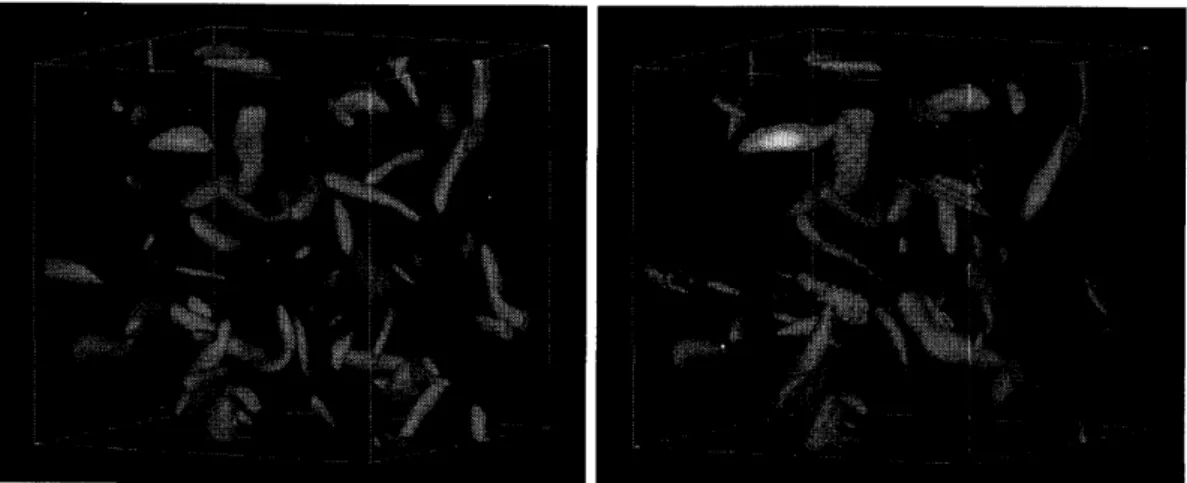
Figure 13 shows the comparisonofvortical structures obtained by Run$0$ and RunEl
at $t=3.5$, where they
were
visualized by using the second invariant $Q$ of the velocityFigure 13: Comparison of the iso-surface of $Q$ for $\eta=0$ (left: Run $0$) and $\eta=0.1045$
(right: Run El) at $t=3.5$
.
Iso-surface level is chosen by $Q/Q_{rms}=3$.
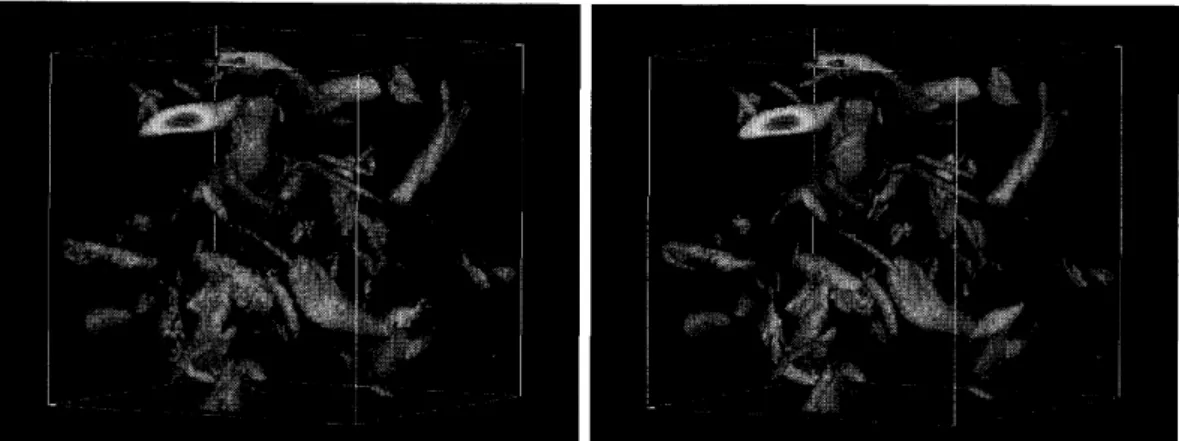
Figure 14: Iso-surface of the trace of polymer stress tensor $X=T_{ii}^{p}$ obtained by Run E2
at $t=3.5$
.
Iso-surface level is chosen by $X/X_{rms}=1.5$ (left) and $X/X_{rms}=6$ (right).indistinguishable each other, the generation of intense structures for Run El was
sup-pressed
more
than thecase
for Run $0$.
This factwas
consistent with the observation forthe reduction ofenergydissipationinFig. 2. Also the similar resultswere obtained in the
DNS studies of FENE-P equation [27, 29]
Figure 14 illustrates the iso-surface of the trace of the polymer stress tensor $T_{ii}^{p}$
ob-tained by Run E2 at $t=3.5$
.
Itwas
recognized that the region for the intermediateintensity of$T_{ii}^{p}$ had the peculiarsheet-like structures which nearly located among intense
regions of $Q(>0)$
.
While for the region oflarger value of $T_{ii}^{p}$ thefilament-like
structureswere
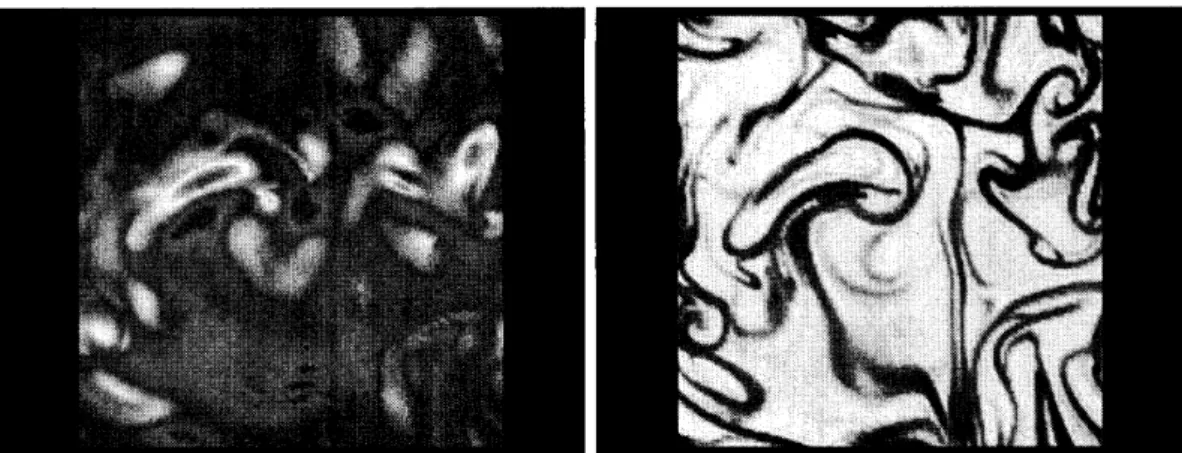
observed. Thus the characteristic structure of $T_{ii}^{p}$ is dependent on the intensityof fluctuation. Sheet-like stmctures could be clearly seen in Fig. 15 where the two
di-mensional slice of Fig. 14
were
visualized. This observation reminds us the sheet-likestructures observed in the scalar gradient field of the passive scalar turbulence. In fact,
the amplfficationmechanism ofscalar gradient vector is similar for that ofthe end-to-end
vector ofdumbbell. We need further analysis to clarify this observation by investigating
$=$ $=$ $=:::::_{=}:\cdot::\cdot=..\cdot.=.\cdot\cdot\cdot:_{:}:^{:^{:_{:}..:=}}$ . $:_{=}^{::}\S_{:}...\cdot\cdot..\cdot$ $:\cdot....:\cdot.\cdot.\cdot$ $.\dot{.}\cdot\cdot\cdot\ldots$
...
$\cdot\cdot=\cdot...\cdot\cdot:^{:.:\cdot\cdot:}:_{::\dot{:}4_{:}}^{:}::_{T_{:}\cdot:_{:}\sim:}.\cdot..\cdot$ . :. $=$ $=1.\cdot..::..$ ...
$\cdot$..$\cdot$..
$\cdot.$. $::^{:^{:}}:.:.\cdot\cdot\cdot:\cdot$ $:...:$ . ::.. :: :.:. $\cdot$ .::.$\cdot$..
$\cdot$Figure 15: Comparison of the $2D$ slice between $Q$ (left) and $T_{*i}^{p}$ (right) obtained by Run
E2 at $t=3.5$
.
$0$ 1 2 $3\ovalbox{\tt\small REJECT}$ 5 6 7 8 $10^{0}$ $10^{1}$
$t$
$k$
Figure 16: Comparison of the timeevolution Figure 17: Behavior of the dissipation
of$\epsilon(t)$ for Runs $L$, E2 and H. spectra$k^{2}E(k,t)$ obtained by Runs $L$, E2
and H.
6
Validation of assumption for
polymer
stress field
We assumed that there
were
many “replica” dumbbells to construct the polymer stressfield from dumbbell configurations because
we
need much larger computationalresources
to realize the reactions from the
enormous
number of dumbbells dispersed in the flowdomain. It is indispensable to know how many dumbbells
are
needed to realize theadequate results in the statistical sense. For this issue, in this section, we examined the
effects ofthe variation of$b$ and $\tilde{N}_{t}$ under fixed
$N_{t}$
.
The comparison of the
curves
for temporalevolutions of$\epsilon(t)$ for Runs $L$, E2 and $H$ isshown in Fig. 16. It
was
seen
that theywere
almost thesame.
Curves for the dissipationspectra $k^{2}E(k, t)$ are also shown in Fig. 17. The spectral behavior
was
indistinguishableexcept for the spectral tails. The deviation in the high wavenumber range may be
at-tributed to
an
insufficient number of dumbbells toobtain smooth variations of$T^{p}$on
thegrid scale. Figure 18 compares coherent vortices visualized using the iso-surface of the
second invariant $Q$ of the velocity grad\’ient tensor. Remarkable zig-zag structures
were
observed in the vortices for Run $L$ compared to Run $H$, although the entire trends of the
Figure 18: Comparison of iso-surface visualizations of vortical structures using $Q$ with
the level $Q/Q_{rms}=2.5$ (left: Run $L$, right: Run H) at $t=3.5$.
These results suggest that the “replica assumption” introduced for the evaluation of
$T^{p}$ works very well
as
faras
the large-scale natureofturbulence is concerned. However,
many
more
dumbbellsare
required for better prediction of the turbulence modfficationaround the Kolmogorov scale.
7
Conclusions
The parallel computations for turbulent polymer solution flow were performed by using the hybrid approach; Brownian dynamics simulation of polymer model (dumbbells)
cou-pled with the DNS of the NS equation. We examined the turbulence modification by
the
enormous
number ofdumbbells $(O(10^{9}))$ dispersed in decaying isotropic turbulence.As a result, we observed
a
significant energy dissipation reduction and energy spectrummodification inthe later stages ofdecaywhen the concentration ofpolymersor the
Weis-senberg number
was
increased. Thesewere
entirely consistent with the results of DNSusing
a
constitutive equation [27, 29].Visualizationofcoherent vortices usingthe secondinvariant $Q$ of$\nabla u$clarified thatthe
generation of intense vortices were suppressed by polymer additives. This
was
consistentwith the observation for the reduction of energy dissipation rate. We also showed that
the region having longer dumbbell extension had the sheet-likeor filament-like structures
located among intense vortices. This implies that the stretching polymers almost locate
in the $Q<0$ region which was dominated by the strain. This
was
consistent with theresults ofour previous studyin which the conditional
mean
distance ofpolymer chainon
$Q$ and $R$ had a large value in the region $Q<0,$$R>0[22]$
.
We found that the spectraltails
were
most affected by polymeradditives in which thedegree ofmodification
was
dependent on theparameters $b$and $\tilde{N}_{t}$, even though $N_{t}=b\tilde{N}_{t}$was
fixed. This naturewas
clearly confirmed by the visualization of vortical structures,where the smaller $\tilde{N}_{t}$ results had a rough surface
on
the vortices due to the insufficient
evaluationof $T^{p}$ ongrid scales.
The results obtainedin this studyrepresentthat thehybrid approachwith theparallel
we
used the dumbbell model for the long chainpolymer, it is interesting to introducemore
realistic polymer chain model having the hydrodynamic interaction or excluded volume
forces among beads [32]. Hybrid approach has agreat advantage for examining theeffect
of these extra forces
on
turbulence modification whose issue cannot be touched by theconstitutive equation. This would be the subject of future work.
T.W. and T.$G$’s work
was
partiallysupportedbyGrants-in-Aid for Scientific ResearchNos. 20760112 and 21360082, respectively, from the Ministry of Education, Culture,
Sports, Science, and Technology of Japan. T.W. thanks S. Uno and D. Sugimoto for
their assistances of making parallelized code. The authors thank the Theory and
Com-puter Simulation Center ofthe National Institutefor Fusion Science and the Information
Technology
Center
ofNagoya University for their computational support.References
[1] J. L. Lumley, J. Polymer Sci.: Macromolecular Reviews 7, 263-290 (1973).
[2] K. R. Sreenivasan and C. M. White, J. Fluid Mech. 409,
149-164
(2000).[3] I. Proccacia, V. S. $L$‘vov and R. Benzi, Rev. Mod. Phys. 80, 225-247 (2008).
[4] A. Groisman and V. Steinberg, Nature 410, 905-908, (2001)
[5]$\cdot$ T. Burghelea, E. Segre, and V. Steinberg, Phys. Rev. Lett. 92, 164501 (2004).
[6] P. E. Arratia, C. C. Thomas, J. Diorio, and J. P. Gollub, Phys. Rev. Lett. 96,
144502 (2006).
[7] A. Groisman and V. Steinberg, Nature 405, 53-55, (2000)
[8] T. Burghelea, E. Segre, and V. Steinberg, Phys. Rev. Lett. 96, 214502 (2006).
[9] Y. Jun and V. Steinberg, Phys. Rev. Lett. 102, 124503 (2009).
[10] N. T. Ouellette, H. Xu and E. Bodenschatz, J. Fluid Mech. 629, 375-385 (2009).
[11] A. Celani, A. Puliafito, and K. Turitsyn, Europhys. Lett. 70, 464-470 (2005).
[12] M. Chertkov, I. Kolokolov, V. Lebedev, and K. Turitsyn, J. Fluid Mech. 531,
251-260 (2005).
[13] S. Gerashchenko and V. Steinberg, Phys. Rev. Lett. 96, 038304 (2006).
[14] M. Chertkov, Phys. Rev. Lett. 84, 4761-4764 (2000).
[15] E. Balkovsky, A. Fouxon, and V. Lebedev, Phys. Rev. Lett. S4, 4765-4768 (2000).
[16] J-L. Thiffeault, Phys. Lett. A 308, 445-450 (2003).
[17] M. M. Afonso and D. Vincenzi, J. Fluid Mech. 540, 99-108 (2005).
[19] S. Gerashchenko, C. Chevallard, and V. Steinberg, Europhys. Lett. 71, 221-227
(2005).
[20] Y. Liu and V. Steinberg, Europhys. Lett. 90, 44005 (2010).
[21] P. G. De Gennes, J. Chem. Phys. 60, $503(\vdash 5042$ (1974).
[22] T. Watanabe and T. Gotoh, Phys. Rev. $E81$, 066301 (2010).
[23] R. B. Bird, C. F. Curtiss, R. C. Amstrong, andO. Hassager, Dynamics
of
PolymetricLiquids, Vol.2 Kinetic Theory, 2nd ed. (Wiley, NewYork, 1987).
[24] B. Eckhardt, J. Kronjager, and J. Schumacher, Comput. Phys. Commun. 147,
538-543 (2002).
[25] J. J. J. Gillissen, Phys. Rev. $E$ 78,046311 (2008).
[26] S. Tamano, M. Itoh, S. Hotta, K. Yokota, and Y. Morinishi, Phys. Fluids 21, 055101
(2009).
[27] P. Perlekar and D. Mitra and R. Pandit, Phys. Rev. Lett. 97,
264501
(2006).[28] P. Perlekar and D. Mitra and R. Pandit, Phys. Rev. $E82$, 066313 (2010).
[29] W.-H. Cai, D.-C. Li and H.-N. Zhang, J. Fluid Mech. 665, 334-356 (2010).
[30] G. Boffetta, A. Celani, and S. Musacchio, Phys. Rev. Lett. 91, 034501 (2003).
[31] S. Jin and L. R. Collins, New J. Phys. 9, 360 (2007).
[32] M. Doi and S. F. Edwards, The Theory
of
Polymer Dynamics, (Oxford University Press, New York, 1986).[33] M. Laso and H. C. Ottinger, J. Non-Newtonian Fluid Mech. 47, 1-20 (1993).
[34] P. A. Stone and D. Graham, Phys. Fluids 15, 1247-1256 (2003).
[35] V. E. Terrapon, Y. Dubief, P. Moin, E. S. G. Shaqfeh, and S. K. Lele, J. Fluid Mech.
504, 61-71 (2004).
[36] J. Davoudi and J. Schumacher, Phys. Fluids 18, 025103 (2006).
[37] T. Peters and J. Schumacher, Phys. Fluids 19, 065109 (2007).
[38] S. Yasuda and R. Yamamoto, Phys. Rev. $E81$, 036308 (2010).
[39] B. R. Elbing, D. R. Dowling, M. Perlin, and S. L. Ceccio, Phys. Fluids 22, 045102
(2010).
[40] H. J. Choi, S. T. Lim, Pik-Yin Lai and C. K. Chan Phys. Rev. Lett. 89,088302
(2002).
[41] P. K. Yeung and S. B. Pope, J. Comp. Phys. 79, 373-416 (1988).
[42] A. Prosperetti and G. Tryggvason (Eds.), Computational Methods