Determinants of primary school attendance in rural Tanzania:
An analysis of children in and out of school
Chihiro Kobayashi
(Graduate School of International Development, Nagoya University)
Abstract
This study aimed to investigate the determinants of rural primary school attendance in Tanzania among in- school (public school) children and out-of-school children (children who have never enrolled) based on the Uwezo Household Survey in 2012. In addition, the factors of school attendance were compared between cohort 1 (7- and 8-year-olds) and cohort 2 (13- and 14-year-olds) to see the difference in factors by age. Binary logistic regression was performed to identify the factors in school attendance. The results showed that both among cohort 1 and cohort 2, the most inluential factor was pre-school experience. Children who attended pre-school were approximately 2.8 times more likely to attend school in cohort 1. Furthermore, in the case of cohort 2, the probability of school enrollment increased 10 times over children who did not attend pre-school. From these results, it was found that pre-school experience has great potential to encourage not only younger children but also adolescents, on whom it has an even greater impact. Additionally, mother’s level of education and home language were found to be signiicant common variables, which have a relatively big impact on school enrollment. On the other hand, the gender of the child was signiicant only among cohort 1. Younger boys tended to enroll in school less than girls although the difference was not signiicant among adolescents. This might be related to the higher opportunity cost among younger boys. As these factor differences show, the characteristics of out-of-school children differ greatly by age. Therefore, the Tanzanian government needs to provide appropriate policies which take the age of out-of-school children into consideration.
1. Introduction
The world situation of access to education has improved greatly in the last 15 years following the World Education Forum held in Senegal and the implementation of the Millennium Development Goals (MDGs) in 2000. As a result of these international efforts to improve the educational situation worldwide, the primary Net Enrollment Ratio (NER) increased from 84% in 1999 to 93% in 2015. In other words, the number of children that begin attending school has increased by approximately 34 million since 2000 (UNESCO, 2015). The change in sub-Saharan African countries is particularly evident, with enrollment in these areas having increased by more than 20% (UNESCO, 2015). The number of out-of-school children decreased significantly from 1999 when approximately 204 million children were out of school (UNESCO, 2015). Therefore, most of these countries have experienced significant progress with regard to access to education, with some countries already attaining Goal 3 of MDG. However, although the enrollment ratio has increased signiicantly, there are still 58 million children out of school worldwide as of 2012 (UNESCO, 2015).
In the case of Tanzania, primary education began to garner attention through the Arusha Declaration by Nyerere in 1967. Following the Arusha Declaration, Nyerere proposed Education for Self-Reliance, which focused on the poor in urging that primary education
be available for the majority. Furthermore, in 1974, the government adopted the Musoma Declaration, and began to achieve Universal Primary Education (UPE) by obligating all citizens between 7 and 13 years of age to attend school. In 2001, the Primary Education Development Program I (PEDP I) was implemented, which included policy to eliminate primary school tuition fees. These strong efforts have been made thus far to make education more accessible, including the increase of the NER from 51% to 82% between 1990 and 2013 (World Bank, 2016). However, according to the Population of Housing Census in Tanzania, 8,599,284 (23.3%) had never enrolled in school among children of ive years and above as of 2012 (Ministry of Finance, 2015). Therefore, it is crucial to research out-of-school children in order to tackle this problem and achieve UPE in Tanzania. However, although inding the causes that perpetuate the problem of children being out of school is important, exhaustive searches have yielded severely limited data in regard to out-of-school children, while a plethora of research has been conducted concerning in-school children.
According to the Global Monitoring Report, there are three categories of out-of-school children; 1) those who will eventually go to school, 2) those who will never go, and 3) those who enrolled but left (UNESCO, 2015). In this research, it was not possible to distinguish the children who will eventually go to school based on the Uwezo survey. Additionally, it was not possible to categorize the duration of schooling years among children who had dropped out because the number of responses to that question were too insufficient to statistically analyze in the Uwezo survey. Therefore, this research dealt only with children who have never enrolled, as far as the out-of-school children category is concerned. It focused on rural areas because of the high concentration of never-enrollees in rural areas (92%) compared to urban areas (8%), according to the dataset from Uwezo Household Survey 2012. It is obvious that the problem of never enrollees is more serious in rural areas. Moreover, since it was found that only approximately 2% of children in rural areas attend private schools, it is safe to conclude that most school children in rural Tanzania attend public schools. For this reason, the decision was made to focus solely on public school children as in-school children.
In this paper, the factors that influence rural school attendance both among in-school (public school) children and out-of-school children (children who have never enrolled) were investigated based on the 2012 Uwezo Household Survey in Tanzania. In addition, the factors in school attendance were compared between cohort 1 (7- and 8-year-old children) and cohort 2 (13- and 14-year-old children). The reason for comparing two different age cohorts was because the characteristics of never-enrolled children in lower age groups and upper age groups are thought to be different. According to Nishimura (2007), in-school children in the upper grades are often from relatively wealthy families as they can survive without dropping out. Thus, the characteristics of children in the upper grades are very different from those of lower grade children. Similarly, since only 59% of the children enter school at their oficial schooling age in Tanzania (Joshi & Gaddis, 2015), a great part of the younger children who
have not yet enrolled might turn out to be future late enrollees. On the other hand, children in the upper age group are mostly will never-enrollees who are often categorized as “last 10% children.” Thus, it is possible to anticipate that enrollment factors differ by the age of the children.
In order to attain the objectives mentioned above, two research questions were established as follows: 1) What factors influence the school attendance of public school children and children who have never enrolled and 2) how are the factors that affect school attendance different between lower age children and upper age children. This study reines the research about the determinants of school attendance, between in-school children and out-of-school children. Since there is little research focusing on out-of-school children, this study opens the door for more precise research concerning these children, particularly never- enrollees that have not been thoroughly investigated by researchers to date. Furthermore, this research will contribute to identifying the difference in school attendance determinants by age, which is something that has not previously been focused on.
2. Literature Review
2.1. Factors inluencing school attendance
Although Tanzania has attained a high enrollment ratio, there are still children who have never attended school. Let us examine the perceived underlying factors. The enrollment decision is inluenced by both the supply-side, i.e., school factors, and the demand-side, i.e., individual factors and family factors. There are many different arguments concerning which factors are the most signiicant for school attendance in different countries. In this research, only demand-side factors (individual factors and family factors) were discussed.
(1) Individual factors Child’s gender
The gender of the child greatly influences school attendance (Guimbert, Miwa, & Nguyen, 2008; Ngware et al., 2009; Rolleston, 2009; Hoogeveen & Rossi, 2011; Alcott & Rose, 2015; Gonsch, 2016). Based on the research in 80 countries by the UNESCO Institute for Statistics, for every 100 boys who do not attend school, there are 117 out-of-school girls. In particular, there are more out-of-school girls in the Middle East, North Africa, and South Asia (UNESCO Institute for Statistics, 2005). For example, in Pakistan, daughters had less probability of entering and graduating from primary school than sons (Sawada & Lokshin, 2001). On the other hand, research shows the opposite trend in Tanzania where girls have greater opportunities to attend school. Hoogeveen and Rossi (2011) explain that the reason for higher enrollment among Tanzania females is the lower opportunity cost, which means a person gives up a potential gain in order to take another course of action, for girls than boys, particularly in rural areas.
Pre-school experience
Pre-school experience is an important factor in school attendance (No & Hirakawa, 2014). According to research that investigated the impact of early childhood education in rural Mozambique, attending pre-school increased primary school enrolment by 5.8 percentage points (Martinez, Naudeau, & Pereira, 2012). It also had a positive inluence on the child’s school completion ratio (Reynolds et al., 2007), because the pre-school experience improved school readiness and early school success (Rumberger & Lim, 2008). Therefore, pre-school experience improved school performance as well as reducing the dropout ratio (No & Hirakawa, 2014).
(2) Family factors
Gender of the head of household
Another influential factor in school attendance is the gender of the head of household. According to research by Rolleston (2009), children whose household head is female are more likely to attend school than children whose household head is male, in the case of Ghana. Bruce and Lloyd (1996) mention that females are more likely to spend more of the household budget on children than males. Also, mothers usually spend more time with their children than fathers, taking care of them and supporting them emotionally (Bruce, Lloyd, & Leonard, 1995). On the other hand, Katapa (2005) concluded that a female-headed household tended to be at a disadvantage to a male-headed household regarding wealth, food, assets, and the number of adult men, in the case of Tanzania.
Age of the head of household
The age of the head of household has an impact on school attendance (Kabubo & Mwabu, 2007; Ngware et al., 2009; Gonsch, 2016). According to research in Kenya by Kabubo and Mwabu (2016), older heads of household were more likely to send their children to school than younger heads of household. The reason for this is that older parents are more likely to know and appreciate the importance of education, and thus they inluence their children to stay in school (Okumu, Nakajjo, & Isoke, 2008).
Home languages
The language spoken in the home is another determinant of schooling decisions. According to the Global Monitoring Report 2014, being born in minority ethnic or linguistic groups seriously influenced not only the probability of school enrollment but also the chance of learning (UNESCO, 2014). For example, in the case of Afghanistan, the probability of enrollment of Pashto speakers was 10% lower than Dari speakers. The reason for low probability of school enrollment among Pashto speakers may be a lack of schools where teachers conduct classes in their mother tongue (Guimbert, Miwa, & Nguyen, 2008). Therefore, in countries like Tanzania, which has 128 minority languages (Petzell, 2012), children who speak minority languages might be impacted to some extent.
Occupation of the head of household
The occupation of the head of household is associated with schooling decisions. According to Sawada and Lokshin (2001), children whose parents’ occupations were business-related or civil service-oriented had the highest probability of attending school. On the other hand, the parents’ occupation had a negative effect on children born into farming or cattle herding households, and these children were less likely to enroll in school (Al-Samarrai & Peasgood, 1998; Huisman & Smits, 2009; Rolleston, 2009; Onphanhdala, 2010). Al-Samarrai and Peasgood (1998) explain that this may be due to the high opportunity cost of children’s labor, in farming households. Household engaging in jobs like farming or cattle herding are more likely to require human resources.
Parents’ education level
The level of education of the parents is another factor affecting school attendance, and children with more educated parents are more likely to enroll in school (Al-Samarrai & Peasgood, 1998; Suliman & El-Kogali, 2005; Kabubo & Mwabu, 2007; Huisman & Smits, 2009; Ngware et al., 2009; Onphanhdala, 2010; Olaniyan, 2011; Alcott & Rose, 2015; Gonsch, 2016). Sawada and Lokshin (2001) infer that educated parents are more likely to recognize the beneits of education than those who are not educated because they can see the returns from education more clearly. Moreover, research by Chevalier (2004) indicates that the mother’s education level had more impact on children than the father’s education level because mothers usually spend more time with their children than fathers.
Number of children
Another factor in school attendance is the number of children in the household. According to researchers, children who have many siblings are less inclined to enroll in school (Al- Samarrai & Peasgood, 1998; Kabubo & Mwabu, 2007; Olaniyan, 2011; Alcott & Rose, 2015; Gonsch, 2016). Alcott and Rose (2015) mention that the number of children in a household can affect the resources available per child. Therefore, as the number of children increases, the more widely they have to spread resources, thus making it more dificult for the parents to send them to school (Alcott & Rose, 2015).
Household wealth
Many researchers claim that household wealth is one of the important determinants affecting school attendance, as children who are out of school tend to be from poor households (Kabubo & Mwabu, 2007; Huisman & Smits, 2009; Ngware et al., 2009; Olaniyan, 2011; Gonsch, 2016). Even if free primary education is implemented, attending school still incurs direct costs such as books and uniforms. Furthermore, sending children to school is also associated with the opportunity cost of children not being able to help at home (Huisman & Smits, 2009). Thus, children from poor households are less likely to enroll in school.
A child with disability within the family
Disability is one of the most dificult factors to see and one of the most inluential factors
in educational marginalization. Children with disabilities are often categorized amongst the 5% of children who are least likely to receive education (Tesemma, 2011). Only 0.35% of all children in primary school were children with disabilities in 2011 (UNICEF, 2016). This is partly due to a lack of regard for the needs of children with disabilities in teacher education and school curricula, and insuficient school facilities for children with disability (Ministry of Labour, Youth Development and Sports, 2004). Although education is one of the essential means to change many other areas of life for people with disabilities, they have the least access to education (Tesemma, 2011).
Parental support for education
Primary school attendance is decided by the parents in most cases and their attitude towards education determines the chance of a child’s enrollment (Chimombo et al., 2000). In the case of India, children whose parents do not value and understand education tend to be out-of- school (Boyle et al., 2002). Therefore, whether parents are supportive for education or not is one of the key factors of school enrolment.
3. Methods 3.1. Dataset
In this research, the analysis was conducted based on the Uwezo Household Survey 2012, which was the third annual assessment conducted by Uwezo in Tanzania. “Uwezo” means capability in English, and is a part of Twaweza, which is an independent East African initiative. Uwezo conducts citizen-led household-based assessments in order to gauge children’s actual learning abilities (Uwezo, 2014). Uwezo’s surveys were conducted in households, villages, and schools across the East African countries: Kenya, Uganda, and Tanzania. Uwezo conducted two-stage cluster sampling in order to gain a representative sample from the enumeration areas and households. Firstly, probability proportion to size was conducted to randomly select the 30 enumeration areas. Secondly, from these enumeration areas, households were selected systematically. The household surveys were aimed at children between 7 and 16 years of age on a household basis. The 7,560 Uwezo volunteers collected data by walking door-to-door, which enabled them to collect not only the data of in-school children but also of those children who are out of school (Uwezo, 2013). Therefore, unlike school surveys and outcome assessments by other organizations, which cannot include out-of- school children, Uwezo data include both dropouts and children who have never enrolled. The Uwezo household survey in 2012 was conducted in four rounds between June 5th and July 19th. The sampling process of the Uwezo survey comprised random sampling so that the results of the survey can be generalized nationwide. It assessed 104,568 children in total, between 7 and 16 years of age, including both school children and out-of-school children. Additionally, the survey was conducted in 55,191 households, 126 districts, and 3,624 schools (Uwezo, 2013).
3.2. Analytical framework
This research conducted a binary logistic regression analysis using IBM SPSS Statistics Base 23 along with IBM Regression 23. Binary logistic regression is used when the dependent variable is a dichotomous variable. In this case, the schooling status (dependent variable) had two different categories: attending school or not attending school. Therefore, binary logistic regression was considered an appropriate method of analysis. The independent variables used in this research were categorized into two groups: 1) individual factor variables and 2) family factor variables (see Table 1). School factor variables were not included in this research as they are irrelevant when discussing children who have never attended school. The impact of the individual factors and family factors on school attendance among public school children and children who have never enrolled were predicted among two age cohorts, a 7- and 8-year- old group and a 13- and 14-year-old group in order to compare the difference in enrollment factors by age.
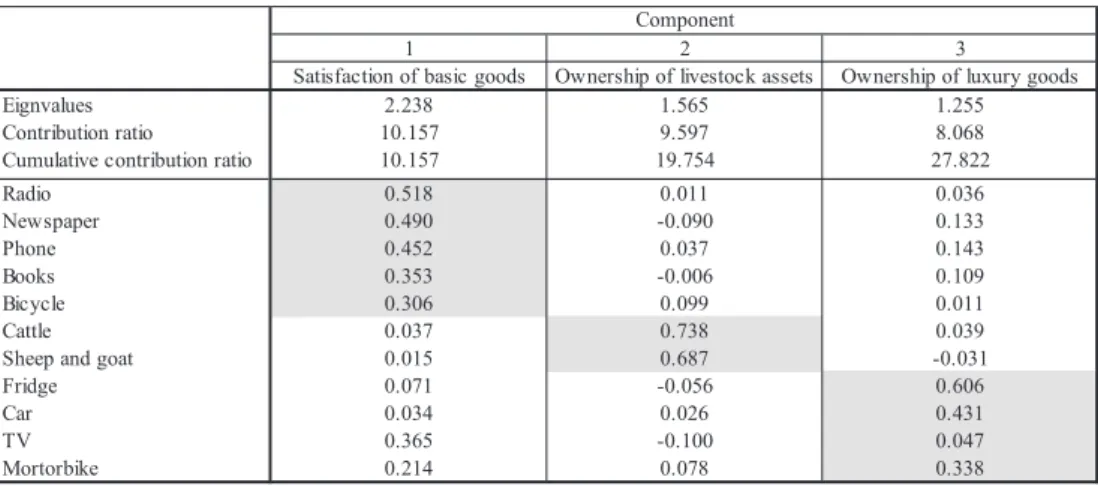
In this research, wealth index was used as an independent variable. In the Uwezo household survey, household income was not included in the questionnaire. One reason for this might be that it is dificult for people to provide their speciic amount of income, particularly for those who do not have monetary income. Therefore, this research calculated the wealth index based on the types of household assets they had. As Table 2 illustrates, the factor analysis with varimax rotation was conducted on 11 household items (cattle, sheep and goats, radio, newspapers, phone, books, bicycle, fridge, TV, car, and motorbike). As a result, three components were extracted. The cumulative contribution rate of these three components was 27.822. The eigenvalues before the rotation were 2.238 among the first component, 1.565 among the second component, and 1.255 among the third component.
Table 1: Variables
The irst component was referred to as satisfaction of basic goods since the ownership ratio of the second component was higher than the ownership ratio of the other two components, as Table 3 shows. In other words, the irst component denotes whether the household of the child meets the average level of wealth or not. The second component was referred to as livestock assets because it constituted cattle, sheep, and goats. Based on Table 3, it was clear that the ownership ratio of the third component was the lowest. Thus, it is reasonable to assert that the assets of the third component were ownership of luxury goods that only the well-off can afford. Therefore, the third component was referred to as ownership of luxury goods. In this research, the irst component (satisfaction of basic goods) was used as a wealth index.
Table 2: Creating Wealth Index
Table 3: Percentage of Assets Ownership Ratio
3.3. Model of binary logistic legression
For the analysis of binary logistic regression, the school attendance (0 = have never enrolled, 1 = enrolling) was used as the dependent variable. The independent variables of the individual factor variables were the gender of the child and pre-school attendance. Family factor independent variables comprised the gender of the head of household, age of the head of household, home language, occupation of the head of household, level of education of the mother and father, number of children aged 7 to 16, wealth index (satisfaction of basic goods), a child with disability within the family, and parental support for education. For the analysis, this study used the following model:
Where α is the intercept, X1 refers to a vector of individual factors, X2 refers to a vector of family factors, and ε is the error term. The equation is estimated using logistic regression.
3.4. Sample
In the analysis, girls and boys aged 7 and 8 were categorized as cohort 1 while children aged 13 and 14 comprised cohort 2. These children included both in-school (public school) children and out-of-school children (children who have never enrolled). In the process of deciding what ages the cohorts should represent, comparing the characteristics of the lower and higher grades was required. The oficial school-age in Tanzania is 7 to 13 years old. However, in developing countries, where many children enter school later than the oficial school starting age or often repeat a grade, there are many children whose ages do not correspond to the oficial grade age. Therefore, the age range between grade 1 and grade 7 was examined to understand the distribution of age. As a result, it was found that 7- and 8-year-olds comprised the largest portion of grade 1 students while 13- and 14-year-olds comprised the largest portion of grade 7 students. Therefore, in this research, children who attend public primary school and children who have never enrolled between 7 and 8 years old (cohort 1) and 13 and 14 years old children (cohort 2) were chosen as the representatives of lower and higher age children respectively.
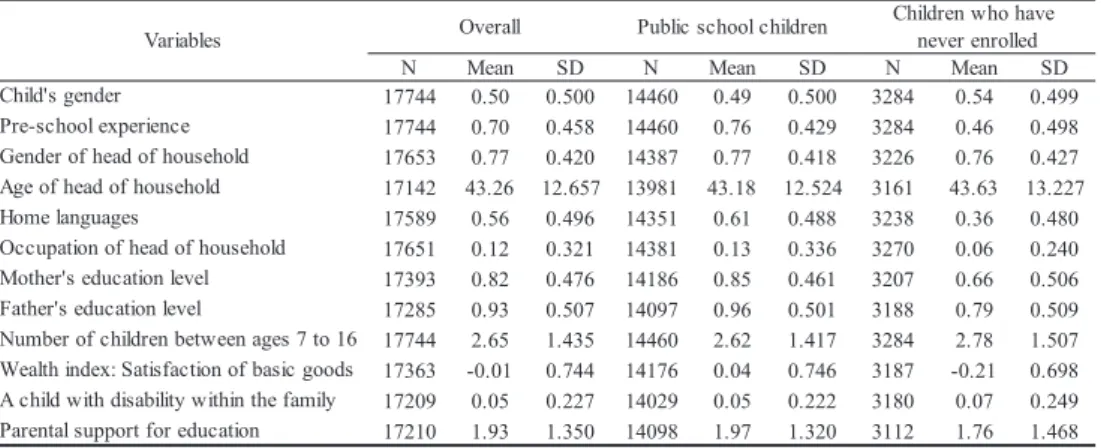
Tables 4 and 5 show the descriptive statistics of cohort 1 and cohort 2. The total number of children in cohort 1 (7- and 8-year-olds) was 17,744 while that in cohort 2 (13- and 14-year-olds) was 15,546. These numbers did not include children who have dropped out or children who attend private schools.
4. Results
In this section, the results of analysis of the school enrollment determinants between children attending public school and children who have never enrolled are drawn up for cohort 1 and cohort 2.
4.1. Cohort 1 (7- and 8-Year-Olds)
According to Table 6, nine variables were identiied as signiicant factors. Signiicant factors among cohort 1 were: pre-school experience, home language, mother’s education level, wealth index, the child’s gender, parental support for education, occupation of the head of household,
Table 5: Descriptive Statistics of Cohort 2 Table 4: Descriptive Statistics of Cohort 1
these factors, pre-school experience and home language had a particularly strong positive impact on school enrolment at an odds ratio of 2.830 and 2.134 respectively. This means that a child who attended pre-school was approximately 2.8 times more likely to attend school, and one who spoke Swahili or English was approximately 2.1 times more likely to attend school than those children who did not attend pre-school or who spoke ethnic languages at home. Although their odds ratios were not as high as these two variables, mother’s education level and household occupation had relatively high impacts on schooling decisions. The results indicate that a higher level of maternal education or non-primary industry parental occupation tends to increase the probability of school attendance by approximately 1.4 times.
4.2. Cohort 2 (13- and 14-Year-Olds)
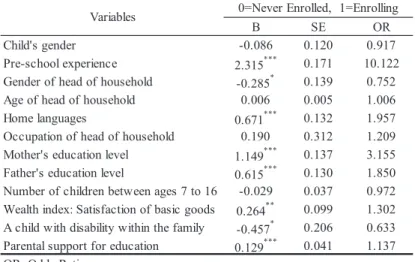
Table 7 indicates the signiicant variables among cohort 2 (13- and 14-year-olds). Based on the results, there were eight variables that were statistically signiicant. They were pre-school experience, mother’s education level, home language, father’s education level, parental support for education, wealth index, a child with disability within the family, and gender of the head of household. Regarding cohort 1, pre-school experience had by far the strongest positive influence on school enrollment at an odds ratio of 10.122, followed by mother’s education level at 3.155. These results revealed that children who attended pre-school were 10 times more likely to attend school, which was the strongest factor among all those dealt with in this research. Moreover, a unit increase in the level of mother’s education, such as from no education to primary school, was associated with a three times’ increase in the probability
Table 6: Results of Cohort 1
of school attendance. Additionally, home language, father’s education level, and a child with disability within the family also had major impacts on the school attendance decision (odds ratio of 1.957, 1.850, and 0.633 respectively). The possibility of a child receiving schooling was doubled if s/he spoke English or Swahili or had a more educated father. On the other hand, having a child with disability within the family had a negative influence on school enrolment.
5. Discussion
5.1. Common factors in school attendance among cohort 1 and cohort 2
According to the results of binary logistic regression, it was discovered that the common determinants of school attendance between cohort 1 and cohort 2 were as follows: 1) pre- school experience, 2) mother’s education level, 3) home language, 4) wealth index, 5) a child with disability within the family, and 6) parental support for education. These factors had effects on school attendance regardless of the children’s age.
Firstly, both in cohort 1 and cohort 2, pre-school experience proved to be the most inluential factor regarding the likelihood of attending school. These results explain that if the child attends pre-school, the probability of attending public school also increases. These results were consistent with research by Reynolds et al. (2007) and Rumberger and Lim (2008), who found that pre-school experience had a positive impact on children’s school attendance because pre-school experience prepared children for school. The interesting point in this research was that the impact of pre-school experience on cohort 2 was approximately
Table 7: Results of Cohort 2
school will strongly inluence their primary school enrolment, particularly among adolescents. This research has revealed that pre-school attendance has a great potential to increase the possibility of primary school enrollment among late entry adolescents.
Secondly, mother’s education had an impact on school attendance both among lower age and higher age children. Based on the results, children who had a more educated mother were more inclined to attend school than children who had a less educated mother, which was consistant with Suliman and El-Kogali (2005), Kabubo and Mwabu (2007), Huisman and Smits (2009), Onphanhdala (2010), and Alcott and Rose (2015). As with the results of Chevalier (2004), these results show that mother’s education level was more important than father’s education level. Furthermore, it found that the inluence of mother’s education was greater among cohort 2 than cohort 1.
Thirdly, home language was another common influential determinant of school attendance among cohort 1 and cohort 2. According to the results, children who speak non- ethnic languages, in other words, children who speak Swahili or English were more likely to attend public school. These results were consistent with claims previously made by Guimbert, Miwa, and Nguyen (2008). Descriptive statistics (Tables 4 and 5) show that the percentage of never-enrolled children who speak Swahili or English in both cohort 1 and 2 was only slightly over 30%, while the percentage of children who speak ethnic languages was approximately 70%. In Tanzania, the national language is Swahili, and the oficial language is English, but there are also 128 ethnic languages (Petzell, 2012). The medium of instruction in primary education is Swahili except in some private schools where the medium of instruction is English. As a result, children who speak a minority language at home tend to struggle in school with a language they are not used to. There was no major difference in the magnitude of impact between cohort 1 and cohort 2.
Fourthly, one of the common determinants of school attendance was the wealth index (satisfaction of basic goods). This variable can be described as whether or not the child’s household meets the standard wealth or not. Children who had basic goods such as a radio, newspapers, phone, books, and bicycle were more likely to enroll in school based on the result. This result was consistent with researchers such as Kabubo and Mwabu (2007), Huisman and Smits (2009), Ngware et al. (2009), Olaniyan (2011), and Gonsch (2016). This outcome demonstrated that children need to have a certain level of wealth in order to attend school. Although free primary education has been introduced since 2001, some amount of money is still required (to pay for school uniforms and the cost of school materials) to attend school (Dennis & Stahley, 2012). Therefore, children who cannot meet the standard, in short, children from extremely poor households, still did not have access to education.
Finally, parental support for education was found to be a statiscally significant determinant of school enrollment both among cohort 1 and cohort 2 in this study. As researchers such as Chimombo et al. (2000) mentioned, most of the decision to enroll children in school is determined by parents in the case of primary school. Therefore, children whose
parents were supportive of education were found to be more likely to attend school. However, the impact of this variable was very small among both cohorts.
5.2. Different factors of school attendance between cohort 1 and cohort 2 (1) Signiicant variables only among cohort 1
According to the results, there were three factors that were statistically significant only among cohort 1. These were child’s gender, occupation of the head of household, and number of children in the household. Contrary to many studies that have concluded that females are less likely to attend school (Guimbert, Miwa, & Nguyen, 2008; Rolleston, 2009; Gonsch, 2016), this research discovered that females tended to attend school more than males in the younger age cohort. This result was consistent with research in Tanzania by Hoogeveen and Rossi (2011), who discovered that 7-year-old females tend to enroll more in school because they have less opportunity cost than males. Additionally, girls are already monetarily and physically more ready to enroll in school by the age of 7 (Hoogeveen & Rossi, 2011). As they mentioned, it seems that girls have a lower opportunity cost than boys, particularly in rural areas, and thus they enrolled in school more than males. Additionally, this research found that a child’s gender does not matter among the older age children (cohort 2).
The occupation of the head of household was signiicant only in cohort 1, and children from households engaged in primary industry occupations were less likely to attend school. The reason for this can be attributed to the characteristics of primary industry occupations, which require more human power than other occupations. Many households that engage in primary industry occupations depend on their children for help when they are busy, such as at harvest time (Mulkeen, 2005).
Schooling decisions were inluenced by the number of children in the household. As in research by Al-Samarrai and Peasgood (1998), Kabubo and Mwabu (2007), Olaniyan (2011), Alcott and Rose (2015), and Gonsch (2016), the number of children in the family impacted the school enrolment negatively although the magnitude of the inluence was very small. This result can be considered to be caused by the decrease in resource availability per child due to an increase in the number of children in the family. The reason for non-signiicance of the number of children in cohort 2 might be the reduction in resource share and childcare. There is a possibility that as a child’s age increases, their younger brothers and sisters do not need so much care, while their older brothers and sisters will generate income by themselves by working.
(2) Signiicant variables only among cohort 2
The factors that were only signiicant among cohort 2 (13- and 14-year-olds) were father’s level of education and gender of the head of household. According to the results, children who had a more educated father were more likely to attend school among the older age children, whereas it was not signiicant among younger age children. These results can be explained
interaction with their mothers, sisters, and female relatives until approximately ive years of age for boys, and until adolescence for girls (Kimambo & Temu, 1969). When they reach the age of 13 or 14, they tend to spend time with their fathers as well, and thus the inluence of the father becomes signiicant in cohort 2. However, the magnitude of the impact of mother’s education level was still greater than that of father’s education level.
Gender of the head of household had an impact on children’s school enrollment only among cohort 2. The results show that children who had a male head of household tended to attend school more than children with a female head of household. The results were consistent with Katapa (2005) that female-headed households are less advantaged than male-headed households. The point is that the gender of the head of household was only signiicant among cohort 2. This implies that children who have never enrolled even at 13 and 14 years of age tend to belong to female-headed households, which are often very poor in money and food.
6. Conclusion
This research aimed to investigate the factors affecting school attendance of public school children and children who had never enrolled in cohort 1 (7- and 8-year-olds) and cohort 2 (13- and 14-year-olds) in Tanzania based on the Uwezo Household Survey 2012. Moreover, the determinants of school attendance were compared between cohort 1 and cohort 2 in order to understand the different enrollment factors by age.
The result, which was reached using binary logistic regression, showed that the common factors that particularly inluence school attendance both among cohort 1 and cohort 2 were pre-school experience, mother’s education level, home language, wealth index, a child with disability within the family, and parental support for education. Among these variables, the most inluential factor was pre-school experience. Although pre-school experience was the strongest factor for both cohort 1 and cohort 2, the magnitude of the impact was by far greater in cohort 2. This implies that pre-school experience has a great potential to reduce the number of older never-enrollees. The factors that were only signiicant among cohort 1 were child’s gender, occupation of the head of household, and number of children in the household. Girls were found to have less opportunity cost compared to boys when they are young, such as at 7 and 8 years of age. Thus, girls in cohort 1 were more likely to attend school. Factors such as father’s education level and gender of the head of household were only signiicant among cohort 2. When children are young, they tend to spend more time with their mothers. However, when they reach adolescence, they are also inluenced by the father, although the impact of mother’s education level was greater both among cohort 1 and cohort 2.
From these results, it is possible to recommend that the Tanzanian government focus more on pre-primary education because this factor had a greater impact on enrollment than any other factor. In particular, the greater impact on cohort 2 (13- and 14-year-olds) means that pre-primary education had great potential to reduce the 5% of children who have extreme difficulties in attending school. Since current pre-primary enrollment rate is still
approximately 70%, it is significant to increase the opportunity for children to attend pre- primary school. Another suggestion is that the government should pay particular attention to younger age boys because they are less likely to attend school due to the high opportunity cost, although this did not have any impact on male adolescents. In order to prevent boys from late entry, the government needs to focus more on younger boys to encourage them to enter school on time.
Through this study, the supply-side factors (school factors) were not taken into account when conducting the analysis. However, some supply-side factors such as distance to school from home and the number of female teachers are significant because school enrollment decisions are influenced by both demand and supply-side factors. Therefore, research into school attendance that includes supply-side factors should be conducted in the future.
Acknowledgement
I would like to express my deepest appreciation to Uwezo for providing the data-set. This research would not have been possible without it.
References
Alcott, B. & Rose, P. (2015) Schools and learning in rural India and Pakistan: Who goes where, and how much are they learning? Prospects, 45(3), 345–363.
Al-Samarrai, S. & Peasgood, T. (1998) Educational attainments and household characteristics in Tanzania. Economics of Education Review, 17(4), 395–417.
Boyle, S., Brock, A., Mace, J. & Sibbons, M. (2002) Reaching the poor - The ‘costs’ of sending children to school. The Policy Division of the Department for International Development.
Bruce, J. & Lloyd. C. B. (1996) Finding the ties that bind: Beyond headship and household. In L. Haddad, J. Hoddwitt & H. Alderman (Eds.), Intrahousehold resource allocation in developing countries: Methods, models and policy. Baltimore: John Hopkins University Press.
Bruce, J., Lloyd, C. B. & Leonard, A. (1995) Families in focus: New perspectives on mothers, fathers, and children. New York: The Population Council.
Chevalier, A. (2004) Parental education and child’s education: A natural experiment. Forschungsinstitut Zur Zukunft Der Arbeit Institute for the Study of Labor, (1153), 1–44.
Chimombo, J., Chibwanna, M., Dzimadzi, C., Kadzamira, E., Kunkwenzu, E., Kunje, D. & Namphota, D. (2000) Classroom, school and home factors that negatively affect girls education in Malawi. Center for Educational Research and Training.
Dennis, C. & Stahley, K. (2012) Universal primary education in Tanzania: The role of school expenses and opportunity costs. Evans School Review, 2(1), 47-65.
Gonsch, I. (2016) Determinants of primary school enrollment in Haiti and the Dominican Republic. Center for International Development and Environmental Research, 54.
Guimbert, S., Miwa, K. & Nguyen, D. (2008) Back to school in Afghanistan: Determinants of school
Hoogeveen, J. & Rossi, M. (2011) Saving goat and cabbages? -Enrollment and grade achievement after the introduction of free primary education in Tanzania. Center for the Study of African Economics. Huisman, J. & Smits, J. (2009) Effects of household- and district-level factors on primary school
enrollment in 30 developing countries. World Development, 37(1), 179–193.
Joshi, A. & Gaddis, I. (2015) Preparing the next generation in Tanzania. Washington, DC: World Bank. Kabubo, J. & Mwabu, D. (2007) Determinants of school enrolment and education attainment: Empirical
evidence from Kenya. The South African Journal of Economics, 75(3), 572–593.
Katapa, R. (2005). A comparison of female- and male-headed households in Tanzania and poverty implications. Journal of Biosocial Science, 38(3), 327.
Kimambo, I. & Temu, A. (1969) A History of Tanzania. Evanston, IL: Northwestern University Press. Martinez, S., Naudeau, S. & Pereira, V. (2012) The promise of preschool in Africa: A randomized
impact evaluation of early childhood development in Rural Mozambique. The World Bank Group
& Save the Children.
Ministry of Finance, National Bureau of Statistics (2015) Literacy and education monograph. Dar es Salaam: Ministry of Finance, National Bureau of Statistics.
Ministry of Labour, Youth Development and Sports (2004) National policy on disability. Dar es Salaam: Ministry of Labour, Youth Development and Sports.
Mulkeen, A. (2005) Teachers for rural schools: A challenge for Africa. Africa Region World Bank. Ngware, M., Oketch, M., Ezeh, A. & Mudege, N. (2009) Do household characteristics matter in
schooling decisions in urban Kenya? Equal Opportunities International, 28(7), 591–608.
Nishimura, M. (2007) Tojokoku ni okeru kyoikuhyoka ni kansuru rironteki hikakukenkyu –Kokusai gakuryoku chousa, gakkou chousa, setai chousa no shiten- [A theoretical comparative analysis on educational evaluation in developing countries: Perspectives of international student assessment, school survey, and household survey.] Japanese Journal of Evaluation Studies, 7(1), 47–59. No, F. & Hirakawa, Y. (2014). Identifying causes of dropout through longitudinal quantitative analysis
in rural Cambodian basic schools. Journal of International Development and Cooperation, 19(1), 25–39.
Okumu, I., Nakajjo, A. & Isoke, D. (2008). Socioeconomic determinants of primary school dropout: The logistic model analysis. Kampala: Economic Policy Research Center.
Olaniyan, O. (2011) The determinants of child schooling in Nigeria. African Economics Research Consortium.
Onphanhdala, P. (2010) Revisiting the determinants of primary school enrolment in Lao PDR. Journal of International Cooperation Studies, 18(1), 1-19.
Petzell, M. (2012) The linguistic situation in Tanzania. University of Gothenburg.
Reynolds, A., Temple, J., Ou, S., Robertson, D., Mersky, J., Topitzes, J. & Niles, M. (2007) Effects of a school-based, early childhood intervention on adult health and well-being. Arch Pediatr Adolesc Med, 161(8), 730–739.
Rolleston, C. (2009) The determination of exclusion: Evidence from the Ghana Living Standards Surveys 1991–2006. Comparative Education, 45(2), 197–218.
Rumberger, R. & Lim, S. (2008) Why students drop out of school: A review of 25 years of research. Santa Barbara: California Dropout Research Project.
Sawada, Y. & Lokshin, M. (2001) Household schooling decisions in rural Pakistan. Washington, DC: The World Bank.
Suliman, E. & El-Kogali, S. (2002) Why are the children out of school?: Factors affecting children’s education in Egypt. Economic and Research Forum.
Tesemma, S. (2011) Educating children with disabilities in Africa: Towards a policy of inclusion. Addis Ababa: The African Child Policy Forum.
UNESCO Institute for Statistics (2005) Children out of school: Measuring exclusion from primary education. Montreal: UNESCO Institute for Statistics.
UNESCO (2014) EFA Global Monitoring Report: Language fact sheet. Paris: UNESCO. UNESCO (2015) Education for all 2000-2015: Achievements and challenges. Paris: UNESCO. UNICEF (2016) Unicef.org. Retrieved 6 November 2016, from
[http://www.unicef.org/tanzania/6911_10810.html]
Uwezo (2013) Are our children learning? Annual learning assessment report 2012. Dar es Salaam: Uwezo Tanzania.
Uwezo (2014) Are our children learning? Literacy and numeracy across East Africa 2013. Nairobi: Uwezo East Africa at Twaweza.
World Bank (2016) Data.worldbank.org. Retrieved 6 November 2016, from [http://data.worldbank.org/indicator/SE.PRM.TENR?locations=TZ]