Disease Event Detection based on Deep Modality Analysis
Yoshiaki Kitagawa†, Mamoru Komachi†, Eiji Aramaki‡, Naoaki Okazaki§, and Hiroshi Ishikawa†
†Tokyo Metropolitan University {kitagawa-yoshiaki at ed., komachi at, ishikawa-hiroshi at}tmu.ac.jp ‡Kyoto University eiji.aramaki at gmail.com
§Tohoku University okazaki at ecei.tohoku.ac.jp
Abstract
Social media has attracted attention be-cause of its potential for extraction of in-formation of various types. For exam-ple, information collected from Twitter en-ables us to build useful applications such as predicting an epidemic of influenza. However, using text information from so-cial media poses challenges for event de-tection because of the unreliable nature of user-generated texts, which often include counter-factual statements.
Consequently, this study proposes the use of modality features to improve disease event detection from Twitter messages, or “tweets”. Experimental results demon-strate that the combination of a modal-ity dictionary and a modalmodal-ity analyzer im-proves the F1-score by 3.5 points.
1 Introduction
The rapidly increasing popularity of Social Net-working Services (SNSs) such as Twitter and Facebook has greatly eased the dissemination of information. Such data can serve as a valuable in-formation resource for various applications. For instance, Huberman et al. (2009) investigated ac-tual linked structures of human networks, Boyd et al. (2010) mapped out retweeting as a conversa-tional practice, and Sakaki et al. (2010) detected earthquakes using SNSs.
An important and widespread application of SNS mining is in the public health field such as infection detection. Among various infectious eases, influenza is one of the most important dis-eases worldwide.
However, it is difficult to estimate the precise number of influenza-infected patients based on naïve textual features because SNS messages that contain the word “flu” might not necessarily refer
to being infected with influenza. The following tweets are examples of such cases:
(1) Imighthave the flu.
(2)IfI had the flu, Iwouldbe forced to rest.
“might” in example (1) suggests that there is only a suspicion of having influenza. Similarly, “if” in example (2) shows that the person is not actually infected.
To filter these instances, we propose to integrate two modalities of information into factuality anal-ysis: shallow modality analysis based on a surface string match and deep modality analysis based on predicate-argument structure analysis. The main contribution of this paper is two-fold:
• We annotate a new dataset extracted from Twitter for flu detection and prediction task, and extend the naïve bag-of-words model of Aramaki et al. (2011) and propose several Twitter-specific features for disease event de-tection tasks.
• We show that modality information con-tributes to the factuality analysis in influenza-related tweets, which demonstrates the basic feasibility of the proposed approach. All fea-tures presented in this paper increase recall.
2 Related work
The task of influenza detection and prediction originates from the work of Serfling (1963) in epi-demiology who tried to define a threshold for in-fluenza breakout.
Since then, various approaches have been proposed for influenza detection and prediction (Groendyke et al., 2011; Moreno et al., 2002; Mugglin et al., 2002).
Table 1: Examples of annotated data.
label tweet
positive やっぱりインフルエンザだったか…こりゃ家族内で蔓延しそうだな... English translation: After all I was infected withflu... This virus is likely to spread in the family.
negative まぁ俺インフルエンザのワクチンとか打ったことないんですけどね
English translation: Well, I’d never got a preventive shot againstflu.
their early stages. Two sources of people’s behav-ior have been mainly employed: (1) web search queries (such as Yahoo! search (Polgreen et al., 2008) and Google search (Ginsberg et al., 2009)), and (2) activity logs of SNSs. This study specifi-cally examines the latter because of the availability and accessibility of data.
Twitter is the SNS that is most frequently used for influenza detection (Achrekar et al., 2012; Ara-maki et al., 2011; Ji et al., 2012; Sadilek et al., 2012; Lamb, 2013). Previous research on the sub-ject has revealed a high correlation ratio between the number of influenza patients and actual tweets related to influenza.
It is possible to obtain large amounts of data from Twitter texts, but the main challenge is to fil-ter noise from this data. For example, Aramaki et al. (2011) reported that half of the tweets con-taining the word “cold (disease)” simply mention some information about a disease, but do not refer to the actual eventuality of having the disease.
To address that problem, a classifier was pro-duced to ascertain the factuality of the disease event. This paper follows that approach, us-ing modality analysis, which provides a strong clue for factuality analysis (Saurí and Pustejovsky, 2012).
Modality has been used and discussed in vari-ous places. Li et al. (2014) employ such modal-ity features, although they do not describe the ef-fect of using modality features in web application tasks. Furthermore, several workshops have been organized around the use of specific modalities, such as Negation and Speculation (e.g. NeSP-NLP1). In this study, we use generic modality fea-tures to improve factuality analysis.
1www.clips.ua.ac.be/NeSpNLP2010/
3 Modality analysis for disease event detection
3.1 Task and data
The disease event detection task is a binary clas-sification task to extract/differentiate whether the writer or the person around the writer is infected with influenza or not. However, because of the in-herently noisy nature of tweets, some tweet mes-sages are unrelated to influenza infection even when the messages include the word “flu.” There-fore, we adopt a supervised approach first pro-posed by Aramaki et al. (2011).
We annotate a tweet with a binary label (in-fluenza positive and negative), as in prior stud-ies (Aramaki et al., 2011) 2. If a tweet writer (or anybody near the writer) is infected with in-fluenza, then the label is positive. Otherwise, the label is negative. Additionally, we save the time stamp when the tweet was posted online. Table 1 presents some examples. For this study, we use 10,443 Japanese tweet messages including the word “flu.” In this dataset, the number of positive examples is 1,319; the number of negative exam-ples is 9,124.
Because language heavily relies on modality to judge the factuality of sentences, modality anal-ysis is a necessary process for factuality analy-sis (Matsuyoshi et al., 2010b). In line with this observation, we propose two ways to incorporate modality analysis for factuality analysis.
3.2 Shallow modality feature
In Japanese, multiple words can serve as a func-tion word as a whole (Matsuyoshi et al., 2007). We designate them as “functional expressions.” Even though functional expressions often carry modal-ity information, previous works including Ara-maki et al. (2011) do not consider functional ex-pressions that comprise several words. Therefore,
2These data are used for training an influenza web
Table 2: Sense ID feature based on Tsutsuji.
tweet sense ID
インフルエンザ ですか...びっくりしました。 で→r32です→D41か→Q31し→n13 English translation: Youwereinfectedwithflu... (The words such us “were” and “with” are I was surprised. converted to sense IDs.)
Table 3: Extended modality feature based on Zunda.
tweet extended modality
隣の患者さんがインフルエンザ 発覚 発覚=成立
English translation: Ifound outthat the patient next to me had the flu. found out= happened
we use the hierarchically organized dictionary of Japanese functional expressions, “Tsutsuji3,” as the first approach.
Tsutsuji provides surface forms of 16,801 en-tries. In addition, it classifies them hierarchically. Each node in the hierarchy has a sense ID. We use the sense ID of Tsutsuji as a shallow semantic fea-ture to capfea-ture the modality of the main predicate in tweets. To find functional expressions related to influenza, we use this feature when a functional expression in Tsutsuji is found within 15 charac-ters to the right context of “flu.” Table 2 presents an example of a tweet and the sense ID feature as-signed by Tsutsuji.
3.3 Deep modality feature
To incorporate deep modality analysis, we use the output of the Japanese Extended Modality Ana-lyzer, “Zunda,4” which analyzes modality such as authenticity judgments (whether the event has happened) and virtual event (whether it is an as-sumption or a story) with respect to the context of the events (verbs, adjective, and event-nouns). It is trained on the Extended Modality Corpus (Mat-suyoshi et al., 2010a) using rich linguistic fea-tures such as dependency and predicate–argument structural analysis. It complements the dictionary-based shallow modality feature described in the previous section.
Specifically, Zunda grasps the modality infor-mation such us negation and speculation. See the following example:
(1) インフルエンザにかかってない。
(English translation: I am not infected
3
Tsutsuji: Japanese functional expressions dictionary
http://kotoba.nuee.nagoya-u.ac.jp/ tsutsuji/
4Zunda: extended modality analyzer https://code.google.com/p/zunda/
Table 4: Result of binary classification for disease event detection.
feature Prec. Rec. F1-score
BoW 74.0 30.5 43.2
BoW+URL 69.9 31.3 43.2
BoW+Atmark 74.0 30.5 43.2 BoW+N-gram 70.7 34.5 46.4 BoW+Season 72.4 33.3 45.6 BoW+Tsutsuji 76.4 32.1 45.2 BoW+Zunda 69.9 31.3 43.2 baseline 69.7 39.2 50.2 baseline+Tsutsuji 70.2 42.0 52.6 baseline+Zunda 67.9 41.2 51.3
All 68.9 44.0 53.7
with influenza.)
(2) イ ン フ ル エ ン ザ にか かった
かもしれない。(English translation: I mightbeinfectedwith influenza.)
For this example, Zunda detects that “infected” is an event and judges the probability of it describing an event. For example (1) and (2), Zunda respec-tively outputs “not happened” and “high probabil-ity happened”.
We consider verbs and event-nouns that follow the word “flu” to be related to influenza infection. In addition, we assign the estimated modality to them as a deep modality feature. Table 3 presents an example of a tweet and the estimated modality feature assigned by Zunda.
4 Experiment of disease event detection
4.1 Evaluation and tools
Table 5: Contribution and error analysis of shallow modality features.
Example 1 @*強力なインフルエンザ らしくてですね,まだまだ完治しておりませぬ
(correct example) English translation: @* The flu is apparently terrible and I have not recovered yet.
Example 2 @*おかえびもずくさん、インフル流行ってるから手洗いうがいしてね
(false positive) English translation: @* The flu is going around, so you should wash hands and gargle.
Example 3 まさかのインフルエンザ...全身鳥肌と震え半端ない寒気が...
(false negative) English translation: I can not believe I have the flu! I have goose bumps. I shiver and feel so cold... .
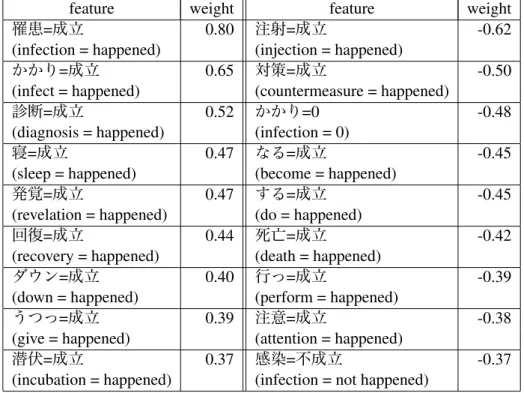
Table 6: Examples of deep modality feature with large weight. English translations are given in paren-theses.
feature weight feature weight
罹患=成立 0.80 注射=成立 -0.62
(infection = happened) (injection = happened)
かかり=成立 0.65 対策=成立 -0.50
(infect = happened) (countermeasure = happened)
診断=成立 0.52 かかり=0 -0.48
(diagnosis = happened) (infection = 0)
寝=成立 0.47 なる=成立 -0.45
(sleep = happened) (become = happened)
発覚=成立 0.47 する=成立 -0.45
(revelation = happened) (do = happened)
回復=成立 0.44 死亡=成立 -0.42
(recovery = happened) (death = happened)
ダウン=成立 0.40 行っ=成立 -0.39
(down = happened) (perform = happened)
うつっ=成立 0.39 注意=成立 -0.38
(give = happened) (attention = happened)
潜伏=成立 0.37 感染=不成立 -0.37
(incubation = happened) (infection = not happened)
less important to predict the number of negative instances, although our system has high accuracy (about 91%). Therefore, we computed the preci-sion, recall, and F1-score as the evaluation metrics and conducted five-fold cross-validation.
We used Classias (ver.1.1)5with its default set-ting to train the model. We applied L2-regularized logistic regression as a training algorithm. We used MeCab (ver.0.996) with IPADic (ver.2.7.0) as a morphological analyzer.
4.2 Feature
The features used for the experiments are pre-sented below. These features are not modality
fea-5Classias:http://www.chokkan.org/ software/classias/
tures. We selected these features by performing preliminary experiments. Here, we omit the de-scription related to modality features because the details are described in Section 3.
BoW: Bag of Words features of six morphemes around the “flu.”
N-gram (character N-gram): Feature of char-acter N-gram around the word “flu.” The value of N is 1–4.
URL: Binary feature of the presence or absence of URL in messages.
Table 7: Contribution and error analysis of deep modality features.
Example 4 10年ぶりにインフルエンザというものにかかりましたwwww
(correct example) English translation: It’s been 10 years since I last had the flu, but now I have one (LOL).
Example 5 ASPARAGUS渡邊忍がインフルエンザに感染してしまい、本日の
柏DOMeでのライブは中止します。
(false positive) English translation: Watanabe of ASPARAGUS is infected with flu, and today’s concert in Kashiwa Dome has been canceled.
Example 6 インフルとな…おだいじに\(^o^)/
(false negative) English translation: So you have a flu... . Take care.:)
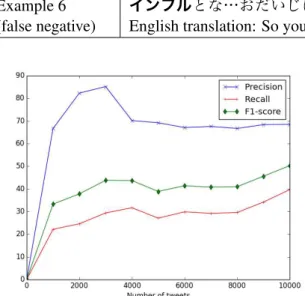
Figure 1: Learning curve for disease event detec-tion.
Season: Binary feature of whether posting time is within December through February or not.
4.3 Baseline
For disease event detection, we follow previous studies Aramaki et al. (2011, 2012) to build the baseline classifier using a supervised approach. The baseline is constructed by combining all fea-tures except the modality feafea-tures.
4.4 Experimental results
The result of disease event detection is shown in Table 4. Overall, they seem to have low recall and F1-Score. However, it turns out to be difficult to achieve high recall because the percentage of pos-itive cases is extremely low (about 12.6%).
As shown, N-gram and Season features improve F1-score. Although the shallow modality feature boosts both precision and recall, the deep modal-ity feature only improves recall in compensation with precision. The highest recall for the F1-score is achieved when using both shallow and deep modality features from Tsutsuji and Zunda (in the case of “All”). This result underscores the utility
of the modality features for classifying a post by its factuality.
In addition, to judge the performance with re-spect to the amount of data, we plot a learning curve in Figure 1. Although the decision changes only slightly, recall tends to improve by increasing the amount of data.
5 Discussion
As described in this paper, we demonstrate the contribution of modality analysis for disease event detection. In what follows, we conduct error anal-ysis of our proposed method.
5.1 Contribution and error analysis for shallow modality
Table 5 shows the correct and incorrect examples for the shallow modality. Example 1 is a cor-rect example. In this case, we convert “らしく” (“seem”) into sense ID; the classifier outputs an appropriate label. Example 2 is an example of false positive. Example 3 is an example of a false negative. Both examples are incorrect because they are assigned wrong sense IDs. That point il-lustrates the limitations of a simple string match, which does not take the context into account. It is necessary to perform word sense disambiguation for modality-related words.
5.2 Contribution and error analysis for deep modality
Next, we examine the deep modality features. Ta-ble 6 presents results of the deep modality features sorted by weight in descending order.
vaccinations, and posts about epidemic news ac-count for a large proportion. This tendency is ex-hibited clearly when one assigns negative weights. Positive weights include many event-nouns and verbs that are related directly to the disease.
Table 7 presents correct and incorrect examples for deep modality. Example 4 is a correct exam-ple. The deep modality feature “infection = hap-pened” makes it possible to judge Example 4 cor-rectly. Deep modality features appear to be criti-cal in many cases, but in some cases they do not function as expected. Example 5 is an example of a false positive. Because of the “infection = happened” feature, the classifier judges it positive. However, not the writer, but a well-known figure (Watanabe of ASPARAGUS) has been infected with influenza. This is a common mistake that the classifier makes. This result indicates the impor-tance of identifying the entity that is involved in a disease event. Furthermore, our classifier is not robust for non-event problems. Example 6 is an example of false positive. This example does not have the argument of an event. It is the character-istics of the colloquial sentence. Such examples can often be found in web documents.
6 Conclusion
This study examined a disease event detection method incorporating both shallow and deep modality features. Results show that the modality features improve the accuracy of the influenza de-tection. Although we have demonstrated that our method is useful for particular disease event detec-tions, we must still ascertain whether it is applica-ble for other infectious diseases such as norovirus and dengue.
As future work, we would like to disambiguate functional expressions using sequence labeling techniques (Utsuro et al., 2007); we would also like to identify the predicate–argument structure of disease events (Kanouchi et al., 2015). Apart from that, an information extraction approach that looks for more specific patterns should be verified. Finally, we would like to adopt these findings to improve the prediction of epidemics.
Acknowledgments
We thank anonymous reviewers for their construc-tive comments, which have helped us to improve the manuscript.
References
Harshavardhan Achrekar, Avinash Gandhe, Ross Lazarus, Ssu-Hsin Yu, and Benyuan Liu. 2012. Twitter improves seasonal influenza prediction. In
International Conference on Health Informatics, pages 61–70.
Eiji Aramaki, Sachiko Masukawa, and Mizuki Morita. 2011. Twitter catches the flu: detecting influenza epidemics using Twitter. InProceedings of the 16th Conference on Empirical Methods in Natural Lan-guage Processing, pages 1568–1576.
Eiji Aramaki, Sachiko Masukawa, and Mizuki Morita. 2012. Microblog-based infectious disease detection using document classification and infectious disease model. Journal of Natural Langage Proccessing, 19(5):419–435.
Danah Boyd, Scott Golder, and Gilad Lotan. 2010. Tweet, tweet, retweet: Conversational aspects of retweeting on Twitter. InProceedings of the 2010 43rd Hawaii International Conference on System Sciences, pages 1–10.
Jeremy Ginsberg, Matthew H Mohebbi, Rajan S Pa-tel, Lynnette Brammer, Mark S Smolinski, and Larry Brilliant. 2009. Detecting influenza epi-demics using search engine query data. Nature, 457(7232):1012–1014.
Chris Groendyke, David Welch, and David R Hunter. 2011. Bayesian inference for contact networks given epidemic data. Scandinavian Journal of Statistics, 38(3):600–616.
Bernardo A Huberman, Daniel M Romero, and Fang Wu. 2009. Social networks that matter: Twitter under the microscope. First Monday, 14(1):1–9.
Xiang Ji, Soon Ae Chun, and James Geller. 2012. Epi-demic outbreak and spread detection system based on Twitter data. In Health Information Science, pages 152–163.
Shin Kanouchi, Mamoru Komachi, Naoaki Okazaki, Eiji Aramaki, and Hiroshi Ishikawa. 2015. Who caught a cold? - identifying the subject of a symp-tom. InProceedings of 53rd Annual Meeting of the Association for Computational Linguistics.
Hubert Horace Lamb. 2013. Climate: Present, Past and Future: Volume 1: Fundamentals and Climate Now. Routledge.
Jiwei Li, Alan Ritter, Claire Cardie, and Eduard Hovy. 2014. Major life event extraction from Twitter based on congratulations/condolences speech acts. InProceedings of the 19th Conferences on Empiri-cal Methods in Natural Language Processing, pages 1997–2007.
Suguru Matsuyoshi, Megumi Eguchi, Chitose Sao, Koji Murakami, Kentaro Inui, and Yuji Matsumoto. 2010a. Annotating event mentions in text with modality, focus, and source information. In Pro-ceedings of the Seventh International Conference on Language Resources and Evaluation (LREC), pages 1456–1463.
Suguru Matsuyoshi, Megumi Eguchi, Chitose Sao, Koji Murakami, Kentaro Inui, and Yuji Matsumoto. 2010b. Factuality annotation for textual information analysis. The IEICE Transactions on Information an Systems, 93(6):705–713.
Yamir Moreno, Romualdo Pastor-Satorras, and Alessandro Vespignani. 2002. Epidemic outbreaks in complex heterogeneous networks. The European Physical Journal B-Condensed Matter and Complex Systems, 26(4):521–529.
Andrew S Mugglin, Noel Cressie, and Islay Gemmell. 2002. Hierarchical statistical modelling of influenza epidemic dynamics in space and time. Statistics in medicine, 21(18):2703–2721.
Philip M Polgreen, Yiling Chen, David M Pennock, Forrest D Nelson, and Robert A Weinstein. 2008. Using internet searches for influenza surveillance.
Clinical infectious diseases, 47(11):1443–1448.
Adam Sadilek, Henry Kautz, and Jeffrey P Bigham. 2012. Finding your friends and following them to where you are. InProceedings of the fifth ACM in-ternational conference on web search and data min-ing, pages 723–732.
Takeshi Sakaki, Makoto Okazaki, and Yutaka Matsuo. 2010. Earthquake shakes Twitter users: real-time event detection by social sensors. In Proceedings of the 19th international conference on World wide web, pages 851–860.
Roser Saurí and James Pustejovsky. 2012. Are you sure that this happened? Assessing the factuality de-gree of events in text. Computational Linguistics, 38(2):261–299.
Robert E Serfling. 1963. Methods for current statis-tical analysis of excess pneumonia-influenza deaths.
Public health reports, 78(6):494.