T itle
A secondary R E T mutation in the activation loop conferring
resistance to vandetanib
A uthor(s )
Nakaoku, T akashi; K ohno, T akashi; A raki, Mitsugu; Niho,
S eiji; C hauhan, R akhee; K nowles, Phillip P.; T suchihara,
K atsuya; Matsumoto, S hingo; S himada, Y oko; Mimaki,
S achiyo; Ishii, Genichiro; Ichikawa, Hitoshi; Nagatoishi,
S atoru; T sumoto, K ouhei; Okuno, Y asushi; Y oh, K iyotaka;
McD onald, Neil Q.; Goto, K oichi
C itation
Nature C ommunications (2018), 9
Is s ue D ate
2018-02-12
UR L
http://hdl.handle.net/2433/229494
R ig ht
©
T he A uthor(s) 2018. T his article is licensed under a C reative
C ommons A ttribution 4.0 International L icense, which permits
use, sharing, adaptation, distribution and reproduction in any
medium or format, as long as you give appropriate credit to the
original author(s) and the source, provide a link to the C reative
C ommons license, and indicate if changes were made. T he
images or other third party material in this article are included
in the article’
s C reative C ommons license, unless indicated
otherwise in a credit line to the material. If material is not
included in the article’
s C reative C ommons license and your
intended use is not permitted by statutory regulation or exceeds
the permitted use, you will need to obtain permission directly
from the copyright holder. T o view a copy of this license, visit
http://creativecommons.org/licenses/by/4.0/.
T ype
J ournal A rticle
T extvers ion
publisher
A secondary
RET
mutation in the activation loop
conferring resistance to vandetanib
Takashi Nakaoku
1
, Takashi Kohno
1,2
, Mitsugu Araki
3,4
, Seiji Niho
5
, Rakhee Chauhan
6
, Phillip P. Knowles
6
,
Katsuya Tsuchihara
2
, Shingo Matsumoto
2,5
, Yoko Shimada
1
, Sachiyo Mimaki
2
, Genichiro Ishii
7
,
Hitoshi Ichikawa
2
, Satoru Nagatoishi
8
, Kouhei Tsumoto
8
, Yasushi Okuno
4
, Kiyotaka Yoh
5
,
Neil Q. McDonald
6,9
& Koichi Goto
5
Resistance to vandetanib, a type I RET kinase inhibitor, developed in a patient with metastatic
lung adenocarcinoma harboring a
CCDC6-RET
fusion that initially exhibited a response to
treatment. The resistant tumor acquired a secondary mutation resulting in a
serine-to-phenylalanine substitution at codon 904 in the activation loop of the RET kinase domain. The
S904F mutation confers resistance to vandetanib by increasing the ATP af
fi
nity and
autophosphorylation activity of RET kinase. A reduced interaction with the drug is also
observed in vitro for the S904F mutant by thermal shift assay. A crystal structure of the
S904F mutant reveals a small hydrophobic core around F904 likely to enhance basal kinase
activity by stabilizing an active conformer. Our
fi
ndings indicate that missense mutations in
the activation loop of the kinase domain are able to increase kinase activity and confer drug
resistance through allosteric effects.
DOI: 10.1038/s41467-018-02994-7
OPEN
1Division of Genome Biology, National Cancer Center Research Institute, 5-1-1, Tsukiji, Chuo-ku, Tokyo 1040045, Japan.2Division of Translational Genomics, Exploratory Oncology Research and Clinical Trial Center, National Cancer Center, 5-1-1, Tsukiji, Chuo-ku, Tokyo 1040045, Japan.3Advanced Institute for Computational Science, RIKEN, 7-1-26 Minatojima-minami-machi, Chuo-ku, Kobe-city, Hyogo 6500047, Japan.4Department of Clinical System Onco-Informatics, Graduate School of Medicine, Kyoto University, 54 Kawaracho, Shogoin, Kyoto-city, Kyoto 6068507, Japan.5Department of Thoracic Oncology, National Cancer Center Hospital East, 6-5-1, Kashiwanoha, Kashiwa-city, Chiba 2778577, Japan.6Signaling and Structural Biology Laboratory, The Francis Crick Institute, London NW1 1AT, UK.7Division of Pathology, Exploratory Oncology Research and Clinical Trial Center, National Cancer Center, 6-5-1, Kashiwanoha, Kashiwa-City, Chiba 2778577, Japan.8Medical Proteomics Laboratory, Institute of Medical Science, The University of Tokyo, 4-6-1, Shiroganedai, Minato-ku, Tokyo 1088639, Japan.9Institute of Structural and Molecular Biology, Department of Biological Sciences, Birkbeck College, Malet Street, London WC1E 7HX, UK. Correspondence and requests for materials should be addressed to T.K. (email:[email protected])
123456789
O
ncogenic
ALK
and
ROS1
fusion-targeted therapy using
type I tyrosine-kinase inhibitors (TKIs), which bind to
the ATP-binding cleft of kinases, is highly effective in
lung adenocarcinoma (LADC)
1,2; however, such cancers
inevi-tably acquire resistance to targeted therapies, which severely
limits the ef
fi
cacy of cancer treatments. Secondary mutations that
cause amino acid substitutions in the kinase domain (KD),
including the gatekeeper and solvent-accessible regions, are an
important cause of resistance to various extents
3. The identi
fi
-cation of resistance mutations in ALK and ROS1 led to the
development of novel TKIs to overcome acquired resistance
1,3,4.
Oncogenic fusions of the
RET
kinase gene are present in 1
‒
2%
of LADCs
5,6, and are the subject of intense investigation. These
fusions are promising targets for the treatment of LADC
7,8,
because of the availability of clinically active RET TKIs, such as
vandetanib and cabozantinib
9. However, the mechanisms
underlying acquired resistance to RET TKIs in lung cancer
patients remain to be elucidated, and the molecular process by
which cancer cells acquire such resistance needs to be
investi-gated. Here we report the
fi
rst case of a secondary
RET
mutation
associated with resistance to the RET TKI vandetanib. The patient
described was enrolled into our clinical trial
8, LURET (Lung
Cancer with RET Rearrangement Study; clinical trial registration
number: UMIN000010095,
https://upload.umin.ac.jp/
), which
investigates the ef
fi
cacy of vandetanib for the treatment of
non-small cell lung cancer (NSCLC) with oncogenic
RET
fusion. In
this trial, 19 RET fusion-positive cases were enrolled through
genetic screening of 1536 patients, and 17 eligible cases showed a
response rate of 53% and a progression-free survival period of
4
–
7 months
8.
Results
Case report
. A 57-year-old Japanese woman was referred to our
hospital with a nodule in her left lung that was detected in a
medical checkup. Bronchoscopic and mediastinoscopic
exam-inations revealed adenocarcinoma of the lung with mediastinal
lymph node metastases. The patient underwent concurrent
che-moradiotherapy with cisplatin and vinorelbine, resulting in a
partial response; however, 2 years later, multiple bone metastases
developed. Genetic examination revealed no mutation in
EGFR.
The patient received second- to sixth-line chemotherapies
con-sisting of ge
fi
tinib, pemetrexed, docetaxel, gemcitabine, and S-1.
During sixth-line chemotherapy, the patient developed right
cervical lymphadenopathy (Fig.
1
a and Supplementary Fig.
1
),
and a biopsy of the lymph node revealed adenocarcinoma (Fig.
1
b
and Supplementary Fig.
2
a). Additional molecular testing for
RET,
ALK, and
ROS1
fusions was performed by LC-SCRUM
(Lung Cancer Genomic Screening Project for Individualized
Medicine in Japan)
10. Reverse transcriptase-polymerase chain
reaction (RT-PCR) analysis of total RNA extracted from
snap-frozen biopsied tumor cells revealed a
CCDC6-RET
fusion and no
other fusions (Fig.
1
c). The
CCDC6-RET
fusion led to the
expression of a fusion transcript in which exon 1 of
CCCDC6
was
joined to exon 12 of
RET. The
CCDC6-RET
fusion was validated
by identifying breakpoint junctions in genomic DNA
a
#2 progression #1 pretreatment
b
c
CCDC6 ex1 RET ex12
#1 (pre)
#2 (pro) mRNA (cDNA)
0 5 10 15 20
0 50 100 150
–6 0 6 12 18
S-1
Size of target lesion
(mm)
Serum CEA level
(ng/mL)
CEA
Size of target lesion
Months Biopsy #1
Vandetanib
Biopsy #2
Response to vandetanib Pretreatment
#1
Progression on vandetanib
#2 Investigational
drug
d
mRNA (cDNA) Genomic DNA
#1 (pre)
#2 (pro) Blood (pre)
Fig. 1Identification of a RET-S904F mutation conferring resistance to vandetanib.aClinical course of the patient and axial chest computed tomographic (CT) scan. (Upper) The blue line indicates the serum CEA level, and the orange line indicates the size of the target lesion (the right metastatic cervical lymph node). The time points of the biopsy of metastatic lymph nodes are indicated by an arrowhead in Biopsy #1 and an arrow in Biopsy #2 (the details of the clinical course are shown in Supplementary Fig.1). (Lower) CT scan images of the metastatic lymph node as a target lesion.bSanger sequencing results of RT-PCR products from pretreatment specimens (Biopsy #1, pre) and specimens obtained at disease progression (Biopsy #2, pro). The same
CCDC6-RETfusion transcript in which exon 1 ofCCCDC6is joined to exon 15 ofRETwas expressed.cHistologicalfindings of hematoxylin/eosin-stained lymph node biopsy specimens obtained before treatment (Biopsy #1) and after disease progression (Biopsy #2). The identical pathological features are shown.dSanger sequencing of genomic-PCR and RT-PCR products from peripheral blood, pretreatment specimens (pre), and specimens obtained at disease progression (pro). A mutation of cytosine to thymine at residue 2902 was detected only in the resistant tumor specimen. Genomic and RT-PCR analysis was performed using a primer inCCDC6-exon 1 and a reverse primer in RET-exon 15. The detection of the substitution, which causes an amino acid substitution of serine-to phenylalanine at codon 904 (in magenta), in genomic DNA and in the fusion transcript suggested that the mutation occurred on the rearrangedRETallele in the resistant tumor
(Supplementary Fig.
2
b). The patient was subsequently enrolled
into the LURET trial.
The patient showed a dramatic response to vandetanib, a type I
RET TKI, with reduction in her tumor size from 20 to 7 mm in
diameter at 12 weeks. This was consistent with a high-response
rate in the LURET study in
CCDC6-RET
–
positive cases (5/6
cases, 83%)
8. However, the patient developed a resistant tumor
with the same histological features and a
CCDC6-RET
fusion (C1;
R12) at 38 weeks (Fig.
1
a
–
c, Supplementary Fig.
1
and Fig.
2
a).
Given the high diversity of breakpoints for
RET
fusions
11, the
identical genome structures of the breakpoint junctions
(Supple-mentary Fig.
2
b) indicated that the resistant tumor originated
from the original tumor present before vandetanib treatment.
Discovery of a S904F secondary mutation in the RET kinase
domain
. Targeted deep sequencing of cancer-related genes from
genomic DNA identi
fi
ed a serine-to-phenylalanine substitution at
codon 904 (S904F) in RET as the only non-synonymous mutation
in the resistant tumor; the baseline tumor samples contained no
non-synonymous mutations (Supplementary Fig.
3
). Sanger
sequencing of RT-PCR products of fusion transcripts veri
fi
ed that
the S904F mutation occurred on the
RET
allele fused to the
CCDC6
locus (Fig.
1
d). Whole-exome sequencing analysis
revealed four mutations speci
fi
c to the resistant tumor, including
the
RET-S904F mutation (Supplementary Fig.
3
b). The lack of
reports connecting the three other mutated genes to drug
resis-tance prompted us to further study the
RET-S904F mutation.
Vandetanib resistance is related to increased ATP af
fi
nity and
autophosphorylation activity
. The serine 904 residue is located
in between two autophosphorylation tyrosines Y900 and Y905
within the canonical activation loop (AL) of RET kinase; however,
it is not conserved among kinases (Supplementary Fig.
4
).
Phosphorylation of an exogenously expressed S904F mutant of
CCDC6-RET in H1299 lung cancer cells, which do not express
endogenous RET
6, was maintained at a higher vandetanib
con-centration (half-maximal inhibitory concon-centration [IC
50]
=
2.6
μ
M) than that in the wild-type CCDC6-RET protein (IC
50=
0.57
μ
M) (Fig.
2
a). This
fi
nding was validated in another cell line, Ba/
F3, which grew in an interleukin 3 (IL3)-independent manner
b
a
pCCDC6-RET (RET_pY905)
Vector
CCDC6-RET Wild type
pCCDC6-RET (RET_pY1015) CCDC6-RET
ACTB
CCDC6-RET S904F mutant
Ratio –
1.00 0.68 0.44 0.19 0.00 0.00 1.00 0.83 0.97 1.05 0.20 0.00 10 5.0 1.0 0.5 0.1 0 10 5.0 1.0 0.5 0.1 0 Vandetanib
µM:
H1299
0 50 100
0 0.1 0.5 1 5 10
Relative signal intensity of pCCDC6-RET (pY905) to total CCDC6-RET (%)
Vandetanib (µM) Wild type S904F mutant
*
Wild type S904F mutant
100
50
0
100
50
0
Vandetanib (nM) 0 10 100 1000 10,000
Vandetanib (nM) 0 10 100 1000 10,000 GI50(nM)
(95 % confidence interval) 278.2 (259.5 – 298.3)
Relative cell viability
(precentage of control) Relative kinase activity (precentage of control) 1070 (993.2 – 1153)
Wild type S904F mutant
IC50(nM) (95 % confidence interval)
67.82 (59.40 – 77.43) 908 (705.4 – 1170)
c
after lentiviral transduction of
CCDC6-RET
cDNAs with or
without the S904F mutation (Supplementary Fig.
5
). Consistently,
Ba/F3 cells expressing
CCDC6-RET
cDNA with the S904F
mutation showed a greater GI
50to vandetanib (1070 vs. 278.2
nM) than those without the mutation (Fig.
2
b). To validate the
results of the cell-based assay, an in vitro kinase assay was
per-formed using puri
fi
ed RET kinase polypeptides, which showed
that the IC
50of vandetanib was higher in the S904F mutant
(908.5 nM) than in the wild-type kinase (67.82 nM) (Fig.
2
c). This
result was consistent with a signi
fi
cantly poorer inhibitory
con-stant (K
i) of vandetanib in the S904F mutant (43.09 nM) than in
the wild type (11.57 nM) (Fig.
3
a and Supplementary Fig.
6
).
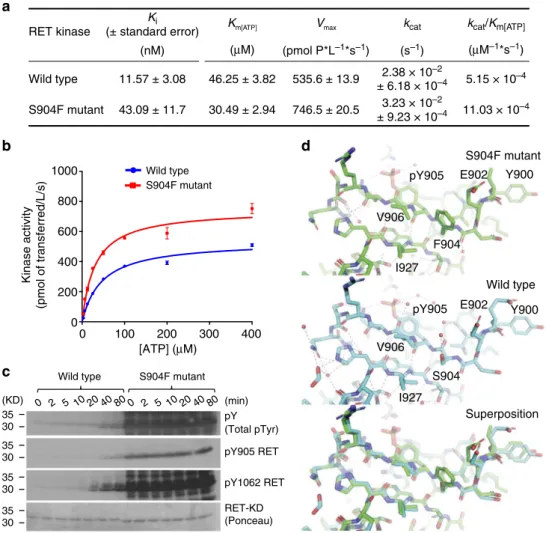
An in vitro kinase assay was performed to examine the effect of
the S904F mutation on the kinetic pro
fi
le of RET kinase toward
synthetic peptide substrates. The results showed that the S904F
mutant had a higher af
fi
nity for ATP (K
m[ATP]), resulting in an
increased catalytic ef
fi
ciency (k
cat/K
m[ATP]) (Fig.
3
a, b). An even
more dramatic difference was observed for the S904F mutant,
which showed accelerated and enhanced autophosphorylation
kinetics compared with those of the wild-type protein (Fig.
3
c).
These results indicate an activating effect of the
RET-S904F
mutation, which is consistent with a previous report indicating
that the same mutation is responsible for familial thyroid
cancer
12. The positive effect of the S904F mutant on the af
fi
nity
for ATP and autophosphorylation of RET kinase may induce
vandetanib resistance by decreasing the relative competitiveness
of the type I inhibitor, vandetanib, against ATP (Supplementary
Fig.
6
).
To explore the impact of S904F on the overall RET
conformation, the crystal structure of auto-phosphorylated RET
kinase domain was determined at 2.3 Å and re
fi
ned to a working
R-value of 19.8% (R-free 23.7%, Supplementary Table
1
), with
good model geometry. The overall structure is very similar to the
wild type (PDB code 2IVT). Residues 820
–
825 are ordered
fi
rst
time compared with previously published RET kinase domain
structures
13. The nucleotide pocket is occupied by an adenosine
Wild type
Superposition S904F mutant
pY905 E902 Y900
V906
I927 F904
pY905 E902 Y900
V906
I927 S904
35 30
pY1062 RET pY905 RET pY (min)
(Total pTyr) 0 2 5 10 20 40 80 0 2 5 10 20 40 80
35 30 35 30 35 30 (KD)
RET-KD (Ponceau) Wild type
0
0 100 200 300
[ATP] (µM)
400 200
400 600 800
Kinase activity
(pmol of transferred/L/s)
1000
S904F mutant
c
b
Wild type S904F mutant
d
a
RET kinase
Ki (± standard error)
(nM) (µM)
Km[ATP] Vmax
(pmol P*L–1*s–1)
kcat/Km[ATP]
(µM–1*s–1)
kcat
(s–1)
Wild type 535.6 ± 13.9 5.15 × 10⁻⁴
S904F mutant 30.49 ± 2.94 746.5 ± 20.5
± 9.23 × 10⁻⁴ 11.03 × 10⁻⁴ 11.57 ± 3.08
43.09 ± 11.7
46.25 ± 3.82
± 6.18 × 10⁻⁴ 2.38 × 10⁻²
3.23 × 10⁻²
Fig. 3Kinetic and structural properties of the RET-S904F mutant.aEnzyme kinetics parameters of wild type and S904F mutant RET KD proteins. The kinase assay was performed in triplicate at 25 °C for different incubation times (0, 10, 20, 30, 40, and 50 min) using purified RET KDs, increasing concentrations of ATP (3.125–400 nM), and serially diluted vandetanib. The assay was initiated by addition of32P-ATP, and the reaction mixture was incubated at 30 °C. These experiments were performed independently three times. The data were analyzed using GraphPad Prism version 6.0 to calculate kinetic parameters,Ki, and IC50values.bSaturation curve graphed by Michaelis–Menten equation. The graph with standard deviations (shown as error bars) was generated using GraphPad Prism.cWestern blotting showing the autophosphorylation time course in the wild type and S904F mutant RET KDs. Phosphorylation of the recombinant purified RET KDs treated with ATP (5 mM) and MgCl2(10 mM) for 0–80 min was detected with the indicated antibodies.dComparison of S904F and wild-type RET structures. (Upper) Detail of side chain contacts close to the F904 mutation site of mutant RET kinase domain (PDB code 6FEK). Selected sidechains are labeled. Bound waters are shown as red spheres and hydrogen-bonds drawn in gray as defined by Pymol Molecular Graphics System (Schrödinger, LLC, New York, NY). (Middle) Detail of side chain contacts close to the S904 of wild-type RET kinase domain (PDB code 2IVT), colored as per panel (upper). (Lower) Overlay of the RET core kinase domain wild type and S904F mutant structures omitting bound waters for clarity
moiety. Only small differences in side chain positioning are
observed close to the F904 residue. F904 side chain makes Van
der Waals contacts with V906, I927 and the aliphatic portion of
E902, thereby de
fi
ning a small hydrophobic core absent from wild
type RET (Fig.
3
d). This may tether the activation loop more
tightly in both non-phospho- and phospho-RET forms,
enhan-cing the basal level of RET activity.
Decreased thermal stability of the RET kinase-drug complex
induced by the S904F mutation
. The
K
iand IC
50values for
vandetanib were increased in the S904F mutant at concentrations
several 1000-fold lower than those of ATP (Figs.
2
c and
3
a). To
further investigate this effect, a thermal shift assay was performed
to examine directly the stability of the enzyme-ligand complex.
This assay determines the drug-induced increase in the melting
temperature (
Δ
T
m) of the puri
fi
ed RET KD, which re
fl
ects the
stability of the kinase-ligand complex
13.
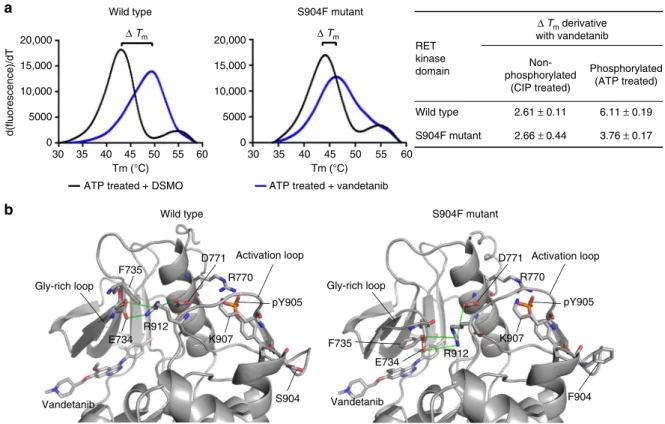
When the RET protein was phosphorylated, addition of
vandetanib increased the
Δ
T
mof the wild-type RET KD by
6.11
±
0.19 °C, consistent with a recent study
14. Addition of
vandetanib increased the
Δ
T
mof the S904F RET KD only by 3.76
±
0.17 °C (Fig.
4
a and Supplementary Table
2
). When the RET
kinase protein was not phosphorylated, the
Δ
T
mincreases were
smaller and comparable between the wild type and S904F RET
KDs (Fig.
4
a and Supplementary Table
2
). These data suggested
that the S904F mutation decreased the af
fi
nity for vandetanib in
the KD by reducing the magnitude of thermal stabilization
induced by drug addiction.
Discussion
The present study identi
fi
ed a secondary S904F mutation
con-ferring resistance to vandetanib in a metastatic LADC harboring a
CCDC6-RET
fusion that initially exhibited a response to
treat-ment but later progressed. The RET-S904F mutation was located
in the AL, in which mutations are not linked to drug resistance to
the best of our knowledge. The mutant showed increased ATP
af
fi
nity and autophosphorylation activity. These results are
con-sistent with the S904F mutation as a germline oncogenic
muta-tion responsible for the development of familial thyroid cancer
and with the ability of the
RET
S904F mutant to activate RET
kinase and transform NIH3T3
fi
broblasts
12. Since vandetanib is a
type I inhibitor that inhibits RET kinase activity in an
ATP-competitive manner, the increased ATP af
fi
nity and
autopho-sphorylation activity may be responsible for the resistance
induced by the mutant. Increased ATP af
fi
nity underlies the
resistance to type I TKIs of an EGFR kinase mutant with a
Wild type S904F mutant
ATP treated + DSMO ATP treated + vandetanib 30 35 40 45 50 55 60 30 35 40 45 50 55 60
RET kinase domain
d(fluorescence)/dT
20,000
15,000
10,000
5000
0
20,000
15,000
10,000
5000
0
∆ Tm derivative with vandetanib
Non-phosphorylated
(CIP treated)
Phosphorylated (ATP treated)
Wild type
S904F mutant ∆Tm
∆Tm
Vandetanib S904
pY905 R770
E734 R912
K907 D771 F735
Gly-rich loop
Activation loop
E734 R912
F735
Vandetanib F904
pY905 R770
K907 D771
Gly-rich loop
Activation loop
6.11 ± 0.19
3.76 ± 0.17 2.61 ± 0.11
2.66 ± 0.44
Tm (°C) Tm (°C)
Wild type S904F mutant
a
b
Fig. 4Decreased thermal stability of the RET kinase-vandetanib complex induced by the S904F mutation.aA thermal shift assay was performed to determine the drug-induced changes in the melting temperature (∆Tm) of purified RET KD, which reflect the stability of the complex13. Recombinant wild type or S904F mutant RET KD was generated using previously published methods13. Each protein was dephosphorylated using CIP-phosphatase and then
T790M mutation in its ATP-binding cleft
15,16. Thus, increased
ATP af
fi
nity might be a common mechanism of drug resistance
in oncogenic kinases.
A thermal shift assay in the presence or absence of drug
sug-gested that the S904F mutation is less able to bind vandetanib. The
co-crystal structure of RET kinase in complex with vandetanib
indicates that the mutated residue (F904) does not directly interfere
with vandetanib binding because of its location (Fig.
4
b)
13.
Therefore, we investigated whether an allosteric effect of the S904F
mutation may result in a conformational change affecting the
stability of the RET kinase-vandetanib complex. Molecular
dynamics (MD) simulation using the human RET KD in complex
with vandetanib
17suggested dynamic coupling pattern differences
in regions of AL and the glycine-rich loop (GRL) between the wild
type and S904F mutant (Supplementary Fig.
7
a), concomitantly
with a decrease in the
fl
uctuation of these regions in the S904F
mutant (Supplementary Fig.
7
b). The GRL of the RET KD, in
particular the side chain of phenylalanine 735 (F735), has been
reported to regulate the ATP-binding capacity by interconverting
between two conformers, open (ATP-binding competent) and
closed (ATP-binding blocked)
18(Supplementary Fig.
7
c). The
mean structures of MD trajectories suggested that the S904F
mutation causes a geometrical change in E734 (in GRL), D771 (in
α
C helix), and R912 (in AL) which compose a triad of tethered
residues via salt bridge interaction
18(Fig.
4
b). The geometrical
change was associated with the appearance of an additional de
novo conformer represented by a higher energy state (i.e., lower
af
fi
nity to vandetanib) than that of the open/closed conformers
(Supplementary Fig.
7
d and e). The de novo conformer (designated
as
“
intermediate
”
) was suggested to have a protrusion of the side
chain of F735 in the GRL toward the drug-binding site, which
would sterically interfere with the binding of vandetanib
(Supple-mentary Fig.
7
c, f and g; and Supplementary Movies
1
,
2
).
The present results indicated that the secondary S904F
muta-tion located in the AL, and therefore distant from the
ATP-binding site, may exhibit allosteric effects conferring resistance to
vandetanib. The increased ATP af
fi
nity and autophosphorylation
activity of the mutant were considered the main factors
under-lying the resistance to the type I inhibitor vandetanib.
Loss-of-tight vandetanib interaction could be inferred from the smaller
thermal melt gains upon drug addition to S904F mutant protein.
The precise mechanisms underlying these allosteric effects remain
largely unclear requiring further clari
fi
cation by crystallography
and/or biophysical studies.
Methods
Study oversight. The study was approved by the Institutional Review Boards of the National Cancer Center. The patient provided written informed consent for the genetic analysis and participation in the investigator-initiated clinical trial.
Clinical trial. The LURET (Lung Cancer with RET Rearrangement Study; clinical trial registration number: UMIN000010095,https://upload.umin.ac.jp/) trial investigated the efficacy of vandetanib in non-small cell lung cancer (NSCLC) with an oncogenicRETfusion. LURET is coupled with a nation-wide genetic screen, LC-SCRUM-Japan (Lung Cancer Genomic Sreening Project for Individualized Medicine in Japan), in which more than 2000EGFRmutation-negative non-squamous NSCLC patients were enrolled from>190 hospitals in all 47 prefectures of Japan for screening ofALK,RET, andROS1gene fusions.
For the LURET clinical trial, eligible patients had pathologically confirmed, locally advanced or metastatic non-squamous NSCLC withRETrearrangement withoutEGFRmutations and failed at least one previous chemotherapy.RET fusion positivity was determined by double positivity in reverse transcriptase-polymerase chain reaction (RT-PCR) and break-apartfluorescence in situ hybridization (FISH) assays. Of 34RETfusion-positive patients detected by RT-PCR, 19 were enrolled in the clinical trial to study the efficacy of vandetanib. In 17 eligible patients included in the primary analysis, the response rate was 53%. In the 19 registered patients, the disease control rate was 90%. Progression-free survival was 4.7 months. The details of the clinical trial are described in the published paper8.
Samples. A patient with lung adenocarcinoma (LADC) harboring aCCDC6-RET fusion underwent biopsy of pretreated and vandetanib-resistant tumors. Histo-pathological and immunohistochemical diagnoses were performed. Total RNA was extracted from grossly dissected, snap-frozen tissue samples using TRIzol (Invi-trogen, Carlsbad, CA, USA), and its quality was determined using a 2100 Bioa-nalyzer (Agilent Technologies, Santa Clara, CA, USA). Genomic DNA was extracted from the same tumors and peripheral blood using the QIAamp DNA mini kit (Qiagen, Limburg, The Netherlands).
PCR and sanger sequencing. Methods for RT-PCR and Sanger sequencing were described previously6. Total RNA (500 ng) was reverse-transcribed into cDNA using Superscript III Reverse Transcriptase (Invitrogen). cDNA (corresponding to 10 ng of total RNA) or 10 ng of genomic DNA was subjected to PCR amplification using KAPA Taq DNA Polymerase (KAPA Biosystems, Woburn, MA, USA). For detection of the fusion point, the following PCR primers were used: for cDNA amplification, 5′-TGCAGCAAGAGAACAAGGTG-3′(CCDC6 forward) and 5′
-TGAGAGGCCGTCGTCATAAA-3′(RET reverse); for genomic DNA amplifi
ca-tion, 5′-TGTCAAAACTGGCCTCTCTG-3′(CCDC6 forward) and 5′
-GGAACC-CACAGTCAAGGTCA-3′(RET reverse). The reactions were carried out in a thermal cycler under the following conditions: 40 cycles of 95 °C for 30 s, 60 °C for 30 s, and 72 °C for 2 min, with afinal extension at 72 °C for 10 min. The gene encoding glyceraldehyde-3-phosphate dehydrogenase (GAPDH) was amplified to estimate the efficiency of cDNA synthesis in the RT-PCR analysis. PCR products were directly sequenced in both directions on an ABI 3130xl DNA Sequencer (Applied Biosystems, Foster City, CA, USA) using the BigDye Terminator kit.
Targeted and whole-exome sequencing. Targeted and whole-exome sequencing was performed using 1.0µg of DNA extracted from biopsied tissues. Targeted genome and exome capture were performed using the Agilent SureSelect kits, NCC Oncopanel (Catalog No. 931196, Agilent) and Human All Exon V5, respectively. Sequencing was performed on the Illumina HiSeq 1500 platform using 100 bp paired-end reads (Illumina). Basic alignment and sequence quality control were performed using the Picard and Firehose pipelines. The reads were aligned against the reference human genome from UCSC human genome 19 (Hg19) using the Burrows Wheeler Aligner Multi-Vision software package. Because duplicate reads were generated during the PCR amplification process, paired-end reads that aligned to the same genomic positions were removed using SAMtools. Somatic SNVs were called by the MuTect program, which applies a Bayesian classifier to allow detection of somatic mutations with low-allele frequency. Somatic insertion/ deletion mutations (indels) were called using the GATK Somatic IndelDetector (https://software.broadinstitute.org/gatk/). In addition, target sequencing was per-formed for 10 ng of DNAs using the Ion Ampliseq Cancer Hotspot Panel v2 and the Ion Proton sequencer (Thermo Fisher Scientific, Waltham, MA, USA).
Alignment of amino acid sequences. Tyrosine kinases belonging to the RET superfamily were listed via the Ensembl Genome Browser (www.ensembl.org) and the human kinome19. The alignments were obtained from Uniprot (http://www.
uniprot.org/) and visualized by Jalview (http://www.jalview.org/).
Immunohistochemistry. Sections (4µm thick) were deparaffinized. Immunohis-tochemical staining was performed using a Ventana Discovery XT instrument supplied by Ventana Medical Systems Inc. (Tucson, AZ, USA) according to the manufacturer’s instructions. The primary antibodies against TTF-1 (SP141) were purchased from Ventana Medical Systems Inc. (Catalog No. 790-4756, ready to use without dilution), and thyroglobulin was purchased from Dako (Catalog No. M078101, Glostrup, Denmark, ready to use without dilution). The reactions were visualized with 3,3′-diaminobenzidine followed by counterstaining with hematoxylin.
Cell lines and reagents. NCI-H1299 cells and Ba/F3 cells were provided by Dr. J.D. Minna of UT Southwestern Medical Center and Dr. Hiroyuki Mano of University of Tokyo, respectively. 293FT cells and WEHI-3B cells were obtained from Invitrogen (Carlsbad, CA, USA) and RIKEN BioResource Center (Japan), respectively. NCI-H1299 and WEHI-3B were cultured in RPMI medium with 10% fetal bovine serum (FBS). Ba/F3 cells were cultured in RPMI medium containing 10% FBS and 10% WEHI-3B–conditioned medium (a source of interleukin 3 [IL3]), and 293FT cells were cultured in DMEM with 10% FBS. All cells were incubated at 37 °C in 5% CO2.
Vandetanib was purchased from Selleck (Houston, TX, USA). Primary antibodies against RET (Catalog No. ab134100) and phospho-Tyr1015 RET (Catalog No. ab74154) were purchased from Abcam (Cambridge, UK). Antibodies against phospho-Tyr 905 Ret (Catalog No. 3221), GAPDH (Catalog No. 5174), and beta-actin (Catalog No. 3700) were purchased from Cell Signaling Technology (Danvers, MA, USA). Antibodies against phospho-Tyr1062 RET (Catalog No. sc-20252-R) and total phospho-tyrosine (Catalog No. sc-7020) were purchased from Santa Cruz Biotechnology (Santa Cruz, CA, USA).
Construction of lentiviral vectors expressing wild type and S904F mutant
CCDC6-RETcDNA. Full-length wild type and S904F mutantCCDC6-RETcDNAs were synthesized by FASMAC (Kanagawa, Japan). cDNAs were ligated into pLenti-6/V5-DEST plasmids (Invitrogen). The integrity of each inserted cDNA was ver-ified by Sanger sequencing. Expression of cDNA products was confirmed by immunoblotting of transiently transfected cells.
Lentiviral production and infection. Lentiviruses were generated in 293FT cells (6 × 10⁶cells per 10 cm plate) transfected with pLenti-6/V5-DEST plasmid
con-taining either the wild type or S904F mutantCCDC6-RETcDNA and ViraPower packaging mix (Invitrogen) using the Lipofectamine 3000 reagent (Invitrogen). Viral supernatants were collected at 42 h after the medium change, and then used to infect 4.0 × 10⁵Ba/F3 cells in the presence of 10μg/ml Polybrene
(Sigma-Aldrich, St Louis, MO, USA) by centrifugation at 3000×gfor 150 min at 32 °C. Following overnight incubation at 37 °C in 5% CO2, the cells were distributed into
24-well plates and selected in medium containing IL3 and 8μg/ml blasticidin (Invitrogen) for 1 week. The blasticidin-resistant cells were grown in IL3-free medium for 2 weeks. The expression of exogenous CCDC6-RET proteins was confirmed by immunoblotting coupled with Sanger sequencing of RT-PCR pro-ducts from the cells (Supplementary Fig.5a, b).
CCDC6-RET phosphorylation assay. NCI-H1299 cells were transiently trans-fected with 5μg of plasmid DNA using Lipofectamine 3000. The cells were re-seeded at 12 h after transfection. After 24 h, the cells were cultured with vehicle or increasing doses of inhibitors for 6 h. Ba/F3 cells (5.0 × 10⁶) stably expressing wild
type or S904F mutant CCDC6-RET were cultured with vehicle or increasing doses of inhibitors for 6 h. The cells were lysed in RIPA buffer (1% NP-40, 0.1% sodium deoxycholate, 50 mM Tris-HCl [pH 7.6], 150 mM NaCl, 1 mM EDTA [pH 8.0], 0.1% SDS, 1 mM Na3VO4, and 10 mM NaF) containing Complete Protease
Inhi-bitor Cocktail (Roche, Mannheim, Germany). Cell lysates were centrifuged at 14,000×r.p.m. for 15 min, and the supernatants were collected. The supernatants were subjected to SDS-PAGE, followed by immunoblotting onto polyvinylidene difluoride membranes. The membranes were blocked for 1 h with TBS containing 0.1% Tween 20 (TBST) and 1.0% BSA, and then probed with primary antibodies; anti-RET (used at 2000-fold dilution), anti-phospho-Tyr1015 RET (used at 500-fold dilution), anti-phospho-Tyr 905 Ret (used at 1000-500-fold dilution), anti-GAPDH (used at 1000-fold dilution), and anti-beta-actin (used at 1000-fold dilution). After washing with TBST, the membranes were incubated with horseradish peroxidase-conjugated anti-mouse or anti-rabbit secondary antibodies, and then visualized with enhanced chemiluminescence reagent (Perkin Elmer, Waltham, MA, USA). Intensities of signals were quantified using a LAS3000 imaging system (Quansys Biosciences, West Logan, UT, USA). Assays were independently performed more than three times. To determine the half-maximal inhibitory concentration (IC50)
values in the H1299 model, the signal intensities of total and phospho-Y905 of CCDC6-RET were quantified using Multi-gauge software (Fujifilm, Tokyo, Japan). After subtraction of the background, the signal intensity at each dose was stan-dardized by dividing it by that of the inhibitor-free sample labeled“0”. The mean ratios of phospho-Y905 to total CCDC6-RET in three independent assays were plotted with error bars. Uncropped gel data are supplied in the Supplementary Fig.8.
Cell viability assays. Twenty-four hours before inhibitor treatment, 2000 Ba/F3 cells stably expressing CCDC6-RET with or without the S904F mutation were plated in quadruplicate in 96-well plates. Serially diluted inhibitors were added to the wells. Cell viability was measured at 72 h after drug treatment using the CellTiter-Glo luminescent cell viability reagent (Promega, Madison, WI, USA) with EnVision (Perkin Elmer, Waltham, MA, USA). Cell viability was calculated as the cell count in drug-treated samples relative to that in untreated samples. The data were displayed graphically using GraphPad Prism version 6.0 (GraphPad Software Inc., San Diego, CA, USA). Assays were independently repeated more than three times.
In vitro kinase assay. The recombinant RET kinase domain (KD; amino acids 658–1072) with or without the S904F mutation was expressed by baculovirus in Sf9 insect cells using an N-terminal GST tag (gene accession number: NM_020630). To determine kinetic constants, RET kinase assays were performed in triplicate at 25 ° C for different incubation times (0, 10, 20, 30, 40, and 50 min) in afinal volume of 25μl as follows: 5μl of diluted active wild type or S904F mutant RET kinase (41.6 ng each); 5μl of kinase assay buffer (SignalChem); 5μl of diluted vandetanib (various concentrations); 5μl of IGF1Rtide synthetic peptide substrate (KKKSPGEYVNIEFG) (SignalChem, Richmond, BC, Canada); and 5μl of radio-active32P-ATP cocktail at various concentrations (32P-ATP [Perkin Elmer,
Wal-tham, MA, USA] and cold ATP [SignalChem, Richmond, BC, Canada]). To determine IC50values, assays were performed in triplicate for 30 min with 5µM
ATP. The assay was initiated by addition of32P-ATP to the reaction mixture,
including kinase assay buffer, serially diluted vandetanib, and IGF1Rtide synthetic peptide as substrate, and incubated at 30 °C for 20 min. After the incubation period, the reaction was terminated by spotting 10μl of the reaction mixture onto a multiscreen phosphocellulose P81 plate. The multiscreen phosphocellulose P81
plate was washed twice for ~15 min each in 1% phosphoric acid solution. The radioactivity on the P81 plate was counted in the presence of scintillationfluid in a TriLux scintillation counter. For each target, blank controls included all assay components except the corresponding substrate, which was replaced with an equal volume of assay dilution buffer. The corrected activity for each target was deter-mined by subtracting the blank control value. Reproducibility was confirmed by performing the same experiment three times. The data were analyzed using GraphPad Prism version 6.0 for Mac to calculate kinetic parameters, inhibitory constant (Ki), and IC50values.
RET kinase domain S904F mutant X-ray structure determination. Recombi-nant RET kinase domain RET-KD (residues 705–1013) was expressed in Sf9 cells using a recombinant baculovirus and purified by affinity chromoatography as described previously20. Residues from the kinase insert region (827–840) were omitted from this construct. Purified RET mutant protein was then concentrated to 4.5 mg/ml in crystallization buffer (20 mM Tris, pH 8, 100 mM NaCl, 1 mM DTT, and 1 mM EDTA). Crystals were grown at 16 °C in sitting drops containing 3.4 M sodium formate, and 0.1 M sodium acetate pH 4.4. All crystals were collected directly into the cryoprotectant oil, perfluoro-polyether (Hampton Research) and flash-frozen in liquid nitrogen. The data were collected, at the Swiss Light Source (Supplementary Table1) and processed using standard data integration and scaling software. The crystals belong to space groupP43212 with a single molecule in the
asymmetric unit. The structure was solved by molecular replacement using phosphorylated RET-KD-P protein (PDB code 2IVT) as a search model and omittingflexible regions and phosphotyrosines. The structure was refined using Phenix.refine21and rebuilt using Coot22. Electron density is of a good quality. The RET activation loop is phosphorylated on Tyr 905 sidechains. The structure was refined at 2.3 Å to anRworkof 19.8% (andRfree23.7%) shown in Supplementary
Table1.
Thermal shift assay. Wild type and S904F mutant RET KD proteins were expressed in SF21 cells and purified using a GST affinity tag as previously described13. Each protein was dephosphorylated and then either left in its dephosphorylated state or phosphorylated by addition of ATP/Mg for 90 min at room temperature. To determine the thermal shifts, recombinant proteins were incubated with DMSO or 1µM vandetanib. Sypro-Orange dye (Life Technologies) was added to each drug treatment, and the thermal shift was measured in a 7500 Fast RT-PCR machine (Applied Biosystems) in a temperature range of 25–90 °C. Subsequent analysis was performed using Protein Thermal Shift Software v1.2 (Applied Biosystems).
Autophosphorylation assay. The time course of autophosphorylation of recom-binant purified RET KD (2.5μM) was examined in the presence of saturating concentrations of ATP (5 mM) and MgCl2(10 mM) for 0–80 min as previously
described18. Reactions were stopped by addition of 4× loading sample buffer (Invitrogen) with 10%β-mercaptoethanol and boiling for 5 min. Samples were then loaded onto to a NuPAGE Invitrogen 4–12% Bis-Tris precast gel. Phosphorylation was detected with the following antibodies: anti-phospho-Tyr1062 RET (used at 3000-fold dilution), anti- tyrosine (used at 1000-fold dilution), phospho-Tyr 905 RET (used at 1000-fold dilution), and anti-total RET (used at 1000-fold dilution), purchased from Cell Signaling Technology. Uncropped gel data are supplied in Supplementary Fig.9.
Molecular dynamics (MD) simulation. The initial structural data of vandetanib-bound RET kinase were obtained from the Protein Data Bank (PDB code: 2IVU). The structures of disordered loops (residues Leu712–Asp714 and Arg820–Arg844) were modeled using the Structure Preparation module in the Molecular Operating Environment (MOE, Chemical Computing Group, Montreal, Canada), version 2013.0823. The initial structural data of ATP-bound RET were obtained from the PDB (PDB code: 2IVT). The structures of disordered loops (residues
Ile711–Pro715 and Val822–Arg844) were modeled using the Structure Preparation module in MOE, andβandγphosphates were modeled using the Builder module in MOE. The N- and C-termini of all protein models were capped with acetyl and N-methyl groups, respectively. Titratable residues remained in their dominant protonation state at pH 7.0. A S904F mutation was introduced into the structure of wild-type RET using the Structure Preparation module in MOE.
All MD simulations were performed using the GROMACS 4 program24on High Performance Computing Infrastructure equipped with NVIDIA Tesla K20 GPGPUs. Both small-molecule compounds (vandetanib and ATP) were optimized, and the electrostatic potential was calculated at the HF/6–31G* level using the GAMESS program25, after which the atomic partial charges were obtained by the RESP approach26. Other parameters for vandetanib and ATP were determined by the general Amber forcefield (GAFF)27using the antechamber module of AMBER Tools 12. The parameters for ATP were as determined by Meagher et al.28. The Amber ff99SB-ILDN forcefield was used for proteins and ions29, and TIP3P was used for water molecules30. Water molecules were placed around the complex model with an encompassing distance of 8 Å to form a 88 × 83 × 72 Å3periodic box
and 17,000 water molecules in the RET-ATP system. Charge-neutralizing ions were added to neutralize the system. Electrostatic interactions were calculated using the particle mesh Ewald (PME) method31with a cutoff radius of 10 Å. Van der Waals interactions were cutoff at 10 Å. The P-LINCS algorithm was applied to constrain all bond lengths32. After energy-minimization of each of the fully solvated systems, the system was equilibrated for 100 ps at 298 K under NVT conditions and run for 100 ps under NPT conditions at 1 bar, with the heavy atoms of the protein and compound held infixed positions. The time constants for the temperature and pressure couplings to the bath were 0.1 ps and 2 ps, respectively. Each production run lasted 50 ns at 298 K, maintained using velocity rescaling with a stochastic term33, and 1 bar, maintained using the Parrinello–Rahman pressure coupling34. Equilibration and production runs were performed with time steps of 2 fs.
For the RET-ATP system, three independent MD simulations were performed with different initial velocities (1μs × 3), resulting in 3μs simulations. For the RET-vandetanib system, 15 independent MD simulations were performed with different initial velocities (50 ns × 15), and an additional 950 ns simulation was performed for each of three trajectories in which open, closed, and intermediate
conformational states were observed. These simulations were conducted for both wild type and mutant RET. Snapshots were output every 2 ps to yield
500 snapshots per ns of simulation.
Clustering of MD structures of the RET-vandetanib complex. Conformational fluctuations of the ATP-binding pocket in the RET-vandetanib complex were analyzed by focusing on the glycine-rich loop (GRL; 731–737) because its crys-tallographic B-factors were higher than those of other regions surrounding the pocket13. In addition, the presence of two distinct conformations of the loop in the crystal structure18indicate that it is highlyflexible. The conformational states of the loop and compound were analyzed using intermolecular potential energy terms35. At even numbers of nanoseconds in the trajectories (e.g., 0, 2, and 4 ns), 2 ns averages of intermolecular electrostatic and van der Waals potential energies were calculated for all pairs of compound atoms and amino acids in the GRL (30 compound atoms × 7 residues × 2=420 energy terms), and each of the CH3, CH2,
CH, and NH groups was treated as a single atom. These energy terms in 50 ns × 15 trajectories for RET-vandetanib (375 frames) were hierarchically clustered using the furthest-neighbor method and Euclidian distance, and the trees produced by the clustering were cut at a height of 0.5 kcal/mol. Almost all frames for the wild-type-vandetanib complex were clustered into a single category, whereas frames for the S904F mutant-vandetanib complex were clustered into two categories. The same method was applied to long time trajectories (1μs × 3, 1500 frames) for RET-vandetanib/ATP.
Calculation of the protein-compound binding free energy. The MP-CAFEE method was used to calculate the protein-compound binding free energy17,36,37. For each protein-compound complex and solvated compound, a 32λparameter set for the Coulomb and van der Waals interactions was used17, and six independent simulations were performed with different initial velocities for eachλparameter. The binding free energy for a single-protein-compound pair was calculated by performing 384 (=6 × 32 × 2) simulations. During these simulations, the
tem-perature was maintained at 298 K using the Nose-Hoover thermostat, and the pressure was maintained at 1 bar using the Berendsen barostat38. The time con-stants for the temperature and pressure couplings to the bath were 0.3 ps and 1 ps, respectively. MD simulations for MP-CAFEE were performed on the K computer (RIKEN, Japan).
Data availability. The authors declare the data supporting thefindings of this study are available within the article and its Supplementary Informationfiles. Uncropped scans of immunoblots are shown in Supplementary Figs.8,9. The cDNA sequence for the S904F mutant is available in GenBank under the accession code KU254649. Raw data for targeted and whole-exome sequencing are available in Integrative Disease Omics Database (https://gemdbj.ncc.go.jp/omics/docs/ others.html) under accession codes TRS001/002 and WES001, respectively. The S904F structure coordinates and structures factors have been deposited with Pro-tein Data Bank (PDB) under the accession code 6FEK. All other data are available from the corresponding author on request.
Received: 10 August 2017 Accepted: 8 January 2018
References
1. Shaw, A. T., Hsu, P. P., Awad, M. M. & Engelman, J. A. Tyrosine kinase gene rearrangements in epithelial malignancies.Nat. Rev. Cancer13, 772–787 (2013).
2. Pasche, B. & Grant, S. C. Non-small cell lung cancer and precision medicine: a model for the incorporation of genomic features into clinical trial design. JAMA311, 1975–1976 (2014).
3. Camidge, D. R., Pao, W. & Sequist, L. V. Acquired resistance to TKIs in solid tumours: learning from lung cancer.Nat. Rev. Clin. Oncol.11, 473–481 (2014).
4. Choi, Y. L. et al. EML4-ALK mutations in lung cancer that confer resistance to ALK inhibitors.N. Engl. J. Med.363, 1734–1739 (2010).
5. Mulligan, L. M. RET revisited: expanding the oncogenic portfolio.Nat. Rev. Cancer14, 173–186 (2014).
6. Kohno, T. et al. KIF5B-RET fusions in lung adenocarcinoma.Nat. Med.18, 375–377 (2012).
7. Drilon, A. E. et al. Phase II study of cabozantinib for patients with advanced RET-rearranged lung cancers.J. Clin. Oncol.33, 8007 (2015).
8. Yoh, K. et al. Vandetanib in patients with previously treated RET-rearranged advanced non-small-cell lung cancer (LURET): an open-label, multicentre phase 2 trial.Lancet Respir. Med.5, 42–50 (2017).
9. Drilon, A. et al. Response to Cabozantinib in patients with RET fusion-positive lung adenocarcinomas.Cancer Discov.3, 630–635 (2013). 10. Bando, H. The current status and problems confronted in delivering
precision medicine in Japan and Europe.Curr. Probl. Cancer41, 166–175 (2017).
11. Mizukami, T. et al. Molecular mechanisms underlying oncogenic RET fusion in lung adenocarcinoma.J. Thorac. Oncol.9, 622–630 (2014).
12. Cosci, B. et al. In silico and in vitro analysis of rare germline allelic variants of RET oncogene associated with medullary thyroid cancer.Endocr. Relat. Cancer18, 603–612 (2011).
13. Knowles, P. P. et al. Structure and chemical inhibition of the RET tyrosine kinase domain.J. Biol. Chem.281, 33577–33587 (2006).
14. Plenker, D. et al. Drugging the catalytically inactive state of RET kinase in RET-rearranged tumors.Sci. Transl. Med.9, eaah6144 (2017).
15. Yun, C. H. et al. The T790M mutation in EGFR kinase causes drug resistance by increasing the affinity for ATP.Proc. Natl Acad. Sci. USA105, 2070–2075 (2008).
16. Sutto, L. & Gervasio, F. L. Effects of oncogenic mutations on the conformational free-energy landscape of EGFR kinase.Proc. Natl Acad. Sci. USA110, 10616–10621 (2013).
17. Fujitani, H., Tanida, Y. & Matsuura, A. Massively parallel computation of absolute binding free energy with well-equilibrated states.Phys. Rev. E Stat. Nonlin. Soft Matter Phys.79, 021914 (2009).
18. Plaza-Menacho, I. et al. Oncogenic RET kinase domain mutations perturb the autophosphorylation trajectory by enhancing substrate presentation in trans. Mol. Cell53, 738–751 (2014).
19. Manning, G., Whyte, D. B., Martinez, R., Hunter, T. & Sudarsanam, S. The protein kinase complement of the human genome.Science298, 1912–1934 (2002).
20. Knowles, P. P. et al. Structure and chemical inhibition of the RET tyrosine kinase domain.J. Biol. Chem.281, 33577–33587 (2006).
21. Adams, P. D. et al. PHENIX: a comprehensive Python-based system for macromolecular structure solution.Acta Crystallogr., Sect. D: Biol. Crystallogr.
D66, 213–221 (2010).
22. Emsley, P. & Cowtan, K. Coot: model-building tools for molecular graphics. Acta Crystallogr., Sect. D: Biol. Crystallogr.D60, 2126–2132 (2004). 23. Goto, J., Kataoka, R., Muta, H. & Hirayama, N. ASEDock-docking based on
alpha spheres and excluded volumes.J. Chem. Inf. Model.48, 583–590 (2008). 24. Hess, B., Kutzner, C., van der Spoel, D. & Lindahl, E. GROMACS 4:
algorithms for highly efficient, load-balanced, and scalable molecular simulation.J. Chem. Theory Comput.4, 435–447 (2008).
25. Schmidt, M. W. et al. General atomic and molecular electronic structure system.J. Comput. Chem.14, 1347–1363 (1993).
26. Bayly, C. I., Cieplak, P., Cornell, W. & Kollman, P. A. A well-behaved electrostatic potential based method using charge restraints for deriving atomic charges: the RESP model.J. Phys. Chem.97, 10269–10280 (1993). 27. Wang, J., Wolf, R. M., Caldwell, J. W., Kollman, P. A. & Case, D. A.
Development and testing of a general amber forcefield.J. Comput. Chem.25, 1157–1174 (2004).
28. Meagher, K. L., Redman, L. T. & Carlson, H. A. Development of polyphosphate parameters for use with the AMBER forcefield.J. Comput. Chem.24, 1016–1025 (2003).
29. Lindorff-Larsen, K. et al. Improved side-chain torsion potentials for the Amber ff99SB protein forcefield.Proteins78, 1950–1958 (2010). 30. Jorgensen, W. L., Chandrasekhar, J., Madura, J. D., Impey, R. W.
& Klein, M. L. Comparison of simple potential functions for simulating liquid water.J. Chem. Phys.79, 926–935 (1983).
31. Darden, T., York, D. & Pedersen, L. Particle mesh Ewald: an N⋅log(N) method for Ewald sums in large systems.J. Chem. Phys.98, 10089–10092 (1993).
32. Hess, B., Bekker, H., Berendsen, H. J. C. & Fraaije, J. G. E. M. LINCS: a linear constraint solver for molecular simulations.J. Comput. Chem.18, 1463–1472 (1997).
33. Bussi, G., Donadio, D. & Parrinello, M. Canonical sampling through velocity rescaling.J. Chem. Phys.126, 014101 (2007).
34. Parrinello, M. & Rahman, A. Polymorphic transitions in single crystals: a new molecular dynamics method.J. Appl. Phys.52, 7182–7190 (1981). 35. Koyama, Y. M., Kobayashi, T. J. & Ueda, H. R. Perturbation analyses of
intermolecular interactions.Phys. Rev. E84, 026704 (2011).
36. Brown, J. B., Nakatsui, M. & Okuno, Y. Constructing a foundational platform driven by Japan’s K supercomputer for next-generation drug design.Mol. Inform.33, 732–741 (2014).
37. Araki, M. et al. The effect of conformationalflexibility on binding free energy estimation between kinases and their inhibitors.J. Chem. Inf. Model.56, 2445–2456 (2016).
38. Berendsen, H. J. C., Postma, J. P. M., van Gunsteren, W. F., DiNola, A. & Haak, J. R. Molecular dynamics with coupling to an external bath.J. Chem. Phys.81, 3684–3690 (1984).
Acknowledgements
We thank Dr. Mamoru Kato, Dr. Kuniko Sunami, Ms. Ayaka Otsuka, and Ms. Sachiyo Mitani for providing technical and methodological assistance. This work was supported in part by grants-in-aid from the Japan Agency for Medical Research and Development (AMED) (JP17ck0106255, JP17ck0106148, and JP17ak0101067) and the National Cancer Center Research and Development Fund (26A-1: NCC Biobank). The simulation study was supported by the FOCUS Establishing Supercomputing Center of Excellence, JST, CREST“Big data application”and MEXT, as“Priority Issue 1 on Post-K computer” (Building Innovative Drug Discovery Infrastructure through Functional Control of Biomolecular Systems). This research used computational resources of the K computer provided by the RIKEN Advanced Institute for Computational Science through the High Performance Computing Infrastructure System Research Project (Project ID: hp150272 and hp160213). N.Q.M. acknowledges that this work was supported by the Francis Crick Institute, which receives its core funding from Cancer Research UK (FC001115), the UK Medical Research Council (FC001115) and the Wellcome Trust (FC001115); by the NCI/ NIH (grant reference 5R01CA197178); by the Association for Multiple Endocrine Neoplasia Disorders MTC Research Fund. We acknowledge expert assistance from Andrew Purkiss in the S904F mutant X-ray data collection.
Author contributions
T.N., T.K., N.Q.M., and K.G. designed the study. S.Ni., S.Ma., G.I., K.Y., and K.G. enrolled patients and provided specimens. K.Tsuc., S.Ma., Y.S., S.Mi., and H.I. performed DNA and cDNA sequencing. T.N., Y.S., N.Q.M., R.C., P.P.K., S.Na., and K.Tsum. per-formed molecular biological/biochemical experiments. M.A. and Y.O. perper-formed com-putational simulation. All authors reviewed thefinal manuscript.
Additional information
Supplementary Informationaccompanies this paper at https://doi.org/10.1038/s41467-018-02994-7.
Competing interests:The authors declare no competingfinancial interests.
Reprints and permissioninformation is available online athttp://npg.nature.com/ reprintsandpermissions/
Publisher's note:Springer Nature remains neutral with regard to jurisdictional claims in published maps and institutional affiliations.
Open Access This article is licensed under a Creative Commons Attribution 4.0 International License, which permits use, sharing, adaptation, distribution and reproduction in any medium or format, as long as you give appropriate credit to the original author(s) and the source, provide a link to the Creative Commons license, and indicate if changes were made. The images or other third party material in this article are included in the article’s Creative Commons license, unless indicated otherwise in a credit line to the material. If material is not included in the article’s Creative Commons license and your intended use is not permitted by statutory regulation or exceeds the permitted use, you will need to obtain permission directly from the copyright holder. To view a copy of this license, visithttp://creativecommons.org/ licenses/by/4.0/.