Proceedings of the 51st Annual Meeting of the Association for Computational Linguistics, pages 238–242, Sofia, Bulgaria, August 4-9 2013. c2013 Association for Computational Linguistics
Discriminative Approach to Fill-in-the-Blank Quiz Generation for
Language Learners
Keisuke Sakaguchi1∗
Yuki Arase2
Mamoru Komachi1† 1
Nara Institute of Science and Technology 8916-5 Takayama, Ikoma, Nara, 630-0192, Japan
2
Microsoft Research Asia
Bldg.2, No. 5 Danling St., Haidian Dist., Beijing, P. R. China
{keisuke-sa, komachi}@is.naist.jp, [email protected]
Abstract
We propose discriminative methods to generate semantic distractors of fill-in-the-blank quiz for language learners using a large-scale language learners’ corpus. Un-like previous studies, the proposed meth-ods aim at satisfying both reliability and
validity of generated distractors; distrac-tors should be exclusive against answers to avoid multiple answers in one quiz, and distractors should discriminate learn-ers’ proficiency. Detailed user evaluation with 3 native and 23 non-native speakers of English shows that our methods achieve better reliability and validity than previous methods.
1 Introduction
Fill-in-the-blank is a popular style used for eval-uating proficiency of language learners, from homework to official tests, such as TOEIC1 and TOEFL2. As shown in Figure 1, a quiz is com-posed of 4 parts; (1) sentence, (2) blank to fill in, (3) correct answer, and (4) distractors(incorrect options). However, it is not easy to come up with appropriate distractors without rich experience in language education. There are two major require-ments that distractors should satisfy: reliability
andvalidity(Alderson et al., 1995). First, distrac-tors should bereliable; they are exclusive against the answer and none of distractors can replace the answer to avoid allowing multiple correct answers in one quiz. Second, distractors should be valid; they discriminate learners’ proficiency adequately.
∗This work has been done when the author was visiting Microsoft Research Asia.
†
Now at Tokyo Metropolitan University (Email: [email protected]).
1
http://www.ets.org/toeic
2http://www.ets.org/toefl
Each side, government and opposition, is _____ the other for the political crisis, and for the violence.
(a) blaming (b) accusing (c) BOTH
Figure 1: Example of a fill-in-the-blank quiz, where (a)blamingis the answer and (b)accusing
is a distractor.
There are previous studies on distractor gener-ation for automatic fill-in-the-blank quiz genera-tion (Mitkov et al., 2006). Hoshino and Nakagawa (2005) randomly selected distractors from words in the same document. Sumita et al. (2005) used an English thesaurus to generate distractors. Liu et al. (2005) collected distractor candidates that are close to the answer in terms of word-frequency, and ranked them by an association/collocation measure between the candidate and surrounding words in a given context. Dahlmeier and Ng (2011) generated candidates for collocation er-ror correction for English as a Second Language (ESL) writing using paraphrasing with native lan-guage (L1) pivoting technique. This method takes an sentence containing a collocation error as in-put and translates it into L1, and then translate it back to English to generate correction candidates. Although the purpose is different, the technique is also applicable for distractor generation. To our best knowledge, there have not been studies that fully employed actual errors made by ESL learn-ers for distractor generation.
Orig. I stop company on today .
Corr. I quit a company today .
TypeNA #REP# #DEL# NA #INS# NA NA
Figure 2: Example of a sentence correction pair and error tags (Replacement, Deletion and Inser-tion).
trained on error patterns extracted from an ESL corpus, and can generate exclusive distractors with taking context of a given sentence into considera-tion.
We conduct human evaluation using 3 native and 23 non-native speakers of English. The result shows that 98.3% of distractors generated by our methods are reliable. Furthermore, the non-native speakers’ performance on quiz generated by our method has about 0.76 of correlation coefficient with their TOEIC scores, which shows that dis-tractors generated by our methods satisfy validity. Contributions of this paper are twofold; (1) we present methods for generating reliable and valid distractors, (2) we also demonstrate the effective-ness of ESL corpus and discriminative models on distractor generation.
2 Proposed Method
To generate distractors, we first need to decide which word to be blanked. We then generate can-didates of distractors and rank them based on a certain criterion to select distractors to output.
In this section, we propose our methods for ex-tracting target words from ESL corpus and select-ing distractors by a discriminative model that con-siders long-distance context of a given sentence.
2.1 Error-Correction Pair Extraction
We use the Lang-8 Corpus of Learner English3as a large-scale ESL corpus, which consists of 1.2M sentence correction pairs. For generating semantic distractors, we regard a correction as a target and the misused word as one of the distractor candi-dates.
In the Lang-8 corpus, there is no clue to align the original and corrected words. In addition, words may be deleted and inserted in the corrected sentence, which makes the alignment difficult. Therefore, we detect word deletion, insertion, and replacement by dynamic programming4. We
com-3
http://cl.naist.jp/nldata/lang-8/
4The implementation is available at https:
//github.com/tkyf/epair
Feature Example
Word[i-2] ,
Word[i-1] is
Word[i+1] the
Word[i+2] other
Dep[i] child nsubj side, aux is, dobj other, prep for
Class accuse
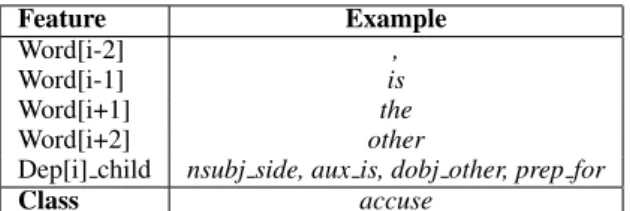
Table 1: Example of features and class label ex-tracted from a sentence: Each side, government and opposition, is *accusing/blaming the other for the political crisis, and for the violence.
pare a corrected sentence against its original sen-tence, and when word insertion and deletion er-rors are identified, we put a spaceholder (Figure 2). We then extract error-correction (i.e. replace-ment) pairs by comparing trigrams around the re-placement in the original and corrected sentences, for considering surrounding context of the target. These error-correction pairs are a mixture of gram-matical mistakes, spelling errors, and semantic confusions. Therefore, we identify pairs due to se-mantic confusion; we exclude grammatical error corrections by eliminating pairs whose error and correction have different part-of-speech (POS)5, and exclude spelling error corrections based on edit-distance. As a result, we extract 689 unique verbs (lemma) and 3,885 correction pairs in total.
Using the error-correction pairs, we calculate conditional probabilities P(we|wc), which repre-sent how probable that ESL learners misuse the word wc as we. Based on the probabilities, we compute a confusion matrix. The confusion ma-trix can generate distractors reflecting error pat-terns of ESL learners. Given a sentence, we iden-tify verbs appearing in the confusion matrix and make them blank, then outputs distractor candi-dates that have high confusion probability. We rank the candidates by a generative model to consider the surrounding context (e.g. N-gram). We refer to this generative method as Confusion-matrix Method (CFM).
2.2 Discriminative Model for Distractor Generation and Selection
To generate distractors that considers long-distance context and reflects detailed syntactic in-formation of the sentence, we train multiple clas-sifiers for each target word using error-correction pairs extracted from ESL corpus. A classifier for
a target word takes a sentence (in which the tar-get word appears) as an input and outputs a verb as the best distractor given the context using fol-lowing features: 5-gram (±1 and±2 words of the target) lemmas and dependency type with the tar-get child (lemma). The dependent is normalized when it is a pronoun, date, time, or number (e.g.he → #PRP#) to avoid making feature space sparse. Table 1 shows an example of features and a class label for the classifier of a target verb (blame).
These classifiers are based on a discriminative model: Support Vector Machine (SVM)6(Vapnik, 1995). We propose two methods for training the classifiers.
First, we directly use the corrected sentences in the Lang-8 corpus. As shown in Table 1, we use the 5-gram and dependency features7, and use the
original word (misused word by ESL learners) as a class. We refer to this method as DiscESL.
Second, we train classifiers with an ESL-simulated native corpus, because (1) the number of sentences containing a certain error-correction pair is still limited in the ESL corpus and (2) corrected sentences are still difficult to parse cor-rectly due to inherent noise in the Lang-8 corpus. Specifically, we use articles collected fromVoice of America (VOA) Learning English8, which con-sist of 270k sentences. For each target in a given sentence, we artificially change the target into an incorrect word according to the error probabilities obtained from the learners confusion matrix ex-plained in Section 2.2. In order to collect a suf-ficient amount of training data, we generate 100 samples for each training sentence in which the target word is replaced into an erroneous word. We refer to this method as DiscSimESL9.
3 Evaluation with Native-Speakers
In this experiment, we evaluate the reliability of generated distractors. The authors asked the help of 3 native speakers of English (1 male and 2 fe-males, majoring computer science) from an au-thor’s graduate school. We provide each partici-pant a gift card of $30 as a compensation when completing the task.
6We use Linear SVM with default settings in the scikit-learn toolkit 0.13.1.http://scikit-learn.org
7
We use the Stanford CoreNLP 1.3.4 http://nlp. stanford.edu/software/corenlp.shtml
8
http://learningenglish.voanews.com/
9The implementation is available at https:
//github.com/keisks/disc-sim-esl
Method Corpus Model Proposed
CFM ESL Generative
DiscESL ESL Discriminative
DiscSimESL Pseudo-ESL Discriminative
Baseline
THM Native Generative
RTM Native Generative
Table 2: Summary of proposed methods (CFM: Confusion Matrix Method, DiscESL: Discrimina-tive model with ESL corpus, DiscSimESL: Dis-criminative model with simulated ESL corpus) and baseline (THM: Thesaurus Method, RTM: Roundtrip Method).
In order to compare distractors generated by dif-ferent methods, we ask participants to solve the generated fill-in-the-blank quiz presented in Fig-ure 1. Each quiz has 3 options: (a) only word A is correct, (b) only word B is correct, (c) both are correct. The source sentences to generate a quiz are collected from VOA, which are not included in the training dataset of the DiscSimESL. We gen-erate 50 quizzes using different sentences per each method to avoid showing the same sentence mul-tiple times to participants. We randomly ordered the quizzes generated by different methods for fair comparison.
We compare the proposed methods to two base-lines implementing previous studies: Thesaurus-based Method (THM) and Roundtrip Translation Method (RTM). Table 2 shows a summary of each method. The THM is based on (Sumita et al., 2005) and extract distractor candidates from syn-onyms of the target extracted from WordNet10.
The RTM is based on (Dahlmeier and Ng, 2011) and extracts distractor candidates from roundtrip
(pivoting) translation lexicon constructed from the WIT3
corpus (Cettolo et al., 2012)11, which cov-ers a wide variety of topics. We build English-Japanese and English-Japanese-English word-based trans-lation tables using GIZA++ (IBM Model4). In this dictionary, the target word is translated into Japanese words and they are translated back to En-glish as distractor candidates. To consider (local) context, the candidates generated by the THM, RTM, and CFM are re-ranked by 5-gram language
10
WordNet 3.0 http://wordnet.princeton. edu/wordnet/
Method RAD (%) κ Proposed
CFM 94.5 (93.1 - 96.0) 0.55 DiscESL 95.0 (93.6 - 96.3) 0.73 DiscSimESL 98.3 (97.5 - 99.1) 0.69 Baseline
THM 89.3 (87.4 - 91.3) 0.57 RTM 93.6 (92.1 - 95.1) 0.53
Table 3: Ratio of appropriate distractors (RAD) with a 95% confidence interval and inter-rater agreement statisticsκ.
model score trained on Google 1T Web Corpus (Brants and Franz, 2006) with IRSTLM toolkit12. As an evaluation metric, we compute the ratio of appropriate distractors (RAD) by the following equation: RAD = NAD/NALL, where NALL is the total number of quizzes andNAD is the num-ber of quizzes on which more than or equal to 2 participants agree by selecting the correct answer. When at least 2 participants select the option (c) (both options are correct), we determine the dis-tractor as inappropriate. We also compute the av-erage of inter-rater agreementκamong all partici-pants for each method.
Table 3 shows the results of the first experiment; RAD with a 95% confidence interval and inter-rater agreement κ. All of our proposed methods outperform baselines regarding RAD with high inter-rater agreement. In particular, DiscSimESL achieves 9.0% and 4.7% higher RAD than THM and RTM, respectively. These results show that the effectiveness of using ESL corpus to gener-ate reliable distractors. With respect to κ, our discriminative models achieve from 0.12 to 0.2 higher agreement than baselines, indicating that the discriminative models can generate sound dis-tractors more effectively than generative models. The lowerκon generative models may be because the distractors are semantically too close to the tar-get (correct answer) as following examples:
The coalition has *published/issued a report saying that ... .
As a result, the quiz from generative models is not reliable since both published andissued are cor-rect.
4 Evaluation with ESL Learners
In this experiment, we evaluate the validity of gen-erated distractors regarding ESL learners’ profi-12The irstlm toolkit 5.80 http://sourceforge.
net/projects/irstlm/files/irstlm/
Method r Corr Dist Both Std Proposed
CFM 0.71 56.7 29.6 13.5 11.5
DiscESL 0.48 62.4 27.9 10.4 12.8 DiscSimESL 0.76 64.0 20.7 15.1 13.4 Baseline
THM 0.68 57.2 28.1 14.6 10.7
RTM 0.67 63.4 26.9 9.5 13.2
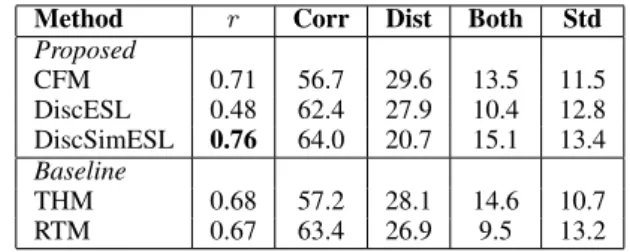
Table 4: (1) Correlation coefficient r against par-ticipants’ TOEIC scores, (2) the average percent-age of correct answer (Corr), incorrect answer of distractor (Dist), and incorrect answer that both are correct (Both) chosen by participants, and (3) standard deviation (Std) of Corr.
300 400 500 600 700 800 900 1000
TOEIC Score
20 30 40 50 60 70 80 90 100
A
ccu
ra
cy
(%
)
DiscSimESL Thesaurus (THM)
Figure 3: Correlation between the participants’ TOEIC scores and accuracy on THM and Disc-SimESL.
ciency. Twenty-three Japanese native speakers (15 males and 8 females) are participated. All the par-ticipants, who have taken at least 8 years of En-glish education, self-report proficiency levels as the TOEIC scores from 380 to 99013. All the par-ticipants are graduate students majoring in science related courses. We call for participants by e-mailing to a graduate school. We provide each participant a gift card of $10 as a compensation when completing the task. We ask participants to solve 20 quizzes per each method in the same manner as Section 3. To evaluate validity of dis-tractors, we use only reliable quizzes accepted in Section 3. Namely, we exclude quizzes whose op-tions are both correct. We evaluate correlation be-tween learners’ accuracy for the generated quizzes and the TOEIC score.
Table 4 represents the results; the highest
lation coefficientrand standard deviation on Disc-SimESL shows that its distractors achieve best va-lidity. Figure 3 depicts the correlations between the participants’ TOEIC scores and accuracy (i.e. Corr.) on THM and DiscSimESL. It illustrates that DiscSimESL achieves higher level of positive cor-relation than THM. Table 4 also shows high per-centage of choosing “(c) both are correct” on Disc-SimESL, which indicates that distractors gener-ated from DiscSimESL are difficult to distinguish for ESL learners but not for native speakers as a following example:
..., she found herself on stage ...
*playing/performinga number one hit.
A relatively lower correlation coefficient on DiscESL may be caused by inherent noise on pars-ing the Lang-8 corpus and domain difference from quiz sentences (VOA).
5 Conclusion
We have presented methods that automatically generate semantic distractors of a fill-in-the-blank quiz for ESL learners. The proposed methods em-ploy discriminative models trained using error pat-terns extracted from ESL corpus and can gener-ate reliable distractors by taking context of a given sentence into consideration. The human evalua-tion shows that 98.3% of distractors are reliable when generated by our method (DiscSimESL). The results also demonstrate 0.76 of correlation coefficient to their TOEIC scores, indicating that the distractors have better validity than previous methods. As future work, we plan to extend our methods for other POS, such as adjective and noun. Moreover, we will take ESL learners’ pro-ficiency into account for generating distractors of appropriate levels for different learners.
Acknowledgments
This work was supported by the Microsoft Re-search Collaborative ReRe-search (CORE) Projects. We are grateful to Yangyang Xi for granting per-mission to use text from Lang-8 and Takuya Fu-jino for his error pair extraction algorithm. We would also thank anonymous reviewers for valu-able comments and suggestions.
References
Charles Alderson, Caroline Clapham, and Dianne Wall. 1995. Language Test Construction and Evaluation. Cambridge University Press.
Thorsten Brants and Alex Franz. 2006. Web 1T 5-gram Corpus version 1.1. Technical report, Google Research.
Mauro Cettolo, Christian Girardi, and Marcello Fed-erico. 2012. WIT3
: Web Inventory of Transcribed and Translated Talks. InProceedings of the 16th Conference of the European Associattion for Ma-chine Translation (EAMT), pages 261–268, Trent, Italy, May.
Daniel Dahlmeier and Hwee Tou Ng. 2011. Cor-recting semantic collocation errors with l1-induced paraphrases. InProceedings of the 2011 Conference on Empirical Methods in Natural Language Pro-cessing, pages 107–117, Edinburgh, Scotland, UK., July.
Ayako Hoshino and Hiroshi Nakagawa. 2005. A Real-Time Multiple-Choice Question Generation for Lan-guage Testing―A Preliminary Study―. In Pro-ceedings of the 2nd Workshop on Building Educa-tional Applications Using NLP, pages 17–20, Ann Arbor, June.
Claudia Leacock, Martin Chodorow, Michael Gamon, and Joel R. Tetreault. 2010. Automated Grammat-ical Error Detection for Language Learners. Syn-thesis Lectures on Human Language Technologies. Morgan & Claypool Publishers.
Chao-Lin Liu, Chun-Hung Wang, Zhao-Ming Gao, and Shang-Ming Huang. 2005. Applications of Lexical Information for Algorithmically Composing Multiple-Choice Cloze Items. InProceedings of the 2nd Workshop on Building Educational Applications Using NLP, pages 1–8, Ann Arbor, June.
Ruslan Mitkov, Le An Ha, and Nikiforos Karamanis. 2006. A Computer-Aided Environment for Generat-ing Multiple-Choice Test Items. Natural Language Engineering, 12:177–194, 5.
Eiichiro Sumita, Fumiaki Sugaya, and Seiichi Ya-mamoto. 2005. Measuring Non-native Speak-ers’ Proficiency of English by Using a Test with Automatically-Generated Fill-in-the-Blank Ques-tions. InProceedings of the 2nd Workshop on Build-ing Educational Applications UsBuild-ing NLP, pages 61– 68, Ann Arbor, June.
Vladimir Vapnik. 1995. The Nature of Statistical Learning Theory. Springer.