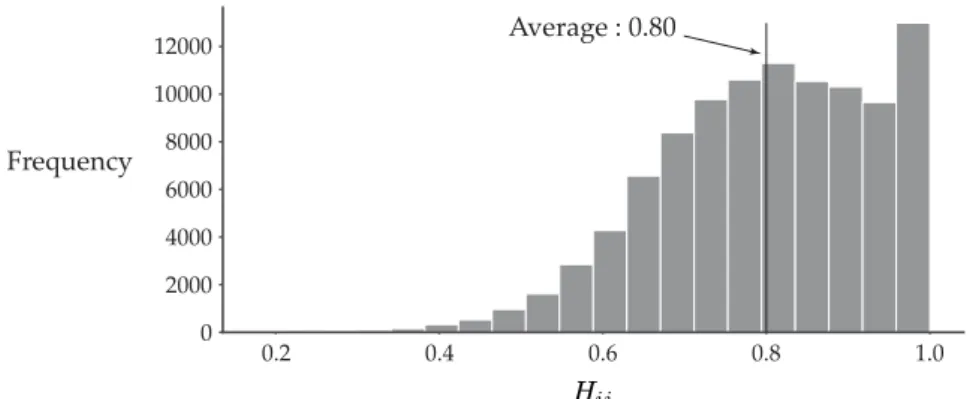
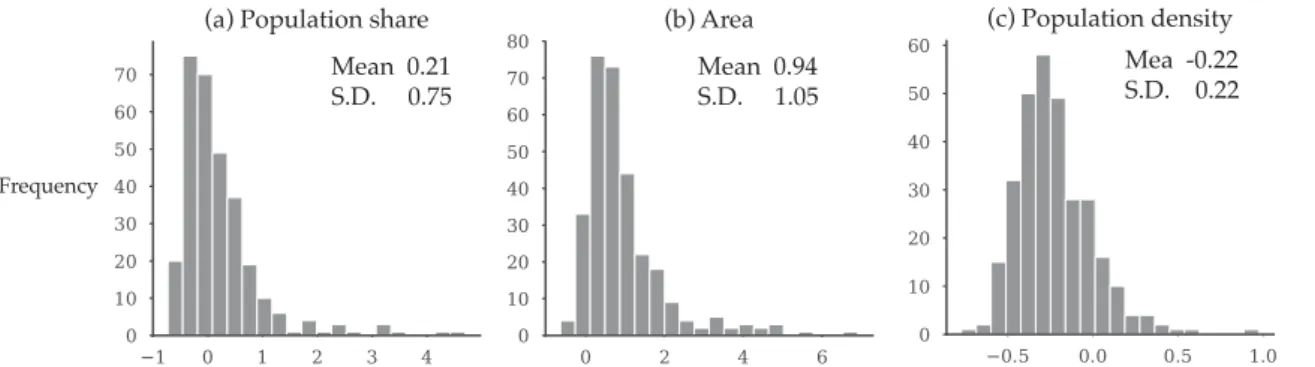
Yet these exogenous locational features may not be the most potent forces governing the spatial pattern of cities. In particular, population size, distance, and industrial composition of cities exhibit simple, persistent, and monotonic relationships. The mechanisms linking the spatial pattern of cities and the diversity of city sizes are also discussed in detail.
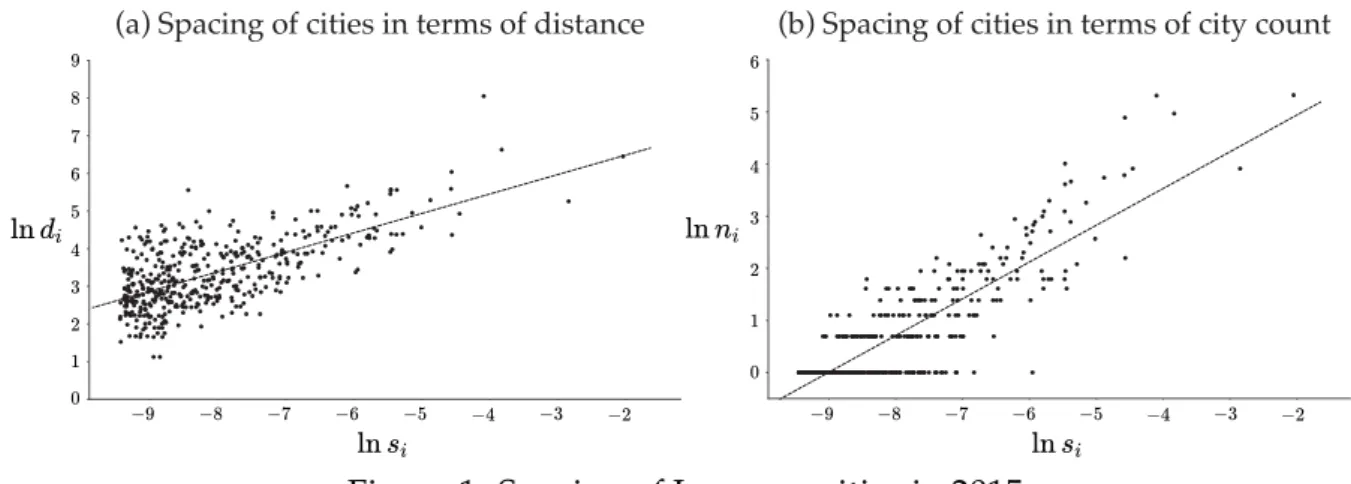
For the size and industrial structure of cities discussed in Section 2.3, qualitatively similar results were also presented for the US case (see Hsu, 2012; Schiff, 2014) within standard urban area and industrial classifications. This core pattern of cities naturally implies that larger cities are further apart. 11 Dobkins and Ioannides (2001) found a negative correlation between the size and spacing of US cities for the period 1900-1980.
The formation of cities began in the northeastern region of the USA in the 19th century, and then gradually expanded to the west and then to the south. As a result, the spacing of cities of the same size class has increased over time. The level of interregional transport access has been one of the key parameters to determine the size and spatial patterns of cities in the literature.
3 Theories
Spatial pattern of cities
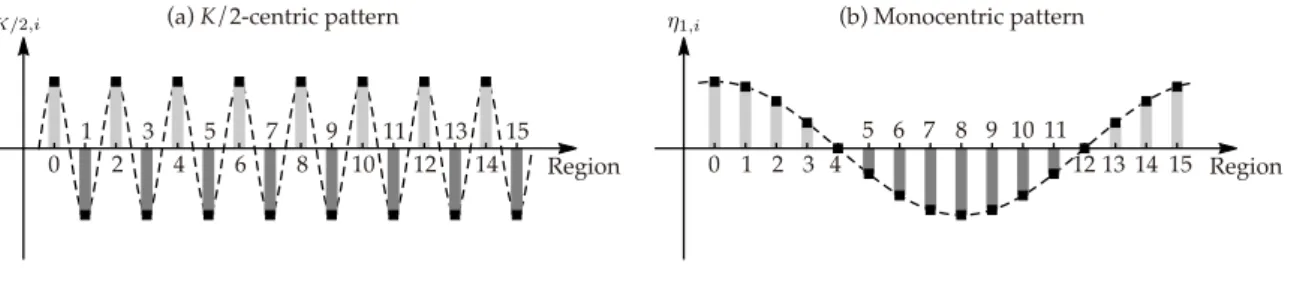
To address the stability of equilibria, a standard approach in the literature is to introduce equilibrium refinement based on local stability under myopic evolutionary dynamics, where the rate of change in the number of inhabitants in region i is modeled based on the regional distribution of agents. , hhh, and that of profit, vvv(hhh). Although the presence of the edge tends to make edge crowding larger, since there is no competitive crowding beyond the edge (see, e.g., Fujita and Mori, 1997; Ikeda et al., 2017), this effect becomes negligible for a large economy, and patterns of accumulation may approximate that in the no-advantage economy. The eigenvector associated with fkis given byηηηk=(ηk,i)=(cos[θki]) fori∈ Kwithθ≡2π/K, and the bifurcation from the flat earth equilibrium occurs in the direction given by hhh=hhh¯+ηηηk with >0.
The split under c0<0 takes place in the increasing phase of the transport costs, while that under c2<0 is in the decreasing phase. Provided that c2<0, the splitting takes place in the direction of ηK/2, i.e. every other region along the circuit attracts immigration of mobile agents, when G(fK/2) becomes positive (see Figure 6(a) ).). Provided that c0<0, the splitting takes place in the direction of ηηη1 when G(f1) becomes positive (see Fig. 6(b)).
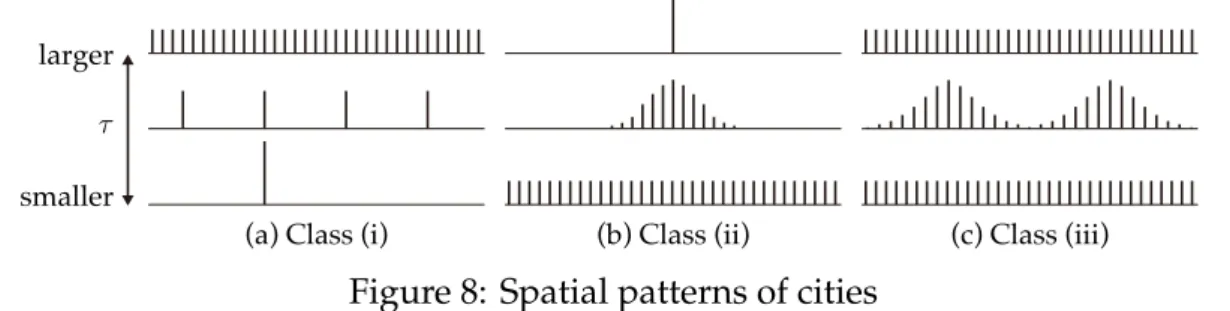
In models of this class, maintaining the unimodal regional distribution, the concentration of mobile agents continues with increasing transport costs, until all mobile agents are concentrated in one region (Figure 8b). In the context of a two-region model or a city systems model in which there is no change in interregional distance, the distribution of mobile agents in class (i) and class (ii) models looks exactly the same. Distribution occurs on a global scale in models of class (i) - in the form of an increase in the number of cities, and on a local scale in models of class (ii) - in the form of a larger spatial extension of a city. .
More specifically, given the lower interregional transport costs, the agglomeration continues on a global scale, i.e. the number of cities decreases, the sizes and the spacing of the remaining cities increase, while the dispersion. Note that the behavior of Class (i) models is essentially responsible for the larger cities that are more spaced apart as discussed in Section 2.1, and the behavior of Class (iii) models, i.e. the combination of Classes (i ) and (ii), may account for the evolution of urban growth of Japan discussed in Section 2.4. 30 Of course, the actual evolution of the spatial patterns under the changing level of transport costs is more complicated, as neighboring cities may eventually merge in the case of Class (iii) models.
In the 1970s and 1980s, there were a number of attempts to explain the endogenous formation of central business districts (CBDs) in the city. While the above models differ in the specification of positive externalities, Fujita and Smith (1990) showed that their formulations are essentially equivalent and are usually reformulated by the so-called additive interaction function, Si(hhh)≡P. In the NEG literature, a particularly important deviation from canonical models is the consideration of different transport cost structures by industry.
This type of dispersive force has been shown to lead to the formation of an industrial belt, a continuum of agglomeration associated with multiple atoms of agglomeration as demonstrated by the simulations in Mori (1997) and Ikeda, Murota, Akamatsu and Takayama (2017 ).
Diversity in city size
This distinction is especially crucial for explaining the locational patterns within a city, while it may be less relevant for explaining the spatial pattern of cities. At present, few formal results have been obtained regarding the spatial pattern of cities that emerge in these models (see Osawa, 2016, for recent theoretical development in this direction). An important implication of random growth theory is that similar power laws hold for all (sufficiently large) random subsets of cities in a country, that is, without regard to the spatial relationship between cities.
This theory thus essentially denies the interdependence of size and spatial patterns of cities. However, as discussed in Section 2.2, Mori et al. 2019) showed that the agreement in power laws for city size distributions is much stronger among the cells in the spatial hierarchical partitions of cities corresponding to the central place patterns than among random subsets of cities, i.e. if city sizes were generated by a random growth process. 36,37. To account for the large diversity in city size actually observed by the many-region models described in Section 3.1, one must include diversity in increasing returns (and/or that in transport costs).
Although the Class (i) models discussed above with global dispersion power can account for the formation of multiple cities, there is little variation in the size of cities to be realized in equilibrium, as each model has only one type of increasing return. The key to accounting for diversity in city size in these models is the spatial coordination of agglomerations between industries through inter-industry demand externalities arising from common consumers between industries. An industry subject to greater increasing returns agglomerates into a smaller number of more widely spaced cities.
37There are still opportunities to extend random growth models by adding spatial relationships between cities, thus accounting for the spatial fractal structure of city systems in terms of power laws of city size distribution. In particular, Hsu (2012) proposed a unique spatial competition model with product differentiation and economies of scale in production, and on this point provided the most far-reaching formal explanation for the interdependence between spatial patterns and diversity in the size of cities. When the distribution of economies of scale in each firm's production (which in his model is expressed in terms of the sector-specific fixed costs of production) varies regularly, his model jointly replicates the power law for the city size distribution (section 2.2). with the positive correlation between the size and distance between cities (section 2.1), the power law for the number and average size of industries' choice cities (section 2.3), as well as the hierarchy principle observed in Japan (section 2.3).
Davis and Dingel (2019) offer an alternative mechanism for spatial coordination among industries, which in turn results in the principle of hierarchy and the diversity of city sizes in the context of a systems-of-city model.38 Concretely, the principle of hierarchy arises in this model. from vertical heterogeneity in skill levels among workers and skill requirements of industries along with positive externality between industries confined to the same city. 38Rossi-Hansberg and Wright (2007) formulate a random growth model using the urban systems model where cities specialize in a single distinct industry and power laws arise for sizes of these cities.
4 Concluding remarks
Blanchet, Adrien, Pascal Mossay and Filippo Santambrogio, “Existence and Uniqueness of Equilibrium for a Spatial Model of Social Interactions,” International Economic Review. Borukhov, Eli and Oded Hochman, “Optimal and market equilibrium in a model of a city without a predetermined center”, Environment and planning A. Combes, Pierre-Philippe, Gilles Duranton and Laurent Gobillon, “Spatial wage differences: sorting matters!, ” Journal of Urban Economics, March.
D´avid Kriszti´an Nagy and Esteban Rossi-Hansberg, “The Geography of Development”, Journal of Political Economy, 2017, forthcoming. Duranton, Gilles, “Some Foundations for Zipf's Law: Product Diffusion and Local Effects”, Regional Science and Urban Economics, July. Economides, Nicholas, and Aloysius Siow, “Market Segmentation Constrained by the Extent of Liquidity (Spatial Competition with Externalities),” American Economic Review, March.
Faber, Benjamin, "Trade Integration, Market Size, and Industrialization: Evidence from China's National Trunk Highway System," Review of Economic Studies. Fujita, Masahisa, "A Monopolistic Competition Model of Spatial Aggregation: The Differentiated Product Approach," Regional Science and Urban Economics. Vernon Henderson and Jacques-Franc¸ois Thisse, eds., Handbook of Regional and Urban Economics, Vol.
Ottaviano, Takatoshi Tabuchi and Jacques-Franc¸ois Thisse, “Agglomeration and trade revisited,” International Economic Review. Ikeda, Kiyohiro, Kazuo Murota, Takashi Akamatsu, and Yuki Takayama, "Agglomeration Patterns in a Long Narrow Economy of a New Economic Geography Model: Analogy to a Race Track Economy," International Journal of Economic Theory. Ikeda, Kyohiro, Takashi Akamatsu, and Tatsuhito Kono, "Spatial period-doubling agglomeration of a core-periphery model with a system of cities," Journal of Economic Dynamics & Control.
Kanemoto, Yoshitsugu, "Optimal Cities with Indivisibility of Production and Interfirm Interactions," Journal of Urban Economics. Smith, "An Industrial Agglomeration Approach to Regularities in Central Place and City Size," Journal of Regional Science. Smith, "The Number Average Size Rule: A New Empirical Relationship Between Industrial Location and City Size," Journal of Regional Science.
Ota, Mitsuru and Masahisa Fujita, “Communication Technologies and Spatial Organization of Multi-Unit Firms in Metropolitan Areas,” Regional Sciences and Urban Economics.