Life Cycle Analysis and Modelling (LCAM) of Jatropha as Biofuel
in Dynamic Economic Environment of Newly Emerging Economies
Sangeeta Sinha*, Seiichi Suzuki**, Toshinori Kojima***,
Shigeru Kato**** and Sanjay Kumar*****
Abstract
The geographic location of new emissions is shifting from the industrialised countries to the newly emerging economies, expanding at a pace of over 5% per annum despite global economic slowdown. India, the 6th largest consumer of energy would spend US$ 19.4 billion (@ US$ 100/barrel) on importing gasoline by 2020, if viable renewable sources of energy are not developed. Biofuels are credible supplement for liquid fossil fuels even at present. They are easy to transport and fall in zero emission category. Biodiesels derived from Jatropha can be locally produced in rural areas for agricultural purposes. Jatropha is being promoted as biofuel crop in India through large scale plantations and nurseries and by women’s self-help groups who use a system of microcredit to ease poverty among semiliterate Indian women. The Life Cycle Analysis was done for a typical arid area, Panna, M.P. (India) for Jatropha cultivation on wasteland, poor agricultural land, scantily planted forest land. The LCA investigation scope includes four landuse change scenarios with four input change scenario in cultivation stage. The economic return to farmers at different selling price of Jatropha seeds have also been studies with carbon mitigation option in diesel replacement in transportation.
I. Introduction
1Energy and economy are always related to each other as economy grows, the energy demand increases rapidly. According to IEA 2012, the energy demand by China, India
* Associate Professor, Center for Renewable Energy and Environmental Research, University Department of Physics, B. R. Ambedkar Bihar University, India
E-mail: [email protected]
** Associate Professor, Faculty of Science and Technology, Seikei University, Japan E-mail: [email protected]
*** Professor, Faculty of Science and Technology, Seikei University, Japan E-mail:[email protected]
**** Professor, Faculty of Science and Technology, Seikei University, Japan E-mail: [email protected]
***** Professor, Center for Renewable Energy and Environmental Research, University Department of Physics, B. R. Ambedkar Bihar University, India
E-mail: [email protected]
1 This article contains part of the research that the chief author, Sangeeta Sinha, conducted at Seikei University in the early summer of 2013. We would like to express our warmest gratitude to the Center for Asian and Pacific Studies (CAPS) for the generous fellowship that made Sinha’s stay at Seikei possible.
and the Middle East will be accounting for 60% out of total global energy demand over the period to 2035. International Energy Agency in its projection says that the growth in oil consumption in emerging economies, particularly for transport in China, India and the Middle East, will be more than the reduced demand by the OECD countries. The fuel demand for transport sector accounts for more than half of global oil consumption. It is responsible for almost 40% of the increase in global oil demand. Demand for diesel-oil for trucks increases much faster than that for passenger vehicles, because no fuel-economy standard is adopted by trucks.
The India’s economy is expected to grow at a rate of over 6% per annum till 2020. At present, India is the world’s 6th largest consumer of energy, accounting for 3.5% of world commercial energy consumption with current consumption of 17.3 billion litres per year of gasoline. Demand of energy in India is also expected to grow at rate 8.5% per year till 2020 (Figure 1). Figure 1 shows that the domestic production of crude oil has stagnated, while the demand has been rising at a rapid rate, resulting in huge gap in demand and supply and increased crude oil imports and also price. It has to spend US$ 19.4 billion on importing gasoline by 2020 (assuming crude oil costs US$ 100/barrel) if no other options are available. It will become the third largest consumer of transportation fuel in 2020 after the United States of America and China. Transport fuel consumption is expected to grow @ 6.8% from 1999 to 2020 (Francis et al. 2005). The demand for diesel is five times higher than the demand for gasoline in India. The number of vehicles on Indian roads has increased rapidly over the last decade with increase in per capita income. Two wheelers will increase from 102 to 393 per 1000 people and cars will increase from 14 to 48 per 1000 people by 2020 (Figure2).
Figure 1: Forecast of oil production, consumption, no. of vehicles and consumption of transport oil in India (Source: Francis et al. 2005)
Figure 2: Increase in no. of vehicles in India with per capita income (Source: Francis et al. 2005)
Indian petrol reserves are expected to last for another 20 years. Rising and volatile prices and respective foreign exchange costs are one of the main risk factors of the Indian economic and social development prospects. The transport sector is the most problematic as no realistic alternatives have been found so far. Hydrocarbons, in India predominantly diesel, is used more than 80% of total transport fuel as compared to Germany uses only 40%. Domestic supply can presently satisfy 22% of demand and dependence on crude oil imports is ever increasing. There is a growing demand gap between production and consumption. At the same time, per capita consumption with 480 kg oil equivalent is quite low. Presently, USA and Europe have policy of blending 5% to 20% of biofuel in petro-diesel without engine modification. In France 5% bio-diesel blending is mandatory and the USA alone produces more than 400,000 m3 biofuel every year (IEA 2012).
1. Biofuel types and processes
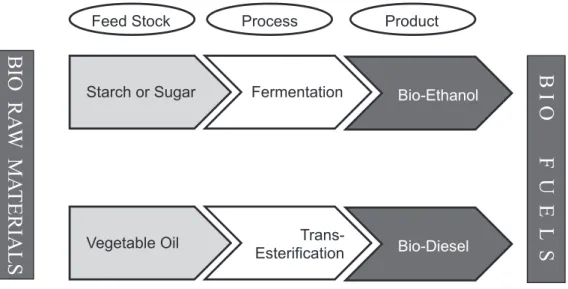
Bioethanol and Biodiesel are two prominent biofuels for mixing in the petro-diesel to reduce the dependence on conventional diesel. Bioethanol is conversion of starch or sugar-rich biomass (sugar cane, other cereals, etc.) into sugar, fermentation, and distillation. In future, the Bioethanol or bio-oil can be produced by hydrolysis of ligno-cellulosic biomass, fermentation and distillation also known as biomass to liquid, (BTL). Similarly, Biodiesel is extraction and esterification of vegetable oils, used cooking oils and animal fats using alcohols. Presently, in India two pathways have been adopted to produce biofuels (Figure3).
Figure 3: Biofuel current pathways in India
Apart from global warming reduction potential, biofuels are environment renewable energy sources and their utilization can generate employment, balance of trade and finally economic development in rural areas. To reduce the dependence and import of petroleum, a National Mission on Biodiesel (NMB) was established by Govt. of India with the Ministry of Rural Development as the nodal ministry to study the possibility and sustainable biodiesel option available in the country. The demand for biofuels has been projected by Planning Commission, Government of India in 2003 (India 2003) and is shown in Table 1. On the basis of estimated growth rates of 7.3% and 5.6% for petrol and diesel, respectively, in the tenth five year plan (2001-2002 to 2006-2007), 5.0% and 5.0% growth in the eleventh five year plan (2006-2007 to 2011-2012) and 5.0% and 4.5% in the twelfth five year plan (2011-2012 to 2016-2017), the projection for biofuel demand at various percentage of blending has been calculated in the following Table 1.
Table 1: Projected demand for petrol and diesel, and biofuels requirements
Year Petrol demand
Mt
Ethanol blending requirement
(in metric tons) demandDiesel Mt
Biodiesel blending requirement (in metric tons) @ 5 % @ 10% @ 20% @ 5% @ 10% @ 20% 2006-2007 10.07 0.5 1.01 2.01 52.32 2.62 5.23 10.46 2011-2012 12.85 0.64 1.29 2.57 66.91 3.35 6.69 13.38 2016-2017 16.4 0.82 1.64 3.28 83.58 4.18 8.36 16.72
2. National mission on biodiesel (NMB): Government of India Policy
In April 2003, the committee on development of biofuels, recommended a major multi-dimensional program to replace 20% of India’s diesel consumption and 5% gasoline/ petrol consumption. India is the fourth largest ethanol producer after Brazil, the USA and China, its average annual ethanol output amounting to 1,900 million litres with a distillation capacity of 2,900 million litres per year. For a 5% ethanol blend in petrol
nationally, the ethanol required would be 640 million litres in 2006-2007 and 810 million litres in 2011-2012.
India is short of petroleum reserve but it has large arable land as well as good climatic conditions, therefore huge potential to produce biomass to be used into biofuels. The demand of edible oil in India is higher than production; it is therefore more expensive than petrol or diesel. Therefore, the edible oil used in Europe and the USA for transport oil cannot be considered eligible to produce bio-oil in India.
In India, bio-diesel is produced from non-edible vegetable oil of Jatropha curcas and
Pongamia pinnata, also known as Mahua. It requires little or no engine modification
up to 20% blend and minor modification at higher percentage blends. The use of bio-diesel results in substantial reduction of un-burnt hydrocarbons, carbon monoxide and particulate matters. It is considered to have almost no sulphur, no aromatics and has about 10% built in oxygen, which helps to bum it fully. Its higher cetane number improves the combustion quality. Almost all present emissions standards are expected to be reached with bio-diesel from Jatropha curcas.
Jatropha curcas is considered the most suitable since it uses lands, which are largely
unproductive for the time being and are located in poverty-stricken and watershed areas and degraded forests. Jatropha is planned as well to be planted under the poverty alleviation programs that deal with land improvements.
Studies show that the impact of bio-diesel production has direct as well as indirect impact e.g. employment generation, balance of trade, emission benefits etc. However, a clear comparison between the yields and economics of different edible and non-edible oils, and why production of non-edible oils for farmers is expected to be more viable than of edible oils, has not been studied in detail as yet. However, the policy by Govt. of India is meant to be designed in such a way that the price of bio-diesel will be slightly lower than that of imported petro-diesel fuel.
Since the demand for edible vegetable oil exceeds supply, the government of India has decided to use non-edible oil from Jatropha curcas seeds and smaller part from Pongomia as biodiesel feedstock. Extensive research has shown that Jatropha has lot of advantages - it requires low water and fertilizer for cultivation, it is not grazed by cattle or sheep, is pest resistant, is easily propagated, has a low gestation period, has a high seed yield and oil content and produces high protein manure.
Therefore NMB had two objectives in Jatropha plantation – one is to blend petro-diesel with a planned 16 Million ton of bio-petro-diesel by 2013 and – other is to use this mission in poverty alleviation. A large percentage of rural population of India has no access to electricity and even if they have access, electricity supply is not consistent or affordable. With developmental process picking up, mega cities have become energy starved. Each unit of energy addition or supply goes to the grid and thus to mega cities. Rural population remains energy deficient. This has particularly affected developmental process, education and agriculture-related activities. Jatropha is useful for decentralized application and is very suitable for rural energy supply and can be used for poverty alleviation. Therefore, direct use of Jatropha oil in rural engines, water pumps, tractors
and generators sets to produce electricity are additional option to provide rural energy and energy security to the rural population.
Thus, NMB proposed to raise Jatropha plantations on 0.4 million ha of wastelands in its first demonstration phase. Govt. of India has set a target of 20% blending of biofuels – bioethanol and biodiesel by 2017. To meet this target, eleven millions ha of presently unused lands was planned to be cultivated with Jatropha in the first phase. For Jatropha plantation in first phase, wasteland area of India was identified by Govt. of India as shown in Table 2 (India 2003). It was expected that ten million ha wasteland suitable for Jatropha crop can generate 7.5 million metric tons of fuel annually (Table 2). Land Resources Department, Ministry of Rural Development Govt. of India in 2010 (India 2010), has also identified the wasteland in state-wise and also percentage of total geographical area in district-wise. Map of Wasteland area suitable for Jatropha curcas. plantation is shown in Figure 4. To plant on ten million ha Jatropha, Government of India mobilized a large number of stakeholders including individuals, communities, entrepreneurs, oil companies, business, industry, the financial sector as well as Government and most of its institutions. The possibility of growing energy crops such as
Jatropha curcas has the potential to enable some smallholder farmers, producers and
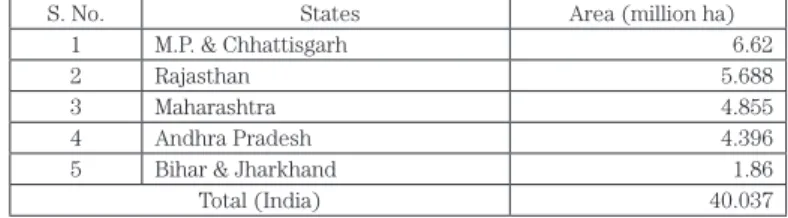
processors to cope with these pressures. Government of India has also identified state-wise wasteland for Jatropha cultivation. Table 3 shows million of hectare of wasteland available in few states.
Table 2: Land available for Jatropha plantations (million hectares) in India
Forest areas Agriculture (boundary Planation)
Agriculture
(agriforestry) fallow landsCultirable
Wastelands under intergrated watershed development Strip lands such as roads, railways, canal banks
Total wastelandsAdditional
3.0 3.0 2.0 2.4 2.0 1.0 13.4 4
Table 3: State-wise distribution of wasteland suitable for Jatropha plantations
S. No. States Area (million ha) 1 M.P. & Chhattisgarh 6.62
2 Rajasthan 5.688
3 Maharashtra 4.855
4 Andhra Pradesh 4.396
5 Bihar & Jharkhand 1.86
Total (India) 40.037
3. Jatropha curcas: overview and status
Jatropha curcas is an underutilized, oil-bearing crop. It produces a seed that can be
processed into non-polluting biodiesel that, if well exploited, can provide opportunities for good returns and rural development. In addition to growing on degraded and marginal lands, this crop has special appeal, in that it grows under drought conditions and animals do not graze on it. Besides, many of the actual investments and policy decisions on developing Jatropha as an oil crop have been made without the backing of sufficient science-based knowledge. Realizing the true potential of Jatropha requires separating
facts from the claims and half-truths.
Interest in Jatropha curcas as a source of oil for producing biodiesel has arisen as a consequence of its perceived ability to grow in semi-arid regions with low nutrient requirements and little care. The seed typically contains 35 percent oil which has properties highly suited to making biodiesel (Achten et al. 2010). Unlike other major biofuel crops, Jatropha is not a food crop since the oil is non-edible and is, in fact, poisonous. It is a low growing oil-seed-bearing tree that is common in tropical and subtropical regions where the plant is often used in traditional medicine and the seed oil is sometimes used for lighting. The tree is occasionally grown as a live fence for excluding livestock and for property demarcation. The rooting nature of Jatropha allows it to reach water from deep in the soil and to extract leached mineral nutrients that are unavailable to many other plants. The surface roots assist in binding the soil and can reduce soil erosion (Kumar et al. 2011).
The oil is highly suitable for producing biodiesel but can also be used directly to power suitably adapted diesel engines and to provide light and heat for cooking, it is fast growing and quick to start bearing fruit, and the seed is storable making it suited to cultivation in remote areas (Punia 2008). Jatropha could eventually evolve into a high yielding oil crop and may well be productive on degraded and saline soils in low rainfall areas. Its by-products may possibly be valuable as fertilizer, livestock feed, or as a biogas feedstock, its oil can have other markets such as for soap, pesticides and medicines, and Jatropha can help reverse land degradation.
Jatropha’s chief weaknesses relate to the fact that it is an essentially wild plant that has undergone little crop improvement. Its seed yields, oil quality and oil content are all highly variable. Most of the Jatropha currently grown is toxic which renders the seedcake unsuitable for use as livestock feed and may present a human safety hazard. Fruiting is fairly continuous which increases the cost of harvesting. Knowledge of the agronomy of Jatropha and how agronomic practices contribute to yield is generally lacking. Furthermore, there is an unknown level of risk of Jatropha curcas becoming a weed in some environments.
Optimum growing conditions are found in areas of 1,000 to 1,500 mm annual rainfall, with temperatures of 20°C to 28°C with no frost, and where the soils are free-draining sands and loams with no risk of water logging. Propagation is typically from seed. Cuttings offer the benefit of uniform productivity with the disadvantage that they do not generally develop a tap root. The production of clonal and disease-free plants using tissue culture is not yet a commercial reality. Attention to crop husbandry and adequate nutrition and water are essential to achieving high yields. Pruning is important to increase the number of flowering branches. Increasing oil yield must be a priority.
Reported yields have been between 1 and 1.6 tonnes per ha (Punia 2008; Lele 2008; Atchen et al. 2010; Biswas et al. 2010). Holistic schemes that embrace Jatropha production, oil extraction and utilization in remote rural communities appear the most viable, particularly where it’s other benefits are recognized, such as reversing land
degradation. Jatropha production systems can be characterized in terms of their direct or indirect potential contribution to pro-poor development.
Jatropha biofuel production could be especially beneficial to poor producers, particularly in semi-arid, remote areas that have little opportunity for alternative farming strategies, few alternative livelihood options and increasing environmental degradation. While there are various possibilities for utilizing the by-products of Jatropha – which would add value for the producers and reduce the carbon cost of the oil as a biofuel – there is an important trade-off between adding value and utilizing the byproducts as soil ameliorants to reverse land degradation. Local utilization of Jatropha oil is one of a number of strategies that may be used to address energy poverty in remote areas and could be part of production systems or part of a “living fence” to control livestock grazing.
The purpose of the research is to investigate the life cycle assessment (LCA) of
Jatropha curcas plantation in four landuse changes and input change scenario in
semi-arid areas region of Panna district, Madhya Pradesh, India. The economic return to the farmers has also been calculated in different cultivation input scenarios at different selling prices of Jatropha seeds.
II. Methodology
1. Study site
The study site is Panna district of Madhya Pradesh, located in the middle part of India. Panna district is situated in the North-East corner of Madhya Pradesh. It is located at a distance of 450 km from Bhopal, the state capital of Madhya Pradesh (Figures 4a, 4b). Geographically it is located between latitudes 23.450 and 25.100N and longitudes 79.45 and 80.400E. It almost lies in the Torrid Zone and extends over an area of 7,135 sq.km. It is situated at a height of 355 m above sea level. The highest topographic elevation in the area is 537 m above sea level in tehsil Panna and the lowest is 341m above sea level in tehsil Ajaygarh. The Ken River is the life line of the district. Agriculture is the basis of Panna’s economy. Total area of Panna district is 702,924 ha and 50% of geological area consists of hard rock. The district administration has identified the landuse as forest land, open forest land (without forest trees), assured arable land, wasteland, cultivable wasteland (single crop area) etc. Figure 5 shows the percentage of different categories of landuse in Panna. The land under agriculture is 268,363 ha of the total land, but only 78,694 ha of the land are under assured and organized source of irrigation and is double cropped. The rest of the agricultural land is totally dependent on rain-fed irrigation and produces only one crop a year (single crop area).
Figure 4a: State-wise wastelands distribution (percentage to total geographical area) (Source: URL: www.dolr.nic.in/wasteland_ atlas.htm )
Figure 5: Percentage distribution of land category in Panna district
Table 4 shows the data of agricultural resources and productivity of Panna district with state and national average data. The data of the most commercialized farming state of India Punjab is also given in the Table 4 for the comparison. Winter produce of wheat yield in Panna is 646 kg/ha as against state average of 927 kg/ha, similarly the summer yield is 977 kg/ha against state average of 1,612 kg/ha. It shows the low quality soil of Panna district. The fertilizer consumption kg/ha in this district is also very low 26kg/ha as against state average 70kg/ha and commercialized farming of Punjab state is 221kg/ha (Table 4). A comparative data for agricultural practices given in Table 4 is to show how poor agricultural practices are being used in Panna district.
Table 4: Comparison of Agricultural Resources/Productivity in Panna District with national, state and Punjab average (2008-09)
Parameters All India productivity)Punjab (max Madhya Pradesh Panna district Geographical area (x1000ha) 328,726 5,036 30,825 702.924 Arable area (x1000ha) 182,442 4,236 17,337 268.363 Irrigated area (% of arable area) 90.9 98.6 83.9 29.32
Av. Rainfall (mm) - 649 1,017 1,076*
Crop productivity kg/ha (2008-09)
Winter 2,192 4,022 927 646
Crop productivity kg/ha (2008-09)
Summer 2,907 4,462 1,612 977
Fertilizer used (kg/ha) 128.58 221.42 70.77 26.12 Electricity used in Agriculture
(GWh) 104,181.69 10,022.20 7,535.59
--Electricity used (kWh/ha) 571.04 2,365.96 434.65
--*Source of rainfall data: http://www.indiastat.com/meteorologicaldata/22/rainfall
2. Study Scenarios
Four landuse scenarios for Jatropha plantation have been assumed in Panna district (Table 5) and their details are explained as follows:
S1: Biodiesel production from Jatropha cultivation in open forest area (122,855ha),
wasteland (22,807ha) and single crop arable land (1,896,694ha) without any irrigation and chemical fertilization. The Jatropha is planted via nursery propagation method during rainy season and cultivation and harvest depends only on rain but first year the preparation of field was done before plantation. On the basis of present cost of labour, fertilizer, diesel for irrigation, etc., input cost up to three years including plantation cost (Rs.25,000/ha) and maintenance for two years (Rs.5,000/ha/yr) is considered in this scenarios comes out to be Rs.5,000/ha (Punia 2008). Due to wasteland and low productivity field and no maintenance the yield after three years can be considered to be 400gm/tree only (Estrin, 2009; Lele 2010).
S2: Jatropha cultivation in wasteland using mild chemical fertilizer 26kg/ha and two
times irrigation in a year up to three years. Due to low productivity area but mild fertilizer and irrigation applied for three years. Input cost up to three years including plantation, fertilizer and irrigation, is considered Rs.45,000/ha. The yield after three years can be expected to be average 1kg/tree.
S3: Jatropha cultivation on wasteland (22,807ha) and single crop arable land
(1,896,694ha) using chemical fertilizer of 70kg/ha and two times irrigation. Input cost up to three years including plantation, fertilizer and irrigation, is considered Rs.55,000/ ha. The yield after three years can be expected to be 1.6kg/tree as the maintenance has increased.
Table 5: Description of four landuse change scenario of Jatropha plantation with different use of fertilizer and irrigation
Panna District,
M.P. (India) availableArea S1 (No fertilizer & Irrigation) Fertilizer =26kg/ha/S2 (upto 3year) yr and Irrigation= 2times/yr S3 (upto 3year) Fertilizer =70kg/ha/ yr and Irrigation= 4 times/yr S4 (commercialized) Fertilizer =220kg/ha/ yr and Irrigation= 4 times/yr Open Forest 122,855 ha Jatropha
plantation No change No change Jatropha plantation Waste land 22,807ha Jatropha
plantation Jatropha plantation Jatropha plantation Jatropha plantation Single Crop
area 189,669 ha Jatropha plantation Single Crop Jatropha plantation Double Crop
S4: Jatropha cultivation in open forest land (122,855ha) and wasteland (22,807ha)
using four times irrigation and chemical fertilizer hectare (220kg/ha) per year with commercialized agricultural management. The cost of labour, fertilizer and diesel for irrigation, the maintenance is the highest in this scenario; however, it is considered to be fixed in successive years. Therefore the input cost including plantation and maintenance for two years is expected to be Rs.85,000/ha. With best agricultural management, the yield after three years is also expected to be 4kg/tree.
3. Assumptions and date inventory
The life cycle of biodiesel has been analyzed in four landuse change scenarios (S1-S4) vis-à-vis different fertilizer and water input during Jatropha cultivation process. The landuse scenarios include Jatropha cultivation on wasteland, single crop land (poor agricultural land) and so-called open forest land (non-existent forest land). Jatropha oil extraction is assumed from mechanical screw pressing and the biodiesel is obtained from transesterification of Jatropha C. oil by base-catalyzed using potassium hydroxide with methanol as the alcohol. It is assumed that the Jatropha oil extraction facility is co-located with the biodiesel transesterification plant for logistical reasons. The plantation technique is adopted using Govt. of India direction and the productivity of the Jatropha seeds per tree from 400gm/tree to 4kg/tree (Lele 2010) in four scenarios has been considered based on fertilizer and water input. Specific data for the cultivation of Jatropha curcas was collected from the test plots in Panna district, Madhya Pradesh, India. The inventory data for biodiesel production from Jatropha has been derived mainly from literature. The background data on energy supply, industrial processes, transportation and infrastructure were taken from ecoinvent v2.2. The Indian electricity mix was modeled according to Withaker and Heath (2009). The global warming potential (GWP) was assessed with a 100-year time horizon and is based on the characterization factors provided by IPCC. It has to be noted that the carbon uptake during Jatropha curcas cultivation is assumed to be equal to the biogenic carbon release during combustion and thus is not accounted for in the impact assessment. This study assumes that both are located at Panna within 50km of range from field. For LCA study of biodiesel production from Jatropha C. oil starting from plantation till end use, MiLCA software has been used. There are two well-known methods of LCA calculation, summation and matrix and MiLCA adopts the summation method. Following assumptions have been made for LCA calculation for biodiesel production from Jatropha C. oil starting from plantation till diesel replacement per hectare.
・ Jatropha plantation is considered via nursery.
・ Tree density is taken as 2,500 trees per hectare in a 2m x 2m planting grid. ・ Four scenarios (S1, S2, S3 and S4) of land-use change have been considered
for Jatropha plantation and harvest to study the change in Carbon stock in different eco-system.
・ Jatropha plants reach maturity within three years from planting when full seed yield is expected.
・ Average or low quality soils and agro-climatic conditions (e.g., temperature, rainfall) at the plantation site of Panna district, M.P.
・ The amount of rainfall required to avoid the need for irrigation is 2,500mm per year, so irrigation is assumed to be required at least two times every year after plantation in S2 and four times in S3 up to three years and but four times for S4 every year. This study calculates the required irrigation as the difference between 2,500mm per year and the average rainfall at the
plantation location 1,076mm per year.
・ 400gms to 4kg of seed is harvested per tree at full yield after three years (from S1 to S4 described on the basis of landuse change as well as fertilizer and irrigation use (Lele 2010).
・ Seed oil content is 35% by weight ・ Oil extraction efficiency is 95%
・ Jatropha oil recovery efficiency is 33.25% (35% oil content multiplied by 95% recovery efficiency)
・ Biodiesel conversion through catalytic transesterification is considered to be 95%
・ Based on above conditions, 3 kg Jatropha seed is required to produce 1 kg Jatropha C. oil (JCO).
・ Seed cake is not used to offset fertilizer use on the plantation in this study. Although, seed cake remaining after oil extraction is rich with nutrients and can be returned to the field as fertilizer with average nitrogen: phosphorous:potassium NPK ratio of 40:20:10 (Prueksakorn and Gheewala 2008).
・ Glycerol used in the industrial process is offset by Glycerol sold in the market.
4. System boundaries
The study analyzes both biodiesel production from Jatropha curcas oil (through transesterification) in Panna district and identifies resource consumption, energy use, cost of production and emissions for the following life cycle stages and sub-processes:
・ Jatropha cultivation
- Seedling production and planting via nursery method - Plantation operation and management
- Fertilizer and irrigation - Seed harvesting
・ Transportation from field to industrial site - Diesel
・ Jatropha oil extraction
- Mechanical screw pressing - electricity
・ Biodiesel production via transesterification of Jatropha C. oil - Catalysis
- Steam - Water - Electricity - Methanol
Figure 6: Flow chart of biodiesel production from Jatropha oil
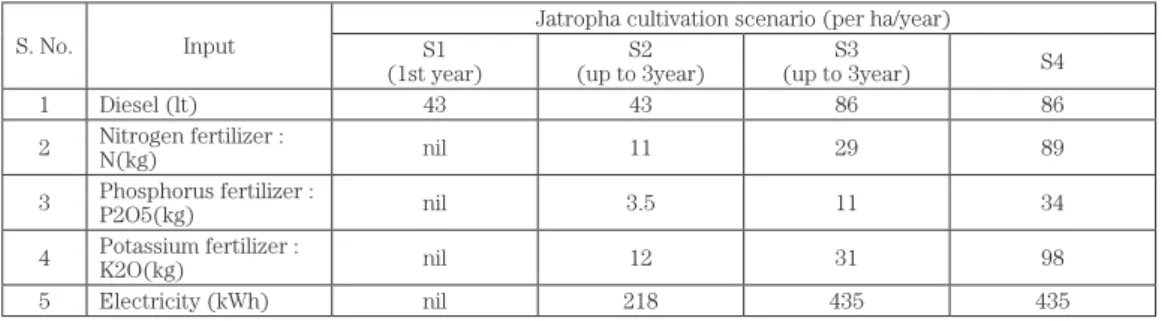
Table 6: Energy and fertilizer input for Jatropha cultivation per hectare
S. No. Input
Jatropha cultivation scenario (per ha/year) S1
(1st year) (up to 3year)S2 (up to 3year)S3 S4
1 Diesel (lt) 43 43 86 86
2 Nitrogen fertilizer : N(kg) nil 11 29 89 3 Phosphorus fertilizer : P2O5(kg) nil 3.5 11 34 4 Potassium fertilizer : K2O(kg) nil 12 31 98
5 Electricity (kWh) nil 218 435 435
III. Results and discussion
1. Impact of land use change
During the Jatropha plantation and harvest of seeds, the input raw material as fertilizers, diesel for field preparation and electricity for irrigation has been assumed. The numerical values considered for LCA calculation are given in four different scenarios (S1, S2, S3, S4) in Table 6. Figure 7 shows the carbon stock in metric ton CO2 equivalent(mtCO2 e) per hectare in the four land eco-system if Jatropha plantation is replaced by the natural eco-system. The case S1 is presents the change in landuse from open forest, designated wasteland and single agricultural land with Jatropha plantation in Panna district. At present, there is no plants/tree exists in the open forest area and afforestation can be carried in future with native indigenous species of Acacia sp. and/or
Prosopis julifera as per planning of Land Sources Department of Panna district. Bailis
and McCarthy (2006) judged that the carbon stock of prosopis juliflora woodland in southern India has about the same carbon storage than Jatropha curcas plantations. So, the carbon stock due to Jatropha plantation has been compared with Acacia sp. and
Prosopis julifera variety and it has the same carbon stock as of Jatropha (Reinhardt et
al. 2007). Scenario S2, and S3 have the same carbon stock per hectare (119.26 mtCO2 e) but more than scenario S1. It is because the wasteland eco-system has minimum carbon stock. However, no change in carbon stock in S2 and S3 is due to no landuse change in the open forest land. Scenario S4 has slightly more carbon stock per hectare (119.35 mtCO2 e) Jatropha is planted in the designated open forest land and wasteland and conversion of single crop area into double crop area.
115 116 117 118 119 120 S1 S2 S3 S4 C ar bo n St oc k (m tC O 2 e pe r h a)
Different Landuse Change Scenarios (S1 to S4) Landuse (mtCO2 e)
Figure 7: Change in carbon stock (metric ton CO2 e/ha) in four landuse change scenario
Figure 8 shows the carbon emission (kgCO2 e) per hectare for Jatropha plantation up to seed harvesting and its industrial process to obtain biodiesel in four scenarios. Industrial process includes mechanical pressing of seed into oil and also transesterification of oil using base catalysis. The change in fertilizer use and irrigation per hectare in four cases has more impact in carbon emission than the industrial process. The carbon emission increases from 159 kgCO2 e to 2,338 kgCO2 e as the fertilizer and irrigation use in Jatropha plantation increase from S1 (nil) to S4 (220kg/ha), which is similar to other studies in this direction (Reinhardt et al. 2007; Prueksakorn and Gheewala 2008; Achten 2010; Withaker and Heath 2010).
0 500 1000 1500 2000 2500 3000 S1 S2 S3 S4 C ar bo n em is si on in B io di es el p ro du ct io n (k g C O 2 e pe r h a)
Landuse change and input change scenarios (S1 to S4)
kgCO2 e emission in industrial process kgCO2 e emission in seed production
Figure 8: Carbon emission (kgCO2 e) per hectare in the cultivation and industrial process to obtain biodiesel from Jatropha curcas. in scenarios (S1,S2,S3,S4)
Figure 9a shows the net carbon reduction potential in case of diesel replacement in transport sector in general. Due to low productivity on wasteland, the carbon mitigation potential in case of diesel replacement in scenario S1 is 847 kgCO2 e per ha however, after discounting the fertilizer and other energy use in production process, the net carbon in scenario S4 is ten times higher than the scenario S1 (8,467 kgCO2 e per ha). Similarly, Figure 9b shows the comparative carbon emission and mitigation in four scenarios in whole life cycle of Jatropha C. biodiesel. In all four scenarios, it is evident that the carbon mitigation in terms of kgCO2 e/ha is much higher than the cumulative carbon emission in cultivation and industrial process stages.
0 1000 2000 3000 4000 5000 6000 7000 8000 9000 S1 S2 S3 S4 C ar bo n m iti ga tio n if di es el re pl ac ed (k gC O 2 e pe r h a)
Different Landuse and input change scenarios
kg CO2 e mitigation in diesel replacement
Figure 9a: Net carbon (KgCO2 e) per ha mitigation if same quantity of diesel is replaced by biodiesel obtained from Jatropha oil in four cases of landuse and input change scenarios
0 2000 4000 6000 8000 10000 12000 S2 S3 S4 S1 C ar bo n em is si on /m iti ga tio n (k gC O 2 e/ ha ) Four Scenarios Diesel replacement
Biodiesel Industrial Process Jatropha cultivation process
Figure 9b: Comparison of net carbon emission/mitigation (kgCO2 e/ha) by biodiesel from Jatropha seeds in four scenarios
On the basis of life cyle analysis, it is important to note that the jatropha plantation in wasteland without fertilizer and irrigation has good carbon stock but if planted for biodiesel production, it has little diesel replacement option due to low productivity, it is
also observed by other authors. Therefore, for commercial use of jatropha seeds and oil, the fertilizer use and additional irrigation is an important investment and can give better conventional diesel replacement option per hectare (Figures 9a, 9b).
2. Economic analysis
Figures 10 (a, b, c, d) show the economic return per hectare from different agricultural input scenarios for Jatropha plantation in four landuse scenarios. The present cost of fertilizer and diesel use for irrigation has been taken for investement calculation for agricultural product. The expected cost of plantation per hectare is taken from Punia (2008) and the maintenance cost per year has been taken on the basis of actual cost of fertilizer and irrigation use in four scenarios; S1, S2, S3 and S4 (Table 7). The selling price of Jatropha seeds is taken from Biswas et al. (2010) and it is expected to increase very soon as the demand of biodiesel is increasing due to fast growing transport fuel demand. However, the government of India in its biofuel policy 2003 has kept the price of Jatropha seeds in such a way that the biodiesel produced should alsways be less than the petro-diesel. Therefore, the cost of selling of Jatropha seeds has been taken from Rs.5 to 20/kg. The economic return per hectare to farmers from jatropha cultivation is shown in Figures 10 (a, b, c, d) in all four scenarios S1 to S4 seperately. In all cases, the Jatropha seeds cannot be harvested before three years, so there is negative return during three years of Jatropha cultivation. If the Jatropha plantation is done on wasteland without additional fertilizer and irrigation (S1), the productivity goes down sharply (Lele 2011) and it will never payback as compared to low productivity of crop in Panna distrcit at present (Figure 10a) if it is sold at Rs.5/kg. However, the payback period decreases with increase in input (Figures 10b, 10c, 10d) even at seed is sold at Rs.5/kg. In scenario S1, the payback period comes from ten years to six years if the rate of seed is Rs.10 to 20/kg respectively. Even little input of fertilizer and water in scenario S2, the payback period reduces from 9 years to five years if seed rate variies from Rs.5/ kg to Rs.20/kg respectively (Figure 10b). In scenario S3 and S4 the cultivators can get comparable financial gain after five years even if the seed rate is Rs.10/kg (Figures 10c, 10d). However, the cumulative financial gain in Scenario S4 after seven years (Rs.635,000) is six times as compared to Scenario S1 after ten years (Rs.100,000) if the seed rate is at Rs.20/kg. Therefore, for biodiesel production from Jatropha oil, the commercialized farming is more important than the carbon stock and for small and marginal farmers and there should be minimum support price of jatropha seed to get the economic benefit.
-40000 -20000 0 20000 40000 60000 80000 100000 1 2 3 4 5 6 7 8 9 10 Ye ar ly F in an ci al g ai n (R s) Number of years Rs 5/kg Rs 10/kg Rs 15/kg Rs20/kg 線形 (Rs 5/kg) 線形 (Rs 10/kg) 線形 (Rs 15/kg) 線形 (Rs20/kg)
Figure10a: Yearly economic gain (Rs.) by farmers in scenario S1 at different selling price of Jatropha seeds
-50000 0 50000 100000 150000 200000 250000 1 2 3 4 5 6 7 8 9 Ye ar ly F in an ci al g ai n (R s) Rs 5/kg Rs 10/kg Rs 15/kg Rs20/kg 線形 (Rs 5/kg) 線形 (Rs 10/kg) 線形 (Rs 15/kg) 線形 (Rs20/kg)
Figure10b: Yearly economic gain (Rs.) by farmers in scenario S2 at different selling price of Jatropha seeds
-60000 -10000 40000 90000 140000 190000 240000 290000 1 2 3 4 5 6 7 8 Ye ar ly F in an ci al g ai n (R s) Number of years Rs 5/kg Rs 10/kg Rs 15/kg Rs20/kg 線形 (Rs 5/kg) 線形 (Rs 10/kg) 線形 (Rs 15/kg) 線形 (Rs20/kg)
Figure10c: Yearly economic gain (Rs.) by farmers in scenario S3 at different selling price of Jatropha seeds
-100000 0 100000 200000 300000 400000 500000 600000 700000 1 2 3 4 5 6 7 Ye ar ly F in an ci al g ai n (R s) Number of Years Rs 10/kg Rs 15/kg Rs20/kg 線形 (Rs 5/kg) Rs 5/kg 線形 (Rs 10/kg) 線形 (Rs 15/kg) 線形 (Rs20/kg)
Figure 10d: Yearly economic gain (Rs.) by farmers in scenario S4 at different selling price of Jatropha seeds
Jatropha cultivation on wasteland can be rewarding in terms of carbon stock and mitigating carbon by replacing petro-diesel. But for farmers, the economic gain is the first priority for cultivation of any crop. In case of crop cultivation the income starts from the first six months; however, the Jatropha seeds can only be ready after three years of plantation. So, the gestation period for poor and marginal farmers is high and also due to lack of minimum support price and timely payments, farmers do not consider Jatropha cultivation rewarding and it cannot be used for poverty alleviation if produced for biodiesel production. This is the main hurdle in successful achievement of National Biodiesel Mission
References
Achten W. M. J., Almeida J., Fobelets V., Bolle E., Mathijs E., Singh V. P., Tiwari D. N., Verchot L., and Muys B. 2010. “Life Cycle Assessment of Jatropha Biodiesel as Transportation Fuel in Rural India”, Applied Energy, 87(12), pp.3652-3660.
Ariza-Montobbio, P. and Lele, S. 2010. “Jatropha Plantations for Biodiesel in Tamil Nadu, India: Viability, Livelihood Trade-offs, and Latent Conflict”, Ecological Economics, 70, pp.189-195.
Bailis, R. O. B. and McCarthy, H. 2006. “Carbon Impacts of Direct Land Use Change in Semiarid Woodlands Converted to Biofuel Plantations in India and Brazil”, GCB
Bioenergy, 3(6), pp.449-460.
Biswas, P. Kumar, Pohit, S., and Kumar, R. 2010. “Biodiesel from Jatropha: Can India Meet the 20% Blending Target?”, Energy Policy, 38(3), pp.1477-1484.
Production: Case of Karnataka State, India, London: Imperial College.
Francis, George, Edinger Raphael and Becker, Klaus 2005. “A Concept for Simultaneous Wasteland Reclamation, Fuel Production, and Socio-economic Development in Degraded Areas in India: Need, Potential and Perspectives of Jatropha plantations”,
Natural Resources Forum 29, pp.12-24.
IEA 2002. World Energy Outlook 2002, Paris: International Energy Agency (IEA). IEA 2012. World Energy Outlook 2012, Paris: International Energy Agency (IEA).
India 2003. Report of the Committee on Development of Biofuel, Planning
Commission, New Delhi: Government of India.
India 2009. National Policy on Biofuels, Ministry of New & Renewable Energy (http:// mnre.gov.in/).
India 2010. Wasteland Atlas of India, Department of Land Resources, Ministry of Rural Development, Government of India
(www.dolr.nic.in/wasteland_atlas.htm).
Kumar, Sanjay, Shukla, S. D., Gautam, P. K., Kato, S. and Kojima, T. 2011. “Effect of Climate and Soil Condition on Oil Content of Jatropha Plants Grown in Arid Areas of India”, Journal of Arid Land Studies, 21(2), pp.51-55.
Lele, S. 2008. “Jatropha Cultivation”, electronic book (http://www.svlele.com). MNRE 2009. National Policy on Biofuels, 2009.
Prueksakorn, K. and Gheewala, S. H. 2006. “Energy and Greenhouse Gas Implications of Biodiesel Production from Jatropha curcas L”, Proceedings of the 2nd Joint International Conference on Sustainable Energy and Environment, Bangkok, Thailand. Punia, M. S. 2008. “Cultivation and Use of Jatropha for Bio-Diesel Production in India”,
National Oilseeds and Vegetable Oils Development Board, Ministry of Agriculture, Government of India
Reinhardt, G., Gärtner, S. I., Rettenmaier, N., Munch, J. and von Falkenstein, Eva 2007. “Screening Life Cycle Assessment of Jatropha Biodiesel”, Tech. Rep., Institute for Energy and Environmental Research Heidelberg, Germany, Dec. 11, 2007.
Withaker, M. and Heath, G. 2009. “Life Cycle Assessment of the Use of Jatropha Biodiesel in Indian Locomotives”, Tech. Rep. NREL/TP-6A2-44428, National Renewable Energy Laboratory, Golden, Colorado (http://www.osti.gov/bridge).