Abbreviations: DCM, dilated cardiomyopathy; ICM, ischemic cardiomyopathy; LVAD, left ventricular assist device; QOL, quality of life; NYHA, New York Heart Association; MR, mitral regurgitation; SAVE, septal anterior ventricular exclusion
Surgical Treatment for Severe Heart Failure:
Recent Progress in Treatment Strategy and its Present
Status in Japan
Motonobu Nishimura
Division of Organ Regeneration Surgery, Department of Surgery, School of Medicine, Tottori Univer-sity Faculty of Medicine, Yonago 683-8504, Japan
Chronic intractable heart failure that is unresponsive to maximum medical therapy can have a wide variety of causes; these include advanced valvular diseases and severe myocardial ischemia, ischemic cardiomyopathy (ICM) in heart failure following extensive myocardial infarction, chronic heart failure due to dilated cardiomyopathy (DCM) in which the myo-cardium itself is progressively damaged or the acute aggravation of the latter. Heart trans-plantation has long been considered the only useful treatment for patients with heart failure due to ICM- and DCM-induced severe left ventricular hypofunction. However, because of the extremely limited number of heart transplant donors, other surgical treatments have also been attempted. In this communication, we provide an overview of the current situation with regard to left ventriculoplasty and heart transplantations, as well as of the treatment of severe heart failure using ventricular assist devices, which have recently shown remarkable progress.
Key words: heart transplant; left ventriculoplasty; ventricular assist device Chronic intractable heart failure that is
unrespon-sive to maximum medical therapy can have a wide variety of causes. These include advanced valvular diseases; severe myocardial ischemia; ischemic cardiomyopathy (ICM), which is a state of chronic heart failure that develops after an extensive myo-cardial infarction; and dilated cardiomyopathy (DCM), which is heart failure due to the failure of myocardial cells. Heart transplant has long been considered the only treatment for patients with heart failure due to severe left ventricular functional decline resulting from ICM and DCM. However, because of the very limited number of heart trans-plant donors, other surgical treatments have also been attempted. Left ventriculoplasty is one such treatment that involves adjusting the shape, reduc-ing the volume, and improvreduc-ing the function of the
left ventricle, whose lumen is enlarged because of heart failure. It has been clinically applied for the treatment of ICM since the 1980s(Dor et al., 1995), and its indication has also spread to the treatment of DCM since the 1990s (Batista et al., 1996). How-ever, the limitations of these surgical procedures have been gradually revealed in recent years, and continual efforts have been made to improve surgi-cal methods and to establish their indications (Suma and RESTORE Group, 2001; Matsui et al., 2004).
Since the establishment of the Organ Trans-plant Law in 1997, heart transTrans-plantation from brain-dead patients has also been performed in Japan. However, the law strictly required that in order for organs to be transplanted, the donors had to express their intent to donate their organs when alive; con-sequently, 10 years since the enforcement of the law,
mural myocardial infarction was first performed by Cooley in 1958 under artificial heart and lung support; many later studies have shown its effective-ness. Dor et al. reported, beginning in the 1980s, that even in treatment of ICM (which causes an overall decrease in left ventricular function because of extensive akinesis), left ventriculoplasty was also believed to improve cardiac function, in the same manner as in its use in the treatment of left ven-tricular aneurysms (Dor et al., 1995). Because of the spread of early intervention in the treatment of acute myocardial infarction, the number of patients with persistent akinesis due to subendocardial infarc-tions tends to be higher than that due to transmural infarctions. However, after a relatively extensive myocardial infarction, and regardless of whether the infarcted region shows dyskinesis or akinesis, a remodeling occurs, causing a gradual expansion of the noninfarcted region along with deterioration in its function. Ultimately, this leads to ICM, namely, a decrease in the contractility of the entire left ven-tricle. In such cases, left ventriculoplasty is applied that aims to improve both the contractility of the re-maining noninfarcted region and the left ventricular dilatation and morphological changes caused by the remodeling during surgical resection or plasty of the infarcted region.
Surgical procedure
The problem with the conventional surgical tech-nique (a method known as “linear closure”, which consists of performing a longitudinal incision in the infarcted region in the anterior wall of the left ventricle, with resection and suturing of the in-farcted area) is that the inin-farcted region remains in the septum; therefore, Dor et al. proposed a method consisting of a purse-string suture (a Fontan stitch) at the infarction site, including the septum and its border with healthy areas, followed by closure through application of a patch (Dor et al., 1995). Ever since its introduction, the method has been widely used worldwide. In addition, the surgical technique known as septal anterior ventricular ex-clusion (SAVE), in which a vertical patch is sewn at the number of brain-dead donors has been
approxi-mately 60, which, in a population of 100 million people, was the equivalent of 5 brain-dead donors per year, in other words, 100 times less than the number found in Western countries. Under such cir-cumstances, the revised version of the Organ Trans-plant Law was enacted in 2010, and organ donation from a brain-dead patient has become possible upon obtaining consent from the patient’s family mem-bers, even in the absence of a declaration of inten-tion provided by the patient before death. Therefore, the number of heart transplants performed has in-creased to 50 per year. However, the number is still only about one-tenth of that in Western countries and thus is still insufficient. In the 1990s, left ven-tricular assist devices (LVADs) were actively used as a bridge in heart transplantation. In particular, implantable LVADs such as HeartMate (Thoratec, Pleasanton, CA)and Novacor (WorldHeart, Ottawa, Canada) have been widely used in Europe and the United States because of their capability to provide a better long-term quality of life (QOL). The practi-cal use of small-sized and long-term durable contin-uous-flow pumps in clinical settings was initiated in 2000. Therefore, the survival rate has improved, and destination therapy has been attempted on pa-tients who are not candidates for heart transplanta-tion. In addition, there have been reported cases in which the patients’ own cardiac function recovered after using VADs for circulatory support, which en-abled these patients to withdraw from these VADs (bridge to recovery); this has attracted attention as a new possibility (Müller et al., 1997).
The present report provides an overview of the current situation regarding the surgical treatment of severe heart failure.
Left ventriculoplasty for
the treatment of ischemic cardiomyopathy
Concept
Resection of left ventricular aneurysms to treat the extensive dyskinesis that can occur after a
trans-the border between trans-the infarcted area and healthy regions, has also been performed. In this technique, Fontan stitch is not required to ensure that the left ventricle has a shortened transverse diameter and an oblong shape (Suma and RESTORE Group, 2001). Both methods allow for a reduction in the volume of the left ventricle and make it possible to ensure that the morphology of the left ventricle (which becomes spherical due to remodeling) returns to its original oblong shape.
Indications and outcomes
The indications for this surgical technique include the presence of symptoms such as heart failure, chest pain, and arrhythmia; akinesis or dyskinesis over a broad region (occupying 35% or more of the left ventricular circumference) due to anteroseptal myocardial infarction; and expansion of the left ventricle (left ventricular end-diastolic volume in-dex greater than 100 mL/m2 or left ventricular end-systolic volume index greater than 60 mL/m2) and a decrease in left ventricular contractility (Meni-canti et al. and RESTORE Group, 2002). Recently reported studies conducted in other facilities have shown that left ventriculoplasty has comparatively favorable outcomes. Surgical patients who met the above-mentioned indications have been reported to account for 1,198 cases, with a hospital mortality rate of 5.3%, a 5-year survival rate of 68.6%, and a 78% avoidance of heart failure at 5 years after surgery (Athanasuleas et al. and RESTORE Group, 2004). In addition, the efficacy of left ventriculo-plasty in the treatment of mitral regurgitation (MR) has recently been the focus of attention. In ICM, which is often associated with left ventricular en-largement, annuloectasia and tethering of the mitral valve leaflets due to displacement of the papillary muscle cause reduction in the coaptation area and is often complicated by MR. Commonly, “undersizing and overcorrecting” by employing small-diameter full-circumference prosthetic valves enables restora-tion of the coaptarestora-tion areas of the mitral valve leaf-lets and an improvement in MR. However, residual MR and recurrences often occur in patients with
severe tethering. During left ventriculoplasty, if su-tures are also placed between the anterior and pos-terior papillary muscles for shortening the distance and restoring the mitral tethering from inside the left ventricle, the treatment was found to be more physiological and recurrences may be prevented (Menicanti et al. and RESTORE Group, 2004). Further, it has also been reported that in patients with a history of severe ventricular arrhythmias, the incidence can be reduced by cryocoagulation of the “gray zone” located at the borderline between the infarcted and noninfarcted regions, and the results comparable to those obtained using automated im-plantable cardioverter-defibrillators (DiDonato et al. and RESTORE Group, 2004).
Left ventriculoplasty
for the treatment of idiopathic DCM
Batista surgery
In treatment of DCM, Batista first reported im-provement in left ventricular contractility by reduc-ing the left ventricular volume by performreduc-ing a partial resection of the posterior wall of the left ven-tricle (Batista et al., 1996). Since then, the method has rapidly spread worldwide as “Batista’s surgery” (Batista procedure). The concept of surgical size re-duction of the dilated left ventricle for preventing or reversing remodeling is similar to that used in ICM. However, the difference from the surgical treatment of ICM is that instead of the infarcted region, the remaining cardiac muscle with deteriorated func-tion is removed.
Outcomes
After Batista’s report, additional tests were con-ducted in Europe and the United States, and accord-ing to a report published by Cleveland Clinic on a study conducted on New York Heart Association (NYHA) class III or IV heart transplant candidates with a left ventricular end-diastolic diameter > 70 mm, the rate of patients who require heart
trans-plantation and assisted circulation because of acute circulatory failure was as high as 16%, and the rates of mortality and avoidance of recurrent heart failure at 1 year and at 3 years were 49% and 26%, respectively, which were considered low (Franco-Cereceda et al., 2001). Although the symptoms and left ventricular function certainly improved in some patients over time, such an outcome was difficult to predict preoperatively; therefore, this surgical tech-nique was not performed in Europe and the United States. In Japan, because of the small number of heart transplant donors, the technique is performed as an alternative to heart transplantation in some institutions. Efforts aimed at improving outcomes continue and include the evaluation of local cardiac function before or during surgery, the resection of all regions showing poorest systolic contractions, rather than limiting the resection to only the poste-rior wall (Suma and RESTORE Group, 2001), and myocardioplasty in which the myocardium is left in place and is superimposed instead of resected (over-lapping method) (Matsui et al., 2004).
Cardiac transplantation
For more severe forms of heart failure in which no improvement is observed even after maximum medical treatment or after having been treated with the new surgical techniques described earlier, heart transplantation is the most effective method of treatment. One of the indications for heart trans-plantation is a diagnosis with a 2-year survival rate of about 50%. Meanwhile, patients treated by heart transplantation have a 2-year survival rate of 80% and a 10-year survival rate of 50%. Even from the perspective of malignant diseases, a 2-year survival rate of 50% suggests that a disease has quite a poor prognosis. Of the currently available treatments, heart transplantation is the one that can be expected to ensure the highest survival rate for such patients. Currently, approximately 3,000 patients per year undergo cardiac transplantation all over the world. In Japan as well, cardiac transplantation was of-ficially initiated in 1997 after the establishment of
the Organ Transplant Law; however, because of various restrictions pertaining to organ donation from brain-dead patients, such as the strict appli-cation of the law requiring the donor to provide a written document stating their intent to donate or-gans before their death, very few people were able to receive heart transplants, and patients had to go through a long waiting period before undergoing cardiac transplantation. In response to that trend, the Revised Organ Transplant Law was enacted in 2010. Since the revised law was enforced, organ donation from brain-dead patients has become pos-sible upon consent from their families, even if the patients themselves did not clearly show an inten-tion to donate their organs before their death. In addition, organ donation from brain-dead children less than 15 years of age has also become possible. Since the enforcement of the revised law, organ do-nations from brain-dead patients have increased in number, and the number of cardiac transplantations performed per year has also increased, from 5 to 10 in the past to approximately 50. However, due to the increasing number of registered patients waiting for heart transplants, the changes did not lead to a shortening of the transplant waiting period.
Although cardiac transplantation is currently the most well-established therapeutic method for severe heart failure, it has also encountered vari-ous problems. One of which is the need for organ donation from brain-dead patients; the other is lifetime immunosuppressive therapy in most cases. Immunosuppressive agents are often expensive and impose a heavy financial burden on patients. In ad-dition, the side effects of immunosuppressive agents are associated with various problems, including ag-gravation of arteriosclerosis and osteoporosis due to steroid use and an increase in carcinogenesis due to long-term suppression of immunocompetence. Therefore, efforts have been made to develop im-munosuppressive drugs with fewer side effects. Given the problems associated with cardiac trans-plantation, treatment outcomes could be better if therapeutic methods are developed that provide a better vital prognosis than that associated with heart transplantation or which ensure an improvement in
QOL in a manner that outweighs that due to heart transplantation. Under such circumstances, treat-ments that use VADs have received attention.
Use of VADs
for the treatment of heart failure
The major VADs currently in use
VADs, which began to be developed in the 1970s, have been used in clinical settings since the mid-1990s as bridges in heart transplantation. Some VADs are extracorporeal, and the others are intra-corporeal. Those that were used in the 1990s were all pulsatile pumps. Because the types of pumps that are implantable inside the abdominal wall or inside the abdominal cavity are excellent in terms of QOL for patients wearing them, implantable pulsatile pumps have been widely used. The pumps were known as the first generation of implantable devices. In the early 2000s, the first-generation devices were found to have limitations such as the fact that the implanted portion was large, infections developed easily, and the mechanical durability of the devices was problematic. Therefore, the second and third generations of artificial hearts were devel-oped. These have been successfully used in clinical settings. The new generation of devices consists of continuous-flow pumps such as axial-flow pumps and centrifugal pumps that are miniaturized. Their durability has also improved. The second-generation devices have a rolling-contact bearing of the rotor, and the third-generation devices have further im-proved durability and no longer have rolling-contact bearing. Previous reports have shown that because of the small size of the second-generation and third-generation VADs, surgery is less invasive and com-plications such as infection are less frequent (Frazier et al., 2004).
Pulsatile pumps
Pulsatile pumps, which are known as the first-gener-ation VADs, are of 2 different types: the paracorpo-real type and the implantable type. Compared to the
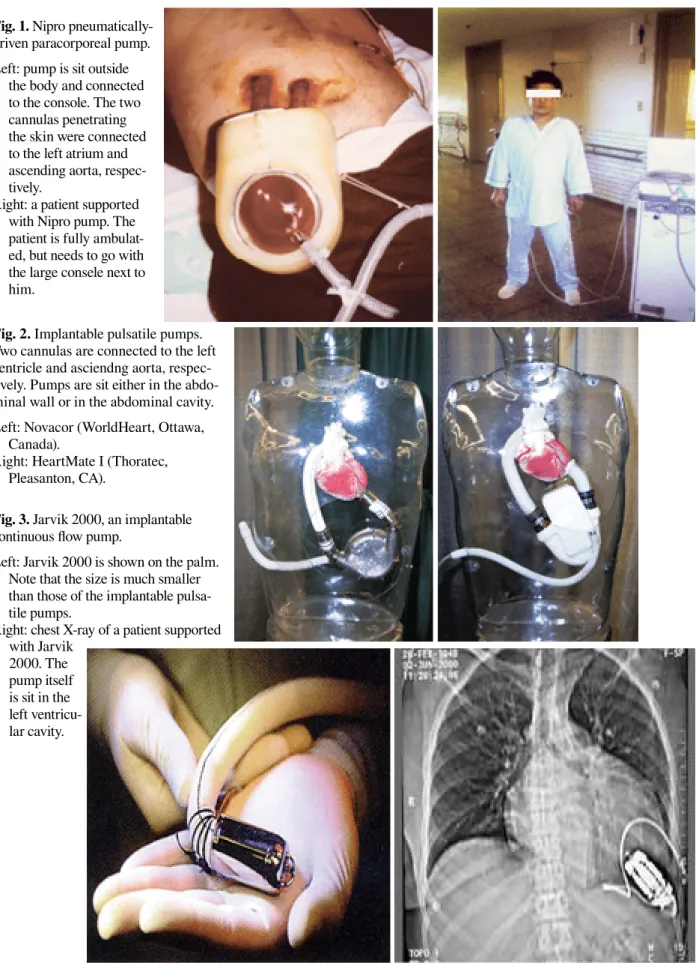
paracorporeal VADs, implantable VADs generally have a blood pump implanted inside the body, such as in the abdominal region, and are therefore asso-ciated with a smaller risk of infection. In addition, because they are also excellent with regard to pa-tient QOL, they are believed to be more suitable for long-term assistance lasting several months or more. Currently, the VADs that are most commonly used in Japan are the paracorporeal pumps manufactured by Nipro Corporation (Osaka, Japan) (Fig. 1).
When used for long-term assistance, paracor-poreal pneumatically-driven VADs are associated with a poorer QOL than that allowed by the im-plantable type. However, like imim-plantable pumps, they are useful as a bridge to heart transplantation. They are particularly useful for patients with a small physique whose body surface area is less than 1.5 m2, for pediatric patients, and for patients in need of bilateral ventricular assist system who, because of severe right heart failure, must be implanted with a VAD in the right ventricle in addition to that in the left ventricle. This is because the currently used implantable pumps have been designed to assist the left ventricle, and do not allow a second one to be implanted in the right ventricle. On the other hand, HeartMate (Thoratec) and Novacor (WorldHeart) are typical implantable pulsatile pumps (Fig. 2). Altogether, these 2 models have been used in more than 5000 cases worldwide; however, they have been rarely used since 2010 because continuous-flow pumps were found to be better.
Continuous-flow pumps
Since the 1990s, active research and development has been done on the continuous-flow pumps such as implantable axial-flow pumps and centrifugal pumps. Their advantages include the fact that their size is smaller than those of conventional pulsa-tile pumps, they cost less because of their simple structure, and there is no need for artificial heart valves. Altogether, MicroMed DeBakey, HeartMate II (Thoratec), and Jarvik 2000 (Jarvik Heart, New York, NY; Fig. 3) have been used in clinical settings in more than 2000 cases in Europe and the United States. There has been a particularly exponential
Fig. 2. Implantable pulsatile pumps.
Two cannulas are connected to the left ventricle and asciendng aorta, respec-tively. Pumps are sit either in the abdo-minal wall or in the abdoabdo-minal cavity. Left: Novacor (WorldHeart, Ottawa,
Canada).
Right: HeartMate I (Thoratec, Pleasanton, CA).
Left: pump is sit outside the body and connected to the console. The two cannulas penetrating the skin were connected to the left atrium and ascending aorta, respec-tively.
Right: a patient supported with Nipro pump. The patient is fully ambulat-ed, but needs to go with the large consele next to him.
Fig. 3. Jarvik 2000, an implantable
continuous flow pump.
Left: Jarvik 2000 is shown on the palm. Note that the size is much smaller than those of the implantable pulsa-tile pumps.
Right: chest X-ray of a patient supported with Jarvik 2000. The pump itself is sit in the left ventricu-lar cavity.
increase in the use of the HeartMate II, which has almost replaced the first-generation pulsatile pumps.
In Japan as well, 2 models of implantable cen-trifugal pumps, namely EVAHEART (Sun Medi-cal, Suwa, Japan) and DuraHeart (Terumo, Tokyo, Japan), received approval for manufacture and sale in January 2011, and have been approved for insur-ance reimbursement since April 2011. HeartMate II (Thoratec) and Jarvik 2000 (Jarvik Heart) are also pending approval.
New purposes of employing VADs “bridge to recovery”
In 1990, when the use of VADs as a bridge to-wards heart transplantation became popular, it was believed that a VAD was installed in case of severe end-stage heart failure due to cardiomyopa-thy, which is a basically progressive disease, and therefore, withdrawal from the use of VADs was considered extremely difficult. However, in 1997, the Berlin Heart Institute reported that 17 patients with idiopathic DCM could withdraw from VADs, and the phenomenon attracted attention (Müller et al., 1997). A normalization of neurohumoral fac-tors, an improvement of calcium handling in myo-cardial cells, and an increase in the number of beta adrenergic receptors are thought to occur while the cardiovascular circulation is assisted and the load on the heart is reduced by VADs. In Japan, where brain-dead donors are difficult to find, the “bridge to recovery” strategy is much more important than it is in Western countries, and its availability to all patients wearing VADs should be pursued. For all patients who undergo placement of a VAD in our institution, medical treatment of heart failure, con-sisting of the administration of medications such as beta-blockers and angiotensin-converting enzyme inhibitors, is initiated after the device has been put in place, as soon as the patient is capable of ingest-ing food and liquid orally. Recently, there has been a focus on strategies that aim at withdrawal from VADs by using methods that actively contribute to the recovery of left ventricular function in patients wearing the device; therefore, pharmacotherapy
and ventricular resynchronization, combined with surgical treatments such as mitral valvuloplasty, left ventricular reduction surgery, and regenerative treatments such as cell transplantation and gene therapy, have been reported to be useful (Nishimura et al., 2005). However, it is currently difficult to pre-dict patients in which cardiac functional recovery is possible. In addition, future studies are expected to solve the issue of predicting or preventing the recur-rence of heart failure after withdrawal from VADs and of evaluating the extent of recovery of cardiac function in patients wearing a VAD.
Conclusion: Although there have been remarkable developments in medical treatment for heart failure, surgery still plays an important role in its treatment, particularly in severe heart failure cases. In the fu-ture, combinations of a wider variety of therapeutic methods could be promising in improving treatment outcomes in severe heart failure.
References
1 Athanasuleas CL, Buckberg GD, Stanley AW, Siler W, Dor V, DiDonato M, et al.; RESTORE Group. Surgical ventricular restoration: the RESTORE Group experi-ence. Heart Fail Rev 2004;9:287–297.
2 Batista RJ, Santos JL, Takeshita N, Bocchino L, Lima PN, Cunha MA. Partial left ventriculectomy to improve left ventricular function in end-stage heart disease. J Card Surg 1996;11:96–97; discussion 98.
3 DiDonato M, Toso A, Dor V, Sabatier M, Menicanti L, Fantini F, et al.; RESTORE Group. Mechanical syn-chrony: role of surgical ventricular restoration in cor-recting LV dyssynchrony during chamber rebuilding. Heart Fail Rev 2004;9:307–315.
4 Dor V, Sabatier M, Di Donato M, Maioli M, Toso A, Montiglio F. Late hemodynamic results after left ven-tricular patch repair associated with coronary grafting in patients with postinfarction akinetic or dyskinetic aneurysm of the left ventricle. J Thorac Cardiovasc Surg 1995;110:1291–1299; discussion 1300–1301.
5 Franco-Cereceda A, McCarthy PM, Blackstone EH, Hoercher KJ, White JA, Young JB, et al. Partial left ventriculectomy for dilated cardiomyopathy: is this an alternative to transplantation? J Thorac Cardiovasc Surg 2001;121:879–893.
6 Frazier OH, Shah NA, Myers TJ, Robertson KD, Grego-ric ID, Delgado R. Use of the Flowmaker (Jarvik 2000) left ventricular assist device for destination therapy and
Naito Y, et al. Integrated overlapping ventriculoplasty combined with papillary muscle plication for se-verely dilated heart failure. J Thorac Cardiovasc Surg 2004;127:1221–1223.
8 Menicanti L, DiDonato M, Castelvecchio S, Menicanti L, DiDonato M, Castelvecchio S, et al.; RESTORE group. Functional ischemic mitral regurgitation in ante-rior ventricular remodeling: results of surgical ventricu-lar restoration with and without mitral repair. Heart Fail Rev 2004;9:317–327.
9 Menicanti L, Di Donato M, Frigiola A, Buckberg G, Santambrogio C, Ranucci M, et al.; RESTORE Group. Ischemic mitral regurgitation: intraventricular papil-lary muscle imbrication without mitral ring during left ventricular restoration. J Thorac Cardiovasc Surg
cardiac support in patients with idiopathic dilated car-diomyopathy. Circulation 1997;96:542–549.
11 Nishimura M, Ogiwara M, Ishikawa M, Imanaka K, Okamura N, Kato M, et al. Successful bridge to resyn-chronization therapy with a left ventricular assist system in a patient with idiopathic dilated cardiomyopathy. J Artif Organs 2005;8:210–213.
12 Suma H; RESTORE Group. Left ventriculoplasty for nonischemic dilated cardiomyopathy. Semin Thorac Cardiovasc Surg 2001;13:514–521.
Received and acceppted September 4, 2012 Corresponding author: Motonobu Nishimura, MD