Corresponding author: Ikuko Nishio, RN, PhD [email protected]
Received 2017 June 5 Accepted 2017 July 19
Abbreviation: CSII, continuous subcutaneous insulin infusion
Self-stigma of Patients with Type 1 Diabetes and Their Coping Strategies
Ikuko Nishio* and Masami Chujo†
*Faculty of Nursing, Soka University, Hachioji, Tokyo 192-8577, Japan, and
†
Department of Adult and Elderly Nursing, School of Health Science, Tottori University Faculty of Medicine, Yonago 683-8503, JapanABSTRACT
Background The purpose of this study was to exam-ine the stigma and coping strategies of patients with type 1 diabetes.
Methods Data were collected from 24 adult patients with type 1 diabetes via in-depth semi-structured inter-views that took place in clinic waiting rooms. Qualita-tive and descripQualita-tive data analysis was conducted to iden-tify stigma and coping strategies of patients with type 1 diabetes.
Results Stigma of patients with type 1 diabetes con-sisted of four categories: (i) “hatred of insulin” due to a treatment-oriented lifestyle after the onset of the disease, (ii) “imperfect body” due to systemic changes caused by the disease, (iii) “social outcast” as a diabetes patient who used to be healthy, and (iv) “poor me,” a negative self-image due to the responses and attitudes of others. Regarding the coping strategies for reducing stigma, the following four categories were derived from the anal-ysis: (i) In a stable disease stage, patients coped with stigma by “hiding their disease” or (ii) “pretending to be healthy” by avoiding self-care behaviors in public. When they told others about their disease, they (iii) “gradually spoke out to those around them about their illnesses.” (iv) When they could not do either (i) or (ii), they resorted to “limiting their social life” or limiting interactions with others.
Conclusion Patients with type 1 diabetes changed their coping strategies for reducing stigma as the disease progressed because stigma was tied to their disease. Physical, psychological, social, and spiritual coping strategies are required to reduce stigma, and the strate-gies are interrelated. It is important for nurses to assess patients from various viewpoints, including the view-point of stigma.
Key words adults; cope; stigma; type 1 diabetes Type 1 diabetes is a disease in which pancreatic β cells are destroyed and insulin therapy is essential for life sup-port due to the absolute insulin deficiency. The number
of patients with type 1 diabetes in Japan is small. They account for five percent or less of the total population of patients with diabetes.1 The current treatment for type 1
diabetes is life-sustaining insulin supplementation with several daily insulin injections or continuous subcuta-neous insulin infusion (CSII). Recently, a diet therapy called Carb-count has also been introduced.2
Thus, patients with type 1 diabetes are required to incorporate knowledge and activities for controlling blood glucose levels with recommended insulin dose into their daily lives. This is not easy for the patients. Patients with type 1 diabetes have been found to feel powerless due to unavoidable life changes, the difficulty of appropriate self-management, and misunderstanding and prejudice in society.3 If the patients try to have a life
that is ideal for controlling their blood glucose levels, they feel isolated from the community. In addition, it is very difficult for them to maintain blood glucose control if they want to fulfill their lives, maintaining their roles and responsibilities in their families and society. Such situations in patients with chronic diseases, including diabetes, have been linked to stigma.4 Stigma is defined
as attributes that add value-deprived identity, which is undesirable, contemptible, and distrustful to others, and involves “the situation of the individual who is
disqual-ified from full social acceptance” (Goffman, 1963).5
However, in society, social stigma varies by time and region.
There are many studies of stigma in patients with mental diseases or HIV infection. That is because they have an inferiority complex about their disease and feel inferior in the community. Patients with stigma have been reported to have poor social skills and a tendency to be tense and anxious, and avoid medical care and continuation of treatment (Earnshaw et al., 2015).6
Although there are fields in which many studies of stigma have been conducted, there are very few studies (i.e., 13 cases) of stigma in patients with type 1 diabetes. Because patients with type 1 diabetes cannot face the “stigma” of diabetes, they tend to refuse to use insulin. In addition, the younger the patients are at the onset of type 1 diabetes, the more susceptible they are to stigma because the disease forces them to have a different life-style (Commissariat et al., 2016).7
in Japan are (i) relatively low age of onset, (ii) small dis-ease population, and (iii) required insulin supplementa-tion for the rest of their lives. No study of the stigma has been based on these characteristics. Because there have been few opportunities to discuss such negative psycho-logical characteristics of the patients in actual clinical settings, their reality has not been fully understood.
Thus, stigma is a challenge for patients with type 1 diabetes. The purpose of this study was to examine the stigma and coping strategies of patients with type 1 dia-betes. In this study, by identifying the stigma of patients with type 1 diabetes, we expect to get suggestions for nursing intervention from the viewpoint of the patients so that the patients accept their disease, receive treat-ment, seek help, and live in the community.
MATERIALS AND METHODS Definition of terms
Stigma: Negative impression and sense of shame for be-ing a diabetes patient due to negative responses of others and their own sense of values
Coping strategies: Patient behaviors to cope with prob-lems caused by stigma
Study design
This study used a qualitative exploratory study design to examine the stigma and coping strategies of patients with type 1 diabetes via semi-structured interviews.
Participants
Patients with type 1 diabetes aged 20 years or older, who visited one of the four outpatient departments of internal medicine in general hospitals, made negative comments about their disease, and hid their disease from others, were included in this study.
Data collection
Data were collected between January and March 2013. Directors of outpatient departments selected participants who were diagnosed with type 1 diabetes and met the study requirements. Afterwards, investigators in charge confirmed the eligibility of candidates who met the study requirements. After eligibility confirmation, the subjects were provided with a sufficient explanation of the study and written informed consent was obtained prior to performing the study procedures. Then, semi-structured interviews were conducted with the participants of this study. The interview consisted of questions on (i) their thoughts at the time of diagnosis with type 1 diabetes, (ii) images of type 1 diabetes, (iii) whether they disclosed their disease, (iv) responses of others at the time of dis-closure, and (v) social distress.
Basic information, such as age, disease duration, treatment approach, HbA1c levels, complications, and occupation, was collected from the participants.
Analysis methods
The analysis was conducted using qualitative and de-scriptive data analysis methods.8 The interviews were
audio-recorded, transcribed verbatim, and stored for analysis. The interview and analysis continued until data saturation. Next, the parts in which the participants spe-cifically talked about their stigma and coping strategies were extracted from the verbatim transcriptions. The ex-tracted parts were classified as data. Next, we performed line-by-line coding. While coding, the participants’ own words were used as much as possible. The codes were then compared to identify differences and similarities, and then grouped into categories and subcategories. During the entire analysis process, we ensured consis-tency by consulting with researchers familiar with qual-itative research. In order to enhance the credibility and clarity of our results, we systematically presented the verbatim records of the interviews to supervisors famil-iar with the qualitative study of diabetes nursing.
Ethical considerations
This study was approved by the ethics committee of Tottori University. Informed consent was obtained from all patients using the procedure approved by the ethics committee, and the confidentiality of the participants’ information was protected (authorization number 2010). Furthermore, participants could stop the interview at any point and refuse to answer any questions.
Parficipants were given pseudonyms to ensure their confidentiality and all data were stored securely during the analysis process.
RESULTS Participants
The participants’ basic attributes are shown in Table 1. The participants consisted of 5 males and 19 females. The age range was 29 to 66 years, and the disease dura-tion was 3 to 28 years.
Three categories and 13 subcategories were derived from the analysis of the stigma of patients with type 1 diabetes. Four categories and 11 subcategories were de-rived from the analysis of coping strategies for reducing stigma. For each category, we have provided a storyline along with a description.
Stigma of patients with type 1 diabetes consisted of four categories: (i) hatred of insulin due to a treat-ment-oriented lifestyle after the onset of the disease, (ii) “imperfect body” due to systemic changes caused by
Table 1. Demographic characteristic of the 24 study participant’s with type 1 diabetes
Participant characteristics n
Gender Male 5Female 19
Age (years old) 29–66 (39.1 ± 10.5) Time living with type 1
diabetes (years) 3–28 (9.8 ± 6.4) Insulin therapy MDI 20, CSII 4 HbA1c† (NGSP) (%) 6.0–8.5% (7.5 ± 1.1%) Employment Full time or part time 16Unemployed 8 †Glycated hemoglobin.
CSII, continuous subcutaneous insulin infusion; MDI, multiple daily injection; NGSP, National Glycohemoglob in Standardiza-tion Program.
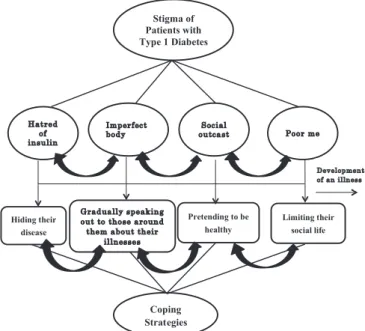
the disease, (iii) “social outcast” as a socially vulnerable diabetes patient who used to be healthy, and (iv) negative self-image due to responses and attitudes of others. Re-garding the coping strategies for the stigma, the follow-ing four categories were derived from the analysis: (i) In a stable disease stage, they coped with stigma by “hid-ing their disease” or (ii) “pretend“hid-ing to be healthy” by avoiding self-care behaviors in public. When they told others about their disease, they (iii) “gradually spoke out to those around them about their illnesses.” (iv) When they could do neither (i) nor (ii) anymore, they resorted to “limiting their social life” or “limiting interactions with others.” The Patients with type 1 diabetes showed a tendency to change their coping strategies as the disease progressed, going back and forth among the four strate-gies that are closely interrelated (Table 2, Fig. 1).
Table 2. Stigma of Patients with Type 1 Diabetes and Their Coping Strategies
Stigma of patients with type 1 diabetes Coping strategies
Category Subcategory Category Subcategory
Hatred of insulin
Insulin makes me aware of the disease
Hiding their disease
I don’t tell others about my disease Insulin is controlling my life I try to hide my disease from my friends I do not like injection I tell my kids not to tell others about my disease I cannot get used to injection
Imperfect body
Body dependent on injections Gradually speaking out to those around them about their illnesses
I minimized the disclosure of disease
Body that is no longer healthy I underestimate my disease
Body with reduced physical strength
Social outcast
People think I am incompetent
Pretending to be healthy
I don’t take insulin in public
People treat me like a sick person I eat and drink whatever they put in front of me
People look down on me I voluntarily quit a job
Poor me
I feel insulted to realize that people mix it up with type 2 diabetes
Limiting their social life
I reduce the number of people I socialize with
I regret having the disease I rarely eat out or go out
I look for a job that doesn’t require me to disclose my disease
I. Nishio and M. Chujo 32
Fig. 1. Stigma of patients with type 1 diabetes and their coping strategies.
1 Imperfect body Hatred of insulin Social outcast Poor me Gradually speaking out to those around them about their
illnesses Hiding their disease Pretending to be healthy Limiting their social life Development of an illness Coping Strategies Stigma of Patients with Type 1 Diabetes 2
Fig. 1. Stigma of patients with type 1 diabetes and their coping
strategies.
Stigma of patients with type 1 diabetes Hatred of insulin
The patients started to receive daily insulin therapy as soon as they were diagnosed with type 1 diabetes. In order to administer insulin, they became conscious of their disease, and sometimes missed the chance to inject insulin while at work or when they could not fi nd a place to do so. It was found that the patients had a negative image of insulin administration and thus hated insulin. This category consisted of four subcategories: (i) “ I hate injections,” (ii) “I nsulin is controlling my life,” (iii) “I
cannot get used to injections,” and (iv) “Insulin makes me aware of the disease.”
At first, I could not accept injections because I hated them. But I have no choice. (Case L)
Injections are cumbersome. The most troublesome sit-uation is where I always have to excuse myself to go to the washroom when eating out. (Case I)
I hated to go to the washroom to have injections in the middle of work. I could not work when I had hypoglyce-mia. Because I couldn’t get used to injections, I switched to insulin pump therapy. (Case S)
When I am out, I have to take injections in the wash-room or somewhere else. I hate the disease in such a situation. (Case D)
Imperfect body
The patients thought that they would need insulin sup-plementation for the rest of their lives and that the dis-ease is not curable. They regarded the systemic changes caused by the disease as physical defects.
This category consisted of three subcategories: (i) “Body dependent on injections,” (ii) “Body that is no longer healthy,” and (iii) “Body with reduced physical strength.”
It is like I cannot live without (insulin) injections. (Case T) Whenever I eat too much, I feel heavy and realize that I cannot eat anymore. (Case N)
I feel cumbersome because I cannot do anymore what I used to do all day without any problems since I devel-oped hypoglycemia. (Case W)
Social outcast
The patients felt that they have moved from the healthy group to the type 1 diabetes group. The patients regard-ed themselves as socially vulnerable and inferior diabe-tes patients who used to be healthy.
This category consisted of three subcategories: (i) “Peo-ple think I am incompetent,” (ii) “Peo“Peo-ple treat me like a sick person,” and (iii) “People look down on me.”
When I was looking for a job, I failed employment tests because of my disease. (Case J)
My colleagues are concerned about my health. People around me are really concerned about me. And I don’t
like that. (Case U)
People probably look down on me because type 2 dia-betes is more common than type 1 diadia-betes. (Case X)
Poor me
When the patient suddenly developed type 1 diabetes, not because of lifestyle mismanagement, he felt miser-able because people misunderstood and thought that he had type 2 diabetes. That made his self-image worse, and he started to interpret things negatively. This catego-ry consisted of two subcategories: (i) “I feel insulted to realize that people mix it up with type 2 diabetes;” and (ii) “I regret having the disease.”
I felt hurt when people around me told me that I was lazy or when people said that you got what you de-served. (Case E)
I cried from shock when I got type 1 diabetes at a young age. (Case F)
I wish I got this disease ten years later. Really. (Case K)
Coping strategies of patients with type 1 diabetes Hiding the disease
As a coping strategy for the stigma, patients with type 1 diabetes hide their disease from others. This category consisted of three subcategories: (i) “I don’t tell others about my disease,” (ii) “I try to hide my disease from my friends,” and (iii) “I taught my kids not to tell others about my disease.”
I never tell others that I have type 1 diabetes. I always carry insulin, but I never tell others about it. (Case C) My friends don’t know about it. Well, I never tell them about my type 1 diabetes, and just tell them that I have to go to washroom. (Case G)
I always tell my kids not to tell them that I take insulin injections. Because I heard that the children of diabetic mothers can get bullied at school. Because most people would misunderstand if my kid tells them that I take in-jections. (Case P)
Pretending to be healthy
Although patients recognized that they must take nec-essary medications, regardless of whether they have al-ready told others about their disease, they usually avoid-ed taking necessary mavoid-edications in public. This category consisted of three subcategories: (i) “I don’t take insulin
in public,” (ii) “I eat and drink whatever they put in front of me,” and (iii) “I voluntarily quit a job.”
When I need an injection, I go to the washroom or do it in my car without telling anyone about it. (Case R) I simply eat sweets when my colleagues offer them to me. I can’t say no. (Case O)
Because of my personality, I knew that I would quit the job someday, regardless of whether I got sick or not.
(Case B)
I had to quit my job. (Case G)
Gradually speaking out to those around them about their illnesses
Patients did not make any attempt to hide they had dia-betes and disclosed their illness in steps and watched the reaction. The patients joked about their disease so that people don’t take it as a serious disease. This category consisted of two subcategories: (i) “I minimized the disclosure of disease” and (ii) “I underestimate my dis-ease.”
I tell my friends that I have an “incurable disease.” I joke about my disease so that people don’t take it as a serious one. (Case N)
I try not to think about my disease because it makes me sad. (Case V)
Limit social life
In order to manage the disease, the patients reduced their relationships with those who did not understand their disease or those to whom they had to disclose their disease. In addition, they chose a job that did not require them to disclose their disease. This category consisted of three subcategories: (i) “I reduce the number of people I socialize with,” (ii) “I rarely eat out or go out,” and (iii) “I look for a job that doesn’t require me to disclose my disease.”
I can’t go out unless I have something to do. I am afraid to meet people. I have stopped seeing friends who used to be close to me. (Case H)
I try to avoid a drinking party. Even if someone asks me to go, I decline the invitation. (Case M)
I would like to work when my kid starts grade 1. The work can be anything, but hopefully one that does not
require me to disclose my disease. (Case Q)
DISCUSSION
Characteristics of stigma of patients with type 1 diabetes
It has been shown that patients with type 1 diabetes face physical (i.e., “imperfect body”), psychological (i.e., “ha-tred of insulin”), social (i.e., “social outcast”), and spir-itual (i.e., “poor me”) stigmas. These four stigmas (i.e., physical, psychological, social, and spiritual) were found to be inseparable and interrelated. The results showed total pain, as in cancer patients.9 Thus, patients with type
1 diabetes face stigma consisting of four aspects. It was found that psychological stigma leads to physical, social, and then spiritual stigma. This is the structure of stigma found in this study. We believe that the negative spiral of these stigmas reduces self-care behaviors and exacer-bates blood glucose and HbA1c levels, leading to devas-tating health consequences. In addition, the development and progression of type 1 diabetes has a great impact on patients’ relationships and social roles, causing work and family problems. Because social stigma shows social rejection, social stigma is an important indicator that is related to physical, psychological, and spiritual stigmas. The negative spiral of these stigmas shares common
causes with the one described by Goffman (1968)5 and
Robert (1984).10 Stigma of patients with chronic
depres-sion has been reported to be due to a sense of shame, fear, lack of trust, lack of close relationships, and lack of communication.11 In patients with type 2 diabetes, the
disease creates negative images and internalizes itself as stigma.12 The current study also found similar results,
showing that the stigma of patients with type 1 diabetes was due to a sense of shame, fear, lack of trust, and lack of relationship. Type 1 diabetes seems to create negative images, leading to stigma.
Unlike patients with type 2 diabetes, patients with type 1 diabetes require insulin supplementation for the rest of their lives, experiencing a stigma of “hatred of insulin.” Jaacks (2015)13 stated that patients with type
1 diabetes can reduce stigma of insulin by switching to insulin pump therapy. However, the current study could not replicate their findings.
Type 1 diabetes develops suddenly. As soon as patients are diagnosed with type 1 diabetes, they are re-quired to learn proper insulin injection techniques. Hy-poglycemia or hyperglycemia appears in patients with type 1 diabetes when their blood glucose levels remain unstable due to improper blood glucose control (HbA1c). Thus, they are very aware of their disease. This makes them feel bad and discourages self-care behaviors.3 This
as (i) “Body dependent on injections,” (ii) “Body that is no longer healthy,” and (iii) “Body with reduced phys-ical strength.” Because some of the participants in this study were employed, work-related stigma (i.e., “social outcast”) was also derived. They face social stigma because people think they are incompetent because of type 1 diabetes. In particular, insulin injections give an impression that the patients have severe diabetes, lead-ing to discrimination and unfounded judgment that they cannot even handle typical tasks.14 This in turn leads to
the spiritual stigma of “social outcast” such as (i) “People think I am incompetent,” (ii) “People treat me like a sick person,” (iii) “People look down on me,” and (iv) “poor me,” a negative self-image due to the responses and atti-tudes of others.
Type 2 diabetes is more common than type 1 dia-betes. People blamed me for developing type 1 diabetes, which they thought was basically the same disease as type 2 diabetes despite the different onset mechanisms. Thus, the patients feel discriminated against and have a tendency to think that type 1 diabetes ruined their lives. This leads to the stigma of “poor me.” Once patients with type 1 diabetes’ relationships with others get worse, that affects their identity and self-esteem, leading to excessive self-denial.7 The current study found the same
results, showing that it leads to the stigma of “poor me.”
Coping strategies of patients with type 1 diabetes
Patients with type 1 diabetes were found to cope with stigma by “hiding their disease.” Most patients with type 1 diabetes look totally normal and healthy. Thus, patients with type 1 diabetes who look totally healthy resort to coping strategies such as (i) “I don’t tell my colleagues about my disease,” (ii) “I don’t take insulin in public,” and (iii) “I voluntarily quit a job,” in order to secure their job and income.
In patients with type 1 diabetes, symptoms of hy-poglycemia and hyperglycemia appear if they cannot adjust food and insulin intake, and if the symptoms get worse, they will be hospitalized. Even if their disease worsens, when no symptoms are present, they hide their disease by gradually speaking out to those around them about their illnesses or by pretending to be healthy, de-pending on the conditions. According to Holm (2014),15
people with chronic diseases do not want to let others know about their disease and are hesitant to perform self-care behaviors in public. There are similar findings in patients with type 1 diabetes.16 Because insulin
injec-tions make patients with type 1 diabetes aware of the disease, they resort to coping strategies as they gradually speak out to those around them about their illnesses or by pretending to be healthy in order to avoid self-care
behaviors.
However, the results of this study show that the cop-ing strategy of “pretendcop-ing to be healthy” was developed through patients’ efforts to cope with the disease rather than behaviors resulting from lack of knowledge of the disease.
As the disease progresses, the patients became more aware of their disease, started to avoid self-care behaviors, and could not resort to coping strategies such as “hiding their disease” or “pretending to be healthy.” Then, as the last resort, they “limited their interactions with others.” Patients can create a comfortable envi-ronment by intentionally underestimating the severity of their disease, reducing social stigma.17 In this way,
the patients coped with stigma by “limiting their social life.” Two coping strategies, i.e., “I reduce the number of people I socialize with” and “I rarely eat out or go out,” seem to be the results of their efforts not only to hide their disease, but also to facilitate their social life. However, when patients could not hide their disease anymore, they minimized the disclosure of the disease or pretended that their disease was not so serious, de-pending on the situation. Patients with type 1 diabetes seem to be manipulating information about their disease in order to avoid discrimination and bitter experiences and to maintain their quality of life. Those two strategies of “hiding their disease” and “limiting their social life” sound negative. However, nurses need to understand the meaning of such patient behaviors because these are sig-nificantly painful experiences for the patients.
Suggestions for nursing from the viewpoint of stigma
Patients with type 1 diabetes face stigma as do other patients with chronic diseases. Their tendency to asso-ciate the disease with stigma was found to affect their self-care behaviors. We believe that nurses should make assessments from the viewpoint of stigma when the patients are in situations where they reject disclosure of their disease and avoid taking insulin injections or per-forming self-care behaviors in public. In this study, both the viewpoints of the patient (the change of the patient/ oneself) and the surrounding people (including support from those people) are important.
To whom, when, and how to disclose their disease should also be considered. It might be possible for them to disclose their disease by gradually speaking out to those around them about their illnesses at the right time with confidence.
What is noteworthy in this study is that the view-points of the patient (change of one’s self) and surround-ing people (includsurround-ing support from people around the
patient) are mutually helpful, that is, helpful to both the patient and the people around them. It is necessary to provide a space to inform people about type 1 diabetes through public awareness campaigns and ensure that type 1 diabetes patients interact with each other so that we can better support them. However, this coping strat-egy might be effective in balancing their social life and self-care behaviors if the patients know blood glucose control methods that fit their lifestyle. Although they hid their disease by gradually speaking out to those around them about their illnesses in the early stages, most pa-tients became more dependent on the strategy of “limiting their social life” as the disease progressed. If the patients cannot do self-management due to stigma, it is important for us to show them an example of the coping strategy of gradually speaking out to those around them about their illnesses, discuss with them how to control blood glu-cose levels without being noticed, and help them change their self-care behaviors in the early stages before the disease gets worse. For that purpose, it is also desirable to discuss with patients their living conditions, social life, and relationships in order to assess their stigma.
As described above, assessment of patients from the viewpoint of stigma can provide nurses with a new viewpoint of intervention to support patients with type 1 diabetes’ lives.
Limitations of this study
In this study, stigma and the coping strategies for it were derived from 24 participants. The analysis was conduct-ed using a qualitative data analysis method. Although it was difficult to generalize the results, we were able to re-duce sampling bias. However, we did not have an oppor-tunity to observe the nursing support for patients with stigma. Therefore, there may be other stigma coping strategies that are not covered in this study. Further, to ensure that the study is reliable, I used the triangulation method to reduce sampling bias. Future studies should focus on a more refined approach including the analysis of observational studies.
The authors declare no conflict of interest. REFERENCES
1 The Japan Diabetes Society. Treatment Guide for Diabetes. Tokyo: Bunkodo; 2016-2017. p. 92-3.
2 American Diabetes Association. Standard of medical care in diabetes 2015. Diabetes Care. 2015;38:S5-S76.
3 Nishio I, Chujo M, Kataoka H. A Qualitative Study of Con-fusing Experiences among Japanese Adult Patients with Type 1 Diabetes. Yonago Acta Med. 2016;59:81-8. PMID: 27046954.
4 McGonagle AK, Barnes-Farrell JL. Chronic illness in the workplace: stigma, identity threat and strain. Stress Health. 2014;30:310-21. PMID: 23955842.
5 Goffman. Stigma: Notes on the Management of Spoiled Iden-tity. New York: Simon & Schuster; 1968. p. 12-5.
6 Earnshaw VA, Smith LR, Cunningham CO, Copenhaver MM. Intersectionality of internalized HIV stigma and internalized substance use stigma: Implications for depressive symptoms. J Health Psychol. 2015;20:1083-9. PMID: 24170015.
7 Commissariat PV, Kenowitz JR, Trast J, Heptulla RA, Gonzalez JS. Developing a Personal and Social Identity With Type 1 Diabetes During Adolescence: A Hypothesis Generative Study. Qual Health Res. 2016 ;26:672-84. PMID: 26893304.
8 Patrick W. Corrigan. The stigma of mental illness: Explana-tory models and methods for change. 2005;11:179-90. DOI: 10.1016/j.appsy.2005.07.001.
9 Chou FY, Lee-Lin F, Kuang LY. The Effectiveness of Sup-port Groups in Asian Breast Cancer Patients: An Integrative Review. Asia Pac J Oncol Nurs. 2016;3:157-169. PMID: 27981154.
10 Robert. Stigma. London: Routledge & Kegan Paul; 1984. p. 1-24.
11 Liu NF, Brown AS, Younge MF, Guzman SJ, Close KL, Wood R. Stigma in People with Type 1 or Type 2 Diabetes. Clin Diabetes. 2017;35:27-34. PMID: 28144043; DOI: 10.2337/ cd16-0020.
12 Kato A, Fujimaki Y, Fujimori S, Izumida Y, Suzuki R, Ueki K, et al. A qualitative study on the impact of internalized stig-ma on type 2 diabetes self-stig-management. Patient Educ Couns. 2016;99:1233-9. PMID: 27873575.
13 Jaacks LM, Liu W, Ji L, Mayer-Davis EJ. Type 1 diabetes stig-ma in China: a call to end the devaluation of individuals living with a manageable chronic disease. Diabetes Res Clin Pract. 2015;107:306-7. PMID: 25547225.
14 Shiu AT, Wong RY, Thompson DR. Development of a reliable and valid Chinese version of the diabetes empowerment scale. Diabetes Care. 2003;26:2817-21. PMID:14514585.
15 Holm AL, Severinsson E. Perceptions of the need for im-provements in healthcare after implementation of the Chron-ic Care Model. Nurs Health Sci. 2014;16:442-8. PMID: 24785824.
16 Watts S, O’Hara L, Trigg R. Living with type 1 diabetes: a by-person qualitative exploration. Psychol Health. 2010;25:491-506. PMID: 20204938.
17 Brown RL. Perceived Stigma Among People With Chronic Health Conditions: The Influence of Age, Stressor Exposure, and Psychosocial Resources. Research on Aging. 2015;37:335-60. DOI: 10.1177/0164027514533133.