On the Interpretation of Floating Numeral
Quantifier Constructions in Japanese
著者
横田 賢司
内容記述
学位記番号:論言第13号, 指導教員:スコウラップ
, ローレンス
大阪府立大学博士学位論文
On the Interpretation of Floating Numeral Quantifier
Constructions in Japanese
(日本語の遊離数量詞構文の解釈について)
大阪府立大学大学院 人間社会学研究科
Kenji Yokota
横田 賢司
2013年3月
A Doctoral Dissertation
submitted to the Graduate School of Humanities and Social Sciences, Osaka Prefecture University
Thesis Committee:
Professor Lawrence Schourup (Chair) Professor Sachiko Takagi
Professor Yumi Takagaki
Associate Professor Kiyota Hashimoto
i
On the Interpretation of Floating Numeral Quantifier
Constructions in Japanese
Kenji Yokota
Abstract
This dissertation deals with Japanese floating numeral quantifier (FNQ) constructions of particular kinds and provides an integrated analysis of these constructions focusing on their distribution and interpretation. The dissertation is organized as follows: Chapter 1 briefly introduces Japanese FNQ constructions and presents the objectives of the study. Chapter 2 reviews the pertinent literature and introduces basic assumptions necessary for the alternative analysis of FNQ sentences to be developed. Chapter 3 discusses major interpretive issues (i.e., ambiguity and intonation) and related unsolved problems. In describing the basics of FNQ interpretation to facilitate subsequent explanations, it is suggested that FNQs cannot be described by looking at syntactic structure alone; rather, it is necessary to examine the process of structure building and the interaction between prosody and information structure. In Chapters 4 and 5 this hypothesis is shown to be plausible. Chapter 4 focuses on the syntax and semantics of FNQ interpretation. Based on various interpretive facts, FNQs are classified into two types (NP-related and VP-related) and it is posited that FNQs are potentially ambiguous in the sense that semantics generates possible readings and preference is then determined by discourse pragmatics (e.g., information structure and prosody). Chapter 5 focuses on the relationship between information structure and prosody, which is closely related to the interpretation of FNQ sentences. It is argued that information structure influences the position of an FNQ and its interpretation by way of prosody. The results of a perception test are adduced to corroborate this assumption. Chapter 6 presents a formal analysis within CCG (Combinatory Categorial Grammar) that can straightforwardly handle FNQ interpretation. This theory permits the proper description of the syntactic, semantic, and pragmatic (e.g., informational and prosodic) aspects of Japanese FNQ constructions. Chapter 7 summarizes the earlier discussion and offers concluding remarks.
iii
Table of Contents
Abstract i
Table of Contents iii
CHAPTER 1 Introduction 1
1.1 Overview of Japanese FNQ constructions 1
1.2 Objective 11
1.3 Organization 12
CHAPTER 2 Previous Studies and Background 14
2.1 Three approaches 14
2.2 Grammatical judgment of FNQ sentences 22
2.3 Architecture of CCG 23
2.4 Summary 26
CHAPTER 3 The Issues 27
3.1 Ambiguity 27
3.1.1 Distributivity and non-distributivity 28
3.1.2 Distributive and non-distributive FNQ readings 30
3.1.3 Partitive and non-partitive FNQ readings 32
3.1.4 Scope of FNQs 37
3.1.5 Quantificational and referential use of FNQs 41
3.2 Prosody 42
3.2.1 Prosodic effects on FNQ interpretation 43
3.2.2 Prosody and focus in FNQ constructions 45
3.2.3 Improvement of acceptability by prosody 46
3.3 Summary 48
CHAPTER 4 Structure and Meaning of FNQ Constructions 50
4.1 Syntax of FNQ constructions 50
4.1.1 Overview 50
4.1.2 Syntactic properties of two types of FNQs 52
4.1.3 NP-related FNQ constructions (preliminary) 56
4.1.4 Partitivity 58
4.2 Semantics of FNQ constructions 60
4.2.1 Overview 60
iv
4.2.3 Focus and quantification in the tripartite quantificational
structure 65
4.2.4 Accenting versus deaccenting 69
4.2.5 FNQs and conservativity 74
4.2.6 Existential individuation of ga 83
4.2.7 Towards a proper treatment of NP-related FNQs 86
4.2.7.1 Analogy to restrictive and non-restrictive modifiers 88
4.2.7.2 Parallelism between pronouns and NP-related FNQs 95
4.2.7.3 Parallelism between E-type pronouns and NP-related FNQs 98
4.2.8 Atomicity and distributivity 101
4.2.8.1 Distributive operator and event semantics 102
4.2.8.2 Landman’s event semantics 105
4.2.8.3 Lexical-semantic representations of FNQs 108
4.2.9 Revisiting the atomicity constraint 111
4.2.10 Plurality and non-distributive interpretations 113
4.3 More on non-distributive interpretations 116
4.3.1 Case 1: Non-distributivity with progressive 117
4.3.2 Case 2: Non-distributivity with isshoni ‘together’ 120
4.3.3 Case 3: Non-distributivity with collective predicates 123
4.4 Summary 125
CHAPTER 5 Information Structure and Prosody in FNQ Constructions 128
5.1 Information structure in FNQ constructions 128
5.1.1 Information partition of an utterance 129
5.1.2 Information flow 133
5.2 Prosody of FNQ constructions 136
5.2.1 Overview 136
5.2.2 Intonation of Japanese 137
5.3 Two types of intonation patterns 142
5.3.1 Intervention by pause and constituent strength 142
5.3.2 Examples with contexts 146
5.3.2.1 Broad focus 147
5.3.2.2 Narrow focus 150
5.3.2.3 Summary and predictions 156
5.4 Experiment (comprehension test) 157
5.4.1 Design 157
5.4.2 Material and procedure 158
5.4.3 Results 165
5.4.4 Discussion 167
v
CHAPTER 6
A Formal Account in CCG 174
6.1 Combinatory Categorial Grammar 174
6.2 Intonation marking 176
6.3 Quantifier scope 183
6.4 Sample derivations 186
6.5 Grammar and intonation 195
6.6 Summary 197
CHAPTER 7 Conclusion 198
APPENDICES 201
Appendix A: Pitch contours for the material sentences 201
Appendix B: Test sheet 210
1
C
HAPTER1
Introduction
This dissertation deals with Japanese floating numeral quantifier (hereafter FNQ) constructions of particular kinds and provides an integrated analysis of these constructions focusing on their distribution and interpretation. The first chapter provides background on Japanese FNQ constructions and sets forth the objectives of the study. FNQ constructions have been the subject of much research in linguistics and their grammatical behavior has presented serious challenges to all grammatical theories. By elucidating the roles of information structure and prosody, which are assumed to affect sentence interpretation, we argue that FNQs in Japanese, which have long been analyzed
as purely syntactic phenomena, are sensitive to discourse relations.1,2 More
specifically, it is shown that the interpretation of FNQ sentences should be handled in terms of syntax, semantics, and pragmatics (i.e., information structure and prosody). This can be formalized in the CCG framework in a straightforward manner.
1.1 Overview of Japanese FNQ constructions
It is well known that Japanese is a language that allows for the relative freedom of grammatical elements within the sentence. FNQ constructions
1 The term float does not have a precise, self-evident definition. Essentially, we use it as a
convenient label (or a figurative expression) for the FNQ phenomenon, partly because it is widespread in the literature.
2 Hogan (2011: 387) defines information structure as the organization of elements within a
sentence according to their pragmatic contribution (givenness-newness and theme-rheme) in a piece of discourse or text, as opposed to their syntactic role (e.g., subject and object) or semantic role (e.g., agent, goal, and beneficiary). An element’s degree of importance, or salience, influences its linguistic realization; in particular, it affects grammatical choices (e.g., word order and voice), prosodic choices (e.g., choice of intonation contours and placement of sentential stress), and lexical choices (e.g., definiteness, ellipsis, pronominalization, and use of specific particles). Chapter 5 provides an in-depth discussion of information structure relevant to FNQ interpretation.
2
exemplify this and are quite common in Japanese (see (1.1) b, c). As the name implies, the NQ appears to “float” away from its position ((1.1) b, c), despite
its construal with the host noun gakusei.3 Syntactically, a numeral classifier
(e.g., san-nin three-Cl) appears either as a local or non-local quantifier, as shown in ((1.1) b) and ((1.1) c), respectively. The NQ san-nin ‘three-Cl’ in ((1.1) a) is NP-internal and accompanied by the genitive marker -no, thus
quantifying the host noun gakusei ‘student’.4 Let this type be a non-FNQ; this
paper does not concern this paradigm. Unlike non-FNQs, an FNQ does not occur in its expected standard position of a noun determiner. In the examples below, the quantifier has been italicized and its host noun boldfaced. The abbreviation Cl stands for classifier.
(1.1)
a. San-nin no gakusei ga kita. (NQ is not floated.) 3-Cl Gen student Nom came
‘Three (and no more) students came.’
b. Gakusei ga san-nin kita. (Local-FNQ) student Nom 3-Cl came
‘Three (of the) students came.’
c. Gakusei ga kinoo/koremadeni san-nin kita. (Non-local FNQ) student Nom yesterday/so far 3-Cl came
‘Three (of the) students came yesterday/have come so far.’
This study focuses on subject-oriented (or subject-related) FNQ sentences in Japanese, as illustrated in ((1.1) b, c). Unless indicated, all
3 Generally, a Japanese pronominal quantifier is post-positioned by no. Kuno (1973) notes
that this no is the attributive form of the copula da, not the genitive case marker (Kobuchi 2007: 6).
4 This paper does not concern the nature of ((1.1) a), but simply states that there is a
systematic relationship between ((1.1) a) and ((1.1) b). For instance, the sets individuated by pre-nominal NQ phrases are subject to further individuation, whereas those individuated by FNQ phrases are not. The matter, however, is not that simple (see (1.2) and section 4.2.8 (Chapter 4)) (Kamio 1977; Inoue 1978; Miyagawa 1989; Fukushima 1991; Gunji and Hasida 1998b; Kobuchi 2003; Shimojo 2004; Kuroda 2008, among many others).
3
examples cited in the study revolve around Japanese subject-oriented FNQ sentences, wherein the host noun (the subject) bears the nominative marker -ga; the nominative marker is generally assumed to signal the separation of the
FNQ from the host noun.5
Semantically, the NQ san-nin ‘three-Cl’ in ((1.1) a) occurs inside an NP (or DP), implying that we are referring to a set or complete group in a salient context. In contrast, the NQ follows the particle -ga in ((1.1) b) and ((1.1) c), which indicates that we are referring to any three students, rather than a particular set of students or a partitive subset of a larger set, that is, a part of the whole (McClure 2000: 253-4). However, we must investigate whether the interpretation (or processing) of the sentence’s meaning is influenced by non-syntactic factors: this is a question which has been largely neglected in the relevant literature. What if sentences ((1.1) b) and ((1.1) c) were presented in their respective contexts?
Additional research about contextual factors that may affect FNQ construal is necessary, especially with regard to prosodic influence on FNQ interpretation. The following discussion emphasizes the role of prosody. Prosody plays a vital role in encoding information structural relations such as focus, topic, and background (see Lambrecht 1994; Butt and King 2000;
Steedman 2000a, b; Dalrymple and Nikolaeva 2011 for more discussion).6 This
study is designed to provide an account of prosodic interaction with syntax and information structure by examining how prosody helps to determine the information structure roles imposed by context such as focus, topic, and
background in FNQ sentences.7,8
5 A close examination of intonational patterns observed in FNQ sentences shows that this is
not always the case (see section 5.3 (Chapter 5)).
6 The terms prosody and intonation are commonly used interchangeably in the literature.
This study also follows this convention. Often, the term prosody will refer to the underlying prominence and constituent structure of speech, while intonation will refer to the realization of this structure by acoustic means, primarily pitch variation (see Pierrehumbert and Beckman 1988, and Beckman 1996 for details).
7 We assume that information structure is the key for understanding FNQ sentences and
offers a fresh picture of how structure and intonation fit together. Here, information conveyed by prosodic features is communicated in the sense of Grice’s (1975) theory of
4
To outline the basic structure of FNQ sentences, we consider (1.2), wherein the meaning of the FNQ sentence (e.g., (1.1) b, c) is essentially the same as that of a non-FNQ sentence (e.g., (1.1) a). It is noteworthy that in these cases the floating quantifier generally preserves a logical and invariant meaning as seen in (1.2).
(1.2)
San-nin no gakusei ga hataraite-iru. ⇔ Gakusei ga san-nin hataraite-iru.
3-Cl Gen students Nom working-are ‘students are, three of them, all ‘three (of the) students are working’ working’
(Kuroda 2008: 132) This relation implies that, in all likelihood, the choice between the use of an FNQ and non-FNQ structure is not random, but determined by factors
including the speaker’s communicative needs.9 Given that we rarely encounter
sentences devoid of context, it is highly probable that the use of an FNQ construction is constrained by the fact that the FNQ is interpreted in relation to
the discourse information available.10 (We return to this issue in section 4.2.5
(Chapter 4).)
To account for the grammatical behavior of FNQs as outlined thus far,
meaning, wherein one is not concerned with the question of how expressions acquire their meaning, but rather with the distinction between what is said and conveyed or implied (Hogan 2011: 330). Adopting this definition, this study concentrates on a particular notion of prosodically marked focus and refers to an item carrying emphatic new information, such as that was studied in detail in Jackendoff (1972).
8 Following Kadmon (2001: Chapter 13), we assume that the “highlighting” or “marking as
unexpected” role of pitch accents is the most important factor in prosody-based focus identification. It should be given a more central place in theory than those given in Ladd (1980) and Selkirk (1984, 1995), which simultaneously grant lesser significance to the role of syntactic and lexical factors.
9 In a study of intonation and its uses, Bolinger (1989) states that it is a matter of conscious
or unconscious choice, of favoring some patterns over others and of preferences in how to perform them, the latter being the domain of gradient differences: prolonging an accent, levelling off instead of going higher or lower, realizing a drop within a syllable rather than after it, and so on (Bolinger 1989: 9).
10 There may be stylistic reasons why one order is preferred to another, especially in
5
we propose that in Japanese there is more than one type of FNQ—NP-related and VP-related FNQs — both of which exhibit distinctive intonations and prompt varying interpretations. More specifically, in sentence interpretation, the FNQ is associated with either the subject NP (adnominal FNQ) or the verb (adverbial FNQ), especially when contextual or prosodic information is not readily available.
Even though they possess different internal structures, on the surface, the order of words appears identical in both constructions, resulting in syntactic ambiguity. To consider the problem of ambiguity, the central topic in this study, we investigate in detail the factors determining the position occupied by the FNQ when there are multiple “bracketing” possibilities. More specifically, given that information structure roles are in some sense aligned with phrase structure constituents in Japanese, (Selkirk 1990, 1995; Steedman 1996, 2000a, b) prosody determines the choice of structure (or bracketing) and controls the information structure roles of constituents. In general, prosodic disambiguation is very common in natural speech (see Schafer et al. 2000a, b and references therein). In regard, one problem with most existing studies is the presentation of isolated FNQ sentences with differing prosody, which is based on the researchers’ intuition.
By way of illustration, let us consider (1.3). In Nakanishi (2004, 2007, 2008), the presence of a prosodic boundary is briefly discussed as influencing the interpretation of an FNQ sentence. According to Nakanishi, in (1.3) the sentence seems to be ambiguous because it offers both distributive and collective (non-distributive in our terms) readings without a boundary; however, it only allows for a distributive reading with a boundary. A prosodic boundary that accompanies a long pause is indicated by “//.”
6
(1.3)
Gakusei ga (//) go-nin tsukue o mochiageta.
student Nom five-Cl desk Acc lifted
(i) ‘Five (of the) students lifted a desk (individually).’ [Distributive] (ii) ‘Five students lifted a desk (together)’ [Non-distributive]
(Nakanishi 2007, 2008) When determining sentence meaning, to avoid the potential ambiguity and ensuing complications that reside in the FNQ sentence, Nakanishi focuses on a case wherein a certain element (e.g., kinoo “yesterday”) intervenes between an FNQ and its host noun to make the FNQ sentence produce a distributive meaning, as in (ii). However, as Nakanishi admits, we must inevitably question the implications of the data presented in (1.3) with regard to the theory of FNQ constructions in Japanese. The current study instead shows that the role of prosody and information structure cannot be ignored in syntactic research. Indeed, as will become evident below, prosody must be given a major role in FNQ construction.
One assumption that has not been called into question is that an FNQ is a distributive operator (Gunji and Hasida 1988; Kobuchi 2003, 2007; Nakanishi 2004, 2007, 2008). In terms of semantics, for many researchers the denotation of an FNQ is never interpreted as an established set. They claim that due to the lack of status as an established set, the FNQ cannot have a collective (or non-distributive) reading and each instantiated entity must be individually involved in the event or action to produce a necessarily distributive reading as in (1.3 (i)). We discuss this in detail in Chapter 4.
However, the issue with FNQ semantics has not yet been sufficiently explained. It is noteworthy that appropriate prosody (in the right context) can even make the non-distributive (or collective) FNQ interpretation the most natural one, as seen in (1.3 (ii)). Evidently, the difficult issue here is identifying a non-distributive reading, but there is indeed a natural reading of
7
non-distributive FNQs, as shown in example (1.4) below. Sentence ((1.4) a) does not allow for a distributive reading without a boundary, as shown in ((1.4) b). However, this reading becomes acceptable with a pause that is immediately inserted after the FNQ, as in ((1.4) b) (see also Miyagawa and Arikawa 2007: 661-2).
(1.4)
a. ??Gakusei ga kinoo san-nin Peter o koroshita. student Nom yesterday three-Cl Peter Acc killed
‘Three students (as a group) killed Peter yesterday.’ (Nakanishi 2007:53) b. Gakusei ga kinoo san-nin // Peter o koroshita.
student Nom yesterday three-Cl Peter Acc killed ‘Three students (as a group) killed Peter yesterday.’
The example above demonstrates that even though a sentence is deemed
ungrammatical, it may still be used in certain circumstances.11 Note that, as
indicated in the translation in ((1.4) b), the contribution of the FNQ meaning is not distributive. In other words, the verb korosu ‘kill’ used in (1.4) ensures that the sentence is not distributive in terms of individuals or events (see section 3.1
for the definition of distributivity).12
Examples (1.3) and (1.4) strongly indicate that we may not be able to
think of FNQs as distributive operators.13 If this is the case, then the previous
analyses that treated FNQs as distributive would need an additional mechanism to account for the presence of non-distributive readings. Contrary to existing
11 Pinker (2007: 33) states that designating a sentence as “ungrammatical” simply means that
native speakers tend to avoid the sentence, cringe when they hear it, a nd judge it as sounding odd. See also a similar example (2.5) in Chapter 2.
12 The difference between verbs such as kill and make is interpreted as the distinction of
whether an individual’s direct contribution to or involvement in the action, denoted by the predicate, is perceived (see Chapter 4 for further discussion).
13 For instance, Kobuchi (2003) and Nakanishi (2004) insist that this non-distributive
reading can still be explained according to their theory by modifying the cover reading. Whether this is the correct direction to pursue depends on what the notion of distributivity is and whether the FNQ is indeed a distributive operator in the sentence (see section 3.1 (Chapter 3) for discussion of distributive readings employed in this study).
8
studies, the present essay argues that FNQ interpretation follows the assumption that prosody and interpretation are distinctly assigned to FNQ sentences (even in silent reading) either as NP-related FNQs (the subject NP and its associate FNQ form a single intonational phrasing) or as VP-related FNQs (the subject NP and its associate FNQ form separate phrasings); see Chapter 5 for the description of distinctive intonational patterns.
The issue of interpretation illustrated above indicates that a reconsideration of past data on distributive or non-distributive readings is advisable. The fundamental question to be answered is why FNQ sentences are
ambiguous, offering both distributive reading and non-distributive readings.14
In an attempt to answer this question, we present evidence in support of the claim that FNQs are ambiguous between NP-related FNQs (object (or individual) quantifiers) and VP-related FNQs (event quantifiers), and
preference is a matter of degree (see Chapter 5 for discussion).15
In addition to distributive and non-distributive interpretations, FNQ sentences exhibit another type of semantic ambiguity: partitive or non-partitive, as the English translations of ((1.1) b, c) imply, with different degrees of preference for various interpretation. Whether the FNQ sentence is ambiguous with regard to these two readings (in conjunction with distributive and non-distributive readings) or simply vague is open to debate (Fujita 1994; Ishii 1998; Kobuchi 2003; Nakanishi 2004, 2007; Kuroda 2008). We address this significant issue in Chapters 4 and 5.
A conclusive theory must also explain that sentences (1.3) and (1.4) become more natural and easily understood as non-distributive if a long pause
14 In semantic terms, when the denotation as a set (group) is highlighted, the FNQ
presumably has a non-distributive reading. By contrast, when the individuality in the denotation as a set of individuals is highlighted, the FNQ has a distributive reading (see Chapter 4 for more discussion on this matter).
15 For expository reasons, we simply take the traditional (and more familiar) view that the
verb phrase (VP) consists of a verb, direct and indirect objects, and verbal modifiers. It does not include external arguments (the NP in this situation). This view contrasts with many versions of the Minimalist Program (Chmsky 1995), wherein the VP is split into two parts: a lower part, which corresponds to the traditional view of VPs, and a higher part (a light vP), which includes the external argument (see Carnie 2008 for a detailed discussion on phrasal categories in modern linguistic theory).
9
is inserted immediately after the FNQ.16 This means that there must be more
than just syntax and semantics informing FNQ construal: the FNQs in ((1.1) b, c) yield different readings (with different types of contextual information) in
the discourse in which the quantifier is used.17 In the following chapters, we
provide arguments in support of the assumption that an FNQ sentence has different interpretations because its sentence structure is ambiguous in nature (between NP-related and VP-related readings), and people use syntactic and discourse contextual information (along with intonation) about the subject NP and the following FNQ phrase to choose between possible “attachment” locations (i.e., nominal or verbal) when processing the sentence.
Regardless of approach, the analysis must explain the variances in FNQ interpretations presented so far. To the best of our knowledge, no established study has straightforwardly explained the apparent interpretation difficulties observed in (1.3) and (1.4) or attempted to examine in detail the aspects of
FNQ prosody.18 This is no doubt problematic. Thus, to understand the nature
of FNQ constructions, we must inevitably consider prosody and information structure and structure and meaning.
Note that we assume the grammaticality (or acceptability) of (1.3) and (1.4) to involve prosody (see also section 2.2). We expect similar sentences to improve with appropriate prosody control and relevant information structures. The findings of the perception test in section 5.4 (Chapter 5) suggest the significance of the relationship between prosody and syntactic disambiguation, particularly regarding the listener’s sensitivity to the presence or absence of prosodic boundaries at key points and variance in pitch range (see Clark and
16 Gricean considerations also may lead us to claim that certain reasons cause a speaker to
use a more complex NP than necessary. The grammaticality of examples (1.3) and (1.4) seems to be more associated with discourse-pragmatic factors (e.g., focus or non-focus) than syntactic factors.
17 Sections 3.1.2 (Chapter 3) and 4.2.8 (Chapter 4) provide a detailed examination of the
interpretive differences between distributivity and non-distributivity by considering further examples.
18 One exception is Miyagawa and Arikawa (2007), which reports that prosody may play an
important role in processing FNQ construction, although the main focus of the research is subject-object asymmetry (i.e., subject-oriented vs. object-oriented FNQs) in structural terms.
10
Wasow 1998, and Férry and Ishihara 2009 for related discussion).19 In written
language, structural information is often entirely missing, except when indicated by an occasional comma (Bolinger 1968; Fodor 1995, 2002; Kitagawa and Fodor 2006). The silent reading of (1.3) would permit a different range of quantifier scope interpretations than that obtained from pronounced examples; however, that range can still be controlled by prosody in a subtle way (see section 3.1.4 (Chapter 3) for a discussion of scope interpretation in FNQ constructions).
The present study addresses the meaning and function of FNQs, which have been overlooked by existing research. Most importantly, a closer examination of prosody has enabled us to better understand the interpretive aspects of FNQs. This study differs from previous studies in that by conducting an experiment, it shows how some FNQs are adnominal (serving as object-related quantifiers), while others are adverbial (functioning as event-related quantifiers). More specifically, an FNQ is not necessarily an adverb to the verb phrase. That is, it is not always syntactically expected that the FNQ phrase will occur in the verbal domain, but rather as a special sort of determiner to the noun phrase, which is construed with the noun in the nominal domain, not the verbal domain (see Chapters 4 and 5 for more discussion). This is contrary to what has been shown in studies such as Dowty and Brodie (1984), Fukushima (1991), Gunji and Hasida (1988), Kobuchi (2003, 2007), Nakanishi (2004, 2007, 2008). This systematic difference can be naturally integrated into a Combinatory Categorial Grammar (hereafter CCG) analysis of FNQs as will be proposed in Chapter 6.
19 This study does not examine how speakers produce various FNQ sentences. As Shafer et al.
(2000) point out, the difficulty with a production study is the difficulty in creating an ideal situation. This ideal situation means that the utterances produced are spontaneous and typical of everyday conversation, and at the same time carefully controlled for the sentence types used, such that various renditions of the otherwise same syntactic structures can be contrasted. Typically, many previous production studies have elicited utterances from read speech, which is often produced by professional speakers such as trained phoneticians or professional radio announcers (for further discussion, see Price et al. 1991 and Cowart 1997).
11
1.2 Objective
To provide a viable approach to Japanese FNQ sentences and address the interpretive variances outlined in section 1.1, we offer distributional and interpretive arguments for different types of FNQs (NP-related and VP-related FNQs). We suggest that both context and prosody, in addition to syntax and semantics, contribute to the disambiguation of an FNQ (whether NP related or VP related) and overall acceptability of the sentence.
Our primary objective is to provide an empirical and theoretical explanation of the existence of more than one possible FNQ interpretation (NP-related and VP-related readings). We assume that a language like Japanese makes a syntactic and semantic distinction between these quantifiers in relation to a particular context, and focus on the behavior of NP-related FNQ sentences wherein an object-quantifier (rather than an event-quantifier) interpretation is obtainable and presumably chosen in accordance with the information structure
encoded within the discourse.20
Our second objective is to examine in detail how informational and prosodic factors are related to the interpretation of FNQ sentences. We expect to find these factors embodied by prosodic boundaries, the relative pitch ranges of prosodic boundaries, the choices of prosodic patterns, among others. To investigate the role of information structure and prosody with regard to FNQ placement and associated interpretation, as seen in (1.3) and (1.4), we conducted an experiment on FNQ sentence comprehension (see Chapter 5).
As a basic tenet of pursuing these objectives, it is worth mentioning Pinker’s (2007) informal statement on the speakers’ judgment. Pinker (2007: 33–4) states that calling a sentence ungrammatical means that it sounds odd all other things being equal. That is, in a neutral context, the sentence is used with its conventional meaning and with no special circumstances in play. In light of
20 We may say that VP-related FNQs are common rhetorical patterns and NP-related FNQs
are newly identified rhetorical patterns, both of which express the informative intention of the speaker in a given context.
12
this, we argue that the study of FNQ constructions brings into focus that humans are able to change the way they perceive quantification, depending on the viewpoint taken in the context (For similar views, see Bolinger 1968; Fodor and Sag 1982; Fodor 1995, 2002; Larson 2006; Abbott 2010).
Since Japanese FNQ constructions constitute a major source of complexity for current theories of natural language grammar, it is uncertain whether the cooperation between syntax and prosody can identify a unified notion of syntactic constituent structure that is different from the traditional one. In the theoretical part of this study, we formalize in CCG the interaction of
syntactic and phonological constraints on information structure.21 As argued in
Chapter 6, this interaction seems best described using the notion of flexible constituency, as utilized in CCG (Steedman 1996, 2000a, b, 2012, and Steedman and Baldridge 2011). The theory allows for the division of a clause into components of various types, including standard (X’-theoretic) constituents and sequences of words that are not components according to either a principles-and-parameters-based or LFG-based view (for relevant discussion, see Carnie 2008: Chapters 9-10).
1.3 Organization
The dissertation is organized as follows: Chapter 1 briefly introduces Japanese FNQ constructions and presents the objectives of the study. Chapter 2 reviews the pertinent literature and introduces basic assumptions necessary for the alternative analysis of FNQ sentences to be developed. Chapter 3 discusses major interpretive issues (i.e., ambiguity and intonation) and related unsolved problems. In describing the basics of FNQ interpretation to facilitate subsequent explanations, it is suggested that FNQs cannot be described by looking at syntactic structure alone; rather, it is necessary to examine the
21 Here, we use the term constraint in a fairly neutral sense and refer to a rule of grammar
that can be either satisfied or violated in a given structure (see Hendriks 2003, and Hendriks and de Hoop 2001).
13
process of structure building and the interaction between prosody and information structure. In Chapters 4 and 5 this hypothesis is shown to be plausible. Chapter 4 focuses on the syntax and semantics of FNQ interpretation. Based on various interpretive facts, FNQs are classified into two types (i.e., NP-related and VP-related) and it is posited that FNQs are potentially ambiguous in the sense that semantics generates possible readings and preference is then determined by discourse pragmatics (e.g., information structure and prosody). Chapter 5 focuses on the relationship between information structure and prosody, which is closely related to the interpretation of FNQ sentences. It is argued that information structure influences the position of an FNQ and its interpretation by way of prosody. The results of a perception test are adduced to corroborate this assumption. Chapter 6 presents a formal analysis within CCG (Combinatory Categorial Grammar) that can straightforwardly handle FNQ interpretation. This theory permits the proper description of the syntactic, semantic, and pragmatic (e.g., informational and prosodic) aspects of Japanese FNQ constructions. Chapter 7 summarizes the earlier discussion and offers concluding remarks.
14
C
HAPTER2
Previous Studies and Background
This chapter reviews the relevant literature and sets out the basic assumptions necessary for the alternative analysis of Japanese FNQ sentences to be presented in later chapters. Japanese FNQs have been subjected to in-depth syntactic analysis to determine how FNQs come to occupy their positions within particular sentences. There is, however, some disagreement in the literature about the precise analysis of FNQ positioning in sentences. The present study agrees in many cases with the existing proposal that FNQs are adverbial. However, the study will suggest that FNQs are in some cases adnominal. It is proposed that there are two types of FNQs in Japanese: NP-related and VP-related. This is consistent with the fact that one of the most important factors affecting prosodic phrasings is the focusing of certain words (cf. Yamamori 2006). This makes it possible to consider FNQ constructions focus-sensitive in the sense that the focus can be on either the NP or the VP, depending on where the emphatic stress (or pitch accent) is located.
2.1 Three approaches
There have been three major approaches to describe the non-local dependency and signification relationship between the subject noun and its associated NQ in FNQ sentences. This study does not evaluate all theories of FNQs in detail (see Gunji and Hasida 1988; Yamamori 1999; Nakanishi 2004, 2008 for thorough overviews). Instead, we first review three major approaches to FNQ constructions on the basis of observations made by Ko (2007, 2010) and Nakanishi (2007, 2008). We then argue for a hybrid analysis that admits both adnominal and adverbial FNQs. On this analysis, we assume that FNQ sentences are potentially ambiguous, offering both a VP-related and an
15
NP-related FNQ reading when such a reading is possible.22
First, we address the adnominal approach, in which the FNQs observe syntactic locality with their associated NP by transformational movement (see Haig 1980; Kuroda 1980; Miyagawa 1989; Fukushima 1991; Miyagawa and Arikawa 2007; among others). This approach has some advantages in explaining the close relationship between FNQ and non-FNQ constructions (see Fitzpatrick 2006 for a summary and examples to support this approach). For instance, the semantic similarities between ((1.1) a) and ((1.1) b) in Chapter 1 straightforwardly follow from the claim that they share a similar base structure (see Inoue 1978; Kamio 1977 for relevant discussion). A set of data comes from the widely known word order restriction on FNQs: the subject and its FNQ need to be adjacent, as shown in ((2.1) a, b) (see Haig 1980; Kuroda 1980).
(2.1)
a. *Gakusei ga hon o san-nin kat-ta. student Nom book Acc 3-Cl buy-Past ‘Three students bought a book/books.’ b. Gakusei ga san-nin hon o kat-ta. student Nom 3-Cl book Acc buy-Past
One of the most convincing attempts is found in Miyagawa’s (1989) stranding analysis. His theory requires that the subject and its FNQ be in a mutual c-command relation and successful in accounting for various distributional restrictions on FNQs, including (2.1). However, this account has been challenged by alternative theories—notably, the adverbial view described
22 In the present study, we do not take a particular position on how FNQ constructions are
best derived syntactically. Rather, our main interest lies in their functional properties. Note that we do not consider syntactic structure as irrelevant, rather it is indirectly relevant because syntactic information is referred to in the construction of various prosodic constituents above the word level, which is discussed later (see Selkirk 1986, 1995; Selkirk and Tateishi 1991; Shiobara 2004, among others).
16
below.
It is likely that some FNQs are adnominally used; however, we take a different position than that of the above mentioned studies in arguing that the adnominal approach to Japanese FNQs is motivated by semantic considerations of FNQs, rather than syntactic ones (see Kitagawa and Kuroda 1992, and Ishii 1999 for a similar claim). As previously mentioned, what plays a crucial role is a distinction between distributive and non-distributive interpretations. Based on the assumption that an FNQ interpretation in principle derives from its surface structure, adnominal FNQs quantify over the host NP in the nominal domain. For the most part, this reading is non-distributive and non-partitive
(see, (1.3 (ii)) and ((1.4) b) above).23 Another hypothesis to be made in this
study is that the availability of a non-partitive reading indicates that the FNQ serves to emphasize the exhaustivity (or totality) present in the subject NP. On the other hand, adverbial FNQs quantify over events denoted by verbal predicates. In Chapter 4, we discuss in detail the description of semantic distinctiveness represented by the two types of FNQs.
Second, we take the adverbial approach (Kuno 1978; Gunji and Hasida 1998; Takami 1998; Kobuchi 2003, 2007; Nakanishi 2004, 2007, 2008, 2009). In the literature, the adverbial approach has been a topic of controversy and opposed by the transformational approach, which continues to be influential (Fitzpatrick 2006; Watanabe 2006, 2008; Miyagawa and Arikawa 2007). In this approach, FNQs are free from such locality, which is similar to the adnominal approach. The adverbial approach possesses some merits as well. When an FNQ appears in a non-argument position, the adverbial approach best explains
23 Note that, as Nakanishi (2008: 302) mentions, semantic properties of FNQs do not per se
rule out the stranding view. Indeed, we can expect to find some semantic differences as a result of movements involved in the stranding view. For instance, Watanab e (2006, 2008) discusses another semantic difference between FNQ and numerals (NQ no NP; e.g., san-nin
no gakusei) in a nominal projection—namely, partitivity (the FNQ, not the numerals in a
nominal projection, evokes a partitive interpretation: see Inoue 1978; Fujita 1994; Hamano 1997)—and argues that this semantic difference can be captured under the stranding view in his theory. Next, the task for the stranding view is to explain why FNQs have semantic properties that differ from numerals that apparently quantify over nominal predicates. This is also problematic for many studies that assume all FNQs are adverbial. We hypothesize that the two types of Japanese FNQs are informationally motivated and distinguished.
17
FNQ distribution. Some semantic differences between FNQ and non-FNQ constructions are also naturally explained by the adverbial approach. The core data, which constitute counterexamples to the stranding view by the adnominal approach, are presented in (2.2). The stranding view would predict these examples to be ungrammatical because the FNQ does not c-command the host NP.
(2.2)
a. Kodomo ga butai-de juu-nin odot-ta. child Nom stage at 10-Cl dance-Past
‘Ten children danced on the stage.’ (Takami 2001:129) b. Gakusei ga toshokan de go-nin benkyooshi-tei-ta.
student Nom library at five-Cl study-Prog-Past
‘Five students were studying at the library.’ (Mihara 1998:89) c. Gakusei ga naihu de koremadeni huta-ri te o kegashi-ta. student Nom knife with so-far 2-Cl hand Acc injure-Past ‘So far two students injured their hands with the knife.’
(Fukushima 1991:52) These examples challenge the validity of the stranding view (see Fitzpatrick 2006 and Miyagawa and Arikawa 2007 for an attempt to redefine the locality condition to permit FNQ examples such as these).
Third, we present the hybrid approach, which contends that both adnominal and adverbial approaches are partially correct (see Ishii 1998, 1999; Fitzpatrick 2006; Ko 2007; Ko and Oh 2010). It is argued that in languages such as Japanese, some FNQs are considered adnominal, while others are adverbial. Furthermore, the two types of FNQs display different semantic and syntactic properties. For instance, Ishii (1999) argues that FNQs are ambiguous between a stranded FNQ and an adverbial FNQ, and counterexamples to the adnominal FNQ approaches are limited to cases wherein the FNQ permits a
18
distributive reading, and thus should be analyzed as an adverbial FNQ,
according to the adverbial approach.24
The predictions of these three approaches to FNQs differ. In the adnominal approach, we predict that the distribution of FNQs is restricted by the locality conditions on NP-movement (for further details, see Fitzpatrick 2006). By contrast, in the hybrid approach, only a subset of FNQs exhibits such
locality effects.25 In the adverbial approach, FNQs appear rather freely,
provided event quantification is possible.26
Many researchers supporting the adverbial approach assume that only a distributive reading is possible for FNQ constructions. In particular, as illustrated in ((2.3) b), they believe that FNQs are incompatible with verbal predicates denoting an event that can occur only once, although numerals in a nominal projection do not have such a restriction, as in ((2.3) c). Nakanishi (2004, 2007, 2008) claims that this can be explained if FNQs are tied with quantification over events denoted by a verbal predicate. (In (2.3) judgments on acceptability are Nakanishi’s.)
(2.3)
a. Gakusei ga kinoo san-nin Peter o tatai-ta. student Nom yesterday 3-Cl Peter Acc hit-Past ‘Three students hit Peter yesterday.’
24 Fitzpatrick (2006) argues that the split between the two types of FNQs exists not only
between languages (e.g., Japanese vs. English) but also within a single language (e.g. , Korean, West Ulster English). He also shows that “exhaustivity” is systematically related to FNQ types of exhaustivity. Ko (2007) and Ko and Oh (2010) focus more on the syntactic properties of FNQs and claims that whereas the distribution of adnominal FNQs is affected by various syntactic factors (e.g., grammatical function of the host noun, argument structure of the verb, and the position of the intervening element), the distribution of adverbial FNQs is not restricted by those syntactic factors alone (see also Nakanishi 2007, 2008 for a similar view). This study agrees with Ko’s view; however, as discussed later, both adnominal and adverbial (subject-oriented) FNQs are frequently affected by non-syntactic factors.
25 We do not agree with this view because the distinction of FNQ usage is largely based on
context and intonation rather than syntactic locality (e.g., mutual c-command relation) (see Chapter 3 for more discussion).
26 This statement is not entirely problem-free. FNQs are not true adverbs, so they do not
19
b. ??Gakusei ga kinoo san-nin Peter o koroshi-ta. student Nom yesterday 3-Cl Peter Acc kill-Past
(Nakanishi 2004: 67) c. San-nin no gakusei ga kinoo Peter o tatai-ta/koroshi-ta. 3-Cl Gen student Nom yesterday Peter Acc hit-Past/kill-Past
(Nakanishi 2008: 301) One potential problem with the adverbial view is that FNQs do not necessarily quantify over verbal predicates, as we see in (2.4) (see Bošković 2004). In these sentences, the verb koroshita ‘killed’ and the adverb isshoni ‘together’ ensure that the event described in the sentence is a single event, rather than multiple events.
(2.4)
a. Gakusei ga kinoo san-nin // Peter o koroshita. (=(1.4)) student Nom yesterday three-Cl Peter Acc killed
‘Three students (as a group) killed Peter yesterday.’
(cf. Nakanishi 2007: 53) b. Otokonoko ga kinoo san-nin isshoni booto o tsukut-ta.
boy Nom yesterday three-Cl together boat Acc make-Past ‘Three boys made a toy boat together yesterday.’
(cf. Nakanishi 2007: 58) The data in (2.4) as compared with ((2.3) b) would lead us to advocate for yet another view: a hybrid approach that is informationally and intonationally defined (see Chapter 4 for discussion). Let us remark that, as discussed earlier, this position totally differs from that in Ishii (1998, 1999), imposing syntactic locality on FNQs associated with NP (requiring the FNQ and its host NP be adjacent).
20
be clearly stated, there has been a lack of consensus on which prediction is empirically supported by data. Each approach often uses different sets of data and researchers occasionally report different judgments on the same data set (for debates on Japanese FNQ data, see Hoji and Ishii 2005; Miyagawa and Arikawa (2007)). It has been unclear what is meant by “unacceptability.” This is no doubt problematic, since, as Sorace and Keller (2004: 1) stated, acceptability judgments are the basic data that linguists rely on to formulate their theories. It remains unclear whether unacceptability of FNQ constructions comes from mere processing difficulty or quintessential ungrammaticality (see section 2.2 below). If the former is correct, we expect that unacceptability can be overcome in a judgment task. In accordance, Miyagawa and Arikawa (2007) claimed that prosody plays a role in processing FNQ constructions, although they only conducted a pilot study. Their main focus was on the so-called subject–object asymmetry, a much discussed topic in literature (see Miyagawa 1989; Gunji and Hasida 1998; Shimojo 2004, among others).
The present study broadly agrees with the existing proposal that FNQs are adverbial. However, we claim that FNQs are not only adverbial but also adnominal. This can be ascertained in the light of the fact that one of the most important factors affecting prosodic phrasings is the focusing of certain words. FNQs are considered focus sensitive in that the focus is either on the NP or the VP, depending on where the emphatic stress (or pitch accent) is located, as illustrated in (2.5) below (the uppercased words are those emphatically
stressed).27 In sentence ((2.5) a), the FNQ is focused upon, while in ((2.5) b)
the subject is emphasized, and both expressions presumably contribute to increasing acceptability.
27 This study assumes that a number of factors that deal with relative importance (for
instance, the importance a speaker attaches to a given constituent in a given context and wi th more arbitrary or structural considerations), jointly determine the intonational patterns, which correlate with certain discourse and semantic effects. Focus is a theoretical notion to be used to account for the correlation (Jackendoff 1972, 1997, 2007; Gundel 1999; Gundel and Fretheim 2004; Kadmon 2001).
21
(2.5) (cf. (1.4), (2.4a))
a. ??Gakusei ga kinoo // SAN-NIN Peter o koroshita. student Nom yesterday three-Cl Peter Acc killed
‘Three students (each) killed Peter yesterday.’
b. GAKUSEI GA kinoo san-nin // Peter o koroshita. student Nom yesterday three-Cl Peter Acc killed ‘Three students (as a group) killed Peter yesterday.’
In fact, there are cases wherein FNQ sentences can have non-distributive readings; however, only with a particular prosody. Although the frequency of such FNQs may vary according to context, as further discussed in Chapter 5, this tells us that prosody disambiguates syntactic structure. Given that prosody correlates with interpretation, the FNQ construction, in information structure terms, can be regarded as a sort of focus construction in the sense that it generates a focus-affected reading in discourse (see (2.5)). This means that the FNQ itself does not always encode new information (contrary to Takami 1998, 2001; Hatori 2002), which is an important claim both empirically and
theoretically in this study.28
Note that the adverbial approach needs to somehow account for the contrast in acceptability between (2.5) a and b. This also raises an interesting question as to whether the FNQ in ((1.1) b, c) in Chapter 1 really quantifies over the host NP just as the numerals “NQ no NP” in ((1.1) a) do. The answer is affirmative for the FNQ-as-adnominal view (see Kobuchi 2003, 2007), in which the FNQ, being in the same nominal projection as its host NP, should quantify over the host NP just as the numerals in ((1.1) a) do (see footnote 4). Examples such as (2.2) and (2.3) indicate that the FNQ has something to do with quantification over a verbal predicate. The challenge for the adnominal view is to provide a mechanism of the FNQ having an effect on a verbal
28 In the present account, we assume that this type of FNQ is usually realized in the
22
predicate. In contrast, in the adverbial view, the FNQ syntactically combines with, and correspondingly quantifies over, a verbal predicate. Then, the challenge is accounting for the fact that the connection between the FNQ and its host NP cannot be ignored.
Given these considerations, a hybrid approach to FNQs motivated by interpretation seems promising to explain these phenomena. My assertion is that the mixed acceptability observed in ((2.3) a, b) and ((2.5) a, b) should be attributed to the existence of two distinct types of FNQs (i.e., NP-related and VP-related FNQs). In this sense, the FNQ is ambiguous between these two uses. The current study then evaluates the predictions and validity of this hybrid approach as motivated by the two types of interpretations present in FNQ sentences, and provides a new outlook on old issues and problems regarding
FNQ placement and interpretation.
2.2 Grammatical judgment of FNQ sentences
As briefly discussed in section 1.1 (Chapter 1), most prior analyses of Japanese FNQs have been problematic because the data is given in isolation without context (see, e.g., Bolinger 1968 for a criticism of such linguistic research). In this study, FNQ sentences, commonly analyzed in terms of syntax, are re-examined in the light of growing awareness of the role played by prosody in language (see Bolinger 1968; Fodor 1995, 2002; Deguchi and
Kitagawa 2002; Kitagawa and Fodor 2006, among others).29 Syntactic
structure, as Kitagawa and Fodor (2006: 340) argue, certainly influences prosodic structure, and speakers and listeners often use prosodic differences to disambiguate utterances of different syntactic structures. Taking into account that it is rare to encounter sentences without any context, we examine how prosodic information interacts with a salient context in determining FNQ
29 Deguchi and Kitagawa (2002) offer arguments to show that the relationship between the
typology of wh-questions and sentential stress has interesting implications for determining the type of a language with respect to wh-questions.
23
placement and interpretation.
We make an important departure from previous studies in assuming that the grammaticality of a linguistic expression (here FNQs) cannot be determined
for that expression in isolation.30 This in turn means that information structure
(with particular intonation) has much to do with the felicity (and acceptability)
of an FNQ sentence.31,32
This approach leads to the assumption that interpreting FNQs highlights the importance of the relationship between syntax and phonology. We need carefully controlled data on FNQ constructions to re-examine the judgments found in previous studies and better address the issue of grammatical judgment variations.
2.3 Architecture of CCG
A significant argument of this study is that the interpretation of FNQ sentences should be accounted for in terms of syntax, semantics, and pragmatics (e.g., information structure and prosody). In Chapter 6, we propose a formal account exploiting CCG, which serves as a useful framework for the analysis of the two types of FNQ constructions. CCG syntax subsumes prosodic structure: it is possible to subsume both intonation and information structures under a single notion of information structure (see Steedman 2000a, b, and Steedman and Baldridge 2011 for discussion).
Regarding CCG theory, it is conceptually and technically easier to incorporate into the theory a syntactic pragmatic description of grammatical
30 Contextual effects relevant to FNQs in Japanese have largely been left untou ched, except
for Downing’s (1984, 1993) pragmatic studies, which substantiated Martin’s (1975) earlier work (see also Takami 1998, 2001 for a functional analysis of Japanese FNQ sentences), although Downing does not address the specific issues discussed on this study.
31 An utterance’s focus can be identified by asking “To what question(s) is the utterance with
the specified accent pattern felicitous?” (cf. Halliday 1967 and Kahnemuyipour 2009) See Chapter 5 for further discussion.
32 Here, we adopt the widely accepted view that information structure is an aspect of
syntactic representation, which interfaces with the phonological form by rules of information structure realization.
24
phenomena (including FNQ constructions in Japanese), largely determined by the context of use. The CCG account clarifies how the process works and how its interpretation relies on prosodic events such as pitch accents or boundary tones to delineate its information status; for instance, ‘theme’ and ‘rheme’ components (see Steedman 2000a, b for details). The CCG approach
successfully account for the relationship between prosody and information
structure. Here, we first provide an outline of this section’s analysis. The grammar to be assumed in CCG contains semantic information and
pragmatic information.33 However, in CCG the traditional distinction between
semantics (what is in the grammar) and pragmatics (what is outside of the grammar) is no longer necessary. This view is compatible with our present
analysis of FNQ constructions.34 Steedman (2000a, b) goes as far as to propose
a separate level of representation for information structure, schematized in
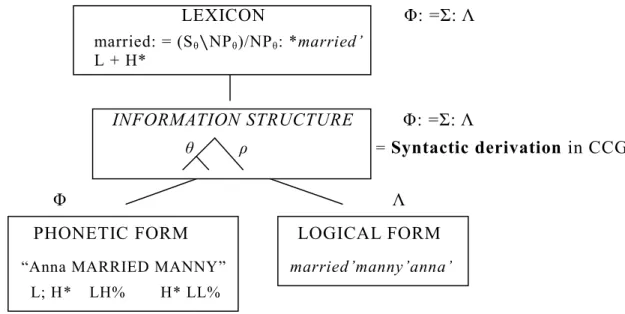
Figure 2.1 below.35 This presents a more liberal notion of syntactic structure,
one that is directly compatible with the boundaries observed by phonologists (Steedman 2000b: 126). Prosody provides important indications regarding information structure. In Figure 2.1, the lexicon statically assigns a triple consisting of a phonological form Φ, a syntactic type Σ, and a logical form Λ to all lexical items, and is the sole locus of language-specific information in the grammar. (In the figure, the tone symbol, which is associated with the accented syllable, is represented as a superscript “*” to the right of H. The subscript θ
and ρ are the two information values theme and rheme, respectively.36)
33 In addition, there are factors outside of the grammar that affect sentence meaning,
probably factors affecting both semantics and pragmatics (see Kadmon 2001 for a detailed discussion of numerous phenomena at the semantics-pragmatics interface).
34 The view may also be in accordance with that adopted in the model of Dynamic Syntax
(Kempson et al. 2001), although this study does not compare and evaluate the two grammar models.
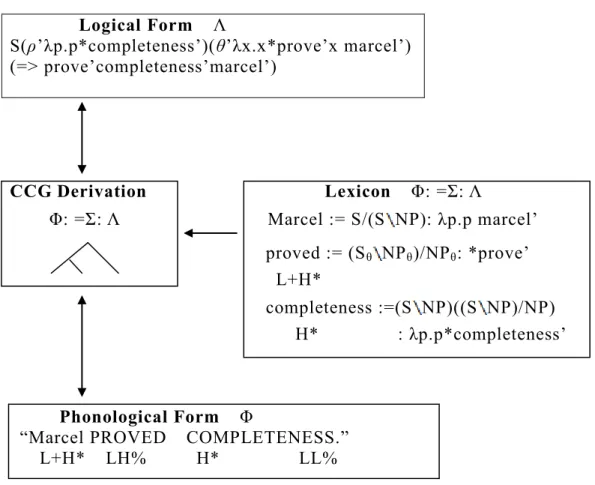
35 A more refined architecture of CCG is provided in Figure 6.1 (Chapter 6).
36 The term theme and rheme originate with Halliday (1967); we have somewhat generalized
his usage here. The much abused term focus is used in CCG strictly in the phonological sense of the term to refer to the effects of contrast or emphasis on a word that ensues from the presence of a pitch accent (see, e.g., Steedman 2000a, b, 2012; Steedman and Baldridge 2011).
25 LEXICON Φ: =Σ: Λ married: = (Sθ∖NPθ)/NPθ: *married’ L + H* INFORMATION STRUCTURE Φ: =Σ: Λ θ ρ = Syntactic derivation in CCG Φ Λ PHONETIC FORM LOGICAL FORM
“Anna MARRIED MANNY” married’manny’anna’ L; H* LH% H* LL%
Figure 2.1. Architecture of CCG (Steedman 2000b: 126)
The combinatory rules and process of lexical insertion monotonically map between PF and LF, also assigning a triple Φ: Σ: Λ: to all elements in the derivation. Note that there is no fixed order in which particular kinds of information are considered in the model. For example, it is not the case that syntactic information (e.g., agreement or case-marking information that might rule out a particular parsing) is always consulted before semantic information (e.g., semantic incompatibility that would favor or disfavor a potential interpretation of an utterance) (see Steedman 1996, 2000a, b, 2012; Steedman and Baldridge 2011).
Crucially, syntax derives from information structure (Figure 2.1). In the figure, the level of Phonetic Form (PF) is a true interface level, representing only the information necessary to specify speech or orthography. The level of Logical Form (LF) is the sole structural level of representation and identified with information structure, a level which contains all the information that is needed for processes of verification and inference in the context of discourse. Since in CCG meaning is derived from aspects of phonology (or phonological structure), words and clauses, larger textual structures, and aspects of semantic component are considered because they relate to “all”
26
levels. However, since meaning is strongly associated with lexical items and syntactic structures, a section on word semantics follows the morphological section and a section on sentence semantics follows the syntactic section.
In Chapter 6, considering the architecture and representation of a sentence’s information structure (in relation to a particular intonation contour) are interpreted as an interface between the syntactic and pragmatic module, we develop and argue for a syntactic analysis of FNQ constructions. This allows us to precisely and succinctly describe both information structure and prosody.
2.4 Summary
Our discussion so far can be summarized as follows: although the adnominal approach is successful in many cases, it cannot adequately account for several problems. Considering that FNQ patterns behave like adverbs, the adverbial approach deals with FNQ placement more successfully than the adnominal approach; nonetheless, it leaves several questions unanswered.
One of the strongest arguments against the adverbial approach is that some FNQs behave like NP-internal modifiers in that they produce an object-related quantifier reading, rather than an event-related quantifier reading (e.g., (2.4) and (2.5)). This leads to the consideration that there are some cases wherein FNQs cannot be classified as modifying only the VP or the NP, since they have a relationship with both the NP and VP (Nakanishi 2008: 302). Both the subject and the predicate obviously engender restrictions on the FNQ in some way.
Compared with other models, the hybrid approach is superior because it can account for the specific position FNQs occupy and their resulting interpretation. This issue is discussed in further detail in Chapters 4 and 5.
27
C
HAPTER3
The Issues
This chapter discusses the major interpretive issues of concern in this study (i.e., ambiguity and intonation) and related unsolved problems. These issues have sometimes been addressed in previous studies, but have rarely been exmined in detail. To clarify the main differences between VP-related and NP-related FNQs, the present study re-examines FNQs that have been widely analyzed as adverbs, in terms of context and intonation. It is shown that existing research errs in assuming that FNQs can only generate distributive readings, and that this error arises due to the incorrect treatment of non-syntactic aspects of these constructions. Accordingly, the present study claims that it is necessary to examine the process of structure building and the interaction between prosody and information structure.
3.1 Ambiguity
In general, different readings involve different truth conditions in accordance with information structure (Jackendoff 1972, 2007; Kadmon 2001; Dalrymple and Nikolaeva 2010). FNQ interpretation is the result of distinctive levels of interrelated phenomena, both syntactic and discourse pragmatic. To illuminate factors affecting FNQ interpretation, we limit arguments to the ambiguity between distributive and non-distributive and between partitive and
non-partitive readings.37
37 For other issues supposedly involving individual or stage-level predicates, see Horn