1.
I
nt
r
oduct
i
on
In Japan,the percentage ofresidentsoverthe age of65 hasreached 24.1%—the highestpercentage ever—and isstillrising,leading towardsasuperageing society.Elderly people represent30% ofallJapanese households.Even more striking isthatelderly people living alone constitute 24.2% ofallhouseholds,and
The
Local
Communi
t
y
Vol
unt
eer
Soci
al
Wor
ker
Syst
em
i
n
J
apan
:
Anal
ysi
s
of
Survey
Dat
a
OZAWA
Wa
t
a
r
u
ⅰ,
MAKI
TA
Yuki
f
umi
ⅱ,
HI
GUCHI
Koi
c
hi
ⅲ,
NI
SHI
MURA
Ki
yot
a
da
ⅳ,
I
SHI
KAWA
Kuni
ko
ⅴ,
OGAWA
Ei
j
i
ⅰ,
KATO
Hi
r
os
hi
ⅵAbstract:The word Minsei-Iin isused foragroup ofJapanese socialwork volunteersor‘persons commissioned to promote and stabilize the livesofpeople’(Goodman 1998:143).The Minsei-Iin system isunique asaform ofdirectsocialwelfare in Japan because thatdependson volunteers.Japan’srapidly ageing population hascreated new demandson these volunteerservants.We conducted asurvey ofall the membersofMinsei-Iin in Kyoto City,UjiCity and YawataCity from Augustto September2012,using astructured questionnaire to obtain detailed information on these volunteers’working conditions.The response rate wasmore than 90%.Thisreportanalysesthe survey dataand commentsusing statistical and textualmethodsin orderto identify areasofconcern with the Minsei-Iin system and waysto address them.The survey resultsshow thatMinsei-Iin are highly enthusiasticaboutand dedicated to theirwork, butthatthey are facing challengesdue to the increasing need to assistelderly people with psychological problems,especially dementia.Minsei-Iin identified barriersto finding outaboutpeople in need because ofthe provisionsofthe PersonalInformation Protection Law astheirmostcommon systematicor institutionalproblem.They generally reporthaving astrong supportnetwork,butmany ofthem believe thatthey could benefitfrom additionaltraining.
Keywords : Minsei-Jidou-Iin,Homen-Iin,Roujin-Fukushi-In,Community Care System,Survey of Minsei-Iin in 2012
ⅰ Professor,Faculty ofSocialSciences,Ritsumeikan University
ⅱ Specially Appointed Lecturer,Faculty ofUrban Management,FukuyamaCity University ⅲ Associate Professor,Faculty ofSocialSciences,Ritsumeikan University
ⅳ Part-time Lecturer,Ritsumeikan University
ⅴ Associate Professor,DepartmentofSocialWelfare,Osaka-Ningen-Kagaku University ⅵ Professor,DepartmentofSocialWelfare,Ryukoku JuniorCollege
thisrate ison the rise aswell(CabinetOffice 2013:13-14).Japan’srate ofageing ranked close to the bottom during the 1980scompared with thatofotherdeveloped countries.However,by the 1990s,Japan wasin the middle ofthatgroup and iscurrently atthe top.Ageing isproceeding atamuch fasterpace in Japan than in otherdeveloped countries,in fact,ataspeed neverseen before anywhere in the world.Ittook Japan 24 yearsto increase itsageing rate from 7% to 14%,butittook Germany 40 and UK 64 yearsto achieve the same (CabinetOffice 2013:8-11).
With thisrapid growth ofthe ageing population,the increase in the numberofelderly people living alone isbecoming aserioussocialproblem.According to datafrom the NationalInstitute ofPopulation and SocialSecurity Research in Japan,the numberofelderly people living alone was4.98 million in 2011. However,thisnumbermay rise to 7.62 million by 2035,an increase of53%.In addition,in 87% ofJapan’s totalland area,the portion ofhousehold headsover65 yearsmay reach 40%.Along with thisincrease in the ageing population,family care providersare becoming older.Moreover,instancesofsingle elderly persons dying alone have become amajorsocialproblem in Japan.
To tackle these concerns,Japan hasadopted the Long-Term Care Insurance Act,modelled on German care insurance system.Simultaneously,the Integrated Community Care Centre System hasbeen introduced so thatthe elderly can continue to live athome within theircommunity1.Before the enactmentofthe Long-Term Care Insurance Act,governmentagenciesfound residentialplacementsand determined socialwelfare servicesforthe elderly people who needed care.However,since 1998,underthe influence ofneoliberal socialwelfare policy,the recipientsofcare themselveshave been able to choose the servicesthey need by collaborating with welfare service providersdirectly.Thissocialwelfare policy aimsto strengthen the reciprocity within the community and quasimarketcare servicesforthe elderly.The role ofMinsei-Jidou-Iin (hereafterreferred to asMinsei-Iin),who have provided informalsocialwelfare supportwithin their community,isnow attracting attention underthispolicy.
Thisthesisfirstclarifiesthe relationship between community care and Minsei-Iin by reviewing the activitiesand historicalbackground ofMinsei-Iin;itthen discussesthe analysisand significance ofour survey on Minsei-Iin,conducted in 2012.In the following section,we willreview the historicalbackground ofthe Minsei-Iin system.
2.
The
act
i
vi
t
i
es
of
Mi
nsei
-
I
i
n
and
i
t
s
hi
st
or
i
cal
backgr
ound
The history ofMinsei-Iin goesback to the period before the Second World War.The predecessorof the Minsei-Iin system issaid to have been the Homen-Iin system (1918),developed by Shigejiro Ogawa (1863-1925)and established in Osakaprefecture.When Ogawawasachiefprison officer,he attended the internationalprison congressesof1895 and 1900 in Europe asaJapanese representative.During these conventions,he became acutely aware ofthe importance ofthe poorreliefsystem in preventing various formsofcrime.He especially studied the Hamburg system and the Elberfeld system2in Germany.
Ogawamade reference to the abovementioned systemsin Germany in orderto tackle the aftermath of the rice riots3and also provide poorrelief.He divided OsakaCity into sixteen areasand commissioned approximately three hundred residentsasHomen-Iin.These people compiled information to identify and record the levelofpoverty to overcome the community problem systematically.
Thissystem spread nationwide in ashorttime and waseventually legislated by the governmentin 1936. Thislegislation marked the beginning ofthe currentMinsei-Iin system.The initialactivitiesofMinsei-Iin were performed to grasp the levelofpoverty problemsand monitorresidents’activities.In addition,they
gave counselling on household finance issuesto familiesand individualsliving in poverty.In some cases, Minsei-Iin themselvesoffered financialsupporton apersonalbasis.Before the Second World War,members of reputable families within the community were commissioned as Minsei-Iin. The post was legally designated asan honorary position thatplayed asupplementary role in administering poverty relief. Afterthe Second World War,amidstthe democratization ofvarioussystems,Minsei-Iin activitieswere entrusted to volunteerswho assisted in implementing the administration’ssocialwelfare policiessupporting families,children,handicapped and elderly in need.Localadministration officersmade recommendationsfor the postofMinsei-Iin,and the nominee wascommissioned by the Ministry ofHealth,Labourand Welfare forathree-yearterm (with apossible extension).Currently,Minsei-Iin are unpaid posts,although before the amendmentofthe Minsei-Iin Actin 2000,asmallfee had been included.Theirmain role wasto seek out people in need,provide them with volunteeraid and assistthe localgovernment’sadministration.The status ofthisposition asan honorary postwasmaintained until2000.
With regard to supportthe elderly people,Minsei-Iin worked togetherwith the CouncilofSocial Welfare—acommunity socialwelfare system introduced afterthe Second World War,modelled on the US system—and accomplished numerousresults.Forexample,in the 1950s,the Minsei-Iin Association conducted asurvey on the condition ofbedridden elderly people living athome and developed asystem of temporary helpersforthose in need.Afterthat,the association continued to supportsingle elderly people and familieswith bedridden elderly members,and itestablished the foundation forasystem ofwatching overelderly people in the community.When the Minsei-Iin Association celebrated itsfiftieth anniversary in 1967,itsetforth three new coursesofaction,emphasising on 1)contributing to the independence ofelderly persons,2)serving othersand 3)being community-minded.
During the 1970s,the population’sageing rate rose to 7%,and the increase in the numberofthe elderly and the need forlong-term nursing care became an importantissue in policy discussions.Asaresult,the Japanese governmentbegan to provide free medicalservicesforthe elderly,made improvementsin medical insurance paymentsand introduced an indexing system forpensions.These majorsocialpolicy reforms marked a substantial expansion of the welfare state and were believed to take steps towards a comprehensive,government-led welfare system.However,the economicslowdown caused by the oilcrisisof the 1970sled to atransition in socialpolicy from the responsibility ofpublicsectorforindividualsocial welfare to an emphasison people’sown responsibility to care fortheirimmediate family membersand relatives.Thistransition ofthe centre ofsocialpolicy from the state to the community orto self-help was modelled on asimilarpolicy,the Community Care system,which gained prominence in the 1960sin the UK.In the 1980s,Japan experienced rapid economicgrowth and maintained alow unemploymentrate.In thiscontext,neo-liberalsbegan to review welfare state policy,leading to areduction in publicservicesfor socialwelfare.In 1987,atthe time ofthe seventieth anniversary ofthe Minsei-Iin Association,‘coordination’ and ‘supportforlivelihood’were added to the existing five aspectsofthe association mission.In the 1990s, the CouncilofSocialWelfare established and began operating community centrescalled Fureai-Ikiiki centresaspartofaprojectof‘community developmentformutualaid’(the Fureai-no-machizukuriplan). Minsei-Iin began serving asthe node pointin operating these community centres,watching overthe elderly in the community and developing relationshipsamong them.Minsei-Iin therefore had to be committed to establishing relationshipswithin the community and providing livelihood supportforcommunity residents. Aswe can see from such activities,the role ofMinsei-Iin haschanged from awatchdog body thatmonitored community needsduring the pre-warerato ‘personscommissioned to promote and stabilize the livesof people’in democratized Japan (Goodman 1998:143).
Since the end ofthe 1990s,socialwelfare policiesforthe elderly and the activitiesofMinsei-Iin changed drastically.Japan’ssocialwelfare policiesforthe elderly continued to shifttowardsneo-liberalism. However,the limitationsofrelying too heavily on family members’supportwere becoming apparent.To promote the utilization ofvarioussocialwelfare resources,the Long-Term Care Insurance Actwasenacted in 1998.Thispolicy called foratransition from care servicesdesigned by welfare administratorsto market -oriented services.Currently,the policy focusison long-term care forthe elderly living athome.The main policy initiative implementsthe Integrated Community Care Centersystem fordelivering preventive services forthe ageing,and itgivesgreatimportance to the supportand monitoring provided to the elderly by community volunteers.In 2000,the Minsei-Iin Actwasrevised and the honorary postclause wasabolished. Minsei-Iin are now considered asvolunteersocialworkers4who supportJapan’sIntegrated Community Care Centersystem by taking care ofthe community,supporting food delivery and operating othercommunity servicestailored to the needsofeach community5.
Minsei-Iin have been continuously working towardsthe needsoftheircommunitieslong before the Second World War.Although they are notprofessionalsocialworkers,they are residentsliving within the community who possessan understanding ofthe characteristicsoftheirlocale and can thusoffereffective community supportin avolunteercapacity.
The elderly population is increasing in number all over the world, and the question of how to implementcommunity care isamajorconcern in severalcountries.Itistherefore usefulto monitorMinsei -Iin’sactivitieswithin the Japan’sIntegrated Community Care Centersystem in orderto tackle issuesofcare forthe elderly and,hopefully,find the appropriate balance between publicand informalsupportwithin community care.
3.Resear
ch
out
l
i
ne
and
dat
a
anal
ysi
s
met
hod
Ourresearch group conducted asurvey ofMinsei-Iin in 2012 within Kyoto City and itsvicinity (including UjiCity and YawataCity).Thisreportanalysesthe survey datawith two aims:1)to establish the presentconditionsofMinsei-Iin,who are positioned ascommunity socialwelfare volunteersand clarify the problemsthey face and 2)to understand the methodsofcollaboration among volunteerworkerssuch as Minsei-Iin within the community forimplementing community-based care.
Since 2006,we have implemented action research6,aiming to establish asupportnetwork forforeign elderly residentswithin Kyoto City7.The 2012 Minsei-Iin survey wasimplemented aspartofthisaction research with the goalofstrengthening thiscommunity volunteernetwork.
A review ofexisting research documentsconfirmed thatoursurvey targeting each Minsei-Iin in a region ofJapan wasthe firstofitskind.Itwasperformed between 1 Augustand 20 September2012 with cooperation from the Minsei-Iin Association and the localsocialwelfare authority.Within Kyoto City,the targetpopulation included all2,720 Minsei-Iin,ofwhom 2,478 responded with valid data,foran extremely high return rate of91.9%.The main objectivesofthissurvey were to clarify the problemsMinsei-Iin were facing aswellasthe effortsmade to overcome such problemsin orderto assistin determining the future shape ofthe Minsei-Iin system.We have conducted statisticalanalysisofthe obtained dataand have provided feedback regarding the resultsto the Minsei-Iin Association and the localcommunitiesin orderto enhance theirsocialwelfare capacity.
The survey questionnaire covered 1)basicand demographicinformation including the length oftime working asMinsei-Iin,areaofresponsibility,age and sex,2)respondents’workload by the type ofactivity
(with additionalspace foropen-ended answerson the contentoftheiractivities),3)the numberofelderly personsand householdsaboutwhom the respondenthasinformation,4)the numberofproblematiccases and theirdetails(with additionalspace foropen-ended answers),5)the extentofnetworking with other Minsei-Iin membersorsocialworkers(with additionalspace foropen-ended answers),6)Minsei-Iin’s interestin variousrolesin monitoring the elderly,7)theirideason how to monitorthe elderly (open-ended answer)and 8)theirrequestsfortraining programs(open-ended answer).Crosstabulation and multivariate analysiswasused fornumericdataitemssuch asworkload ornetworking volume.Geographicinformation system (GIS)software wasalso used to constructmappingsofdata.Moreover,the textmining method was used to analyse textualdatamathematically and form adiagram illustrating the co-occurrence ofselected key concepts.
4.
Resear
ch
r
esul
t
s
and
anal
ysi
s
The research resultshighlightthe daily activitiesofMinsei-Iin such astheirdetailed currentstatus, difficultiesthey face and effortsmade to overcome those difficulties.In thisreport,the following five points willbe discussed in detail:1)the multivariate analysisofhow Minsei-Iin’sworkload isdetermined,2)the analysisofproblematiccases,3)the analysisofMinsei-Iin’snetworking in the course oftheiractivities,4) the analysisoftraining programsrequested by Minsei-Iin and 5)the analysisofproblemsconcerning the Minsei-Iin system,especially the problem ofthe ageing workforce and waysto overcome it.
4―1.Analysis ofhow Minsei-Iin’s workload is determined
The activitiesofMinsei-Iin vary widely,because they covercommunity care in general.Theirfourmain emphasesare supportforthe elderly,helping poorresidentsgain eligibility forpublicassistance and supportforchildren and people with disabilities.
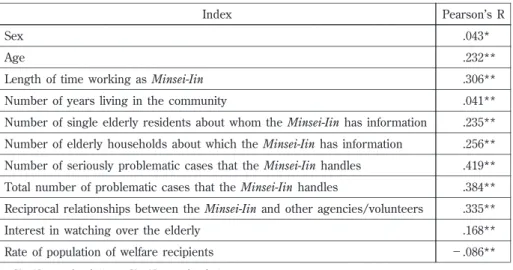
How isthe workload ofeach Minsei-Iin determined?Theirworkload can be divided into two categories: supporting activities(divided into eightcategorieswith fourrating choicesforeach question in the survey) and institutionalactivities(divided into fourcategorieswith six rating choices).We have added the ratings within each activity type to constructan overallindicatorofeach person’sworkload.Table 1 summarizesthe relationship between the overallworkload and othersurvey data.
Two hypothesescan be stated regarding the overallworkload ofMinsei-Iin.The firsthypothesisisthat the workload isdetermined mainly by the socialwelfare needsin each community;the second hypothesisis thatthe workload isdetermined mainly by the enthusiasm ofeach individualMinsei-Iin based on hisorher volunteerspirit.The resultsofmultivariate analysisbased on these hypothesesare summarized in Tables2, 3 and 4.
The multivariate analysisshowsthatthe workload ofMinsei-Iin isdetermined by the numberof problematiccasesthey handle,the length oftime working asaMinsei-Iin,reciprocalrelationshipsbetween the Minsei-Iin and otheragenciesorvolunteersand the age ofMinsei-Iin.
On the otherhand,there wasno correlation between the workload and the proportion ofelderly membersin the community,which mighttypically serve asan approximation ofthe levelofsocialwelfare needsin each community.In addition,the coefficientbetween the workload and percentage ofwelfare recipients,which can also reflectthe levelofsocialwelfare need in each community,issmalland negative, indicating thatthe workload ofaMinsei-Iin isnotcorrelated with the overallsocialwelfare needsofthe community.On the otherhand,the workload dependson the volunteerspiritofaMinsei-Iin.Enthusiastic
Table 2.Results ofthe multivariate analysis:modelsummary Std.Errorofthe Estimate Adjusted R Square R Squared R Model 1.36679863 .309 .311 .557a 1 1.3672002 .308 .311 .558b 2 a.
Predictor:(constant),Rate ofpopulation ofwelfare recipients,Numberofseriously problematiccasesthatthe Minsei-Iin
handles,Interestin watching overthe elderly,Age,Reciprocalrelationship between the Minsei-Iin and otheragencies/ volunteers,Length oftime working asMinsei-Iin.
b.
Predictor:(constant),Rate ofpopulation ofwelfare recipients,Numberofseriously problematiccasesthatthe Minsei-Iin
handles,Interestin watching overthe elderly,Age,Reciprocalrelationship between the Minsei-Iin and otheragencies/ volunteers,Length oftime working asMinsei-Iin,Dummy data(women),Numberofyearsliving in the community.
Table 3.Results ofthe multivariate analysis:ANOVAc
Sig. F Mean Square Df Sum ofSquares Model .000a 160.366 299.585 1.868 6 2134 2140 1797.512 3986.608 5784.120 1 Regression Residual(ANOVA) Total(pivottable) .000b 120.257 224.813 1.869 8 2132 2140 1798.501 3985.619 5784.120 2 Regression Residual(ANOVA) Total(pivottable)
a.
Predictor:(constant),Rate ofpopulation ofwelfare recipients,Numberofseriously problematiccases,Interestin watching overthe elderly,Age,Reciprocalrelationship between the Minsei-Iin and otheragencies/ volunteers,Length oftime working asMinsei-Iin.
b.
Predictor:(constant),Rate ofpopulation ofwelfare recipients,Numberofseriously problematiccasesthatthe Minsei-Iin
handles,Interestin watching overthe elderly,Age,Reciprocalrelationship between the Minsei-Iin and otheragencies/ volunteers,Length oftime working asMinsei-Iin,Dummy data(women),Numberofyearsliving in the community.
c.
Dependentvariable:Overalltotalworkload.
Table 1.Correlation coefficientbetween the workload ofMinsei-Iin and otherindices
Pearson’sR Index .043* Sex .232** Age .306** Length oftime working asMinsei-Iin .041** Numberofyearsliving in the community
.235** Numberofsingle elderly residentsaboutwhom the Minsei-Iin hasinformation
.256** Numberofelderly householdsaboutwhich the Minsei-Iin hasinformation
.419** Numberofseriously problematiccasesthatthe Minsei-Iin handles
.384** Totalnumberofproblematiccasesthatthe Minsei-Iin handles
.335** Reciprocalrelationshipsbetween the Minsei-Iin and otheragencies/volunteers
.168** Interestin watching overthe elderly
−.086** Rate ofpopulation ofwelfare recipients
Minsei-Iin tend to have greaterresponsibilities,and the workload also becomesheavierwith increased work experience and ispositively correlated with the extentofreciprocalrelationshipswith otheragenciesand volunteers.
Minsei-Iin who handle many problematiccasestend to be very active in both personalsupportand group supportactivities.Thisfinding indicatesthateitherthe encounterswith problematiccasesraise awarenessin the Minsei-Iin and fosterenthusiasm aboutfulfilling theirresponsibilitiesorwhen Minsei-Iin encounteraproblematiccase during theirinvolvementin community activities,thismay be atriggerfor them to become involved in furthercommunity work.
Table 4.Results ofthe multivariate analysis:Coefficientsa
95.0% of confidence intervalofB Sig t Standarized Coefficients Un-standarized Coefficients Model Maximum Minimum Beta Std.Error B −2.631 .157 .210 .858 .181 .120 −.001 −3.192 .048 .142 .686 .129 .051 −.005 .000 .000 .000 .000 .000 .000 .000 −20.381 3.666 10.120 17.665 11.715 4.875 −3.584 .076 .211 .327 .219 .089 −.065 .143 .028 .017 .044 .013 .018 .001 −2.912 .103 .176 .772 .155 .086 −.003 1.(constant) Age Period ofwork asMinsei-Iin Numberofseriously problematiccases Reciprocalrelationship between Minsei-Iin and otheragencies/volunteers Interestin watching over
the elderly
Rate ofwelfare recipients
−2.028 .158 .212 .857 .180 .121 −.001 .160 .063 −3.436 .046 .146 .686 .129 .052 −.005 −0.97 −.113 .000 .000 .000 .000 .000 .000 .000 .629 .579 −7.613 3.586 10.109 17.651 11.684 4.880 −3.591 .484 −.554 .075 .213 .327 .219 .089 −0.65 .009 −.010 .359 .029 .018 .044 .013 .018 .001 .066 .045 −2.732 .102 .178 .772 .154 .086 −.003 .032 −.025 2 (constant) Age Length oftime working as Minsei-Iin Numberofseriously problematiccases Reciprocalrelationship between Minsei-Iin and otheragencies/volunteers Interestin watching over
the elderly
Rate ofwelfare recipients Dummy (women) Numberofyearsliving in
the community
When asked abouttheirmosttroubling cases,44% ofMinsei-Iin said thatthey had atleastone such case and 9% had more than three troubling cases.Itcan be said thatJapanese community care iswell supported by Minsei-Iin with enthusiasticvolunteerspirits.Thisconfirmsthe significance ofhuman resource developmentin termsofvolunteernetworking thatsupportscommunity care.In line with society’sneeds, the role ofMinsei-Iin hasclearly changed from an honorary postin earliertimesto acore community volunteerpostin the present.
In the nextsection,we willanalyse the detailsofproblematiccasesthatMinsei-Iin face.
4―2.Problematic cases handled by Minsei-Iin
The largestcategoriesofthe mosttroubling caseshandled by Minsei-Iin are asfollows:1)dementia, 17.4%,2)problemswith neighbours,15.6% and 3)clientswho refuse to acceptvisitsfrom Minsei-Iin,9.8%. Currently in Japan,the estimated rate ofcognitive dementiaamong the elderly overage 65 is15%.Thishigh frequency ofdementiacasesunderscoresthe importance ofwatching overthe elderly within the community. The respondentswere asked to write aboutthe detailsoftheirmosttroubling casesin afree-response format.These response dataare classified below:
(1) Difficulty in communicating when watching overthe elderly (138 cases), (2) Difficulty in coordinating orinteracting with neighbours(99 cases), (3) A suspected dementiacase (64 cases),
(4) Poverty (61 cases),
(5) Strong refusalto acceptany kind ofsupport(36 cases),
(6) Extreme and outrageousdemandsfrom community residentstowardsMinsei-Iin (32 cases), (7) No family orrelatives(30 cases),
(8) Housesburied in garbage (hoarders)(16 cases), (9) Addicts(11 cases),
(10) Behaviouralproblems(10 cases),
(11) Schizophrenia,depression and othermentaldisorders(10 cases).
Using the textmining method,key wordswere picked from free-response textualdatato analyse their co-occurrence mathematically.Thisdataanalysisisdisplayed in Figure1.The size ofthe circle in which the key word isplaced denotesthe frequency ofthatword’soccurrence.Such mathematicalanalysisdraws attention to the problemsfaced by Minsei-Iin from anotherpointofview.
We can conclude from thisfigure thatthe Minsei-Iin take on farmore seriouscasestoday than those traditionally assigned to them.In earliertimes,theirprimary task wasto help poorresidentsin establishing theireligibility forpublicassistance.Now,many casesinvolve mentalorcommunication disorders,which are extremely difficultforMinsei-Iin to handle.The reason forthese more difficultassignmentsmay be the lack ofcommunication abilitiesand community relationshipsamong many elderly people asthe ageing population grows.
In theirfree-response answers,some participantsdescribed systematicand institutionalproblemsthat impede supportforpeople in need.The following listshowsthe mostcommon systematicand institutional barriersthatMinsei-Iin are facing:
(1) Implicationsofthe PersonalInformation Protection Law (82 cases), (2) Problemswith systematiccollaboration orinformation sharing (30 cases),
(4) Problemswith welfare policy oritsadministration (26 cases),
(5) Difficultiesin monitoring community residentswho do notbelong to the neighbourhood association (16 cases).
In recentyears,mostofthe apartmententrance doorsin Kyoto City have been fitted with automatic locks.Numerousisolated elderly personsare residing in such apartments.The elderly are increasingly dropping outofthe neighbourhood association.However,the PersonalInformation Protection Law prevents individualsfrom sharing with Minsei-Iin any personalinformation aboutthe isolated elderly orothersin need.Thissituation ismaking Minsei-Iin’sactivity extremely difficult.Undersuch circumstances,Minsei-Iin themselvespointoutthe importance ofnetworking among those in community care.
The nextsection analysesnetworking activity,which isalso closely related to the workload ofeach Minsei-Iin.
4-3.Analysis ofthe Minsei-Iin’s various networks
In thisresearch,we have classified Minsei-Iin’srelationshipsinto fourcategories:1) Minsei-Iin
Table 5.Networks ofMinsei-Iin in Kyoto City (%) Minsei-Iin and othersubjects consulting each other Otherspecialists consulting Minsei-Iin Minsei-Iin consulting other specialists 38.6 43.0 83.1 Minsei-Iin 33.5 45.6 59.5 Roujin-Fukushi-In 16.8 33.8 34.5 Neighbourhood association staff
3.5 10.8
10.9 Landlord/apartmentmanager
18.0 21.9 61.3 Ward office–socialwelfare section 2.7 4.4 15.3 Ward office–health care centre 1.6 3.4 11.5 Ward office–others 3.5 6.5 16.2 Police/fire station 0.4 1.2 5.7 Consumeraffairscentre
24.2 27.9
66.3 Integrated Community SupportCentre
2.5 4.5
10.7 Home Care SupportCentre
0.4 4.1 10.1 Medicalstaff 13.2 19.4 33.1 CouncilofSocialWelfare
3.6 7.3 11.9 Home care providers 2.2 3.4 4.9 Othersocialwelfare organizations
15.2 44.0 25.7 Neighbours 4.8 12.4 10.1 Volunteers
0.0 0.3
0.6 Non-Japanese socialworker
(Gaikokujin-Fukushi-Iin)
0.9 2.2
2.3 Others
consulting otherspecialists,2)otherspecialistsconsulting Minsei-Iin,3)Minsei-Iin and otherspecialistswho have atwo-way consultation and (4)otherrelationshipsnotfalling into any consulting category.
Table 5 summarizesthe outcomesofthe networking questionsin oursurvey.Itindicateshow the Minsei-Iin are working togetherwith otherconcerned individualsand organizations.The Minsei-Iin in Kyoto City have created anetwork with theircolleaguesand districtvolunteers,Roujin-Fukushi-In,who are in charge ofwatching overthe elderly.The networksformed among volunteersare supported by officialssuch asstaffofthe Integrated Community Care System,ward officesand the CouncilofSocialWelfare.Figure 2 showsusthe relationship diagram ofthe community care system in Japan.
Kyoto City introduced the system ofRoujin-Fukushi-In more than forty yearsago.These localresident volunteersfrequently visitthe homesofthe elderly.The resultsoftheirpersonalservicesare reflected in Table 5.In Kyoto City,supportforthe elderly living in the community hasbeen implemented through well -coordinated effortsamong community volunteers,including the Minsei-Iin and othersinvolved in elderly care.
We asked Minsei-Iin abouttheircoordination activitieswith variousgroups.We found thatthey have
Table 6.Networks ofMinsei-Iin in Kyoto City (top three collaborators with Minsei-Iin)
Third Second First % Frequency % Frequency % Frequency 5.1 127 9.1 225 44.7 1108 Minsei-Iin 7.7 190 22.1 547 5.6 138 Roujin-Fukushi-In 6.8 168 5.0 123 1.1 28 Neighbourhood association staff
0.6 16 0.4 9 0.2 4 Landlord/apartmentmanager
12.3 306 12.6 312 8.4 209 Ward office–socialwelfare section 0.9 23 0.5 12 0.1 2 Ward office–health care centre 0.7 18 0.6 14 0.2 4 Ward office–others 0.9 23 0.4 10 0.1 3 Police/fire station 0.0 1 0.0 1 0.0 0 Consumeraffairscentre
17.3 428 13.9 345 10.7 264 Integrated Community SupportCentre
0.6 15 0.3 8 0.1 2 Home Care SupportCentre
0.6 14 0.1 3 0.0 1 Medicalstaff 6.3 157 4.2 104 1.9 46 CouncilofSocialWelfare
1.0 24 0.2 6 0.3 7 Home care providers 0.7 18 0.9 23 0.4 11 Othersocialwelfare organizations
4.8 120 2.3 58 0.6 14 Neighbours 0.9 23 0.3 7 0.2 5 Volunteers
0.1 2 0.0 0 0.0 0 Non-Japanese socialworker
(Gaikokujin-Fukushi-Iin) 0.0 1 0.4 11 0.3 8 Others 67.6 1674 73.4 1818 74.8 1854 Subtotal 32.4 804 26.6 660 25.2 624 No answer/Don’tknow
100 2478 100 2478 100 2478 Overalltotal
high levelsoftrustin Integrated Community Care System supportstaff,fellow membersofMinsei-Iin and community volunteersincluding Roujin-Fukushi-In.These individualsand organizationsare nearby and easy to consultwith.In some localcommunities,regularmeetingsare held among differentorganizationsand Minsei-Iin.These volunteerworkersconsulteach otheron aregularbasis,and when aproblem occurs, ordinarily they tend to consultIntegrated Community Care System staff.
Asstated previously,in Japanese society,the Integrated Community SupportCentresplay akey role in community care.We have constructed amap,shown in Figure 3,using the GIS software in orderto visualize how Minsei-Iin and the Integrated Community SupportCentresform anetwork ofreciprocal relationshipswithin theirareasofjurisdiction.
Figure 3 showsthe levelofreciprocalrelationship between Minsei-Iin and Integrated Community Support Centres in various shades. The figure indicates a large variance in the level of reciprocal relationshipsacrossjurisdictions.The reasonsforthisvariance may include factorsrelated to Minsei-Iin as wellasto the centres.On one hand,the Minsei-Iin may perceive the centresashaving alow levelofsocial capital—i.e.asnothaving gained much trustwithin the community—and thusasineffective partnersin forming anetwork with community residentsand workers.On the otherhand,the Integrated Community SupportCentresmay notsee networking with community volunteersastheirpriority.We intend to conduct furtheranalysisofthese factorsin the future.
Anotherimportantpointcan be seen in Tables5 and 6,namely the absence ofnon-profitor non-governmentalorganizations(NPOsand NGOs)in supporting community care.Forexample,the non-Japanese socialworkersystem wasbuiltin Kyoto City by the volunteerorganization known as‘More Network’.However,itplaysaminimalrole in community care in Kyoto City.Thispointhighlightsa difference in community care delivery between Japan and othercountries,especially the UK.
Figure 3.Mutual networks between Integrated Community Support Centres and
Minsei-Iin (within Integrated Community SupportCentres’jurisdiction) Legend
Itshould be acknowledged thatthe Minsei-Iin system hasbeen operating nationwide in Japan for seventy-eightyearsand functionsasakeystone ofthe Japanese community welfare system.
In the nextsection,we willanalyse the problemsthatthe Minsei-Iin system iscurrently facing aswell asthe question ofhow to empowerMinsei-Iin.
4―4.Empowering Minsei-Iin
To generate ideason how to furtherempowerMinsei-Iin,we invited respondentsto write theirdetailed requestsand opinionsregarding the training programsprovided by theirorganization.We received answers to thisquestion from 341 respondents.
We used the textmining method to selectkey wordsfrom the commentsand then mathematically analysed the datawith attention to the co-occurrence ofthese key words.In Figure 4,the size ofthe circle in which akey word isinserted correspondsto the frequency ofthatword’soccurrence in Minsei-Iin’s comments.
Figure 4 highlightsthe following fourpoints:1)Minsei-Iin’sstrong desire fortraining with regard to monitorthe elderly in theircommunity,2)theirinterestin case study–based training to enhance theirskills
in response to community needs,especially in dealing with dementia,3)theirdesire forstrongerinteraction and networking with membersofMinsei-Iin and otherspecialists,including information sharing with these specialists,Integrated Community SupportCentresand socialwelfare officesand 4)theirconcern for determining how to overcome the problem ofdeficientinformation flow in the community resulting from the PersonalInformation Protection Law.
Asforthe empowermentofMinsei-Iin,itisimportantto investigate how they have overcome existing difficultiesin information sharing through greateffortand creativity8.During ourresearch,we asked Minsei -Iin to commentin detailabouttheirdaily activities.Ourresearch team hasattempted to summarize and categorize allthese answerswithoutlosing the essence ofthe originalobservations.A reportsummarizing these commentshasbeen distributed to the Minsei-Iin Association aswellasto the relevantadministration office.In addition,ProfessorHiroshiKato made apresentation on the outcomesofoursurvey atthe Kyoto Minsei-Iin Association conference on 1 December2013 in orderto provide feedback to the community. The Minsei-Iin system isnow in crisis,because ithasdifficulty maintaining itscurrentlevelofservice in some communities. Figure 5 indicates the percentage of Minsei-Iin with fewer than six years of experience in each localarea.Some areas(shown in white)are experiencing difficultiesin recruiting new Minsei-Iin.
Currently,the genderbalance ofMinsei-Iin residing in Kyoto city isoverwhelmingly female;71% female whereas29% male.Asforthe age,44% ofMinsei-Iin are over66 yearsold,indicating thatthe average age ofMinsei-Iin hasbeen rising.Thispresentsaseriousproblem with regard to finding replacementsfor oldermembers.
Variousproblemspersist,such aslack ofinteraction between veteran and youngerMinsei-Iin,securing youngervolunteersin the community and the overallageing ofthe population.The baby boomershave
Figure 5.Minsei-Iin with fewerthan six years ofwork experience (within Kyoto’s local schooldistrict)
reached retirementage,and therefore itisimportantto considerhow to involve them,especially retired people,in community activities.
5.Concl
usi
ons
In January 2013,The SpecialCommittee on the Security CouncilforNeedy Personsissued areport stating that‘in orderto formulate anew system to supportthe people in need,the role ofMinsei-Iin,who are to grasp the realcondition ofeach community and to provide supportbased on community needs,will become increasingly important9’.
In recentyears,the variousrolesofMinsei-Iin,who form apartofthe localvolunteernetwork within the community care system,have been re-evaluated in Japan.Oursurvey hashelped to elucidate the activitiesofMinsei-Iin from theirpointofview,clarify the problemsthey are facing and identify waysto overcome these problems.
We can summarize the key outcomesofourresearch in the following five points.
5―1.Minsei-Iin’s volunteermentality has been verified statistically through oursurvey
The history ofthe Minsei-Iin system can be traced back to the pre-World WarIIera.The early Minsei -Iin memberswere chosen from reputable familiesin the community and were given an honorary position. However,with the enactmentofthe Long-Term Care Insurance Actin 2000,Minsei-Iin ceased being an honorary postand were repositioned ascommunity socialwelfare volunteers.Itissignificantthatthe multivariate analysison workload confirmsthe nature ofMinsei-Iin’svolunteermentality.
The three basicstandardsforMinsei-Iin activitiesspecified underthe Minsei-Iin Actare spiritofsocial volunteerism,respectforfundamentalhuman rightsand prohibition ofabuse oftheirstatusforpolitical purposes.In addition,on itsfiftieth anniversary in 1967,the NationalMinsei-Iin Association setforth three guiding principlesforitsactivity:residency,continuity,comprehensivenessalong with five operating principles:survey,consultation,information provision,communication,advocacy’.Furthermore,on its seventieth anniversary in 1987,two additionalprinciplesofoperation:coordination and supportforresidents’ livelihood were added.The above-listed three basicstandards,three guiding principlesofactivitiesand seven operations are considered the foundation of Minsei-Iin activities. Through our survey, it was reconfirmed thatthe membersofMinsei-Iin adhere faithfully to thismission and play akey role in the promotion ofcommunity socialwork asvolunteers.
5―2.The problematic cases thatMinsei-Iin handle have been identified
With the help ofthissurvey,the overallpicture ofthe problematiccasesthatMinsei-Iin handle has been established.Traditionally,Minsei-Iin were tasked with supporting the poorwithin theircommunity. However,in recentyearsthere have been farmore problemsrelated to the elderly living in the community. Mostofthe casesthatMinsei-Iin find difficultto handle involve psychologicalproblems,especially dementia. Therefore,providing supportforMinsei-Iin in such casesisessential,because people who find itdifficultto communicate with otherstend to be hidden from the community.
5―3.Socialproblems thatMinsei-Iin are facing have been identified
Thissurvey hasalso helped to identify in detailthe systematicand institutionalproblemsthatMinsei-Iin are facing.From the open-ended answercommentswritten in the questionnaire,we have been able to
identify the barrierscreated by the implementation ofthe PersonalInformation Protection Law.These barrierspresentthe largestsingle obstacle to the community volunteerwork ofMinsei-Iin.Thislaw has been enacted to protectindividualrights,butishaving anegative effecton community care support. Therefore,the application ofthislaw needsto be reviewed.
5―4.The socialnetwork supporting Minsei-Iin has been determined
The relevantcollaboratorsand networkssurrounding Minsei-Iin have been identified.In orderforthe Minsei-Iin to dealwith problematiccasesand to overcome systematicand institutionalbarriers,theirsupport network isvery important.Community care systemsmustbe setup,with Integrated Community Support Centresbeing the focalpointso thatothervariouscommunity socialwelfare actorscan network with each otherand remain in close contact.
Through our survey, problems related to local administration, social welfare organizations and community neighbourhood watch groupshave also been identified.The survey elicited both positive and negative commentsregarding the relationshipsbetween Minsei-Iin and these organizations.The comments have been summarized and categorized and have been submitted to the concerned organizationsand individualsinvolved in community care.
In addition,thisresearch implicitly assessed the effectivenessofMinsei-Iin’sadvocacy function. Advocacy,orrepresenting the voice ofthe residents,isamong the seven operating principlesofMinsei-Iin, and how to strengthen theirfunction asadvocateshasbeen an issue ofconcern.Although the scope ofthis survey islimited to three cities,itwascertainly significantthatauniversity research projectinvolving allthe membersofMinsei-Iin in thisareacould be conducted with the cooperation ofthe Minsei-Iin Association and thatitcould achieve an impressive response rate ofmore than 90%.The enthusiasm ofMinsei-Iin was evidentin the returned questionnaires,asthe outside marginsofthe formswere filled with comments.This response showsthatthey are sincerely trying to fulfiltheirrole asadvocates.
We believe thatanalysisand classification ofsurvey databased on action research isan effective way of empowering Minsei-Iin aswellasthe socialwelfare actorsin the community.We intend to continue conducting action research in orderto encourage socialwelfare actorsthemselvesto become aware of existing concernsthatare illuminated by the resultsofsuch dataanalysis.The significance ofthisaction research liesin the collaboration between university researchersand the community in orderto shed new lighton the developmentofcommunity care.
1 The Ministry ofHealth,Labourand Welfare in Japan ispromoting the Integrated Community Care System so that‘in 2025,when the baby boomersreach the age of75 ormore,they willbe able to continue living in their own community untilthe end oftheirliveswith dignity,even ifthey require high-level,long-term nursing care’.The Integrated Community Care System refersto ‘the provision ofhousing,long-term nursing care, preventing servicesand livelihood supportin theircommunity asawhole’.To implementthissystem, ‘community-based services’were introduced in 2005 within the partialrevision ofthe Long-Term Care Insurance Act.
2 The Hamburg system wasintroduced in 1788 by setting up apoor-reliefcommittee in orderto grasp poverty levelsand coordinate serviceswith differentcharities.The Elberfeld system began in 1853 in whatwe call today the German city ofWuppertalby updating and improving the Hamburg system.The city wasdivided
into smallareascontaining notmore than fourpoorhouseholdseach time.More than five hundred poor-relief officerswere assigned accordingly.The Strasbourg system,established in 1906,used acombination ofboth paid staffand volunteersto provide support.
3 Many localriotsoccurred in Japan during 1918,because ofthe decrease in the distribution ofrice and itshigh price.
4 The Minsei-Iin system,asagroup ofvolunteersocialworkerscomposed oflocalresidents,isunique to Japan. Goodman,who positionsJapan’ssocialwelfare policy asamodelforEastAsia,analysesJapan’sMinsei-Iin from aculturalpointofview.He describesMinsei-Iin associalworkerswith socialwelfare viewsdistinctive to Japan,with heavy emphasison self-help within the family and mutualassistance among neighbours.
5 Following are the Minsei-Iin Association’smain activitiesin termsofsupporting the elderly and the numberof answersto questionson each activity:(1)operation ofcommunity centresforthe elderly (in conjunction with the CouncilofSocialWelfare and othercommunity organizations),642,(2)community events(such assports daysorspecialdaysforthe elderly),535,and (3)partiesforsingle elderly people (including food preparation forthese events),357.
6 Action research isaresearch method used in variousfieldssuch asethnicstudies,institutionaldevelopment (Lewin 1946,Zuber-Skerritt1996),education,health,and socialcare (Susman and Evered 1978).Itisatype of jointimplementation research involving researchersand practitionersthataimsto respond to pressing social issues,determine the substance and tendenciesofthe problem,and bring aboutchangesin the current situation.By providing feedback on the research resultsto community practitioners,datacan be verified and new recommendationsthatcould inspire both practicalchange and future research can be generated.One characteristicofaction research isthatitisconducted togetherwith community actorsin orderto pursue a solution to theirproblems.
7 In 2012,we presented thisresearch resultatthe conference ofISTR (InternationalSociety forThird-Sector Research).See Ozawa,W.Makita,Y.Higuchi,K.Ishikawa,K.Yamada,H.Mensendiek,M.Ogawa,E and Kato,H.(2012)‘VolunteerSupportNetwork forElderly Foreigners:A New MovementofKorean Residentsin Kyoto’,Ritsumeikan SocialScienceReview 48 (3):19-40.
8 See the Note provided atthe end ofthisarticle fordetails.
9 The Ministry ofHealth,Labourand Welfare issued thisreportby ‘The SpecialCommittee on the Security CouncilforNeedy Persons’in January 2013.
References
Bavelas,A.& Lewin,K.(1942)‘Training in DemocraticLeadership’,JournalofAbnormaland SocialPsychology,37 (1),115-119
Lewin,K.(1946)‘Action Research and Minority Problems’,JournalofSocialIssues,2,34-46.
Ben-Ari,E.(1991)ChangingJapaneseSuburbia:A StudyofTwoPresent-DayLocalities,Kegan PaulInternational, London and New York.
Goodman,R.(1998)‘The ‘Japanese-Style Welfare State’and the Delivery ofPersonalSocialServices’,Roger. Goodman,Gordon.White & Huck-ju.Kwon.(eds.),TheEastAsian WelfareModel:WelfareOrientalism and the State.Routledge,140-158.
NikakuFu.(CabinetOffice,GovernmentofJapan)(2013)KoreiShakaiHakusho(Ageing Society White Paper). Tokyo,GyouseiPress.
Ministry ofHealth Labourand Welfare (2013)ShakaiHoshou ShingikaiSeikatsu Konkyuusyano Seikatsu Shien no ArikataniKansuru Tokubetsu BukaiHoukoku (The SpecialCommittee on the Security CouncilforNeedy person). http://www.mhlw.go.jp/stf/shingi/2r9852000002tpzu.html
SupportNetwork forElderly Foreigners:A New MovementofKorean Residentsin Kyoto’,Ritsumeikan Social ScienceReview,48 (3),19-40.
Susman,G.& R.Evered,(1978)‘An assessmentofthe scientificmeritsofaction research’,AdministrativeScience Quarterly,23(4),582-603.
Wu,Y.(2004)TheCareofTheElderlyin Japan.London and New York Routledge. Zuber-Skerritt,O.(ed.)(1966)New Directionsin Action Research.London:FalmerPress.
Note
The following are examplesofcreative ideasfrom Minsei-Iin memberson how to implementtheirdaily activitiesin theirown words:
(1)Talk to the elderly people in arespectfulmanner.
(2)Prepare community newslettersorapersonalletterand distribute thisinformation when the Minsei-Iin visits the elderly person’shome.
(3)Make jointvisitswith home-care workers,
(4)Coordinate with volunteersocialworkersin charge oflooking afterthe elderly to conductmonitoring activity, (5)Perform otheractivitiesin conjunction with visitations,such asthe following:
1)Distribute flowerseedsin the spring
‘We make visitations once a year in December, but three times a year is more desirable. How about distributing flowerseedsin the spring season to cheerthem up?’
2)When distributing lunch boxes,include aletterwith children’sdrawings.
‘The monitoring activity isnecessary,butwe also encourage the elderly to participate in community activities and interactwith othercommunity members[during summercommunity festival].The elderly are very happy to receive aletterwith drawingsmade by children’.
3)A sukiyaki(Japanese-style one-potdish)party isalwayswellreceived.Itprovidesagood opportunity for people to getto know each other.
‘We invite the residentsto participate in eventsconducted by the Minsei-Iin Association orCouncilofSocial Welfare.We make visitationstogetherwith the volunteersocialworkersin charge oflooking afterthe elderly. Delivery ofoden (aJapanese-style hotpotdish)oran invitation to asukiyakiparty isgenerally well-received. Residentswho had been absentfrom mostcommunity eventsparticipated in one party.Afterthatthey never missed aparty,and thisgivesusalotofjoy.The residentshave acquired new friendsand seem to enjoy their life even more’.
4)Distribution ofemergency kits
‘We have visited single elderly people in ourareato distribute information kitswhen dealing with emergency cases’.
5)Listening to the opinionsofelderly people
‘In ourarea,the Neighbourhood Association ismaking variouseffortsto supportsingle elderly people,and we cooperate with them wheneverthey requestourassistance.We try to visitthem athome wheneverwe have community newslettersto distribute;we talk to them and listening to theiropinions’.
Acknowledgements
Thisstudy wasfinancially supported by aGrant-in-Aid forScientificResearch (C)(No.22530663)from the Ministry ofEducation,Culture,Sports,Science and Technology in Japan.We thank the Minsei-Iin Associationsof Kyoto City,UjiCity and YawataCity fortheircooperation with ourresearch.Withouttheirhelp,we would not have been able to conductoursurvey.
日本政府は,介護保険制度のもとで高齢者の在宅ケア重視政策を打ち出し,地域包括ケア制度にもとづく 公的な支援とインフォーマルな支援との協働によって,超高齢化社会を乗り越えようとしている。こうした なか,地域社会においてインフォーマルな支援を担ってきた民生児童委員(以下では民生委員と略記)の役割 が改めて注目されている。従来の研究を振り返ると,海外の研究者による民生委員制度に対する注目度の高 さに比して,国内研究者の民生委員研究の蓄積は少ない。また,民生委員組織を対象とする調査研究は見ら れるものの,民生委員自身から現状を聞き取ろうとする調査は今まで実施されてこなかった。 加藤博史氏を研究代表とする文部省科研費研究グループは,京都市民生児童委員連盟,宇治市民生児童委 員協議会,八幡市民生児童委員協議会,宇治市健康福祉部地域福祉課,八幡市福祉部福祉総務課の協力を得 て,民生委員に対する悉皆アンケート調査を2012年8月1日から9月20日にかけて実施した。京都市調査で は,2478名から有効回収データを得ることができ,有効回収率は91.9%だった。ちなみに,宇治市調査では, それぞれ,264名,86.6%。八幡市調査では,136名,91.3%であり,いずれも回収率はきわめて高率だった。 調査内容は,①民生委員の活動レベルと活動実態,②民生委員が抱える困難ケースの実態,③民生委員のネ ットワーク形成の実態,④高齢者見守り活動に関する関心と民生委員自身の工夫点,⑤民生委員による問題 提起とその乗り越え案,⑥今後の民生委員研修に向けた希望など多岐にわたっている。データ分析において は,SPSSによる集計・クロス分析や多変量解析を行ったほか,自由筆記回答の分析では,テキストマイニン グの手法によって,回答データのキーワードを抽出し,共起性に注目して数理解析を行った。また,地理情報 システム(GIS)を用いて,地域の問題を地図として視覚化する分析手法も用いた。 得られた知見について,簡単に3点をまとめておくと,まず第1に,地域ソーシャルワーカーとしてボラン ティア精神を発揮する民生委員の特徴を数値解析によって確認することができたことである。民生委員の活 動量について重回帰分析を行ってみると,「特に困ったケース数」,関連機関や地域アクターとの「相互的関係 性の豊富さ」,「在職年数」「年齢」というファクターによって,活動量が規定されていることが明らかとなっ た。困難な事例との遭遇が,民生委員の問題意識を醸成し,民生委員の活動意欲を駆り立てていく,あるい は,活動実践のなかで困難事例に遭遇し,それをきっかけとしてさらに地域活動に奮闘していこうとする積 極的なボランティア像が浮かびあがった。
民生児童委員の現在
─2012年京都市・宇治市・八幡市民生児童委員悉皆調査の分析─
小澤 亘
ⅰ,牧田 幸文
ⅱ,樋口 耕一
ⅲ,西村 清忠
ⅳ,
石川 久仁子
ⅴ,小川 栄二
ⅰ,加藤 博史
ⅵ ⅰ 立命館大学産業社会学部教授 ⅱ 福山市立大学都市経営学部特任教員 ⅲ 立命館大学産業社会学部准教授 ⅳ 立命館大学非常勤講師 ⅴ 大阪人間科学大学社会福祉学科准教授 ⅵ 龍谷大学短期大学部教授また第2に,地域福祉を支える人々の高齢化と女性化が進んでおり,一部の地域では,新たな民生委員の任 命がここ数年で出来ておらず,担い手の確保が深刻な問題となっていることも明らかになった。 そして第3に,民生委員が,個人情報保護法によって生じた必要情報の欠如に苦しみながらも,同僚や地域 の老人福祉員とネットワークを作りながら地域福祉活動を活性化させていること,そして,こうした地域福 祉活動を専門スタッフである地域包括支援センター,福祉事務所,社会福祉協議会・学区社会福祉協議会が 支えていくという地域社会の実像が明らかとなった。しかしながら,地域包括支援センターと民生委員との 相互的な関係性については地域包括支援センター管区ごとに大きな地域差があることも明らかとなった。 今回の調査は,民生委員の意見具申(アドボカシー)活動を大学側研究者が民生委員組織と連携して活性化 させていくという点で大きな意義があったものと考えられる。調査分析結果は,民生委員組織主催の研修会 でフィードバックされた。今後,その他の地域アクターにもフィードバックすることによって,地域コミュ ニティー全体の福祉力をエンパワメントしていくことが課題となる。 キーワード:民生児童委員,方面委員,老人福祉委員,地域包括ケア制度,民生児童委員京都市・宇治市・八幡市悉 皆調査
注記 本研究は,2014年7月にドイツのミュンスター市で開催された国際学会 ISTR(InternationalSociety for Third-SectorResearch)で小澤・牧田によって報告されている。