Shifting, Updating and Inhibition in Interaction-driven Second Language Acquisition: A Critical Review of the Evidence
MOXON, Jonathan
Abstract
In this paper, evidence for the role of the executive functions (EFs) in the processes of second language (L2) acquisition, with particular emphasis on interactionally-driven L2 acquisition, is examined. A brief review of EF theory is provided with special reference to Miyake et al.ʼs (2000) shifting, updating and inhibition model precedes a survey of the empirical evidence for the roles these EFs play in L2 proficiency and performance. I examine how EF capacities may interface with interactional-driven L2 acquisition with reference to a learner-as-information-processor metaphor and conceptualise the role each EF may play in noticing, noticing the gap and modified output. The small body of existing research investigating these processes is reviewed, and in the light of this, the article concludes with suggestions for the future trajectory for this important area of L2 research.
Introduction
In this paper, I examine the evidence for the role played by executive functions in the processes of second language (L2) acquisition, with particular emphasis on their roles in interactionally-driven L2 acquisition. Recent research in L2 acquisition has seen an increasing interest in the role of cognitive capacities in the processes of L2 learning. While a large part of this work has focused on the influence of working memory (WM) capacities on various domains of L2 learning and performance, a growing body of research has also begun to examine a finer-grained conception of these cognitive capacities; specifically, those involved in the focus of attention, and which therefore can be differentiated from WM as directional rather than magnitudinal. These attentional capacities, or executive functions (EFs), are important in second language acquisition (SLA) because they play a potentially crucial role in what part of input becomes intake, and how that intake is further processed to bring about interlanguage development.
The paper begins with a brief review of EF theory and a discussion of the nature of EFs as seen
in the cognitive psychology literature, with particular emphasis on Miyake and colleagueʼs unity-
diversity model of executive functions (Miyake, Friedman, Emerson, Witzki, Howerter & Wager,
2000). Following this I briefly survey the empirical evidence for the roles EFs play in L2
proficiency and performance. Finally, I examine, in what is the central analytical contribution of
the paper, how EF capacities may influence interactionally-driven L2 acquisition. This analysis
involves covering the small body of research investigating these processes. In the light of this
review and analysis, the article concludes with suggestions for the future research trajectory for
this important area of inquiry.
Executive Functions
Executive functions have been defined as “a family of top-down mental processes needed when you have to concentrate and pay attention, [and] when going on automatic or relying on instinct or intuition would be ill-advised, insufficient or impossible” (Diamond, 2013, p. 135). Alternatively, they have also been described as “general-purpose control mechanisms that modulate the operation of various cognitive subprocesses and thereby regulate the dynamics of human cognition” (Miyake et al., 2000, p. 50). Both definitions highlight two important characteristics: first, they are at work in the effortful controlled processing of the automatic/controlled dichotomy (Shriffin & Schneider, 1977); and second, they can be fractionated into processes that perform specific roles in human cognition.
They are associated with the processing component in models of working memory, which is a limited capacity mechanism, or group of mechanisms, that manipulates information from external stimuli and information stored in short-term memory spaces, and which is subject to individual differences (Wen, 2015). They also correspond to the sub-processes involved in the working of the central executive component of the Baddeley and Hitch model of working memory (1974; Baddeley, 2000, 2003, 2012), and Norman and Shalliceʼs Supervisory Attentional System (SAS; 1986).
In the early stages of their theoretical elaboration, both the central executive and the SAS assumed a somewhat diffuse and poorly understood form. Subsequent refinements, however, have postulated specific executive processes including cognitive flexibility, attentional control, inhibition, goal- setting, sequencing complex actions, and abstract thinking among others (For a review see Jurado &
Rosselli, 2007). A body of recent work in cognitive psychology suggests that at least three basic EFs can be identified: switching between task sets, updating working memory representations, and conscious inhibition of prepotent responses irrelevant to the completion of a task. Each of these, and the tests associated with their measurement, is described in detail below.
Shifting
Shifting (also referred to in the literature as task switching, attention switching, and cognitive flexibility) concerns switching back and forth between multiple tasks, operations, or mental sets (Monsell, 2003). It involves disengaging attention from one task, as it is completed and becomes irrelevant, and then engaging actively with another (Miyake et al., 2000). Switching is one of the roles assumed to be carried out by the SAS (Norman & Shallice, 1986) and the central executive (Baddeley, 2012). Neuroimaging studies indicate that operation of this EF is associated with localized areas of the frontal lobes (Collette, Hogge, Salmon & Van der Linden, 2006; Wager, Jonides & Reading, 2004).
Shifting capacities are typically measured using tasks that require the subject to switch
between different mental sets. Stimuli are first presented in task-similar blocks, then in blocks that
alternate between the two, and reaction times (RTs) are measured for each block. The shift cost is
the difference between RTs on the task-similar blocks and the alternating task blocks. Example
instruments include the Wisconsin Card Sorting Task (WCST; Milner, 1964) and the number-letter
task (Rogers & Monsell, 1995). The underlying principle is that effort is required from within
controlled processing to make a switch from one set of mental operations to another (Collette et al.,
2006).
Updating
Updating requires control over the renewal and monitoring of contents held in WM space, and is closely associated with WM itself. As new information is constantly available, the updating function carries out the work of coding that information into limited capacity short-term memory spaces, and deciding which items should be retained, or replaced, according to their relevance to the current task. This storage and manipulation of information appears at first sight to be no different from the definitions of WM referred to above, but the important distinction is that updating refers to one of the manipulations made within WM spaces by the SAS or central executive. This function has also been linked to specific, though different, areas of the prefrontal lobes (Collette et al., 2006; Wager et al., 2004).
Several tests are available to measure updating, all of which require the simultaneous recall and processing of information presented to the subject. These include the reading span test (Daneman
& Carpenter, 1980), listening span test (Daneman & Carpenter, 1991), backward digit span test (Wechsler, 1991), the operations span test (Turner & Engle, 1989), and the N-back task (Owen, McMillan, Laird, & Bullmore, 2005). The reading span test, for example, calls on the subject to read and comprehend a set of sentences and then recall a word from each (recall component). The subject must also make a judgment about the semantic viability of the sentence, thus measuring the ability to both process and store information. The sentences are presented in sets of increasing number of sentences. Updating capacity is operationalised as the number of correct semantic viability judgments and recalled words, and sometimes includes RTs (Conway et al., 2005).
Inhibition
Inhibition, the third and final EF covered for this analysis, is the ability to exert conscious control to inhibit automatic or prepotent responses when this is necessary for successful task completion.
It is also known as attentional control. This function is also associated with localized areas of the brain (Collette et al., 2005).
Typical measures of inhibitory control include the Stroop task (Stroop, 1935), the stop-signal task (Logan, 1994) the flanker task (Eriksen & Eriksen, 1974), and the Simon task (Simon & Wolf, 1963).
In the Simon task, for example, subjects are required to respond to one type of stimulus by pressing a key on the left of a keyboard, and a second type of stimulus with a key on the right of the keyboard. The stimuli are presented on the left and right of a computer screen, sometimes congruent with the response key and sometimes incongruent. Inhibition capacity is operationalised as the average difference in RTs between congruent and incongruent stimuli.
Executive Function: Unitary or Fractionated?
Although the above three executive functions have often been posited as carried out by the central executive, systematic investigation begins with Miyake et al.ʼs (2000) seminal study. They employed confirmatory factor analysis (CFA) to investigate the latent variables behind performance on a battery of tests commonly used to assess executive function performance.
College-age participants (N = 137) completed nine EF tests, three for each of the EFs under
investigation in the study. Shifting was measured using plus-minus, number-letter, and local-global tasks; updating using keep track, tone monitoring, and letter memory tasks; and inhibition using antisaccade, stop-signal and Stroop tasks. CFA indicated that the three-factor model fit the data significantly better than a one-factor model that assumes that executive function is a unitary construct. The three-function model also fit the data significantly better than any two-factor model which assumed equivalence between any pair of shifting, updating and inhibition. In addition, when a model in which latent variable correlations were set to zero (in other words one in which the factors were considered to be completely independent) was used, it was found to be a significantly worse fit for the data than the full three-factor model. The authors concluded that, while the EFs of shifting, updating and inhibition may share some underlying commonality, they were also clearly separable constructs, and as such EFs are both unitary and diverse. Several replication studies have subsequently lent support to these findings (Bull & Scerif, 2001; Fisk &
Sharp, 2004; Friedman, Miyake, Corley, Young, DeFries & Hewitt, 2006; Lehto, Juujärvi, Kooistra,
& Pulkkinen, 2003; St Clair-Thompson & Gathercole, 2006).
As previously remarked, further evidence for this unitary-diversity model of EFs comes from neuroimaging studies showing distinct and separate areas of brain activation during the performance of different tasks (Collete et al., 2005) leading Diamond (2013) in her review of the EF literature to conclude that there was now general agreement on shifting, updating and inhibition being three components of executive function.
While acknowledging the overlap of these three capacities of shifting, updating and inhibition, the remainder of this paper adopts the Miyake et al. (2000) framework as one means of conceptualizing the “internal process” (Long, 1996, p. 451) important in interaction-driven L2 learning. In the next sections, I examine the roles of EFs in L2 learning, after which I consider the theoretical and empirical investigations of EFs in interaction-driven L2 learning.
Executive Functions in Second Language Learning
This section presents a brief overview of the large body of research pertaining to the role of EFs in L2 performance, proficiency and acquisition. Cross-sectional studies of general proficiency measures are briefly summarised, before more detailed consideration is given to studies which examine the role of the three EFs in interaction-driven learning. As no studies have simultaneously and systematically investigated the roles of all three EFs in these matters, previous work can be reviewed in terms of the three sections already covered, namely updating, shifting and inhibition, but with specific reference to their intersection with L2 learning.
Shifting and L2 Learning
The relationship of shifting to L2 learning has been the subject of only a handful of studies.
Segalowitz & Frenkel-Fishman (2005) found that shifting ability (operationalised via a bespoke lexical task) predicted speed of lexical access which, according to the authors, indicates the importance of attention control in L2 proficiency.
Kapa and Colombo (2014) examined the role of shifting in the acquisition of an artificial language.
Adult participants (N = 87) whose first language was English took part in two one-hour treatments
targeting vocabulary and syntax, and their degree of acquisition was measured using posttest measures of receptive and productive vocabulary as well as a grammaticality judgment test.
Shifting was measured using the WCST. WCST scores did not predict scores on any of the posttests.
Trofimovich, Ammar & Gatbonton (2007) also investigated the role of complex WM and shifting ability on the development of accurate use of English possessive determiners, and the study was conducted using 32 adult Francophone ESL learners. These learnersʼ language development was observed using a pre-test - post-test - delayed post-test design. Shifting was measured using a trail- making task, a timed task in which participants first join numbers in ascending order (1- 2 - 3 - 4 - 5 - 6, etc), and then alternating between numbers and letters (1 - A - 2 - B - 3- C, etc). Switching cost is operationalized as the difference in time taken to complete the two tasks. After controlling for initial proficiency and using multiple regression analysis, WM (letter-number task) was not found to be a significant predictor of grammatical or lexical accuracy on either the post test or the delayed post test. In contrast, shifting predicted grammatical accuracy at post-test, R
2= .14, and in both grammatical, R
2= .23, and lexical accuracy, R
2= .23 at delayed post-test.
Updating and L2 Learning
Of the three EFs described above, updating (i.e. complex WM measured with a variety of span tasks) has received by far the most attention from L2 acquisition researchers, providing a large body of evidence for its involvement in L2 acquisition. As several comprehensive surveys of this large body of work are available (see Juffs & Harrington, 2011 for a comprehensive review; and Linck, Osthus, Koeth & Bunting, 2014 for a meta-analysis of relevant research), only a brief summary is provided here.
In cross-sectional studies, updating (scores on a variety of complex WM tasks including reading span, listening span, speaking span, and operation span tasks) has been shown to be positively correlated with oral performance measures such as fluency and accuracy (Finardi & Weissheimer, 2009; Fortkamp & Bergskeithner, 2007; Mota, 2003; Weissheimer & Mota, 2009); to written performance measures (Kormos & Safar, 2008; Revesz, 2012); reading comprehension (Harrington
& Sawyer, 1992; Walter, 2004; Waters and Caplan, 1996); and listening comprehension (Kormos &
Safar, 2008).
In longitudinal studies, measures of updating have predicted the acquisition of novel lexical
items (Martin & Ellis, 2012; Service & Kohonen, 1995) and grammatical items (Goo, 2012; Mackey,
Philp, Egi & Fujii, 2002; Mackey, Adams, Stafford & Winke, 2010; Martin & Ellis, 2012; Revesz,
2012; Trofimovich, et al., 2007). Goo, for example, measured complex WM using an operation span
task and an L1 reading span task, and examined how their scores predicted learning after explicit
metalinguistic feedback and recasts. Adult Korean L2 English learners were divided into three
groups: recast, prompt and control. The experimental groups took part in two written classroom
treatment tasks that focused on improving a learnersʼ ability to correctly delete that after subject
clause movement, but not after object clause movement. Development was measured using
normalised gain scores derived from pretest and posttest grammaticality judgment tests and
written production tests. WM capacity was operationalised as scores on L1 reading span and
operation span tests. Scores on both WM tests significantly predicted gain scores on both
dependent variables for the recast group. In contrast, no relationship was found between WM and L2 development for the prompt group.
Further, Mackey et al.ʼs (2002) small-scale study also reported on the relationship of composite scores of phonological short-term memory (PSTM, nonword recall task) and complex WM (reading span task) to development in the use of English question forms among 30 lower intermediate adult Japanese ESL learners. Interestingly, oral posttests showed greater gains for lower WM learners, but these gains were not maintained in the delayed posttest, where higher WM learners showed larger gains. While the small sample size precluded rigorous statistical analysis, and their operationalisation of WM may be problematic ( i.e. the combination of PTSM scores with those from the updating task may have resulted in a less accurate measure of updating capacity), the researchers suggest that their results “can be viewed as implicating WM capacity as a factor that constrains development through interaction” (p. 204) ‒ a matter I return to more fully in a subsequent section of the paper.
Inhibition and L2 Learning
Kapan and Colomboʼs (2014) study also examined the role of inhibition in artificial language learning. Inhibition was operationalised as scores on the Simon task and attention network task.
Attention-network task scores were found to predict learning outcomes, indicating that participants with higher capacities for inhibition were more successful learners of the artificial language.
Linck and Weiss (2015) investigated the relationship between measures of updating and inhibition, and gain scores on pre- and posttest general proficiency measures of L2 Spanish after eight weeks of instruction. Participants were American college students (N = 24) whose L1 was English. WM was measured using the operation span test and inhibition using a Simon task. A significant correlation was observed between WM and gains in Spanish proficiency, but no relationship was observed between inhibition and L2 gains. While remarking on the confirmatory nature of the WM finding, the researchers suggest that there may exist “a more important role for inhibitory control in fine-grained online language processing outcomes than in courser measures of language proficiency” (Linck & Weiss, 2015 p. 7). This suggests that any role for inhibition in L2 acquisition may be more apparent in contexts such as L2 input processing, speech production, and interaction episodes.
Gass, Behney and Uzum (2013) sought to investigate one of those fine-grained processes ‒ gains made after corrective feedback episodes - in a study examining the role of updating (L1 reading span task) and inhibition (L1 and L2 Stroop tasks) in the acquisition of gender-noun agreement in L2 Italian. The study employed a pre-test-treatment-post-test design among 29 university students studying in the United States. The pre-test and post-test was carried out using cards depicting object-modifier combinations, such as a yellow star. Participants were required to describe the cards to demonstrate their knowledge of adjective-noun gender agreement. During the treatments (picture description tasks), participants in the experimental group received corrective feedback in the form of recasts, while the non-experimental group received no feedback in response to errors.
While RST (WM) scores did not predict gain scores, L2 Stroop scores significantly predicted the
gains made.
Summative Findings of Executive Functions in L2 Learning
Some general comments can be made in the light of this summary of previous research into shifting, updating and inhibition in L2 learning.
First, the most robust support for a role for EFs in second language learning is for updating (WM), reflecting the weight of research carried out in this domain already reviewed in the literature (Juffs & Harrington, 2011; Wen, 2015). The evidence for there being a role played by either shifting or inhibition, or both, is less clear-cut. Empirical investigation has produced contradictory results, and it is difficult to draw any clear conclusions given the dearth of available evidence.
Beyond this, two issues remain as regards approach and methodology. The first is that approaches employed by researchers (particularly in earlier studies) to investigate these relationships contain methodological shortcomings that raise some questions about the validity of the results obtained. Use of bespoke tests and, in one instance, task completion times measured using a handheld stopwatch, may lead to doubts over whether the operationalizations are fit to measure the underlying constructs they purport to measure, or whether readings may be obscured by undue noise in the data. Judgment on the relationships between these cognitive capacities and L2 learning outcomes need to be examined with more rigorous and standardized observational procedures.
Secondly, while correlations and regression analyses may indicate whether a relationship exists between an EF and one domain of L2, they shed little light on how EFs might be involved in the micro-processes of L2 acquisition as it occurs in discrete instances of L2 learning, specifically in interaction episodes during which corrective feedback is provided in response to learnersʼ errors.
The next section represents an initial analytical excursion, grounded in the limited empirical research available, into the conceptualisation of these processes.
Shifting, Updating and Inhibition in Interaction-Driven Second Language Learning
Before considering the role that EFs may play in interaction-driven L2 acquisition, it is useful to briefly review why interaction has been considered beneficial to learnersʼ interlanguage development, and to highlight some of the evidence supporting claims for these interactions.
Interaction-Driven L2 Acquisition
It has been argued that participation in conversational interaction can facilitate L2 development (Gass & Mackey, 2007; Long, 1996; Pica 1994). A large body of empirical evidence exists attesting to the veracity of this claim in a wide range of L2 domains and conditions (Ellis, Tanaka &
Yamazaki, 1994; Han, 2002; Mackey, 1999; Mackey & Philp, 1998; McDonough, 2005; for summaries see Mackey & Goo, 2007; Lyster, Saito & Sato, 2013).
The Interaction Hypothesis (Long, 1996) proposes that interaction, and the corrective feedback
that is provided during interaction episodes, promotes L2 acquisition because it “connects input,
internal learner capacities, particularly selective attention, and output in productive ways” (Long,
1996, pp. 451-452). Participants in interaction engage in meaning-centred activities that require the
exchange of information (e.g. information gap activities, Doughty & Pica, 1986). However, due to communication breakdowns, or opportunities to improve learnersʼ interlanguage, teachers may use corrective feedback to switch the focus of the interaction to morphosyntactic elements. This focus on form “involves…an occasional shift in attention to linguistic code features…triggered by perceived problems with comprehension or production” (Long, 1998, p. 23). For these interventions to be pedagogically successful, it is incumbent on the learner to perceive the corrective feedback and switch the focus of attention from meaning to form.
Interaction thus provides useful input to the learner, as well as opportunities for output and information from which they are able to gain awareness of deficiencies in their interlanguage.
Input from corrective feedback (CF; Lyster & Ranta, 1994) plays an important role in these processes because it provides negative evidence for erroneous output. This may, in turn, serve as the comparative basis for learners to notice new linguistic information, setting in motion and enabling processes which lead to awareness of deficiencies in current L2 knowledge; with this awareness often referred to as ʻnoticing the gapʼ (Schmidt & Frota, 1986). A large body of evidence indicates that oral CF plays a facilitative role in interlanguage development (Lyster et al., 2013;
Mackey & Goo, 2007), although evidence also suggests that many learners do not always realize that they are being corrected (Gurzynski-Weiss & Baralt, 2014; Loewen, 2005; McDonough &
Mackey, 2006).
One of the internal processes that must precede this stage of original and corrected forms is noticing of relevant input. The necessity of noticing for interlanguage development forms the central tenet of Schmidtʼs Noticing Hypothesis (Schmidt, 1990, 1995, 2012). This hypothesis states that learning cannot take place without learners becoming consciously aware of some language feature. For Schmidt, there can be no acquisition without awareness of form.
Modified output, which occurs when a learner responds to an instance of corrective feedback by modifying her original utterance in some way, is also theorized to play a key role in interlanguage development (Izumi, 2003; McDonough, 2005; Swain 1985). Empirical studies indicate that it is facilitative of L2 learning (McDonough, 2005), and also, as with the noticing of corrective feedback, subject to individual differences, especially with regard to frequency of modified output production (Gurzynski-Weiss & Baralt, 2014; Loewen, 2005).
Given the overwhelming body of evidence that supports the efficacy of interaction for L2 acquisition, the remaining questions concern how interaction works rather than whether it works (Mackey, 2006). In this regard, one growing body of evidence suggests that individual differences in cognitive capacities may influence the effectiveness of interaction. Most of this work has examined the broader role of working memory in these processes, but there have been calls old and new for a move beyond ʻcourse-grained conceptionsʼ of these capacities (Tomlin & Villa, 1994;
Linck et al., 2014). I turn next to a consideration of how finer-grained conceptions of cognitive capacities, i.e. EFs, may help us to describe the processes of interaction-driven L2 acquisition in more detail.
The Role of Executive Functions in Interaction-Driven L2 Acquisition
This section examines how switching, updating and inhibition may be at work in the interaction-
related concepts of noticing, noticing the gap and modified output. In order to understand more
clearly the cognitive processes at work at each of these stages of interaction episodes, it will be useful, following previous work, to refer to a generic model employing the metaphor of the learner as an information processor of limited capacity (Robinson, 1995; 2003; Schmidt, 1990; 1995; 2000;
Tomlin & Villa, 1994; Van Patten, 2000). This learner-as-information-processor model can then be related to a generic model of L2 acquisition (Gass, 1988).
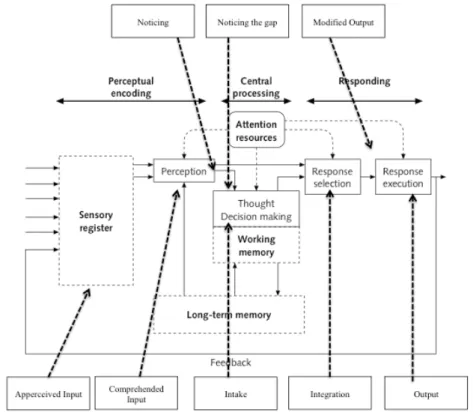
One such generic information processor model is that proposed by Wickens (1997; later reproduced in Robinson, 2003), and it comprises three broad and sequential stages: perception, central processing, and responding. As can be seen in Figure 1, all of these stages involve the action of executive functions and the allocation of attentional resources.
At the perceptual encoding stage, information enters the sensory register from where, using attentional resources and long-term memory representations, it may enter perception. From here the information is encoded into working memory, where capacities focusing attention are again employed in central processing in order to move to the responding stage. After this, an appropriate response is selected and executed, again with the use of attention resources.
Figure 1. Schematic summary of stages and cognitive processes of interaction-driven SLA (adapted from Wickens, Lee, Liu and Gordon-Becker, 1997 & Gass, 1988)
In her generic model of L2 acquisition, Gass (1988) proposed five stages of L2 acquisition:
apperceived input, comprehended input, intake, integration, and output. Apperception is the initial
encounter with a piece of L2 information, perceived in the light of existing L2 knowledge, and can
be seen as occurring at the stage of the sensory register. If some meaning can be derived from
this apperceived input, it proceeds to the stage of comprehended input, corresponding to perception
in the generic model, and can then be encoded into short-term WM (the central processing stage of the generic model) and become intake. Alternatively, if it is not used for further analysis, it may be discarded at this stage. If not discarded, it may prompt the learner to reject an existing hypothesis about the structure, thus forming the raw material or start-point for the formation of a new acquisitional hypothesis, or possibly the confirmation of an alternate acquisitional hypothesis that the learner already held. Each of these operations may lead to integration of information available in the input into interlanguage knowledge. Finally, in the output stage of Gassʼ model, the learner formulates and executes a response in the light of this hypothesis.
Under this mapping of the generic theoretical perspective to the L2 acquisition process, it can be further elaborated that in processing an instance of corrective feedback the following inferences are plausible: 1) noticing can be understood as the shift from comprehended input to intake in the perceptual encoding stage, 2) noticing the gap as the beginnings of integration in the central processing stage, and 3) modified output to Gassʼs output as the response selection and execution stages of the responding stage of the generic information processor model. It also becomes clear from this conceptualization that ʻattentional resourcesʼ play an important role at all stages of the processing of corrective feedback. The difficult questions remain, however, of what specific form these attentional processes take, and where shifting, updating and inhibition may be at work. To answer these questions, I will consider the tasks required of the learner at each stage of CF processing, and in this light make suggestions about the attentional processes involved.
Noticing – shifting
If it is to be noticed and thus become intake, corrective feedback must be 1) understood, and 2) perceived as corrective feedback. Understanding is contingent upon a number of factors, including current level of proficiency, familiarity with feedback moves, phonological knowledge, phonological encoding capabilities, and morphological knowledge. Deficiencies in any of these areas could result in a block from apperceived input to comprehended input. Even if corrective feedback is understood, it may, as noted above, be rejected. At work here are the processes of attention. As Robinson (2003) suggests, this selection is “a response to control processes such as attention allocation policy, scheduling and switching between concurrent task demands, and strategy monitoring” (p. 635). That is, the learner brings their executive functions to bear on the input to judge and select what part is relevant to the current task, and reject what is not, or cannot be comprehended.
If the corrective feedback does become comprehended input, there is no guarantee that it will
be perceived as a move to correct some error in the original utterance. As previously remarked,
several studies have shown that learners often fail to realize that CF is being offered (Loewen,
2005; Mackey, Gass & McDonough, 2000), meaning that, though it may reach the stage of
comprehended input, it may simply be considered another communication move such as a
confirmation response to the learnerʼs utterance, and therefore go unnoticed for what it is. One
possible reason for this failure to perceive corrective feedback is the tendency for learners to
concentrate their limited attentional resources on meaning during interaction rather than form
(VanPatten, 1995), a phenomenon which forms the basis of pedagogical techniques such as
processing instruction (VanPatten, 1995), input flooding (Trahey & White, 1993), and input
enhancement (White, 1998). All of these interventions are aimed at somehow ʻforcingʼ the learner to focus on form. Without this shift to consideration of form there can be no possibility of noticing (or detection: Robinson, 1995, 2003; Tomlin & Villa, 1994); and as no exemplars of target-language forms will be available to the learner for the hypothesis testing that must take place at the stage of noticing the gap, acquisition cannot take place (Tomlin & Villa, 1994).
The difficulty for the learner, then, is that focus-on-form episodes require her to stop focusing on meaning, and deactivate the task set of processes associated, and start focusing on morphosyntactic, and often metalinguistic aspects of the interaction, requiring the activation of a different set of processes and knowledge. Only if this can be successfully achieved does noticing of form take place, and corrective feedback become intake.
It is possible to argue that shifting ability may play a part in the learnerʼs success, or otherwise, in achieving this switch. The success of interventions aimed at focusing learnersʼ attention on form, such as processing instruction, can then be seen as curtailing the constraints imposed by individual differences in switching capacities by ʻbootstrappingʼ the learner into making the shift between the meaning and form task sets.
These observations may help to shed further light on the findings of the only study of which the author is aware that has investigated this relationship between noticing of feedback and switching ability. Trofivimich et al. (2007) found no correlation between these variables, which the authors put down to the indiscriminate provision of recasts employed in the study. This may have amounted to an input flooding-like effect that resulted in the corrective feedback being sufficiently explicit to the participants to override any constraints imposed by individual differences in switching capacities.
Noticing the gap – updating
Corrective feedback that has been noticed as such by the learner next enters central processing which is the stage at which integration through hypothesis formation, or confirmation, based on the processed information, becomes possible. The feedback is encoded into WM, and attentional resources are brought to bear on both the feedback and original utterance, at the same time as relevant target-language metalinguistic knowledge is activated and brought into WM. Before this process can unfold, or even during the process of unfolding, PSTM capacities may limit the learnerʼs capacity to hold both the feedback and the original utterance in this memory space (Robinson, 2002), while at the same retrieving knowledge about L2 grammar from long-term memory. For noticing the gap to happen, the information in the WM store needs to be constantly updated, rejecting irrelevant items, recalling new ones from LTM (Miyake et al., 2000), and/or adding hypotheses about the perceived gap in current interlanguage (Mackey et al., 2010). The results of these processes can then be used to formulate modified output. In this light we can understand the reported role of complex WM in interaction-driven SLA (Goo, 2012; Mackey et al., 2002; Martin & Ellis, 2012; Trofimovich, et al., 2007) as constraining the ability to make the necessary cognitive comparisons to notice the gap.
Modified output –updating and inhibition
As previously remarked, modified output takes place in the responding stage of the generic model,
and in the output stage of Gassʼ model of SLA. Modified output may have a complex relationship with SLA, playing a number of roles in that process, such as hypothesis testing (Swain, 1985), and additional noticing the gap (Izumi, 2002; Izumi & Bigelow, 2000).
Any role for executive functions in modified output production are likely to be constrained by WM roles in more general speech production processes (Levelt, 1989; De Bot, 1992). Evidence suggests that these processes are heavily dependent on limited WM (updating) resources (Finardi
& Weissheimer, 2009; Mota, 2003; Weissheimer & Mota, 2009), and individual differences in WM capacity may therefore influence the frequency of modified output production via the constraints such differences might variably impose on general L2 speech production. By extension, the degree of acquisition possible after focus on form episodes may be contingent upon WM capacity. This constraint on acquisition is suggested by work which indicates learner variation in the production of modified output (McDonough & Mackey, 2006). Direct empirical investigation also indicates that some aspects of complex WM capacity predict the frequency of modified output produced (Mackey et al., 2010).
It is also possible to argue a case for the role of inhibition in the production of modified output.
As the learnerʼs original utterance is a reflection of her current interlanguage state, the knowledge employed has potentially become proceduralised. This may represent one form of prepotent response, and hence one which needs to be put aside as a new attempt at formulating a more target-like utterance in the light of corrective feedback is attempted. This may call upon capacities of inhibition for successful completion of the task. Also this relationship has not been investigated directly, although circumstantial evidence is provided by Gass et al. (2013), who found that inhibition (L2 Stroop) did predict improvement in control in oral production of Italian adjective- noun agreement after the provision of recasts.
Directions for Future Research
This review of previous research into the roles of executive functions, specifically shifting, updating and inhibition, has provided some support for the notion that these processes may play some role in interaction-driven L2 acquisition. It has also been argued that different EFs may play different roles at different stages of the process: switching at the stage of noticing, updating at the stage of noticing the gap, and updating and inhibition at the point where modified output is attempted.
At present, there is a paucity of methodologically rigorous work in the literature examining the roles of EFs in L2 learning, other than for complex memory or what I have referred to as updating. As the evidence suggests that shifting and inhibition also form reliable constructs, further research into their roles in interaction processes would seem to be merited. Two suggestions can be made to address this deficiency.
First, there is a clear need for the use of instruments to measure these cognitive capacities that
are grounded in the methodology of wider cognitive psychology research. The reading span test
(Daneman & Carpenter, 1980), for example, is still prevalent in L2 acquisition research as a
measure of working memory when more reliable tests (such as the N-back task or backwards digit
span task) are available to researchers. Where the roles of other EFs have been investigated, the
implementation of the instruments used, such as Trofivimich et al.ʼs (2007) use of a hand-timed trailmaker task, may again not provide the most reliable data. Utilization and proper implementation of the tasks referred to above would give more validity to results in future investigations.
Second, and with a few notable exceptions (Mackey et al., 2010; Trofivimich et al., 2007), much of the work investigating how these cognitive processes operate during interaction has employed outcome measures that operationalise interlanguage development which could be characterized as the ʻfinal productʼ of episodes of interaction. While useful in assessing the effectiveness of interaction for effecting interlanguage development, this before-after approach sheds little light on when and where executive functions become important during the overall process that led to that production. In order to better understand the roles played, and constraints imposed, by executive functions during interaction-driven L2 acquisition, it is necessary to carry out quantitative investigation of these processes at the stages of noticing, noticing the gap, and modified output.
Because noticing and noticing the gap are internal processes, and hence not directly available to real-time observation, there are methodological difficulties in examining these processes. However, approaches are available for their quantification. One methodology widely used in L2 research that can provide quantitative data of frequency of noticing and noticing the gap is stimulated recall (Mackey & Gass, 2013). First developed by Bloom (1953) and refined by Siegel et al. (1963), this research methodology is a technique in which participants are asked to recall and verbalise their thought processes during a prior event, task or intervention. The recall is ʻstimulatedʼ by means of some tangible record of that event, such as an audio or video recording. In interaction research, for example, the participant is asked to remember their thoughts during a previous task at the points where corrective feedback was provided in response to his errors. By analyzing these responses, it is possible to obtain quantitative data of the frequency of noticing of corrective feedback and noticing the gap that takes place (Mackey, Gass & MacDonough, 2000), and this has been used to examine the relationship of frequency of noticing to working memory capacities (Mackey et al., 2010). Such data can also be employed as the dependant variable in an examination of the hypothesised roles of EF capacities, as operationalised by the instruments described above, in noticing and noticing the gap during corrective feedback episodes.
This basic approach can be employed to examine how EF capacities interact with noticing and
noticing the gap in different corrective feedback conditions. Such an approach may offer new
perspectives on learnersʼ reported lower ability to notice corrective feedback in response to
morphosyntactic over lexical errors (Mackey, Gass & MacDonough, 2000), or their greater success
in noticing some types of corrective feedback over others (Lyster, 2004; Lyster & Ranta, 1997). The
latter of these has been indirectly related to working memory capacities (Goo, 2012), at least in as
far as noticing results in improvement of control of the target structure. Extending the scope of
such studies to investigate the roles of other EFs in noticing in different feedback conditions may
shed further light on this issue. Employment of these approaches in these domains may help us to
understand better the roles that executive functions play in the processes of interaction-driven
second language acquisition.
References
Baddeley, A. (2000). The episodic buffer: a new component of working memory? Trends in Cognitive Sciences, 4(11), 417-423.
Baddeley, A. (2003). Working memory and language: An overview. Journal of Communication Disorders, 36(3), 189-208.
Baddeley, A. (2012). Working memory: theories, models, and controversies. Annual Review of Psychology, 63, 1-29.
Baddeley, A. D., & Hitch, G. (1974). Working memory. The Psychology of Learning and Motivation, 8, 47-89.
Bloom, B. S. (1953). Thought-processes in lectures and discussions. The Journal of General Education, 7(3), 160-169.
Bull, R., & Scerif, G. (2001). Executive functioning as a predictor of children's mathematics ability:
Inhibition, switching, and working memory. Developmental Neuropsychology, 19(3), 273-293.
Collette, F., Hogge, M., Salmon, E., & Van der Linden, M. (2006). Exploration of the neural substrates of executive functioning by functional neuroimaging. Neuroscience, 139(1), 209-221.
Conway, A. R., Kane, M. J., Bunting, M. F., Hambrick, D. Z., Wilhelm, O., & Engle, R. W. (2005).
Working memory span tasks: A methodological review and userʼs guide. Psychonomic Bulletin and Review, 12(5), 769-786.
Daneman, M. (1991). Working memory as a predictor of verbal fluency. Journal of Psycholinguistic Research, 20(6), 445-463.
Daneman, M., & Carpenter, P. A. (1980). Individual differences in working memory and reading.
Journal of Verbal Learning and Verbal Behavior, 19(4), 450-466.
De Bot, K. (1992). A bilingual production model: Levelt's ʻspeaking' model adapted. Applied Linguistics, 13(1), 1-24.
Diamond, A. (2013). Executive functions. Annual Review of Psychology, 64, 135-168.
Doughty, C., & Pica, T. (1986). "Information Gap" Tasks: Do They Facilitate Second Language Acquisition? TESOL Quarterly, 20(2), 305-325.
Ellis, R., Tanaka, Y., & Yamazaki, A. (1994). Classroom interaction, comprehension, and the acquisition of L2 word meanings. Language Learning, 44(3), 449-491.
Eriksen, B. A., & Eriksen, C. W. (1974). Effects of noise letters upon the identification of a target letter in a nonsearch task. Perception & Psychophysics, 16(1), 143-149.
Finardi, K., & Weissheimer, J. (2009). On the Relationship between working memory capacity and L2 speech development. Signótica, 20(2).
Fisk, J. E., & Sharp, C. A. (2004). Age-related impairment in executive functioning: Updating, inhibition, shifting, and access. Journal of Clinical and Experimental Neuropsychology, 26(7), 874-890 Friedman, N. P., Miyake, A., Corley, R. P., Young, S. E., DeFries, J. C., & Hewitt, J. K. (2006). Not all
executive functions are related to intelligence. Psychological Science, 17(2), 172-179.
Fortkamp, M. B. M., & Bergsleithner, J. M. (2007). Relationship among individual differences in working memory capacity, noticing, and L2 speech production. Signo, 32(52), 40-53.
Gass, S. M. (1988). Integrating Research Areas: A Framework for Second Language Studies1.
Applied Linguistics, 9(2), 198-217.
Gass, S. M., Behney, J. N., & Uzum, B. (2013). Inhibitory control, working memory and L2
interaction Psycholinguistic and Sociolinguistic Perspectives on Second Language Learning and Teaching (pp. 91-114): Springer.
Gass, S. M., & Mackey, A. (2007). Input, interaction, and output in second language acquisition.
Theories in Second Language Acquisition: An Introduction, 175-199.
Goo, J. (2012). Corrective feedback and working memory capacity in interaction-driven L2 learning.
Studies in Second Language Acquisition, 34(03), 445-474.
Gurzynski-Weiss, L., & Baralt, M. (2015). Does type of modified output correspond to learner noticing of feedback? A closer look in face-to-face and computer-mediated task-based interaction. Applied Psycholinguistics, 36(6), 1393-1420.
Han, Z. (2002). A study of the impact of recasts on tense consistency in L2 output. TESOL Quarterly, 36(4), 543-572.
Harrington, M., & Sawyer, M. (1992). L2 working memory capacity and L2 reading skill. Studies in Second Language Acquisition, 14(01), 25-38.
Izumi, S. (2003). Comprehension and production processes in second language learning: In search of the psycholinguistic rationale of the output hypothesis. Applied Linguistics, 24(2), 168-196.
Izumi, S., & Bigelow, M. (2000). Does output promote noticing and second language acquisition?
TESOL Quarterly, 34(2), 239-278.
Juffs, A., & Harrington, M. (2011). Aspects of working memory in L2 learning. Language Teaching, 44(02), 137-166.
Jurado, M. B., & Rosselli, M. (2007). The elusive nature of executive functions: a review of our current understanding. Neuropsychology Review, 17(3), 213-233.
Kapa, L. L., & Colombo, J. (2014). Executive function predicts artificial language learning. Journal of Memory and Language, 76, 237-252.
Kormos, J., & Sáfár, A. (2008). Phonological short-term memory, working memory and foreign language performance in intensive language learning. Bilingualism: Language and Cognition, 11(2), 261-271.
Lehto, J. E., Juujärvi, P., Kooistra, L., & Pulkkinen, L. (2003). Dimensions of executive functioning:
Evidence from children. British Journal of Developmental Psychology, 21(1), 59-80.
Levelt, W. J. (1989). Speaking: From intention to articulation. Cambridge, Massachusetts: MIT press.
Linck, J. A., Osthus, P., Koeth, J. T., & Bunting, M. F. (2014). Working memory and second language comprehension and production: A meta-analysis. Psychonomic Bulletin & Review, 21(4), 861-883.
Linck, J. A., & Weiss, D. J. (2015). Can working memory and inhibitory control predict second language learning in the classroom? SAGE Open, 5(4), 2158244015607352.
Loewen, S. (2005). Incidental focus on form and second language learning. Studies in Second Language Acquisition, 27(3), 361.
Long, M. H. (1996). The role of the linguistic environment in second language acquisition. Handbook of Second Language Acquisition, 2(2), 413-468.
Long, M. H. (1998). Focus on form Theory, research, and practice Michael H. Long Peter Robinson.
Focus on Form in Classroom Second Language Acquisition, 15, 15-41.
Logan, G. D. (1994). On the ability to inhibit thought and action: A users' guide to the stop signal paradigm. Inhibitory Processes in Attention, Memory, and Language, 189-239.
Lyster, R. (2004). Differential effects of prompts and recasts in form-focused instruction. Studies in
Second Language Acquisition, 26(03), 399-432.
Lyster, R., & Ranta, L. (1997). Corrective feedback and learner uptake. Studies in Second Language Acquisition, 19(01), 37-66.
Lyster, R., Saito, K., & Sato, M. (2013). Oral corrective feedback in second language classrooms.
Language Teaching, 46(01), 1-40.
Mackey, A. (1999). Input, interaction, and second language development. Studies in Second Language Acquisition, 21(04), 557-587.
Mackey, A. (2006). Epilogue: From introspections, brain scans, and memory tests to the role of social context: Advancing research on interaction and learning. Studies in Second Language Acquisition, 28(02), 369-379
Mackey, A., Adams, R., Stafford, C., & Winke, P. (2010). Exploring the relationship between modified output and working memory capacity. Language Learning, 60(3), 501-533.
Mackey, A., & Gass, S. M. (2013). Stimulated Recall Methodology in Second Language Research: Routledge.
Mackey, A., Gass, S., & McDonough, K. (2000). How do learners perceive interactional feedback?
Studies in Second Language Acquisition, 22(04), 471-497.
Mackey, A., Philp, J., Egi, T., & Fujii, A. (2002). Individual differences in working memory, noticing of interactional feedback, and L2 development, in P Robinson (Ed). Individual Differences and Instructed Language Learning, 181-209.
Mackey, A., & Goo, J. (2007). Interaction research in SLA: A meta-analysis and research synthesis.
Conversational Interaction in Second Language Acquisition: A Collection of Empirical Studies, 407-452.
Mackey, A., & Philp, J. (1998). Conversational interaction and second language development:
Recasts, responses, and red herrings? The Modern Language Journal, 82(3), 338-356.
Martin, K. I., & Ellis, N. C. (2012). The roles of phonological short-term memory and working memory in L2 grammar and vocabulary learning. Studies in Second Language Acquisition, 34(03), 379-413.
McDonough, K. (2005). Identifying the impact of negative feedback and learners' responses on ESL question development. Studies in Second Language Acquisition, 27(1), 79-103.
McDonough, K., & Mackey, A. (2006). Responses to recasts: Repetitions, primed production, and linguistic development. Language Learning, 56(4), 693-720.
Milner, B. (1964). Some effects of frontal lobectomy in man. The frontal granular cortex and behavior., 313-334.
Miyake, A., Friedman, N. P., Emerson, M. J., Witzki, A. H., Howerter, A., & Wager, T. D. (2000). The unity and diversity of executive functions and their contributions to complex “frontal lobe”
tasks: A latent variable analysis. Cognitive Psychology, 41(1), 49-100.
Monsell, S. (2003). Task switching. Trends in Cognitive Sciences, 7(3), 134-140.
Mota, M. B. (2003). Working memory capacity and fluency, accuracy, complexity, and lexical density in L2 speech production. Fragmentos: Revista de Língua e Literatura Estrangeiras, 24.
Norman, D. A., & Shallice, T. (1986). Attention to action. In Consciousness and Self-regulation (pp. 1-18).
Springer US.
Owen, A. M., McMillan, K. M., Laird, A. R., & Bullmore, E. (2005). N-back working memory
paradigm: A meta-analysis of normative functional neuroimaging studies. Human Brain Mapping,
25(1), 46-59
Pica, T. (1994). Research on Negotiation: What Does It Reveal About Second ‐ Language Learning Conditions, Processes, and Outcomes? Language Learning, 44(3), 493-527.
Revesz, A. (2012). Working memory and the observed effectiveness of recasts on different L2 outcome measures. Language Learning, 62(1), 93-132.
Robinson, P. (1995). Attention, memory, and the “noticing” hypothesis. Language Learning, 45(2), 283- 331.
Robinson, P. (2002). Effects of individual differences in intelligence, aptitude and working memory on adult incidental SLA. Individual Differences and Instructed Language Learning, 211-266.
Robinson, P. (2003). Attention and memory during SLA. The Handbook of Second Language Acquisition, 631-678.
Rogers, R. D., & Monsell, S. (1995). Costs of a predictable switch between simple cognitive tasks.
Journal of Experimental Psychology: General, 124(2), 207.
Schmidt, R. W. (1990). The role of consciousness in second language learning1. Applied Linguistics, 11(2), 129-158.
Schmidt, R. (1995). Consciousness and foreign language learning: A tutorial on the role of attention and awareness in learning. Attention and Awareness in Foreign Language Learning, 9, 1-63.
Schmidt, R. (2012). Attention, awareness, and individual differences in language learning.
Perspectives on Individual Characteristics and Foreign Language Education, 6, 27.
Schmidt, R., & Frota, S. (1986). Developing basic conversational ability in a second language: A case study of an adult learner of Portuguese. Talking to Learn: Conversation in Second Language Acquisition, 237-326.
Segalowitz, N., & Frenkiel-Fishman, S. (2005). Attention control and ability level in a complex cognitive skill: Attention shifting and second-language proficiency. Memory & Cognition, 33(4), 644-653.
Service, E., & Kohonen, V. (1995). Is the relation between phonological memory and foreign language learning accounted for by vocabulary acquisition? Applied Psycholinguistics, 16(02), 155- 172.
Shiffrin, R. M., & Schneider, W. (1977). Controlled and automatic human information processing: II.
Perceptual learning, automatic attending and a general theory. Psychological Review, 84(2), 127.
Simon, J. R., & Wolf, J. D. (1963). Choice reaction time as a function of angular stimulus-response correspondence and age. Ergonomics, 6(1), 99-105.
St Clair-Thompson, H. L., & Gathercole, S. E. (2006). Executive functions and achievements in school: Shifting, updating, inhibition, and working memory. The Quarterly Journal of Experimental Psychology, 59(4), 745-759.
Stroop, J. R. (1935). Studies of interference in serial verbal reactions. Journal of Experimental Psychology, 18(6), 643.
Swain, M. (1985). Communicative competence: Some roles of comprehensible input and comprehensible output in its development. Input in Second Language Acquisition, 15, 165-179.
Tomlin, R. S., & Villa, V. (1994). Attention in cognitive science and second language acquisition.
Studies in Second Language Acquisition, 16(2), 183-203.
Trahey, M., & White, L. (1993). Positive evidence and preemption in the second language classroom.
Studies in Second Language Acquisition, 15(2), 181-204.
Trofimovich, P., Ammar, A., & Gatbonton, E. (2007). How effective are recasts? The role of attention, memory, and analytical ability. Conversational Interaction in Second Language Acquisition:
A Collection of Empirical Studies, 171-195.
Turner, M. L., & Engle, R. W. (1989). Is working memory capacity task dependent? Journal of Memory and Language, 28(2), 127-154.
VanPatten, B. (2000). Processing instruction as form-meaning connections: Issues in theory and research. Form and Meaning: Multiple Perspectives, 43-68.
Wager, T. D., Jonides, J., & Reading, S. (2004). Neuroimaging studies of shifting attention: a meta- analysis. Neuroimage, 22(4), 1679-1693.
Walter, C. (2004). Transfer of Reading Comprehension Skills to L2 is Linked to Mental Representations of Text and to L2 Working Memory. Applied Linguistics, 25(3), 315-339.
Waters, G. S., & Caplan, D. (1996). The measurement of verbal working memory capacity and its relation to reading comprehension. The Quarterly Journal of Experimental Psychology A: Human Experimental Psychology, Section A, 49(1), 51-79.
Wechsler, D. (2012). Wechsler Preschool and Primary Scale of Intelligence—Fourth Edition. San Antonio, TX: Psychological Corporation.
Weissheimer, J., & Mota, M. B. (2009). Individual differences in working memory capacity and the development of L2 speech production. Issues in Applied Linguistics, 17(2).
Wen, Z. (2015). Working memory in second language acquisition and processing: The phonological/
executive model. Working Memory in Second Language Acquisition and Processing, 41-62.
White, J. (1998). Getting the learnersʼ attention: A typographical input enhancement study. Focus on Form in Classroom Second Language Acquisition, 85-113.
Wickens, C., Lee, J., Liu, Y., & Gordon-Becker, S. (1997). Automation. Flight to the Future: Human
Factors in Air Traffic Control. National Academy Press, Washington, DC.
対話を通じた第二言語習得における課題ルールのシフト、
情報の更新、抑制の役割について
―先行研究の批評的評価―
モクスン・ジョナサン