Local Structure Analysis around Kr in Minerals by XAFS MaM Okubea, Akira Yoshiasab, Takuya Matsumoto0, Eiji Itod and Yasuko Teradae
"Materials and Structures Laboratory, Tokyo institute oj'Technology>, 4259, nagatuta, Yokohama, 226-8503, Japan
bDepartment ofScience, Kumamoto University, Kurokami2, Kumamoto, 860-8555, Japan
department ofEarth and Space Science, Osaka University, Machimaneyama, Toyonaka, Osaka, 560-0043, Japan dJapan Synchrotron Radiation Research Institute, 1-1-1, Kouto, Sayo-cho, Sayo-gun, Hyogo, 679-5198, Japan
'Institutefor the Study ofthe Earth's interior, Okayama University, 827, Yamada, Misasa, Tottori 852-0193, Japan
Abstract In order to investigate reactivity of noble gas (Kr) in minerals, several kinds of Kr-doped minerals were synthesized under high pressures and temperatures and were subjected to mass spectxoscopy and XAFS. We observed that some Kr trapped in the samples was retained in the samples at temperatures above 1000 °C. Interestingly, the atomic distances between Kr and neighboring atoms derived from XAFS analysis appeared to be shorter than the distances expected for the case of simple adsorption. These results suggest that Kr might be bound in the samples with interaction stronger man the adsorption and/or exist in the internal sites of the structure of the host minerals (not in a grain boundary as is often presumed).
Keywords: noble gas, minerals, high-pressure and high-temperature, mass spectroscopy, XAFS PACS: 91.60,-x, 91.6O.Ed, 91,65.An
INTRODUCTION
With their scarcity in nature, chemical inertness, presence of many distinguishable isotopes and elemental components, noble gases are a quite powerful probe to discuss the early history of the earth (e.g., [1]). Many models with respect to the evolution processes of the Earth's atmosphere and mantle based on noble'gas isotopes carry a common presumption that noble gas behaves highly incompatible (i.e., elements unsuitable in their sizes to the cation sites of the minerals thus are partitioned into the melt over solid upon magma formation). However, such a notion might not be supported as some recent work has showed that noble gases can exist as solid phase [2] or form Fe-alloy [3] and silicate phases [4] stable under high-temperature and high-pressure of the mantle conditions.
In order to further clarify the apparent "reactivity"
of heavier noble gases, we tried local structure analysis on Earth's materials. Knowledge of the structural state of noble gases in minerals would give constraints to various controversies. However, structural analysis on natural samples has not been possible as their concentrations are generally extremely low (typically below ppt levels). In this study, we synthesized several kinds of mineral samples doped with Kr under high- pressure and high-temperatures and carried out
quantitative analysis by mass spectroscopy and local structure analysis around Kr by XAFS.
EXPERIMENTAL Sample Preparation
Krypton was doped into samples under high pressure and high temperature. Minerals (olivine, Ca- feldspar, graphite, zeolite and silica gel) were put in the intemally-heat vessel and kept in Kr atmosphere under pressures up to 75 MPa and temperatures up to 500 °C for a few days. High-pressure mineral (coesite, stishovite and wadselyite) syntheses were carried out in a Kawai-type multi-anvil press with Kr-doped silica gel or a mixture of silica gel with Kr and MgO powder. The mixture of starting materials was put into Pt capsules and sealed by welding both edges to avoid leakage of Kr. The pressure cell assembly was 7/14 (edge length of the MgO octahedron/ truncated edg&
length of the tungsten carbide anvils) and its details are shown in Fig. 1. The experiments were conducted under the conditions of high-pressure up to 15.5 GPa and high-temperature up to 1400 °C. The temperature in the pressure cell was monitored with a W/Re thermocouple without correction for the effect of pressure on the EMF. The generated pressure was estimated using a calibration curve based on Bi I-II
CP882, X-ray Absorption Fine Structure—XAFS13 edited by B. Hedman and P. Pianetta
© 2007 American Institute ofPhysics 978-0-7354-0384-0/07/$23.00 296
Downloaded 25 Fcb 2007 to 133.95.156.121. Redistribution subject to AIP license or copyright, sec hup://procesdings.aip.org/proccedingB'cpsrjsp
(2.75 GPa), m-V (7.7 GPa) and ZnS (15.4 GPa) transitions. The samples were quenched after dwelling one hour at the target temperature and pressure.
Re heater Tafoil
Thermocouple^
LaCrO3 Ft capsule
MgO ' 2.0mm
FIGURE 1. A schematic drawing of the sample cell assembly for the high-pressure and high-temperature experiments.
Mass Spectroscopy
Some of the run products were subjected to mass spectroscopic analysis to determine the concentration of Kr. We applied a stepwise heating method to extract Kr from the samples (i.e., heating up the sample incrementally from 300 to 1850 °C) to see the retentivity of Kr upon heating. The sensitivity of Kr by the quadrupole mass spectrometer (QMS) was calibrated by analyzing a known amount of air standard. A schematic diagram of the gas extraction and mass spectrometer system is illustrated in Fig. 2.
Sampte tree /\
Ta crucible
Air standard Turbo molecular
pump
Turbo molecular pump
Turbo molecular
pump
Electric furnace
FIGURE 2. A Schematic of diagram of mass spectrometry.
The system consists of a double vacuum resistively heated furnace and gas handling line with a getter pump and a turbo
molecular pump.XAFS
XAFS spectra for the samples prepared as described above were measured at room temperature, where both transmission and fluorescence modes were used at the Kr K-edge (14.3 keV). The XAFS experiments were carried out at the XAFS station BL- 12C of the Photon Factory. Intensities of Io were measured by Ar/N2 gas flow ionization chamber and
the intensities of Kr fluorescence x-rays .were measured by Ar gas flow Lytle-type ionization chamber or 19-elements SSD detector. The X-ray beam was monochromatized using Si(lll) reflection.
The X-ray beam size on the sample was 1 (horizontally) by 1 (vertically) mm.
The EXAFS interference function was extracted from the measured absorption spectra and was normalized using MacMaster coefficients according to the EXAFS workshop report [5]. The radial structure function was obtained by the Fourier transform over
the k range of 3.0-11.0 A'1. In parameter fitting, we
carried out the Fourier-filtering technique and a nonlinear least squares fitting method by comparing the observed and calculated EXAFS interference function. We used the EXAFS formula in the single scattering theory with the cumulant expansion up to the third order term.
RESULTS AtfD DISCUSSION
Quantitative analysis results by QMS are shown in Table 1. Degassing of Kr occurs from all the samples at temperatures between 500 and 800 °C and, in some cases, more than 1000 °C. In the field of geochemistry, it is a common exercise that the gases released at temperatures below about 800 °C are regarded as the adsorbed component as they are loosely bound to the surface of the materials. Our samples also release the bulk of Kr at temperatures below 800 °C so the adsorbed component appears to be dominant in our samples as well. However, it should be noted that we observed yet significant release of Kr at temperatures above 1000 °C. For example, some 30 % of total Kr was released from the feldspar and coesite samples at 1000 °C. Also, 20 % of total Kr in the olivine was, released at temperatures between 1400 to 1800 °C.
Such a strong retentivity against heating is not expected if Kr is bound by only weak interactions in the host minerals with Van der Waals Forces. This indicates a possibility that Kr could exist in some structural site inside the minerals or Kr might form some chemical bonding as was reported [6].
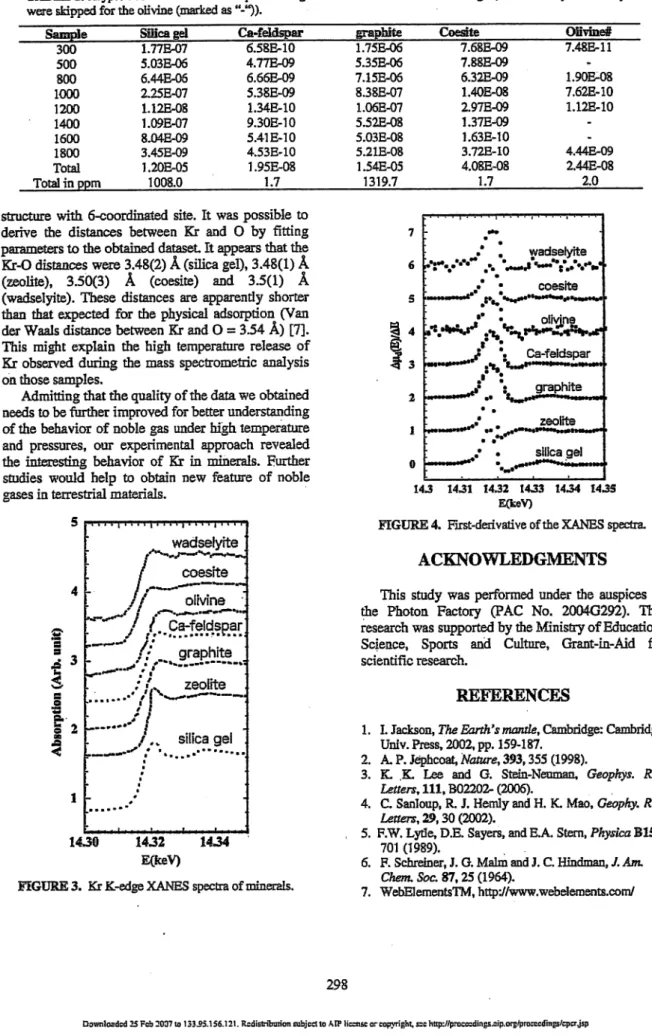
Figure 3 shows XANES spectra and Fig. 4 shows first-derivatives of XANES spectra of silicagel, zeolite, Ca-feldspar^ olivine, graphite, coesite and wadselyite. XAFS measurements of stishovite were unsuccessful due to insufficiency of the sample volume. All samples have structures on their XANES spectra and this implies that Kr would have some kind of local structure in those samples. Natural samples (graphite, Ca-feldspar and olivine) have similar trends in their spectra but coesite shows different figure corresponding to XAFS spectra like NaCl-type
297
Downloaded 25 Fcb 2007 to 133.9i.lS6J 21. Rcdisirfturion subjea to AIP license or copyright, scs
TABLE 1. Krypton concentrations in samples. The gas amounts are in the unit of mol/g. (#: Some temperatnre steps were skipped for the oiivine (marked as "-"))•
Sample SiMca gel Ca-feLdspar graphite Coesite O5ivine#
300 500 800 1000 1200 1400 1600 1800 Total Total in ppm
1.77E-07 5.03E-06 6.44E-06 2.25E-07 1.12E-08 1.09E-07 8.O4.E-O9 3.45E-09 1.20E-05 1008.0
6.58E-10
4.77E-09 6.6SE-09 5.38E-09 1.34E-10 9.30E-10 5.41 E-10 4.53E-10 1.95E-08
1.7
1.75E-O5
5.35E-06 7.15E-06 8.38E-07 1.06E-07 5.52E-08 5.O3E-O8 5.21B-08 1.54E-05 1319.7
7.68E-09
7.88E-09 6.32E-09 1.4OE-O8 2.97E-09 1.37&Q9 1.63E-10 3.72E-10 4.08E-08
1.7
7.4SE-11
-
1.90E-08 7.62E-10 1.12E-10
-
-
4.44E-09 2.44E-08
2.0 structure with 6-coordinated site. It was possible to
derive the distances between Kr and O by fitting parameters to the obtained dataset It appears that the
Kr-O distances were 3.48(2) A (silica gel), 3.48(1) A (zeolite), 3.50(3) A (coesite) and 3.5(1) A
(wadselyite). These distances are apparently shorter than that expected for the physical adsorption (Van
der Waals distance between Kr and O = 3.54 A) [7].
This might explain the high temperature release of Kr observed during the mass speetrometric analysis on those samples.
Admitting that the quality of the data we obtained needs to be further improved for better understanding of the behavior of noble gas under high temperature and pressures, our experimental approach revealed the interesting behavior of Kr in minerals. Further studies would help to obtain new feature of noble gases in terrestrial materials.
wadselyite
olrvine • r Ca-feldspar
7 graphite
zeolite
:L z
silica gel
1439 1432 1434
E(keV)
FIGURE 3. Kr K-edge XANES spectra of minerals.
y m wadselyite
143 1431 14.32 1433 1434 143S
E(keV)
FIGURE 4. First-derivative of the XANES spectra,
ACKNOWLEDGMENTS
This study was performed under the auspices of the Photon Factory (PAC No. 2004G292). This research was supported fay the Ministry of Education, Science, Sports and Culture, Grant-in-Aid for scientific research.
REFERENCES
1. I. Jackson, The Earth's mantle, Cambridge: Cambridge Univ. Press, 2002, pp. 159-187.
2. A. P. Jephcoat, Nature, 393,355 (1998).
3. K. KL Lee and G. Stein-Neuman, Geophys. Res.
Letters, 111, B02202- (2006).
4. C. Sanloup, R, J. Hemly and H. K. Mao, Geophy. Res.
Utters, 29,30(2002).
5. F.W. Lytfe, D.E. Sayers, and E.A. Stern, Physlca B158, 701 (1989).
6. F. Schreiner, J. G. Malm and J. C. Hindman, J. Am.
Ckem.Soc. 87,25 (1964).
7. WebElementsTM, http://www.webelements.com/
298
Downloaded 25 Fcb 2007 to 133-95.156.121. Redistribution subject to AIP license orcopvright, sec http://procccdings.2ip.org/procccdings/cpcr.jsp